Blood Recipient and Survivor: Jack Colwell’s Inspiring Journey from Sportscasting to Liver Transplant

From the sportscasting booth to the fight of his life, Jack Colwell’s journey is a testament to resilience, adjusting the game plan, and taking each day play-by-play.  

“It’s been quite a ride I must say,” says Colwell, blood recipient and liver transplant survivor. 

Jack Colwell recently celebrated his birthday and credits blood with helping save his life. Photo submitted.

As a radio sportscaster, Colwell – also known as Action Jack, has announced play-by-play calls for countless sports games, but never thought his own life’s playbook would include a cancer diagnosis.

Colwell had abdominal pain for three years before he received the news that he had end stage bile duct cancer. 

“I just felt something wasn’t right – my liver was deteriorating, and I found out I needed a liver transplant.” 

Colwell’s name was immediately put on the transplant list, and he started radiation and chemotherapy treatments. On December 23, 2023, Colwell got the call that a liver was available. “I was in surgery from 8 p.m. to 5 a.m. on Christmas Eve morning,” says Colwell. “I needed quite a bit of blood – what a gift that was!” 

Thankful to blood donors for ensuring blood was available when he needed it, Colwell says “If you can do it, certainly do it! Someone is always in need.” 

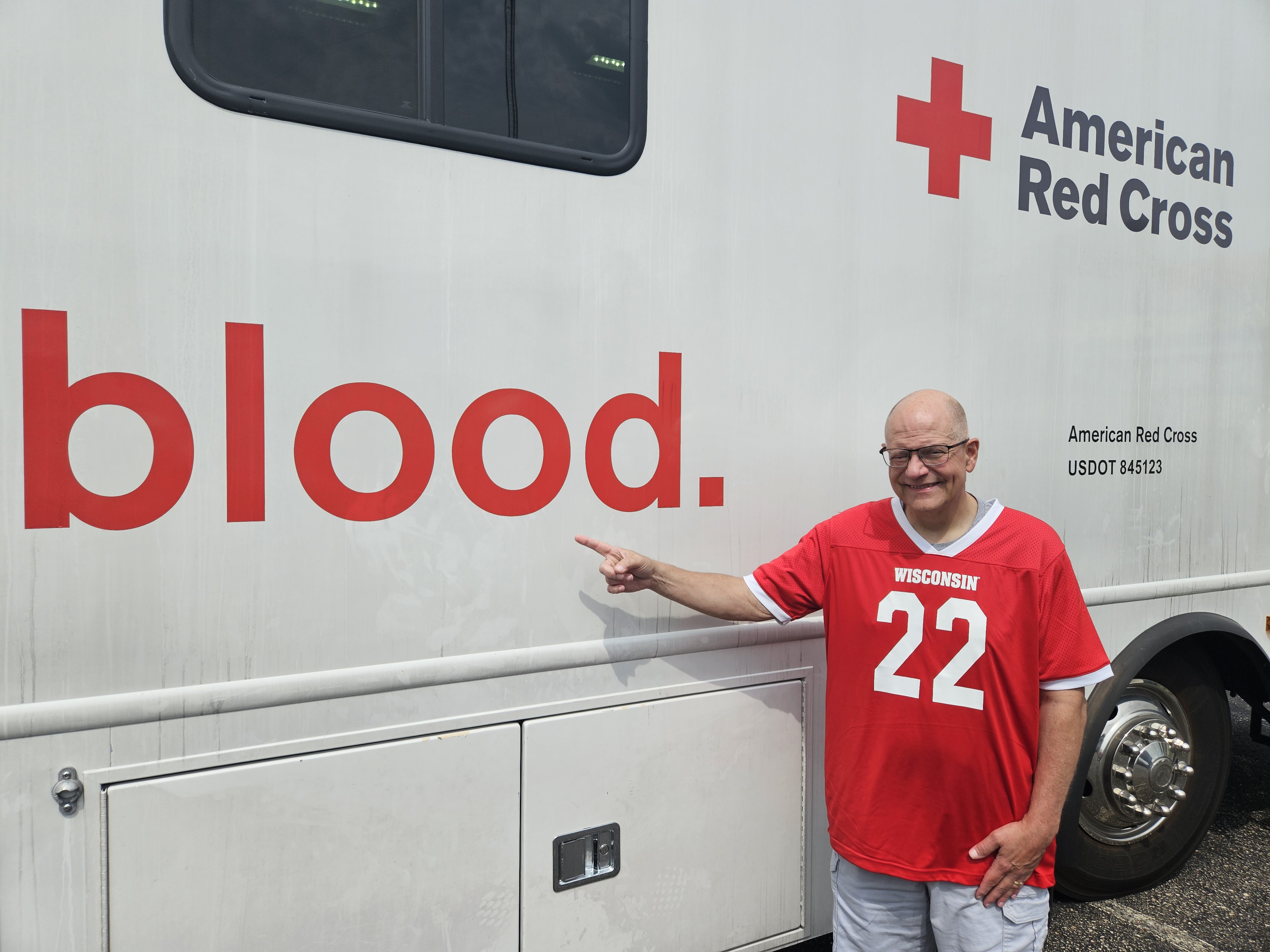
Jack Colwell, who announces games as Action Jack, pictured outside the Red Cross bloodmobile at a blood drive his employer KWNG/KCUE in Red Wing, Minnesota recently hosted. 

Post transplant, Colwell is grateful he is still here to have the chance work, be a husband, to see his daughters get married, and hopefully to enjoy being a grandparent alongside his wife. “Cherish life and live every day to the max,” he says. “I’m living proof that blood helps save lives. It’s a big reason I’m still here.” 

A round of applause for Colwell who reminds us that in the great game of life, someone is always in need. Let’s answer the call!

Be a hero for patients like Jack. Appointments can be scheduled by downloading the free Red Cross Blood Donor App, visiting RedCrossBlood.org or calling 1-800-RED CROSS (1-800-733-2767). To help reduce wait times, donors are encouraged to make appointments and complete the RapidPass online health history questionnaire at RedCrossBlood.org/RapidPass


Celebrating 5 Years Cancer Free

Bradley Arnold is a sweet, fun-loving 10-year-old boy who loves fishing, farming and searching for treasures with a metal detector. But five years ago, unlike other kids his age, Bradley was diagnosed with kidney cancer.

Bradley Arnold, 10.

“It just appeared all of the sudden,” said Mandy Arnold, who noticed a bulge under her son’s shirt. She knew something wasn’t right, so she took Bradley to an emergency room. After four hours, they were sent home with a diagnosis of severe constipation.

But nothing changed overnight – the bulge was still there. That day, they were lucky enough to get an appointment with his pediatrician who ordered several tests.

Mandy recalls the look on the doctor’s face and knew right away something was wrong. “Our world turned upside down when I heard the doctor say she was confident it was kidney cancer.”  

They went straight to a regional hospital, where they went through a in-depth series of questions and tests. That night, Bradley had an ultrasound, showing an 8-inch tumor, weighting more the three pounds. “It was the size of a cantaloupe – I couldn’t believe it got so big, so fast,” said Mandy. Bradley was scheduled for surgery the next morning to have his left kidney and a Wilms tumor removed.

Bradley recovering in the hospital following surgery. Submitted photo.

“I never thought I would have a child with cancer,” said Mandy. “It’s just not our nature to think of worst case scenarios.”

Thankfully, doctors were able to remove the entire tumor – it had not spread to other parts of Bradley’s body. Following surgery, Bradley required blood and platelet transfusions to help his body recover and heal.

Every Friday for the next 19 weeks, Bradley had chemotherapy treatments. “He never complained – he blew me away with how resilient he was,” Mandy said.

Witnessing her son’s bravery and cheerful outlook through his cancer journey, brought a new perspective to Mandy. “I’m a changed person – our family all went through this together – and we look at life differently now.”

“When your struck with a nightmare, the last thing you want to do is to worry about what you need,” said Mandy. “We’re so grateful the blood that Bradley needed was available when he needed it most.”

It wasn’t the first time the Arnold family was helped by the generosity of blood donors. Mandy needed transfusions after complications when her first and third children were born.

Mandy now serves as a Red Cross blood program volunteer leader with the Minnesota and Dakotas Red Cross Region. To celebrate Bradley’s five-year cancer free milestone and to raise awareness of the need for blood products to be readily available for cancer patients, the Arnold family hosted a blood drive on Monday, June 5, 2023. Family, friends and the community came together and rolled up a sleeve to honor Bradley. Forty nine blood donations were made in honor of this brave cancer warrior.

Bradley Arnold at the blood drive held in his honor, thanking donors for their “roll” in helping save lives with a Tootsei Roll goody bag!

You can help patients like Bradley! Schedule a blood donation today to help ensure lifesaving blood products are available whenever and wherever they are needed most. Visit redcross.org/mndaks to make an appointment or for more information.

I didn’t realize how important blood donation was until my dad got sick and needed it.” 

A family honors husband and father who died from cancer

Throughout his life, Ed Sturm from New Ulm, Minnesota was known for his witty one-liners and his unwavering passion to help others. The 68-year-old served in the US Army, worked for New Ulm Manufacturing and Caterpillar, and later was as a truck driver. Sadly, his life ended following a long battle with cancer in 2020.

Ed Sturm

To honor his legacy of helping others, his wife Jean Sturm and daughter Rachel Sturm hosted an American Red Cross blood drive in his memory. Their family and friends rallied to show support – filling all appointment and collecting 35 pints of lifesaving blood.

Jean and Rachel both donated blood in honor of Ed at the drive. Jean, a regular blood donor, reached her 100th donation milestone! They hope the Ed Sturm Memorial Blood Drive becomes an annual event to help pay it forward and build awareness of the need for blood donations to help treat cancer patients like Ed.

Jean and Rachel Sturm donated at the Ed Sturm Memorial Blood Drive (photo submitted).

“Everyone thought this was a great way to remember him because they knew his long journey and how much he struggled. Blood donation is an easy way for people to help others and give more time to another family going through the same situation,” said his daughter.

Sturm was first diagnosed in November 2012 with multiple myeloma, a type of blood cancer that affects plasma cells — crowding out the normal plasma cells that help fight infection. After a stem cell transplant in April 2013, Sturm’s cancer went into remission but returned in 2015. In March of 2019, their worst fear came true when Sturm was diagnosed with another form of cancer – myelodysplastic syndrome – where healthy blood cells die in the bone marrow or just after entering the bloodstream.

From March 2019 through March 2020, while trying to deal with the two different cancers, Sturm was in the emergency room multiple times getting blood transfusions because his hemoglobin dropped to dangerously low levels. But there wasn’t always blood on the shelves when he needed it.

I didn’t realize how important blood donation was until my dad got sick and needed it.”  – Rachel Sturm

His wife, Jean Sturm, recalls writing in his Caring Bridge journal in March 2020 that Ed had to wait for blood when donations declined during the pandemic. He was moved to the University of Minnesota Medical Center to help ensure blood products would be more readily available. “Cancer is a very physically & emotionally draining disease and having to worry about blood availability is just one more burden piled on,” she said.

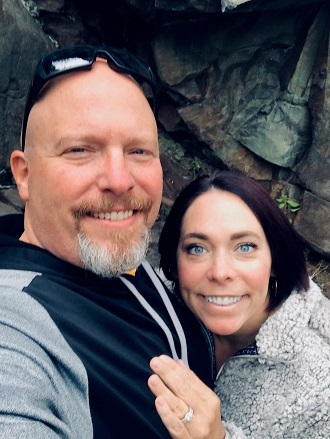
Ed and Jean Sturm at Glacier National Park

In total, Sturm received 72 units of blood and 41 units of platelets. “These transfusions gave him the strength and endurance to withstand the chemotherapy and gave him more time with us,” said his daughter. “It was eye-opening to us that one person would need so much blood. I didn’t realize how important blood donation was until my dad got sick and needed it.”

Pictured from left to right: Ed Sturm, Rachel Sturm (daughter), Brandon (grandson) and Jean Sturm

Blood and platelets play a critical role in the treatment of cancer and other chronic diseases, as well as traumatic injuries. Patients fighting cancer need more blood than patients fighting any other disease, using nearly one-quarter of the nation’s blood supply. Healthy donors are needed to ensure that patients have lifesaving blood products available for cancer treatment, emergencies and everyday medical treatments. 

To support families affected by cancer and help prevent a blood shortage this summer you can book a time to give. Simply download the Red Cross Blood Donor App, visit RedCrossBlood.org or call 1-800-RED CROSS (1-800-733-2767).

Story by Sue Thesenga, American Red Cross. Photos provided by Sturm family.

Let’s Kick Cancer’s Butt

Blood donors can help ‘Barrett the Brave’ and other children with cancer

Barrett has needed multiple blood and platelet transfusions during cancer treatment.

“Today my baby’s health was improved because someone gave blood,” wrote Abby Gregory on June 4 in his CaringBridge journal when Barrett received his first transfusion. This was a couple months after she found “a lump the size of a grape” in her son Barrett’s cheek this spring.

The lump – in a muscle – is a rare and serious form of pediatric cancer called rhabdomyosarcoma. Barrett – not yet two years old when diagnosed – started several weeks later on a brutal treatment plan of chemotherapy, radiation, and possibly surgery, over a 12-to 14-month period.

“We’re fighting for his life, which is still hard for me to wrap my head around,” says Abby.

Part of this fight for a boy “who loves trucks, shovels and his mom and dad” has involved multiple, hours-long transfusions of red blood cells and platelets during a time of shortages across the country. Both are often critical for giving lifesaving strength and time to patients enduring aggressive treatments against cancer.

Barrett’s first transfusion was the day before his second birthday – when he was in the hospital with his platelets and red blood cell counts too low. “It was overall fairly simple but, for some reason felt extra scary to us. But I guess all of this is scary,” says Abby.

“Barrett the Brave”

In October, Barret completed 28 proton radiation treatments and during this time he’s needed more lifesaving transfusions. He’s a brave boy experiencing great physical suffering, but “he’s keeping us smiling even through the pain,” says Abby.

Abby holds Barrett during chemo.

Barrett will need more transfusions to keep his red blood cell count high enough for more chemotherapy treatments during the coming months.

Grateful for blood and platelet donors, Barrett’s mom encourages people to donate or host a blood drive. Witnessing her son’s bravery, Abby asks for others to donate blood or platelets to help “kick cancer’s butt.”

Visit redcrossblood.org to schedule your blood donation appointment.

Story by Lynette Nyman/American Red Cross; Photos courtesy of Barrett’s family. Visit Barrett’s CaringBridge journal here. #BraveBarrett

Red Cross blood donors make meaningful moments possible

Donations needed to overcome national blood shortage and help prevent delays in crucial patient care

Brent and Shari Danzeisen

While it may be easy to lose sight of where your blood flows after you leave the donation center or a blood drive, others can clearly see the exact implications of blood donations.

Brent Danzeisen is a donor that feels these impacts within his family. Brent had donated blood in the past and began again when his wife, Shari, started receiving weekly blood transfusions due to cancer treatments. Brent may have felt as many other donors do – knowing that their blood helps someone, somewhere. Now, the final destination of a blood donation’s journey is very relevant to Brent and his family.

Shari usually receives two transfusions weekly of 1-2 units, but recently was only able to receive 1 unit due to the national severe blood shortage. “Better than nothing!” Brent says. While being able to receive 1 unit of blood is still valuable, it may not provide Shari with the same energy that 2 units would.

Brent credits Shari’s blood transfusions for making many meaningful moments possible. “With the transfusions she receives, she was able to attend the Confirmation of our daughter this spring and has been able to attend our two boys’ baseball games so far this summer.” The quick and easy experiences Brent has had donating blood have certainly provided other families with similar moments.

“I would like to say to anyone who is thinking about it, just do it!” urges Brent, and donating blood really is as simple as that. “Half hour every other month is not a huge time commitment to help save a life or to give someone the opportunity to see their kids’ ball game or other major life event.”

The possibilities of what blood donations do down the road may seem difficult to picture, but for families like Brent and Shari’s they are anything but that. Shari’s blood transfusions are given her more time with her family.

As Brent has put it, “Thank you to all the donors, for without you the Red Cross would have no blood to give [Shari]!”

Schedule your appointment today: redcrossblood.org

Story by Julia Clingen/American Red Cross

Stuart’s Back – Rolling Up a Sleeve to Help Patients in Need

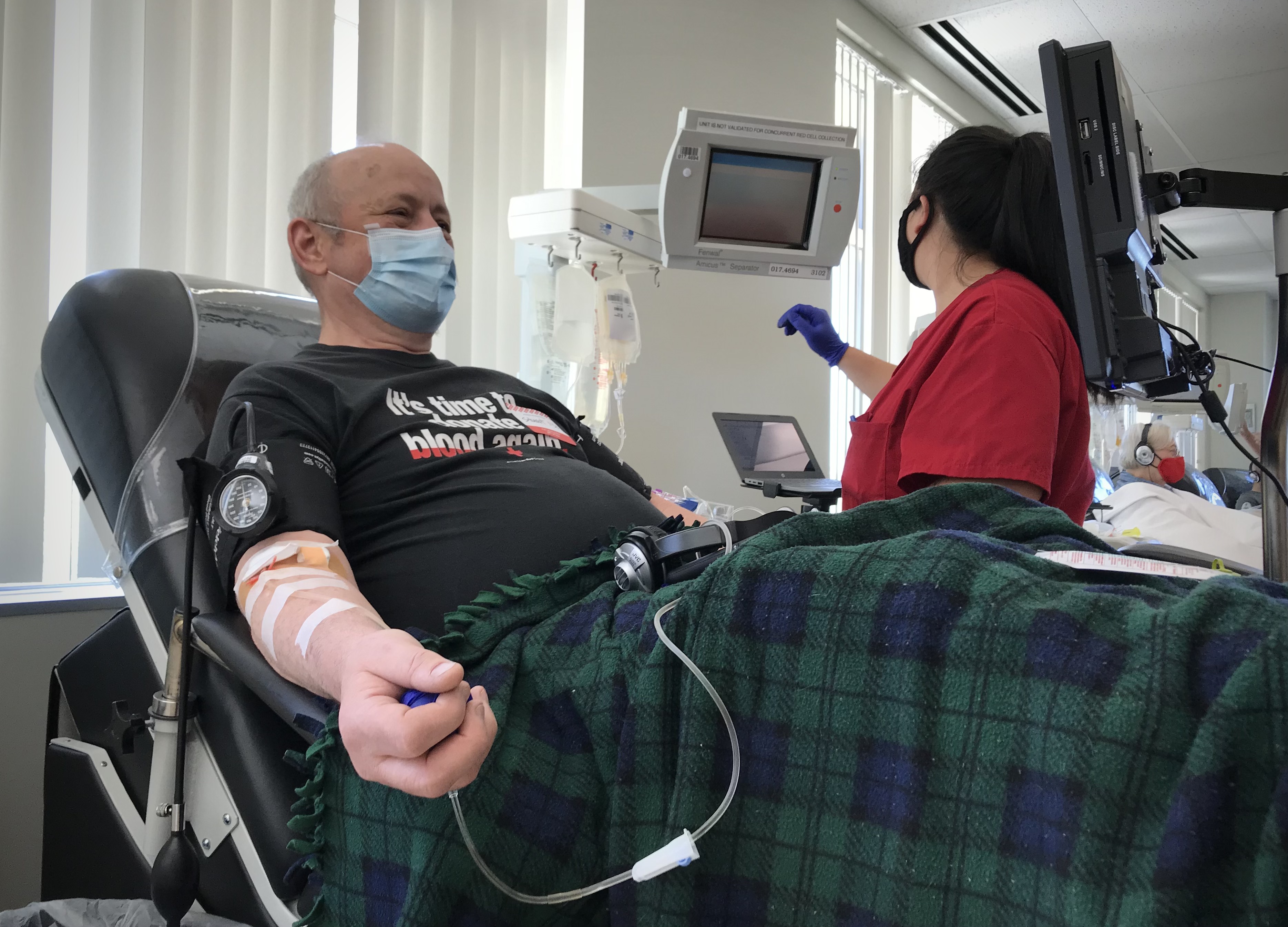
Stuart Anderson at the Red Cross Blood Donation Center in Minneapolis, June 4, 2021.

“It’s time to donate blood again,” reads the message on his vintage Red Cross T-shirt, speaks to his moment: Stuart is back, helping others have time together in the midst of cancer treatment or other traumatic events that touch so many of us. He has time and good health so he wants to help anyway he can.

“It’s been a while,” says Stuart Anderson while starting his platelet donation at the Red Cross Blood Donation Center in Minneapolis. For years he donated, starting in 1984, but then time passed and he got busy, like most of us.

Then tragedy happened. Stuart’s son developed cancer, specifically a brain tumor in the midst of being fully alive and studying to be an oncologist. “We had a few years together after his diagnosis,” says Stuart. Donated platelets for cancer treatment helped give them time. “I talked to him every day.” His son died six years ago at 30 years old.

More motivation comes from his own need for blood after falling out of a tree when he was a child. His wife and daughter have received blood, too.

Red Cross phlebotomist Suriya and platelet donor Stuart, Minneapolis, June 4, 2021.

Just steps away from the Mississippi River, a team works inside the Red Cross donation center to help Stuart and other donors be comfortable during a process that can take, on average, around two hours. Blankets keep them warm and movies keep them entertained. Stuart is patient while a phlebotomist adjusts his donation lines.

This Navy veteran served years in active duty and in the reserves. While getting his platelet donation underway, he recalled turning to the Red Cross for emergency financial assistance when he was a young recruit and newly married. “We were living off base,” he says, “and got a loan, $250, to help us.”

“Great people at the Red Cross,” he says. “Thanks for all you do.” We’d like to say thank you to Stuart and to all who donate to help patients in need. His return is a great reminder for donors who’ve been away for a while to make time. It’s super easy to make an appointment via the Red Cross Blood Donor App, which also allows you to follow your donation journey.

Story and photos: Lynette Nyman/American Red Cross

Give Blood to Give Time

Supporting cancer patients through blood donation

In August 2016, Myel Bowers-Smith received an unexpected and life-changing medical diagnosis

Sunday, June 6, is National Cancer Survivors Day, and we’re celebrating Myel. In August 2016, Myel received an unexpected and life-changing medical diagnosis. What she thought was an infection from a mosquito bite was actually stage 4 inflammatory breast cancer.

Myel’s treatment included chemo. She needed the support of platelet & plasma transfusions during her treatment. The need for blood products in cancer care is important & often untold. Patients may need blood products regularly due to chemo side effects or surgery complications.

After months of treatment, Myel was told her cancer was in remission in February 2017. “I was more than excited because I survived. I won, and it was time to get my life back! This couldn’t defeat me,” she says.

Myel knows the important role blood products had in helping her get through treatment & encourages others to give. “Everyone needs someone, and this is your time to help someone who needs your blood or platelets. Be a blessing. A pint of blood can help save lives.”

You might not be able to change a cancer diagnosis or treatment, but you can help those going through it by donating blood or platelets. Join the Red Cross and American Cancer Society and make your appointment to #GiveBloodToGiveTime at rcblood.org/3bYtlqn.

The American Red Cross and the American Cancer Society have teamed up this June to encourage people across the country to Give Blood to Give Time and help ensure loved ones have the strength and support they need as they undergo cancer treatment.

According to the American Cancer Society, many patient visits and procedures were forced to delay or cancel early in the pandemic to reduce the risk of exposure to COVID-19. With procedures resuming, blood donations are critical for cancer treatments. Unfortunately, the Red Cross is seeing fewer blood and platelet donors give as the nation begins to climb out of this pandemic. This downturn comes at a time when the Red Cross continues to see strong demand for blood products − including platelets − by hospitals, causing concern for the sufficiency of the blood supply this month and throughout the summer.

We currently have an emergency need for eligible donors to make an appointment now to give platelets to ensure critical patient needs are met. Platelets, the clotting portion of blood primarily given to cancer patients during treatment, must be transfused within five days of donation and, therefore, are always in great demand.

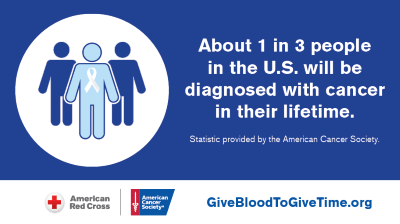
Source: American Cancer Society

“Many cancer patients, especially those going through chemotherapy, will have a need for blood products during treatment,” says Dr. Baia Lasky, medical director for the Red Cross. “When someone donates blood or platelets, they may not only help prevent life-threatening bleeding that can cause stroke or relieve some symptoms, like shortness of breath and headaches, but also give patients and their families the time and hope they need to fight back.”

Some types of chemotherapy can damage bone marrow, reducing red blood cell and platelet production. Other times, the cancer itself or surgical procedures cause the need for blood products. About six blood products are needed every minute to help someone going through cancer treatment. Yet only 3% of people in the U.S. give blood. It is vital that more people donate blood and platelets regularly to meet that need.