Tiffany Circle Spring Fashion Social

Story by Jill Michaelree/American Red Cross

Happy for the promise of spring and social respite from this lion of a winter, 50 cheerful ladies gathered on a recent Saturday at Macy’s in downtown Minneapolis to attend the Tiffany Circle Spring Fashion Social. This brunch featured a spring fashion preview curated by experts from Macy’s by Appointment, makeup tutorials from Chanel on making the “Perfect Red (Cross) Lip” and a look at Red Cross women leaders throughout history.

For these Red Cross philanthropists and their guests, the surprise bonus models, decked out in vintage Red Cross uniforms, were the highlight of the day. These amazing volunteers donned historic garments from the 1920’s-1950’s that were donated by Minnesotans whose mothers and grandmothers served during times of peace and in war.

Katherine with Dee and Barb
Photo credit: Katie Kusnierek/American Red Cross

Volunteer model Katherine Lewiston (above center) shows Barbara Gauhan (left) and Dee Rasmussen (right) her Viet Nam-era summer suit and garrison cap. This style was worn by young women who served in the American Red Cross Supplemental Recreation Overseas program during the Vietnam War. Also known as “Donut Dollies,” these college-educated women served one-year tours intended to boost troop morale.
sharpened Cyndi and Carla with poster and vintage gals
Photo credit: Megan Dulgar/American Red Cross

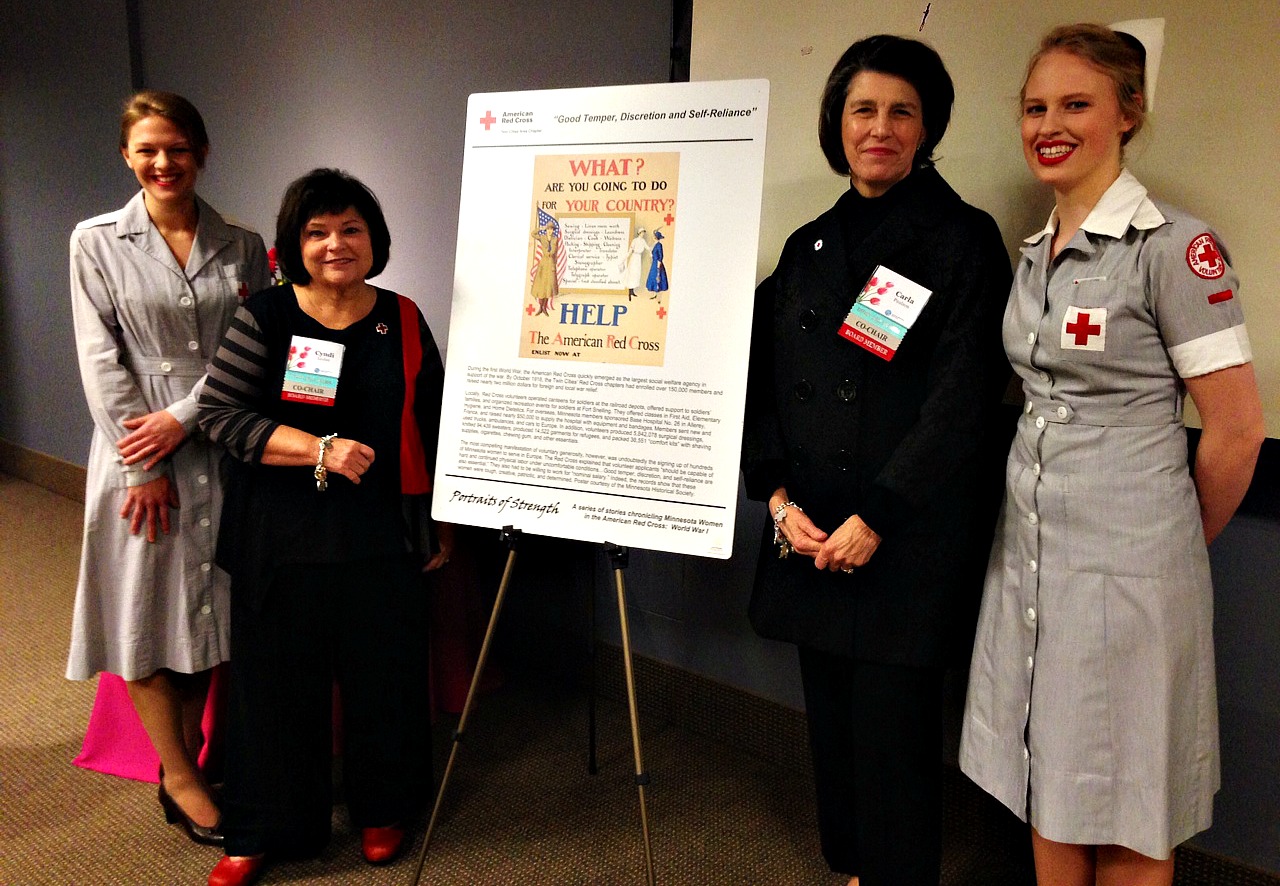
Models Jacinta Lagasse (above, far left) and Amanda Burgdorf (far right) join Tiffany Circle Co-Chairs Cyndi Lesher (center right) and Carla Paulson (center left) around a wartime recruitment poster.

During World War I, American Red Cross volunteer services faced rapid expansion. To delineate the lines of service, the Red Cross employed a color coding system for the uniforms and service pins. Jacinta’s gray, crepe dress denotes her as a non-medical hospital volunteer in the “Gray Lady Service.”

Amanda is wearing a Volunteer Administrative dress from the Second World War. The American Red Cross enrolled more than 104,000 nurses for service, prepared 27  million packages for American and Allied prisoners of war, and shipped over 300,000 tons of supplies overseas. At the military’s request, the Red Cross also initiated a national blood program that collected 13.3 million pints of blood for use by the armed forces.

Like the women who wore these dresses in the 20th Century, thousands of volunteers throughout American Red Cross history have served our country. In honor of Volunteer Appreciation Week, we’d like to thank our volunteers and the Tiffany Circle Members for their dedication to making the Spring Fashion Social and all American Red Cross efforts successful. It is an honor to work with such caring individuals who continually dedicate their time and efforts to alleviating human suffering in the face of emergencies.

The women of the Tiffany Circle invest $10,000 annually in their local American Red Cross chapters, following in the footsteps of a long line of women leaders who have helped the Red Cross serve the American public in times of war and peace with disaster assistance, blood collection, safety training and countless other community assistance services. For more information about the Tiffany Circle, contact Megan Dulgar at megan.dulgar@redcross.org or 612.872.3246. 


House of Cards: The Clara Barton Connection

by Carrie Carlson-Guest

Like so many others, I am obsessed with House of Cards, the political drama starring Kevin Spacey and Robin Wright as Frank and Claire Underwood.  No plot spoilers here I promise, just some thoughts about the connection between Frank and Clara. Clara Barton that is. I freely admit to watching multiple episodes in one sitting, complete with popcorn and fuzzy pajamas. And honestly, the weather lately has been rather conducive to Netflix marathons.

Part of the show’s popularity may stem from the references to real life events, issues, people and places. One of the episodes my husband and I watched last night, included a Civil War re-enactment at the Battle of the Wilderness.  On hand to commemorate the 150th anniversary of the battle, Frank is approached by one of the re-enactors who suggests one of Frank’s ancestors fought and died in the battle, with thousands of others.

What does this have to do with Clara Barton? She was at the Battle of the Wilderness. Before the Red Cross was even a formal organization, Clara Barton brought medical supplies and nursed wounded soldiers on Civil War battlefields, including during the Wilderness Campaign.  She, theoretically, could have comforted Frank Underwood’s great-great-great-grandfather and connected him to his family after his death.

Clara’s work during and after the Civil War became the first mission of the American Red Cross  – caring for the wounded and displaced and their families. More than 150 years later, the Red Cross proudly continues our Service to Armed Forces, supporting military members and their families, connecting them in times of crisis and by their side wherever they are around the world.

Check out this video for a great mini-history lesson on Red Cross SAF programs and services.  Then, if you haven’t already, check out House of Cards, but don’t tell me what happens after episode five of the second season.

Red Cross Family Tracing Helps Husband and Wife Live Again

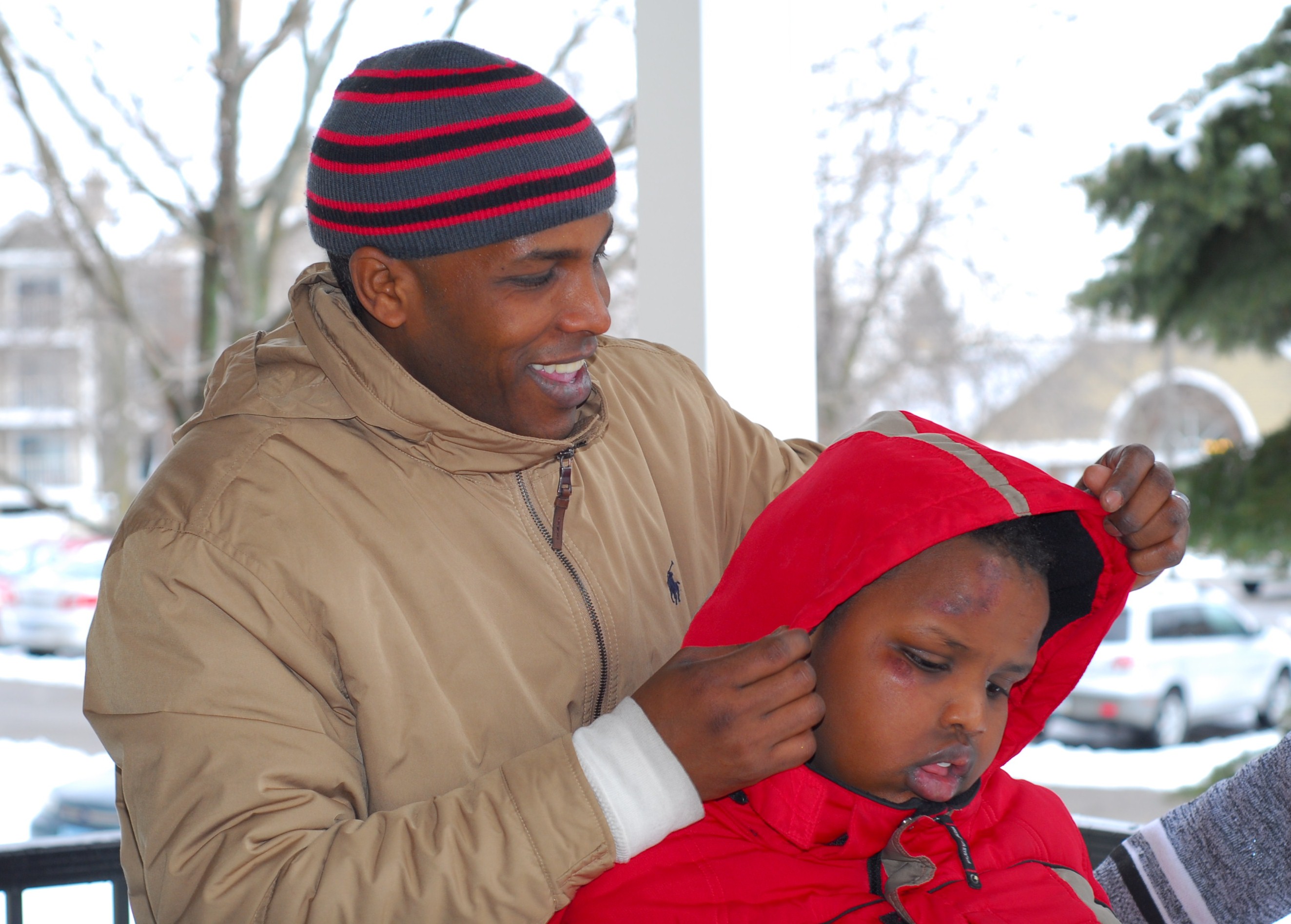
With Red Cross help, Abdiaziz Warsame, 35, learned that his wife is alive after being abducted by militia six years ago in Mogadishu, Somalia. He now lives in Minneapolis, Minnesota, with his son. Photo credit: Lynette Nyman/American Red Cross

Abdiaziz Warsame has lived in Minneapolis for the past six years taking care of his son and anticipating a life without his wife, his son’s mother. That was until he reached out to the Red Cross and its family tracing services.

“I am really thankful to the Red Cross for the job they did for me and my family,” says Warsame. “I gave up until the Red Cross found her alive.”

Abducted by militia in Mogadishu, Somalia, there was little reason for Warsame to believe that his wife was anything but dead. He fled with his son to Cairo, Egypt, where he sought refuge with the United Nations. His son’s condition, which includes brain damage and some paralysis, prompted a quick departure for an operation in the United States.

“I will not forget how the Red Cross helped me find my wife and how the Americans have been good to us,” says Warsame.

Abdiaziz Warsame, 35, fled Mogadishu, Somalia, with his son Shamusdin, 10, who has brain damage and paralysis. Red Cross family tracing services helped find Warsame’s wife alive in Somalia. Photo credit: Lynette Nyman/American Red Cross

The Red Cross sent a message from Minneapolis to Washington D.C., to Geneva, Switzerland, and then to the Red Cross in Nairobi, Kenya. From there, the Somali Red Crescent conducted a field search and found Warsame’s wife, Ayan Mohamed, in Mogadishu. They returned a message in the opposite direction that the Red Cross delivered to Warsame in Minneapolis.

The message came with a phone card, which Warsame immediately used to call his wife who had no idea her husband was living in America. Now, Warsame talks on the phone with his wife every day.

“We married for love,” says Warsame. “These six years are like 60 years. For that reason we live when we talk to each other.”

Warsame wants to be reunited with his wife—who also survived a bullet wound with Red Cross medical services in Somalia. “My son always says ‘where’s my mom,’ but I am so happy,” says Warsame. “I have found her now and hope to bring her here.”

Learn more about Red Cross family tracing and international services. Story and photos by Lynette Nyman/American Red Cross, with assistance from Yahye Mohamed/American Red Cross. Posted February 22, 2012