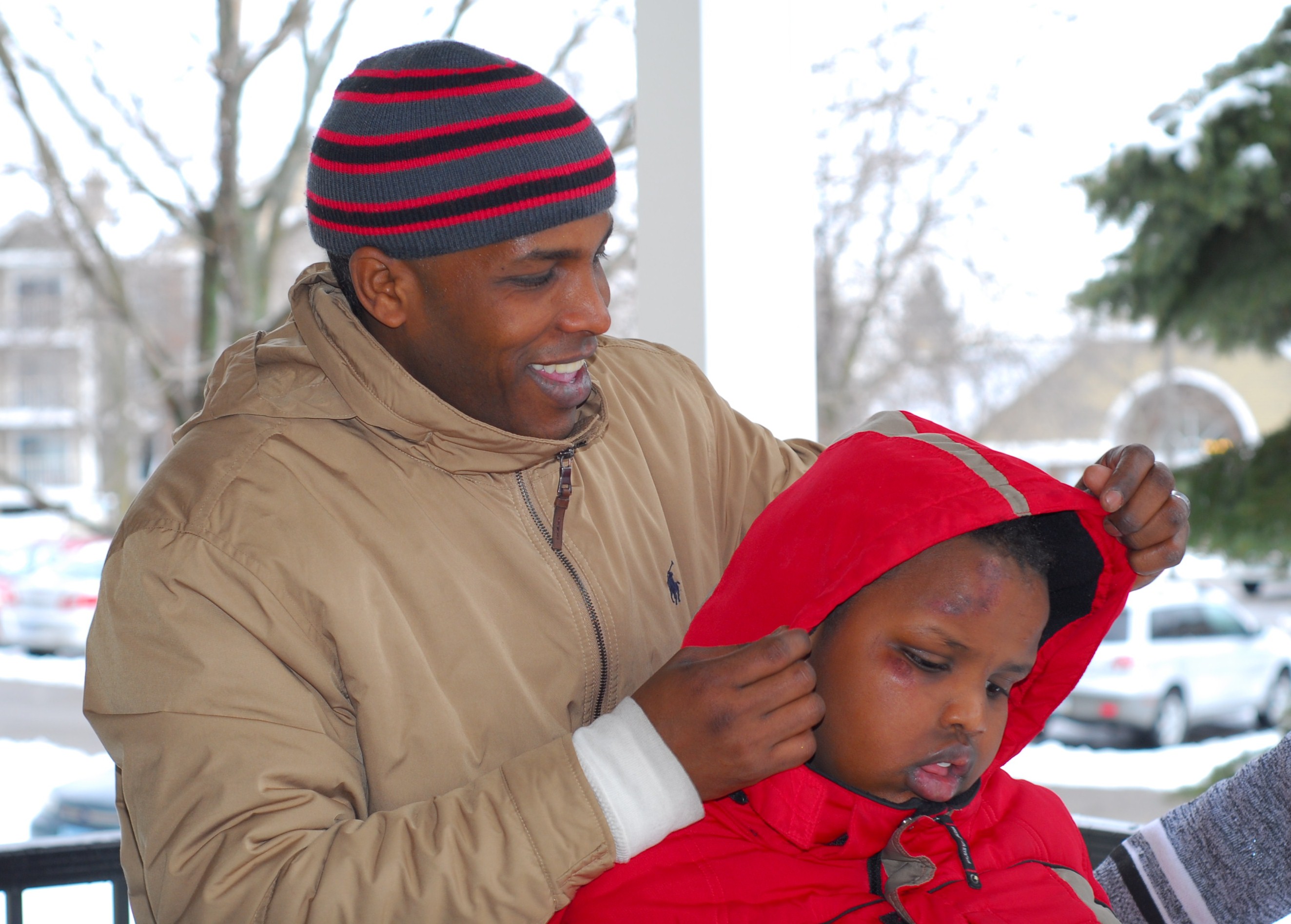
With Red Cross help, Abdiaziz Warsame, 35, learned that his wife is alive after being abducted by militia six years ago in Mogadishu, Somalia. He now lives in Minneapolis, Minnesota, with his son. Photo credit: Lynette Nyman/American Red Cross
Abdiaziz Warsame has lived in Minneapolis for the past six years taking care of his son and anticipating a life without his wife, his son’s mother. That was until he reached out to the Red Cross and its family tracing services.
“I am really thankful to the Red Cross for the job they did for me and my family,” says Warsame. “I gave up until the Red Cross found her alive.”
Abducted by militia in Mogadishu, Somalia, there was little reason for Warsame to believe that his wife was anything but dead. He fled with his son to Cairo, Egypt, where he sought refuge with the United Nations. His son’s condition, which includes brain damage and some paralysis, prompted a quick departure for an operation in the United States.
“I will not forget how the Red Cross helped me find my wife and how the Americans have been good to us,” says Warsame.
Abdiaziz Warsame, 35, fled Mogadishu, Somalia, with his son Shamusdin, 10, who has brain damage and paralysis. Red Cross family tracing services helped find Warsame’s wife alive in Somalia. Photo credit: Lynette Nyman/American Red Cross
The Red Cross sent a message from Minneapolis to Washington D.C., to Geneva, Switzerland, and then to the Red Cross in Nairobi, Kenya. From there, the Somali Red Crescent conducted a field search and found Warsame’s wife, Ayan Mohamed, in Mogadishu. They returned a message in the opposite direction that the Red Cross delivered to Warsame in Minneapolis.
The message came with a phone card, which Warsame immediately used to call his wife who had no idea her husband was living in America. Now, Warsame talks on the phone with his wife every day.
“We married for love,” says Warsame. “These six years are like 60 years. For that reason we live when we talk to each other.”
Warsame wants to be reunited with his wife—who also survived a bullet wound with Red Cross medical services in Somalia. “My son always says ‘where’s my mom,’ but I am so happy,” says Warsame. “I have found her now and hope to bring her here.”
Learn more about Red Cross family tracing and international services. Story and photos by Lynette Nyman/American Red Cross, with assistance from Yahye Mohamed/American Red Cross. Posted February 22, 2012
Below, a note of thanks from Jill Hallonquist, Emergency Services Director, American Red Cross Northern Minnesota Region, who is now enjoying a well-deserved vacation.
This morning I woke up thinking about the Governor’s emergency management training conference that I’m attending this week. Many of our partners throughout our response region are in St Paul for this training. I have been chatting with Emergency Managers, Public Health, Homeland Security, Salvation Army, NECHAMA, and other friends of ours from across the Minnesota. Many of them ask how the Red Cross is doing these days. Most know that we have a new region structure and wonder how that’s going.
Red Cross volunteers answered questions from attendees of the 2012 Governor’s Homeland Security and Emergency Management Conference. Photo credit: Andrea Bredow/American Red Cross
Here’s what I tell them: I am so grateful that we have you, the incredible volunteers in their communities. You are the heart of the Red Cross. The restructuring that we did changed the way that staff supports the volunteers. It did not change the fact that the person they see responding in their community is a volunteer, teaching people to be prepared and to prevent disasters, comforting those affected, and helping to connect them with the local resources they need to get back on their feet. Your passion for helping your neighbors is as strong as ever and you’re there to help!
Do you ever catch yourself telling someone how much you like a certain person…and then you wonder if you have told THEM? I didn’t want to let another day pass without telling you how much I appreciate each and every one of you. You are treasured.
Click here to learn more about the 2012 Governor’s emergency management conference and click here to learn more about how the Red Cross helps in Minnesota and beyond.
Last fall the American Red Cross trained members of the Mille Lacs Band of Ojibwe in emergency sheltering. Below is the article about the training published in the Mille Lacs Band newspaper Ojibwe Inaajimowin and written by Jamie Edwards, public information officer of the Mille Lacs Band of Ojibwe Tribal EmergencyResponse Committee.
A baby on a Red Cross cot during the Minneapolis tornado response May 2011. Photo credit: Lynette Nyman/American Red Cross
Red Cross officials were on the Mille Lacs Reservation on November 17 [2011] to train the Band’s Tribal Emergency Response Committee (TERC) on how to set up a temporary shelter. This training session helped TERC members understand the Band’s role and each of their roles in setting up an emergency shelter in partnership with the Red Cross.
After the storm in District III this past summer, committee members requested training on how to set up temporary shelters at each District’s Community Center. If any future disasters should leave Band members temporarily homeless or without basic necessities, a shelter would be the most efficient way to respond.
“Setting up a temporary shelter takes a lot of teamwork since an emergency shelter can be needed any time during the year and at all hours of the day,” said Monte Fronk, Mille Lacs Band emergency management coordinator. “TERC requested this additional training because we want to be prepared in the event that we need to set up a temporary shelter.”
In general, the process would involve the Band preparing a shelter site (such as one of the community centers) for the Red Cross to bring cots, blankets and meals. Since government entities do not normally keep these supplies in their inventories, the Duluth Red Cross [American Red Cross Northern Minnesota Region] would provide these resources under the direction of TERC. The Band would also be responsible for operating the shelter as well as services such as transportation, medical care, and mental health services.
Mii gwech to the Red Cross’s Duluth office for providing the training session…
Click here to learn more about the Mille Lacs Band of Ojibwe.
When a devastating EF-5 tornado slammed into Joplin, Missouri on May 22, 2011, St. John’s Mercy Regional Medical Center stood directly in its path. Over 180 patients – including some in operating rooms, intensive care, or the emergency room – were being treated. Dennis Manley, Director of Quality and Risk Management, returned to the hospital to help lead the evacuation of patients and staff that afternoon.
“Because of the dirt and debris blown by 200 mile per hour winds, we had difficulty identifying some of the people we treated. One doctor, in fact, treated his assistant – but didn’t realize it until much later,” Manley says.
The complete destruction of the hospital and surrounding buildings required evacuation of everyone in the facility. It took over 90 minutes, because virtually every window was shattered, corridors were blocked with debris, and doors were jammed. Fortunately, Manley observed, previous emergency drills had helped to prepare the hospital staff for many of the situations they faced that day. Advance preparation and close working partnerships with a wide variety of governmental and non-governmental organizations helped deal with the need for swift and effective emergency response.
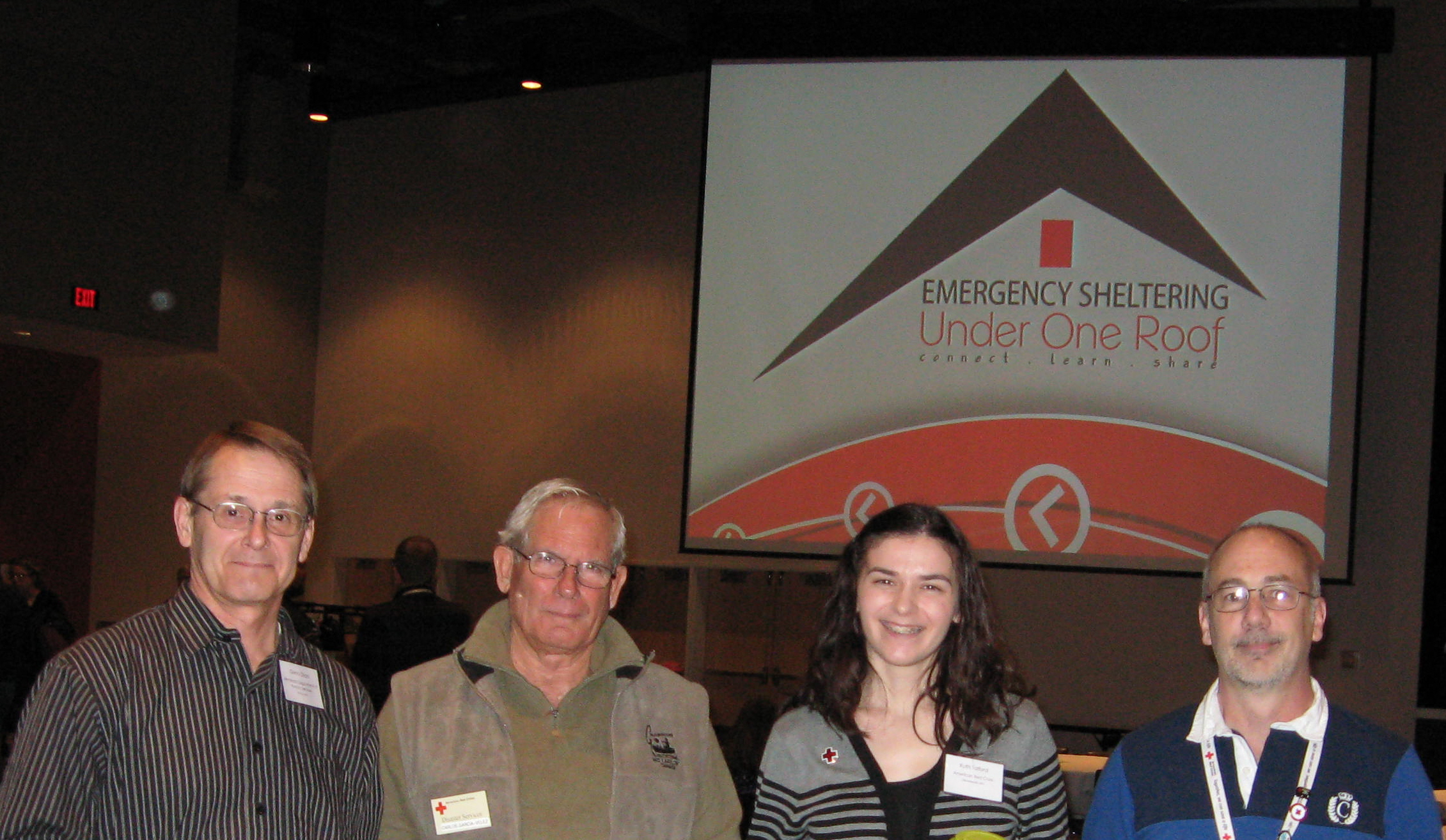
Attending the conference were (L-R) Glen Olson, Minnesota Department of Public Health, Carlos Garcia-Valez, Red Cross Northland Chapter volunteer and keynote speaker, Ruth Talford, Red Cross Readiness Manager, and Eric Nikolai, Red Cross St. Croix Valley Chapter volunteer.
Building partnerships continued when more than 275 representatives from local, state and national government public health, human services, health care, and emergency response organizations, along with community volunteer emergency responders, shared updates, networked, and heard experts at the second annual “Emergency Sheltering: Under One Roof “ Conference. Participants came from five states and Canada.
“We are focusing on mass care events such as major wildfires, tornadoes, floods, or winter storms that could displace hundreds of people,” says Tony Guerra, a Red Cross Readiness Manager based in Duluth, Minnesota. “The goal is to strengthen and create local, regional, and national networks which help people increase collaboration.”
The American Red Cross Northern Minnesota Region and the Community Health Information Collaborative (CHIC) hosted the conference, which was held January 31-February 2 at the Black Bear Otter Creek Convention Center in Carlton, MN, and was funded by the Fred C. and Katherine B. Andersen Foundation in Bayport, MN.
During 2011 the Red Cross responded to hundreds of disasters, including the May 22 tornado that swept through north Minneapolis and left hundreds homeless. Photo credit: Jason Viana/American Red Cross
Janice Springer of St. Cloud, Red Cross Disaster Health Services Advisor for Minnesota, discussed meeting the access and functional needs of people in shelters.
”In 2011, the Red Cross opened 978 shelters in the U.S., serving more than 41,000 people with over 125,000 overnight stays,” says Springer.
Red Cross volunteer Carlos Garcia-Velez was among those who responded to disasters last year. Garcia-Velez has served as an American Red Cross volunteer in multiple roles since 1992, including leading the Partner Services and Government Operations activities through many disaster relief operations. Most recently Garcia-Velez responded in North Carolina following Hurricane Irene. Garcia-Velez challenged the sheltering conference participants to work more closely together and collaborate on all levels.
“We have to approach disasters as a whole community,” says Garcia-Velez. “Experience has taught us that we must do a better job of providing services for the entire community, regardless of their background, demographics, or challenges,” says Garcia-Velez. “This means planning for the actual makeup of a community, making sure we meet the needs of every disaster survivor regardless of age, economics, or accessibility requirements.”




 American Red Cross Minnesota and Dakotas Region