Even zombies and vampires need to know how to celebrate safely. Check out the Red Cross tips below and share them with your favorite super hero or princess this Halloween.
COSTUME SAFETY Whether the little one wants to be a ghost, a princess or a superhero, parents can help keep them safe by following some costume advice:
Add reflective tape to costumes and trick-or-treat bags.
Have everyone wear light-colored clothing to be seen.
Use flame-resistant costumes.
Use face makeup instead of masks, which can cover your eyes and make it hard to see.
SAFE TRICK-OR-TREATING To maximize safety, plan the route ahead of time. Make sure adults know where children are going. If the children are young, a parent or responsible adult should accompany them as they make their way around the neighborhood.
Other safety tips to follow include:
Make sure trick-or-treaters have a flashlight to see where they are going and be seen by drivers.
Visit only the homes that have a porch light on. Accept treats at the door—never go inside.
Walk only on the sidewalks, not in the street. If no sidewalk is available, walk at the edge of the roadway, facing traffic.
Look both ways before crossing the street, and cross only at the corner.
Don’t cut across yards or use alleys. Don’t cross between parked cars.
It’s not only vampires and monsters people have to look out for. Be cautious around animals, especially dogs.
WELCOMING THE KIDS If someone is manning the candy giveaway at their house, they can make sure it’s a fun night for all by doing the following:
Make sure the outdoor lights are on.
Sweep leaves from the sidewalks and steps.
Clear the porch or front yard of any obstacles that a child could trip over.
Restrain the pets.
Use a glow stick instead of a candle in the jack-o-lantern to avoid a fire hazard.
Use extra caution if driving. The youngsters are excited and may forget to look both ways before crossing
FIRST AID APP Download the free Red Cross First Aid App. Users receive instant access to expert advice for everyday emergencies whenever and wherever they need it. Use the Emergency App for weather alerts and to let others know you are safe if severe weather occurs. Find these and all of the Red Cross apps in smartphone app stores by searching for the American Red Cross or going to redcross.org/apps.
MONSTER GUARD APP Download the free Monster Guard: Prepare for Emergencies App, a game that helps kids learn how to save lives. Children between the ages of 7 and 11 learn ways to prepare and stay safe in home fires, hurricanes, tornadoes, floods and other disasters by role-playing as different monster characters.
Dee Smith, 36, served with the American Red Cross as secretary in Paris, during World War I. Photo from the Minnesota Historical Society collection.
During World War One, people in Minnesota made a major contribution to The Great War effort. Minnesota women were among them. At home, they did many things to help, such as darn socks, make bandages, pack comfort kits, and offer first aid classes. More than 120 of them chose to be close to the front lines in Europe. Their names included Ruby, Marion, Grace, Marguerite, Julia, Aileen, Verna, Leila, Mary, Alice, Helen, Dee, and Rose. Their jobs were many, such as canteener, secretary, nurse, supply-truck driver, and social worker. They, like the men they helped, held steadfast.
As part of ongoing remembrances during the war’s centenary years through 2018, we share below an exceprt from “Awfully Busy These Days: Red Cross Women in France During World War I” by Nancy O’Brien Wagner and published in the Minnesota History Magazine, Spring 2012.
Late train arrivals were just one of many wartime annoyances. Flies, lice, fleas, hives, chilblains–nearly every woman complained of these. Food shortages, food and coal rationing, and high prices were popular topics, too. Marion Backus wrote: “Between cooties, fleas, and hives I am having an interesting time. The last two bother me most…the only things I miss are pie and cake. When I get home am going to eat a dozen pies right straight at one lick, and then a strawberry short cake.”
Alice O’Brien dismissed these discomforts with suspiciously adamant protests.
All your letters carry messages of Sympathy such as–I must be working so hard–not enough food–not enough sleep–feet must be sore, etc. etc. I am sorry if my letters have given you that impression because it is not a true one. Of course we do work hard but we love it and nothing is as healthy as hard work. We have fine beds, and I assure you we use them a lot. I have never been better in my life–never–and I have everything I need.
Everything but intact socks, it appears. In July Alice wrote, “Mugs [Marguerite Davis] came into the room last night and said that she realized, for the first time, how far we were from home. You bet we’re a long way off when I started darning.” She went on to request that socks be sent from St. Paul. They arrived four months later, in the hands of Grace Mary Bell, an acquaintance who had signed on as a canteener. She described the meeting for Alice’s parents: “I delivered safely into her hands sundry articles at which point she devoutly remarked ‘Thank the Lord, I can stop darning!'”
Cases of homesicknesses developed, too, though few would admit it. Dee Smith wrote from Paris with insightful candor:
The whole idea here is anything to keep the morale of the men as high as possible, & everyone is so proud of them that no one begrudges them a good time. It is fine for the girls, too, tho no one ever seems to think they may get lonely and discouraged. I have met an occasional one who was frankly homesick, & don’t doubt there are others who are, but keep it to themselves. I think I might be if I didn’t have lots of work, but I haven’t time to think of being homesick. I sometimes even forget there is a war.
Alone in a foreign land, fighting a war with an uncertain outcome, these women were determined not to let their comrades or their country down. Helen Scriver summed up these attitudes: “My conclusions are always the same, namely if others can speak this language, I can, if the rest can life in these houses, so can I and if the rest can hold their jobs, I must be able to hold mine. It is a good philosophy.”
World War I-era, 1914-1918, Red Cross poster in the Minnesota Historical Society collection.
Helen’s steadfast determination was common, and the volunteers’ unflinching efforts made the work of the American Red Cross possible. For example, nurse Marion Backus was transferred to Evacuation Hospital #110 in Villers-Daucourt in September 1918. After a long day of travel, she went on duty that night and stayed on for two weeks. “If anybody had told me that I could take care of more than two ether patients before I came over here I would have laughed and thought them joking. But now I can watch 45 in one ward, 36 in the next and never wink an eye.”
In the fall of 1918, Marguerite Davis and Alice O’Brien watched as train after train of men unloaded at their camp near Chantilly. “We are awfully busy these days,” Alice wrote home. On September 7, their friend Doris Kellogg reported that, with just three other women, they served 1,157 meals in their canteen in three-and-a-half hours; on September 18, they dished up 1,300 meals, and on October 20, more than 1,600.
Good humor, resourcefulness, and flexibility were invaluable traits for Red Cross volunteers. When asked, these women dropped their work and jumped to do whatever was needed. Margaret MacLaren enlisted as a hospital worker, then began running a canteen. Soon, she was driving a supply truck. Minneapolitan Winifred Swift volunteered as a physiological chemist at Red Cross Hospital #2 in Paris, helping to research the nature and treatment of gas gangrene. “During the heavy work following the offensive in spring 1918 and summer, research work was abandoned to give more hands for the task of caring for the wounded…all spare moments were given to relieve the nurses of such work as might be done by those less trained.”
To read the full article, click here. To learn more about the American Red Cross during World War I, click here.
Story and photos by Dave Schoeneck, Red Cross Volunteer
Sunset at Camp Ripley, Little Falls, Minn.
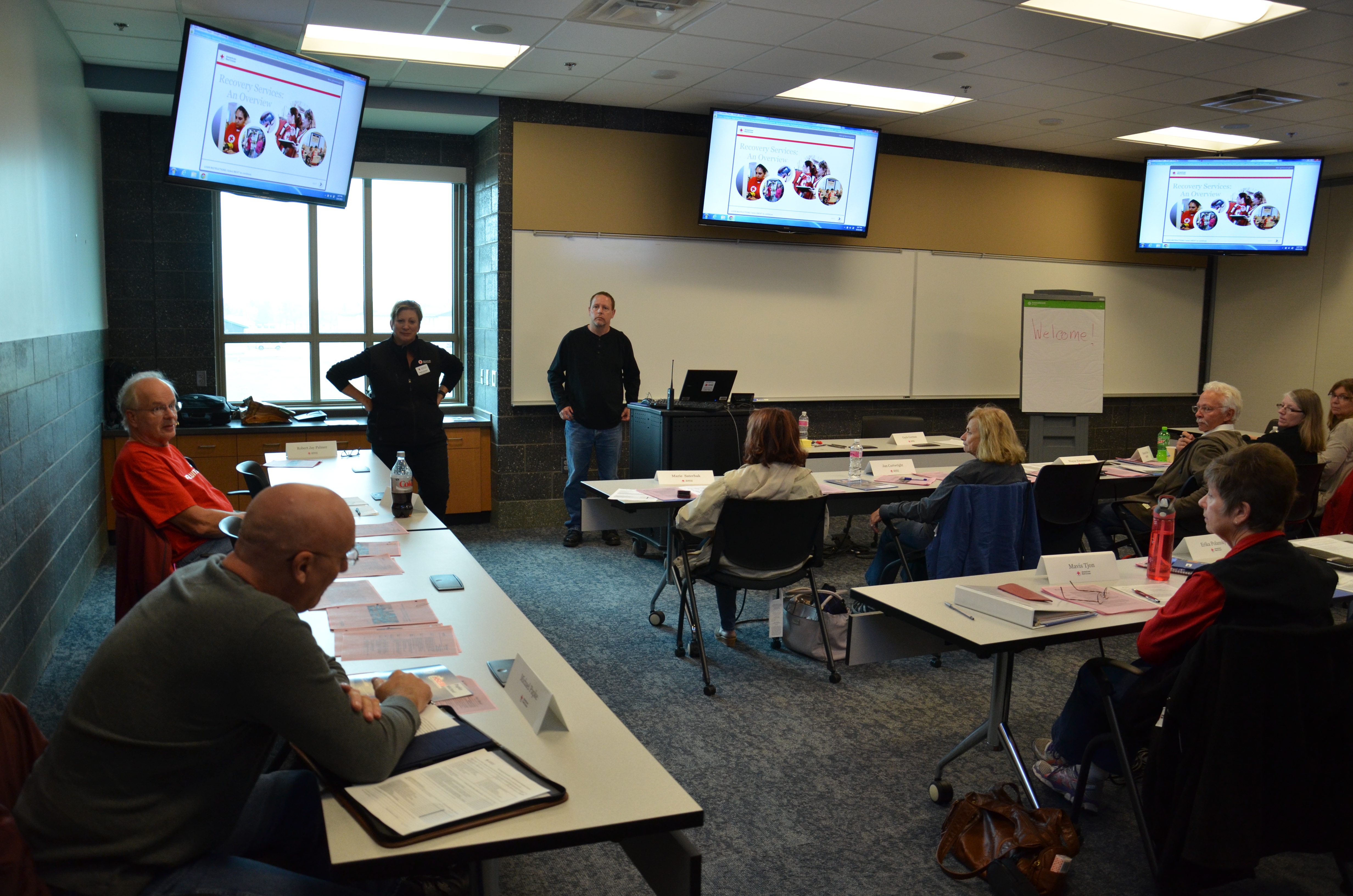
More than 160 Red Cross volunteers, staff and community partners came together during the North Star Disaster Training Institute (NSDTI) at Camp Ripley last week to learn fundamental and advanced skills to help prevent, prepare for and respond to emergencies.
Organized by the American Red Cross Minnesota Region, the third North Star Disaster Training Institute, included more than 30 classes on client assistance, psychological first aid, disaster assessment, volunteer supervision, sheltering and more.
New classroom technology at Camp Ripley’s Education Center made instructing and learning easy for everyone.
Twin Cities disaster volunteer Jennifer Pluhar said, “The Institute was definitely time well spent. From a variety of training offerings, to networking opportunities and overall Red Cross team building – I’m leaving better equipped to serve my community and with even more admiration for the truly amazing people I’m privileged to serve with.”
To test skills learned at the Institute, the weekend culminated in a four-hour tabletop disaster exercise simulating an F2 tornado ripping through St. Cloud. More than 80 people participated in the exercise, including community partners from the city of St. Cloud and Stearns County: Erin Hausauer, Emergency Manager, Stearns County; Kristen Tschida, Stearns County Emergency Management Planner; Dean Wrobbel, St. Cloud Fire Chief; and Jerry Raymond, St. Cloud Fire Battalion Chief. They helped Red Cross volunteers understand how the government would coordinate its disaster response and work with the Red Cross and other agencies.
Terrance Schoonover (left) of Rochester and Terri O’Grady of Edina practiced their first aid skills during a First Aid and CPR class at the Institute.
“We were very pleased to again be able to utilize all of the wonderful facilities at Camp Ripley, including the newly constructed classroom and cafeteria wing of the Education Center,” said Art McIntyre, Director of the NSDTI planning team and a Red Cross volunteer. “We also had excellent assistance from the staff at Camp Ripley, which made the Institute run very smoothly and efficiently.”
Joe Kelly, director of Minnesota’s Homeland Security and Emergency Management agency and a member of the American Red Cross Minnesota Region Board of Directors, delivered the Friday night keynote address. He told the volunteers, staff and Red Cross partners, “I was reminded of what you really do this summer when I visited the Brainerd Lakes disaster area. It made me proud of my association with this organization. If not the Red Cross, who would be there to help? I don’t have an answer for that. I couldn’t really do my job without you.”
Terry Sluss (left) Baxter, MN, was presented with the Minnesota National Guard Commander’s Award for Public Service by Major Joe Sanganoo.
Terry Sluss of Baxter, MN, lead Red Cross volunteer on this summer’s Vigilant Guard Exercise, was presented the Minnesota National Guard’s Commander’s Award for Public Service by Major Joe Sanganoo. Phil Hansen, Regional Chief Executive Officer, presented Vonnie Thompson with her 65-year service pin and plaque for her tireless work as a volunteer Red Cross nurse.
The NSDTI Planning team included Steve Bonnie, Judy Pike, Paul Baker, Cheryl Thompson, Mike Hofmann, Rick Graff, Rick Solheid, Eric Adams, Dan Hoffman, Megan Mrozek, Brenda Mead, Bill Satterness, and David Schoeneck.
The institute was made possible by a private donor and the Fred C. and Katherine B. Andersen Foundation, and several in-kind donations of materials and food. Planning is underway for the next training institute. Meanwhile, additional online training for Red Cross staff and volunteers is available through EMBARC.
For information about becoming a Red Cross volunteer, click here.
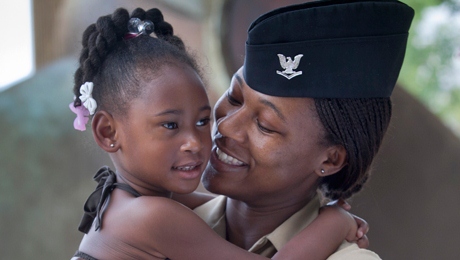
The American Red Cross has two new workshops that help children of military families to manage challenges that are specific to their lives. The workshops, Roger That! Communication Counts and 10-4: Confident Coping, teach essential life skills for military kids and teens to better manage stressful social situations.
“All kids face challenges,” says Diane Manwill, a behavioral health expert with the American Red Cross. “They are growing up and learning to navigate social situations. However, challenges faced by military kids may be compounded because military families move more frequently and family members may be more absent due to military deployments.”
Each of the workshops is composed of two modules with activities designed for children 8 to 12 and teens 12 to 18 years old. The Roger That! Communication Counts workshop focuses on the importance of developing quality interpersonal communication and listening skills. Operation 10-4: Confident Coping focuses on bolstering strengths present in older military children to help manage stressful situations. The new workshops are part of the Red Cross reconnection workshop series.
“My children have participated in these workshops and they make a difference,” says Kelsey Liverpool, co-founder and president of Kids Rank. “It helps because it gives children of military families a place where they can talk, where they feel safe, be with other people who understand what they are going through and learn how they might better adapt to their situation.”
Red Cross volunteers, who are licensed behavioral health professionals and trained to work with children, facilitate the workshops. All professionals have undergone extensive background checks as required by the Department of Defense for adults working with children. Additionally, a second adult is also available during these workshops for support and assistance to the groups.
“We were very proud to support the Red Cross in the development of this program over the past year along with many other subject matter experts in the field,” says Dr. Mary Keller with the Military Child Education Coalition. “We know that community-based initiatives, like this, make a positive difference for our military kids.”
 Even zombies and vampires need to know how to celebrate safely. Check out the Red Cross tips below and share them with your favorite super hero or princess this Halloween.
 FIRST AID APP Download the free Red Cross First Aid App. Users receive instant access to expert advice for everyday emergencies whenever and wherever they need it. Use the Emergency App for weather alerts and to let others know you are safe if severe weather occurs. Find these and all of the Red Cross apps in smartphone app stores by searching for the American Red Cross or going to redcross.org/apps.




 American Red Cross Minnesota and Dakotas Region