Cultivating Compassion with Red Cross Psychological First Aid Training

By CC McGraw, Red Cross Volunteer

Once COVID-19 reached the United States and everything began to shut down, it was hard to grasp the severity of this whole thing. As an athlete at the University of Minnesota in the Twin Cities, our spring season was canceled completely, and we were immediately moved off campus and forced to complete the rest of the semester online.

Inevitably, this was a big change for all of the athletes, especially since we had grown so used to having such crazy hectic schedules and nonstop training. This was heartbreaking to say the least, but our athletics department prioritized our mental health and stress levels by taking certain initiatives of providing access to meditation apps and ensuring we were staying connected with our teams via Zoom.

CC McGraw, UMN Gopher Volleyball (photo provided by CC)

For me, those efforts were a kind of psychological first aid, a bandage for mental health. Like a good bandage, psych first aid brings mental health stability during emergencies, especially during disasters. Psych first aid mitigates acute distress and serves as a bridge to continued support and care if necessary.

Whatever the case may be, it’s always important that those affected by a disaster are provided with empathetic and practical psychological support. This begins with a strong, compassionate, and supportive presence by an American Red Cross volunteer. But it can also begin with you, now at home, in the midst of the COVID-19 pandemic.

To help, the Red Cross is offering online psych first aid training for free. I recently completed the training, and I realize the necessity for it now more than ever. Emotional distress is not always as visible as a physical injury, and yet it has the power to be just as painful and debilitating.

After going through a life-altering experience and traumatic event, it’s very common to be affected emotionally. Psych first aid is simply a strategy to reduce the wide range of painful emotions experienced by those with high volumes of stress.

Tips from the American Red Cross online psychological first aid training course

The training touches on the vast range of stress reactions which can be manifested in thoughts, feelings, behaviors, physical effects, and spiritual beliefs. It informs us of the many contributing factors to stress reactions and the role that they play in the distress of the individual. More importantly, it raises awareness on how to analyze the situation, then describes how to approach it accordingly.

There are a variety of actions you can take depending on the situation. However, the training provides twelve main components that you should consistently try to follow. Now that I have them, I feel a new confidence and awareness in order to approach and help those affected.

I’ve found that this training benefits my ability to aid individuals in a more compassionate and supportive way, as well as use this new knowledge to support my family, friends, and others in my community. It’s a tool we can all use to reduce our own stress levels, by simply understanding our reactions to different forms of stress and then applying the principles of psych first aid to enhance our resilience to those stressors.

I recently completed the training, and I realize the necessity for it now more than ever. Emotional distress is not always as visible as a physical injury, and yet it has the power to be just as painful and debilitating.

Of course, I continue to have my worries and doubts with all of the uncertainty that stems from COVID-19, but I also understand that this pandemic is affecting every single person in the world, in some form or another.

Regardless of the circumstance, people are having to sort out their stressors and stress reactions in order to maintain their mental health in quarantine, so this is another reason why the free and online psych first aid course from the Red Cross is so beneficial. It provides you with many forms of stress reactions, stressors, and how to manage your stress in a healthy manner.

I’ve also found that to effectively help and support those around you, you should feel confident that your mental health and stress levels are intact as well.
Desperately Seeking Sewers

Red Cross is asking home stitchers to make face coverings for service members, veterans and their family members

Face coverings volunteers sent to the Fargo VA for veterans and their families, May 2020.

Continuing Legacy
For more than 130 years, the American Red Cross has provided comfort and care to service members, veterans and their families. One long-standing activity is the Red Cross program to knit socks and helmet liners, sew coverings for casts, and crochet or quilt lap blankets for injured wheelchair patients.

We’re continuing this legacy during the COVID-19 pandemic crisis because an ongoing need exists for face coverings that people can wear on military installations, at veteran’s homes and hospitals, and other areas where they are required. To help, our volunteer workforce is joining others to help sew and distribute these coverings.

Take for example Judi, a long-time Red Cross volunteer in Minot, North Dakota. She made 170 (wow!) of the 262 we’ve given so far to the VA in Fargo, ND. “I’ve always felt that everyone should take care of our veterans, in any way that we can. It’s a small gesture, but one that’s greatly needed. It’s a privilege to be able to help,” says Judi, who’s also a military veteran.

Get Sewing
If you’re interested in making face coverings to support service members, veterans and/or their families, please read this article from the CDC for sewing and design details. We’re particularly looking for face coverings made with gender neutral, masculine, or patriotic fabrics and sewn at home by hand or machine. We especially recommend that they’re sturdy enough for industrial laundry machines.

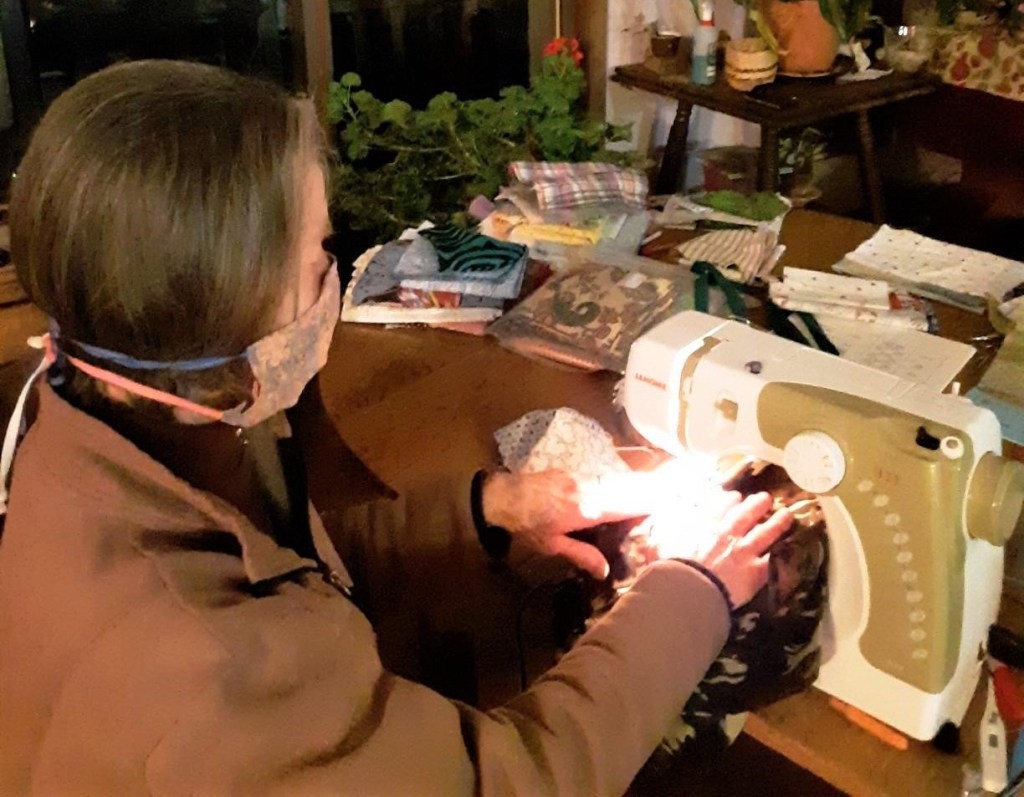
Community stitcher JoAnn sews face coverings for distribution at the VA in Hot Springs, SD, May 2020.

JoAnn, pictured above at her sewing machine, made face coverings for the VA in Hot Springs, South Dakota. For her, taking up the sewing project was a way to come together during a time when lives have changed so much and so quickly. “I learned about the need for face masks and just one mask turned into forty!  The challenge encouraged me to keep reaching out. Thank you for the privilege and honor to assist the Red Cross and the VA.”

Stitching Tips
• Consider expanding the sizes seen in the link above to accommodate a wider variety of face types/sizes (man vs. woman, facial hair, etc.).
• Using a softer material for the interior part of the covering can make it more comfortable to wear.
• Launder and dry material prior to making face coverings to reduce the chance of shrinkage.
• Tie closures provide greatest size and comfort accommodation as well as making them sturdier for multiple washings in heavy-duty laundry machines.

Final Step
When your home stitched face coverings are ready, reach out to our Service to the Armed Forces (SAF) team at minnesotadakotassaf@redcross.org for mailing or drop-off information. Working with our volunteers, our team will verify the need for face coverings with service member partners and make arrangements for delivering your home-sewn coverings to where they’re needed most across our Minnesota and Dakotas region.

Thank you so much for helping our military heroes!

An American Red Cross historical poster from World War I.

Critical need for African American blood donors

Hi Everyone,

We want to let you know that the American Red Cross has a critical need for African American blood donors to help patients, especially those battling sickle cell disease, following a significant decrease in diverse donors in the midst of this COVID-19 pandemic environment.

Across the nation since mid-March, the number of African Americans donating blood with the Red Cross has dropped by more than half. This low donor turnout is largely due to blood drive cancellations at businesses, churches and schools and the disproportionate COVID-19 infection rates for African Americans compared to other ethnicities.

Despite the steep decline in blood donations, the need for blood products for patients with sickle cell disease has remained relatively steady.

So, we’re reaching out to partners, community influencers, organizations, and YOU! for support that could help raise awareness about the need for diverse blood donors, especially African American blood donors during this COVID-19 pandemic.

In addition, we’re encouraging eligible donors from communities of color to keep their scheduled donation appointments and to look for open appointments at redcrossblood.org, especially in the weeks ahead as blood drives are added.

Thank you! 😘

Ethan Hiew – Overcoming fear to help others with COVID-19

On April 28 at the Red Cross in St. Paul, Minnesota, Ethan Hiew stepped up in big way – he overcame his fear of needles and donated convalescent plasma that will help COVID-19 patients recover.

“I’m not fond of needles and I definitely was a bit scared. But this is very relaxing and I’m just chilling out listening to some music. I’m happy I’m able to share my good health.”

Ethan, 17, is a Boy Scout and a St. Thomas Academy junior who’s aspiring to have a career in the film industry. He tested positive for COVID-19 after the illness was spread by a family member who had traveled to Europe for business.

He started having headaches. He thought the headaches were from adjusting to a new pair of glasses. But they persisted, and then he tested positive for COVID-19.

Ethan did not have severe symptoms or require hospitalization, and once he fully recovered after self-quarantine, his family talked together on how they could help others during these uncertain times. They decided to fill out the donor eligibility form on the Red Cross website to see if Ethan qualified to donate convalescent plasma for critically ill COVID-19 patients. A few days later, they heard back that Ethan was a candidate to donate.

“Ethan has never donated blood before. He was a little nervous because he almost fainted a couple of years ago during a blood draw at a doctor’s office,” said his mom who provided morale support for her son from a social distance.

“As a scout and student, giving back to local communities is very important to Ethan,” said his mom. “Our Christian faith calls for us to love and serve others – we are blessed and so proud of him that he wanted to help in such a meaningful way!”

Ethan agreed and said he would do anything to help others who had this illness. “I’m in this situation for a reason – and it must be to help!” he said.

Story and photo by Sue Thesenga/American Red Cross