Update: On January 25 the American Red Cross issued an emergency appeal for blood and platelet donations following recent severe weather that has forced the cancellation of more than 300 blood drives across 20 states. The result is more than 9,500 donations uncollected, further depleting an already low winter supply. Blood donation appointments can be quickly and easily scheduled by using the Red Cross Blood Donor App, visiting redcrossblood.org or calling 1-800-RED CROSS (1-800-733-2767).
12 January 2016 — Every day in January hundreds of additional donations of blood and platelets are urgently needed for patients across the United States.
Severe winter weather in some areas of the country has already forced the cancellation of approximately 30 blood drives this month, resulting in over 1,100 uncollected donations. More cancellations are likely.
Hectic holiday schedules in November and December contributed to about 1,700 fewer blood drives held, and 50,000 less donations collected, than the two previous months.
Meanwhile, blood products are being distributed to hospitals as quickly as they are coming in for patients like 2-year-old Charlie who has leukemia. Click here to meet Charlie and her mom.
Blood and platelet donors of all types are needed to reverse the declining supply and help ensure blood products continue to be available. A shortage can be avoided if at least two more donors – above what’s currently expected – come to donate at every Red Cross blood drive in January.
On average, the Red Cross must collect 14,000 blood and platelet donations every day for patients at about 2,600 hospitals and transfusion centers across the country. Blood and platelets are often needed to respond to emergencies large and small, including the personal ones that occur in communities across the country every day involving accident and burn victims, heart surgery and organ transplant patients, and those receiving treatment for leukemia, cancer or sickle cell disease.
Eligible blood donors with types O, B negative and A negative blood are encouraged to donate double red cells where available. During a double red cell donation, two units of red blood cells are collected while most of the plasma and platelets are returned to the donor.
Make an appointment now to help replenish the blood supply by downloading the Red Cross Blood Donor App, visiting redcrossblood.org or calling 1-800-RED CROSS (1-800-733-2767).
As the holidays approach, people are getting busy – organizing dinner parties, plotting out Black Friday shopping strategies and planning family get-togethers. Lots of fun stuff awaits, and people want to feel good for the holidays, but not everyone does. Patients in hospitals are still in need of blood products from generous donors in good health.
Donors are especially needed in the weeks leading up to and after the holidays. Blood and platelet donations often decline from Thanksgiving to New Year’s Day when festivities pull people away from their donation appointments. This often causes a drop in the blood available for patients in the winter months.
You can give someone the chance to feel better before the holidays are in full swing. Be part of something meaningful, and give blood or platelets through the American Red Cross to help someone hurt or sick. If you are unable to give blood, you can still help by hosting a Red Cross virtual blood drive, volunteering or making a financial donation.
As Thanksgiving approaches, reflect on your blessings and look for ways to give back to the community or someone less fortunate. Remember that giving an hour of your time and donating blood could give a patient needing blood the most valuable gift of all – the gift of life. Many families have started giving blood together on Thanksgiving Day, or over the Thanksgiving weekend, as a way of giving back and giving thanks.
To help encourage blood donations around the holidays, the American Red Cross has teamed up with celebrity chefs John Besh, Richard Blais, Rocco DiSpirito, Mike Isabella, Ellie Krieger and Ali Larter to bring gourmet recipes to donors’ kitchens. Those who come out to donate blood or platelets November 25-29 will receive a Red Cross mixing spoon and celebrity chef recipes, while supplies last.
Make a blood or platelet donation appointment now by downloading the Blood Donor App, visiting redcrossblood.org or calling 1-800-RED CROSS. Please share the need with others in your social network and use the hashtag #GiveWithMeaning.
The Minnesota State Fair is your chance to hit the rides, grab some food and help save lives! Every day at the fair is a chance to give hope. By giving blood through the Red Cross, donors offer people who need blood a chance to create memories that will last a lifetime.
As a thank you, all presenting donors will receive a special Red Cross gift. And to help increase donations over Labor Day weekend, all presenting blood donors from Sept. 5 through Sept. 7 will receive a Red Cross T-shirt, while supplies last!
To make an appointment or for more information in advance of the fair, you can book your appointment via the Red Cross blood donation webpage (use sponsor code MN State Fair), the Red Cross Blood Donor App, or 1-800-RED CROSS (1-800-733-2767).
At the fair, you can find the Red Cross bloodmobile parked outside the agriculture and horticulture building, just west of the space tower. A blood donor card or driver’s license, or two other forms of identification are required at check-in. Individuals who are 17 years of age (16 with parental consent), weigh at least 110 pounds and are generally in good health may be able to donate blood.
#ChooseYourDay to #RestocktheShelves and help save lives during the 2015 Great Minnesota Get Together!
Story by Vivi Engen, American Red Cross Intern, Minneapolis, Minnesota
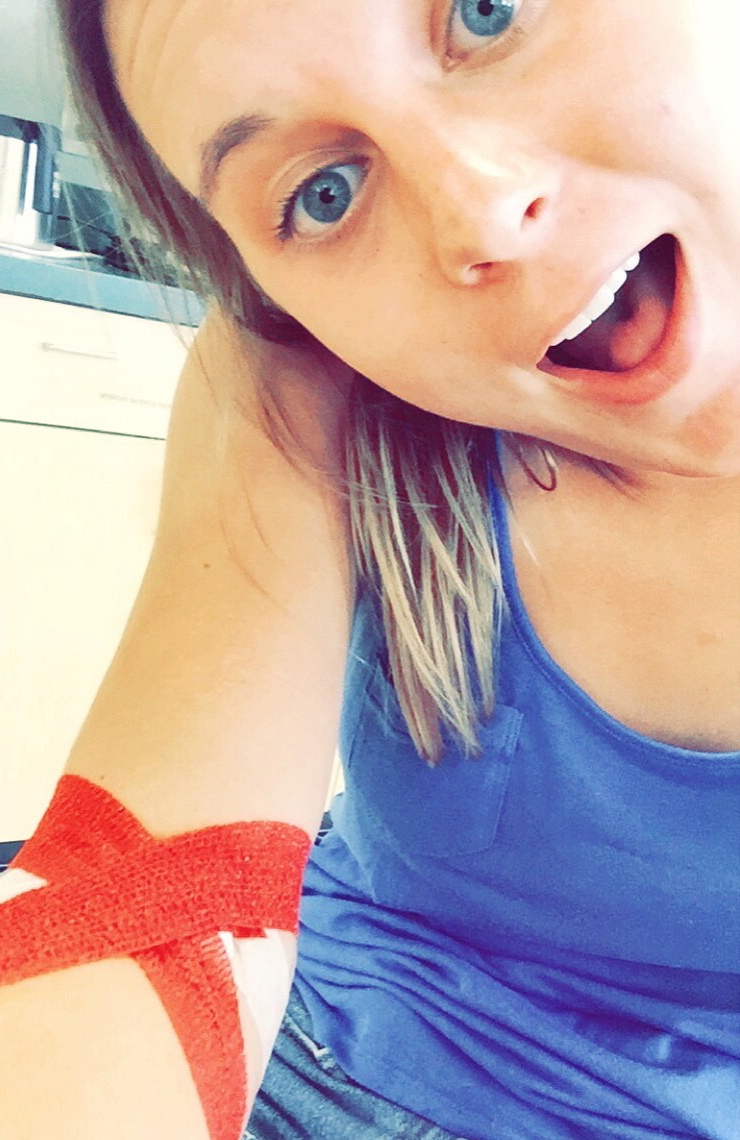
Spoiler alert: I survive the blood donation. This is a picture of me and my Red Cross bandage after I finished giving blood.
This is the story about my first time giving blood. I will not spare you the bloody details, because if I did, I would have nothing to write about.
Remember that five-year-old who went in to get her flu shot and needed five nurses (all wearing ear plugs to mute the screaming) to hold her down? Well, that was me. Over time, I have learned to brave getting shots but never fully outgrew the anxiety that comes at the sight of blood and needles. I studiously avoided offering my arm for 20 years, even though I’ve witnessed firsthand how important donating blood can be. I had to swallow hard to overcome that fear, and the good news is, it wasn’t nearly as bad as I thought it would be.
Monday, July 13, 2:15 p.m. rolled around much too quickly. A week after I had booked my appointment through the Blood Donor App, I found myself in the Red Cross blood donation center on the third floor at 1201 West River Parkway in Minneapolis. It was the ideal day to give blood. Outside was a blazing 89-degrees topped by an 83% humidity index, so even without giving blood, I felt sweaty and faint just from walking outside.
As I sat in the waiting room (which was comfortably air-conditioned), I sipped on my fifth Nalgene of the day. I realized that I had to use the restroom, again, and decided that I might have taken the recommendation to show up hydrated a little too seriously. My mom, who had agreed to give blood with me, was uncharacteristically late. (She later claimed that she took a wrong turn, but I know that she delayed her arrival because she was just as nervous as I was.)
The poster that trumped my fear of needles.
With time to spare, I scanned the waiting room until my eye caught a poster that asked, “Why do you give?” My mind initially jumped to ‘because my boss suggested it would be a good idea’, but then I realized I had many reasons to give blood—reasons that trumped my fear of needles.
Blood donations help millions of patients in need. In fact, in the past few years, blood donations have helped some of the most important people in my life. My dad, handy man that he is, cut his foot open with a chainsaw a few years ago and he needed blood. This past ski season one of my best friends crashed into a tree and she needed blood. Even more recently, my grandfather died of leukemia. And while he was alive, he received blood transfusions that made him feel much better.
Finally, my mom arrived and both of us were invited back. After a short health history exam and another trip to the bathroom, the nurses began prepping me. But one thing was missing, my partner in crime (a.k.a. mom). A few minutes later, she came in to deliver some tragic news. She would not be able to donate blood today because she had traveled to the Dominican Republic earlier this spring. (The Red Cross has a list of eligibility requirements that blood donors must clear before they can donate, one of those criteria include not having traveled to the Dominican Republic in the past year. For a list of the Red Cross blood donation eligibility criteria click here.)
The room where patients sit to complete their donation at the Red Cross blood donation center in Minneapolis.
So I embarked on my blood donation solo. The nurse laid me down on my back in the middle of an open room that offered a great view of downtown Minneapolis. She explained that first-time donors must lie down as a safety precaution. I glanced around the room and noticed that everyone else was sitting up. Perfect, I was instantly labeled as the newbie.
I get chatty when I’m nervous, and the nurse happily obliged, making small talk while she prepared my arm. At one point I asked how many donors they usually receive at this location. She guessed that an average of 15 people a day show up. There were at least 15, if not more, donors in the room at this moment. Word must have spread that I made an appointment and people came to witness the tears and screaming.
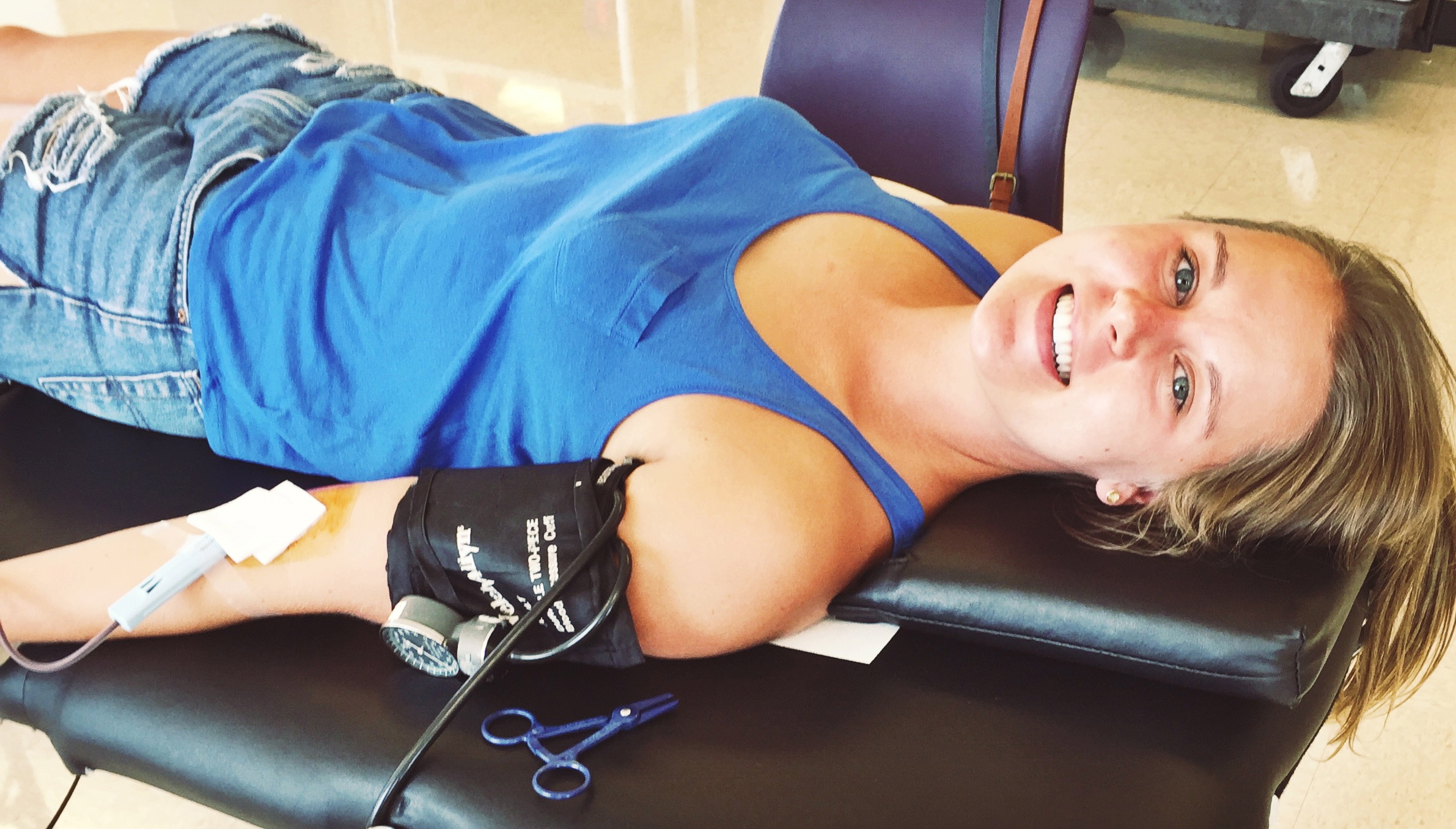
Me in the midst of my donation! All smiles, no pain.
Then came the moment I’d been dreading. The nurse told me not to look and slid the needle into my inner-left-elbow-crevasse (I don’t know how else to explain that spot on my arm). She did not stab or jab or pinch, she slid it into my arm. The needle entering was effortless, like it was meant to be there. OK that was an exaggeration, but it was manageable.
12 minutes and 43 seconds later I was done, and to my surprise feeling good! I looked at the pint of blood that had just come out of my body. The nurse saw me eyeing the bag and told me that my donation could help save up to three lives. Three lives? I asked if I had heard her correctly. She nodded and I sat, recovering from what probably counts as the most heroic, if somewhat anti-climactic, 15 minutes of my life.
The snack bowl was wayyyyyyy less full after I left the blood donation center.
After the nurses were convinced that I still knew my name and could stand on my own, they told me to slowly make my way to the snack table. I had been obedient for the last hour, but I admit, this time I broke the rules and hurried over to the food. First I enjoyed an M&M cookie, then I grabbed granola bar. Resisting a third snack might have been the most painful thing I did all day.
As I sat indulging myself, I scanned the donation room. There were business people on their way home from work, seniors reading newspapers, even a few students like me. Everyone was sitting up, which meant that they were all experienced donors coming back to save more lives. I knew that I too would be back, next time sitting up like the veterans surrounding me, to participate in one small deed that can make a world of difference.
So trust me: If I can give blood, so can you. And you’ll get a cookie.
Help prevent a seasonal blood supply shortage: A seasonal blood donation decline is common during the summer. Currently, the Red Cross has an urgent need for type AB blood to help replenish the plasma supply. Blood donors with types O negative, B negative and A negative and platelet donors are also especially needed to maintain sufficient supplies. For information about blood donation, or to schedule an appointment, download the Blood Donor App, visit redcrossblood.org or call 1-800-RED CROSS (1-800-733-2767).
On July 25, the American Red Cross Minnesota Region will host the 2015 Run for Blood. This family-friendly walk and run event celebrates the people who give lifesaving blood and supports Red Cross blood services. This inspiring story helps tell why we’re doing this event and why you should participate, too. Go Kate Go!
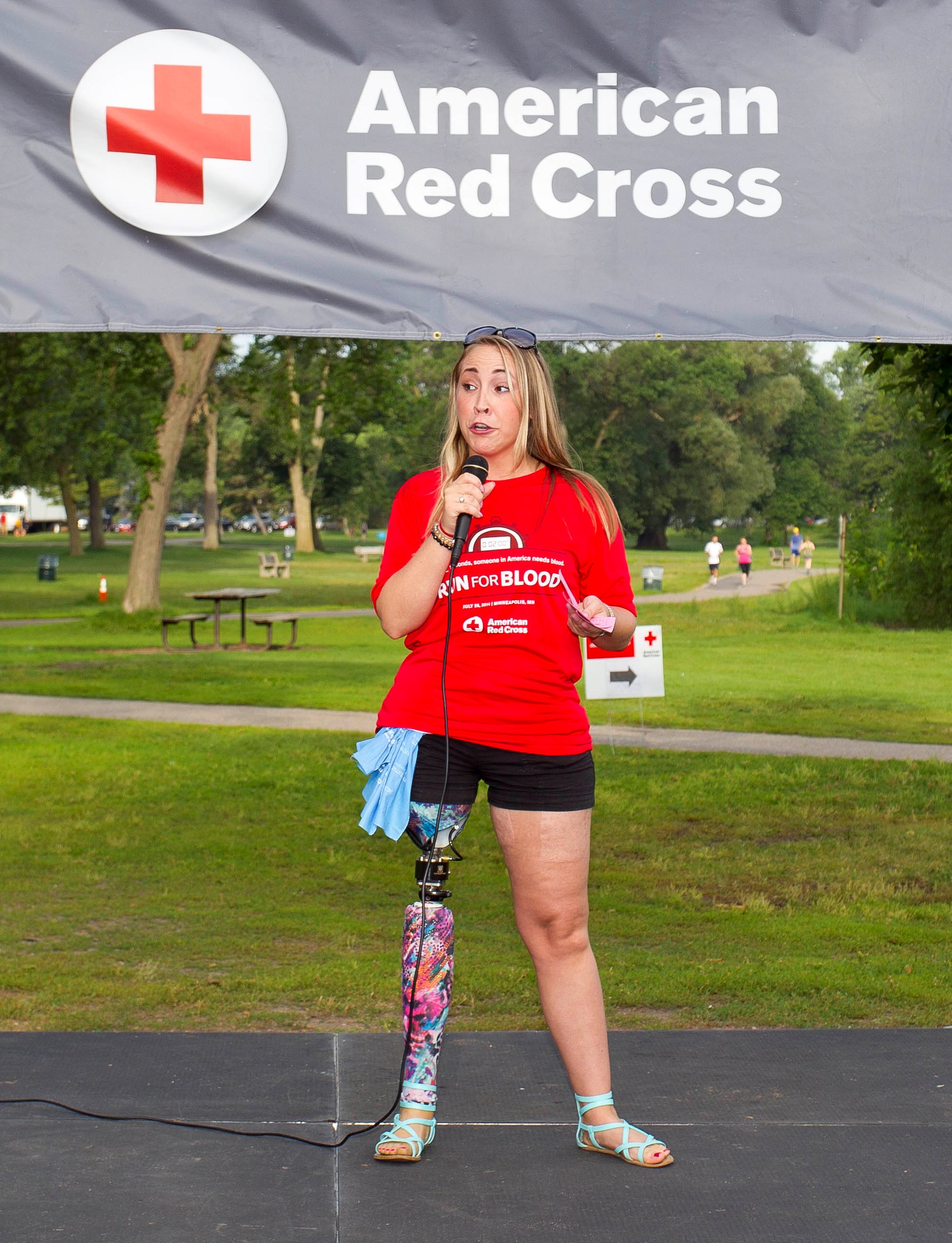
Kate Ross became a donor advocate following a life changing accident that required multiple surgeries and blood donations to save her life. Photo credit: Andy King
When you first meet Kate Ross you are instantly moved by her infectious smile and constant laughter. Her friends describe her as fun, inspiring, outgoing, incredible, full of energy, strong and a positive presence. She describes herself on her blog biography as a “student, animal lover, daughter and sister, spiritual, music-obsessed fitness enthusiast, artistic, friendly, optimistic and a volunteer.”
You would never sense from her upbeat demeanor or the words used to describe her that nearly five years ago her life changed in an instant, and she now proudly wears a fashionable crystal-studded, paisley prosthetic leg. Nowhere in the description of Kate could you tell that she was faced with a tragedy that could have easily left her feeling sorry for herself.
In fact, her story is quite the opposite.
“In December 2009, I was weary from the exhaustion of being a full-time student and working full time. I took my finals at school and on my way home that evening I fell asleep while driving,” said Ross. When she dozed off, she was traveling 60 mph and hit a guardrail, which penetrated her car and went through her right calf and thigh.
“I knew that something was drastically wrong with my leg, although I’m lucky that I didn’t realize there was a guardrail basically through my entire body at that point.”
Red Cross advocate Kate Ross participated in the 2014 Run for Blood in Minneapolis. She’s training for the 2015 event and is planning to use a new prosthetic leg made especially for running. Photo credit: Andy King
Ross was taken by ambulance to the hospital, and after several surgeries, doctors put her in a medically induced coma. Seven days later, on Christmas Day, doctors made the grave decision to amputate her leg above the knee.
Ross underwent more nearly two years of occupational and physical therapy before her life returned to a “new normal.” Through 19 surgeries, she needed more than 25 pints of lifesaving blood products.
“I was very thankful for the blood being available when I needed it, but I never thought about being a blood donor myself because I’m terrified of needles.” But when her best friend and co-worker asked her to participate in a blood drive, she realized that, despite her fear, she should give blood, too.
“She reminded me it was donated blood that helped save my life after my accident. It was like a big, needed slap in the face that reminded me that I wouldn’t be here to tell my story if it hadn’t been for the generosity of blood donors.”
With a new found gratitude and outlook on life, Ross became a blood donor last year and strives to “be the good you wish to see in the world.” Once a blood recipient, now she is paying it forward.
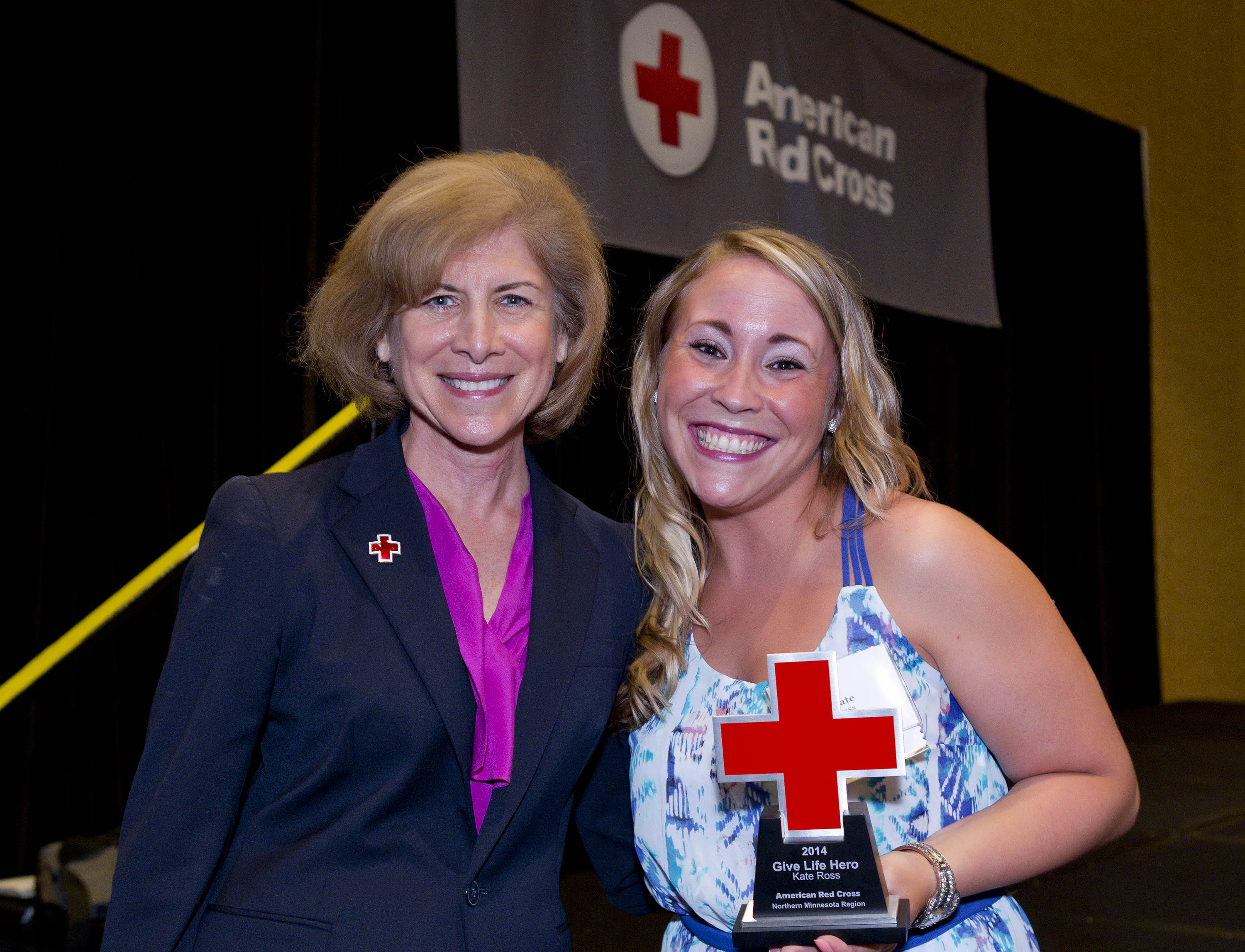
Kate Ross (l), a Red Cross Hero, is shown here with American Red Cross President and CEO Gail McGovern during the 2014 Heroes Breakfast in Minneapolis. Photo credit: Andy King
“I am very excited to say that I have become a blood donor myself because I know how important it is to give something that means something – the gift of life. You never know when you or a loved one will be the one that needs blood.”
Ross is thankful for the heroes who helped save her life and has become an advocate for the Red Cross and a true hero herself. In 2014, she received an American Red Cross Minnesota Region Heroes Award that honors those who have made the simple, yet powerful decision to put their personal needs aside in order to help others.
Ross underwent another surgery last fall on her leg. She was fit for a new prosthetic that improves her mobility and allows her to run. She’s currently training for the 2015 Run for Blood walk and run event at Lake Calhoun in Minneapolis on July 25.
Throughout March 2015, U. S. Bank is making it easy for its customers to support the important work of the American Red Cross. All month long, customers can make a financial donation to support Red Cross Disaster Relief at more than 5,000 designated U.S. Bank ATMs nationwide.
We are grateful to U.S. Bank for its generous support and partnership that helps ensure that the Red Cross has reliable funding for disaster relief services. It’s support helps us immediately respond to disasters in Minnesota and across the country. The sooner our volunteers get to an emergency site, open shelters, serve hot meals and provide comfort to victims of disaster, the more quickly people and communities can begin to recover.
Our partnership with U.S. Bank extends our reach so that we can help more people before emergencies happen. Richard Davis, Chief Executive Officer of U.S. Bank and a member of the American Red Cross Board of Governors, makes preparedness a priority within U.S. Bank. His effort helps employees to be prepared at work and at home for anything, anytime. By working together, we deliver preparedness information and First Aid, CPR and AED training.
Also, U.S. Bank employees roll up their sleeves and help save lives at Red Cross blood drives. In 2014, U.S. Bank hosted 86 blood drives across the country. In Minnesota, the Red Cross collected an impressive 1,006 units of blood at 26 drives hosted by U.S. Bank and its employees.
Through our combined efforts, U.S. Bank and the Red Cross are strengthening the ability of the communities we serve to prevent, prepare for and respond to emergencies and help rebuild lives after a disaster strikes.
Gray Ladies members include (back row, left to right) Rhonda Steinberg, Sue Jelen, Marlene Strehlow, Marlien Lohrman, Luella Peterson, Judy Schjei, Judy Steidl, Janet McHugh and Pat Pederson; (front row) Candy Bohjanen-Hammitt, Sylvia Klimek, Irene Wheeler, Hazel Holt, Myrtle McKay and Irene Bundy. Not pictured are Pat Katzmsarek, Linda Kuhlman, Kathleen Linn, Julie Roering, Fran Schultz, Ruth Steidl and Renee Stomberg. (Amy Chaffins/Echo Press)
The American Red Cross Gray Ladies of Alexandria, Minn., celebrated its 60th anniversary on October 30, 2014. The group primarily helps out during Red Cross bloodmobile events.
A special meeting brought the women together at the Traveler’s Inn in Alexandria to celebrate and share stories. There are currently 22 active local members.
In 2013, the Alexandria Gray Ladies volunteered about 1,951 hours at more than 50 bloodmobile events in Douglas County, according to member Candy Bohjanen-Hammitt.
Since its start in 1954, 170 Gray Ladies have served as members.
About the Gray Ladies
The Gray Ladies, formerly known as Hostess and Hospital Service and Recreation Corps, was founded in 1918 at Walter Reed Army Hospital and became a unique and enduring symbol of the Red Cross service in military and later civilian hospitals.
Their gray uniforms worn by the female volunteers at the hospitals prompted wounded soldiers in their care to affectionately call them Gray Ladies.
In 1947, the name was officially changed to the Gray Lady service.
The Gray Ladies do not provide medical care, rather recreational services to patients and assistance where needed at military and civilian hospitals, blood centers and disaster response.
Early on in the Alexandria chapter, the Gray Ladies would visit nursing home patients, write letters and sometimes transport patients to appointments.
Nationwide, during World War II, the service reached its peak with almost 50,000 women serving as Gray Ladies in military and other hospitals across the U.S.
The Gray Ladies continued serving in hospitals until the mid-1960s when the Red Cross shifted to a unified concept of volunteers.
This story is published on our blog with permission. It was originally published in the Echo Press on November 5, 2014.
If you’re interested in volunteering for the American Red Cross, click here.
 Update: On January 25 the American Red Cross issued an emergency appeal for blood and platelet donations following recent severe weather that has forced the cancellation of more than 300 blood drives across 20 states. The result is more than 9,500 donations uncollected, further depleting an already low winter supply. Blood donation appointments can be quickly and easily scheduled by using the Red Cross Blood Donor App, visiting redcrossblood.org or calling 1-800-RED CROSS (1-800-733-2767).
 Meanwhile, blood products are being distributed to hospitals as quickly as they are coming in for patients like 2-year-old Charlie who has leukemia. Click here to meet Charlie and her mom.
 On average, the Red Cross must collect 14,000 blood and platelet donations every day for patients at about 2,600 hospitals and transfusion centers across the country. Blood and platelets are often needed to respond to emergencies large and small, including the personal ones that occur in communities across the country every day involving accident and burn victims, heart surgery and organ transplant patients, and those receiving treatment for leukemia, cancer or sickle cell disease.
 Eligible blood donors with types O, B negative and A negative blood are encouraged to donate double red cells where available. During a double red cell donation, two units of red blood cells are collected while most of the plasma and platelets are returned to the donor.






 American Red Cross Minnesota and Dakotas Region