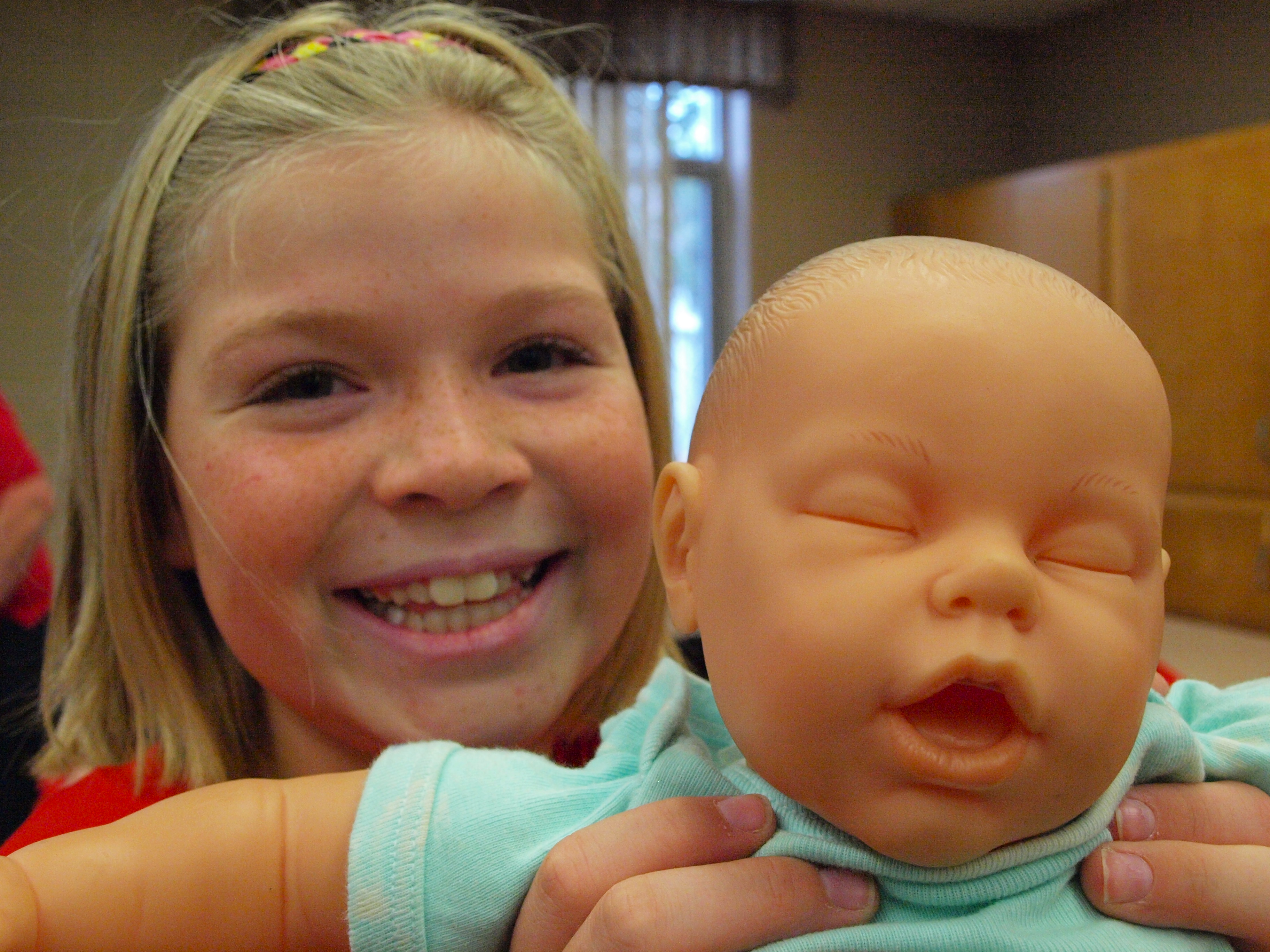
Brianna Kompelien holds up her Red Cross baby. Photo credit: Lynette Nyman/American Red Cross
Oops! Brianna’s baby’s head popped off! Not the head of a real baby. No! No! No ! It’s Brianna’s babysitter’s training doll’s head! Phew. That’s a relief, which is kind of the whole point of the Red Cross Babysitter’s Training Class: to teach young people how to care for children (including how to hold them) and to be outstanding babysitters.
Recently, around 10 kids from Willmar, a small town west of the Twin Cities metro, took a Red Cross babysitter’s training class that a generous donor helped fund (thank you!) making the class nearly free ($10). Liz Sheehy, the Red Cross instructor teaching the class, says that the grant funding is terrific because “it gives kids who normally couldn’t afford the class to chance to take the class.”
Tammy Rudningen says the grant funded classes were a “screamin’ deal” for Willmar kids. Photo credit: Lynette Nyman/American Red Cross
The Red Cross worked with Tammy Rudningen at Willmar Community Education & Recreation to arrange the classes. Rudningen, who also teaches at Willmar Public Schools, says that more than “50 percent of her students qualify for reduced fee or free lunches. That’s reflective of the economy of our community.” And costing $85 normally, $10 she says, is “a screamin’ deal.”
As usual, the Red Cross is over the moon to have had a hand in making important emergency training available for young people, and especially future babysitters of Willmar. We hope you are, too. Click here to learn more about Red Cross health and safety classes in your area.
Story and photos by Lynette Nyman/American Red Cross
Two of our 2012 Heroes, Zachary Pierson (l) and Elizabeth Estepp, on the Target Field Jumbotron during a game day recognition event last spring. Photo credit: Gene Sung/American Red Cross.
We’re now accepting nominations for our Northern Minnesota Red Cross region’s 2013 Heroes Awards. Last year’s award recipients were outstanding people. They shared their amazing stories of saving lives, caring for their community and human kindness during our annual Heroes Breakfast held last year at Target Field in Minneapolis. In addition to the breakfast, the Heroes were invited onto the baseball field for special recognition from the Twins and their fans. This year’s breakfast–our 5th annual–will also be at Target Field. And again, we expect to hear life-changing and inspiring tales that will likely make us cry (we bring extra tissue just in case). Without a doubt there are people among you who helped others, saved lives and elevated what it means to be human. We ask that you help us find them by nominating them for the 2013 Heroes Awards. Click here to learn more and to nominate your hero today.
During the holiday season there is much to be thankful for as we gather with loved ones, participate in traditions and winter festivities, and search for the perfect gifts to give to family and friends. However, there are some gifts that are less tangible than others. Tacy Fleener from Alexandria, Minnesota, describes her recent deployment to the Red Cross disaster relief response to Superstorm Sandy in New York City, and the special “gift of a lifetime” she received.
Red Cross disaster relief volunteer worker Tacy Fleener. (File photo: American Red Cross)
Tacy has been with the Red Cross for 30 years as the first national responder out of Douglas County. She started at 16 years old, teaching swimming lessons and CPR training. Later on, with the help of her husband, she got the local Red Cross chapter in Alexandria up and running with different classes and opportunities of involvement for local community members. Her heart is most passionate about disaster relief and being of use during times of great need.
During past deployments, Tacy specialized in mass care shelter management and hands-on experience. However, this deployment was a different involvement; one that was also very intense but rewarding. Tacy’s job was behind the scenes to guide volunteers through the deployment process. She would enter these volunteers into data bases and designate hotel rooms to keep track of individuals during their deployment.
Tacy expertly handled stress the minute she arrived on site, “Things were chaotic when I got there, my job was to try to keep the peace with the hotels we had under contract. I played detective to try to spend Red Cross’ money the right way, while making sure that volunteers were where they needed to be, with places to stay.”
“Just to see the need I had been hearing about with individual faces and stories kept me motivated throughout my deployment. It was easy to see that the distribution process was very difficult. People on the distribution team were bringing supplies to outskirt areas, such as Stanton Island where 12,000 people are still without power.” She remembers that distribution volunteers are overwhelmed with the need. One story that impacted her life was one gentleman leading a distribution team. She recalls, “He had just got back from Staten Island where he had been sleeping on pallets for two weeks. He looked like death warmed over and I thought to myself, oh wow, we need to find a hotel for this guy so he can rest and get cleaned up.”
A “thank you” from Josh Holper and his friends to the Red Cross. (Photo credit: Sue Gonsior/American Red Cross)
Though rooms were in a shortage in Stanton Island during this time, various New York hotels were gracious and gave American Red Cross a block of discounted rooms. This is an example of a reoccurring theme of camaraderie and teamwork throughout the east coast disaster relief. Even with support and understanding, every day was mentally and emotionally stressful. “We spent 12-14 hours a day keeping track of hotels to try to save the Red Cross as much money as possible,” says Tacy. “Every volunteer constantly gave it their all and was very supportive. Thanksgiving was especially a wonderful time to be volunteering; we had the opportunity to make sure that people had a Thanksgiving dinner. Citizens were very appreciative and it was neat to spend Thanksgiving by giving back to this community. To hear someone say ‘thank you’ was wonderfully rewarding.”
Volunteering during this disaster is a constant 24/7 job, without many breaks, yet Tacy says she would do it again in a heartbeat. “I love the Red Cross, the volunteers, the people I meet. Everyone that is there wants to make a difference. Even when you had been working 12-14 hours a day, you just go and give a big hug to each other and say thank you.”
Helping others & making friends: Red Cross volunteers (l-r) Lizzie Kampf, Ed Newman and Sue Buelow in New York City for Superstorm Sandy.
Thank you’s and appreciation can go a long way. The American Red Cross Northern Minnesota would like to extend its gratitude to Tacy and more than 100 relief workers who have donated, volunteered or been involved with the Red Cross mission to reduce human suffering during the Sandy disaster response on the east coast.
Tacy hopes her experience encourages others to volunteer. “Just to meet one person who says thank you brightens my whole day. It really helps me when I come back home to Minnesota; to appreciate what I have; to appreciate helping others in a time of need. It fills my heart to be able to give back by doing something truly important. I know my whole heart is into it when I’m there. I know the other volunteers feel the same way, young and old. I recommend that anyone become a Red Cross volunteer–it’s an experience of a lifetime. Make the time, take some classes and experience the opportunity to give back to others, because you never know when you will need it yourself. Some of the friends you meet will touch your heart for a lifetime.”
Click here to find out more about how you can help with Superstorm Sandy relief this holiday season and give the gift of a lifetime.
Red Cross responder Sue Buelow is back from New Jersey where she helped with Superstorm Sandy disaster relief efforts. Below, Sue looks back.
The very beginning was a lot of trying to figure out the response system and getting used to hurry up and wait. But soon after arriving I was assigned to supervising special field teams doing “seek and serve” emotional support and traveling to Moonachie, Newark, Jersey City, Toms River and nearby damaged communities.
Sue Buelow (l) and Lizzie Kampf (r) while responding to Superstorm Sandy disaster relief in New Jersey.
I learned a few things along the way: 1) speed limit signs are a suggestion, 2) many cities are not on a map, 3) there are few places that allow left turns, 4) be thankful for clean clothes; and 5) they love Minnesotan accents there!
The work was hard emotionally and physically. My first partner had to return home to California for health reasons. Then, for the next 12 days I had the pleasure of partnering with Lizzie Kampf, a new “just-in-time” disaster mental health responder who was also from the Twin Cities. It felt like we’d known each other a lifetime. I was sad to see Lizzie leave before I finished my final week there. I didn’t know what I’d do without her driving the truck — she took on the persona of a New York cab driver quite naturally.
Lizzie and I went to New Jersey’s upper Barrier Island as the residents returned to see their homes, or absence of, for the first time. The devastation to the townships there was beyond words. The water and sand was 4-5 feet deep and the waves were up to 12 feet high. The stories of the emergency medical services (EMS) workers and residents who rode out the storm there were frightening. We bonded with these communities and it was not unusual to hear “Hey, Minnesota….” My last contact with one of the EMS workers that had been struggling was “Minnesota, I got your back.”
Being there when the residents saw their condemned or empty lot of debris was indescribable as they collapsed into my arms, sobbing and needing a “Minnesota hug.” We helped look for mementos in the debris, from small things to stones of a child’s hand and foot prints. We were there for those in shock who couldn’t think to pack up some clothes. Listening to them tell their stories and showing us their homes or pictures was moving.
I certainly have received a great gift from the same people: I believe I have helped them. I am blessed to have had a small part of their lives and in their recovery from this disaster. I will always remember my time spent there.
Sue returned home a few days ago. She is among more than 100 Red Cross disaster relief workers (mostly volunteers) from Minnesota who have responded to Sandy.
During swim practice in River Falls, Wisconsin, Becca Thomas, a 15-year-old trained lifeguard, noticed that there was something wrong with her teammate, Marissa Metzler, a 12-year-old in the lane next to her.
Becca Thomas (l) and her mom Shelley Thomas (r) outside of their home in Rollins, Wisconsin.
“There was a split second where my brain was saying ‘what’s going on, why isn’t she swimming?'” says Becca. What she didn’t know at the time was Marissa’s heart had gone into sudden cardiac arrest. After briefly thrashing around, Marissa’s body went limp and lifeless.
Becca responded in seconds. She swam over and, keeping Marissa’s head out of the water, brought her to edge of the pool where their coach helped pull Marissa out of the pool and onto the pool deck. There, Becca and a couple of her teammates tipped Marissa’s head upward to clear the airway. When they couldn’t find a pulse, 911 was immediately called.
Becca’s teammates, who are also CPR certified, sprang into action and together they began the life-saving skills necessary to keep Marissa alive. They started chest compressions and mouth-to-mouth breathing before grabbing an AED, (automated external defibrillator). The AED was administered to Marissa’s chest and delivered an electric shock to her heart twice to try and re-establish a heartbeat. Becca took over handling chest compressions at that time and Marissa began to come to. Shortly after, the River Falls ambulance paramedics arrived and took over.
“In the moment I didn’t think about what was happening, I just did what I needed to do,” says Becca, “But then afterward, all I could think is ‘oh my goodness’ as it all sunk in.” She left the pool that night feeling tired both emotionally and physically. The following Sunday at church she was greeted with an overwhelming support of friends who congratulated her and were encouraged by what had happened. All the glory goes to God, says Becca, for her being in the right place at the right time.
Becca’s mom, Shelley Thomas, tears up when talking about her daughter’s heroic actions. “I’m so thankful that I had her do the Red Cross training.” Shelley takes CPR training every year and believes in passing this practice to future generations, just as her mom encouraged her. She hopes to inspire others with this story of her daughter’s bravery and wants them to know that, “CPR is good training to have, please take it.”
Becca was the youngest person, by many years she says, during her Red Cross lifeguard and CPR courses that previous summer. On her first day of class, when they went around the room doing introductions, many people stated that they were taking the training for their job or other reasons. “I was the only one who didn’t really have a reason to be there, other than the fact that my mom wanted me to take it. The training really isn’t that much busy work and you’re in the water almost every day practicing life-saving skills.” And because Becca was equipped with the skills necessary to save Marissa’s life, Marissa and Becca were able to visit each other recently and celebrate Marissa’s thirteenth birthday.
Many people agree that a CPR class can make the difference between life and death, including Denise Metzler, Marissa’s mom. When the Red Cross contacted Denise and told her that Becca has the potential to receive a American Red Cross Certificate of Merit Award, she cried and said “I just hope more people get CPR trained.”
Click here to find your local CPR training location today.
(Story and photo by Megan Barnes/American Red Cross)
Red Cross volunteer Claudia Kelly, on the ground responding to Superstorm Sandy, sends us “Greetings from New York City”:
I’m halfway through my third week on this operation. I started in Mass Care Sheltering, and was sent to manage a shelter in Glen Cove, Nassau County, Long Island during and immediately after the storm. I had the chance to work with some fabulous people there. Our shelter population stayed small, ranging from 3 to 18 residents, but many community members stopped by during the day to charge their phones and to escape their powerless and increasingly cold homes. A group of Seniors joined us to eat one afternoon (this was a few days into my super effective all-cold-sandwich diet), and they had so much fun that several of them registered as shelter guests and proceeded to stay up all night laughing, chatting, and watching DVDs.
It’s a small Red Cross world: Claudia Kelly (right) bumped into Choua Yang (left), another disaster responder from Minnesota, while working at the Red Cross headquarters in New York City. (Seeing friends during disaster response is nice.)
Later, some shelter consolidation took place and I joined the staff of an 800-resident mega shelter at the Nassau County Community College just before Election Day. The state Board of Elections brought in absentee ballots for the residents, and Best Buy provided TVs, computers and WiFi hotspots so they could follow the election results. (Over at the staff shelter, we were all just exhausted and went right to sleep.) The mega shelter had many other amenities as well: a free laundry service, a medical clinic, a cell phone charging and loan station, and a supervised children’s play area. Nevertheless, a population that large is chaotic. Several residents were transferred to hospitals, including one in full labor who gave birth to a baby boy (+1 to shelter count since Mom was still registered!).
After two weeks in Sheltering I transferred to Client Casework, which is based out of Operation Headquarters at the New York City Red Cross office building. I’ve been on Staten Island for the past few days representing the Red Cross at a FEMA Disaster Recovery Center near the shore. There was a tremendous amount of damage there, and our presence seems meaningful as a validation of the incredible loss the community has suffered. I am being sent to a different area tomorrow, as I am among the fearless and possibly foolish few who are willing to take on New York City driving, and another team’s driver is having a day off. Traffic here is truly abysmal, as some of the tunnels remain closed, and many streets in Lower Manhattan are clogged with recovery trucks and trailers. But that’s only half the fun: New York City drivers are an aggressive lot. I’m working on my swerve technique in hopes that defensive driving becomes an Olympic sport in Rio in 2016.
Red Cross volunteer Kris Posey (right) helps get other volunteers, including Lori Olsson (left), quickly and safely out the door for disaster response.
Question: Who are those people working tirelessly to get Red Cross relief workers deployed to disaster locations, such as Superstorm Sandy? Answer: They’re Emergency Services Staffing volunteers!
In the case of our American Red Cross Northern Minnesota Region, we’re talking about volunteers Kris Posey, Susan Waananen & Cari McCollor. Although they’re often not working on the ground in affected disaster areas, they’re working hard to get those who are responding in the field out the door quickly and safely.
Emergency Services volunteers work behind the scenes 24/7 when disaster occurs. They’re in the Red Cross offices on weekends monitoring email, helping arrange training and processing volunteers. They’ve been doing this nearly every day since before Superstorm Sandy made landfall on the East Coast. Every day, they return calls and answer emails that come in from our 700+ volunteers across our Red Cross region.
Hey, Cari, we like that henna tattoo!
In addition, we’ve had staff services volunteers in the office these past few weeks learning all there is to know about national deployment. Thank you Steve, Marcia, Lois, Bonnie, Barb, Jan & John. We’re building great capacity throughout our region.
Thank you to Emergency Services staffing volunteers. You help make our mission happen. And we love you for it!
P.S. Emergency Services staffing volunteers also deploy to disasters. Cari (pictured) is now on the East Coast working as part of the Red Cross field response to Superstorm Sandy. Return home happy and safe!
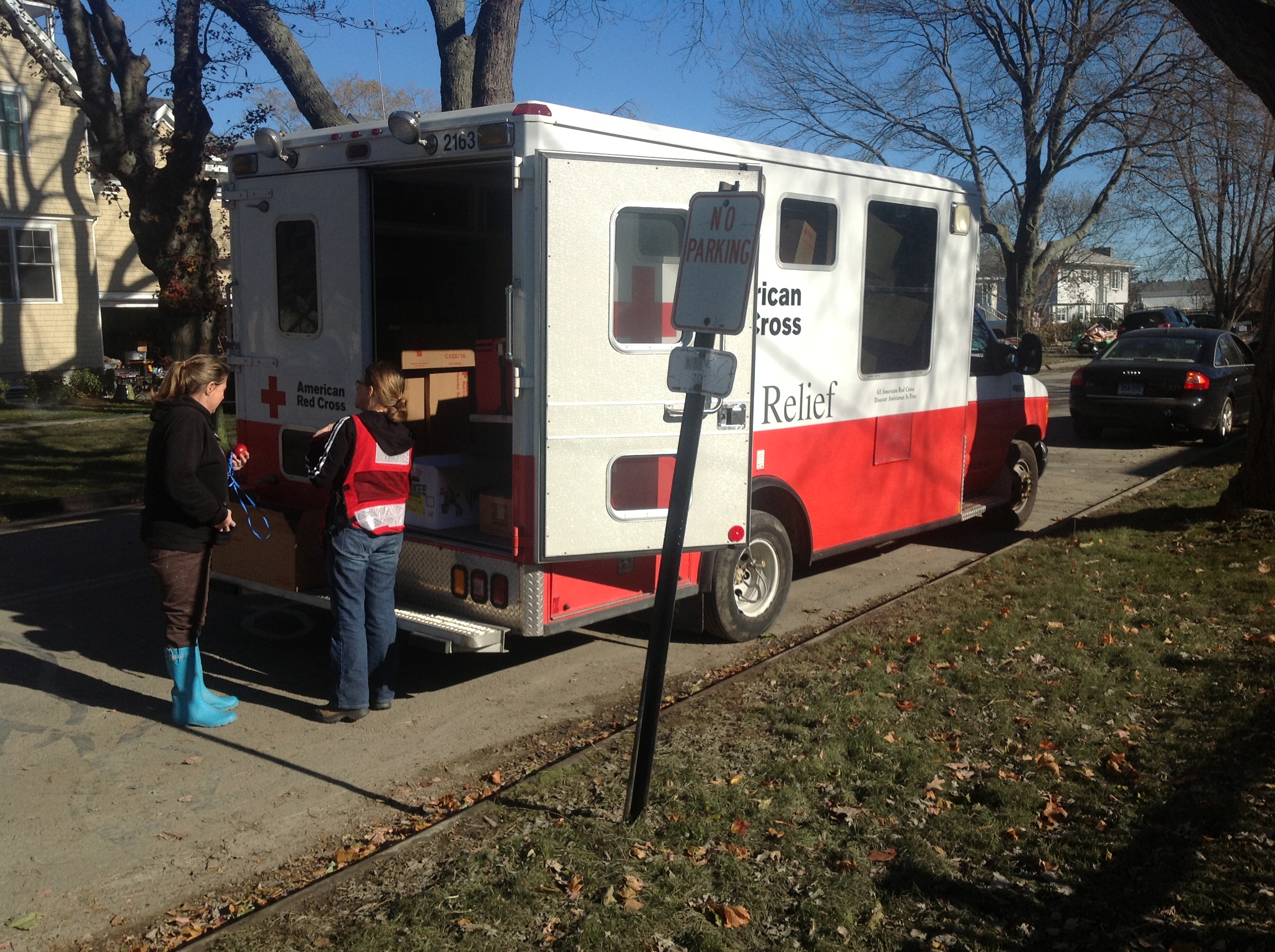
Red Cross volunteers Sheldon Bruce and Lori Olsson deployed to Superstorm Sandy days ago–how many? (Too many to remember.) They drove a Red Cross emergency response truck 1,200 miles from Minnesota to New York and since then they’ve been busy handing out hot meals and relief supplies to people in devastated areas. We’re grateful for the work that Sheldon and Lori are doing. Here, through Sheldon’s eyes, we share with you a bit of what they’re experiencing.
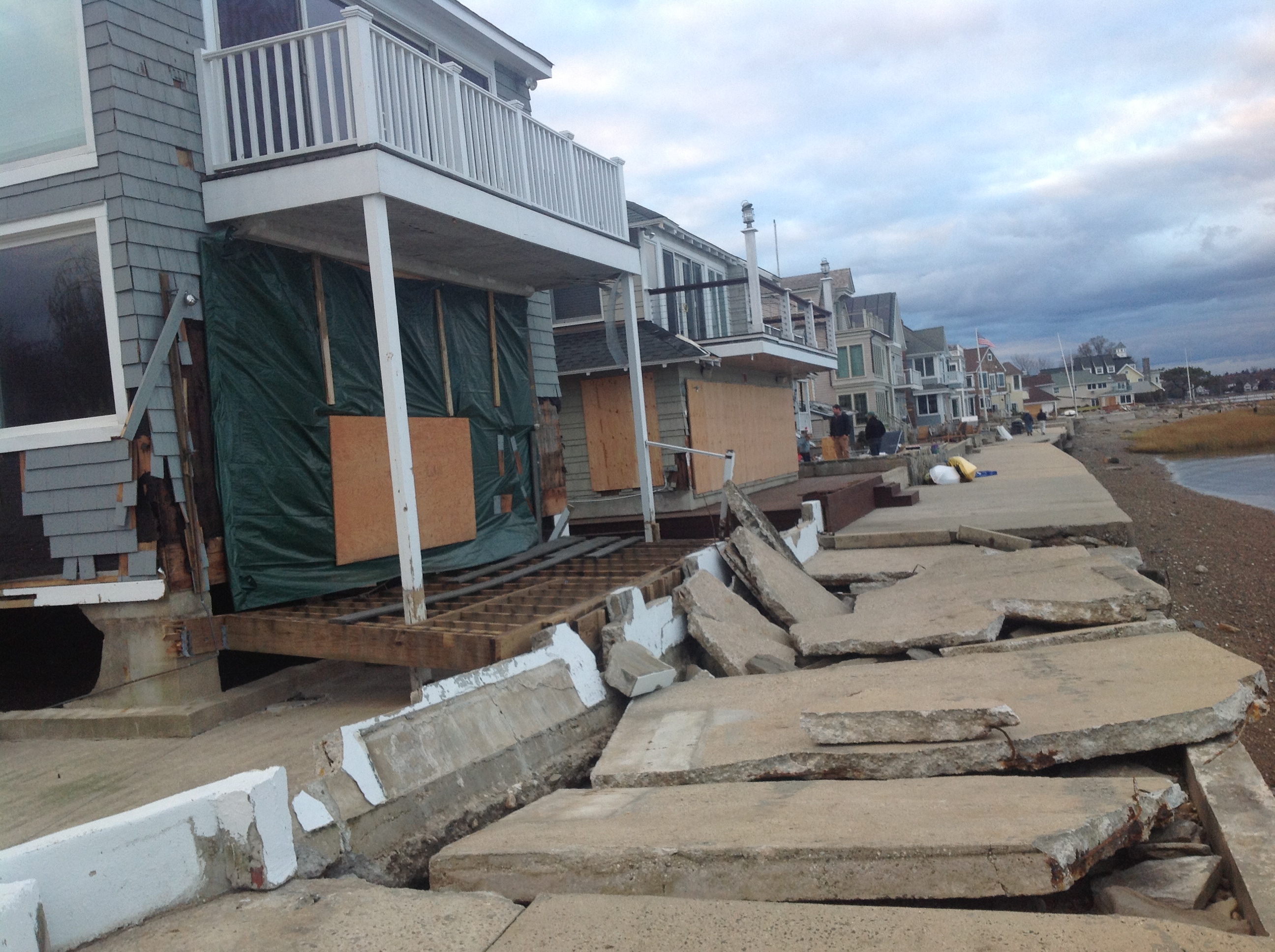
A street after flood waters receded.Families wait for meals and supplies from a Red Cross disaster relief truck.Red Cross disaster relief workers at their temporary home-sweet-home accommodations.Red Cross trucks waiting to refuel.Beach front damage.Clean out after the flood.Loading Papa John’s.Delivering clean up kits in affected neighborhoods.
Greetings from Greater New York, Superstorm Sandy Aftermath Followed by Nor’easter, November 7, 2012
Hello from Greater New York,
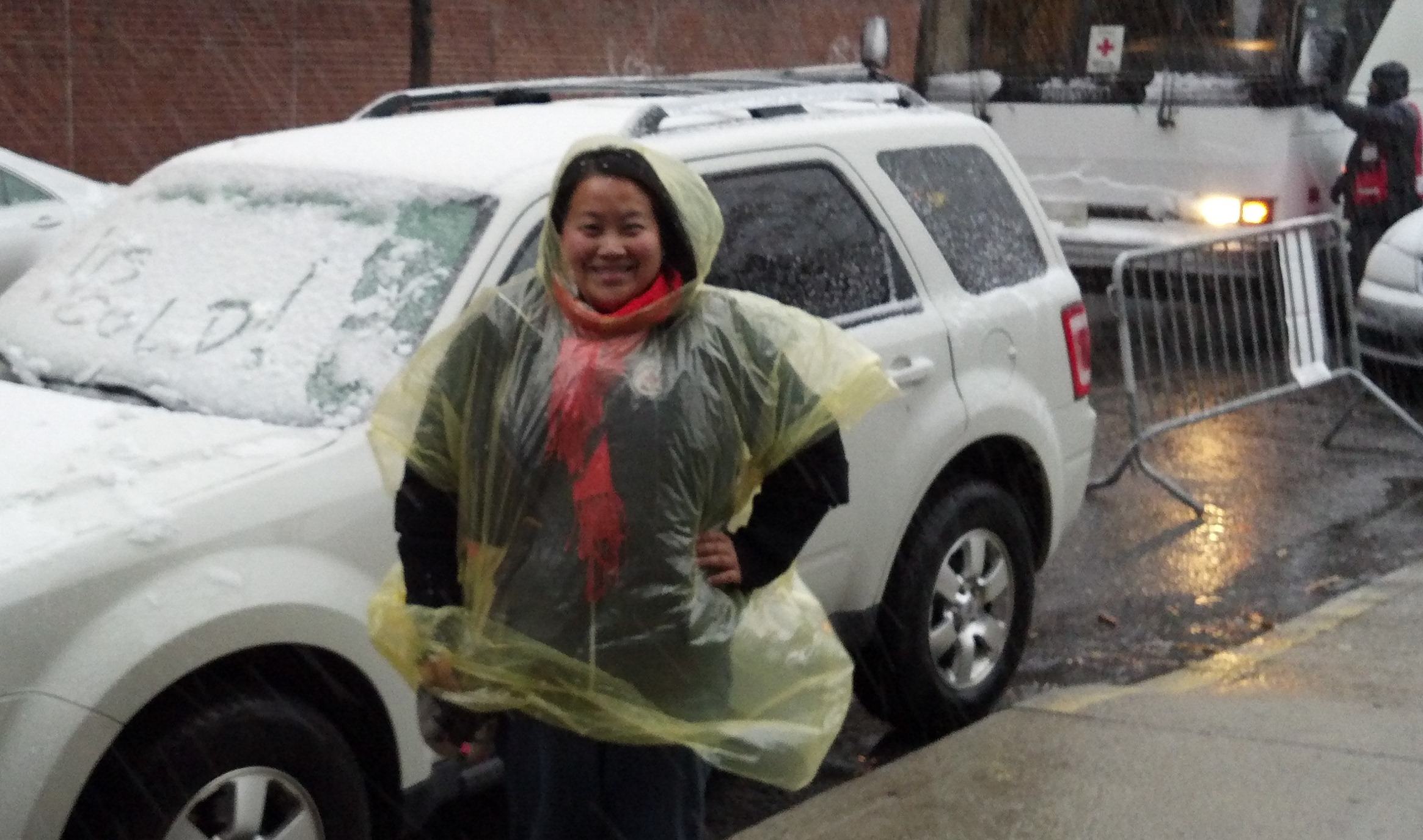
I’ve been going out doing Disaster Assessment (DA). There are so many homes affected and or destroyed by the storm. DA is on hold right now due to the snow mix with rain. Based on the data that we collected, upper managements are planning to deliver supply of goodies to those affected areas. Yesterday, I went to eat with my team and our server asked where we were from. One of the teammates told her that we are with Red Cross and the server just broke down and cried. She was very grateful and happy that we were there for her community. She thanked us for leaving our families and friends to come help out. It was such an amazing experience with this disaster response so far. I am so happy and proud to be Red Crosser!!!
Thanks,
Choua
Choua Yang is one of 5,700 or so Red Cross disaster relief workers responding to Superstorm Sandy. (Around 50 are from Minnesota.) 90 percent of Red Cross responders are volunteers. You can help support Red Cross humanitarian disaster relief.
Special Post From Red Cross Disaster Volunteer Dun Bui
Dun Bui (far right) and other Red Cross disaster responders at the shelter in Oceanport, New Jersey.
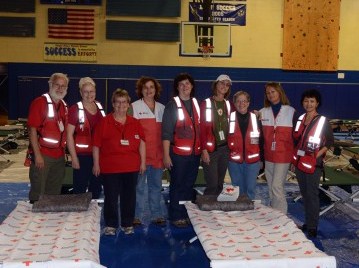
Red Cross volunteers from Kentucky, Ohio, New York, Minnesota and Wisconsin are working together at the shelter at Maple Place School in Oceanport, New Jersey.
Over 600 people have checked into the Red Cross shelter established at Maple Place School in Oceanport over the past 48 hours. Many have come in for a hot meal, chance to charge some electronic devices, file a claim with FEMA or just talk with a friendly volunteer.
A majority of the Red Cross volunteers are not even from this area or state. A husband and wife drove from Kentucky, one woman came in from Ohio, another from up-state New York while two others are from Minnesota and Wisconsin.
Volunteers are needed at the shelter to assist with serving breakfast, lunch and dinner. Also people are needed to help watch and supervise children and play games with senior citizens. The shelter is open 24 hours. And if you can spare an hour or so, stop over and make someone smile.
Thank you to Dun Bui and the other 5,400 Red Cross volunteers responding to the Superstorm Sandy disaster on the East Coast. Take care and return home safe and happy.








 American Red Cross Minnesota and Dakotas Region