
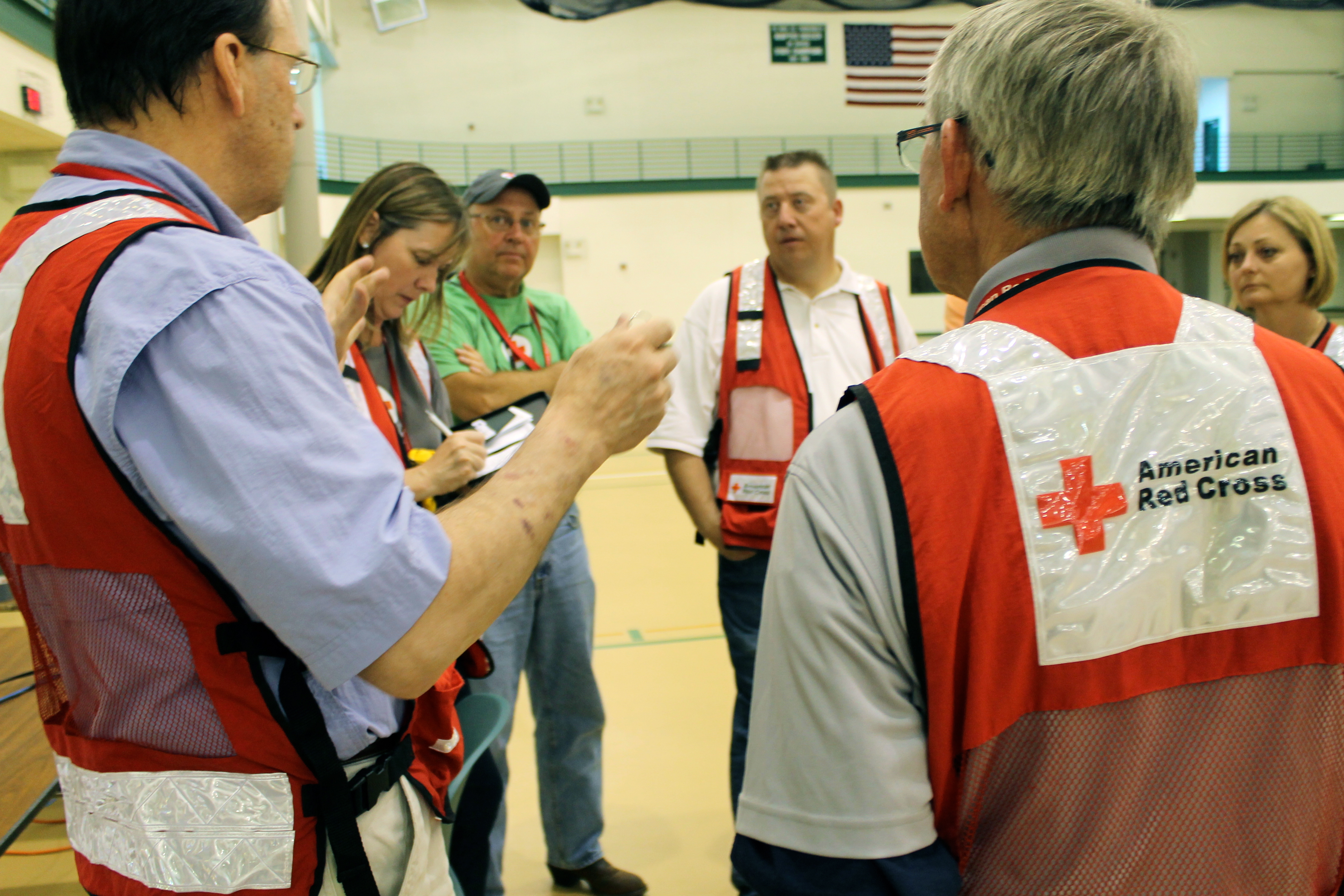
More than 150 volunteers got a firsthand look at how to help disaster survivors during a Radiological Emergency Preparedness (REP) drill on Wednesday, June 10, at Park High School in Cottage Grove, Minnesota. The American Red Cross, along with partner organizations, such as the Salvation Army, the Department of Homeland Security Emergency Management and Washington County, helped manage the annual training drill.
Park High School is one of two designated reception centers for evacuees who live within a 10 mile radius of the Prairie Island Nuclear Power Plant in Red Wing. If a nuclear disaster occurs, the center would provide food, shelter and medical services for displaced residents. The Red Cross would be in charge of providing shelter and emotional support, and reconnecting families through Safe and Well.
Wednesday’s drill allowed volunteers to practice running their designated stations without the pressure of a real disaster, a concept that Red Cross volunteer Mark Doble calls “controlled chaos.” “This is all about preparation,” said Doble. “Controlled chaos allows us to highlight and address potential problems that might not otherwise have been recognized.” And Doble was right, things got quite chaotic at times. From the distributing dosimeter radiation monitoring badges to all volunteers, to herding anxious individuals through multiple checkpoints and reuniting separated family members, there were a lot of moving parts.
“We need our volunteers to build muscle memory in their departments and be able to communicate using the same jargon for everything to run smoothly,” said drill incident commander Wes Halverson. “Tonight is so valuable because we are able to set that precedent.”
Jill Hallonquist, a Red Cross disaster program manager, said that the drill gives the relief workers an opportunity to coordinate with its partners. “It’s so rare that we get to talk through all the little steps that go into disaster planning,” she said.“Usually we have to jump into action without the chance to advise on all the minor details.”
Mastering those details now will make the operation run more smoothly when it counts. It quickly became evident, for instance, that the original plan made no provision for providing water for volunteers. Hallonquist was able to coordinate with the Salvation Army, which agreed to supply water for both Red Cross and Salvation Army volunteers in a real emergency.
Other issues that were addressed included how to transport people to the shelter and how to work around the school’s wifi block on Facebook access. The social network might be a distraction during the school day, but it’s a vital form of communication during emergency response. Red Cross mental health volunteers also took advantage of being on location to identify quiet nooks where they could connect with distressed evacuees during the response.
Red Cross volunteer Rick Campion said he appreciated the chance to prepare for his assignment. “When it’s a blue sky day, literally, we don’t always think about disaster,” he said, gesturing at the sky. “But it can happen at anytime and we have to be ready when it does.”
The next step is moving from REP drill to exercise on July 22. On this date, the Federal Emergency Management Agency (FEMA) will evaluate state, county, and local partner ability to operate a reception center and provide for displaced residents during a radiological emergency in Minnesota.
Story and photos by Vivian Engen, Communications Intern, American Red Cross Minnesota Region

 American Red Cross Minnesota and Dakotas Region