
When the Local Pub Becomes a Disaster Relief Hub

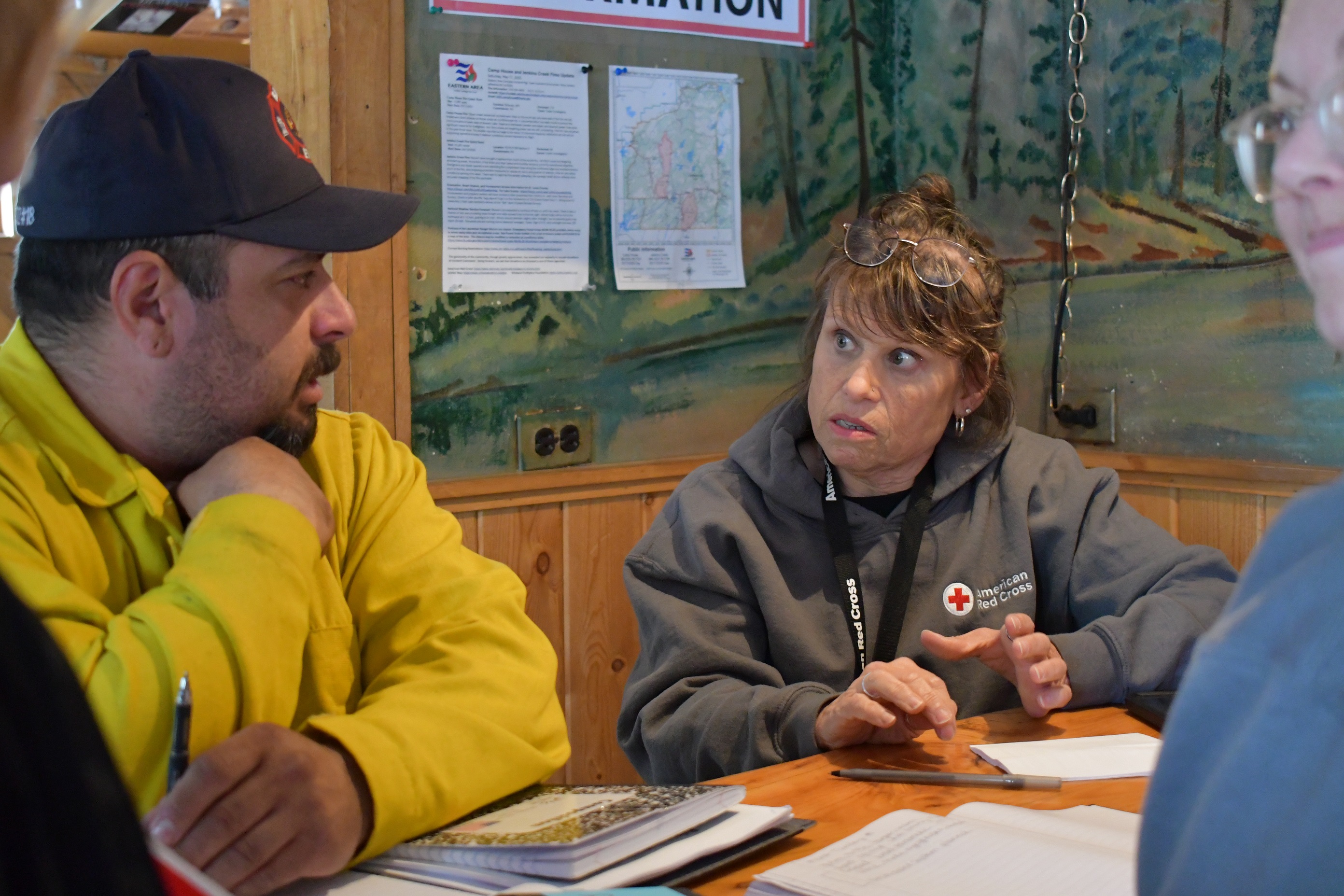
Brimson Volunteer Fire Chief Randy Freyholtz talks to Red Cross disaster relief volunteer Lisa Posch at Hugo’s Bar, May 16 2025. Photo: Nate Russell/American Red Cross

These days, the sustenance at Hugo’s Bar in Brimson, Minnesota isn’t your standard pub fare. The tables where folks normally take classes for building fishing rods are now piled with diapers, tarps, thick gloves, contractor bags, and totes.

A small group huddles around a table. They hug, share a laugh, they cry. They discuss things they’ve lost, and they speak hopefully of rebuilding once the Northland Wildfires abate.

“We lost a lot,” a homeowner shares with Debbie Ecklund, who’s helping  to manage the resource center, “the bar, the furniture, all handmade.”

“Stuff that you made?” She asks.

“No, the house was made in 1906. I wasn’t around to help.”

Debbie and the homeowner share a laugh at that.
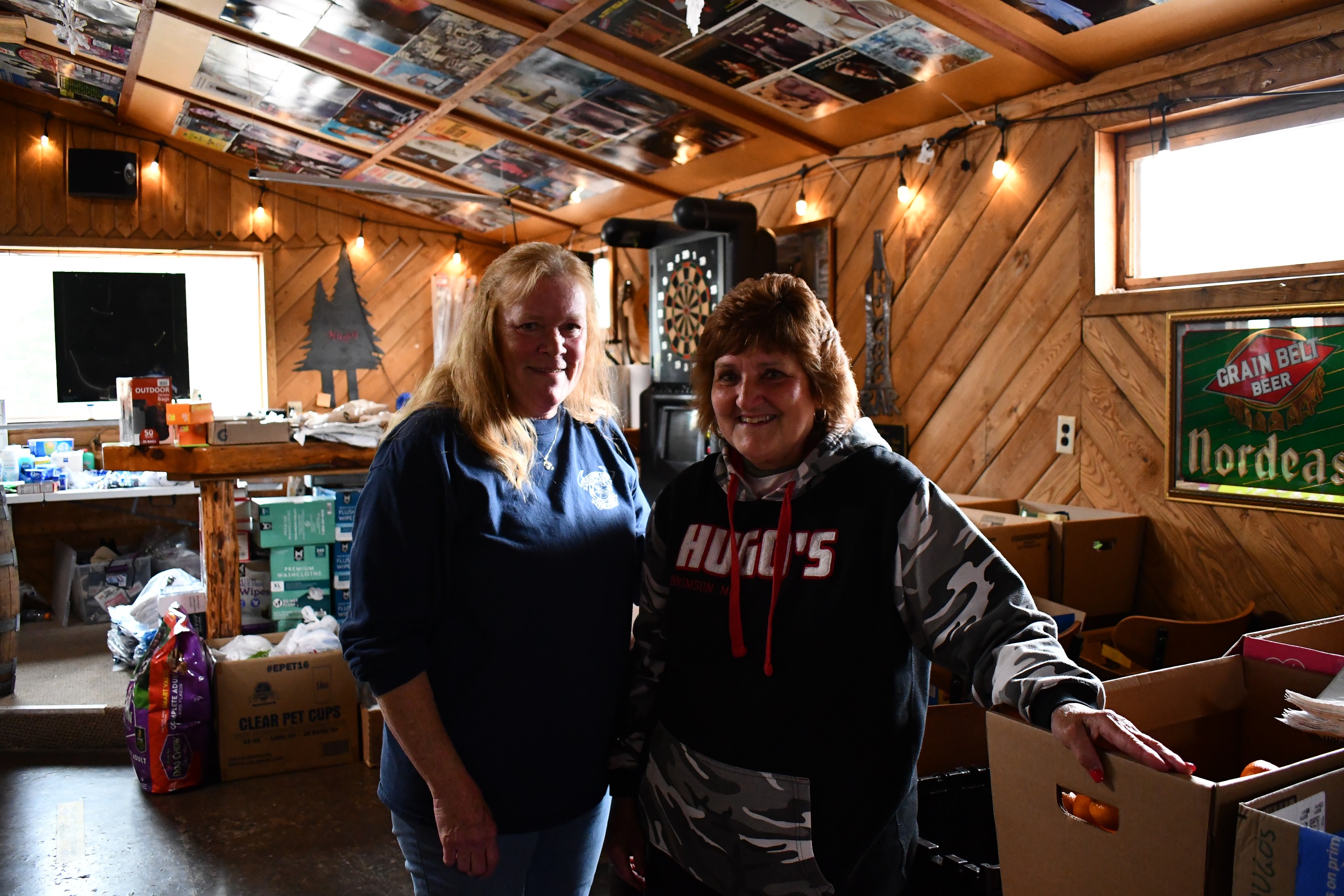
Penny Linn and Debbie Ecklund at Hugo’s Bar in Brimson, Minn., May 16, 2025. Photo: Nate Russell/American Red Cross

Since the onset of the Brimson wildfire the owners of Hugo’s Bar, Jesse and Jessica Willemarck, converted their establishment into a 24-hour resource hub, sleeping in four-hour shifts to maintain round-the-clock services for wildfire relief.

“I don’t know what we would have done without Hugo’s here doing this for us – without Jess and Jessica doing this,” says Fire Chief Randy Freyholtz. “This has been amazing. The support, the community outreach has been phenomenal.”

As the crowd grows, Chief Freyholtz can be seen checking in on families and making sure his neighbors have everything they need. After he’s made the rounds and talked to everyone, he sits down at a table with Red Cross volunteers.

“Some of us [firefighters] have been evacuated,” he explains, “but so far none of our structures have been affected, so we’ve been lucky in that aspect. Very lucky. For how fast this fire’s been moving, we’ve been very lucky that we haven’t lost anybody.”

Chief Freyholtz and his small group of volunteer firefighters have been fighting the fire since day one. And he’s been evacuated from his home, sleeping in his truck at the fire station when not committing his waking hours to combatting the flames threatening his community.

“And how are you doing?” a Red Cross volunteer asks Chief Freyholtz.

“I’m doing good. I’m tired,” he says, “I think it’s starting to catch up with me finally. Now that things are starting to slow down and I’m sitting down more.”

Red Cross volunteer Kyle Parkinson compares distance between Hugo’s Bar and the fireline, Brimson, Minn., May 16, 2025. Photo: Nate Russell/American Red Cross

Rain during the weekend brought some respite. And information reports at Hugo’s say they’re full on donated goods and focused on distributing them to the people affected while donating the rest to food pantries and other community organizations to ensure nothing goes to waste.

To help reach people, Red Cross volunteers will be at Hugo’s to assess individual disaster care needs, such as health, mental health, and spiritual care. They’ll also use the site as a hub for working directly to provide support for those who have lost their homes to the fires.

If you or someone you know has been displaced by the Northland Fires, call 1-800-RED-CROSS.

Story and photos by Nate Russell/American Red Cross Volunteer

Red Cross volunteer reflects on deployment to Hawaii wildfires

“The timing was right,” says DeAnn Grimmius who responded for three weeks to provide relief for people on Maui.

Devastating wildfires swept across Maui and the Island of Hawaii in early August, 2023. Photo: DeAnn Grimmius

More than 1,300 trained Red Cross disaster workers — from Maui, other Hawaiian Islands and all corners of the country — have responded to the wildfires.

Among them was DeAnn Grimmius, a volunteer from the Minnesota and Dakotas Red Cross region. DeAnn boarded a plane in late August for a three-week deployment.

“You know, it’s one that’s stuck in my mind,” says DeAnn. Her primary role was supervising a Red Cross shelter on west Maui, just outside of the Lahaina area.

The shelter was what we call non-congregate. In other words, people had separate rooms at what would normally be a tourist resort – that was before the devastating fires.

DeAnn’s primary post was at the lobby from where she guided people to Red Cross and other services. Many stopped by to pick up daily meals individually packaged for their families.

“I didn’t get to know everybody but because I was on the same assignment for three weeks straight, at the shelter working with people, I felt more connected,” she says.

This unique role, being in the same location for an extended period of time, allowed her to get to know what she describes as the heart of the people.

“I worked with them daily and lived in their area. I got to know some families, their histories, their stories, what happened to them in this whole event and how it was affecting their families.”

Among the first she got to know was a man outside a coffee shop where she stopped on her way to the shelter. She asked the man about the parrot on his shoulder. Later she learned that he needed a shelter for his wife and children, including a five-day old infant. His story, like many, was a desperate effort to save his family and others from the devastating blaze. Later, at the shelter, his family looked for her. Like many, they continued to build a connection with DeAnn.

“Sometimes people just needed to talk and tell me how their life was changing. They didn’t expect me to have magic answers, but I was the ear and sometimes I could offer additional guidance, where they could go for help.”

The guidance was, in some ways, returned in that DeAnn witnessed the deep, family relationships across generations, cultures and communities. While moms and dads went to work, grandmas and grandpas picked up meals and provided emotional support to kids who comprised more than sixty percent of the shelter population.

These experiences embedded in DeAnn’s mind her purpose responding to help people affected by disasters. This deployment was, she says, an affirmation of what the Red Cross can do.

“A feeling like, wow, this was so worth it, giving up anything at home to be here to respond to this disaster. The timing was right and I don’t regret a minute,” says DeAnn.

DeAnn Grimmius, Red Cross volunteer in Lahaina, Maui, Hawaii. Submitted photo.

Since returning home, DeAnn has told and retold her experiences with family and friends. Her aim is to raise awareness about the needs of the people she met and encourage generosity – doing whatever’s possible to help them.

The Red Cross and partners have provided more than 193,500 overnight shelter stays in emergency shelters since the fires began. With the help of partners, we’ve provided more than 625,000 meals and snacks to people affected the fires. Reached an estimated 16,000 people with disaster relief and recovery services. To learn more, click here.  

Story by Lynette Nyman with the American Red Cross Minnesota and Dakotas Region.

“I Know You”

On a sunny October afternoon, a young EMT pulled long-time Red Cross disaster volunteer Diane Dunder from the tangled wreckage of her SUV after another driver lost consciousness and struck her.  “I know you,” the young woman told Diane.  “You were my teacher in high school.”  Diane recalled how that young EMT made sure she was calmed and comforted.

Red Cross disaster relief volunteer Diane Dunder talks with Joan and John Belch.
Diane Dunder talks with Joan and John Belch about American Red Cross disaster relief services following the Germann Road Wildfire in western Wisconsin.

Two years later, Diane was at a Red Cross shelter when she ran into that young woman’s parents, who had lost their home during the Germann Road Wildfire near Solon Springs, Wisconsin, in May 2013.

“I know you,” Diane said.  Now it was her turn to provide comfort.

John Belch and his wife Joan lost almost everything in the wildfire that overnight destroyed over 8,700 acres of woodland and 77 structures, including John and Joan’s home, garage, and many of their belongings.

Joan wasn’t home when fire erupted in their yard. Earlier that afternoon John had watched fire trucks come in and out of their rural neighborhood without much concern.  Their home wasn’t in danger.  Then a sudden switch in the wind put the Belch home directly in the path of the blaze. Joan cried as she remembered learning from her son that her home was gone.

“The Red Cross was great,” John told Dunder and Red Cross worker, Nancy Rogers, who stopped in to check on them and deliver Red Cross comfort kits. “The help you gave us has really come in handy.”

The 3,000 pine trees that John Belch had planted since 1996 will never recover from the fire.  The sound of logging equipment harvesting the burned trees to be recycled into fence posts was a steady back-beat to the sound of brightly colored goldfinches that flitted through the blackened branches.  However, the Belch family is ready to start making plans, thanks in part to a twist of fate that brought them in contact with Diane Dunder and the American Red Cross.

The couple said that they’ve learned from the experience and are making sure they are prepared and have a plan in place in case disaster strikes again.

Free information about disaster preparedness is available at www.redcross.org.

Story and photo by Judy Hanne Gonzalez/American Red Cross