We’re thinking ahead, and we hope you will, too, because we have three things for you to do before the Fourth of July weekend arrives. So, let’s get started…
One: Download the Red Cross First Aid App
This free and helpful app for your smartphone gives you instant access to the most common first aid emergencies like cuts, burns, and eye injuries. The app is free. Download it now from the Apple App Store or Google Play. Or text GETFIRST to 90999.
Two: Brush Up On Fireworks Safety
Photo: Tony Webster, Portland, OR / Wikimedia Commons
The best way to enjoy fireworks is to attend a public fireworks show presented by professionals. Here are five safety steps for people setting fireworks off at home:
Never give fireworks to small children, and always follow the instructions on the packaging.
Keep a supply of water close by as a precaution.
Make sure the person lighting fireworks always wears eye protection.
Light only one firework at a time and never attempt to relight “a dud.”
Never throw or point a firework toward people, animals, vehicles, structures or flammable materials.
Three: Prepare for Grilling Safely
Every year people are injured while using charcoal or gas grills. Here are several steps to safely cook up treats for the backyard barbecue:
Always supervise a barbecue grill when in use.
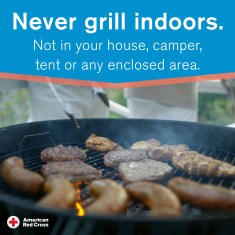
Never grill indoors – not in the house, camper, tent, or any enclosed area.
Make sure everyone, including the pets, stays away from the grill.
Keep the grill out in the open, away from the house, the deck, tree branches, or anything that could catch fire.
Use the long-handled tools especially made for cooking on the grill to keep the chef safe.
September 13, 2018. Strong winds and rain from the outer bands of Hurricane Florence begin impacting the Cape Fear River and Wilmington, NC. Photo by Daniel Cima for the American Red Cross.
During Hurricane Florence, John Decker was not at the shelter in North Carolina the night a woman died from an opioid overdose in September of 2018.
But he heard about the death almost as soon as it happened because for one month, at the onset of the response, Decker was in North Carolina serving as Disaster Health Services chief for the Red Cross relief effort. The young woman who died was her mother’s care-taker, he recalls.
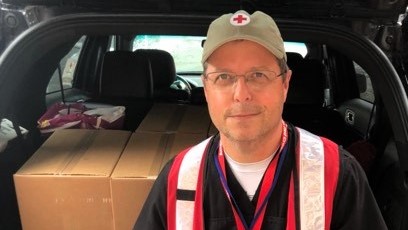
Decker is a Red Cross volunteer who responds to major disasters across the United States. When home in Minnesota, he’s a registered nurse. Now, after ten years with the Red Cross, he’s often at the front lines of providing disaster relief in shelters.
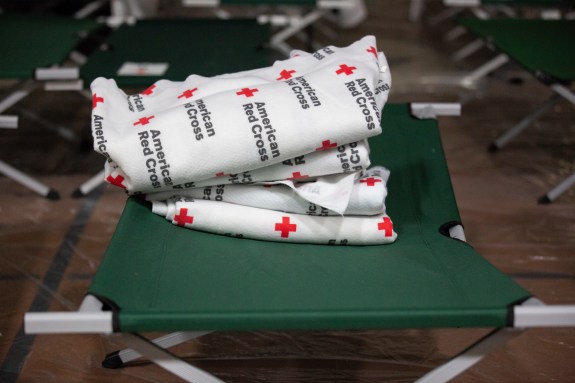
September 15, 2018. Red Cross shelter relief supplies at Farmville Middle School, NC. Photo by Adam Jennings for the American Red Cross.
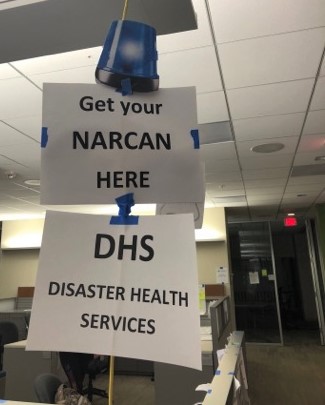
That night in North Carolina their first concern, Decker says, was to support the young woman’s mother. Their second was to prevent more deaths. Decker connected with national Red Cross disaster leadership that was supporting field activities. Together, they set two immediate priorities: find naloxone and train shelter workers.
The CDC reports that around 130 people die from opioid overdose every day in the United States. During 2017, 47,600 people died from overdoses involving opioids. Those deaths were 68% of drug-related overdoses.
John Decker
Decker found a local source for Narcan, one type of naloxone medicine that reverses overdose. There were only a couple boxes. Not enough, he figured. Plus, they were expensive. Then, his phone rang. On the line was a woman who worked with a relief partner. She had 2,500 – 3,000 doses. With help, Decker picked them up and got them distributed to more than 400 shelters.
The Red Cross and its partners supported more than 129,700 overnight stays for people displaced because of Hurricane Florence across North Carolina, South Carolina and Virginia. During Fiscal Year 2018, the Red Cross and its partners provided more than 1 million overnight shelter stays for people affected by disasters.
A sign at the Red Cross relief headquarters in North Carolina. Courtesy of John Decker.
Next up was teaching shelter workers the signs of opioid overdose and the steps to respond. Initially, some people resisted. They were comfortable delivering relief supplies, not giving someone a medicine requiring injection. The training transformed their feelings and their skills. At first it’s scary, and then we learn, and then it’s nothing, Decker says. “It’s good to get rid of the mystery. It’s no more complicated than a kid’s Legos.”
September 17, 2018. The Red Cross shelter at the University of North Carolina Friday Center in Chapel Hill. Photo by Daniel Cima for the American Red Cross.
Since then, the Red Cross released an online class that helps people respond to opioid overdose emergencies. I took the course and learned a lot. It removed my anxiety and strengthened my confidence about helping someone during an opioid overdose emergency. Check out and take the class here. For a quick understanding of opioid overdose, watch this new video.
Do you know that only 3 out of 100 Americans donate blood each year, but every two seconds someone in the U.S. needs blood? Here’s another surprise: blood donation can be super easy. Once you’re seated comfortably, the actual donation time takes only 8 to 10 minutes. To help bring more ease for new and continuing donors, below are six things we’d like you to know before donating blood.
You do not need to know your blood type. A national survey conducted earlier this year for the Red Cross revealed that54%of people believe they need to know their blood type to donate blood. Find more eye-popping results here.
You should be well-hydrated. Blood has a lot of water. To promote a good flow during donation and to prevent dizziness during or after, we recommend drinking an extra16 oz.of liquid before donating. Hydrate after, too. Check out our fave water bottle that will help keep you hydrated on the go.
You should eat a healthy meal rich iniron and vitamin Cwhile avoiding high-fat foods just prior to donation. Your body needs iron to make new blood cells, replacing the ones lost through blood donations. Vitamin C promotes iron absorption. Find a list of iron rich foods here. Yum!
You should wearcozy clothes. Whatever’s on top should be loose and comfortable with short sleeves or sleeves that can be easily rolled up above the elbow during your donation. Find our classic T-shirt here in many colors.
You can speed up your appointment time. Complete aRapidPass® on the day of your donation, prior to arriving, and you’ll save time completing your health history that’s required before your donation can begin. Click here for more.
You should remember to bring apicture ID. Your ID can be one primary ID, such your Red Cross blood donor card or state driver’s license; or two other forms of secondary ID. Click here to check for acceptable forms of ID.
Now that you’re feeling more confident about blood donation, click here to schedule an appointment near you. Need more tips? Watch this video of some pro blood donors. They make it look easy, because it is. Thanks!






 American Red Cross Minnesota and Dakotas Region