On September 24, 2023, Travis Muller faced a life-altering event. It was fall harvest time and while working in a grain bin in Windom, Minnesota, his legs got trapped in the machinery. “I knew instantly my legs were in trouble,” Travis shared, recalling the harrowing moment.
The main arteries in his legs had been severed and blood began pouring from his injuries. His quick-thinking uncle, who was working alongside him, yelled to Travis’ brother outside the grain bin to shut it down. They leaped into action and made makeshift tourniquets from their belts to stop the bleeding – a crucial first step in saving his life.
Local first responders arrived almost immediately. Travis received two units of blood from an ambulance onsite. A helicopter, equipped with additional units of blood, arrived to airlift him to a regional trauma hospital. Midway to the hospital, the pilot landed for more units of blood because he calculated that they didn’t have enough for the entire flight to keep Travis alive. “I think I received at least seven pints of blood before I even arrived at the hospital,” says Travis.
Travis’ situation was grave and time was of the essence. “I was hemorrhaging so bad that the doctor figured at one point I was down to two units of blood left in my body,” recalls Travis. “They had to replace the majority of my blood volume.”
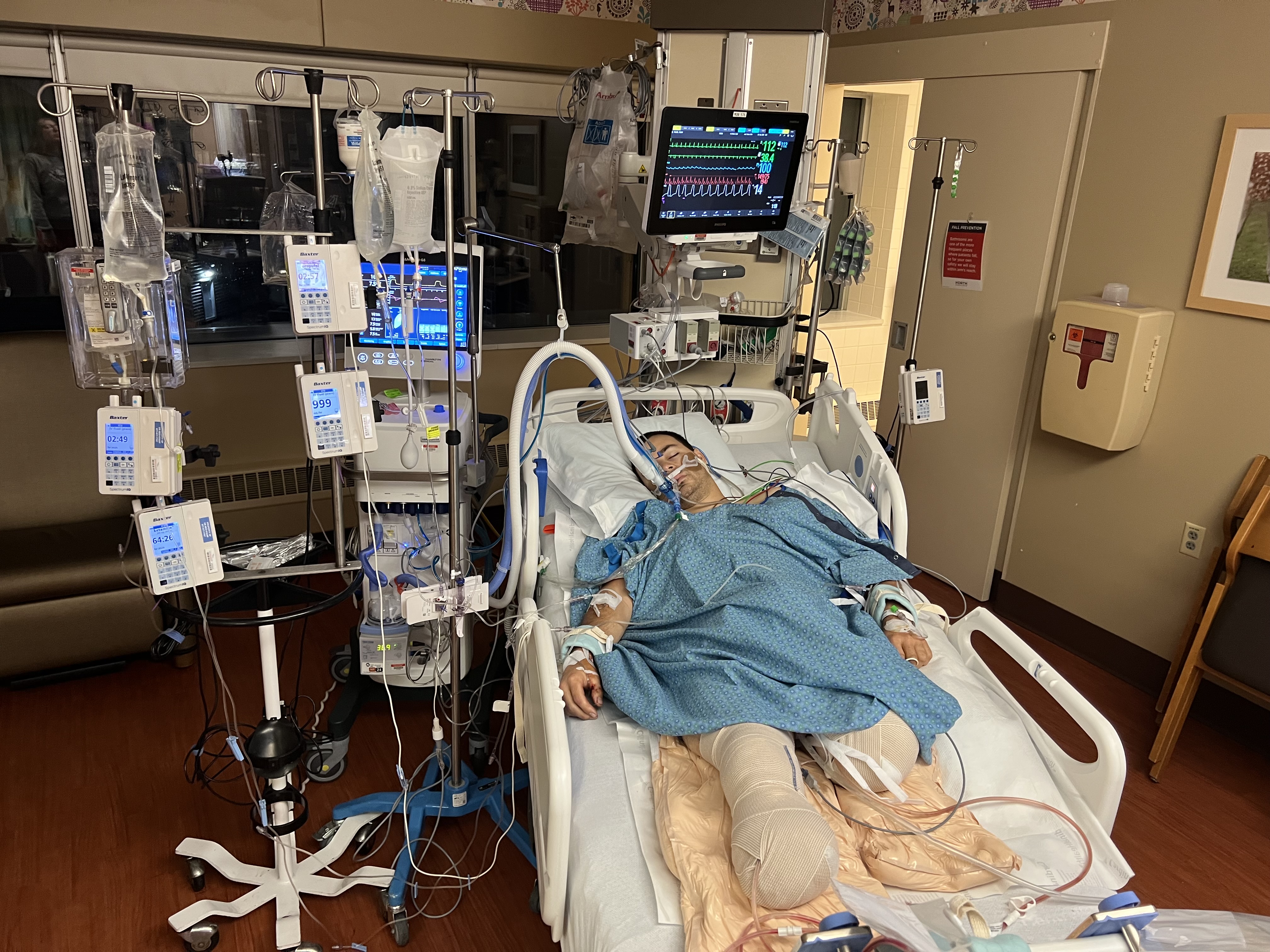
Travis Muller in the hospital following a tragic farm accident that lead to both of his legs being amputated (photo submitted).
Upon arrival at the hospital, Travis faced the unimaginable. Emergency surgery revealed the extent of his injuries to save his life: both legs had to be amputated. Six additional surgeries soon followed. “I believe I received blood in at least five of those surgeries,” he says.
As Travis reflects, he’s filled with gratitude for the first responders and the blood donors who never knew they’d be saving his life that day. His wife Jasmine, and their toddler daughter Shaylie, are thankful for every additional moment they now share with Travis. “As life changing as this injury is, and heartbreaking to lose his legs, the doctor said just a few more seconds without blood transfusions and he would no longer be with us,” says Jasmine.
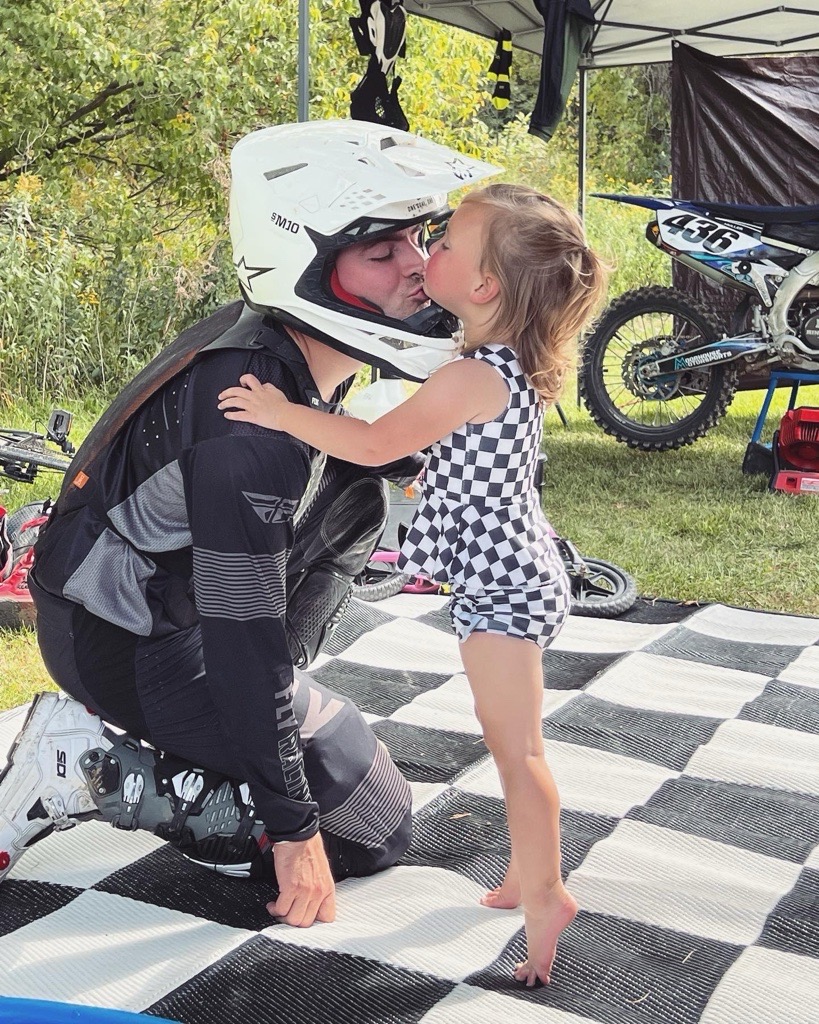
Travis, and daughter Shaylie, prior to the accident (photo submitted).
Travis agrees and adds, “What can you say except thank you to everyone – thank you for thinking of other people and taking time out of your day to make a difference.”
To raise awareness about the need for blood donations to help patients like Travis, his aunt, Monica Muller, a long-time Red Cross volunteer, organized a blood drive in his honor in his hometown of Windom, Minnesota.
“I’ve been a Red Cross volunteer for 15 years because I believe that when you donate you give the gift of life – and that’s what happened in Travis’ situation,” says Monica. “You just don’t realize the importance until it hits home. Whether it’s a serious illness or an accidental injury, people never know when they’ll be on the receiving end of a simple act of kindness.”
Monica adds, “this blood drive in honor of Travis is a call to action! It really makes a difference. Blood can’t be manufactured. There’s no other way than donating to ensure our hospitals have blood on the shelves.”
Holiday tree decorated with hand-made Red Cross blood bag ordaments to help promote the blood drive in January in honor of Travis (photo submitted.)
January is National Blood Donor Month, and the American Red Cross celebrates those who give blood to help save lives – especially now as we work to ensure a stable blood supply after a busy holiday season. The new year is a great time for people to donate for the first time or get back into giving, if it’s been awhile. Make a resolution to help save lives in 2024!
To schedule an appointment, download the Red Cross Blood Donor App, visit RedCrossBlood.org, or call 1-800-RED CROSS (1-800-733-2767).
Family rallies to support blood donation in honor of their son
The Wadd family – pictured left to right, Kloe, Trent, Kari and Mason (photo submitted)
Seventeen-year-old Mason Wadd is not your typical 11th grade high school student. Not only is he active in his school’s speech, theatre and drama clubs, a member of 4-H and Future Farmers of America, he’s also an entrepreneur who owns and co-operates a 5-acre sweetcorn business with his sister Kloe. A strapping young man with a bright future ahead, you would never know that Mason was born extremely premature at 26 weeks due to a rare blood antibody disorder and needed multiple blood transfusions to help save his life.
At just 18 weeks it was discovered that Mason had inherited an antigen (Kell) that caused antibodies to destroy his red blood cells – leading to severe fetal anemia. Even before he was born, Mason received his first blood transfusion through his umbilical cord. Two more transfusions followed and soon after, Mason was born at 26 weeks weighing just 2.8 pounds and 14” long.
Mason had a rough start. The preemie was in the NICU on a ventilator for the first 5 days of his life. During his 77-day stay in the NICU, Mason required surgery to have a blood clot removed from his brain and also received an additional 8 blood transfusions due to being anemic before he was strong enough to go home. Remarkably, the Wadd’s were able to take Mason home from the hospital just days before his original due date.
Mason and his sister Kloe pictured amongst their a-maize-ing sweetcorn crop (photo submitted)
“We credit blood with helping save our son’s life,” says his mother, Kari Wadd. “Without blood being available when Mason needed it, he may not have survived.”
In November 2022, Mason faced the possibility of needing more blood products during a mechanical heart valve replacement surgery. The hospital had to ensure they had blood available if a transfusion was required, but they were able to use Mason’s own recycled blood.
When Kari heard the Red Cross had a blood shortage this fall, she felt compelled to help by hosting a Red Cross blood drive in honor of Mason. “It’s the perfect time to do our part now that Mason is old enough to understand the importance that blood has played in his life,” Kari says. “This blood drive is a celebration of Mason’s one year post heart surgery and a way to help raise awareness of the need for blood donations.”
Why the Red Cross?
The Red Cross has always held a special place in Kari’s heart. In 1998, when her family’s farm was hit by a tornado that ravished the St. Peter, Minnesota community, the Red Cross was there to help. “The only thing that was left on our farm was the house and the Red Cross came and asked us what we needed,” Kari vividly recalls.
In college, Kari went on to help organize Red Cross blood drives and still helps at community blood drives. Even Mason’s sister Kloe, advocates for blood donations through her Miss Southern Minnesota platform and Community Service Initiatives while competing in the Miss Minnesota competition. “It’s so much part of our lives – she knows how important it is too,” says Kari.
The Wadd’s are grateful to blood donors and encourage others to give to help ensure a stable blood supply. “When it’s something so simple to do – it doesn’t cost you a thing, just time – we want to encourage others to donate so if their family was ever in need, they wouldn’t have to worry about blood being there.”
Mason is thankful for blood donors too. “I feel guilty even asking others to donate because I can’t myself, but it is so important,” he says.
“What’s next for me? I have my junior and senior years of high school ahead of me; without blood donations I wouldn’t be able to say that.”
Mason Wadd (photo submitted)
Blood drive in honor of Mason Wadd
Farmamerica Community Room 7367 360th Ave. Waseca, MN Friday, December 29, 2023 11 a.m. to 4 p.m.
Please call 1-800-RED CROSS (1-800-733-2767) or visit RedCrossBlood.org and enter: Farmamerica to schedule an appointment.
If you can’t join the blood drive in Mason’s honor and wish to help patients like him receive lifesaving transfusions, pleasebook a blood donation appointment by using the Red Cross Blood Donor App, visiting RedCrossBlood.org or calling 1-800-RED CROSS (1-800-733-2767).
Dedicated platelet donor hits 800-units/100-gallon milestone and encourages others to give during Red Cross national blood and platelet shortage
Tom Meyer donated blood for the first time when he was in high school. Several years later, in the late 70’s, he became a platelet donor when his cousin who headed the platelet donation program at the American Red Cross St. Paul Donation Center informed him that he had an appointment the next day at 7:30 a.m. “I believe I was one of the first platelet donors in our region,” says Tom.
That was the beginning of a decades-long journey of giving back.
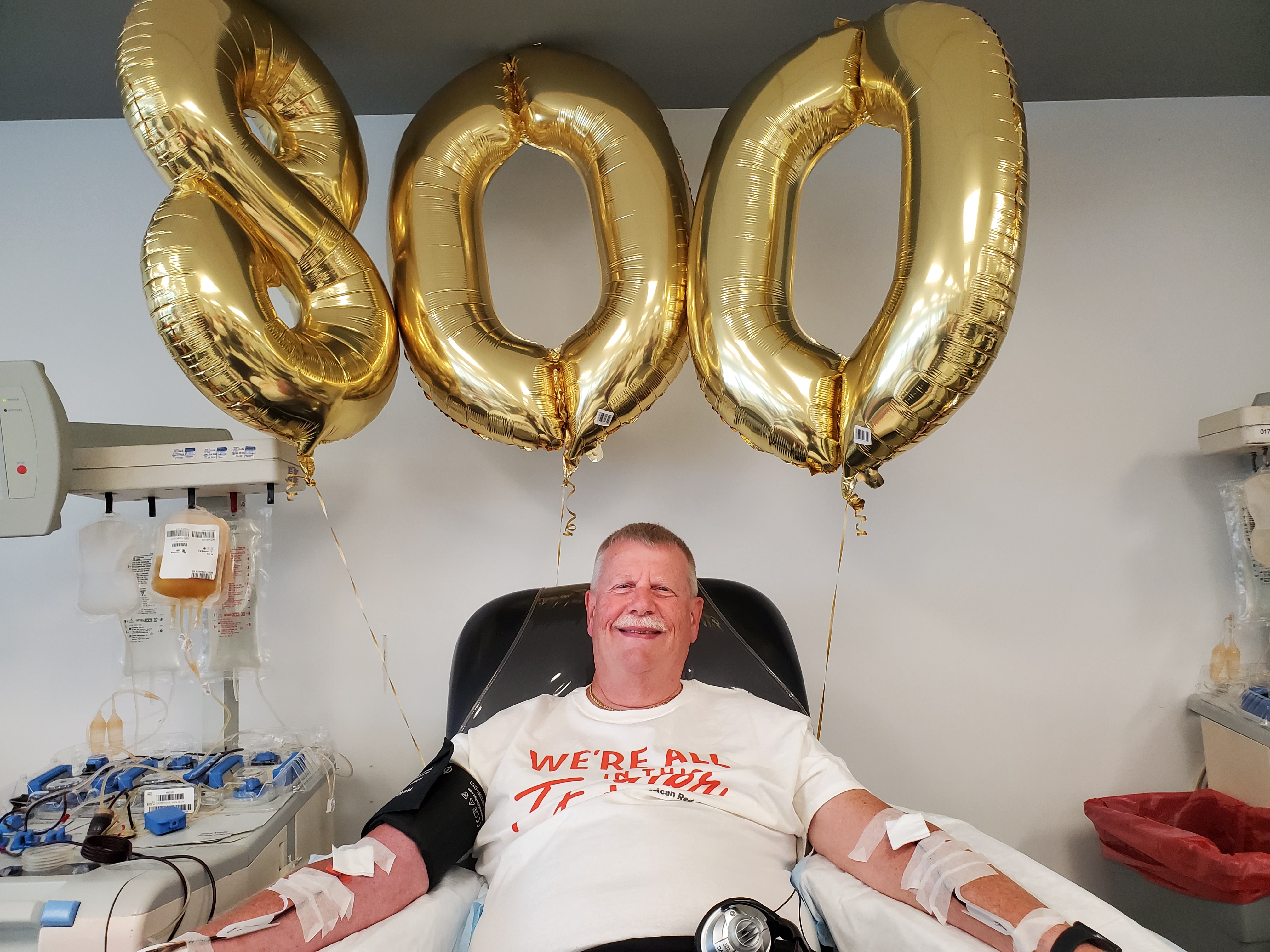
Tom Meyer reaches his 800-unit/100-gallon platelet donation milestone – September 13, 2023.
Since then, Tom tries to donate platelets every two weeks (24 times a year) and often has his appointments scheduled six months in advance through the Red Cross Blood Donor App. “There’s no substitution for blood – it’s a big priority for me!”
Tom’s donations are vital because of his high platelet count and O+ blood type. Type O positive is the most transfused blood type and can be transfused to Rh-positive patients of any blood type.
Recently, Tom hit a milestone when his donations reached 800-units/100-gallons.
“The number is less important than the impact on patient care,” says Tom. “I think there’s a good chance that I’ve made a difference in a few lives somewhere along the way. If we can give people more days with their family and friends, that’s a gift.”
Tom urges Minnesotans to become regular donors to help the cause and possibly save the lives of strangers. “One of the most enjoyable experiences I’ve had was assisting young students coordinate a blood drive at their school,” says Tom. His advice for first time donors is to be courageous. “Don’t be afraid of a small needle, but instead think of the impact of your donation and the patients you are helping.”
In addition to being a platelet donor, Tom serves on the Red Cross Minnesota and Dakotas Region Board of Directors. For the past 25 years, he has served two terms as chair of the region’s Blood Services Board, has been involved in multiple board committees, and has been an advocate for the Red Cross – from lobbing state legislature to change the blood donor age in the State of Minnesota to 16 years old with parental consent, to emceeing the region’s annual 12 Hours of Giving holiday blood drive, to serving as a disaster relief volunteer.
WHY ARE PLATELETS IMPORTANT Every 15 seconds someone in the U.S. needs a platelet transfusion. Platelets are tiny cells in your blood that form clots and stop bleeding and play a critical role in the treatment of millions of Americans fighting cancer and other chronic diseases, as well as those recovering from traumatic injuries. Since platelets must be used within five days of donation, platelet donors are constantly needed.
During a platelet donation, blood is collected by a device that separates platelets, along with some plasma, from whole blood and returns the remaining blood components back to the donor. Ideal blood types for a platelet donation are A positive, A negative, B positive, O positive, AB positive and AB negative.
NATIONAL BLOOD AND PLATELET SHORTAGE Tom hopes his story will inspire others to give, especially now as the Red Cross is facing a national blood shortage. Fewer donors than needed gave blood this summer, drawing down the national blood supply and reducing distributions of some of the most needed blood types to hospitals.
HOW YOU CAN HELP Donors of all blood types are urgently needed and there is an emergency need for type O blood donors, as well as platelet donors. More donors are needed now to ensure patients at hospitals across the country continue to receive critical medical care.
“I’m so grateful for blood donors who gave the gift of life to Addi and Rachel who also needed blood following complications from the childbirth.”
Pastor Joseph Naumann recalls the evening of Saturday, June 5, 2021, when his wife’s water broke at 22 weeks pregnant while at church. Following a visit to the emergency room, Naumann’s wife Rachel was hospitalized in Minneapolis to help keep the baby in the womb as long as possible so it could develop as much as possible before birth. Nine days later, Adelaide (Addi) Hope Naumann came into this world weighing just 1 pound, 8 ounces.
“It was touch and go if Addi would survive,” said Naumann. “Lots of hope was needed – we baptized her right away.”
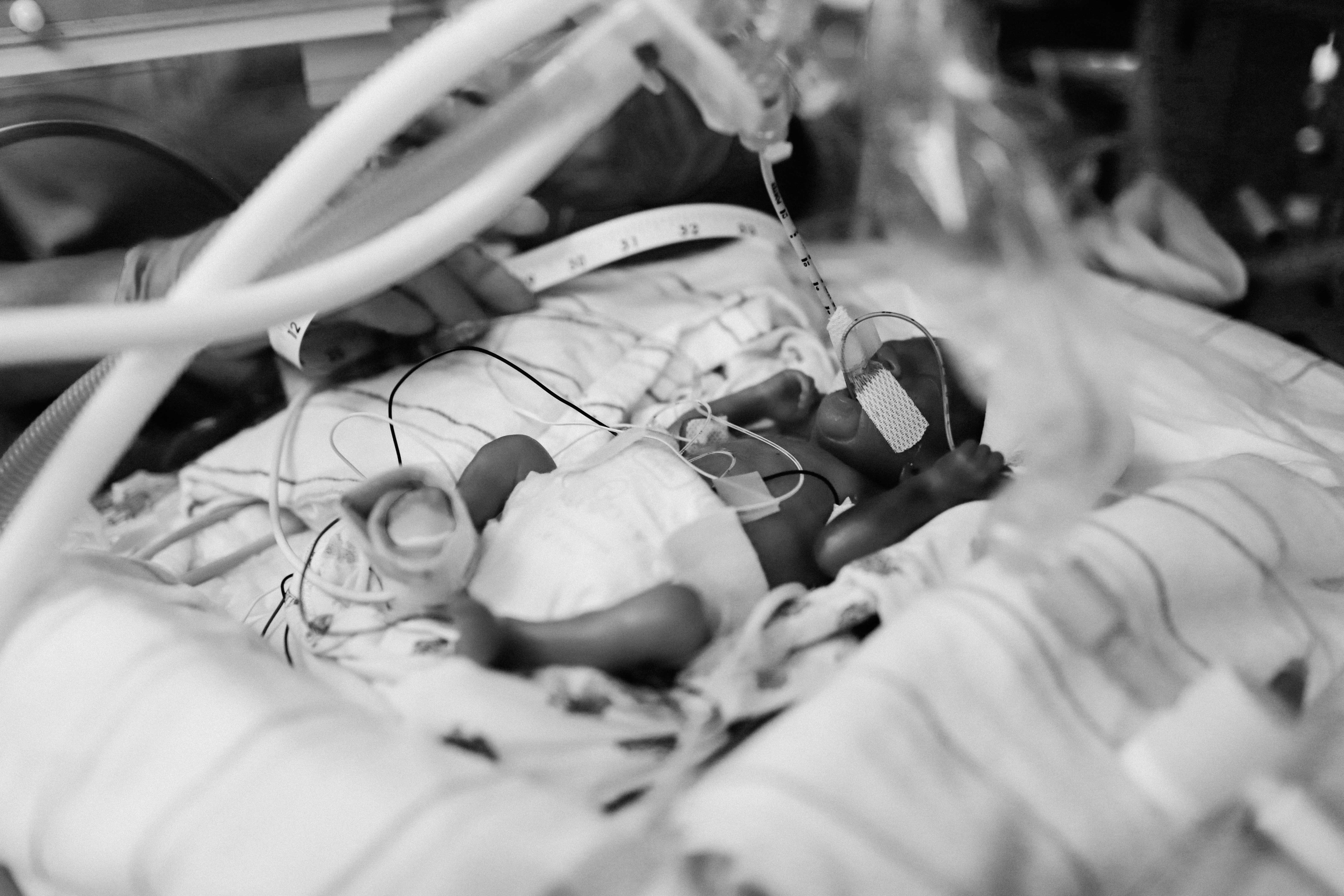
Newborn Addi weighing 1 pound 8 oz. (photo provided).
Addi was immediately intubated because her lungs were not strong enough to breathe on her own. Her left lungs began leaking air into her chest cavity, so a chest tube was inserted in her small chest to release air building up. “Her skin was thin and transparent,” Naumann says. Addi needed two blood transfusions to help her survive.
There were lots of difficulties that Addi encountered, and the new mom and dad weren’t able to hold their daughter for a week. For 164 days, the Naumann’s traveled back and forth to the hospital to be with Addi, while also caring for their older three children. On Thanksgiving Day, they finally took their sweet new baby Addi home.
The Naumann family (photo provided).
“I’m so grateful for blood donors who gave the gift of life to Addi and Rachel who also needed blood following complications from the childbirth,” Naumann said. “I think showing love and care to others is something all of us want to do. I encourage people to give – it could be your own family member in need. Giving the gift of life is the ultimate gift – a gift out the goodness of your heart – expecting nothing in return.”
Addi just turned two years old this summer and is talking and growing up just like other 2-year-olds. She loves to play with her sisters and brother and enjoys being outside in the sandbox or playing with her baby dolls. Naumann jokes, “I might be biased, but I think Addi may the cutest baby of all time!”
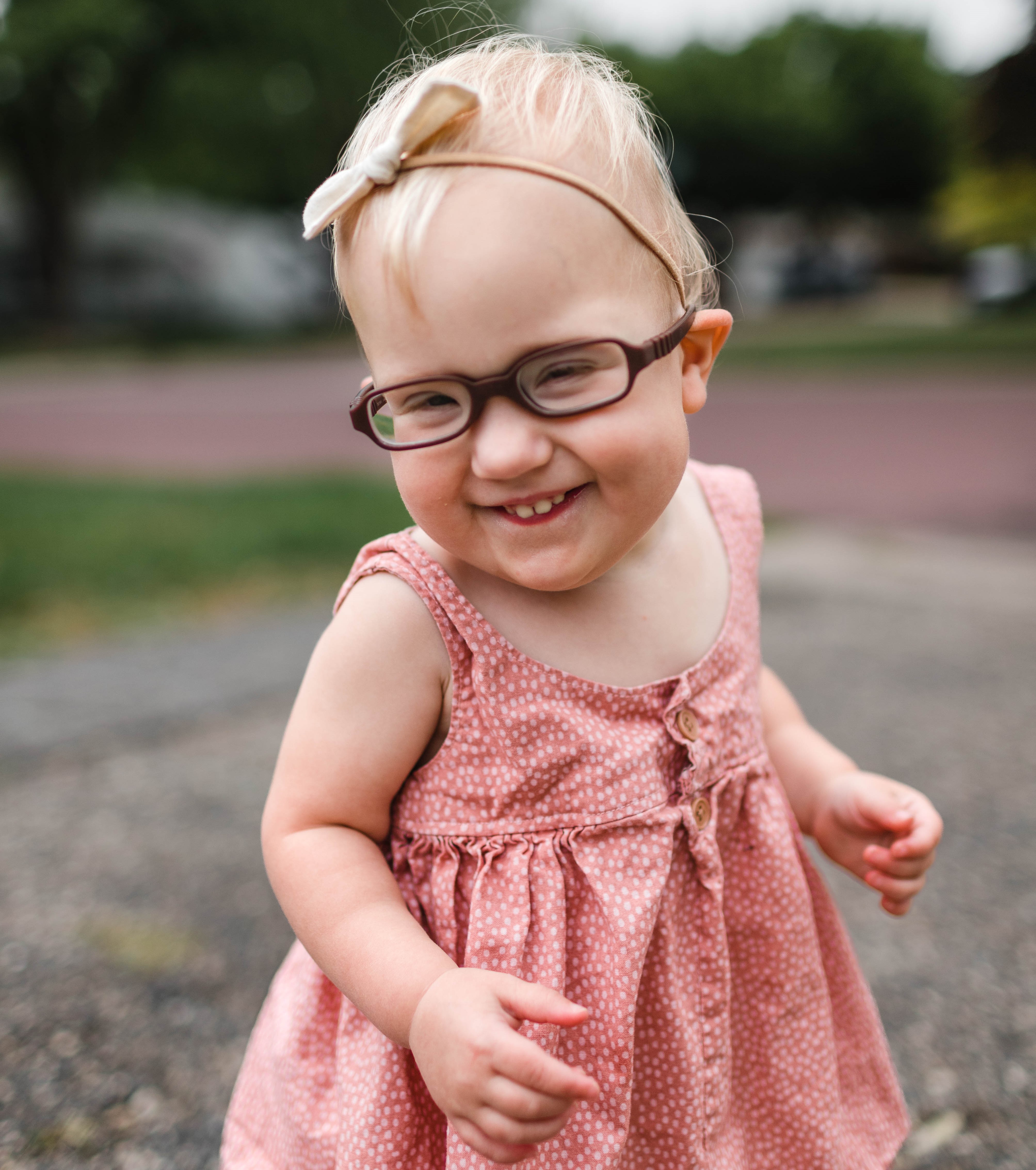
Two-year-old Addi loves to play outside (photo provided).
The Naumann’s have both donated blood in the past and plan on continuing to pay-it-forward. “It’s definitely something that is easy to be taken for granted as just being there when you need it, but I am so very thankful that there was blood available for both me and Adelaide when we needed it most,” said Rachel.
The American Red Cross is experiencing a national blood shortage. Fewer donors than needed gave blood this summer, drawing down the national blood supply and reducing distributions of some of the most needed blood types to hospitals. Donors of all blood types are urgently needed, and there’s an emergency need for type O blood donors, as well as platelet donors. More donors are needed now to ensure patients at hospitals across the country continue to receive critical medical care.
Help ensure lifesaving blood products are available for patients like Addi! Schedule a blood donation today. Visit redcross.org/mndaks to make an appointment or for more information.
Bradley Arnold is a sweet, fun-loving 10-year-old boy who loves fishing, farming and searching for treasures with a metal detector. But five years ago, unlike other kids his age, Bradley was diagnosed with kidney cancer.
Bradley Arnold, 10.
“It just appeared all of the sudden,” said Mandy Arnold, who noticed a bulge under her son’s shirt. She knew something wasn’t right, so she took Bradley to an emergency room. After four hours, they were sent home with a diagnosis of severe constipation.
But nothing changed overnight – the bulge was still there. That day, they were lucky enough to get an appointment with his pediatrician who ordered several tests.
Mandy recalls the look on the doctor’s face and knew right away something was wrong. “Our world turned upside down when I heard the doctor say she was confident it was kidney cancer.”
They went straight to a regional hospital, where they went through a in-depth series of questions and tests. That night, Bradley had an ultrasound, showing an 8-inch tumor, weighting more the three pounds. “It was the size of a cantaloupe – I couldn’t believe it got so big, so fast,” said Mandy. Bradley was scheduled for surgery the next morning to have his left kidney and a Wilms tumor removed.
Bradley recovering in the hospital following surgery. Submitted photo.
“I never thought I would have a child with cancer,” said Mandy. “It’s just not our nature to think of worst case scenarios.”
Thankfully, doctors were able to remove the entire tumor – it had not spread to other parts of Bradley’s body. Following surgery, Bradley required blood and platelet transfusions to help his body recover and heal.
Every Friday for the next 19 weeks, Bradley had chemotherapy treatments. “He never complained – he blew me away with how resilient he was,” Mandy said.
Witnessing her son’s bravery and cheerful outlook through his cancer journey, brought a new perspective to Mandy. “I’m a changed person – our family all went through this together – and we look at life differently now.”
“When your struck with a nightmare, the last thing you want to do is to worry about what you need,” said Mandy. “We’re so grateful the blood that Bradley needed was available when he needed it most.”
It wasn’t the first time the Arnold family was helped by the generosity of blood donors. Mandy needed transfusions after complications when her first and third children were born.
Mandy now serves as a Red Cross blood program volunteer leader with the Minnesota and Dakotas Red Cross Region. To celebrate Bradley’s five-year cancer free milestone and to raise awareness of the need for blood products to be readily available for cancer patients, the Arnold family hosted a blood drive on Monday, June 5, 2023. Family, friends and the community came together and rolled up a sleeve to honor Bradley. Forty nine blood donations were made in honor of this brave cancer warrior.
Bradley Arnold at the blood drive held in his honor, thanking donors for their “roll” in helping save lives with a Tootsei Roll goody bag!
You can help patients like Bradley! Schedule a blood donation today to help ensure lifesaving blood products are available whenever and wherever they are needed most. Visit redcross.org/mndaks to make an appointment or for more information.
“I’m super grateful for people who gave blood and made it possible for me to live…”
The phrase “saved by blood” was something I always associated with a great Easter sermon – that is, until a stranger’s blood literally saved my life 35 years ago. Gratefully, that person cared enough to be a donor, and doing so, saved two lives on that fateful day.
Mother/daughter duo DeAnna and Mandy volunteered together at the Red Cross blood drive held at the Church of Jesus Christ of Latter-day Saints in Waconia, MN on Jan. 31, 2023.
I was a 23-year old soon-to-be mother of a new baby girl, and unlike so many other expectant mothers, I loved being pregnant! I loved the feeling of life inside me as she squirmed and kicked and reminded me that she was coming. I loved making baby blankets and spending long hours oohing and aahing over the baby girl clothes in the discount store near our home. My husband and I talked often and excitedly about the day when she would finally join our little family.
One beautiful early June afternoon, I could feel the summer sun calling to me. Our two-year old son, Matt, was as thrilled as I was to be going on a long walk, and our hearts were light as we made our way toward the duck pond that we often frequented.
Matt tightly held the breadcrumb bag and chattered energetically as we walked along. Then the moment he could see the pond, he begged to get down. I lifted him out of the stroller, taking a mental picture of his radiant face as he enthusiastically bounded toward the ducks. “Duckie, duckie,” he called, as he went. From their reaction, I’m pretty sure that they were as happy about his visit as he was to be there.
After he had emptied his bread bag, I lifted him again to put him back in the stroller. It was then that I felt the muscles pull in a strange way across my swollen belly. It didn’t feel right. There wasn’t much I could do about it in that moment, except to slow my pace as I gingerly made my way back home. The stroller felt much heavier than it had before, and I knew I needed to be off my feet as soon as possible.
A few hours later, I found myself in an emergency room, losing blood so fast that even the medical staff seemed worried. I had a condition known as placenta previa, something that had taken the life of many an expectant mother through the years. Apparently, the combination of the long walk pushing a stroller, and lifting our little son in and out of it, had put extra pressure on the womb, and caused the bleeding to start. And it didn’t seem to be slowing or stopping.
One of the many worries in this equation was that our baby girl still needed another 10 weeks in the womb in order to survive. Our neonatologist was particularly scared, given that our daughter also had an open spine and would need surgery right after birth. Our obstetrician was worried – and we were terrified.
The next 24 hours passed like a bad dream. I was in and out of consciousness, vomiting until there was nothing left in my stomach. The lights seemed to burn at my eyes whenever I tried to open them, and the voices around me often seemed far away. In fact, there were times when I almost felt disconnected from my own body.
I do remember one very lucid moment when I awoke to see a unit of blood flowing into one arm, with an IV in the other. As my eyes fluttered open just then, no doubt reflecting the confusion I felt, Dr. Parker explained that a blood transfusion had been necessary to save my life, not to mention the life of our little girl.
Several units of blood and many hours later, I awoke to find my husband next to my bed still holding my hand. His eyes were blood shot and he looked as if he hadn’t slept in days. He smiled wanly at me as he said, “you’re finally back with us.” He told me that they thought the bleeding had nearly stopped, and that it looked like I was going to be okay.
That was the first miracle. The second came five weeks later, when four-and-a-half-pound Mandy was finally placed in our arms. She was premature, but her lungs were formed, and she was beautiful! She had a full head of dark hair and bright blue eyes that looked from one of us to the other.
In that moment, I smiled tiredly down at her, knowing that we had both been saved by blood. The seemingly small act of a stranger had produced great miracles that changed the course of our lives and our family’s history forever.
We’ll never be able to thank our anonymous hero, but if you are someone who cares enough to donate blood, just know that someone out there is thanking God tonight for you. You are a hero to somebody!
I’m super grateful for people who gave blood and made it possible for me to live to give birth twice more after that and be here to raise my children!
This blog story was written by DeAnna Murphy – American Red Cross co-blood program leader for The Church of Jesus Christ of Latter-day Saints in Waconia, MN, blood donor, author and Top 100 Global Coaching Leader. She is also the mother of three, and grandmother of four. She currently lives in the Minneapolis area.
Want to be someone’s hero? Schedule a blood donation today. Simply download the American Red Cross Blood Donor App, visit RedCrossBlood.org or call 1-800-RED CROSS (1-800-733-2767) to make an appointment or for more information.
I’ve been donating blood to the American Red Cross ever since I was 17 years old.
I’m not sure what attracted me initially to contributing to this non-profit that has been around since 1881. It may have been a desire to give something essential that wasn’t simply money.
I was just a high schooler after all, working at a Save-A-Lot supermarket in upstate Pennsylvania on the weekends at the time. I wasn’t exactly flush with cash.
It may have been a desire to finally overcome my fear of needles. I’d suffered a crippling syringe-phobia ever since I was five and had to be strapped down to the examination table for a booster shot.
Certainly not a preferred early childhood memory.
Probably it had to do with the idea that the simple action of giving a pint of my blood could help someone’s life, or even several people’s lives. That appealed to me more than giving other things, like money, time, or labor. As the Red Cross states, “Blood and platelets cannot be manufactured; they can only come from volunteer donors.”
Since that initial decision to donate blood, I’ve given 23 times.
If I’m able to donate about four times a year for, say, the next 30 years or so, that means I could potentially donate up to almost 15 gallons of blood. I’ve given nearly three so far. You can donate whole blood every 56 days. While it would be great to be able to make it in perfectly on cue, it doesn’t always work out that way.
I’d like to donate 20 gallons of blood over my lifetime. I think that’s a reasonable goal.
When I lived in Philadelphia I donated like clockwork every two months at the donation center on Spring Garden street near Center City. On the way back home, I’d drive past John F. Kennedy Plaza, aka Love Park, and admire the famous red sign with the swooning letter “O.”
After moving to Williston, ND during the oil boom my donations became less frequent. Sometimes, when my work schedule allows, I’m able to make the blood drives that take place on occasion in nearby Sidney or Fairview, MT.
Other times in the past, I’ve actually driven six hours to Saint Cloud, MN to donate at the Red Cross center located in town. The phlebotomists there are friendly, and often they ask where I’m coming from. So when I mention Williston, they give me these weird looks. You drove six hours just to donate blood? At the Red Cross? Aren’t there places closer you can donate? Yeah. There’s United Blood Services, but I don’t give there. I’m a bit of a loyalist. The Red Cross takes me back to high school.
Hey, everyone’s sentimental about something. Music, movies, wine. You stick a Red Cross needle in my arm to draw blood, and suddenly I’m feeling nostalgic.
– Dean Brooks, a loyal and dedicated Red Cross blood donor
While it’s nice to donate blood and know I may have helped save somebody’s life, I also do it because it makes me feel good. I follow a strict dietary ritual the day before, eating foods rich in iron. Lots of fruits and vegetables. A big breakfast.
And, of course, drinking plenty of water. Always make sure you are well-hydrated before donating blood.
Seriously, I’m like an athlete prepping for a big game before I give blood. You’ve probably never met someone as excited to have their blood drained as me the day before a draw.
Giving blood compels me to stay active and in shape. When you donate you receive a mini-physical. They take your temperature, measure your hemoglobin levels, and take your pulse. When you go in for your appointment, the technicians there will have you fill out a lengthy health screening questionnaire.
While the Red Cross check-up is not a substitute for a full-body one by your doctor, it’s a good, cheap way to keep an eye on your health.
The Red Cross screens your blood before giving it to anybody, so if you have a disease or some kind of health problem, they’ll tell you. In my last donation, the Red Cross informed me that I had developed reactive+ Covid-19 antibodies. This means, according to the Red Cross anti-body test results page, that, “Antibody levels were detected at levels high enough that your plasma may be used as convalescent plasma.”
So, hopefully my blood went to someone who needed a leg up fighting that virus.
I have been told by several doctors that I have “great blood.” Which is no surprise. I work hard eating right and staying fit. I expect my crimson essence to be premium 94 octane.
I also think those who donate like me do so out of some unconscious need to affirm their own health and vitality. Some guys rip down the highway at 80 MPH on a Kawasaki motorcycle to “feel alive.” Me, I have a needle stuck in my arm to drain off a pint. It may not make for a Red Bull commercial, but donating blood is essential for millions of people every year who need transfusions or blood components to survive.
There’s also a very cool thing the Red Cross does that makes the ordeal worth it. They let you know where your blood donation went.
Usually just a few weeks or so after your donation, the Red Cross will send you an email with a message like the one above. It’s uplifting to know not just that your donation helps, but specifically where it did so.
Have you donated blood before? Or given thought to doing so? I know a lot of people are held back due to fear of needles, or concerns they’ll pass out or get sick.
Yeah, I’ve been there myself.
The whole blood donation process is mostly painless. I won’t lie, though. Sometimes it can hurt. It usually depends on the person sticking the needle in your arm. There’s a lot of finesse to finding the vein and inserting the syringe just right. I’ve had experiences where I barely felt anything. Other times the technician had to go digging around to find the right spot, and left me with black and blue marks. That sucked.
But look at it this way. You’re almost certainly going to have to have blood drawn at some point in your life anyway. Especially as you get older. You’ve probably already had blood work done up after an appointment.
At least if you get into the habit of donating regularly, you’ll get used to it. And you’ll be saving lives along the way. You might even become a freak like me and actually enjoy giving blood.
The technicians at the Red Cross are considerate professionals. They’ll make sure everything goes smoothly. It’s normal to feel light-headed after a blood draw. Having blood taken effects everyone differently. I’ve only had one instance where I felt like I was going to faint. That was likely due to being underfed and dehydrated before going in for my appointment. But the process has generally been a smooth one for me over my twenty-plus year Red Cross blood donation career.
This is why it’s so important to eat right and drink plenty of water before going in. Check out the Red Cross page on Tips for a Successful Blood Donation for more important details.
Republished with permission from Dean Brooks, novelist. His original post was dated June 14, 2022, on World Blood Donor Day, when Brooks completed his 25th blood donation. World Blood Donor Day is a day the American Red Cross joins blood collection organizations around the world to recognize the importance of a safe and stable blood supply and the donors who generously give to help save lives and enhance solidarity in communities.
How Annie, Liana and Katie are turning their life-threatening childbirth experiences into advocacy and awareness for blood donation.
Annie, Liana and Katie (pictured from left to right) all experienced devastating amniotic fluid embolisms during childbirth and collectively needed over 100 units of blood products.
Most of us have never heard of amniotic fluid embolism (AFE). Neither had Annie, Katie and Liana, three women from the Minneapolis and St. Paul metro area. They met through the AFE Foundation because they all experienced an AFE during childbirth. Their stories are different, but they all credit blood with helping to save their lives. Together, they needed over 100 units of lifesaving blood products. To raise awareness about AFE, they are sharing their stories and hosting a blood drive to help ensure blood products are available for others who need lifesaving transfusions.
AFE is a rare and serious condition – occurring in about 1 in 40,000 births in the U.S. It’s sudden. It’s unexpected. It’s life-threatening. AFE causes birth complications that affect both mother and baby during labor or shortly after delivery. It’s thought to be the result of an allergic-like reaction to the amniotic fluid that enters the mother’s bloodstream. It can result in the mother going into respiratory failure, cardiac arrest, and DIC. Some women also experience strokes.
Meet these three strong, brave and remarkable women who are AFE survivors and who, not too long ago, were total strangers.
Meet Annie – On March 23, 2020, just 12 days after COVID-19 was declared a global pandemic, Annie had an emergency cesarean section and went into cardiac arrest. A code blue was called, CPR and shocks were administered, but her heart continued to fail. She entered disseminated intravascular coagulation (DIC), which causes blood to clot where it shouldn’t and then hemorrhage where clotting is necessary.
A massive blood transfusion was called for. Annie received about 25 units of blood products to replace the blood she lost.
“You just never think you’ll be the one in need. I had never donated blood before but made my first donation last September after I knew how important it was.”
Her son Henry was born without a pulse and quickly taken to the neonatal intensive care unit for treatment.
After over two weeks of unresponsiveness, Annie woke up and had paralysis on her right side and confusion about what had happened – she had no memory of going to the hospital to give birth and even thought she had miscarried.
An MRI revealed that Annie had suffered numerous strokes and bleeds. Following additional complications, set-backs and being isolated from her husband and family due to COVID-19 restrictions, the doctors said she would likely have long-term physical and cognitive disabilities and would require months of treatment in a rehab facility.
Annie met Henry for the first time in the rehab facility and six days later was able to go home. Henry doesn’t seem to have been impacted by the circumstances of his birth – his MRI was normal, and he is developing beautifully.
Although Annie has survived AFE physically unscathed and has returned to work recently, she says the “emotional wounds are deep and ones I’ll likely carry for the rest of my life. Something like this shouldn’t happen on the best day of your life.”
Meet Katie – In August 2017, at 41+ weeks pregnant, Katie went in for her scheduled induction – anxious to meet her baby daughter. Once her water broke, everything went dark. Katie went in and out of consciousness but remembers the chaos going on around her as they wheeled her into the operating room for an emergency cesarian section.
Three days later she woke up in the ICU and found out that she had an AFE followed by DIC, which required her to receive 50+ units of blood products.
“I’ve donated blood once or twice before – and I’m filled with tremendous gratitude on how many people had to donate for me and how much more need there is out there.”
Her newborn daughter had suffered complications too and was transferred to a local children’s hospital for treatment. A week later, Katie was finally able to meet and hold her precious girl. It was the most unbelievable moment — “one I’ll never forget,” she says. On day 10, her daughter was cleared to go home, and Katie was hospitalized for an additional 15 days.
Once home, the littlest tasks were difficult – going up and down stairs, taking a shower, or changing one diaper. After two weeks at home, Katie was back in the hospital with bi-lateral pulmonary embolisms and was in and out of the hospital for a couple months with various other complications.
Katie went on to have a subsequent pregnancy and complication free delivery with her second child in April 2020.
Meet Liana – In January 2019, right before her delivery, a very pregnant Liana recalls a feeling that something was wrong. Her husband tried to reassure her, saying that the humans have been having babies for millions of years and that all would be okay. She wrote off her feelings as the jitters for a first-time mother.
Liana was induced at 38 weeks and was excited to meet her baby. Her fear turned real when she experienced complications during delivery. Liana’s blood pressure plummeted followed by massive hemorrhaging, coding, seizing and a stroke. Doctors performed an emergency cesarean section and Liana required more than 10 units of blood products. Her daughter Lydia was born with no heart rate.
“Blood is the ultimate gift – it helped save my life!”
When Liana woke up in the ICU she could hardly move or speak. She tried, but nothing came out. She was told she had given birth and had a daughter named Lydia. “So many thoughts were racing through my mind. No matter how much I wanted to talk, I couldn’t. So, I just cried.”
Liana spent 17 additional days in the hospital going through speech and occupational therapy.
Although AFE caused significant and lasting health complications that affected her memory, speech and motor skills, it hasn’t stopped Liana from keeping a positive attitude and a sense of humor. With great determination and many hours of rehab she’s been able to resume her passion to do the things she loves.
“I’ve physically made a full recovery, but am mentally dealing with the trauma.”
Liana has donated blood in the past and plans on being a regular blood donor.
——————————
To help build awareness for the importance of blood donation and AFE, their first-ever “friends of AFE blood drive” will be held February 18, 2022, for their families and friends.
Bathesheba Benson, a sickle cell warrior, keeps her eyes on the future
Bathesheba Benson knows hope and pain more than most. Known as Sheba, she’s among the estimated 100,000 people in the United States living with sickle cell disease.
Sickle cell disease turns soft and round red blood cells into hard and crescent-shaped cells that clump together, reducing blood flow.
Sheba’s first sickle cell crisis happened when at home in New Hope, Minnesota. She was just five years old and had a stroke. It was then that her family learned she had inherited the sickle cell trait from both of her parents.
“My parents kind of knew because I would swell up. They knew something was wrong, but they didn’t know I had sickle cell,” she says.
“I want to see the world. There’s so much to do. ” – Sheba Benson, a sickle cell warrior
Now thirty-seven years old, Sheba knows well the challenges facing ‘sickle cell warriors’ who shape their days, weeks, and years into a life that prevents pain and reduces crises to the best of their abilities.
Sometimes a crisis can’t be prevented. Certain factors, like extreme cold, elevate risks. Even something quite ordinary, such as five-minute walk to a nail salon, can ignite the spiral.
“Oh, my goodness, it’s so hard,” she says. “I have to plan life out ahead of time. I have to double think about my decisions that I take in life.”
One decision – staying in college to study childcare – came to halt when she was twenty-one years old. She suffered a second stroke. The event also triggered a bout of depression so she went with her mom to visit relatives in Ghana.
“I feel healthier once I get blood in my system – I feel brighter, stronger and healthier – you can see it in my face – my sister says ‘you look better’.”
Sheba Benson – Sickle Cell Warrior
“I was depressed there, too, because I wasn’t doing anything and not going anywhere. So, I decided to come back to Minnesota,” she says.
A critical, lifesaving treatment through all of this is blood transfusion. Red cell transfusion increases oxygen in the blood, boosting her immune system and reducing a severe pain crisis, stroke or other life-threatening conditions. Sheba’s transfusions have been numerous throughout the years, including more intensive apheresis therapy.
“They always transfuse me when my hemoglobin is low. Sometimes they give me an apheresis transfusion when I’m very very sick. They place a tube in my neck or groin area, and then hook me up to a big machine where they exchange blood,” she explains.
The transfusion transforms her in moments.
“I feel a lot lot better, like instantly – I feel stronger instantly – I feel healthier once I get blood in my system – I feel brighter, stronger and more healthier – you can see it in my face – my sister says ‘you look better’.”
“I feel healthier once I get blood in my system.” – Sheba Benson receives blood transfusion when she has a sickle cell crisis.
Sickle cell warriors like Sheba rely on blood donors for this crisis mitigating and lifesaving therapy, which could be needed any day of the year. Finding a blood match beyond well-known blood types like A, B and O is essential.
The hardship of finding a match lessens with a more diverse blood supply. The most likely matches are with donors who are Black. And because blood compatibility decreases with each transfusion, ongoing diversity from new and regular Black donors makes the difference for Sheba and other sickle cell patients.
“My blood bags always have Red Cross on it,” she says. “Please donate because it really goes along way – it helps me, it helps other patients out there. If I could donate, I would donate. Please go out there and donate if you can.”
When feeling well, meaning her pain is okay, Sheba holds her gaze on happiness, especially being with her friends and family. Meeting new people brings her joy, too.
“I want to see the world. There’s so much to do. My dream for 2022 is to stay out of the hospital and travel more. The ocean is my peaceful place. I want to be on the beach somewhere!”
To learn more about sickle cell disease, click here. To find a donation appointment, click here.
Story by Lynette Nyman/American Red Cross. Photos provided by Sheba Benson
Three months ago, Jenapher Blair made a promise to give blood. After being on the receiving end of blood donation following the birth of her child, Jenapher hoped to become a blood donor herself.
Feeling a little emotional and filled with anticipation, Jenapher and her husband Steve arrived for her appointment at an American Red Cross blood drive in Hutchinson, Minn. on Nov. 9. “I’m wondering where my blood will go and who it’s going to help – I’ll be watching my blood donor app to follow the journey of my donation,” said Jenapher.
First-time blood donor Jenapher Blair rolled up a sleeve at a Red Cross drive on Nov. 9, 2021.
In just a little over five minutes, Jenapher’s donation was finished and she proudly held her blood bag close to her heart. “Wow, I can’t believe how quick that was – it’s such a great feeling to know that I’m going to help make a difference for someone, just like the people who’s blood I received did for me and my family!”
Jenapher Blair holding baby Adalyn with her husband and children.
Everything was going well…until it wasn’t
Following the birth of baby Adalyn in July, Jenapher started to hemorrhage and was losing blood quickly. It was a matter of life and death. Doctors couldn’t control her bleeding and the nearest blood was 80 miles away. The hospital called the Red Cross and in-turn the Minnesota State Patrol was immediately contacted to help rush four units of type O-negative blood to the hospital.
The lifesaving blood was delivered in just 65 minutes. Doctors told Jenapher “we were on borrowed time while waiting for the blood to arrive” and that she would not have survived had the blood arrived even minutes later.
Grateful and giving back
Jenapher left the blood drive pumping her fist in the air with excitement and thanking everyone in the room for giving the gift of life.
“Paying it forward doesn’t stop here for me,” she said. “It’s more personal. I want to be an example for my kids. We want to do our part and spread the word about the need and help get the numbers up because I realize how important it is to have blood available – if I hadn’t received the blood I needed, things could be very different.”
An exuberant Jenapher Blair after donating blood for the first time.
Jenapher, Steve, and their kids are also gamers who are raising funds through Mission Red, the official gaming and streaming charity program of the Red Cross. Learn more here or join their fundraising campaign TheOasisFam.
“The more we can do to be advocates for the lifesaving mission of the Red Cross, the better!”
Story by Sue Thesenga, American Red Cross. To find a blood drive near you click here.