If you’re like Sean and new to the upper Midwest, you might be wondering what winter is really like. Spoiler alert: it’s not all cozy snow days! Around here, a snowstorm can feel like just another Tuesday. That’s why it’s important to prepare before the cold sets in—because winter can stick around well into spring.
Sean Kelly, our Senior Volunteer Recruitment Specialist in North Dakota, moved from Virginia this past July. He says, “I’m prepared for most things, but having never experienced -40° with wind chill, I’ve been wondering—how cold is that?”
The truth? It’s cold enough to make your eyelashes freeze! For newcomers, the sudden drop in temperatures and heavy snow can be a shock. Snowstorms can lead to power outages or dangerous road conditions.
As Sean asks, “I know I can call emergency services, but how long do you need to survive in your car?” Hey Sean, below are some tips to help you and everyone stay safe and comfortable this winter!
Car Survival Kit Add these essentials to your regular car kit: • Snow brush and ice scraper • Warm boots and clothing • Blanket or sleeping bag • Hand and foot warmers • Shovel, sand or kitty litter • Phone charger and jumper cables • Snack bars • Flares and safety vests (especially helpful in a whiteout!)
Find Warming Shelters Know where to go if the cold becomes dangerous. Some cities, like Fargo, operate warming shelters, while others partner with local organizations. Check your city and county resources before the bitter cold hits—especially if you plan to travel.
Dress for the Weather On the worst days, avoid travel if you can. If you must go out, cover your nose, ears, cheeks, chin, fingers, and toes with warm, dry clothing. These areas are most at risk for frostbite.
Get More Tips Download the free American Red Cross Emergency App for additional preparedness advice.
Whether you’re a winter rookie or a seasoned pro, a little preparation goes a long way. With the right gear and planning, you can turn the upper Midwest’s extreme cold into a true winter wonderland!
Post written with support from Jana Humphreys, a Communications Volunteer with our Minnesota and Dakotas Red Cross region!
More than two weeks after floodwaters inundated parts of Minnesota and eastern South Dakota, neighbors, local community organizations and government partners continue to work together to help people recover from the extensive damage.
If you need help, please visit redcross.org/mndaks and click “Get Help,” or you can call 1-800-RED CROSS (1-800-733-2767).
Shelters are available for people displaced by recent flooding. Shelters provide essential resources, including food, water, emotional support and information. Click here for info on what to bring, services available and more.
Red Cross Emergency App: To stay informed and prepared during severe weather, download the free Red Cross Emergency app. Customize 40 different weather alerts, toggle between English and Spanish, and ensure accessibility for people with disabilities. Text “GETEMERGENCY” to 90999 or find the app in your app store.
The Emergency app includes an “I’m Safe” feature that help people check on loved ones. Search “American Red Cross” in app stores or go to redcross.org/apps.
Turn around, don’t drown. Stay off the roads. If you must drive and encounter a flooded roadway while driving, turn around and go another way.
How you can help
Support Red Cross Disaster Relief and help people affected by disasters like flooding and countless other crises by making a financial donation today. Your gift enables the Red Cross to prepare for, respond to and help people recover from disasters big and small, like the Minnesota and South Dakota floods.
Donate online at RedCross.org, call 1-800-RED CROSS (1-800-722-2767) or text REDCROSS to 90999 to make a $10 donation.
The Red Cross encourages financial donations, which provide the quickest and most effective way to assist those in need. Please note that the Red Cross is not accepting donations of food, household items, or clothing, as these cannot be distributed by their teams.
Volunteer for disasters Many people have expressed interest in volunteering to support our response efforts, and we are appreciative of the offers to assist. At this time, our trained Red Cross volunteers are working this disaster.
Help us pre-stage valuable volunteers for the next disasters to help your neighbors in need – from home fires to flooding and more. Put on a red vest and join us as a volunteer today to provide relief and hope when it matters most. Visit redcross.org/givetime to check out opportunities with your local chapter.
Donate blood Unfortunately, the American Red Cross continues to address a concerning shortfall in lifesaving donations since late spring. If you are in an area not impacted by a disaster, please keep your appointment or schedule an appointment to roll up a sleeve and donate blood.
To make an appointment simply download the American Red Cross Blood Donor App, visit RedCrossBlood.org, call 1-800-RED CROSS (1-800-733-2767).
CrisisCleanup.org
Home Cleanup Hotlines have been opened by CrisisCleanup.org to help survivors cleanup in Minensota and South Dakota. We anticipate that most volunteer groups will work through Friday, July 5. 2024. Survivors needing assistance can call 218-288-2213 in MN and 605-519-5413 in SD.
Floodwaters continue to impact our neighbors in southeast South Dakota and southern and northeast Minnesota. The Red Cross is closely monitoring weather updates and river crest forecasts, while trained disaster responders are assisting those in need. Please see below for resources.
If you need help, please visit redcross.org/mndaks and click “Get Help,” or you can call 1-800-RED CROSS (1-800-733-2767).
Nobles County Prairie Justice Center 1530 Airport Road Worthington, MN 56187 4 p.m. – 7 p.m.
Jackson County Red Cross teams are driving around the community today with kits. If you don’t see us, clean-up kits are also available at our shelter in Jackson. Jackson County Community High School (JCC HS) 1128 N Hwy., Jackson, MN 56143
Windom Mobile distribution, 2:30 p.m. to 4 p.m. Teams delivering kits throughout the community.
Turner County County Building 1055 E Sanborn St Parker, SD 57053 10:30 p.m. – 2:30 p.m.
Saturday, June 29, 2024
Davison County Mt. Vernon Public School 500 N Main St Mt. Vernon, SD 57363 10:00 a.m. – 2:00 p.m.
City of Mitchell 612 N Main St Mitchell, SD 10:00 a.m.-2:00 p.m.
Shelters and Temporary Evacuation Point
If you or anyone you know is affected by this situation, safe shelter is available. It’s crucial to have a safe place during emergencies.
Shelters and a Temporary Evacuation Point are available for people displaced by recent flooding. Shelters provide essential resources, including food, water, emotional support and information. Click here for info on what to bring, services available and more
Red Cross Emergency App: To stay informed and prepared during severe weather, download the free Red Cross Emergency app. Customize 40 different weather alerts, toggle between English and Spanish, and ensure accessibility for people with disabilities. Text “GETEMERGENCY” to 90999 or find the app in your app store.
The Emergency app includes an “I’m Safe” feature that help people check on loved ones. Search “American Red Cross” in app stores or go to redcross.org/apps.
Turn around, don’t drown. Stay off the roads. If you must drive and encounter a flooded roadway while driving, turn around and go another way.
How you can help
Support Red Cross Disaster Relief and help people affected by disasters like flooding and countless other crises by making a financial donation today. Your gift enables the Red Cross to prepare for, respond to and help people recover from disasters big and small, like the Minnesota and South Dakota floods.
Donate online at RedCross.org, call 1-800-RED CROSS (1-800-722-2767) or text REDCROSS to 90999 to make a $10 donation.
The Red Cross encourages financial donations, which provide the quickest and most effective way to assist those in need. Please note that the Red Cross is not accepting donations of food, household items, or clothing, as these cannot be distributed by their teams.
Volunteer for disasters Many people have expressed interest in volunteering to support our response efforts, and we are appreciative of the offers to assist. At this time, our trained Red Cross volunteers are working this disaster.
Help us pre-stage valuable volunteers for the next disasters to help your neighbors in need – from home fires to flooding and more. Put on a red vest and join us as a volunteer today to provide relief and hope when it matters most. Visit redcross.org/givetime to check out opportunities with your local chapter.
Donate blood Unfortunately, the American Red Cross continues to address a concerning shortfall in lifesaving donations since late spring. If you are in an area not impacted by a disaster, please keep your appointment or schedule an appointment to roll up a sleeve and donate blood.
To make an appointment simply download the American Red Cross Blood Donor App, visit RedCrossBlood.org, call 1-800-RED CROSS (1-800-733-2767).
CrisisCleanup.org
Home Cleanup Hotlines have been opened by CrisisCleanup.org to help survivors cleanup in Minensota and South Dakota. We anticipate that most volunteer groups will work through Friday, July 5. 2024. Survivors needing assistance can call 218-288-2213 in MN and 605-519-5413 in SD.
Floodwaters continue to impact our neighbors in southeast South Dakota and southern and northeast Minnesota. The Red Cross is closely monitoring weather updates and river crest forecasts, while trained disaster responders are assisting those in need. Please see below for resources.
If you need help, please visit redcross.org/mndaks and click “Get Help,” or you can call 1-800-RED CROSS (1-800-733-2767).
If you or anyone you know is affected by this situation, safe shelter is available. It’s crucial to have a safe place during emergencies.
Shelters and a Temporary Evacuation Point are available for people displaced by recent flooding. Shelters provide essential resources, including food, water, emotional support and information. Click here for info on what to bring, services available and more
Red Cross Emergency App: To stay informed and prepared during severe weather, download the free Red Cross Emergency app. Customize 40 different weather alerts, toggle between English and Spanish, and ensure accessibility for people with disabilities. Text “GETEMERGENCY” to 90999 or find the app in your app store.
The Emergency app includes an “I’m Safe” feature that help people check on loved ones. Search “American Red Cross” in app stores or go to redcross.org/apps.
Turn around, don’t drown. Stay off the roads. If you must drive and encounter a flooded roadway while driving, turn around and go another way.
How you can help
Support Red Cross Disaster Relief and help people affected by disasters like flooding and countless other crises by making a financial donation today. Your gift enables the Red Cross to prepare for, respond to and help people recover from disasters big and small, like the Minnesota and South Dakota floods.
Donate online at RedCross.org, call 1-800-RED CROSS (1-800-722-2767) or text REDCROSS to 90999 to make a $10 donation.
The Red Cross encourages financial donations, which provide the quickest and most effective way to assist those in need. Please note that the Red Cross is not accepting donations of food, household items, or clothing, as these cannot be distributed by their teams.
Volunteer for disasters Many people have expressed interest in volunteering to support our response efforts, and we are appreciative of the offers to assist. At this time, our trained Red Cross volunteers are working this disaster.
Help us pre-stage valuable volunteers for the next disasters to help your neighbors in need – from home fires to flooding and more. Put on a red vest and join us as a volunteer today to provide relief and hope when it matters most. Visit redcross.org/givetime to check out opportunities with your local chapter.
Donate blood Unfortunately, the American Red Cross continues to address a concerning shortfall in lifesaving donations since late spring. If you are in an area not impacted by a disaster, please keep your appointment or schedule an appointment to roll up a sleeve and donate blood.
To make an appointment simply download the American Red Cross Blood Donor App, visit RedCrossBlood.org, call 1-800-RED CROSS (1-800-733-2767).
CrisisCleanup.org
Home Cleanup Hotlines have been opened by CrisisCleanup.org to help survivors cleanup in Minensota and South Dakota. We anticipate that most volunteer groups will work through Friday, July 5. 2024. Survivors needing assistance can call 218-288-2213 in MN and 605-519-5413 in SD.
As we step into a new year, many of us are looking for ways to make a positive impact in our lives and the lives of others. The American Red Cross offers a variety of quick and meaningful ways to make a difference. Here are five resolutions you can accomplish in one hour or less, not only benefiting those in need but also enhancing your own well-being.
Cassie and Ben, parents of 3-year-old Oliver who is battling kidney cancer, recently rolled up a sleeve at a blood drive held in their son’s honor. Oliver has needed multiple blood transfusions during his treatment so they are helping pay it forward. Every donation helps patients like Oliver.
Donate Blood One of the most significant contributions you can make is donating blood – and it’s simple. In just about one hour, you can make a real difference in the lives of patients requiring life-saving transfusions. It may be the only resolution that includescookies. Schedule on our free appand follow your blood donation’s journey every step of the way as it makes its way to a hospital to help patients in need.
Learn Hands-Only CPR Learning hands-only CPR is a quick, vital skill that could save a life. The Red Cross offers online resources and local classes that can teach you this life-saving technique in under 30 minutes. By knowing how to perform hands-only CPR, you can help keep a person alive until professional help arrives. Bonus: have fun practicing the rhythm by checking out these “Next Gen Life Beats” friends at the Australian Red Cross. And yes, it includes a Taylor Swift song.
Check Smoke Alarms and Practice an Escape Plan Ensuring your home is prepared for emergencies is crucial. Take a few minutes to test your smoke alarms and replace any batteries if needed. Then, spend some time with those you live with drafting and practicing a home escape plan. Knowing what to do in the event of a fire can significantly increase your chances of safely escaping. And you probably haven’t checked your smoke alarms since last time you burnt pizza. Check out how-to videos and other resources at SoundTheAlarm.org/MNDAKS.
Find your Fit, Take the Volunteer Quiz The American Red Cross depends on volunteers to carry out its humanitarian work. In less than an hour, you can explore various opportunities online and sign up for something that resonates with your skills and interests. Whether it’s assisting at a local blood drive, helping with disaster response, or supporting military families, your time and effort can make a huge impact. Punch in your zip, take a our quick quiz and we’ll match you up with cool opportunities near you.
Make a Gift in Someone’s Honor Making a charitable donation in honor of a loved one is a meaningful way to recognize special occasions. It’s a simple process that takes just a few minutes online. Your gift can support various Red Cross initiatives, from disaster relief to supporting military families, and it’s a beautiful way to spread kindness and compassion. Bonus, warm and fuzzy feelings for you and them. Visit RedCross.org/MNDAKS to make a gift.
As you consider your resolutions for the year, remember that even the smallest acts can have a significant impact. By dedicating an hour or less to any of these Red Cross activities, you’re not only helping others but also fostering your own health and happiness*.
Here’s to a year filled with kindness, compassion, and community support!
*From the Mayo Clinic Health System, “Kindness has been shown to. increase self-esteem, empathy and compassion, and improve mood. It can decrease blood pressure and cortisol, a hormone directly correlated with stress levels. People who give of themselves in a balanced way also tend to be healthier and live longer.”
In my nineteen years of life, I had never been scared of drowning. But, I never realized how easily it could happen until this past spring.
I have always loved the water. Growing up, I swam competitively for 10 years and relished anytime I got to jump into a pool, lake or ocean. After the restrictions started to lift towards the beginning of last fall, I decided to rekindle my love of the water and join my university’s surf club at St. Andrews, Scotland. I had never surfed before, but with my long swim history, I figured I would feel close to home in any water sport.
“I have always loved the water.” Olivia, pictured poolside, always was a strong swimmer and was comfortable keeping herself afloat. Submitted photo.
I wasn’t the only one with that idea. Over one hundred other students at my university also had the same idea. So, when I finally snagged an opening on a surfing excursion this past February, I jumped on the opportunity.
The day of the excursion was cold but clear. I biked down to the surf shed and met with everyone else who had also managed to land a surf slot. We changed into thick wetsuits and booties to protect us from the North Sea temperatures, grabbed our boards, and headed towards the sea. Because the sky was clear, I thought that the water would only have two to three-foot swells, but as we walked toward the beach, I could hear the roar of crashing waves. When we finally crested the dunes, we were met with five-foot swells all along the beach. The leader of our surf group saw the nerves on our faces and explained to us that all we had to do was paddle through the rough surf and reach the calm spot beyond the breaking waves. He pointed out to another group of surfers sitting on their boards. We watched as one of them paddled out from this calmer area to the breaking point and caught a wave into shore. At this point, any nerves I had at the prospect of such big swells had turned into excitement at the possibility of catching my first big wave.
At the beginning of the year, we attended surf lessons with the club and were taught how to safely duck under big waves with our boards. This came in handy as we set out into the water. It felt like every 15 seconds, I had to duck under another massive wave. Finally, I made it to the calm water beyond the breaking waves. My arms ached, but I was still excited to try and catch a big wave. I rested for a bit in the calm water, trying to regain my strength. After a while, I spotted a promising wave. I lined myself up and started paddling to try and catch it. Just as I finally felt comfortable enough to try and stand up, my weight shifted, and I tumbled off the board.
“Growing up, I swam competitively for 10 years and relished anytime I got to jump into a pool, lake, or ocean.” Olivia, pictured on the right. Submitted photo.
As soon as I entered the water, I was tossed around like clothes in a washing machine. I didn’t know which I was up or down. When I finally felt the pressure of the wave release, I came up sputtering for air, only to have to duck down again to avoid the next wave crashing right on top of me. I managed to swim to my board and start the long journey of paddling back out beyond the breaking point. It took me twice as long as the first time to reach the calm section of the water and my arms were even more drained. Still I was excited and waited patiently on my board for a second chance at a big wave. I repeated the process, lining up and paddling to try and catch a good wave, and this time I managed to get to my knees before falling off the board. I was immediately shoved under and somersaulted through the water before breaking the surface again. I was able to spot my board but didn’t have time to swim for it before another wave crashed right on top of me. After two more waves passed, I was finally able to grab my board but after being tossed around in the sea I hardly had the energy to do more that hold on to the side of the board and float. At this point, I had a crucial decision to make, try to paddle back out against the harsh waves as my strength faded or point my board towards the shore and try and catch a less powerful wave to the sand.
The skyline of St. Andrews viewed across the East Sands. Photo credit: Val Vannet / St. Andrews from Kinkell Braes / CC BY-SA 2.0
I made the decision to paddle back to shore. From my years as a competitive swimmer I knew a tired swimmer was not a good swimmer and I didn’t want to take my chances. I didn’t even realize how tired I was until I had to pick my board up and carry it back to the surf shed. I could barely lift the board and couldn’t even manage to pull off my tight wet suit booties when I tried to change back into dry clothes. It wasn’t until I called my mom to report on my experience that I realized I had come close to drowning. It was only after my mother had said, “Thank goodness you didn’t drown! A couple more waves, and you might not have come back up!” that the seriousness of the situation struck me. She was right. A couple more waves and tumbles, and I don’t know if I would have had the strength to keep my head above the surface. I had always imagined drowning as someone waving around for help, not quietly slipping beneath a wave.
The only reason that my experience ended well that day, and I never once thought drowning was a possibility, was because I had the skills to bring me to safety. I was a strong swimmer and was comfortable keeping myself afloat. I wore a wetsuit to protect myself from cold water shock. I hadn’t gone in the water by myself. I was at least one of ten people out on the water that day. I had told my roommate where I was going and when to expect me back. But that one decision, to stay in the water and paddle back or head for shore, was the major decision that decided my safety on that day. If I had chosen to paddle back out and try and catch another wave, I can not confidently say that I would be here writing this article today, despite all the other safe choices I had made.
I know many of you will not be braving the North Sea cold to try to catch big surf. However, I hope my experience illustrates how strong swimming abilities and strong water safety knowledge can provide happy endings to potentially dangerous water situations. Without these two skills, any experience with water can be just as close a call as mine. So, I encourage everyone to start their journey towards becoming strong swimmers or brush up on their water safety as summer rounds the corner so that everyone can enjoy the lake, pool, or ocean this summer.
The Red Cross offers a free Swim app that helps families and kids have fun while learning about water safety.
A great place to start is on the Red Cross website! We offer lots of great resources, from swim lessons for children and adults to a free Swim app that helps families and kids have fun learning about water safety. On our website, you can find Red Cross partner swim lessons that are being offered near you and find lessons for parents about children’s water safety. In addition, the Swim app has videos and activities to make learning about water safety more engaging for young children. You can even track your kids’ progress, allowing them to earn badges as they learn to swim.
Resources like these make water safety more accessible than ever, so please don’t hesitate to take a look! One more person who learns how to be a safe swimmer is one more person whose story ends like mine, safely on shore.
Submitted photo.
Olivia Wolf is an American Red Cross volunteer for the Minnesota and Dakotas Region. She’s attending university in St. Andrews, Scotland.
After back-to-back years of record-breaking wildfires, this year it’s more critical than ever to get ready now. Like the home and apartment fires we respond to every day, wildfires are dangerous and can spread quickly, giving you only minutes to evacuate.
Getting ready is easy with four steps.
Create an evacuation plan. Include in your plan what to do in case you’re separated from your family during an emergency and for evacuation. Coordinate your plan with your child’s school, your work and your community’s emergency plans. Plan multiple routes to local shelters, register family members with special medical needs as required and make plans for pets. If you already have an emergency plan, talk about it again with family members so everyone knows what to do when an emergency occurs.
Build an emergency kit. Include a gallon of water per person, per day, non-perishable food, a flashlight, battery-powered radio, first aid kit, medications, supplies for an infant if applicable, a multi-purpose tool, personal hygiene items, copies of important papers, cell phone chargers, extra cash, blankets, maps of the area and emergency contact information. Because of the pandemic, include a mask for everyone in your household. If you already have a disaster kit, now is the time make sure the food and water is still okay to consume and that copies of important documents are up to date.
Be informed. Find out how local officials will contact you during a wildfire emergency and how you will get important information, such as evacuation orders.
Download the Red Cross Emergency App. Our free emergency app will help keep you and your loved ones safe with real-time alerts, open Red Cross shelter locations and safety advice on wildfires and other emergencies. To download the app, search for ‘American Red Cross’ in your app store or text “GETEMERGENCY” to 90999.
In addition to preparedness, take steps to prevent wildfires.
Don’t drive your vehicle onto dry grass or brush. Hot components under your vehicle can spark fires.
Use equipment responsibly. Lawn mowers, chain saws, tractors and trimmers can all spark a wildfire.
Use caution any time you use fire. Dispose of charcoal briquettes and fireplace ashes properly, never leave any outdoor fire unattended, and make sure that outdoor fires are fully extinguished before leaving the area.
If residential debris burning is allowed — use caution. After obtaining any necessary permits, ensure that burning is not currently restricted in your area.
Store combustible or flammable materials in approved safety containers away from the house.
Find an outdoor water source, such as a pond, well, even a swimming pool, and have a hose that can reach any area of your property.
Create a fire-resistant zone free of leaves, debris or flammable materials for at least 30 feet out from your home.
Regularly clean roofs and gutters.
Make sure driveway entrances and your house number are clearly marked so fire vehicles can get to your home.
We want you to stay safe from home fires—the nation’s most frequent disaster—by testing your smoke alarms (English, Spanish) and practicing your home fire escape plan. In addition, we have these 10 simple safety tips as you put up lights and ornaments:
Check all holiday light cords to make sure they aren’t frayed or broken. Don’t string too many strands of lights together—no more than three per extension cord.
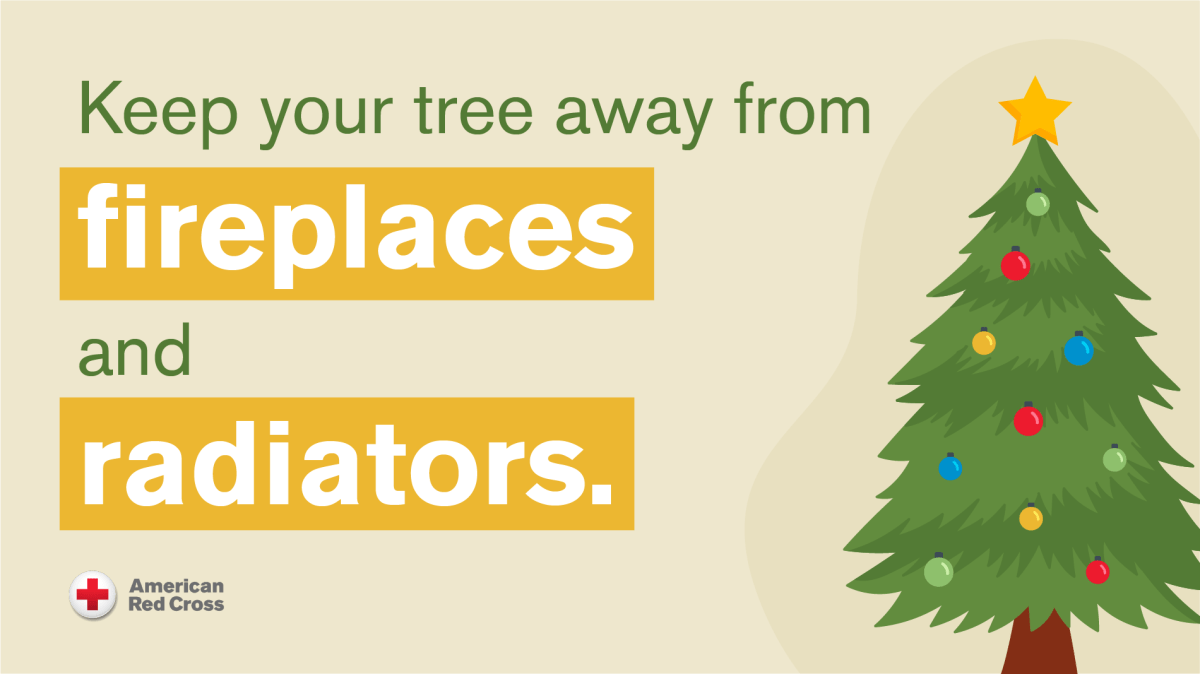
If you’re buying an artificial tree, look for the fire-resistant label. When putting it up, keep it away from fireplaces, radiators and other sources of heat.
If you’re getting a live tree, make sure it’s fresh and water it to keep it fresh. Bend the needles up and down to make sure no needles fall off.
If you’re using older decorations, check their labels. Some older tinsel is lead-based. If using angel hair, wear gloves to avoid irritation. Avoid breathing in artificial snow.
When decorating outside, make sure decorations are for outdoor use and fasten lights securely to your home or trees. If you’re using hooks or nails outside, make sure they are insulated to avoid an electrocution or fire hazard.
If you’re using a ladder, be extra careful. Make sure to have good, stable placement and wear shoes that allow for good traction.
Don’t use electric lights on metallic trees.
Remember to turn off all holiday lights when going to bed or leaving the house.
Keep children, pets and decorations away from candles.
If you’re hanging stockings on the fireplace mantel, don’t light the fireplace.


 Red Cross Emergency App: To stay informed and prepared during severe weather, download the free Red Cross Emergency app. Customize 40 different weather alerts, toggle between English and Spanish, and ensure accessibility for people with disabilities. Text “GETEMERGENCY” to 90999 or find the app in your app store.



 American Red Cross Minnesota and Dakotas Region