Every Step Counts When You’re a Veteran Supporting Veterans

Curtis Ghylin

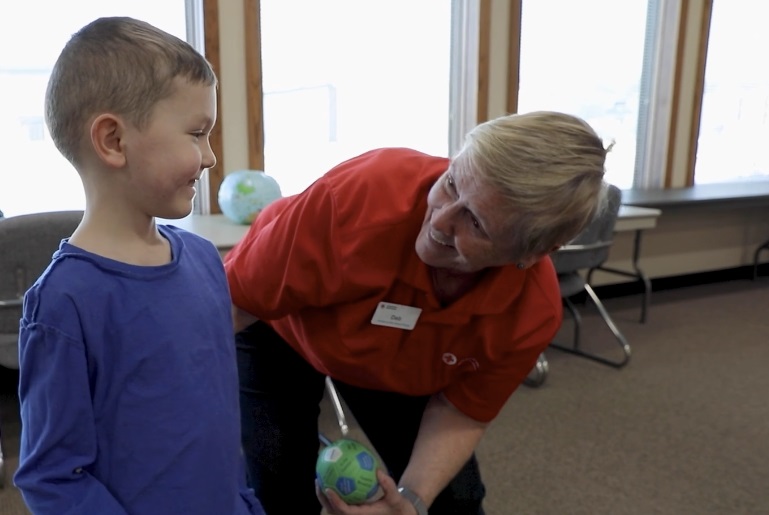
On Friday mornings, Curt Ghylin gets many steps in during his morning volunteer shift at the VA Medical Center in St. Cloud, Minnesota. The steps add up to around four miles. “I feel pretty lucky,” says Curt, who is 87 years old.

He racks up the steps while he pushes patient after patient in wheelchair after wheelchair going from x-ray to lab to cardiology or other appointments. Established in 1923 for World War I veterans, the medical center is a sprawling complex on the National Register of Historic Places.

Curt has walked its halls for twenty-two years while serving as an American Red Cross volunteer supporting veterans who served in more recent armed conflicts. His role places him at the hub in Building One. Patient assignments arrive at the main entrance or on the house phone.

“Front desk, this is Curt. Can I help you?” he says when answering a call. The assignment will take around 30 minutes. At the pick-up point, “We’ve got the right guy,” he says, and takes the handles of a regular patient’s wheelchair and starts the journey.

“He’s got good legs,” says the patient when asked to describe Curt and his help for someone who’s just a couple several years older. “Good people here,” the patient adds.

You could call Curt good people or simply a veteran helping veterans. In the 1950s, he served with the North Dakota National Guard and then in the 1960s with the U.S. Air Force as a “crypto operator,” which supports information intelligence. His stations included Libya, Wyoming, Nebraska and Louisiana. After leaving the military, he became a teacher and then flourished as a computer programmer in Minnesota.

He retired in 2003, and he looked for places to volunteer. A church friend and Red Crosser recommended reaching out to the VA. He did and folks there agreed: Curt would be a great Red Cross rep. Since then, the steps haven’t stopped – from supporting people in their adult day care program to his current role as a greeter and escort, Curt has put in his miles.

“He needs a wheelchair? Big guy? Little guy?” Curt asks when the phone rings again. Curt tends to that request and returns to the desk. A man with striking white hair ambles up. “Thanks for your help this morning. Ninety-two years old. It happens fast,” he tells Curt. The two share a warm moment in a place where people make friends.

When the volunteer shift change happens, his replacement stops by and asks about Curt’s fall. A few weeks ago it landed him face down on the pavement while with his running group that’s now slowed to a stroll. He shows a photo of his broken nose. New to everyone is a scruff of beard covering his stitches and scars.

As soon as possible after the accident, he got back to his volunteer work at the VA and other community organizations in the St. Cloud area. “It’s important and there aren’t enough people doing it,” he says. “I was born to worry about somebody else.”

A bonus for Red Cross and those we serve: Curt is a regular blood donor who recently reached a 23-gallon milestone.

Story by Lynette Nyman with the American Red Cross Minnesota and Dakotas Region. To learn more about regional Service to the Armed Forces programs, please RedCross.org/MNDAKS.

“Everything Comes Full Circle”: Deb Perkins, Army Veteran and Red Cross Volunteer

One day in Buffalo, Minnesota, early in 1973, a girl named Deb Butman came home from high school with an announcement. “Hey dad, I’m going to join the army.”  

Deb Perkins, ca. 1973. Submitted photo.

Her dad, an U.S. Army Air Corps staff sergeant who served in the UK and Africa during World War II, laughed because he knew his daughter ‘did not like being told what to do’ says Deb, when reflecting on her impulse to enlist. And yet, Kenneth Butman stood by his daughter and was proud she chose to carry on the family’s legacy of military service.  

Deb hoped to attend the army’s language school with a focus on Russian. Being unable to get the right security clearance, the found herself presented with other recommendations like becoming a cook. “No thanks,” she said.

Even so, that summer at the tail end of the Vietnam War, she found herself in the thick humidity surrounding Fort Anniston in Alabama. There she stood, barely 18, among a group of female soldiers of different ages and backgrounds attending bootcamp.

Julie (l), Jonetra (c) , and Deb (r), taking a break during bootcamp, ca. 1973. Submitted photo.

She made friends with Julie, another soldier. A friendship grew and soon they were chosen to call out drills, earning the nicknames ‘Putt and Butt,’ which referred to their last names. Deep bonds developed with soldiers and leaders. “You respect those people training you,” she says. “You build a kind of family, whether you mean to or not.” 

Despite the challenges for women, Deb proved herself and established credibility. She went from Alabama to Texas where she trained to become a medical corpsman. “You’re smiling,” said one instructor. “I’m a happy person,” she said. “You won’t be after you spend a few days with me,” the instructor said.

One day, tragic news arrived from her first lieutenant, who approached Deb while she was standing at attention. “I don’t know how to tell you this. Your dad died,” she said simply and, with what Deb recalls, little empathy. It turned out that Deb’s dad did not survive a heart attack.

Kenneth Butman, ca. 1940s. Submitted photo.

Thankfully, and within moments of receiving the life-changing news, Deb’s first sergeant wrapped an arm around her. “We’ll get you home,” he promised and brought her to the American Red Cross office on base where a flight was arranged. She was back home the same day to be with her family in Minnesota.

Deb Perkins, circa 1973. Submited photo.

The next year, “we were in the middle of nowhere” Deb says about being at Fort Dix in New Jersey. She when to work, administering shots to deploying soldiers and tending to children in the pediatrics unit. Her patients included a young man with severe burns from a stove explosion. “You have a nice touch,” she remembers him saying through bandages and pain. “I’m glad I can help you feel better,” she replied, meaning every word.

Deb’s military service lasted three years, which was the length of commitment at the time. She received her honorable discharge under President Nixon, one of the last before he resigned.  

“Things will be as they’re meant to be.”

After the army, Deb used the G.I. Bill to pay her way through school and eventually found herself back where her heart had always been – working with kids. First as a teacher and then, after earning her master’s degree, as a licensed mental health therapist. 

She married Clark Perkins, also a licensed therapist. Together, they opened a small practice in Brookings, South Dakota. The work was meaningful and rewarding. And yet she found room in her life for more. She was, in fact, called to Red Cross service, especially because it was “instrumental when I was a struggling soldier.”  So, in 1997, Deb took up another uniform – that of the Red Cross volunteer.

“Play is our language,” says Deb Perkins, who was in Fargo this past April to lead an ’emotional grit’ workshop for military families. Photo: Mutz Media

At first, she was a general volunteer, but her long-time connection to working with children and families led her to disaster mental health. Then, someone suggested that she would be a great fit for supporting military families and veterans through Service to the Armed Forces (SAF), a program going back to the beginning of the Red Cross.

That fit has turned out to be true and an echo of her dad’s often shared sentiment that “things will be as they’re meant to be.”

For nearly 14 years, Deb and Clark have traveled across the country, helping military families through deployments, separations, and loss. “This work is near and dear to my heart,” confesses Deb. Together, they’ve been to Michigan, Alabama, New Hampshire, Texas, Minnesota, Iowa and the Dakotas. They’ve also provided virtual support and training to service members and families in Hawaii and Japan.

Deb Perkins leading an ’emotional grit’ workshop in Fargo, ND, April 14, 2025. Photo: Mutz Media

She recalls one time at a military camp for kids. “Of course, the first day it rained, so we handed out garbage bags to keep the boys dry.” But one boy stood apart, telling everyone that he didn’t have a daddy, that he’d killed himself after Iraq. “It was profound. And it was amazing how the rest of the kids came together to support him,” she remembers.

Over the years, they’ve seen some kids multiple times – before and after deployments. “When they know us, they feel more comfortable and more willing to share,” says Deb. One boy told them, “Hey, I remember you guys!”

That familiarity matters when supporting kids and families through grief, laughter, and healing. Serving in partnership with her husband Clark helps, too. “We’ve learned to bounce off each other and it works. Play is our language,” she says. “And really, we should all play more.” 


U.S. Army veteran and Red Cross volunteer Deb Perkins supports resiliency and other ’emotional grit’ workshops. Photo: Mutz Media

Today, Deb credits her military service for shaping her, helping her grow up. “I’m glad I did it,” she says. Her goal is to grow old with grace while continuing with the Red Cross. “Volunteer work helps you stay involved, connected, and giving back.”  

To learn about current opportunities, pleasle visit RedCross.org/GiveTime.

New Volunteers at Military Treatment Facility continue Red Cross tradition

Referred to as the ‘clinic,’ the 5th Medical Group (5DG) on Minot Air Force Base in North Dakota, offers all kinds of healthcare, including urgent care, routine wellness, internal medicine, women’s health, pediatrics and more, to around 12,000 active-duty military and their family members.  

“At one time or another, they all have to be seen,” says the 5DG’s Chief Nurse and Lt. Col. Donna Eaton, who’s also a Red Cross volunteer board member based in Minot. “Some providers see 80 to 100 patients a week.”

Pictured (l to r): Red Cross volunteers Kristin Settersten and Amanda Conte; Red Cross volunteer and First Lieutentant Ashley Manzano-Latorre; 5 MDG Chief Nurse and Lt. Col. Donna Eaton; 5 MDG Nurse and Lt.Col. Jessica Scirica, Red Cross SAF Regional Manager Lorie Herbal and Red Cross Executive Director Zoe Wergeland Manstrom at the 5 Medical Group (5 MDG), Minot Air Force Base, March 19, 2025. Photo: Lynette Nyman/American Red Cross

To help provide care at the clinic, the American Red Cross Minnesota and Dakotas Region has launched a new volunteer program to the 5DG’s clinic. Three new volunteers – two of whom are licensed nurses – will help tend to patients just like regular nurses, or they will support projects, depending on their availability.

Take First Lieutenant Ashley Manzano-Latorre, an active-duty missileer who’s making time to volunteer. She helped to provide disaster relief during Hurricane Maria in Puerto Rico. “I like helping people,” she says. In addition to her career in the Air Force, Ashley plans to build on her education, training, and interest in healthcare.

Amanda Conte, also a new Red Cross volunteer, has a spouse who’s deployed to MAFB, which is home to the 5th Bomb Wing and 91st Missile Wing. She’s likely to have a role at the clinic in supporting pediatrics based on her professional nursing experience. “I want to keep up with my nursing skills and help out the military, be involved,” she says.

Support for the US military dates back to when American Red Cross founder Clara Barton tended to the ill and injured during the Civil War.

“Our Military Treatment Facility program is a continuation of that tradition,” says Lorie Herbel, Regional Manager of Service to the Armed Forces for the Red Cross in North Dakota. Two years in the making, she says, “We’re really happy to see this program come together at Minot Air Force Base. We’re thankful for everyone working together to help meet patient and clinic needs.”

The volunteer experience will be tailored, making it possible for them to do all kinds of things, including health promotion and prevention, says Lt. Col. and nurse Jessica Scirica. “I’ve been doing education and training for a very long time. It’s vital that we have a good relationship with the American Red Cross.”

Now that the new volunteers are through the screening, orientation and overall warm welcome, which was hosted at the base in March, the volunteers will have additional training at the clinic. With her years of experience in family medicine and women’s health, Kristin Settersten is eager for her assignment. “I always wanted to volunteer.”

For more about Red Cross services for military members, their families and veterans, click here. To learn about volunteer opportunities in the Minnesota and Dakotas Region, click here. To read more about our MTF program at Ellsworth AFB, click here.

Story and photos by Lynette Nyman/American Red Cross

See the Need, Meet the Need

The Inspiring Story of June (Ahlfs) Qualy

Growing up, I was always very close to my grandmother, June (Ahlfs) Qualy. She taught me to read by the age of three embroider by the age of seven and the importance of helping those who need the most help by 12, at which time she encouraged me to take my first Red Cross class in babysitting. While most pre-teens spent their time at the mall or playing with makeup, I was busy learning the basics of survival skills and how to properly tie a makeshift sling in case of a broken arm. By 16 I was in Red Cross lifeguarding classes and became First Aid and CPR certified via a college class at 21. June was always a beacon of light in my life, modelling what a responsible, compassionate person in our society looks like.

It wasn’t until I joined the American Red Cross in 2022 that I started learning more about June’s time serving with the Red Cross in World War II. She had just graduated from St. Catherine University in 1945, where she was an active member of the League of Women Voters, and then entered the nursing service of the Red Cross. June was deployed to Hiroshima and Tokyo, Japan, where she witnessed firsthand the devastating aftermath of the war. Her experiences there shaped her perspective on human suffering and the power of compassion to heal.

Red Cosser June (Ahlfs) Qualy, 1946.

June served with the Red Cross until she decided to marry and start a family in 1949. However, her commitment to helping others didn’t end there. She went on to have a wonderfully impactful career at Saint Mary’s in Minneapolis as a chemical dependency counselor at their inpatient rehabilitation facility. June was known to be the toughest counselor on staff, often assigned the patients who were least likely to recover. Her approach was firm but compassionate, believing in the potential for change in even the most challenging cases.

“June always said, ‘see the need, meet the need’ and that keeps me going every day.” – Sarah Qualy, June’s granddaughter

Image of cover of book, "Saint Mary Blue" by Barry H. Longyear

June’s dedication and unique methods led to an alarming success rate despite the odds. Her work was so influential that former patient Barry B. Longyear wrote a book about her in the 1980s called “Saint Mary Blue.” This book not only chronicled June’s methods but also highlighted the lasting impact she had on countless lives.


When I think about June, I think about the tenacity of what it means to be a woman in times of crisis. Much like our Red Cross matriarch, Clara Barton, June embodied the spirit of humanitarianism that requires not only compassion and philanthropy but also courage and defiance. In this spirit, I’m reminded of my favorite Clara Barton quote: “I have an almost complete disregard of precedent, and faith in the possibility of something better. It irritates me to be told how things have always been done. I defy the tyranny of precedent. I go for anything new that might improve the past.”

While my Grandma June is no longer with us, having passed away at almost 90 in 2013, I know that I carry her light within. There’s a fire inside me that I learned from her, to step up for our community in times of tribulation. To not fear the emotions of disaster, but to use them to alchemize into action. June always said, “see the need, meet the need” and that keeps me going every day. Her legacy lives on through the countless lives she touched and through those of us who continue to serve in the spirit of the Red Cross.

By Sarah Qualy, proud Red Crosser, following in her grandmother’s footsteps

As we celebrate March as both Red Cross Month and Women’s History Month, honor June’s legacy by joining the American Red Cross in our mission to alleviate human suffering—whether it’s through volunteering, donating blood, or making a financial contribution, your support can make a difference in your community and beyond. Visit RedCross.org/MNDAKS to get involved.

Touching lives, caring for patients

Red Cross volunteers in South Dakota honor the tradition of providing care and comfort for injured service members

“It’s just such a wonderful feeling – it’s my privilege to help out,” says Judy Button, a Red Cross volunteer at the Military Treatment Facility (MTF) on Ellsworth Air Force Base in Rapid City.

A retired operating room nurse and wife of an Air Force retiree, Judy jumped at the chance to help after learning about the need for volunteers at the MTF. Judy serves as pharmacy assistant.

Red Cross volunteer Judy Button serves as a pharmacy assistant at Ellsworth AFB in Rapid City, South Dakota. Photo submitted.

“I do whatever it takes to make the pharmacist’s job easier – from unpacking boxes and stocking medications to removing outdated medications – I try to free them up, so our veterans and active-duty service members don’t have to wait long for their prescriptions,” she says.

Judy’s skills and medical knowledge learned from working in an operating room carry over to the work she does in the pharmacy. “It was nothing new to me – I asked a lot of questions, but they didn’t have to do a lot of teaching.”

The American Red Cross has a long history of helping members of the military community – from its start with its founder Clara Barton and her work during the Civil War.

“From the time a service member takes their oath to navigating life as a veteran and every step in between, we’re there to help with the challenges of military service,” says Richard Felix, a regional SAF program manager for the Red Cross in South Dakota.

Lesser known is the work done at military hospitals and care facilities across the country and around the world. Our work at the Ellsworth MTF honors this long-standing tradition.

The Minnesota and Dakotas Red Cross Region currently has six hospital volunteers at the Ellsworth MTF, several serving since the start in 2017. They support a variety of departments, including pharmacy, lab, and insurance. The partnership between the Red Cross and the 28th Medical Group at Ellsworth has been great, says Felix.

“Being able to support various departments within the MTF, and ultimately serving our military community, is special. Volunteers at the MTF are unsung heroes who dedicating their time and knowledge.”

Cheryl Lemley serves as a healthcare office assistant. “I’ve got a lot of institutional knowledge,” chuckles Cheryl. No stranger to military life, Cheryl was born in Germany where her father was stationed. She grew up as an “Army brat” and is a Navy veteran herself.

She’s a newer Red Cross volunteer, starting her service in June 2023. Cheryl spends about 8 – 12 hours a month working at the Ellsworth MTF.

“It’s one of my biggest joys in life to help military members, veterans, and their families navigate the complexities of Tricare and hopefully get better outcomes on their claims.”

She enjoys being a part of the Red Cross. “The Red Cross is there to help, just like I’m helping the military community – letting them know that their sacrifices haven’t gone unnoticed and trying to make things a little easier – it’s just an awesome feeling to lessen the burden for them.”

Efforts are also underway to establish a MTF volunteer program at the Minot Air Force Base in North Dakota. Once approved we’ll start recruiting volunteers.

Click here to learn more about our work supporting military members, their families and veterans. To become an SAF volunteer, click here.

Northland Embraces Purple Up! for Military Kids

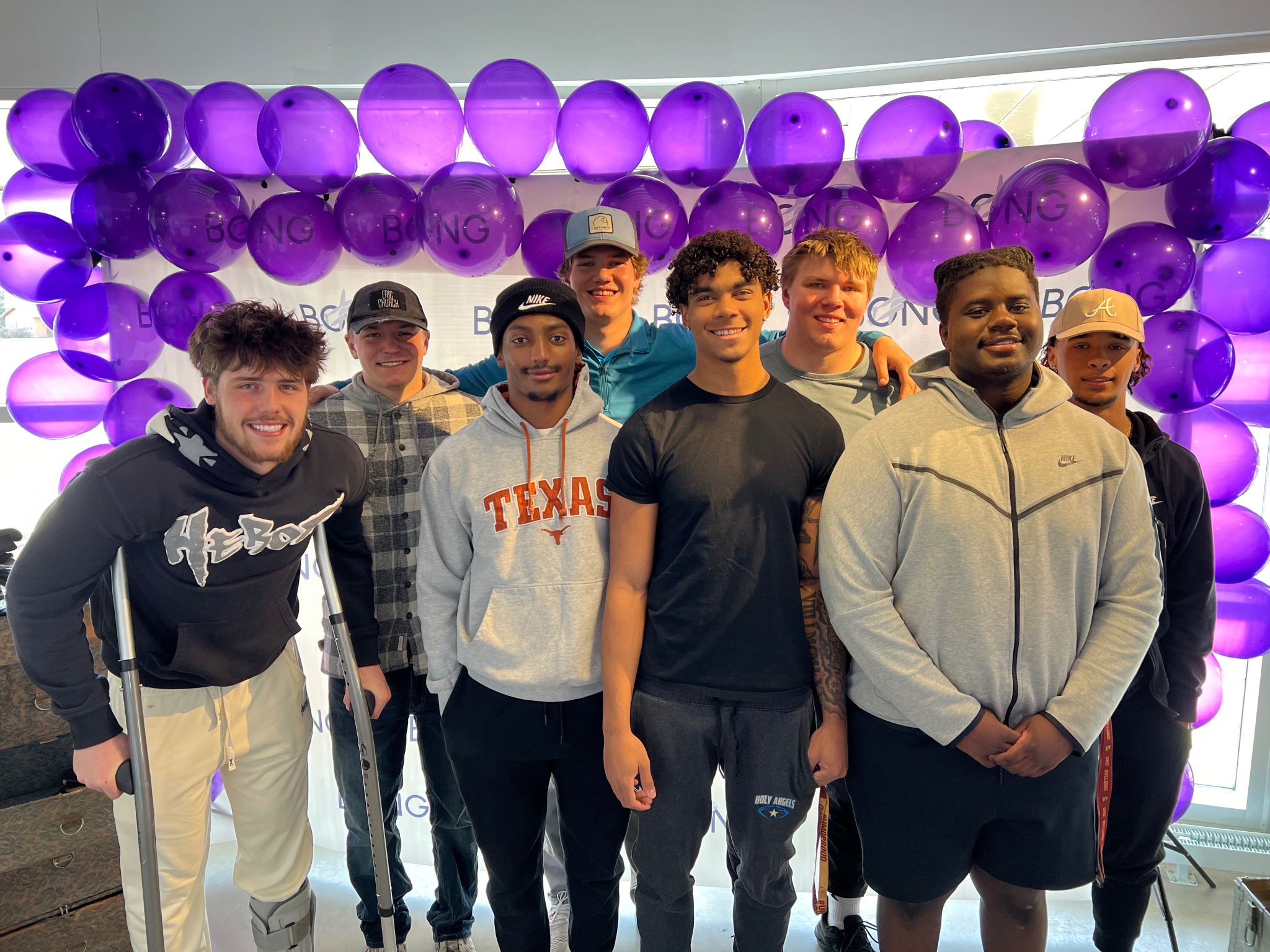
University of Minnesota Duluth (UMD) football players who volunteered at the first Purple Up! Northland event which held this year on Saturday, April 13, 2024, in Superior, Wisconson.

On Saturday, April 13, we were able to bring Northland military families some Purple Up! support that generally happens in the Twin Cities or other large metro areas. These events happen around the nation each April, which is the Month of the Military Child. (A little more about the background of Purple Up! events here.)

This year, there was a desire by the local military community to bring an event like this to the Northland. And we were delighted to take part. We had families come from as far away as Ely and Willow River to participate!

We had partners from a bunch of organizations and local Red Cross volunteers, including those who serve with the Minnesota Army National Guard and those who work with local community partners like Essentia Health and US Bank. And through our partnership with University of Minnesota – Duluth Athletics, we had nine football players who volunteered. The students did an amazing job interacting with the around 40 military kids and their parents.

Our football volunteers ran games outside and tasked kids identifying who built up others, who were supporting their fellow participants, hyping up their friends as well as kids they did not know.  When the end of the event came and it was time to give out special prizes, the football players called kids one by one and shared what they had done to be selected – ranging from “you helped your little brother” to “you were cheering for everyone!” A big part of work like this is to make sure military families feel connected and supported by each other and the community.  The UMD football players were 100% that. 

Our favorite picture is the compilation above when our Regional Service to the Armed Forces Director (SAF), Jeff Kazel gave a young man the final ‘grand prize.’ After, the young man shook the hand of each and every one of the football players.  It was very sweet, and we think a couple of them might have got a little ‘dusty’ from it.

P.S. Much, much thanks to Red Cross volunteer Julie M. for tracking down some great giveaway prizes and to 148th Fighter Wing Family readiness leader Suzy H. for wanting to get this going in the Northland.

Red Cross helps unite military family following explosion and home fire

“I didn’t know that emergency communications for military families in times of a disaster was something the Red Cross could help with.”

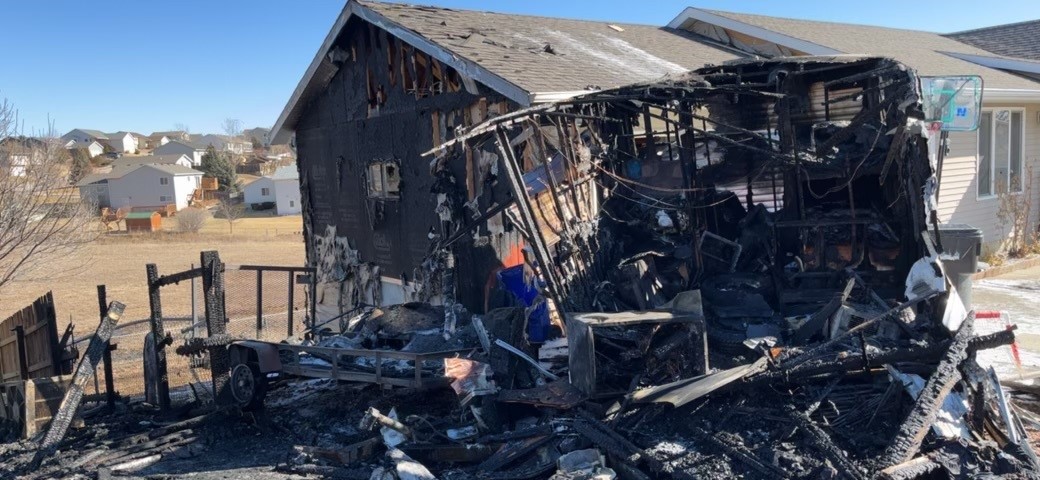
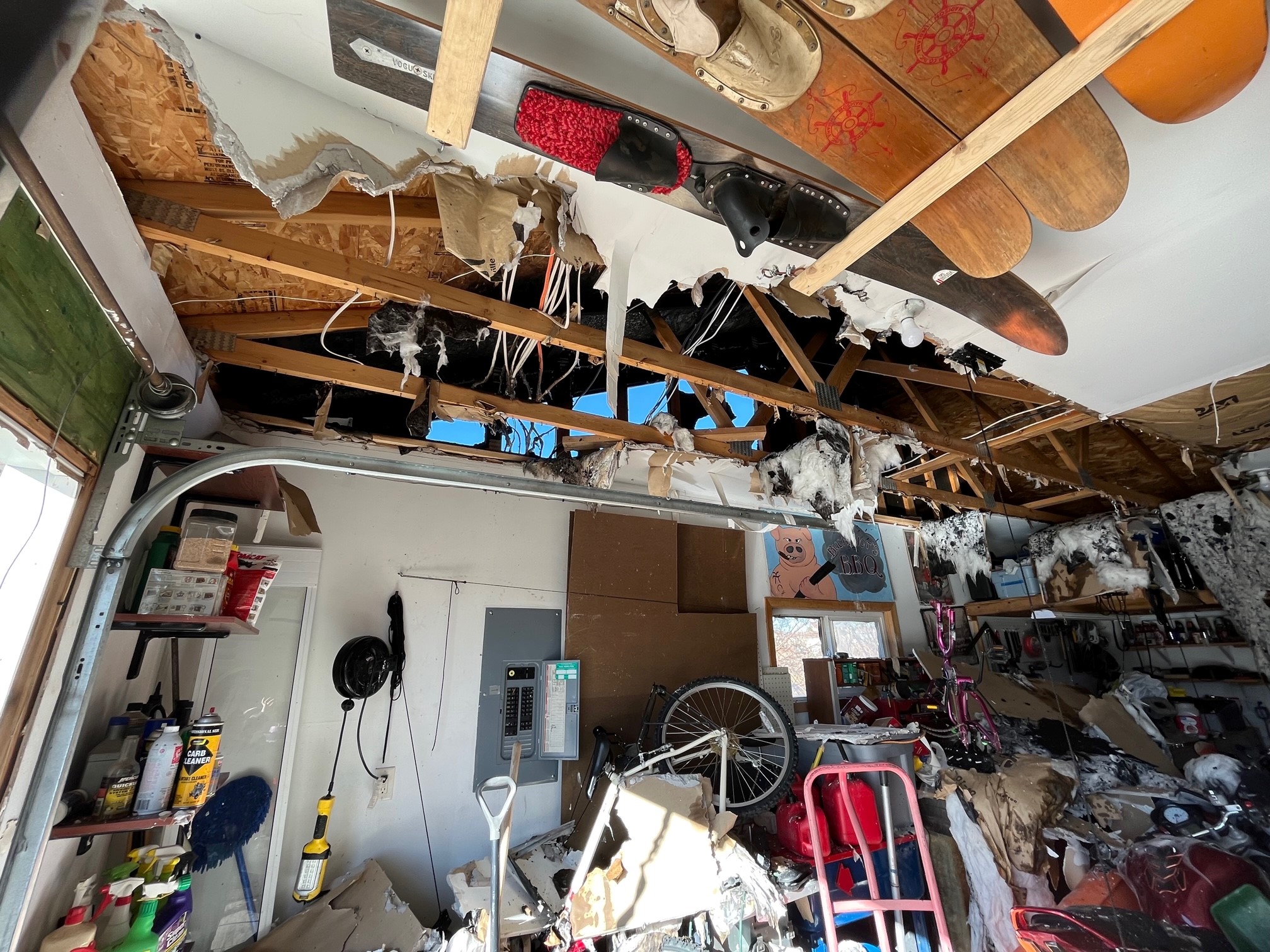
Early one morning in February, in Rapid City, South Dakota, a loud noise awakened Misti O’Connor. “Startled, I rushed outside to see what was going on and I could ‘hear’ the gas,” said Misti. A vehicle had crashed through the camper parked in her driveway, and then into her neighbor’s home, rupturing a gas line and causing the home to explode. This set the O’Connor’s garage on fire.

Aerial view of the damage at the O’Connor’s and neighbor’s houses. Submitted photo.

Misti ran back into the house to get her kids and that’s when they heard the next explosion. “It was really scary,” recalls Raenan, her 8-year-old son.

The O’Connor’s garage and camper following an explosion at their neighbor’s house. Submitted photo.

Back outside, Misti tried calling her husband, Jason, a staff sergeant deployed with the South Dakota Army National Guard on U.S. southern border. “He didn’t pick up at first because it was the middle of the night.  I had to try several times.” Finally, they connected and once Misti explained what was happening, they both started making calls to see if they could get him home. Jason informed his guard command that there was an emergency at home and he needed to go.

Meanwhile, the local Red Cross disaster action team (DAT) was dispatched to respond to the fire and immediately mobilized volunteers, staff and the emergency response vehicle. On-site they provided hot chocolate to the first responders and people affected – and made sure everyone had a warm place to stay.

Extensive damage inside the O’Connor’s garage. Submitted photo.

Richard Felix, regional manager for Red Cross’s Service to the Armed Forces program in South Dakota, was part of the fire response team. Once he found out that Jason was deployed, he informed them of the Red Cross emergency communications program for military members. “Being on-scene was crucial in helping this family make a connection and getting Sgt. O’Connor home when his family needed him most,” said Richard.

“I didn’t know that emergency communications for military families in times of a disaster was something the Red Cross could help with,” said Misti. “We don’t like to accept help from others, so I was very reluctant, but I’m glad the Red Cross was there to help!”

They made the necessary arrangements through the Red Cross and Jason was on a plane headed home to be with his family by Saturday afternoon – just a day after the disaster. “The Red Cross made it so easy,” Jason said.

Having her husband home during this time was “everything” to Misti. “At first, we didn’t know the extent of the damage, but once I saw it, I realized I needed him home. I don’t think I could have done it without his help – I could have, but it would have been hard.”

“I definitely needed to come home to be with my family – to provide moral support,” said Jason who was able be at home for 10 days before returning to his deployment.

The O’Connor family spent five nights in a hotel before returning to their home. There’s still no electricity in the garage, but they’re getting close to having the work completed. “We’re just grateful things weren’t worse, and Jason was able to be home with me and the kids during such a scary and uncertain time,” said Misti.

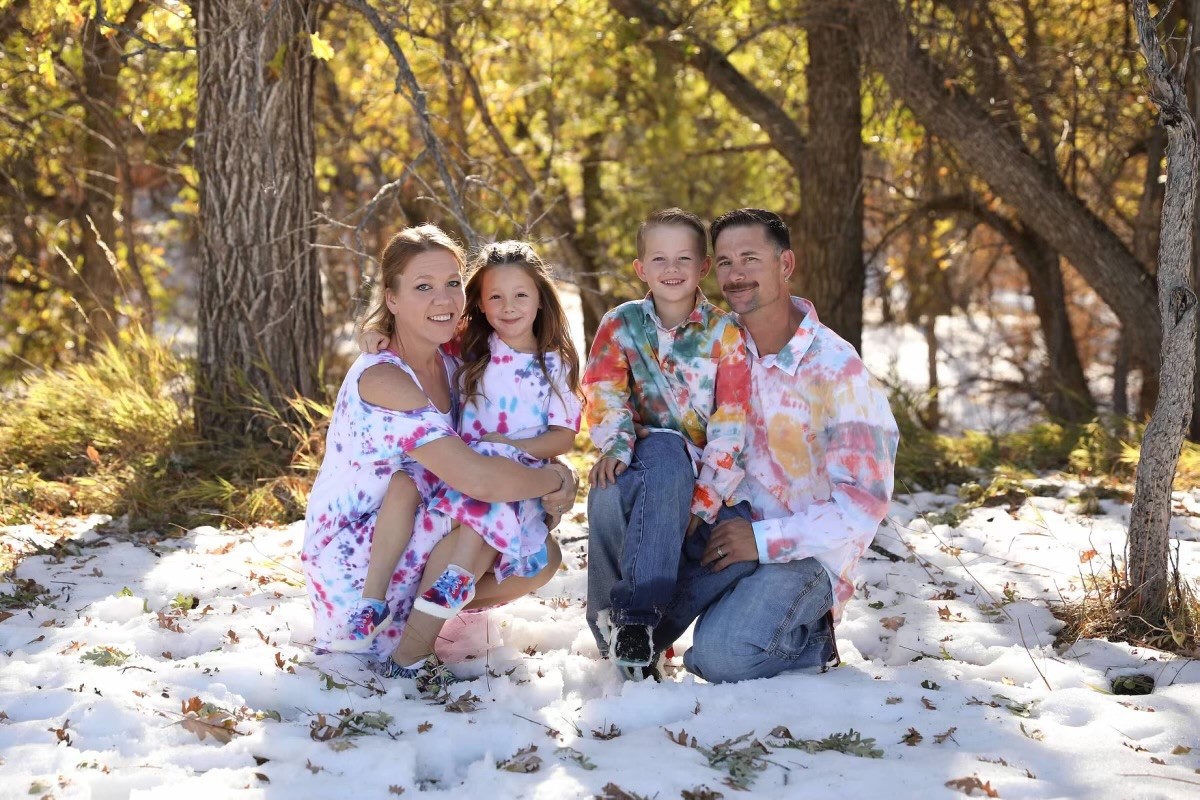
Misti and Jason O’Connor with their children Raenan (8) and Lorelai (6). Submitted photo.

The Red Cross helps members of the military, veterans and their families prepare for, cope with, and respond to, the challenges of military service. Click here to learn more about Red Cross services for military and veteran families.

Welcome Archie!

Meet our newest (and cutest) Service to the Armed Forces (SAF) volunteer in the Minnesota and Dakotas Region. This certified Golden Retriever Therapy Dog joins owners Dan and Kathie Brusseau, and Dillion, their first therapy dog, to bring joy, positive energy and smiles to everyone they meet.

Welcome Archie to our SAF team!

Since 2020, the Brusseau’s have been valuable members of our SAF team. You might recall first meeting Dillion in 2021 when he visited hospitalized veterans who were experiencing high levels of isolation during the pandemic. 

The newly formed foursome are now spreading double the love and kindness. They visit various locations in central and western South Dakota including the Rapid City Airport, Fort Meade Veterans Affairs Clinic in Sturgis, South Dakota, and attend other military-related events across the region.

Dan, Kathie, Archie and Dillion bring joy, positive energy and smiles to everyone they meet.

“Their goal is to provide comfort and happiness to someone’s day,” says Richard Felix, Red Cross Regional Program Manager, Service to the Armed Forces. “Whether they are comforting high stressed travelers at the airport or providing a gentle interaction with a Veteran at the clinic, the Brusseau’s and their therapy dogs provide an exceptional service to our community.”

Felix adds, “These four are such a blessing and valuable part of our SAF team, spreading kindness everywhere they go!”

Across the country and around the globe, American Red Cross therapy dogs use their time and talent to serve the community in unique ways. They comfort disaster survivors who may have lost everything after a storm, veterans receiving medical care at hospitals, and military families in need of support before, during and/or after deployment.

Be sure to give Archie a Red Cross welcome!

Click here to learn more about how the Red Cross helps service members, veterans and their families.

Desperately Seeking Sewers

Red Cross is asking home stitchers to make face coverings for service members, veterans and their family members

Face coverings volunteers sent to the Fargo VA for veterans and their families, May 2020.

Continuing Legacy
For more than 130 years, the American Red Cross has provided comfort and care to service members, veterans and their families. One long-standing activity is the Red Cross program to knit socks and helmet liners, sew coverings for casts, and crochet or quilt lap blankets for injured wheelchair patients.

We’re continuing this legacy during the COVID-19 pandemic crisis because an ongoing need exists for face coverings that people can wear on military installations, at veteran’s homes and hospitals, and other areas where they are required. To help, our volunteer workforce is joining others to help sew and distribute these coverings.

Take for example Judi, a long-time Red Cross volunteer in Minot, North Dakota. She made 170 (wow!) of the 262 we’ve given so far to the VA in Fargo, ND. “I’ve always felt that everyone should take care of our veterans, in any way that we can. It’s a small gesture, but one that’s greatly needed. It’s a privilege to be able to help,” says Judi, who’s also a military veteran.

Get Sewing
If you’re interested in making face coverings to support service members, veterans and/or their families, please read this article from the CDC for sewing and design details. We’re particularly looking for face coverings made with gender neutral, masculine, or patriotic fabrics and sewn at home by hand or machine. We especially recommend that they’re sturdy enough for industrial laundry machines.

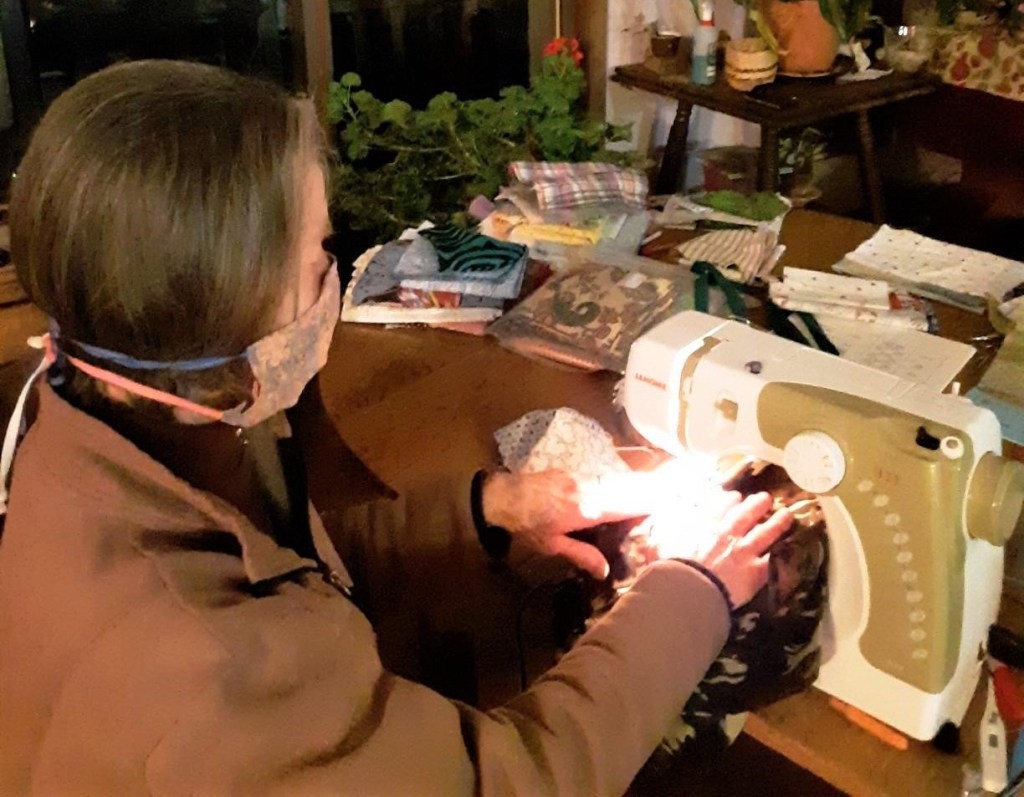
Community stitcher JoAnn sews face coverings for distribution at the VA in Hot Springs, SD, May 2020.

JoAnn, pictured above at her sewing machine, made face coverings for the VA in Hot Springs, South Dakota. For her, taking up the sewing project was a way to come together during a time when lives have changed so much and so quickly. “I learned about the need for face masks and just one mask turned into forty!  The challenge encouraged me to keep reaching out. Thank you for the privilege and honor to assist the Red Cross and the VA.”

Stitching Tips
• Consider expanding the sizes seen in the link above to accommodate a wider variety of face types/sizes (man vs. woman, facial hair, etc.).
• Using a softer material for the interior part of the covering can make it more comfortable to wear.
• Launder and dry material prior to making face coverings to reduce the chance of shrinkage.
• Tie closures provide greatest size and comfort accommodation as well as making them sturdier for multiple washings in heavy-duty laundry machines.

Final Step
When your home stitched face coverings are ready, reach out to our Service to the Armed Forces (SAF) team at minnesotadakotassaf@redcross.org for mailing or drop-off information. Working with our volunteers, our team will verify the need for face coverings with service member partners and make arrangements for delivering your home-sewn coverings to where they’re needed most across our Minnesota and Dakotas region.

Thank you so much for helping our military heroes!

An American Red Cross historical poster from World War I.

Step aside Baby Yoda: Red Cross gets soldier home in time for Baby Cory love

By Lynette Nyman/American Red Cross

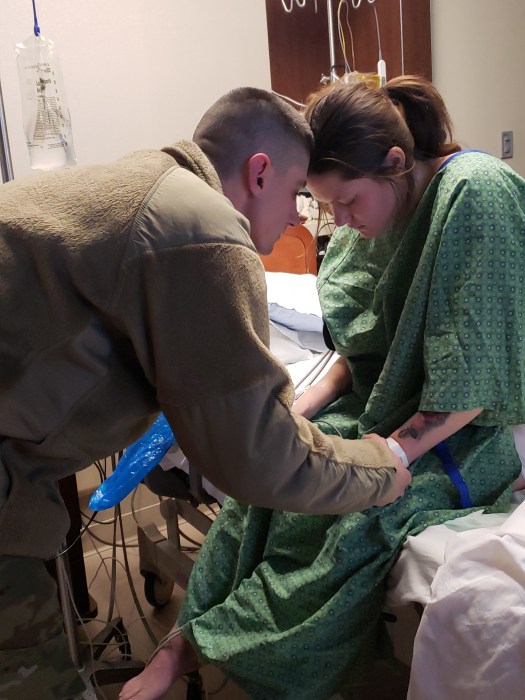
Late on January 25, Sergeant Cory Hicks was preparing for the next day of training in Virginia when he answered a call from his fiancé, Sergeant Shanyn France in Minnesota.

“They hold each other up,” says Janelle France about the relationship of her daughter Sergeant Shanyn France and Sergeant Cory Hicks. (Family photo)

She had just taken a shower but could not get dry. “Just dry off, I told her. I can’t, she said, water is running down my leg. I got a call back later that said her water broke and that she was going into labor.”  This was one month before their baby was due.

Cory remembered his training packet and a Red Cross brochure tucked inside. The ‘Hero Care Network’ brochure explained the steps for requesting emergency communications assistance. Cory reached out to his course instructor who said maybe the Red Cross could help.

Once the test results confirmed Shanyn’s water had definitely broke, her mom Janelle France made the call to Red Cross that would get Cory home. She provided all the information needed to give him the best chance of getting home. “We were also texting Cory to try to not have him panic,” she says.

Cory rarely panics these days. He has served 12 years in the U.S. Army Reserves with the 353rd Transportation Company based in Buffalo, Minnesota. When he was 19 years old, he deployed to northern Iraq where he supported fuel missions. “If you get me behind the wheel of a trailer, I’m phenomenal at it,” he says. The premature birth of his first child was another matter. “It was nerve racking because Shanyn was dilating a centimeter every hour.”

Sergeant Shanyn France, Cory Junior, and Sergeant Cory Hicks together as a family for the first time. (Family photo)

At around 4 a.m. on January 26, a verified Red Cross message arrived and requested his return. He’d have to drop leadership training for now. It was, his instructor said, Cory’s decision. That day, he got the last seat on the last flight going to Minnesota. Word of the crisis made its way to the Delta pilots, who asked everyone to stay seated while Cory exited. “The whole plane erupted, and I got to run off the plane. It was pretty cool. That could have been the difference between me making the birth because I had just an hour to spare until baby Cory was born.”

Shanyn was scared. “I was excited, but I was scared that he was not going to make it in time because airports are always tough to get through.” She hung on while Cory raced to the hospital in Coon Rapids. “He didn’t have time to change out of his uniform. I don’t even think I gave him a hug because I was so miserable.” She then asked for an epidural after 23 hours in labor.

Being there for the birth of his child was only part of Cory’s urgency. The other part was “just being able to comfort Shanyn while she was in a lot of pain,” he says.

Baby Cory arrived one month early. “It’s pretty amazing,” says his dad Sergeant Cory Hicks who arrived with only an hour to spare before Cory Jr.’s birth. (Family photo)

“They hold each other up. And there’s nothing these two won’t do for that little boy,” says Janelle, who has worked every reserves drill weekend at unit headquarters since her daughter joined in 2016. “Without the Red Cross he would not have made it home.”

Baby Cory, also known as “CJ” for Cory Junior, is doing well at home after spending six days in a neonatal intensive care unit. Cory was there throughout each. He’s grateful for what the Red Cross does for service members. “Over the 12 years of my military experience I’ve heard about Red Cross, saw it work for others. I was skeptical until I had to use it. Someday I hope to give back.”

Click here to learn more about Red Cross services for military and veteran families.