We’re ready to help military kids manage stress

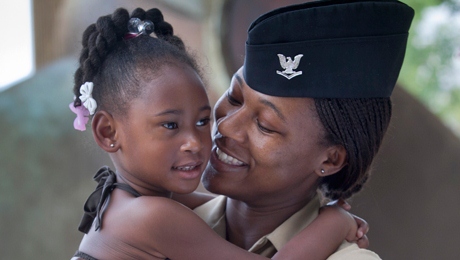
reconnection-workshop-a-spot_cropThe American Red Cross has two new workshops that help children of military families to manage challenges that are specific to their lives. The workshops, Roger That! Communication Counts and 10-4: Confident Coping, teach essential life skills for military kids and teens to better manage stressful social situations.

“All kids face challenges,” says Diane Manwill, a behavioral health expert with the American Red Cross. “They are growing up and learning to navigate social situations. However, challenges faced by military kids may be compounded because military families move more frequently and family members may be more absent due to military deployments.”

Each of the workshops is composed of two modules with activities designed for children 8 to 12 and teens 12 to 18 years old. The Roger That! Communication Counts workshop focuses on the importance of developing quality interpersonal communication and listening skills. Operation 10-4: Confident Coping focuses on bolstering strengths present in older military children to help manage stressful situations. The new workshops are part of the Red Cross reconnection workshop series.

“My children have participated in these workshops and they make a difference,” says Kelsey Liverpool, co-founder and president of Kids Rank. “It helps because it gives children of military families a place where they can talk, where they feel safe, be with other people who understand what they are going through and learn how they might better adapt to their situation.”

Red Cross volunteers, who are licensed behavioral health professionals and trained to work with children, facilitate the workshops. All professionals have undergone extensive background checks as required by the Department of Defense for adults working with children. Additionally, a second adult is also available during these workshops for support and assistance to the groups.

“We were very proud to support the Red Cross in the development of this program over the past year along with many other subject matter experts in the field,” says Dr. Mary Keller with the Military Child Education Coalition. “We know that community-based initiatives, like this, make a positive difference for our military kids.”

For more information about this free and confidential program, go to redcross.org/reconnectionworkshops.

Families safer in Plainview after smoke alarm installation

Story and photos by Richard Underdahl-Peirce, Red Cross Volunteer

The American Red Cross and the Plainview Fire Department in Minnesota worked together to install more than 300 smoke alarms on September 19, 2015. Photo credit: Richard Underdahl-Peirce/American Red Cross.
The American Red Cross and the Plainview Fire Department worked together to install more than 300 smoke alarms on September 19, 2015.

On a crisp and sunny Saturday morning, thirty-eight volunteers spread out across Plainview, Minnesota, to install more than 300 smoke alarms in family homes. On the previous Saturday, volunteers had canvassed around 400 homes in the community to identify where new fire detectors should be added or old ones replaced. Now, on September 19, 2015, firefighters, community and American Red Cross volunteers went in teams of three to five to install the new fire alarms and to give home safety materials concerning home fire prevention and escape planning as part of the national Red Cross Home Fire Campaign.

Jake and Bobbie Sievers, and their son (r), survived a house fire in Plainview, MN, in 2014. Photo credit: Richard Underdahl-Peirce/American Red Cross.
On hand for the Home Fire Campaign, Jake and Bobbie Sievers, and their son (r), survived a house fire in Plainview, MN, in 2014.

As the volunteers gathered at the Plainview Fire Department, the Sievers family was there to greet and thank them for the Red Cross help they received following a home fire disaster. A year ago Bobbie and Jake, and their young son, escaped from a fire that damaged the front of their house and up into the rafters. Red Cross volunteers responded, providing food and clothing for humanitarian relief after the disaster. Finally, last December, they moved back home with much appreciation for the assistance they had received from local American Red Cross volunteers. The Sievers family was a concrete reminder to the volunteers of the importance of what they were doing this day.

Red Cross volunteer Donny Schreibo installs a smoke alarm in Plainview, MN, on September 19, 2015.
Red Cross volunteer Donny Schreibo installs a smoke alarm during the Home Fire Campaign in Plainview, MN, on September 19, 2015.

Volunteers came from Plainview and neighboring communities. Some, like Bev Holzheu, from Zumbrota, also had helped in the pre-canvassing in Lake City, where home safety materials and smoke alarms were given out by Red Cross volunteers. Others, like Michael Burgdorf, were long-time residents of Plainview and fire department volunteers as well.

Residents receiving the smoke alarms ranged from young parents to senior citizens. Sarah Hassig, a mother with young children, had three new smoke alarms installed in the home where they have lived for ten years. James Haley, a twenty year home owner and proud grandparent, also had three new smoke alarms installed. His three dogs delighted in being petted by the visitors – one of the side benefits of being a Red Cross Home Fire Campaign volunteer!

Homeowner Sarah Hassig received Red Cross home fire safety materials and also had 3 smoke alarms installed during the Red Cross Home Fire Campaign outreach in Plainview, MN, on September 19, 2015. Photo credit: Richard Underdahl-Peirce.
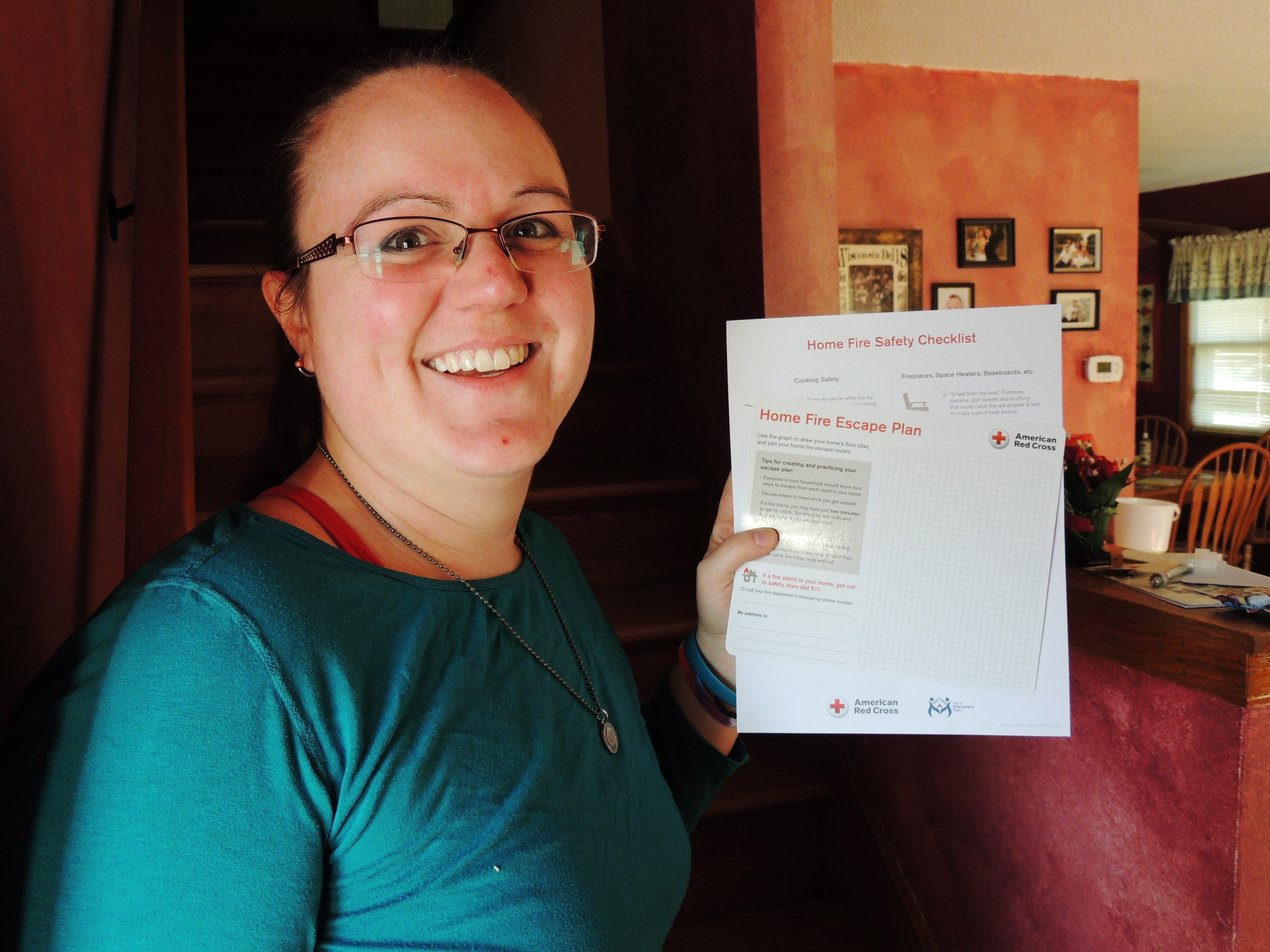
Sarah Hassig received home fire safety materials and had 3 smoke alarms installed during the Home Fire Campaign in Plainview, MN, on September 19, 2015.

The morning passed quickly, and the volunteers enjoyed rolls provided by the local Kwik Trip, plus water and pop on their return to the fire department. But most of all they left with the thanks of dozens of residents, and the satisfaction of improving the safety of the homes of so many men, women and children.

Super awesome: an additional 143 smoke alarms were installed on Sunday and during the following week! To learn more about the Red Cross Home Fire Campaign, click hereTo get involved, contact your local Red Cross

In Saipan, every interview was the start of a new day

BobPearce_photo2American Red Cross volunteer Bob Pearce recently returned from deployment to Saipan where he worked directly with more than 400 people affected by Typhoon Soudelor. New to the Red Cross, the typhoon relief operation in Saipan was Bob’s first large-scale response. He’s already responding to his second, serving as a virtual volunteer from his home base in Minnesota for the Red Cross response to the wildfires in California. Below, Bob shares with us his Saipan experience.

Information about Typhoon Soudelor and its damage may be interesting, but it doesn’t tell the real or whole story. Many of the Red Cross volunteers used the term resilient to describe the islanders. Others said they were patient. For me, the people of Saipan are remarkable.

Tin roof & coconut treeSaipan is a 12 by 5.5 mile island in the south Pacific. Guam, Tinian, Rota and Saipan form the Commonwealth of Northern Mariana Islands, a United States Territory. With a small garment manufacturing industry in continuing decline, the 53,883 residents of Saipan have relied on tourism to help their economy. So, when Typhoon Soudelor slammed into the island in the late night and early morning hours of August 2 and 3, 2015, damage was felt in more than one way.

Winds from the Category III Typhoon broke the NWS anemometer on Saipan at 91mph. Whatever their speed, the winds were sufficient to snap off over 300 power poles on the island, far exceeding the 80-some spares stored for an emergency. Rain and wind-driven sea water also damaged generating plants, further hampering infrastructure recovery. Without power, processing and delivery of fresh and waste water were still further casualties of the storm.

Cleanup of splintered and downed trees from roads began immediately. Hotels and a few businesses, including gas stations, fired up emergency generators and began providing needed services during daylight hours.

The U.S. Navy moved three ships from Guam to Saipan to provide fresh water for the island. People drove cautiously through intersections formerly controlled by traffic signals. And neighbors helped neighbors dig out from the remains of their homes. The same winds and water that knocked out electrical power and stopped road traffic, had also destroyed or seriously damaged well over 500 homes, and many hundreds of other residences were also damaged to some extent.

NMI ChapterIn the first hours after the typhoon, the Northern Mariana Islands Chapter of the American Red Cross mobilized ten core volunteers plus a trained group of 14 other local volunteers. Together with chapter staff, this initial response force began providing immediate assistance to many of the more than 2000 people who called for help. Gradually, the chapter response was supplemented by volunteers from “the mainland,” which is the islanders’ term for the continental U.S. Minnesota provided four of those volunteers, who served in Disaster Health Services (DHS), Disaster Services Technology (DST), and client casework.

Local residents began lining up at the chapter office early each morning, well before the generator was started, DST had reset all systems, and the doors were opened. With daily preparations and briefings completed, health services and client casework volunteers began seeing local residents by 9:00 each morning, and continued well into the evening until there were no more lines. Estimates of the number of clients seen ranged from 200 to 500 daily, seven days a week, for the first couple of weeks. Direct Assistance to Saipan Households (DASH), ranged from cans of food, bottles of water, and bags of rice, to financial assistance cards for people to use for disaster-related needs.

BobPearce_photoSaipan definitely has a slower lifestyle than many of us are accustomed to, yet there’s more to the calm and peace that the residents exhibit. Each client greeted us with a warm smile and a firm handshake. Every interview was the start of a new day. One after another, they thanked the Red Cross volunteers for being there. Most of the islanders have little compared to what many of us have. On the other hand, they have so much. They are happy, generous and content. Saipan is unique and its people exceptional in the face of disaster.

To learn more about how to become a Red Cross volunteer, click here. For more about the Red Cross disaster relief response in Saipan, click here.
Photos provided courtesy of Bob Pearce.

Meet BJ, a new Red Cross Community Volunteer Leader

Story by Nancy Rogers, Volunteer Services Specialist for the American Red Cross serving Northern Minnesota

An American Red Cross Community Volunteer Leader (CVL) is a single point of contact for a community with the primary goal of developing, building and expanding the presence of the Red Cross in a given area.  A CVL serves as the face of the Red Cross to local communities with a dedicated focus on recruiting volunteers, managing relationships, fulfilling region-wide objectives and supporting delivery of the Red Cross mission.

BjBJ Kohlstedt was selected recently as the first Community Volunteer Leader (CVL) for the American Red Cross serving Northern Minnesota.  She’s excited about a new role that allows her the opportunity to represent the Red Cross along Minnesota’s North Shore.

Since 2008, BJ has been the Emergency Manager for Lake County. She first became acquainted with the Red Cross when a shelter was opened in Silver Bay during the 2009 ice storm, and she was very impressed by and grateful for the work the Red Cross did while helping people in that community. While later serving as a Red Cross chapter board member, BJ learned more about the variety of services the Red Cross provides.  Now, she’s looking forward to building local awareness and engagement in her community that will strengthen a Red Cross presence.

“We’re fortunate to have BJ representing the Red Cross on the North Shore.  She has a perfect combination of credibility and genuine concern about the people in the communities she works with,” says Dan Williams, Executive Director for the American Red Cross serving Northern Minnesota.

BJ is jumping right into her new volunteer role. Already, she’s met with officials from all of the local fire departments in her area,  making them aware of the Red Cross services available to home fire victims. “The firefighters I met were very appreciative of my outreach and glad to know of our services so they can further assist those in their communities affected by a fire disasters.”  Soon, BJ will meet soon with other Red Cross volunteers and local partners to set up a Home Fire Campaign in the Two Harbors area.

BJ sees a lot of opportunities for the Red Cross to be involved in her area and she wants to build on that. One plan is to hold North Shore meetings for volunteers, giving them a way to stay connected to and involved with the Red Cross.

Another goal is to build the partnership between the Red Cross and the Certified Emergency Response Team (CERT) on the North Shore. According to BJ, “The Red Cross and CERT serve communities throughout the United States in a variety of ways before, during and after emergencies. Both programs accomplish a great deal individually and they can do even more working together. In partnership, we can increase preparedness and resilience in communities, and offer assistance and support in the aftermath of disasters.”

BJ sees collaboration between the Red Cross and other emergency response organizations as vital to strengthening disaster preparedness and response. And she says she’s honored to have a new role and opportunity to help make it happen.

To learn more about Red Cross volunteer opportunities, click here.

It’s National Preparedness Month — Make your emergency plan

Last year, the Red Cross in Minnesota supported more than 2,500 people with basic comfort and care after local disasters — mostly home fires, which is the most common disaster threat people face across the country. During September, also known in some circles as National Preparedness Month, we encourage everyone to be ready for emergencies, such as home fires. A few important, easy steps are below. Take them and you and your loved ones will be more Red Cross ready when disaster strikes.

HOME FIRE SAFETY As part of the national American Red Cross Home Fire Campaign, which aims to reduce deaths and injuries from home fires by as much as 25 percent over the next five years, the Red Cross urges households to develop a fire escape plan; and to install and test smoke alarms.

When developing the plan, walk through the home and look at all exits and possible escape routes, including windows. List two ways to get out of every room in case fire blocks one of the paths. Pick a place to meet outside, a safe distance away and – no matter the circumstances – stay out of the home until fire officials say it is okay to go back inside. All households should practice their plan at least twice a year.

People should also install smoke alarms on every level of their home, inside bedrooms and outside sleeping areas. They should test the alarms monthly, replace the batteries at least once a year and replace them every ten years. Need help developing your plan? View our charts for single, multiple and high rise dwellings.

Icon PreparednessEMERGENCY PLAN Everyone in the household should help put the emergency plan together so they know what they should do if something occurs. Because everyone may not be together at home when a disaster happens, the plan should include ways to contact one another and two places to meet – one near the home in case of a sudden emergency like a fire, and one outside the neighborhood in case circumstances prevent people from returning home. The plan should also identify an emergency contact person from outside the area in case local telephone lines are overloaded or out of service.

Any emergency plan should also include decisions about where to go if ordered to evacuate and what route to take to get there. It’s a good idea to include alternate routes in case roads are closed. Remember planning for family pets. Make sure to include places to stay for them, such as pet-friendly hotels and animal shelters, along the evacuation route.

MOBILE APPS Download today the free American Red Cross Emergency  App. The app combines more than 35 emergency alerts to help keep you safe, including information about what to do in case of floods, tornadoes and other major disasters. To find it and other Red Cross mobile apps, including Monster Guard, a fun preparedness game for kids, and pet first aid, search for American Red Cross in smartphone app stories or go to redcross.org/apps.

For more information on how to prepare for all types of emergencies, visit redcross.org.

Full-scale exercise readies Red Cross and its partners for disaster response

Story by Dan Williams, Executive Director, American Red Cross serving Northern Minnesota

Vigilant Guard disaster response exercise, Duluth, MN, 2015. Photo credit: Jon Snyder.
Vigilant Guard disaster response exercise, Duluth, MN, 2015. Photo credit: Dan Williams.

Disaster response training is serious business for a wide range of players. Government, military, hospitals, schools, and non-profit organizations, such as the American Red Cross, are among them. On August 24 and 25 in Duluth, Minnesota, the Red Cross and several partners got deep-in-the-weeds serious for Vigilant Guard 2015, a full-scale disaster response 4 years in the making.

According to the Minnesota National Guard, “Vigilant Guard is a United States Northern Command and National Guard Bureau sponsored exercise program. The program provides an opportunity for the State of Minnesota to improve emergency coordination, response and recovery management with federal, regional, local, civilian and military partners. The citizens of Minnesota depend on state and federal agencies to work together to prevent, protect, respond and recover from disasters. Together, we provide the capabilities to save lives, protect property and the environment, and meet basic human needs after an incident has occurred. Vigilant Guard is a rare training opportunity that greatly supports everyone–both participants and the citizens we serve.”

The mock disasters for Vigilant Guard were straight line winds causing severe damage to Hermantown, Proctor and the Duluth Hillside; a railway chemical spill; and a ship destroying the Blatnik Bridge spanning the bay between Duluth and Superior. The Red Cross role in the exercise was to establish a shelter at the Duluth Entertainment and Convention Center (DECC), which is a designated Red Cross shelter location for a real, large-scale disaster response.

Red Cross volunteers set-up a mock shelter during the Vigilant Guard at the convention center in Duluth, Minn., August 24, 2015. Photo credit: Jonathan Snyder.
Red Cross volunteers off load supplies for a mock shelter during the Vigilant Guard at the convention center in Duluth, Minn., August 24, 2015. Photo credit: Jonathan Snyder.

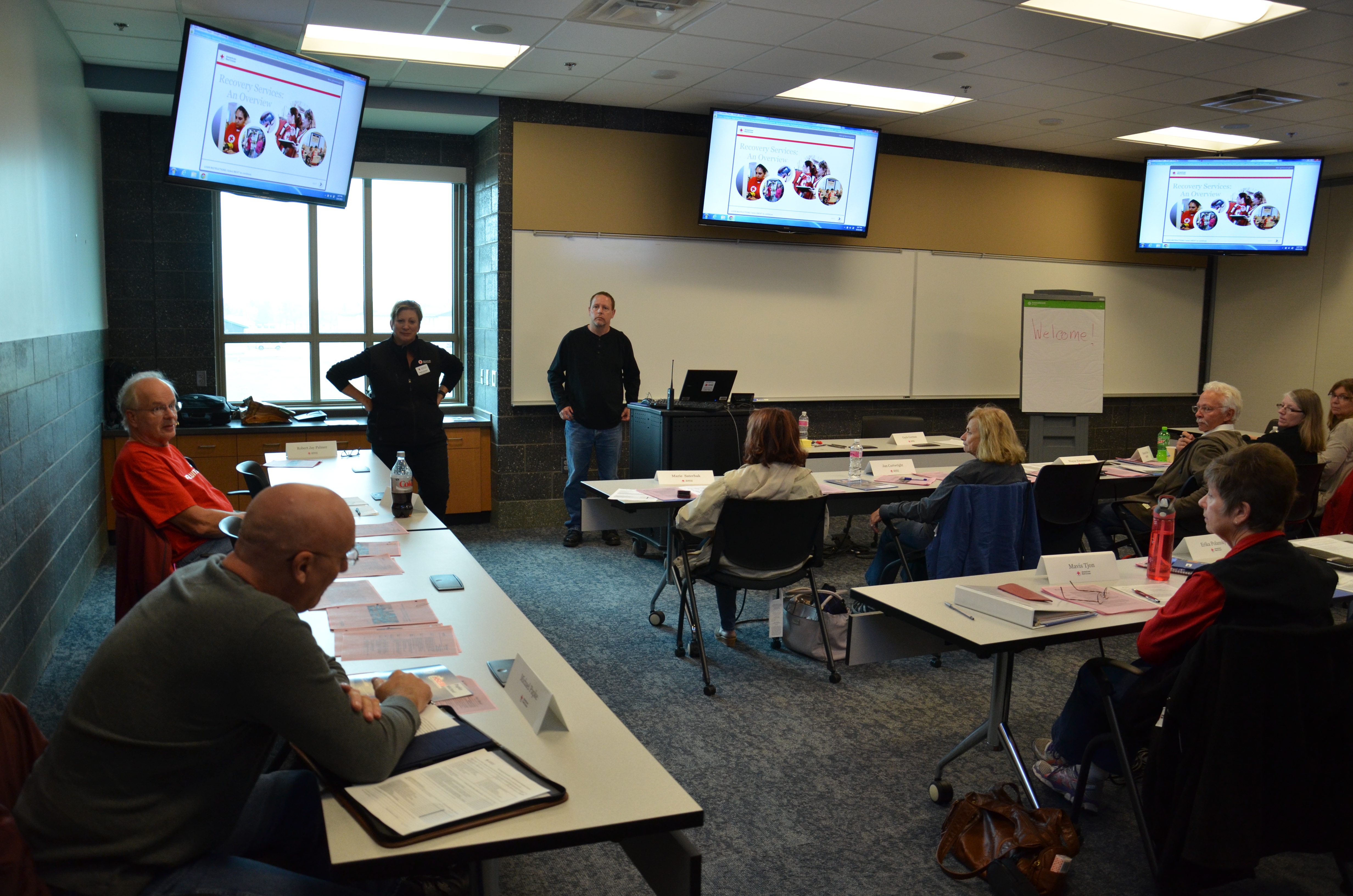
On Monday at the Red Cross chapter office in Duluth, 35 public health nurses from 7 Counties, one Native American tribe, the Medical Reserve Corps and the Minnesota Department of Health took training on how to provide nursing services in a disaster shelter. At the same time, more than 35 Red Cross volunteers and others from partner organizations conducted a training on how to stand-up a disaster shelter. The training ranged from setting up cots and doing registration to ensuring client safety and securing shelter resources. Red Cross volunteers from across Minnesota were represented.

That evening, Red Cross volunteers had the mock shelter up and running. Their effort added to individual expertise as well as response capacity state-wide. At the end of the day, more than 25 participants stayed at the shelter as if they were people displaced by disaster. They needed their sleep, as the next day they would operate the shelter for community members who were invited to come to the shelter as evacuees and register as if they would be staying there, which was an important part of the exercise. One FOX21 story put it this way:

It will offer an opportunity for Red Cross volunteers, new and old, to test their skills when disaster strikes. “Tomorrow is the day to make mistakes. I always tell people the key word is disaster…We take care of people in the time of disaster small or big,” said Red Cross Disaster Program Manager Tony Guerra.

Red Cross volunteers operated a mock shelter to support the Vigilant Guard disaster response exercise, August 2015. Photo credit: Dan Williams.

On Tuesday, day two, starting at 7:00 a.m., the Salvation Army began serving breakfast, just as they might during a disaster response in the area. Then, at 8:30 a.m., community members began arriving to register for staying at the shelter. More than 130 community members gave their time to test the newly trained shelter staff! Some went through the registration line multiple times to simulate an even larger group of evacuees. As an important part of the training, community members with functional needs were invited to participate and we were grateful for their participation. People with hearing and sight impairment, as well as those with service animals, put the participants in a great position to use their training. A Duluth News Tribune story put it this way:

Red Cross volunteer Karen Campion oversees the sign-in process prior to setting up a mock shelter at the convention center in Duluth, Minn., during the Vigilant Guard disaster training exercise, August. 24, 2015. Photo credit: Jonathan Snyder.

Other volunteers provided different training opportunities. Jack Bender, who is hearing impaired and communicated through an interpreter, said his participation in the event allowed workers to learn how to help deaf people. “I have to say that they did a really good job handling our communication needs,” Bender said. “There were a few Red Cross workers that knew some basic sign language and finger-spelling, and they were able to help start triaging … until the interpreter arrived.”

We’re also grateful for three new University of Wisconsin-Superior international students who came to the shelter as well and gave the volunteers a chance to use language translation materials the Red Cross uses in shelters.

As a part of the military component of Vigilant Guard 2015, a group of distinguished visitors toured Camp Ripley in Little Falls and the convention center in Duluth where full-scale exercise was taking place. As part of that visit, Phil Hansen, CEO of the American Red Cross Minnesota Region, as well as Regional Board Chair Lori McDougal and Vice Chair Joan Thompson, were able to visit the mock shelter exercise in Duluth. They met many of the volunteers who set up the shelter and several of the Red Cross nurses who trained during the exercise.  Phil, Lori and Joan were impressed with the commitment of the volunteers as well as the close working relationship between the Red Cross and our military partners.

The Minnesota National Guard presented a certificate following the Vigilant Guard disaster response exercise in Duluth, Minn., August 2015. Photo credit: Joan Thompson.
The Minnesota National Guard presented an award of service to the Red Cross following the Vigilant Guard disaster response exercise, Duluth, Minn., August 2015. Photo credit: Joan Thompson.

For all of the hard work, the Minnesota National Guard surprised the Red Cross volunteers and staff with a special public service award. Phil Hansen accepted the award on behalf of the Red Cross relief workers participating in the exercise. About the two-day exercise Phil said, “Vigilant Guard was a terrific opportunity to work as a team with our volunteers and key partners to test our readiness before a disaster strikes. Many thanks to all who organized this exceptional exercise.”

To learn more about getting involved with the Red Cross, click here. To access Red Cross disaster and safety tools and resources, click here. For everyday, handy preparedness, download a free Red Cross mobile app.

Red Cross for life after Katrina

IMG_8628_2
It’s been ten years since Katrina, and Dan Hoffman is still a dedicated Red Cross volunteer. Photo provided courtesy of Dan.

“I became a Red Crosser for life after Katrina.” Ten years ago, Dan Hoffman, from New Brighton, Minnesota, was one of 245,000 Red Cross disaster workers who responded to Hurricane Katrina, which hit the Gulf Coast on August 29, 2005. Dan recently sat down with Red Cross intern Vivi Engen to look back on his experience.

Tell me about how you got involved with Katrina.

Katrina was my first national deployment. At the time, I was an employee for the Red Cross at the St. Paul Chapter and a trained disaster volunteer. I got a phone call on the day the storm hit asking if I wanted to deploy, and I accepted. I was on a plane later that afternoon headed down to Houston. From Houston, I was assigned to work at a 6,000 person American Red Cross shelter at the Convention Center in Baton Rouge, Louisiana.

The Convention Center in Baton, Rouge, LA where Dan worked during is deployment.
The Convention Center in Baton, Rouge, LA where Dan Hoffman worked during is deployment. Photo provided courtesy of Dan.

What was it like to be at the shelter?

The first few days I would describe as organized chaos. Buses and helicopters unloaded a steady flow of scared, mud-covered people just pulled from disaster. We knew what we needed to do–what the Red Cross always does–everything from setting up portable showers outside the convention center, to providing clothes and hygiene kits, and registering people and contacting other shelter locations to find lost loved ones. We did this for 12 hours a day, and just like the refugees, slept on cots. We saw, and lived it all. I knew that I was part of something big and wouldn’t have wanted to be anywhere else.

Tell me about what you did there.

I think a better question is what didn’t I do. I worked the floor so I did whatever needed to be done. I did everything from giving teddy bears to kids, diapers to moms, to taking down names of people sleeping on cardboard boxes because we ran out of cots early on and pushing people around in wheelchairs who couldn’t walk. But more than anything I would just listen. These people were hurting and needed to tell their story.

What were some of the stories that had an impact on you?

Red Crossers busy at work in the shelter.
Red Cross relief workers busy at the shelter in Baton Rouge, Louisiana. Photo provided courtesy of Dan Hoffman.

I’ll tell you a few of my favorites…

Miss Evelyn was one of our shelter residents. Her home had been destroyed by the storm, and when the rescue crew came to save her, they told her she had to leave her dog, Pepper, behind. Pepper was Miss Evelyn’s only family, and she was heartbroken without him. There was a pet shelter set up at Louisiana State University, and a couple of days after talking to Miss Evelyn, I stopped over there while on a supply run to see if I could find her dog. I found a Red Cross worker and asked her if she had seen Pepper and she said she would be in touch. A few days later, I received a few photos of different dogs at the shelter. I showed them to Miss Evelyn and, wouldn’t you know, there was Pepper smiling back at her in one of the photos.

Another woman, Hattie Mae, came to the Red Cross shelter unable to walk, and unable to fit into a wheel chair. A day later I stopped by the local hospital and “commandeered” an over-sized wheelchair to lend to Hattie Mae because she needed something to get around in. I will never forget the look on her face, or the hug that she gave me, when I came back with that chair.

Cots were set up all through the Convention Center for refugees who lost their homes.
Cots were set up all through the convention center in Baton Rouge, Louisiana, for Hurricane Katrina refugees who lost their homes. Photo provided courtesy of Dan Hoffman.

Miss Amelia, another refugee, who was a kind of matriarch over a large family community, introduced me to her family. “This is Mr. Dan, he’s Red Cross, so listen to him.” It sure gave me instant credibility. Then she turned to me and said “You came all the way form Minnesota to help us, you must be an angel.” I am no angel, but I do share the gratitude that the refugees had for my work, for the experience that they gave me. The people at the shelter who had lost everything were so gratified, so appreciative for the smallest things that it changed the way I see life today. And that’s something I will never be able to repay them for.

How did this experience transform your commitment to the Red Cross?

After Katrina, I realized that the work that the Red Cross does is my calling. Once I came home, I shared all of the incredible stories I had been told, what the Red Cross did and how the Red Cross helped all these people.  Just like the stories of the shelter refugees needed to be shared, so did the Red Cross’.

Katrina Pix 027_2
Dan Hoffman (far right) with other Red Cross disaster relief workers and a Hurricane Katrina refugee in Baton Rouge, Louisiana. Photo provided courtesy of Dan.

Is there anything you’d like to add?

I’d like to finish up with a woman named Misty. While working at a shelter as a volunteer, you half adopt people while you are there, meaning there are certain individuals that you go in to check on or eat with them on a regular basis. Misty was one of those people for me. Misty is a poet, and on the day of the storm she wrote a poem that was angry. Angry at Katrina and all of the destruction it had caused and how it impacted her–she lost her dog and everything she owned. A few weeks after I got home, I received a letter in the mail. It was another poem from Misty titled “Thank You”. The last line of the poem read “memories of you will never leave my heart.”  Now I ask you, how could an experience like that not change your life?

To learn more about how you can volunteer with the Red Cross, chick here.

Calling all babysitters!

By Erin Ferris, American Red Cross

During a Babysitter's Training course in Minneapolis, Minn., youth learn that CPR is performed differently on infants than on children and adults. Techniques are performed here that require hands-on skills focusing on back blows, chest thrusts and proper ways to safely hold an infant. Photo credit: Krista Weiler/American Red Cross
During a Babysitter’s Training course youth learn that CPR is performed differently on infants than on children and adults. Techniques are performed here that require hands-on skills focusing on back blows, chest thrusts and proper ways to safely hold an infant. Photo credit: Krista Weiler/American Red Cross, Minneapolis, Minn., Feb. 2015.

My first American Red Cross experience came at 11 years old when I enrolled in a Red Cross Babysitter’s Training course. Eager to earn a little extra spending money, I had plans to start caring for children in my neighborhood and knew I needed to prepare myself for whatever my charges might literally and figuratively throw at me.

The decision to become a babysitter ended up a great one, as it led to years of gainful summer and weekend employment and began me on my journey to a life-long partnership with the Red Cross.

25 years later, the Red Cross continues to offer babysitting courses to students ages 11 and older. The courses, available mainly online, provide participants with the knowledge and skills necessary to safely and responsibly care for infants and children and to manage their own babysitting businesses.

The Babysitting Basics online course takes approximately 4 hours to complete and includes videos, interactive games, and downloadable resources covering basic caregiving skills (holding, carrying, diapering, feeding, bathing, etc.), what to do in emergency situations, how to play with children, how to interact with parents, and how to build a babysitting business. The course is designed for children between the ages of 11-15.

For those 16 and up, the Red Cross offers the online-only Advanced Child Care Training. This training features the latest in learning techniques – simulation learning – for an engaging format that students of this generation prefer.

Learning materials are provided by the American Red Cross to aid in the education of all attendees (Handbook, Reference Guide, Student Kit). Photo credit Krista Weiler/American Red Cross, Minneapolis, Minn., Feb. 2015.

My almost 9-year-old son, while still a little young for babysitting, loves to look out for his younger sister, cousins, and friends. I plan to enroll him in an online Red Cross babysitting course in a couple of years, knowing that along with learning how to care for younger children, he’ll learn how to deal with emergencies, the basics of building a business, and how to work with adults in a professional manner. Sounds like a pretty good introduction to real life responsibility!

Whether your future babysitter wants the Babysitting Basics course or the Advanced Child Care Training course for older, it is guaranteed to be a fun and educational course.

This post was originally published on the national American Red Cross blog. To find Red Cross babysitting and childcare classes near you, click here.

Give blood at the Minnesota State Fair

msf2013_bloodMobileMAP-smallThe Minnesota State Fair is your chance to hit the rides, grab some food and help save lives! Every day at the fair is a chance to give hope. By giving blood through the Red Cross, donors offer people who need blood a chance to create memories that will last a lifetime.

As a thank you, all presenting donors will receive a special Red Cross gift. And to help increase donations over Labor Day weekend, all presenting blood donors from Sept. 5 through Sept. 7 will receive a Red Cross T-shirt, while supplies last!

To make an appointment or for more information in advance of the fair, you can book your appointment via the Red Cross blood donation webpage (use sponsor code MN State Fair), the Red Cross Blood Donor App, or 1-800-RED CROSS (1-800-733-2767).

At the fair, you can find the Red Cross bloodmobile parked outside the agriculture and horticulture building, just west of the space tower. A blood donor card or driver’s license, or two other forms of identification are required at check-in. Individuals who are 17 years of age (16 with parental consent), weigh at least 110 pounds and are generally in good health may be able to donate blood.

#ChooseYourDay to #RestocktheShelves and help save lives during the 2015 Great Minnesota Get Together!

P.S. Look for more Red Cross activities at the Minnesota State Fair on August 29 during Governor’s Fire Prevention Day and on September 1 during Military Appreciation Day!


What does a Red Cross nurse do during disaster?

Story and photos by Vivi Engen, American Red Cross Intern, Minnesota Region

The Disaster Health Services Nursing kit is condensed into one duffle bag and can serve up to 50 people at a shelter.

During large-scale disasters, Red Cross nurses serve as the initial medical response at a shelter. They assess basic medical needs of clients and address quick and easy fixes, such as a cut or sprain. Anything more severe is treated at a hospital.

To speed nursing response during disaster, the Disaster Health Services team in Minnesota recently introduced a nursing kit that will be used at shelters during responses across the state.

The kit, which is condensed inside a single duffle bag, provides a quick-response supply for up to 50 individuals. Supplies include over-the-counter medication, wound dressings, CPR masks, bandages, protective gear and more.

Kami Buccellato goes through the supplies inside the Nursing Kit.

“The kit provides the nursing staff with the materials needed to serve as a starting point for clients,” says Kami Buccellato, the Twin Cities Deputy Lead for Disaster Health Services and one of the creators of the nursing kit. “It’s still a work in progress, but we have already seen good results.”

Earlier this year, the kit was used for the first time at a shelter after an apartment fire. Disaster Health Services received positive feedback on the condensed bag and was happy to report that the kit contained its critical response supplies.

The idea for a nursing kit surfaced when responders showed up to shelters with duplicated supplies. “Duplicated supplies decreases efficiency,” says Buccellato. “In a disaster setting, everything is already chaotic, so anything that we can do to increase organization helps.”

A look at the contents inside the Nursing Kit.

The American Red Cross is always looking for new nurses who are ready to be put on the disaster scene. “Any nurse looking to gain experience, meet new people, and share knowledge is welcome in Disaster Health Services,” says Buccellato.

Are you a nurse? Have you ever thought about volunteering? If so, the Red Cross wants you. To apply, click here.

About the American Red Cross
The American Red Cross shelters, feeds and counsels victims of disasters; provides nearly half of the nation’s blood supply; teaches lifesaving skills; and supports military members and their families. The Red Cross is a charitable organization — not a government agency — and depends on volunteers and the generosity of the American public to perform its humanitarian mission. The Minnesota Region serves 5.2 million people across Minnesota and part of western Wisconsin with offices in Duluth, Mankato, Minneapolis, Rochester and St. Cloud. For more information, please visit redcross.org/mn.  Like us on Facebook: American Red Cross Minnesota Region. Follow us on Twitter: @mnredcross