Apartment Fire Survivor “Worse than Back to Square One”

On Friday, March 9, 2012, a fire burned an apartment building in Minneapolis. That afternoon at the Red Cross service center volunteer relief worker Kevin Berger spoke with two people affected by this disaster and learned more about them.

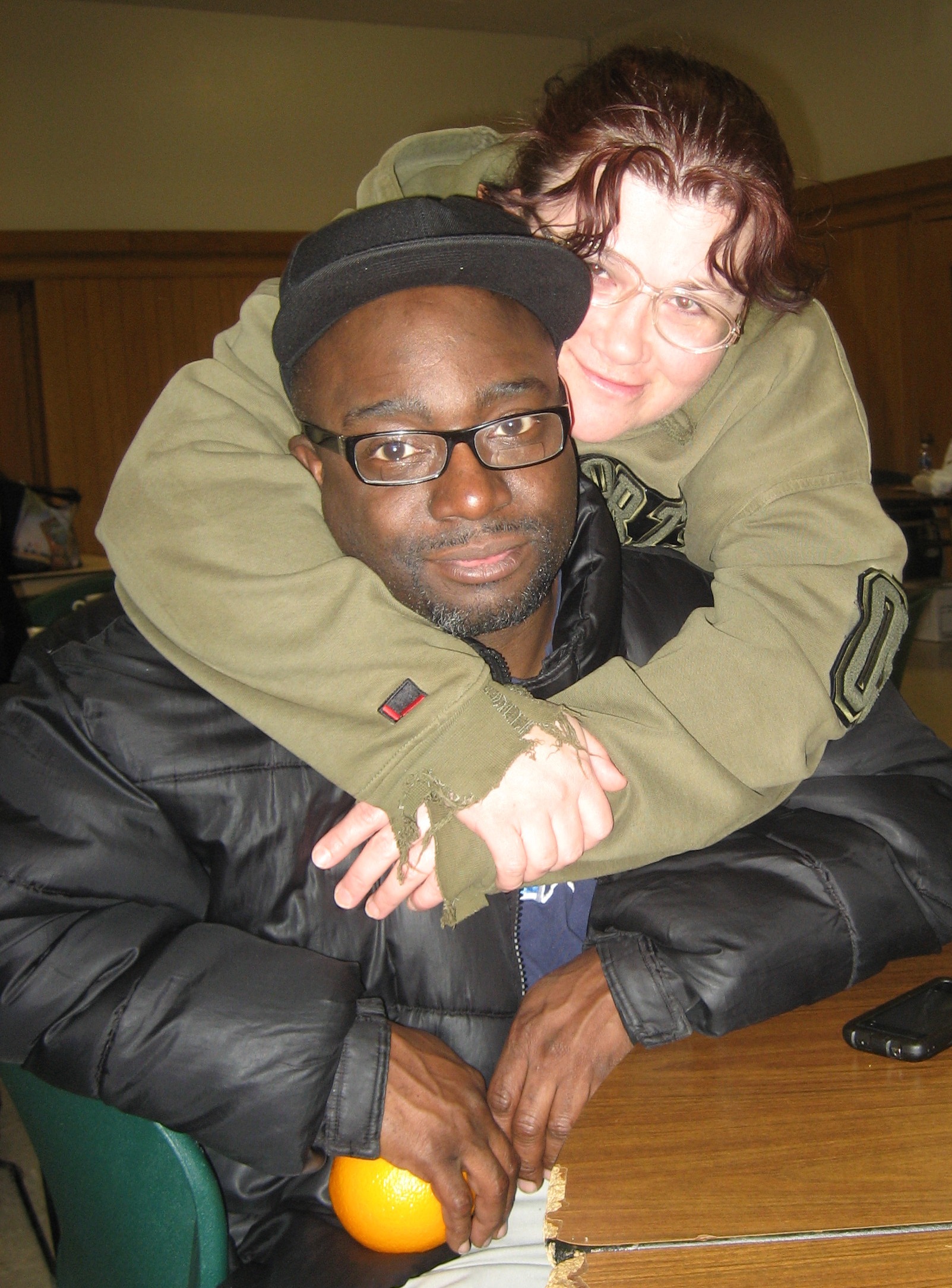
Kimberlee Overvold and Carl Robinsen survived the March 9, 2012, St. George apartment fire in Minneapolis. Photo credit: Kevin Berger/American Red Cross

Kimberlee Overvold was at the temporary Red Cross service center just a few blocks from where she had lived for 11 months before a fire destroyed the St. George apartment building on 17thStreet. She was trying to collect herself and figure out her next steps. Overvold and her boyfriend were in the process of finding a bigger apartment but then the fire took it all away. Overwhelmed with the emotion of the situation she said,“I keep thinking I’m going to wake up and it’s going to be a dream.”

They had just gone to bed around 1:45 a.m. when the fire alarms sounded at 2 a.m. Kimberlee said at first they thought it was a false alarm because even as they headed out of the building there was no signs of smoke or fire. However, it wasn’t long before flames rushed through the building and they found themselves meeting up with their neighbors in a bus temporarily used as a shelter.

Before moving into the St. George apartments she had been homeless for nearly 2 years. Back then she said at least she had some possessions, but now “I’m worse than back to square one” as she’s lost everything. Pointing at herself with her mobile phone in hand, she said, “this is my living room now as all my stuff is gone.”

She reflected on some of her family pictures and watercolors she had from her late grandmother. “That’s the stuff I’m going to miss.”

The St. George apartments burned, displacing more than 30 residents of Minneapolis. Photo credit: Kevin Berger/American Red Cross

Her boyfriend, Carl Robinsen, was also considering how to move forward. “I’m not worried about what caused this to happen, we just need to fix it.” He said they were thankful that no one was seriously hurt or killed in the building that housed 32 units. “You can’t replace life,” he said.

One concern is replacing clippers and shears valued at more than $1500 and needs for the barber program he’s just four months from completing at Minneapolis Community and Technical College (MCTC). As lunch passed by at the Red Cross service center Robinsen was wondering if he should make his way to his job as a janitor in Edina so that he could at least think about something else for a while.

The couple left the service center with information from the Red Cross and The Salvation Army for a temporary place to stay and getting some clothes before finding a new home.

Text REDCROSS to 90999 to give $10 to American Red Cross disaster relief, helping people recover from this fire and similar disasters. Or go to redcross.org to donate even more financial support. This story and the accompanying photos are by Kevin Berger, a volunteer American Red Cross disaster relief worker based in Minnesota.

Morning blaze serves “full meal deal” to volunteer in-training

Scott Olson, a volunteer Red Cross disaster relief worker in-training, got his first on-scene experience, Friday, March 9, 2012, when his phone rang early that morning. The Red Cross was responding to a 3-alarm fire in downtown Minneapolis.

2:30 got the call; 3:00 arrived on scene

Scott Olson, Red Cross volunteer-in-training, at Minneapolis apartment fire, March 9, 2012. Photo credit: Dave Schoeneck/American Red Cross

We tried to walk close to the building, but there were flames licking out the second and third floor windows. The whole area was cordoned off by fire trucks and police.

We went to the shelter bus. About that time there were ten people on it. Most of them were very upset, crying, sort of in shock. I remember another responder saying she expected more people to be on the bus. She handed me a clip board and told me to go ask them some questions. Then they started to trickle out of the bus, finding places to go.

The other responder said this isn’t typical for a first response. I hope it’s not scaring you away she told me. No, I’m not scared. It was neat. I got the full exposure. I got to watch the media. It was the full-meal deal, really.

8:00 am close to getting parking ticket, left the scene; 8:10 am arrived home; stripped and fell on bed; magic happened after that

Want to join us? Click here.

West Liberty Relying on Red Cross After Tornado

West Liberty, Kentucky
A devastating tornado wiped out much of West Liberty, Kentucky, a mountain town of around 3200 people. Dozens are now relying on Red Cross disaster services. Photo credit: Lynette Nyman/American Red Cross

For some, the Red Cross shelter in West Liberty, Kentucky, is the only home they have. “Without the Red Cross,” says Stacy LeMaster, 26, “we would be on the street.”

Since the March 2 tornado hugged the ground, wiping out dozens of homes and businesses in West Liberty, Stacy, her husband, and their three children have sought refuge at the shelter where everybody knows everybody. “This is just like home,” says Daniel.

Daniel LeMaster and his son, West Liberty, Kentucky
Daniel LeMaster and his son Daniel 3, are relying on the Red Cross shelter for safe and warm refuge after a tornado hit West Liberty, Kentucky, on March 2. Photo credit: Lynette Nyman/American Red Cross

Disaster relief workers from around the region are providing essential services to more than 50 people seeking refuge in the shelter. The shelter is also an assistance station for dozens more staying with family and friends, but who are otherwise homeless.

Shelter operations manager Brad Powell says Red Cross relief teams are also in the community. “We have relief workers doing damage assessment and mass feeding,” says Powell.

Some of the relief workers at the shelter have had little sleep, including Breck Hensley, 16, who has friends affected by the tornado. He says being a Red Cross volunteer is a good experience. “I’m just trying to help all those people who need it because if I were them, I would want it,” says Hensley.

Breck Hensley, Red Cross Disaster Volunteer
Breck Hensley, 16, who has friends affected by the March 2 tornado that hit West Liberty, Kentucky, says being a Red Cross disaster relief worker is a good experience. Photo credit: Lynette Nyman/American Red Cross

People in West Liberty are likely to rely on the Red Cross shelter for many more days as the slow process of tornado recovery takes its turn.

Tornado changes lives, not souls, in West Liberty, Kentucky

West Liberty, Kentucky, a small mountain town, was turned upside down when a powerful tornado went through Friday, March 2. Walking around, checking in with affected families, it’s easy to learn that everybody knows somebody whose life was changed that afternoon, including David May, who was scheduled to preach before the tornado hit.

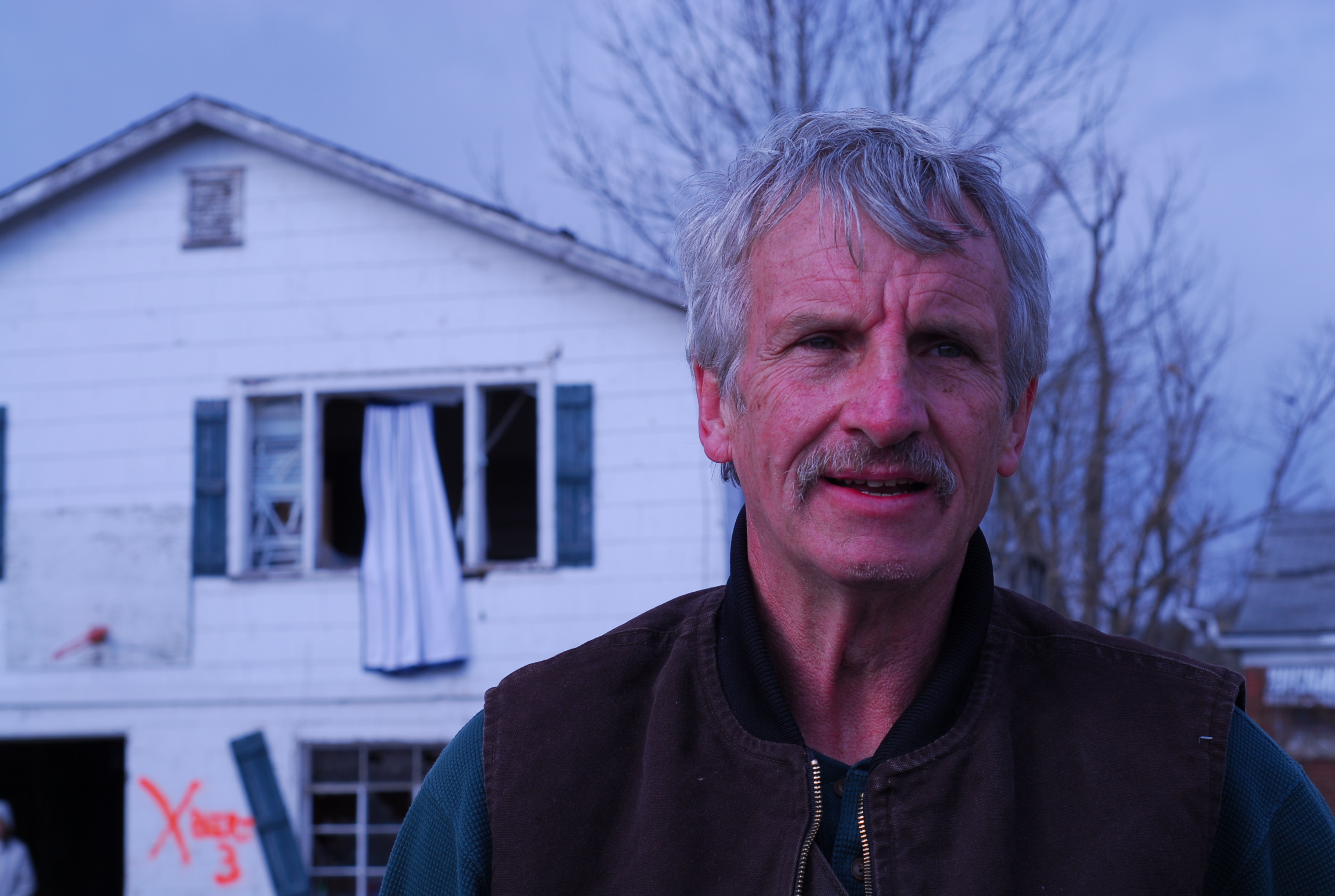
David May, 59, believes that hope and character will come from the suffering brought upon the people of West Liberty, Kentucky, by the March 2 tornado. Photo credit: Lynette Nyman/American Red Cross

“People said no one would come,” says May. Four people showed up for services on Sunday morning and stood near what’s left of West Liberty Christian Church. “The building is gone, but the church is still there,” says May. Fortunately for May, he has a place to stay over the hill, an area that was spared from destruction.

But his childhood home, like that of many here, will not be habitable for a long time, if ever. “The town is probably over,” says May, who expects that the old people won’t be back. If he had small children, he’d move them out. “This devastation and the shock and the work that’s to be done, well, I’d take them to another town for a while.”

Four people attended Sunday services outside the building remains of West Liberty Christian Church in Kentucky following the tornado on March 2. Photo credit: Lynette Nyman/American Red Cross

It’s only a few days into the recovery and many still have no idea what they can keep or rebuild. Even May, whose church recently donated a bus and supplies to ongoing earthquake recovery in Haiti, has a touch of hope that the homeland he loves and has lived in all of his life will find a fresh start.

“I’d like to see us start over,” says May. “Maybe we will.”

If you would like to help people affected by disasters like tornadoes and floods, you can make a donation to support American Red Cross Disaster Relief by visiting http://www.redcrossmn.org, calling 1-800-RED CROSS (1-800-733-2767) or texting the word REDCROSS to 90999 to make a $10 donation. Contributions may also be sent to your local Red Cross chapter or to the American Red Cross, P.O. Box 37243, Washington, DC 20013.

Do you have and use a weather radio?

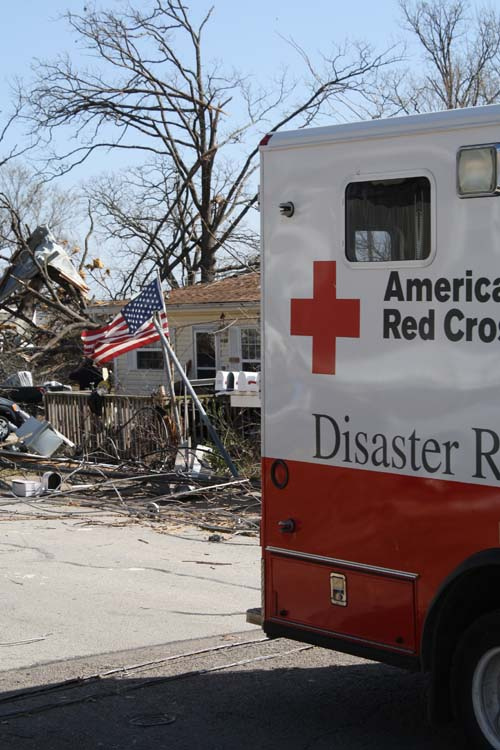
The Red Cross is providing food, shelter, and emotional support to people affected by Wednesday's tornadoes that swept across the South and Midwest, including southern Missouri (pictured here). Photo Credit: Nigel Holderby/American Red Cross

Following the devastating tornadoes that swept across the Midwest and South early Wednesday morning, we urge you, your family, and your friends to take a moment or two now and prepare for what’s turning out to be an early tornado season. 

  • Pick a safe place in your home or apartment building, such as a basement, storm cellar, or an interior room with no windows, where household members and pets can gather.
  • Use a weather radio that broadcasts National Weather Service watches and warnings. A weather radio can alert you to storms during the night, helping to save your life or the lives of your loved ones. Learn more in this NPR story.
  • Watch for tornado warning signs such as dark, greenish clouds, large hail, a roaring noise, a cloud of debris or funnel clouds. Secure outside items such as lawn furniture or trash cans, which could be picked up by the wind and injure someone.
  • If a tornado watch is issued, it means tornadoes are possible and you should be ready to act quickly. If a tornado warning is issued, it means a tornado has been sighted or indicated by radar and you should go underground immediately to a basement or storm cellar or to an interior room such as a bathroom or closet.
  • If a tornado warning is issued and you are outside,  you should hurry to the basement of a nearby sturdy building. If you cannot get to a building, you should get in a vehicle, buckle in, and drive to the closest sturdy shelter.
  • If flying debris occurs while you are driving, you should pull over and stay in the car with the seat belt on and your head below the window, covering your head with a blanket or other available protection.
  • If you do not not have a vehicle, you should find ground lower than the surface of the roadway and cover your head with your hands.

You can help those affected by disasters like the Midwest tornadoes and storms, as well as countless crises at home and around the world, by making a donation to support American Red Cross Disaster Relief. Consider making a donation today by visiting redcross.org, calling 1-800-RED CROSS (1-800-733-2767) or sending a text with the word REDCROSS to 90999 to make a $10 donation. Contributions may also be sent to someone’s local Red Cross chapter or to the American Red Cross, P.O. Box 37243, Washington, DC 20013. Contributions enable the Red Cross to prepare for and provide shelter, food, emotional support and other assistance in response to disasters.


Red Cross Family Tracing Helps Husband and Wife Live Again

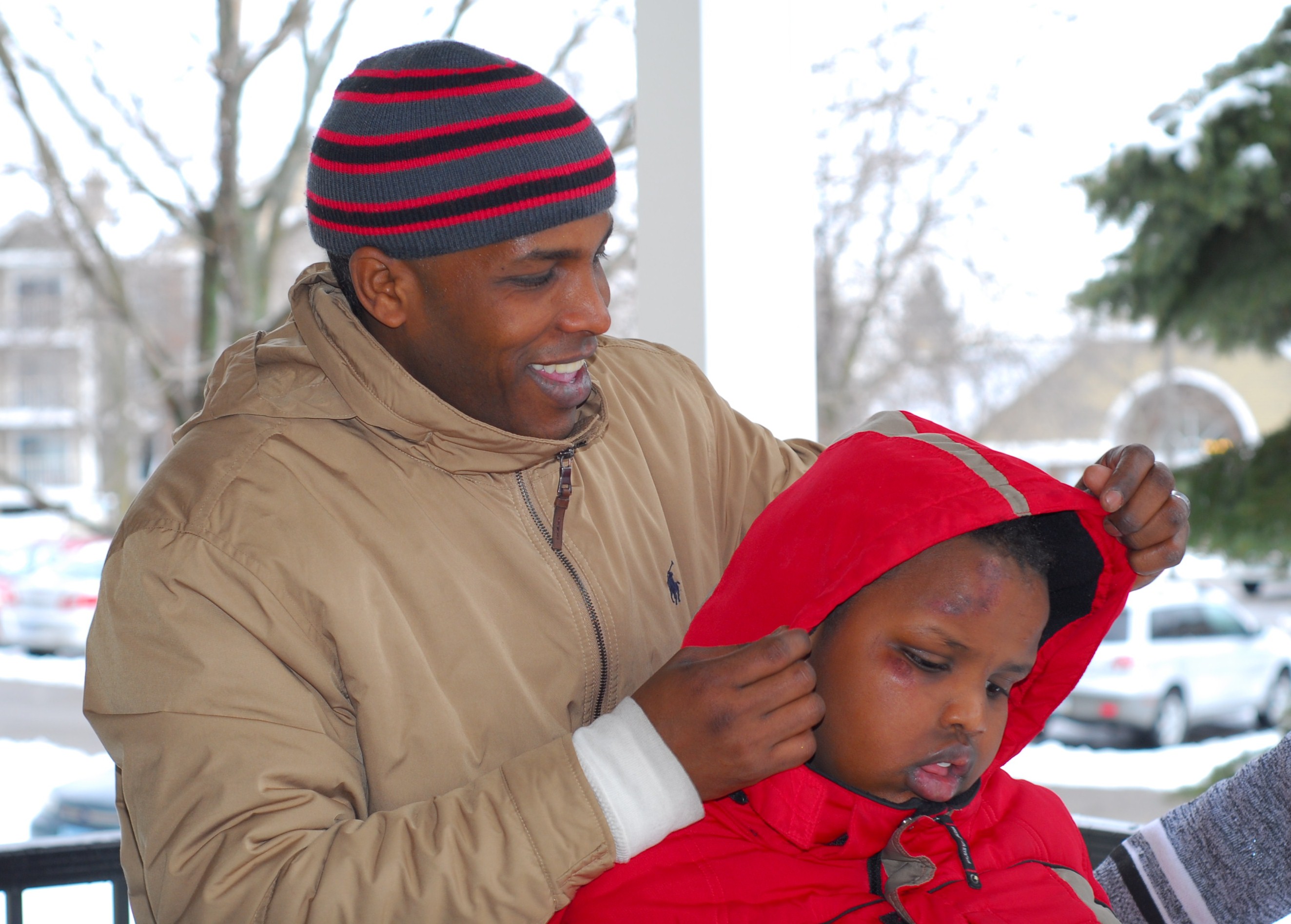
With Red Cross help, Abdiaziz Warsame, 35, learned that his wife is alive after being abducted by militia six years ago in Mogadishu, Somalia. He now lives in Minneapolis, Minnesota, with his son. Photo credit: Lynette Nyman/American Red Cross
Abdiaziz Warsame has lived in Minneapolis for the past six years taking care of his son and anticipating a life without his wife, his son’s mother. That was until he reached out to the Red Cross and its family tracing services.

“I am really thankful to the Red Cross for the job they did for me and my family,” says Warsame. “I gave up until the Red Cross found her alive.”

Abducted by militia in Mogadishu, Somalia, there was little reason for Warsame to believe that his wife was anything but dead. He fled with his son to Cairo, Egypt, where he sought refuge with the United Nations. His son’s condition, which includes brain damage and some paralysis, prompted a quick departure for an operation in the United States.

“I will not forget how the Red Cross helped me find my wife and how the Americans have been good to us,” says Warsame.

Abdiaziz Warsame, 35, fled Mogadishu, Somalia, with his son Shamusdin, 10, who has brain damage and paralysis. Red Cross family tracing services helped find Warsame’s wife alive in Somalia. Photo credit: Lynette Nyman/American Red Cross

The Red Cross sent a message from Minneapolis to Washington D.C., to Geneva, Switzerland, and then to the Red Cross in Nairobi, Kenya. From there, the Somali Red Crescent conducted a field search and found Warsame’s wife, Ayan Mohamed, in Mogadishu. They returned a message in the opposite direction that the Red Cross delivered to Warsame in Minneapolis.

The message came with a phone card, which Warsame immediately used to call his wife who had no idea her husband was living in America. Now, Warsame talks on the phone with his wife every day.

“We married for love,” says Warsame. “These six years are like 60 years. For that reason we live when we talk to each other.”

Warsame wants to be reunited with his wife—who also survived a bullet wound with Red Cross medical services in Somalia. “My son always says ‘where’s my mom,’ but I am so happy,” says Warsame. “I have found her now and hope to bring her here.”

Learn more about Red Cross family tracing and international services. Story and photos by Lynette Nyman/American Red Cross, with assistance from Yahye Mohamed/American Red Cross. Posted February 22, 2012

Volunteers are the heart of the Red Cross

Below, a note of thanks from Jill Hallonquist, Emergency Services Director, American Red Cross Northern Minnesota Region, who is now enjoying a well-deserved vacation.

This morning I woke up thinking about the Governor’s emergency management training conference that I’m attending this week.  Many of our partners throughout our response region are in St Paul for this training. I have been chatting with Emergency Managers, Public Health, Homeland Security, Salvation Army, NECHAMA, and other friends of ours from across the Minnesota. Many of them ask how the Red Cross is doing these days.  Most know that we have a new region structure and wonder how that’s going.

Red Cross volunteers answered questions from attendees of the 2012 Governor’s Homeland Security and Emergency Management Conference. Photo credit: Andrea Bredow/American Red Cross

Here’s what I tell them: I am so grateful that we have you, the incredible volunteers in their communities.  You are the heart of the Red Cross.  The restructuring that we did changed the way that staff supports the volunteers.  It did not change the fact that the person they see responding in their community is a volunteer, teaching people to be prepared and to prevent disasters, comforting those affected, and helping to connect them with the local resources they need to get back on their feet.  Your passion for helping your neighbors is as strong as ever and you’re there to help!

Do you ever catch yourself telling someone how much you like a certain person…and then you wonder if you have told THEM?  I didn’t want to let another day pass without telling you how much I appreciate each and every one of you.  You are treasured.

Click here to learn more about the 2012 Governor’s emergency management conference and click here to learn more about how the Red Cross helps in Minnesota and beyond.

Red Cross Trains Mille Lacs Band on How to Set Up a Shelter

Last fall the American Red Cross trained members of the Mille Lacs Band of Ojibwe in emergency sheltering. Below is the article about the training published in the Mille Lacs Band newspaper Ojibwe Inaajimowin and written by Jamie Edwards, public information
officer of the Mille Lacs Band of Ojibwe Tribal Emergency Response Committee.

A baby on a Red Cross cot during the Minneapolis tornado response May 2011. Photo credit: Lynette Nyman/American Red Cross
Red Cross officials were on the Mille Lacs Reservation on November 17 [2011] to train the Band’s Tribal Emergency Response Committee (TERC) on how to set up a temporary shelter. This training session helped TERC members understand the Band’s role and each of their roles in setting up an emergency shelter in partnership with the Red Cross.

After the storm in District III this past summer, committee members requested training on how to set up temporary shelters at each District’s Community Center. If any future disasters should leave Band members temporarily homeless or without basic necessities, a shelter would be the most efficient way to respond.

“Setting up a temporary shelter takes a lot of teamwork since an emergency shelter can be needed any time during the year and at all hours of the day,” said Monte Fronk, Mille Lacs Band emergency management coordinator. “TERC requested this additional training because we want to be prepared in the event that we need to set up a temporary shelter.”

In general, the process would involve the Band preparing a shelter site (such as one of the community centers) for the Red Cross to bring cots, blankets and meals. Since government entities do not normally keep these supplies in their inventories, the Duluth Red Cross [American Red Cross Northern Minnesota Region] would provide these resources under the direction of TERC. The Band would also be responsible for operating the shelter as well as services such as transportation, medical care, and mental health services.

Mii gwech to the Red Cross’s Duluth office for providing the training session…

Click here to learn more about the Mille Lacs Band of Ojibwe.

Emergency Sheltering Under One Roof

When a devastating EF-5 tornado slammed into Joplin, Missouri on May 22, 2011, St. John’s Mercy Regional Medical Center stood directly in its path. Over 180 patients – including some in operating rooms, intensive care, or the emergency room – were being treated. Dennis Manley, Director of Quality and Risk Management, returned to the hospital to help lead the evacuation of patients and staff that afternoon.

“Because of the dirt and debris blown by 200 mile per hour winds, we had difficulty identifying some of the people we treated. One doctor, in fact, treated his assistant – but didn’t realize it until much later,” Manley says.

The complete destruction of the hospital and surrounding buildings required evacuation of everyone in the facility. It took over 90 minutes, because virtually every window was shattered, corridors were blocked with debris, and doors were jammed. Fortunately, Manley observed, previous emergency drills had helped to prepare the hospital staff for many of the situations they faced that day. Advance preparation and close working partnerships with a wide variety of governmental and non-governmental organizations helped deal with the need for swift and effective emergency response.

Attending the conference were (L-R) Glen Olson, Minnesota Department of Public Health, Carlos Garcia-Valez, Red Cross Northland Chapter volunteer and keynote speaker, Ruth Talford, Red Cross Readiness Manager, and Eric Nikolai, Red Cross St. Croix Valley Chapter volunteer.

Building partnerships continued when more than 275 representatives from local, state and national government public health, human services, health care, and emergency response organizations, along with community volunteer emergency responders, shared updates, networked, and heard experts at the second annual “Emergency Sheltering: Under One Roof “ Conference. Participants came from five states and Canada.

“We are focusing on mass care events such as major wildfires, tornadoes, floods, or winter storms that could displace hundreds of people,” says Tony Guerra, a Red Cross Readiness Manager based in Duluth, Minnesota.  “The goal is to strengthen and create local, regional, and national networks which help people increase collaboration.”

The American Red Cross Northern Minnesota Region and the Community Health Information Collaborative (CHIC) hosted the conference, which was held January 31-February 2 at the Black Bear Otter Creek Convention Center in Carlton, MN, and was funded by the Fred C. and Katherine B. Andersen Foundation in Bayport, MN.

During 2011 the Red Cross responded to hundreds of disasters, including the May 22 tornado that swept through north Minneapolis and left hundreds homeless. Photo credit: Jason Viana/American Red Cross

Janice Springer of St. Cloud, Red Cross Disaster Health Services Advisor for Minnesota, discussed meeting the access and functional needs of people in shelters.

”In 2011, the Red Cross opened 978 shelters in the U.S., serving more than 41,000 people with over 125,000 overnight stays,” says Springer.

Red Cross volunteer Carlos Garcia-Velez was among those who responded to disasters last year. Garcia-Velez has served as an American Red Cross volunteer in multiple roles since 1992, including leading the Partner Services and Government Operations activities through many disaster relief operations. Most recently Garcia-Velez responded in North Carolina following Hurricane Irene. Garcia-Velez challenged the sheltering conference participants to work more closely together and collaborate on all levels.

“We have to approach disasters as a whole community,” says Garcia-Velez. “Experience has taught us that we must do a better job of providing services for the entire community, regardless of their background, demographics, or challenges,” says Garcia-Velez. “This means planning for the actual makeup of a community, making sure we meet the needs of every disaster survivor regardless of age, economics, or accessibility requirements.”

Story by David Schoeneck, Red Cross Volunteer

Cinematic distractions for your head cold zone

Most have heard cold prevention steps (wash your hands often, don’t touch your eyes with hands, drink fluids, and so on), but inevitably this winter someone (maybe you) is going to catch a cold (100+ viruses cause it) and have to stay home (more prescribed advice) at some point.  By then, all you really want is a soft tissue (with lotion please), some stuffy nose relief, and anything to do while you do nothing (get your rest). How about a movie? With comfort-giving in mind, Red Cross staff from around the Northern Minnesota Region offer these cinematic distractions for your head cold zone.

Garden State,” because it’s gentle, and quiet, and lovely.  Angela C.

Big Fish” by Tim Burton. Ok – well, anything by Tim Burton.  Storytelling, myths, and meaning. Plus, how can you go wrong with Ewan McGregor and Helena Bonham Carter? Carrie C.-G.

You’ve Got Mail”  : because Meg Ryan is sick with a cold and her apartment is littered with tissues & dirty dishes and she answers the door in her pajamas and a trench coat. Of course Tom Hanks is very sweet and brings her flowers. Beth D.

In my 12 years with Red Cross I have never taken a sick day!  When I had knee surgery, I spent the recovery day with Ed Winters and the men of Easy Company, “Band of Brothers.” Tony G.

If I want to cry, I watch “The Power of One,”great story, good versus bad, do the right thing. Jill W.

What Dreams May Come,” with Robin Williams. It’s a guilty pleasure.  I just love the visuals, I guess, and it still always makes me cry.  Besides, it’s about a painter. Judy H.-G.

Mrs. Doubtfire.” It’s one of those movies that I can watch again and again. I love the mixture of dumb and mature humor. Keith B.

My go-to movie is “Almost Famous.” It has everything you want: comedy, drama, love, music.  Kristi F.

Jumanji.”  I can never get enough Robin Williams. This is fun, fast paced fantasy movie that is sure to transport you from your illness for a time. Phil H.

Love Actually.”   I love the British zaniness, the music and the fun actors. It uplifts my spirit and makes me want to get up and dance with the prime minister when he dances to “Jump for my Love.” I feel that “love is all around me.” (One of the lines in the movie).  Lori P

In between movie-watching, you can read more (serious stuff) about the Common Cold  and the Seasonal Flu. Most of all, we hope that you feel better soon. XOXO!