Learning Preparedness in Spanish

On May 29, our Red Cross region hosted its first Latino Leadership Summit. Held at Urban Ventures in Minneapolis, the summit brought together local Red Cross leaders and Latino community representatives for a conversation about emergency preparedness. Eleven people representing Latino groups, businesses or service organizations attended. They learned more about the importance of being prepared before disasters happen as well as Red Cross services and programs. They offered, in return, insights into how the Red Cross can do a better job sharing its preparedness message with Spanish-speaking communities and helping them become more disaster resilient in Minnesota.

Here are some highlights:

Victoria Krook, a K-12 educator in Brooklyn Center, says that reaching families one-on-one is best. Winter, she says, is a major emergency issue to address: "Parents don't know frostbite, how quickly it can happen."

Victoria Krook (above), a K-12 educator in Brooklyn Center, says that reaching Latino families one-on-one is best. Winter, she says, is a major emergency issue to address in Latino communities: “Parents don’t know frostbite, how quickly it can happen.”
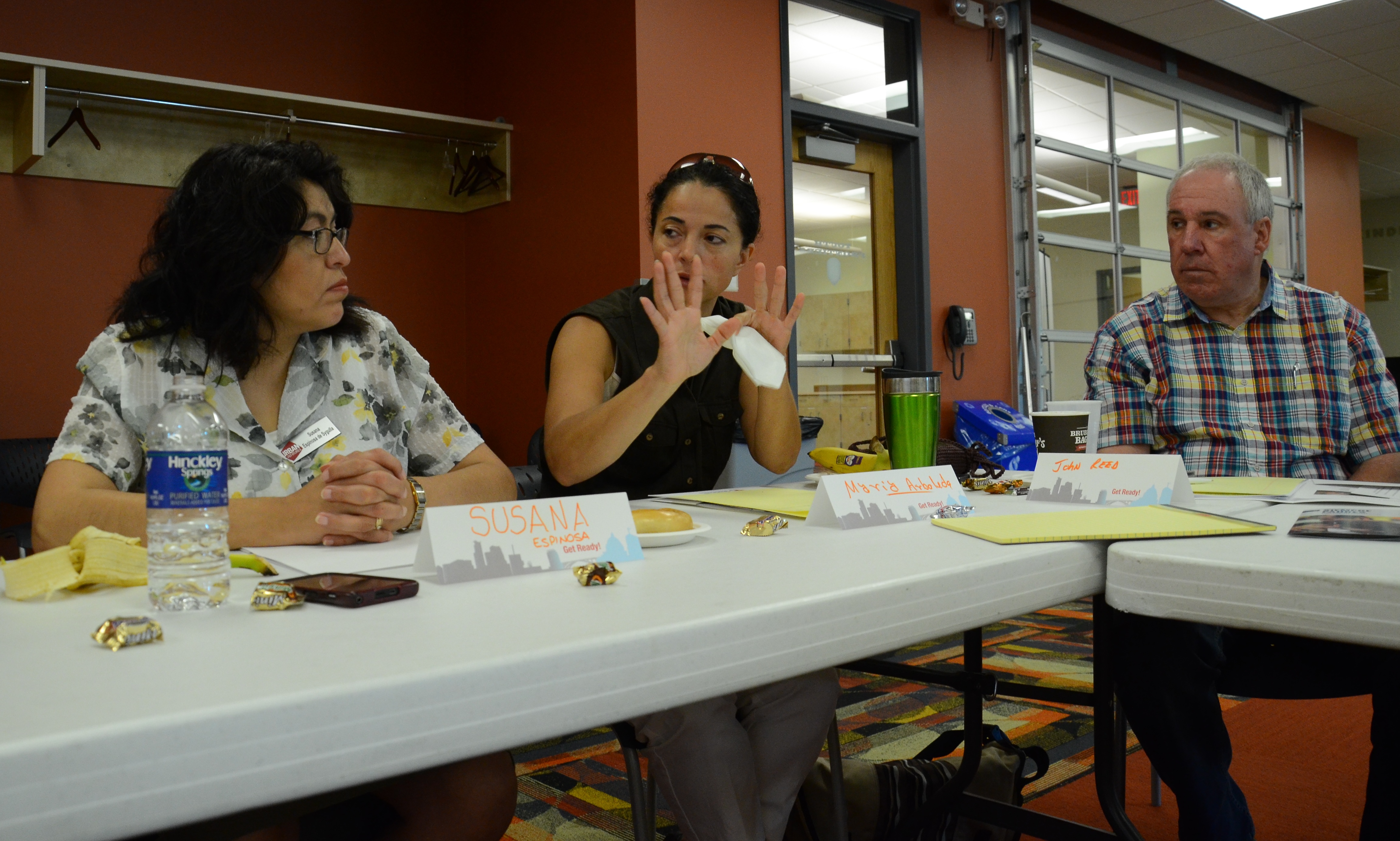
Maria Arboleda, a program coordinator in higher education, says that many people have resources to be prepared, but that "if we want get this education out to communities, then we need more Spanish speakers and more people from the communities."

Maria Arboleda (above center), a program coordinator in higher education, says that many Latino families have resources to be prepared for disasters, but that “if we want to get this education out to communities, then we need more Spanish speakers and more people from the communities.”
DSC_3657_crop

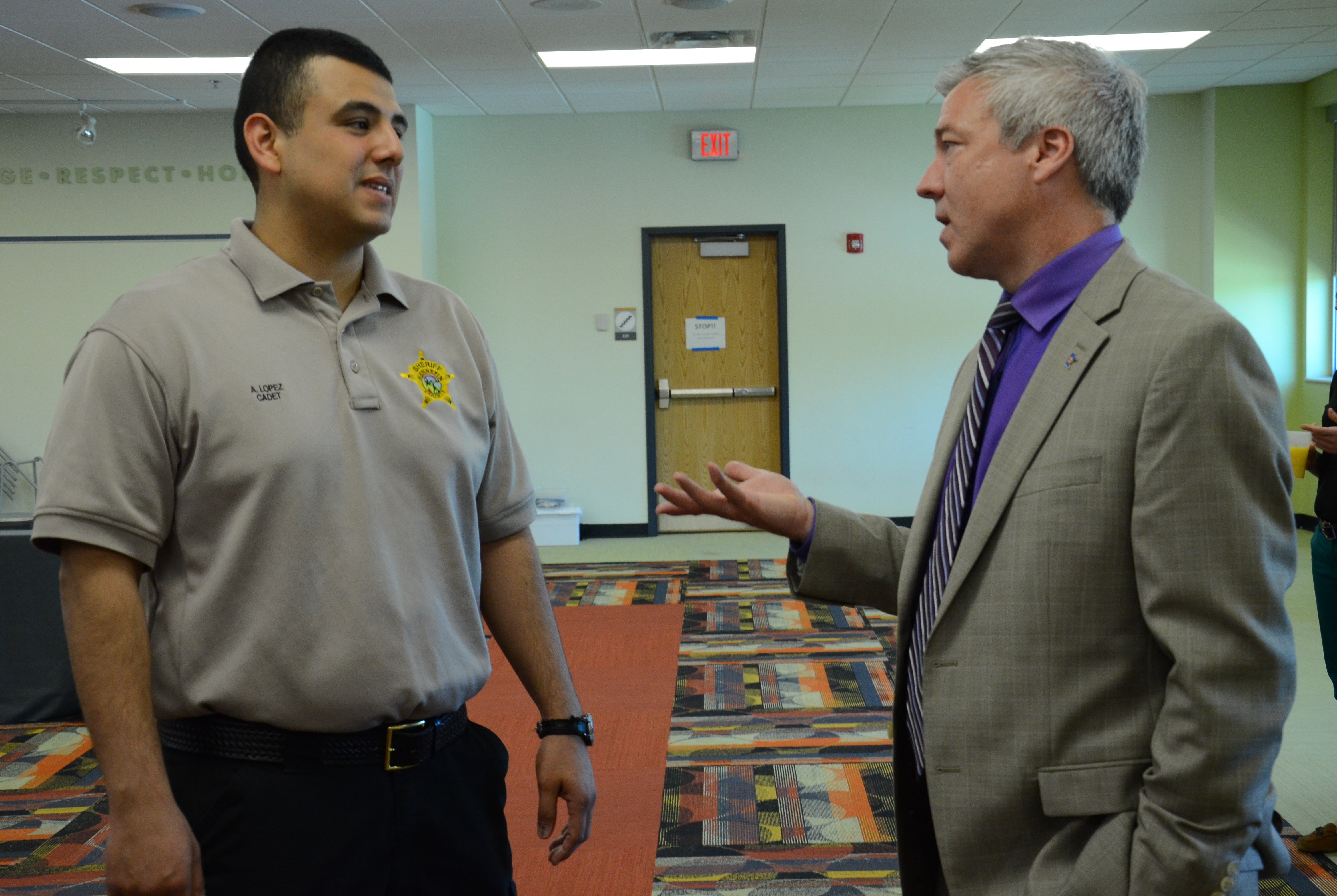
“Every mom is a first responder,” says Arturo Lopez (above left), a cadet in law enforcement training. Lopez says that building trust, reaching children and training women are keys to sharing preparedness messages with Latino families.

Our Latino community partners left the summit with fresh enthusiasm and concrete action steps for preparing and preventing emergencies at home and work. Our Red Cross action plan includes helping them reach their goals and building on our new shared energy.

Story and photos by Lynette Nyman/American Red Cross

Advance community outreach helps after disaster

Red Cross and African immigrant community field trip,  Minneapolis, MN, December 5, 2013. Photo credit: Jenn Vander Woude/American Red Cross.
Red Cross and African immigrant community field trip, Minneapolis, MN, December 5, 2013.

The tragic explosion and fire on January 1 in the Cedar-Riverside neighborhood of Minneapolis was a reminder for us that working ahead of disaster to reach out to diverse communities remains a top priority for the Red Cross. Most recently, on December 5, 2013, nine Red Cross volunteers and staff, representing multiple aspects of disaster prevention, relief, and recovery, met with five African immigrant community leaders to discuss the ways in which we could work together in a culturally sensitive manner. Together, we toured the Cedar Cultural Center, the Brian Coyle Center and areas around a Cedar-Riverside apartment building. Each step of the way there were conversations about the ways they could partner together on different projects including sheltering, cultural training, and preparedness. We know that connections made during this community walk-about, as well as previous community outreach activities, has helped lessen the stress of a tragic event and enabled the Red Cross and its community partners, both organizations and individuals, to provide emergency aid to people during a time of great need.

Story and photo from Jenn Hamrick, a preparedness coordinator for the American Red Cross Northern Minnesota Region. Several community partner groups are taking donations for the Cedar-Riverside fire survivors. Click here for information about how to help. 

Balloon Toss + Lollypop Pull = Disaster Relief

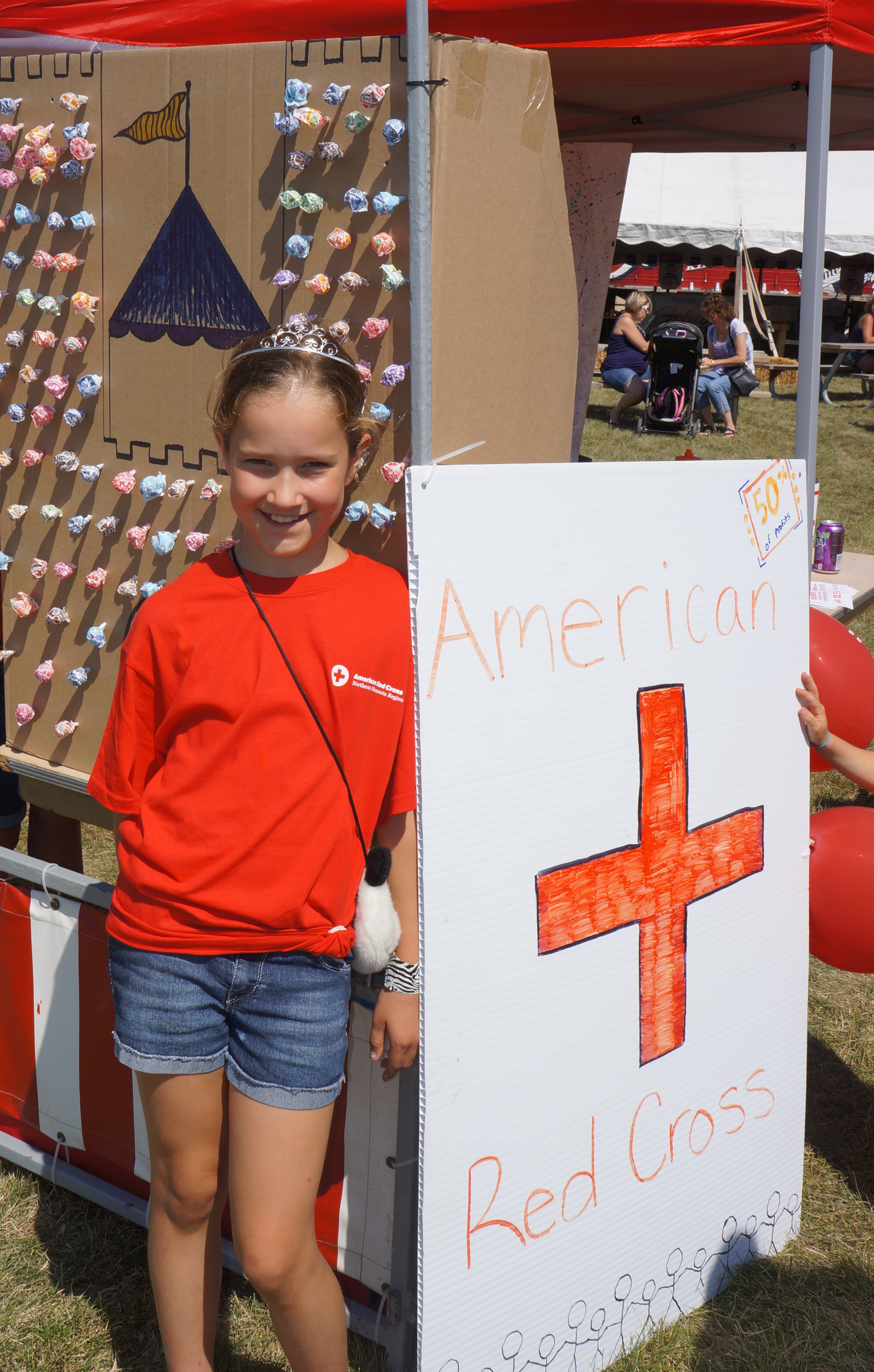
Aliyah Robran, age 9

Balloon tosses, lollypop pulls and county fairs… those were sure signs of summer in Minnesota.  These three things have something else in common: each played a part in ensuring that when disasters strike the Red Cross is prepared to respond.

Let me explain the connection for you.  As the Fundraising Events Director at the American Red Cross Northern Minnesota Region, anytime a community member or group wants to raise funds on behalf of the Red Cross, the call is sent my way.  I work with this group of donors to make sure they have everything they need in order to hold a successful fundraiser.  These can range from canisters on a store counter to choir concerts and bake sales.  If someone wants to raise money in the community, I’m their gal!

One day this past summer, I received a call from Chad, the father of Aliyah Robran.  Aliyah and her friends Brianna and Alyssa Brolin were planning to have a booth at the Corcoran Country Daze Fair and wanted to raise money for the American Red Cross.

Brianna Brolin, age 14

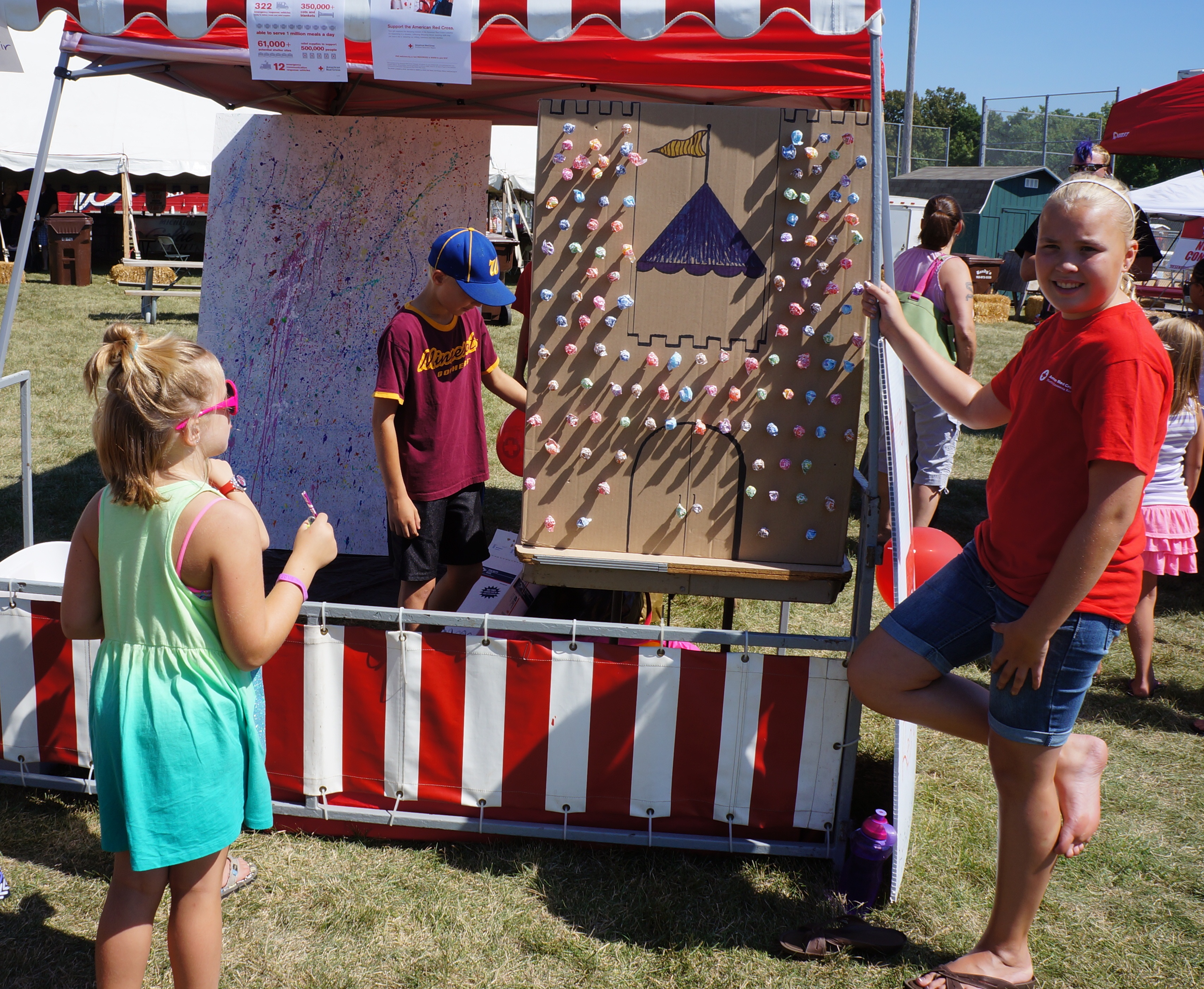
In keeping with the hot summer days we had, the girls decided on a water balloon toss as one of the fundraisers.  For $.25, fair goers could pop a water balloon to reveal a ribbon inside.  The color of the ribbon determined the prize won.  Items came straight from the closets of the girls. The other fundraiser was a $.25 Lollypop Pull.  Those lucky enough to pull a sucker with the correct marking, won a prize as well. All together, the girls raised $126.56 for the Red Cross and wanted to have the money go towards Disaster Relief!

These creative kids are just one example of the generous support we receive from the community. Often people feel called to action once a disaster has happened, but these community fundraisers are a great way to make sure the Red Cross is prepared year round before, during and after disasters.

During their county fair, Brianna Brolin, age 14, and Aliyah Robran, age 9, raised money for American Red Cross disaster relief.
During their county fair, Brianna Brolin (l), Aliyah Robran (r) and Alyssa Brolin (not pictured) raised money for American Red Cross disaster relief.

If you’re interested in hosting a community fundraising event, give me a call at our region offices in Minneapolis: 612-871-7676. I love to hear from people in our community who are passionate about our mission–to alleviate human suffering in the face of emergencies–and want to help fulfill it. 

Guest post by Kristin Peters, Fundraising Events Director for the American Red Cross Northern Minnesota Region. Click here for the Region’s website and to learn more about the Red Cross.

Your Disaster Kit: Better Than a Magic Wand?

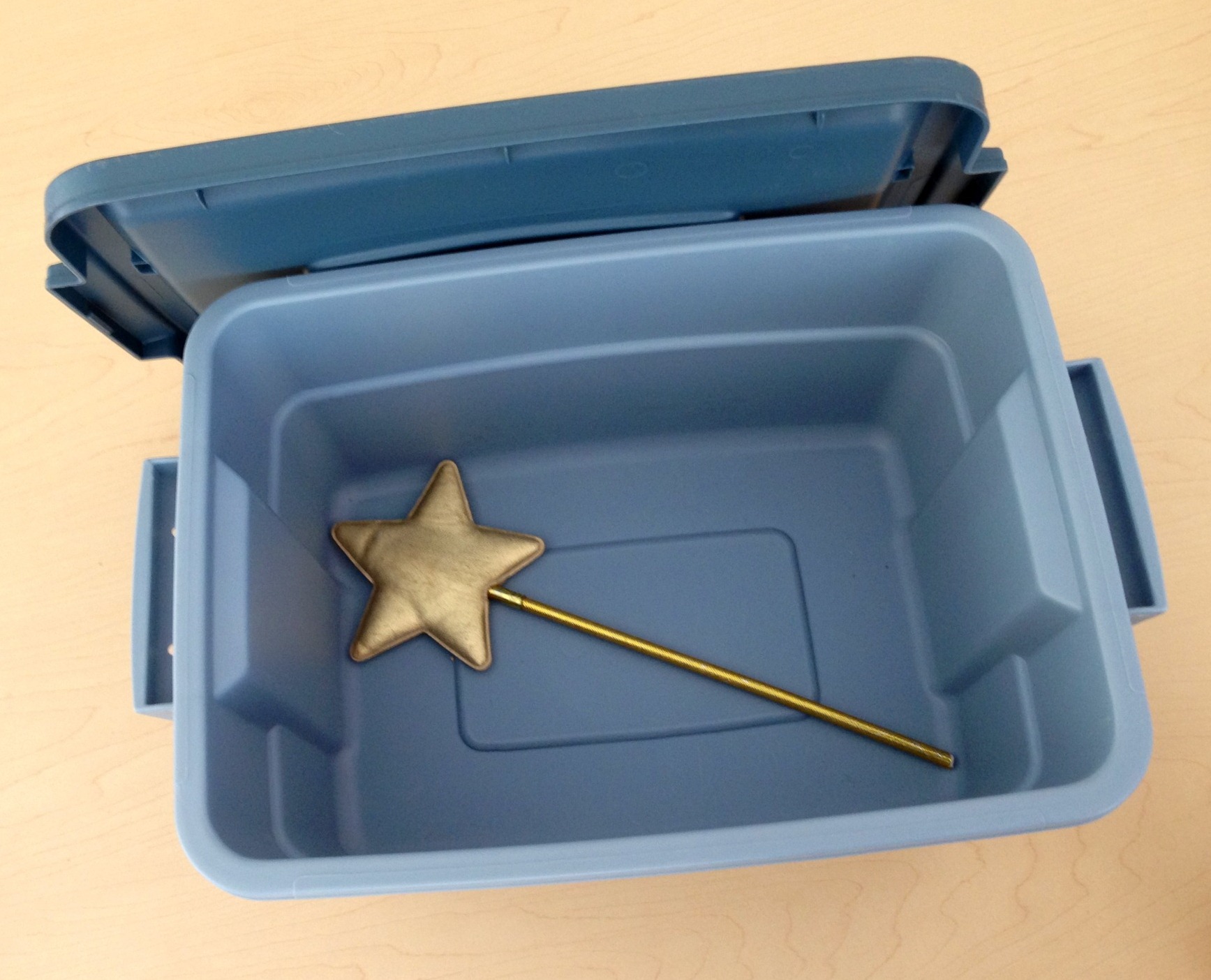
Magic Wand or Bust? Or, Our Favorite Disaster Kit Fail courtesy of Carrie Carlson-Guest.

September is National Preparedness Mont and a great time to get Red Cross Ready for disasters. 

We know – so far your approach to preparedness has looked like a magic wand in a bin. Or maybe it looks like this “kit you don’t want to have” or one of these disaster kit fails.

While we can’t auto-magically get you prepared for disasters, we can give you the tools you need.  The basic steps include making a plan, building a kit and being informed.

Make a Plan Planning together is important. Everyone in the household should help develop the emergency plan and know what they should do if something occurs. The plan should include ways to contact and find one another. Include two places to meet – one near the home in case of a sudden emergency like a fire, and one outside the neighborhood in case circumstances prevent people from returning home. The plan should also identify an emergency contact person from outside the area in case local telephone lines are overloaded or out of service.

Often people are not at home when a disaster occurs and they may not be able to get back into their neighborhood. Plans should include decisions about where everyone will go if ordered to evacuate and what route they will take to get there. When discussing evacuation, everyone should include several different routes in case roads are closed. If pets are part of the household, they should be considered, including where they could be safe if the family has to evacuate such as pet-friendly motels and animal shelters along the evacuation route.

Get a Kit Another step to get ready is to build an emergency kit. Use an easy-to-carry container so the family can use it at home or take it with them if asked to evacuate. It should contain a three-day supply of water (one gallon, per person, per day), nonperishable food, a flashlight, battery-powered or hand-crank radio, extra batteries, a first aid kit, a 7-day supply of medications, a multi-purpose tool, sanitation and personal hygiene items and copies of important personal documents. The Red Cross also recommends having at least two weeks worth of supplies at home.

Be Informed Everyone also needs to stay informed about what types of disasters are most likely to occur where they live or where they plan to visit, and how officials will communicate with you during an emergency. It’s also important to take a first aid and CPR/AED course—a vital component of disaster preparedness in case emergency help is delayed. Click here to find a class near your local Red Cross chapter.

Red Cross Apps People can be ready for whatever comes their way by downloading the free Red Cross apps for mobile devices which not only help people during emergencies, but offer help creating their emergency plan. The apps give people vital information to use during emergencies, even if they can’t connect to the internet. The apps can be downloaded from the Apple App Store and the Google Play Store for Android by searching for American Red Cross.

Happy National Preparedness Month!

Dollhouses Spark Conversation about Fire Safety

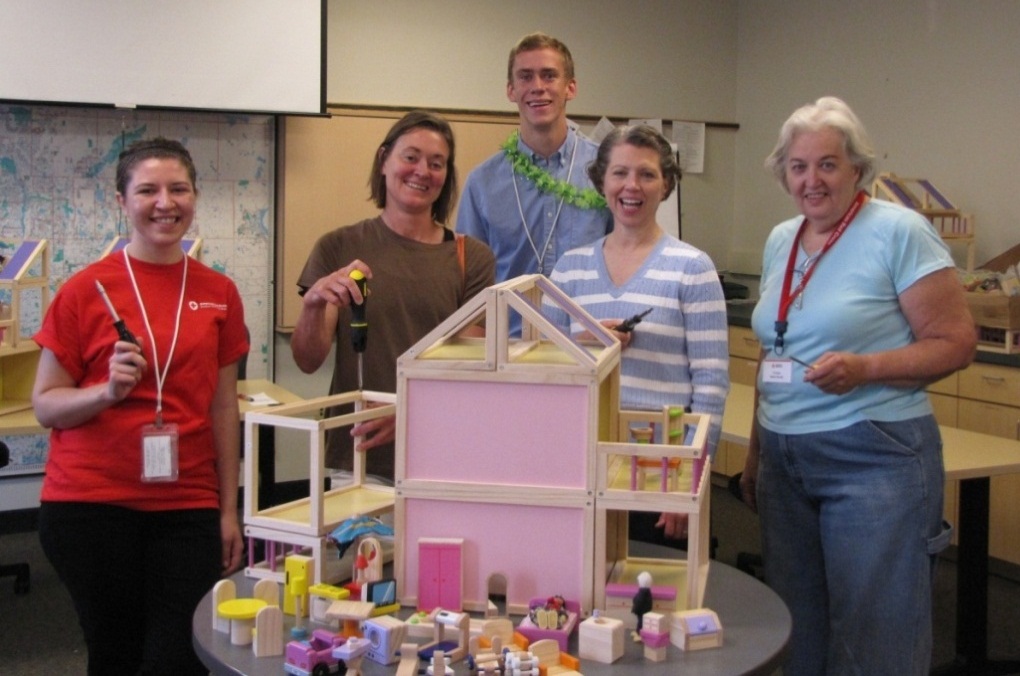
Armed with screwdrivers and one page of instructions, Red Cross volunteers build dollhouses for fire safety instruction, July 31, 2013.
Armed with screwdrivers and one page of instructions, Red Cross volunteers build dollhouses for fire safety instruction, July 2013.

Upon walking into the Preparedness office at the Red Cross in Minneapolis late last July, you may have thought you had instead stepped into a preschool playroom.  You were, in fact, in the correct place. The confusion was caused by 10 pastel colored dollhouses, all of which include over 50 pieces of furniture and two dolls.  These dollhouses, built by Red Cross volunteers, and will be used throughout the region to teach families, especially children, about fire safety.

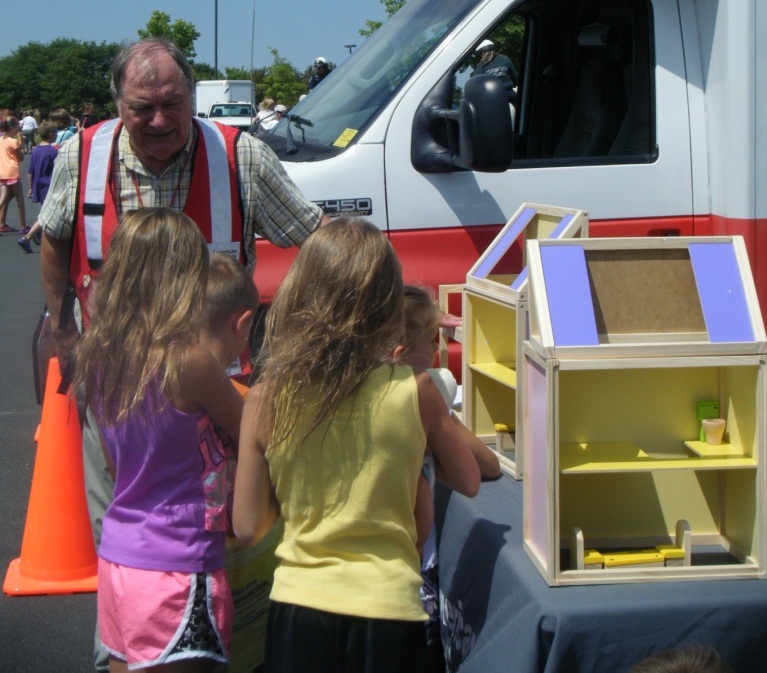
A new dollhouse was first used during National Night Out in Maple Grove, Minnesota.  At this event it was clear the dollhouse was a hit.  Children loved them. And conversations about what to do during a fire started easily with the dollhouse prompt.  Volunteers engaged both children and adults when they asked, “Do you have a plan if there’s a fire in your home?”

A Red Cross volunteer sparks the conversation about fire safety using a new dollhouse, Maple Grove, Minnesota, 2013.
A Red Cross volunteer sparks the conversation about fire safety using a new dollhouse, Maple Grove, Minnesota, July 2013.

The dollhouse project was adopted from our Safety Mobile Program. The next step for the dollhouses will be distribution around the Northern Minnesota Region, especially during October, fire safety month, when the dollhouses will be present at fire department open houses.   

If you’d like to help teach others about fire safety or would like a dollhouse to come to your city’s fire department open house, you can call the Red Cross at 612-871-7676. You can also download our First Aid mobile app with helpful information about preparing for home fires and other emergencies.

Story and photos by:  Ellie Decker, Preparedness Intern, American Red Cross Northern Minnesota Region

Children, too, are grateful for Red Cross

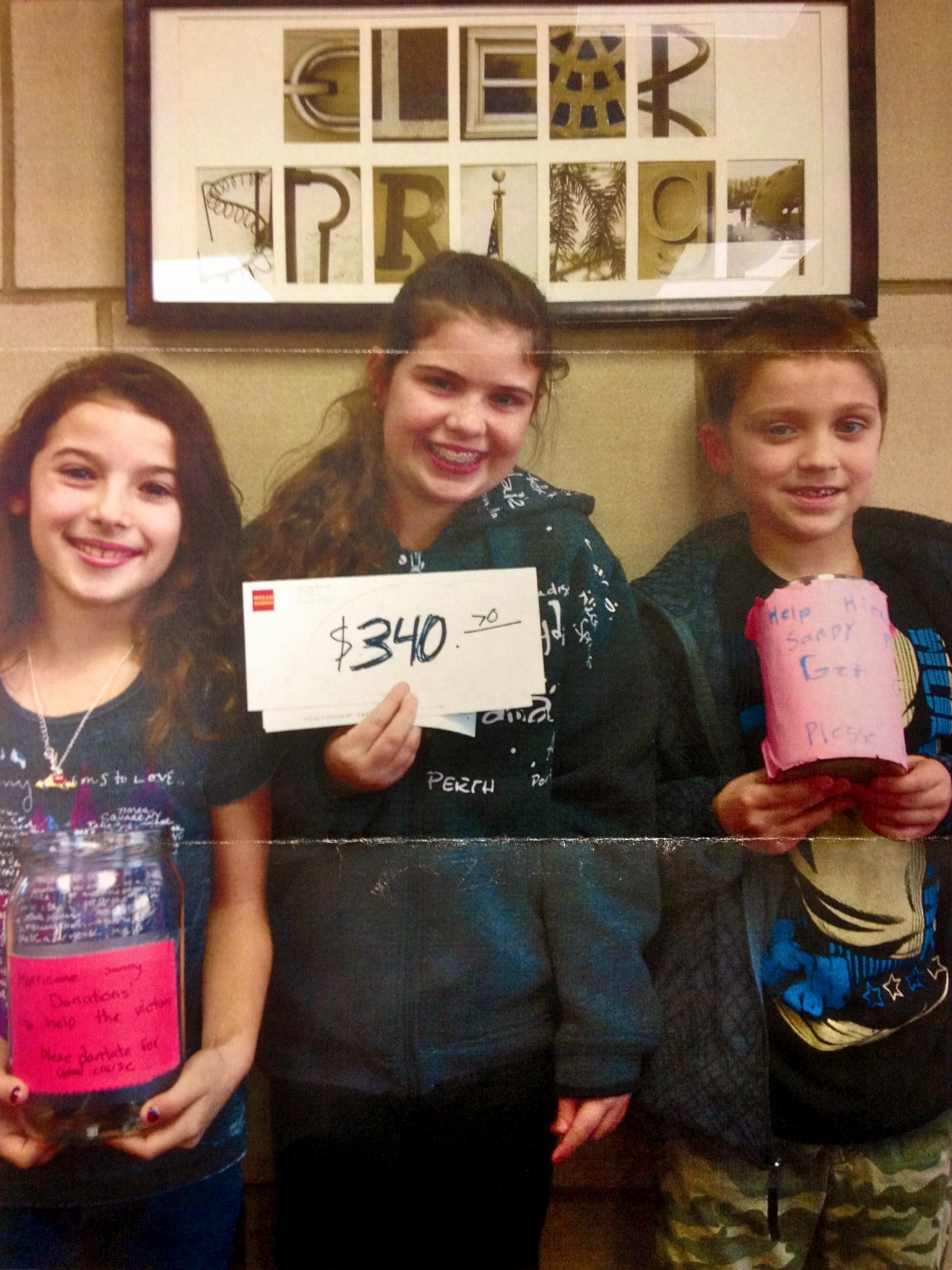
Clear Springs Elementary Students with their well earned donations.

While the American Red Cross has hundreds of people donating money or blood every day, some of the Northern Minnesota Region’s most enthusiastic donors, as well as the cutest, are children.

Within the past year our region has received generous donations and letters of encouragement from several elementary schools across the state of Minnesota. Recent contributors have included children from Clear Springs Elementary, Lake Country Elementary, Oxbow Creek Elementary, and Richardson Elementary.

Most of these donations were given to support victims of the Moore, Oklahoma, tornado which occurred on May 20, 2013. Students and staff of Richardson Elementary School from St. Paul, Minnesota, raised an impressive $1,021.95 specifically for Oklahoma tornado relief efforts.

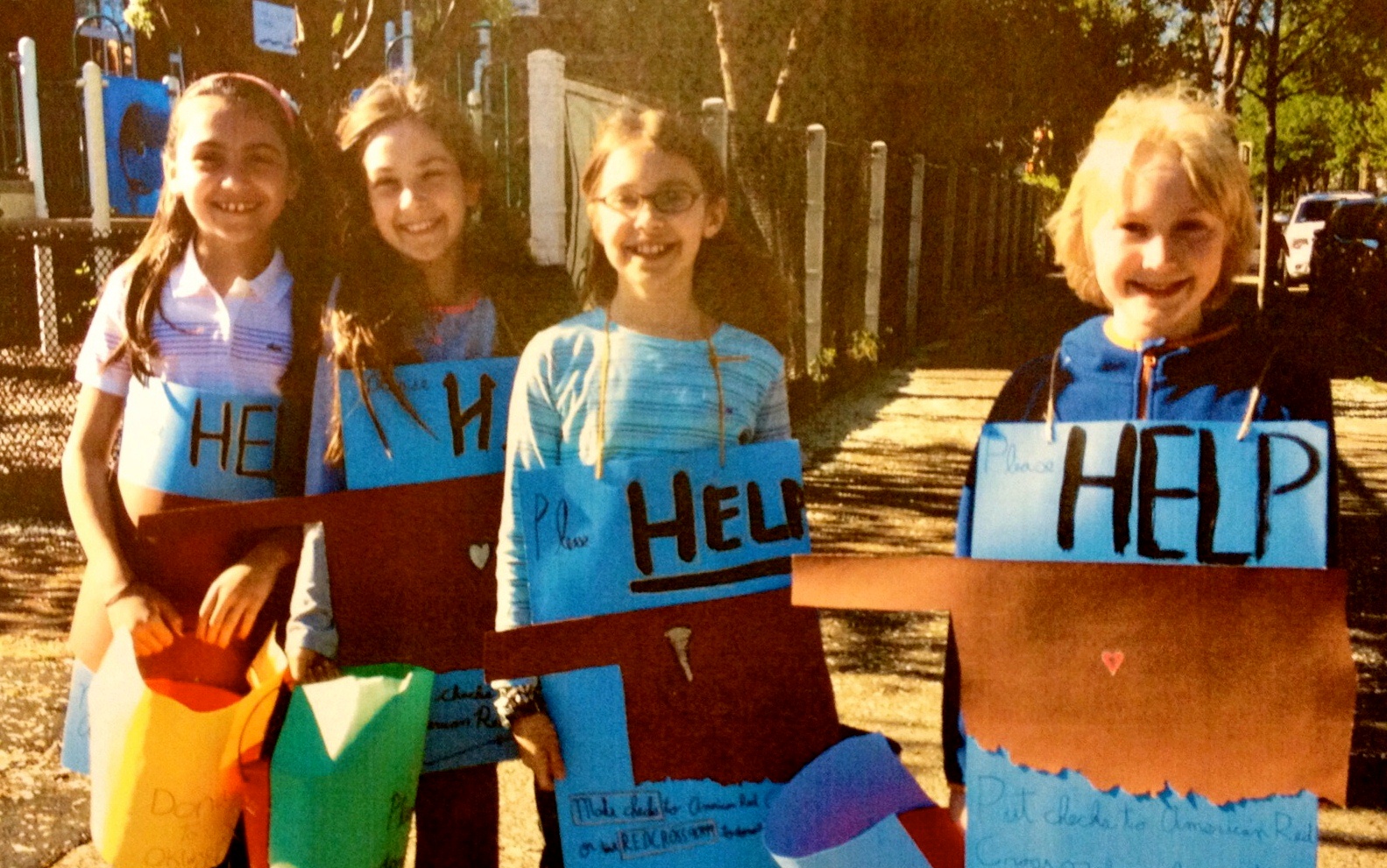
Four Lake Country Elementary students raised money for the Red Cross.
Four Lake Country Elementary students raised money for American Red Cross Disaster Relief.

Not only has our region received various donations, we have also received letters of encouragement from students as well. Clarissa, from Oxbow Creek Elementary of Champlin, Minnesota, sent a wonderful letter expressing her gratitude for all of the American Red Cross’s hard work, “The United States are very grateful for the American Red Cross.”

The support of children like Clarissa brings hope for a new generation of Americans who are learning to help each other in times of crisis. The American Red Cross would not be able to do what it does without the continuing support of the community around it.

Story by Lia Capaldini, Communications Intern, American Red Cross Northern Minnesota Region

Oklahoma Strong

OKTShirt_DeckerDespite the devastation from the May tornadoes, the people in Oklahoma are showing incredible strength and hope during the recovery process. Vonnie Thomas and John Decker, American Red Cross Health Services volunteers, say both the tornado survivors and the volunteers responding to the disaster demonstrate positive teamwork during the ongoing recovery.

“It’ll be a long recovery, but people here are so resilient,” says Decker.

Weeks after the tornadoes hit Oklahoma, more than 1,600 Red Cross workers are helping people get back on their feet – providing shelter, food, relief supplies, health services and emotional comfort.  Thomas says volunteers have come from Florida, Georgia, Texas, Hawaii, Iowa, California, Illinois and a number of other states to help the tornado victims.

“Our outreach team finds families that have fallen through the cracks and need help with medical referrals,” Thomas explains. Since the tornadoes hit, the Red Cross has provided more than 20,000 health services and mental health contacts. “About 75 health services people have passed through, and they’re phenomenal. They’re working so hard and I can’t thank them enough.  It’s amazing teamwork.”

photo_car__deckerRed Cross disaster health services include:

-delivering medical equipment

-finding health resources in the community

-working with shelters to help people with functional needs

-providing transportation to people for their medical needs

– working with hospitals to contact families of hospitalized

-helping with medications

In addition, the Red Cross Safe and Well website is monitored to help communication between family members and friends to make sure missing victims are safe. “We’ve worked closely with Safe and Well looking for people who were missing,” says Thomas.  “We have only one person they haven’t been able to locate, which is good progress.”

decker_1

The tornado victims also display immense strength and hope throughout the long recovery process. “I admire all of the people involved,” says Thomas. “The volunteers are giving 110%–they go above and beyond to help the victims. The victims are so strong and want to be so independent. They are trying to get out on their own, and that’s why the shelters only have a small number of people.  The families stay in tents or with friends in the area to maintain their independence.”

Decker says mental health teams are going into community to help people cope and get their story out. “It’s a great community,” Decker says.  “Some people are standing in front of their completely destroyed homes and are still extremely nice and pleasant.”

“It’s Oklahoma strong,” adds Thomas. “The people are phenomenal and inspiring.”

Reporting and story by Shannon Lewis, Communications Intern, American Red Cross Northern Minnesota Region. Photos provided courtesy of John Decker.

Disaster Gets Me Going

I’ve always admired seeing people respond to disasters and I’ve wished that I could be right there with them. It’s hard for me to put my finger on why I’ve felt that way, but there’s something about arriving early to a scene of a disaster that gets me going.

Terry Menge training for disaster response in Minnesota, June 2013. (Photo courtesy of Terry)
Terry Menge, wearing his Red Cross disaster response vest, demonstrates doing Red Cross disaster relief paperwork, Minnesota, June 2013. (Photo provided courtesy of Terry.)

As a child I was intrigued by disasters, whether it was a tornado, flood, hurricane or earthquake. But after school my life took different direction and I went into sales where I’ve spent much of my career, working mostly at AT&T and then with StayWell, a partnership organization with the American Red Cross. Several years ago, I accepted a health and safety services sales position with the Red Cross. This brought me closer to my life-long interest in disaster relief response. And soon I applied to become–and was accepted to be–a Red Cross Emergency Services Volunteer who responds to disasters in the Northern Minnesota Red Cross Region.

To date, I’ve had the opportunity to respond to three fire disasters: one duplex fire and two single family resident fires. It’s hard to explain, but getting a call to respond at 3:00 in the morning gets my adrenalin flowing as I never know what to expect until I get there. One of my first lessons learned was to bring my reading glasses as I felt very much unprepared in assisting my response partner in filling out forms and having to admit out loud “I can’t read this without my glasses!” How embarrassing was that! Well, never again. The next day I went straight to Office Max and bought some supplies to better prepare myself for the next response. I’m happy to report that it’s going more smoothly now that I can read the Red Cross disaster documents.

My experience with the disaster team members has been very positive. I’m learning new skills by taking training courses, such as Disaster Assessment, Disaster Action Team  Simulation, Client Case-Work, Shelter Fundamentals, Psychological First Aid, and Emergency Response Vehicle Operation.

Being a Red Cross disaster volunteer has many benefits. Having first-hand disaster response experience, for example, has added credibility to my social and business speaking presentations. But for me what’s most rewarding is being able to help people get through a difficult time. I’ve learned that a hug and kind word gives them strength to move on from tragedy. For me, each call to action brings its own unique circumstances. I’m grateful for those who’ve welcomed me to use their home, car, or other space for warmth on a winter night while I’m helping their neighbors affected by disaster. I enjoy the human connections and can confirm that the comfort we bring, the smiles we create and the words of thanks we receive are some of the reasons that I’m a disaster volunteer.

Guest Blog Post by Terry Menge, Prepardness, Health & Safety Services Sales Manager, American Red Cross Northern Minnesota Region (AND Red Cross Volunteer Disaster Relief Worker)

“I Know You”

On a sunny October afternoon, a young EMT pulled long-time Red Cross disaster volunteer Diane Dunder from the tangled wreckage of her SUV after another driver lost consciousness and struck her.  “I know you,” the young woman told Diane.  “You were my teacher in high school.”  Diane recalled how that young EMT made sure she was calmed and comforted.

Red Cross disaster relief volunteer Diane Dunder talks with Joan and John Belch.
Diane Dunder talks with Joan and John Belch about American Red Cross disaster relief services following the Germann Road Wildfire in western Wisconsin.

Two years later, Diane was at a Red Cross shelter when she ran into that young woman’s parents, who had lost their home during the Germann Road Wildfire near Solon Springs, Wisconsin, in May 2013.

“I know you,” Diane said.  Now it was her turn to provide comfort.

John Belch and his wife Joan lost almost everything in the wildfire that overnight destroyed over 8,700 acres of woodland and 77 structures, including John and Joan’s home, garage, and many of their belongings.

Joan wasn’t home when fire erupted in their yard. Earlier that afternoon John had watched fire trucks come in and out of their rural neighborhood without much concern.  Their home wasn’t in danger.  Then a sudden switch in the wind put the Belch home directly in the path of the blaze. Joan cried as she remembered learning from her son that her home was gone.

“The Red Cross was great,” John told Dunder and Red Cross worker, Nancy Rogers, who stopped in to check on them and deliver Red Cross comfort kits. “The help you gave us has really come in handy.”

The 3,000 pine trees that John Belch had planted since 1996 will never recover from the fire.  The sound of logging equipment harvesting the burned trees to be recycled into fence posts was a steady back-beat to the sound of brightly colored goldfinches that flitted through the blackened branches.  However, the Belch family is ready to start making plans, thanks in part to a twist of fate that brought them in contact with Diane Dunder and the American Red Cross.

The couple said that they’ve learned from the experience and are making sure they are prepared and have a plan in place in case disaster strikes again.

Free information about disaster preparedness is available at www.redcross.org.

Story and photo by Judy Hanne Gonzalez/American Red Cross

Fire Chases Away Christmas Joy

by Anne Florenzano/American Red Cross

A tired Yvonne Johnson sat at a table in her apartment complex community room. “I am still in disbelief,” she said. “You hear of people in the news who have fires like this, but I never thought it would be ME in this situation. It still seems so unreal!” she said.

Red Cross volunteer Sheila Miller (l) helps Yvonne Johnson (r) with emergency disaster relief after an early morning blaze burned her home on December 26, 2012. (Photo credit: Anne Florenzano/American Red Cross)

Yvonne, her teen daughter and nephew had enjoyed Christmas together in their apartment in Plymouth when their building fire alarm went off at about 12:30 a.m. They were still up, and dressed, and they grabbed their new gifts and put on their boots and coats and went outside. A half-hour later they were given the okay to go back into their apartment. At approximately 3:30 a.m. Yvonne was woken out of her sleep by the smell of smoke and her daughter saw sparks and flame out of the balcony window coming down from above. Yvonne and the two teens raced out of the apartment, this time dressed only in pajamas and unable to save anything but a clutch with her phone and keys.

The three of them took refuge in their car to stay warm. Eventually Yvonne was able to send her kids to warmth and sleep with her sister while she made arrangements for help from the Red Cross for temporary lodging, clothes and food. The firemen have told her that her apartment is uninhabitable because of water damage. Fortunately her landlord has some empty units where Yvonne can begin rebuilding her home, but she won’t know until she can get back into her apartment if any of the kids’ Christmas gifts or the furniture she recently inherited from her Mom can be salvaged. Yvonne is a middle school English teacher at the Woodson Institute for Student Excellence, and she said, “I’ve never had any help or assistance before – never in my life – but I need this help today.”

Disasters are hard any time of year, but can be especially hard around the holidays. Since Friday, December 22, the Northern Minnesota Red Cross has helped more than 8 families, including 20 adults and 15 children. Our volunteers respond to more than a disaster a day here in our region.  In addition, more than 100 volunteers from our area have deployed east to help those affected by Superstorm Sandy–several are on their second deployment, missing holidays with their families because they want to help those in need. Everyone can help those affected by local and national disasters: please consider making a year-end gift to the Red Cross at redcross.org.