Our Red Cross chapter mobile feeding on the road in Pennsylvania after the flooding. Photo credit: Rick Campion/American Red Cross
(from Rick and Karen Campion, Red Cross Emergency Services Volunteers based in Minneapolis, Minnesota)
Today is day 16 of our Red Cross deployment to the Pennsylvania flood response and we’re on our way home to Minneapolis. This morning we cleared the final mobile feeding truck inspection and out-processing without a hitch.
This Red Cross national disaster response was well organized with a full complement of volunteers covering nearly 12,000 sq. miles of flood ravaged territory. Rick and I had a mobile feeding route in some of the hardest hit areas right along the banks of the Susquehanna River. We went from house to house to deliver meals. Many of the recipients said we were the first disaster relief people they had seen.
It was difficult to not get teary eyed when they expressed their sincere
appreciation.
We have traveled nearly 4000 miles since we left home on 9/11 and today was
a quiet ride allowing us time to reflect on our Pennsylvania experience. It’s easy to
be grateful for your blessings when you see the huge loss of so many.
We plan to be home this week and will see many of you soon.
One destroyed house along the route where Red Cross volunteers are providing meals and snacks following the Pennsylvania flooding. Photo credit: Rick Campion/American Red Cross
It’s now day 11 in our Pennsylvania flood deployment with the Red Cross and we’ve settled into a regular mobile feeding route in the mobile feeding truck (ERV). We travel about 2 hours to get to our first scheduled stop and then serve between 100-150 meals. Our route follows the river and some of the homes that were very close to the river bank (see pic). We recognize our “regulars” and it’s fun to give and get hugs from people who really appreciate the help that the Red Cross provides. Ah, this our reward.
When people see “Minneapolis, MN” on the side of our truck, they’re always surprised and grateful at how far we’ve traveled to serve them.
The Red Cross disaster relief effort in Pennsylvania has served more than 221,000 meals/snacks and it is now down to 4 open shelters. We can see that people are slowly getting back on their feet. Many of the original shelters were opened in schools and it causes some logistical problems with the school’s now regularly scheduled activities. So after 3 weeks, those affected by the floods are encouraged to find alternate housing arrangements.
We expect to be released from the operation next week and look forward to coming home.
Jeff Skoog is a Red Cross volunteer disaster relief work based in Minneapolis. Photo credit: Lynette Nyman/American Red Cross
Red Cross volunteers are amazing for about one billion-gazillion reasons. Take Jeff Skoog, who serves as a volunteer disaster relief worker during both local and national responses.
When Jeff could be out reeling in a sturgeon or walleye on this incredibly lovely summer day in Minnesota, he is instead here at work sprucing up the chapter’s mobile feeding truck.
Paul Vanderheiden is among more than 340 Red Cross disaster relief workers responding to the May 22 tornado in Minneapolis. Photo credit: Lynette Nyman/American Red Cross
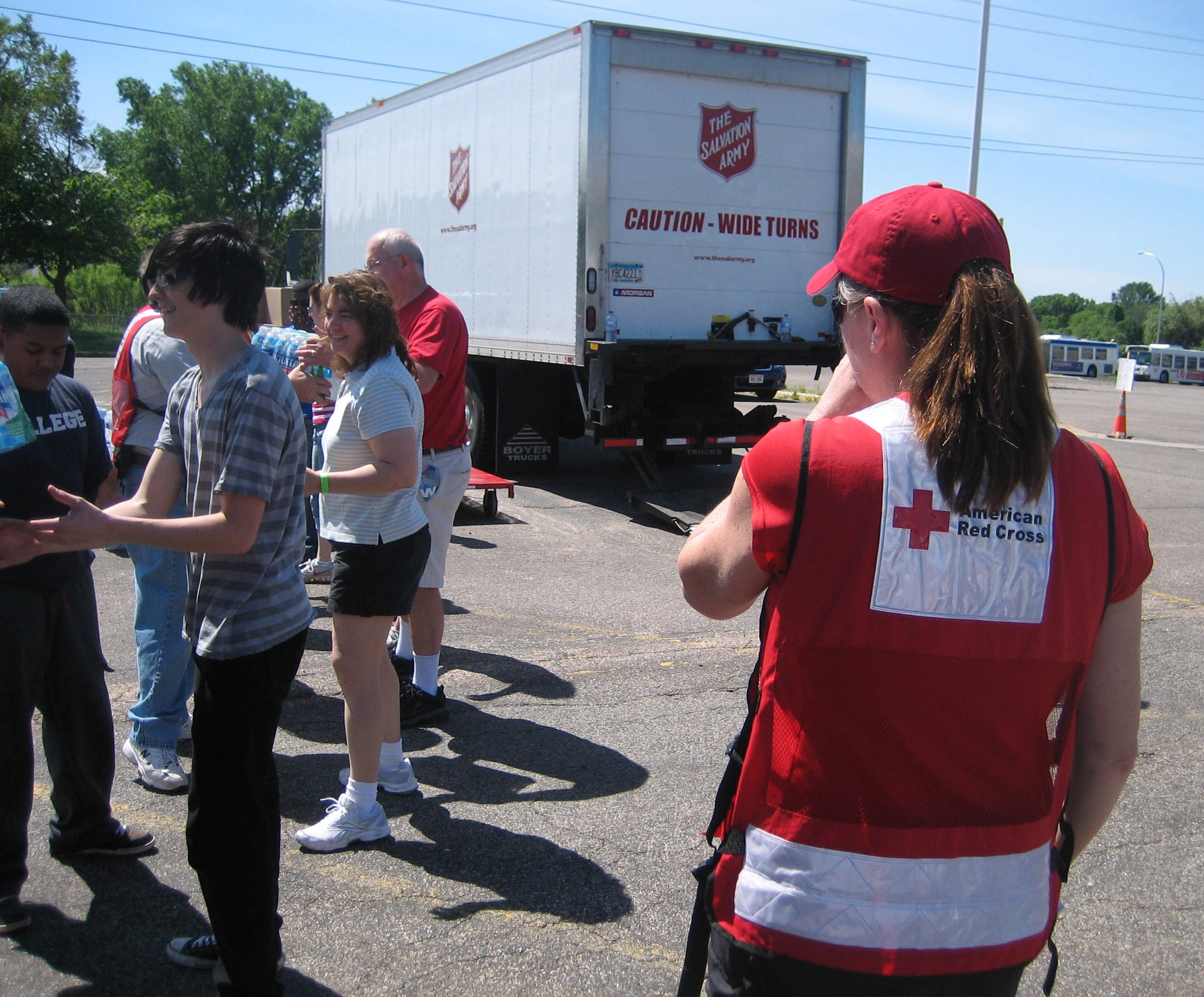
When volunteers arrived for their shifts during the Minneapolis tornado clean-up day on June 4, a Habitat for Humanity volunteer likely received them, a Salvation Army worker probably handed them a meal, and American Red Cross responder gave them bandage packs, gloves, and other useful field supplies such as hand sanitizer and sunscreen.
Once in the disaster area, workers might have made contact with Red Cross mobile feeding trucks supporting the workers on what felt like the first day of summer.
“We’re out here to make sure these folks have enough water and snacks in all this heat,” said Paul Vanderheiden, a Red Cross volunteer from Eau Claire, Wisconsin.
Parking his van near a group of workers, Paul offered them advice. “Make sure you get some salt. Want some chips with that?”
Red Cross disaster relief worker Chris Thomsen surveys the unloading of water during the Minneapolis tornado clean up day on June 4. Photo credit: Bill Fitler/American Red Cross
Paul and fellow volunteer Chris Thomsen had been driving their mobile feeding vehicle around these neighborhoods every day since they had arrived the previous Saturday.
“Back home I’m a surgical nurse,” said Chris. “This is the first time I’ve worked outside the chapter on a disaster. We’ve been out here long enough so I’m starting to know folks, and I’ve been so touched by some of the stories I’ve heard.”
Paul and Chris are among more than 340 Red Cross workers, from as far away as California and Connecticut, helping people affected by the Minneapolis tornado.
To date, Red Cross disaster relief workers have distributed more than 145,000 meals and snacks to affected families and clean-up crews responding to this tornado disaster.
Red Cross disaster relief worker Jacob Tolle (l) and Daniel Schultz (r) are meeting one-on-one with families affected by the May 22 tornado in Minneapolis. Photo credit: Jason Viana/American Red Cross
Volunteers have come from many Red Cross chapters across the country to help the north Minneapolis residents recover from the devastating tornado that swept through town on May 22.
Take Jacob Tolle, 20, a caseworker for the Red Cross. Here from Cinncinati, Ohio, he has been trained for Red Cross disaster relief deployment for only five months.
“I want to give my attention to the families in need,” says Jacob.
His inspiration is one of amazing strength. At the age of 16 Jacob decided to take part in a demolition derby. The night before the derby Jacob’s stepfather told him he was nervous and thought participating in the derby was a bad idea. Despite what his father told him, Jacob took the risk.
“Not more than ten minutes into the derby my car started on fire and the whole car shot into flames while I was trapped inside with my seat belt on,” Jacob explains.
He was rescued from the burning car and rushed to Adams County Hospital where he was given multiple numbing medications. From there he was sent Shriners Hospital Burn Center.
“From day one of treatment, the doctors told me that I would be unable to walk for at least 6 months,” says Jacob.
With perseverance on his side, Jacob walked with a gait belt support within 3 days of his recovery treatment. A week later he walked on his own to check-up at the hospital.
Jacob has used his accident as a way to inspire others to never give up.
“That’s why I volunteer for the Red Cross, because of the devastation of someone telling you that you won’t walk,” say Jacob.
Jacob arrived in Minneapolis on May 27, just a few days after the tornado,and he plans to stay and help until things settle down.
Red Cross shelter night manager Sharon Collin says that she prefers volunteering during the night shift because "it's when you get to know the people and talk through the day." Sharon and McKai have a nightly chat. Photo credit: Amanda Mark/American Red Cross
Red Cross volunteer Sharon Collin is a natural organizer. A former movie theater manager, accountant and school teacher, she’s at ease while directing the flow of traffic that comes through the North Commons Recreation Center where the Red Cross shelter is housed.
Sharon is the night manager at this Red Cross shelter where 43 residents are attempting to rebuild their lives after the May 22 tornado destroyed blocks of North Minneapolis. One week into working at this shelter and Sharon has her routine down.
“I’m calling it organized disorder,” she says. “People are welcomed to come and go as they like as we try to create normalcy in the abnormal.”
Nearly all at once, Sharon sends someone to the snack room, finds a caseworker for another shelter resident, and hugs three kids in between the two tasks, promising one that she’ll tuck her in later.
“We have a lights out time,” she explained. “But one man works nights. Other people are night owls. I offer to fix snacks and hot meals during the night as people come through.”
Red Cross shelter night manager Sharon Collin shares a quiet moment with Willtin, 4. Photo credit: Amanda Mark/American Red Cross
While Sharon has responsibilities and organizational tasks to ensure that the shelter runs smoothly, she says she spends most of her time listening.
“No one wants to be here,” she said. “I listen to where they’re at, answer Red Cross questions, and match them up with services so they can move forward.”
Sharon travelled from Cumberland Foreside, Maine, to be the shelter night manager. She’s volunteered for the Red Cross in various ways for the past 6 years: working on disaster teams, supporting call centers and filling in any way she can, but her favorite assignment is working at shelters.
“People often enter a shelter at their lowest point. Red Cross volunteers enter a shelter, fresh with adrenaline and ready to help. Sometimes that’s really what people need. Someone to support them and provide the energy they don’t have.”
(Reporting and photos by Amanda Mark, Red Cross Volunteer)
Minneapolis tornado survivor Cathy Stolte shares her harrowing story with Red Cross volunteer Dave Schoeneck. Photo credit: Jason Viana/American Red Cross
Kathy Stolte was working on a cross word puzzle Sunday when she heard a crashing sound. She grabbed her dog and headed for the basement, but the tornado had already passed her north Minneapolis bungalow, leaving behind a path of twisted trees, broken homes and destruction.
Kathy, her husband, and her dog were fortunate — no injuries, just property damage. Part of the roof of their home blew off, and rain soaked the insulation, making the house uninhabitable. Her son’s car was skewered by a five inch tree branch, from windshield to floorboard. The worst damage was to the garage, parts of which currently reside in her neighbor’s kitchen.
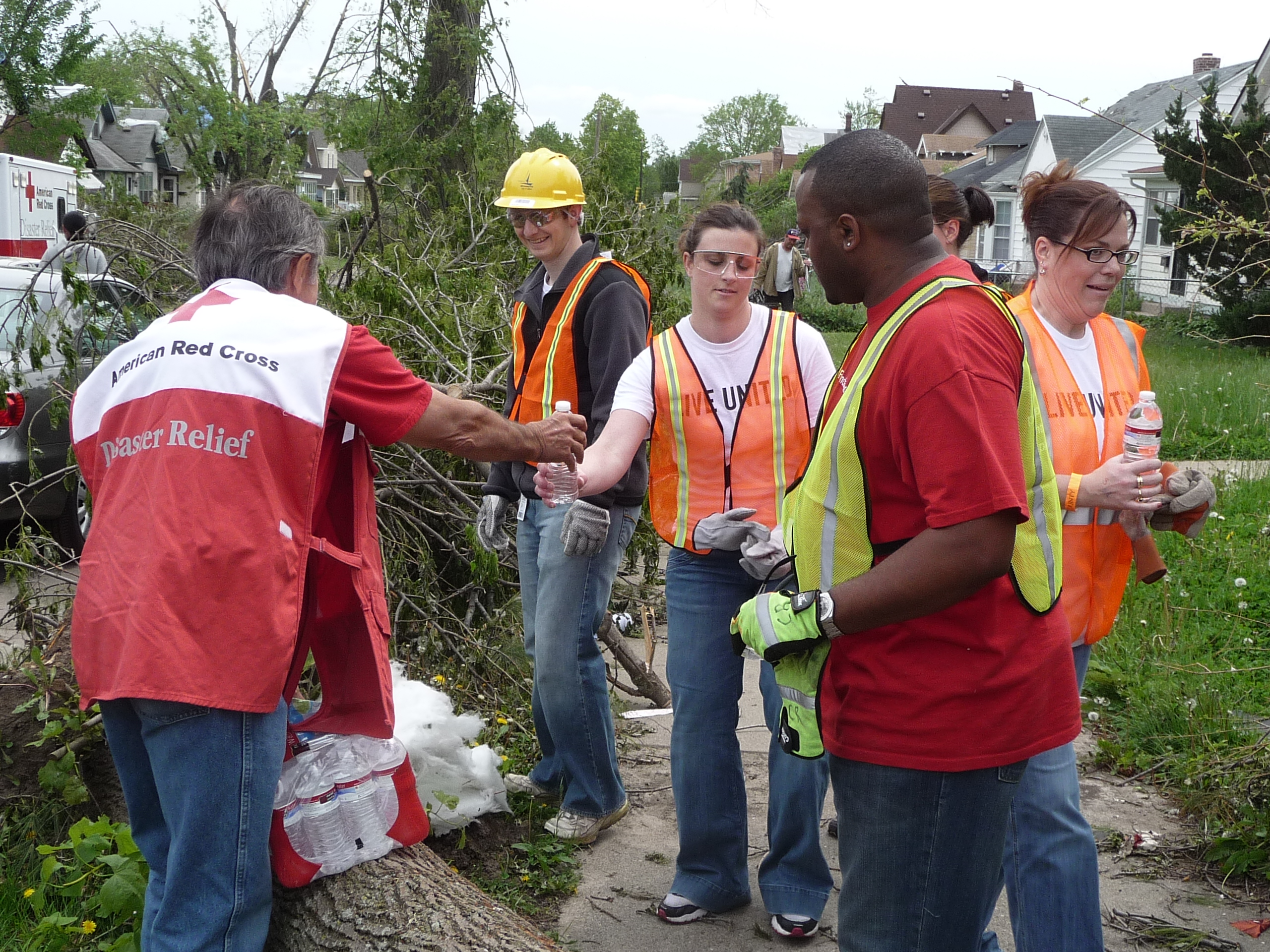
Red Cross volunteers are providing water and snacks to people helping to remove debris after the May 22 tornado in Minneapolis. Photo credit: Jason Viana/American Red Cross
On Wednesday, as repair crews from the City of Minneapolis were hauling away the remains of large trees from their block, and crews from Xcel Energy were restoring electric power to their block, Kathy was grateful when a Red Cross disaster team from the St. Croix Chapter of the American Red Cross came down the street, offering food and water to anyone who needed it. Eric Nickolai and Sherm Boucher were busy handing out water, sandwiches, energy drinks and fruit to residents, volunteers, and work crews.
While Kathy faces weeks before her house can be reoccupied, she is one of the lucky ones who had homeowner’s insurance and has a place to stay temporarily. Hundreds of others were out trying to salvage their belongings and working to find food, clothing and shelter for themselves and their families.
The reality of a long road to recovery is becoming clear for families displaced or homeless following the powerful tornado that swept through Minneapolis on Sunday, May 22.
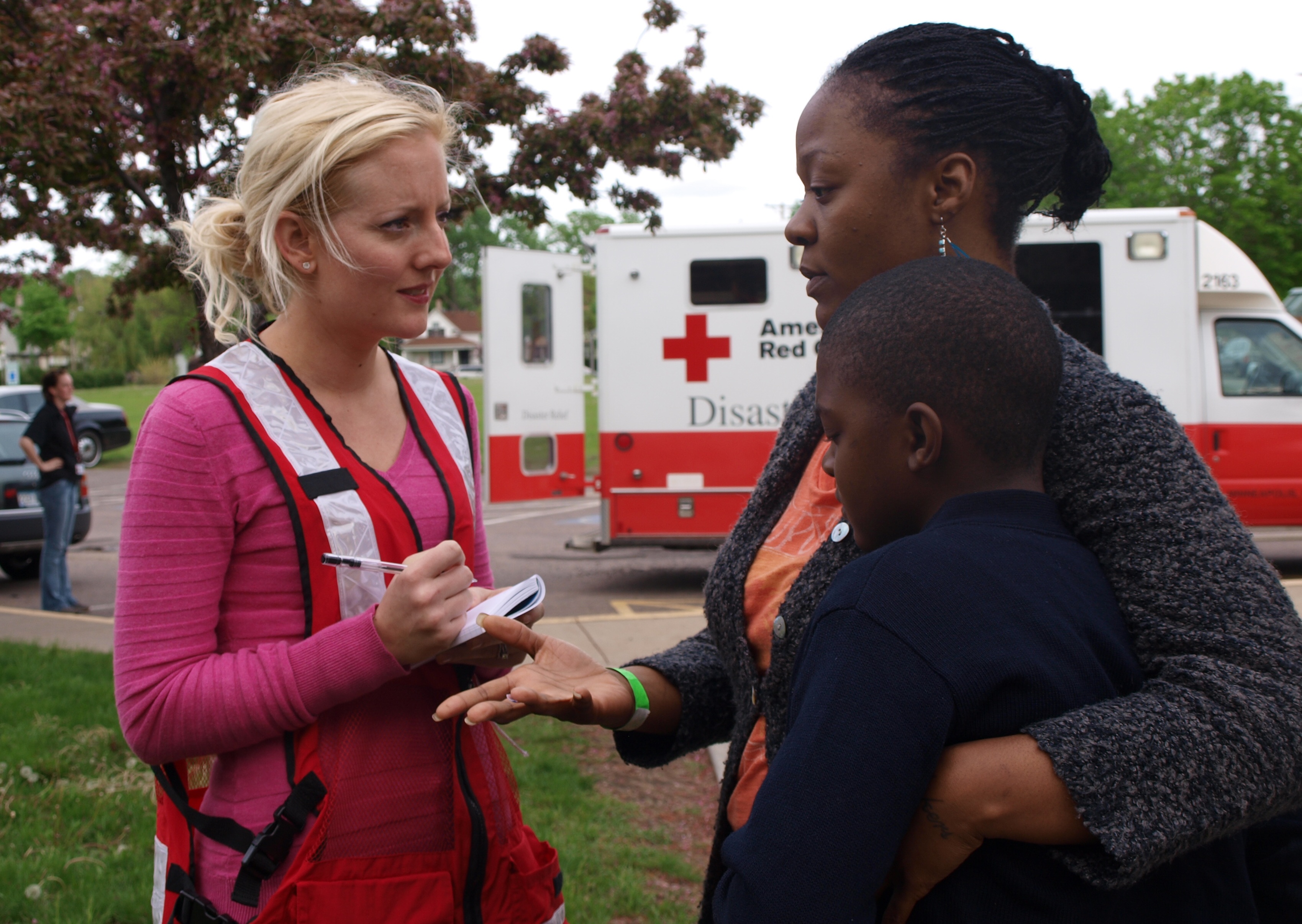
Red Cross responder Sarah Russell talks with Lillian Scott and her son Damon about next steps for their recovery from the May 22 tornado in Minneapolis. Photo credit: Lynette Nyman/American Red Cross
Standing outside the shelter located at the armory in northeast Minneapolis Lillian Scott welcomes her son Damon, 9, who has returned from a day at school.
Scott has been living at the shelter since Sunday, when the tornado touched down in what she describes as a neighborhood that now faces even more challenges.
“Already the neighborhood was bad,” says Scott. “Now it’s not safe for my son to play. There’s so much debris. It’s covered with trees. We can’t stay there. It’s just bad.”
An estimated 5,000 people are affected. Many have found temporary refuge with friends and family. While others, like Scott, have made a new home at a shelter where the Red Cross is providing cots, blankets, and hugs during a tough time.
Scott, whose top priority is finding a new home, is standing strong for her son.
“If I cry, then he’ll cry,” says Scott. “If I’m okay, then he’s okay. Eventually we’ll be taken care of. I know something good will happen.”
(Reporting by Red Cross responders Lynette Nyman and Sarah Russell)
Some of you already know this information, but we wanted to update everyone at the same time. We are deployed by the Red Cross to the Alabama tornadoes for up to three weeks.
We are on the Disaster Assessment team – the first Red Cross representatives on site to do initial damage assessments. Our data gets relayed to the Red Cross Command Center and then on to FEMA. We’re using new technology – hand held collection units. The info is used to assess future aid and services needed.
So far, we’ve been assigned to gather data in 3 counties, which includes the city of Huckleburg. Most of the homes here were destroyed and there is no electric and limited cell phone coverage.
We’ve included a couple pics of what we’ve seen. One of the interesting sights in the middle of town was the cemetery. Headstones had beautiful flowers completely untouched and the grass was perfectly manicured. Total chaos surrounded the cemetery.
The affected people are doing amazingly well (at least for now). They are very gracious and appreciative of those who have come to help. Keep them in your prayers.






 American Red Cross Minnesota and Dakotas Region