Caring for Our Neighbors After the Skyline Tower Fire 

 
When a fire and power outage forced more than a thousand residents from Skyline Tower in St. Paul on October 25–26, the American Red Cross moved quickly to help. Within hours, volunteers were working alongside the City of St. Paul, CommonBond Communities, The Salvation Army, and other partners to make sure everyone had a safe place to stay, warm meals to eat, and someone to turn to for comfort and care. 

Local Red Cross volunteers Todd Johnson and Marilyn Birk serve meals to families impacted by the fire and power outage at Skyline Tower in St. Paul, Minn.
Photo: Nate Russell/American Red Cross.

Every day since, responders have been connecting with residents as they recover across the Twin Cities, offering meals, listening to concerns, and finding ways to meet each person’s needs with dignity. Behind the scenes, volunteers have coordinated food deliveries, managed logistics, and worked hand in hand with community partners to keep things running smoothly. 

More than 70 trained Red Cross responders, most of them volunteers from across Minnesota, North Dakota, and South Dakota, have come together to support this response, each bringing compassion, skill, and heart to the work. 

“We know the people need the help, and the Red Cross has the partnerships and the means to be able to provide that,” said Todd Johnson, a volunteer helping provide meals. So far, Red Cross teams have provided more than 4,100 (as of 11/3) warm meals and thousands of snacks with help from The Salvation Army and local partners. “This is the heart of what we do.”  
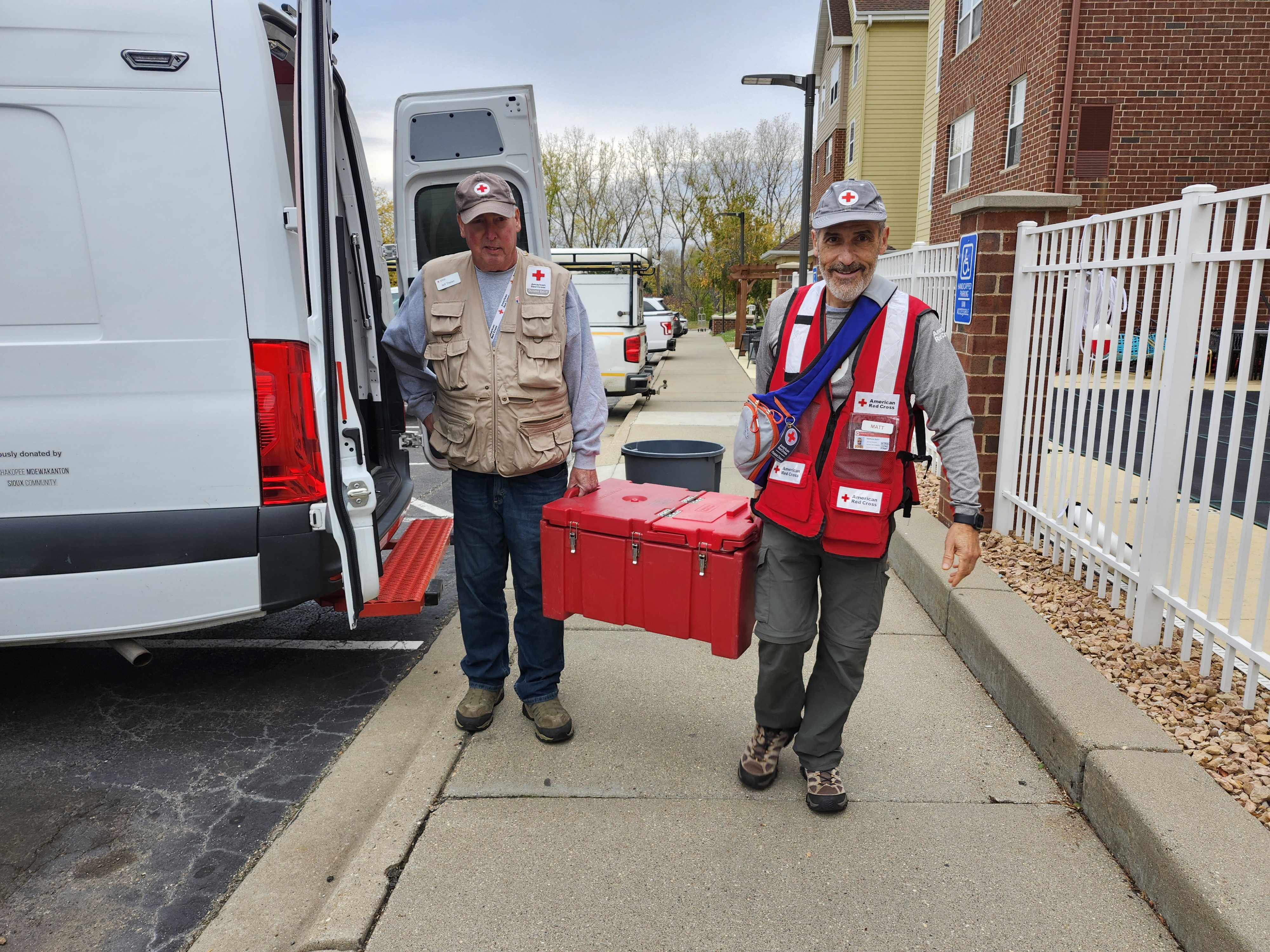
Jeff Thelen and Matt Bellin, two of more than 70 Red Cross responders, help unload food to be served to residents affected by the Skyline Tower fire and power outage.
Photo: Sue Thesenga/American Red Cross.

Health and mental health volunteers are helping replace lost prescriptions, check on medical concerns, and offer a listening ear. “A lot of our services revolve around helping them with that first small step. It might be just someone to help them get their medications replaced and that’s one less thing for them to have to worry about,” said Rick Larkin, who is leading Disaster Health Services. “But we also have disaster mental health volunteers, because this is super stressful for people. It’s a friendly ear; it’s a reassurance that recovery will begin soon.” 

The Red Cross continues to work closely with cultural and community organizations to ensure services honor the diverse languages, traditions, and nourishment needs of Skyline Tower residents. Every act of kindness, whether it’s a shared meal, a gentle conversation, or a moment of rest, reflects the spirit of partnership that has defined this response. 

“This is one of the largest responses our region has supported,” said Brice Johnson, CEO for the American Red Cross Minnesota and Dakotas Region. “But more than that, it’s a reminder of what can happen when neighbors come together to care for one another.”  

As parts of Skyline Tower reopen, residents are beginning to return home. “We’ll be here,” said Johnson. “In the days and weeks ahead, we’ll stand alongside residents, helping meet immediate needs, supporting them as they rebuild a sense of stability, and offering resources and reassurance that things will get better.” 

How You Can Help 

Support Disaster Relief. Every day, disasters like this remind us how quickly life can change and how powerful compassion can be. The Red Cross helps communities prepare for, respond to, and recover from emergencies large and small. 

You can make a difference. Visit RedCross.org ,call 1-800-RED CROSS (800-733-2767), or text REDCROSS to 90999 to make a financial donation. 

An average of 90 cents of every dollar we spend goes toward providing care and comfort for those in need. 

Put on a red vest and join us. Visit RedCross.org/GiveTime to learn how you can support your community. For disasters big and small, Red Cross volunteers provide comfort on what can be the hardest days of people’s lives. 

Helping People Get Through the Unknown

Tom Goebel, Helen Goebel and Mike Hofmann, Cold Spring, MN, April 15, 2024. Photo: Lynette Nyman/American Red Cross

On a frosty January morning in 2023, Tom Goebel was at home in Cold Spring, Minnesota. He was resting on the couch, icing an injured leg when he heard a ‘pop’ sound.

“Like a laundry basket dropping,” he says. Shortly after he heard another ‘pop’ – this time it was louder, more urgent. “I went to the laundry room and saw smoke coming from under the garage door.”

Tom dialed his wife, Helen, who happened to be out, taking his car to the repair shop. “Get out of the house,” she instructed. “Call 9-1-1.”

On crutches, Tom turned back to grab what he could, stood outside on the deck and waited for the fire department. But then, a chilling thought: What if this whole thing blows up? “I threw my crutches over and slid down the snow on my butt!”

Despite firefighters doing the best they could to extinguish the blaze, it had a good head start and unfortunately Tom and Helen’s home was destroyed in January 2023.  Submitted photo.

Meanwhile, Helen returned home, her heart racing. “I didn’t know what was snow and what was smoke,” she says. Most importantly, she didn’t know where Tom was—until she learned he’d sought refuge at a neighbor’s house.

Despite firefighters doing the best they could to extinguish the blaze, it had a good head start and unfortunately their home was destroyed.  

“When you say you lost everything, people don’t understand,” says Tom. “Until you’re in this situation, it’s a little bit more real.”

Amid the chaos, the Red Cross stepped in. Mike Hofmann, a longtime volunteer who had known Tom since childhood, reached out.

“At first they didn’t want anything,” says Mike. “And then they called back. It was a cold, winter day. Two of us met them and we walked through what we could do to help them.”

Care included comfort kits, basic hygiene items, personal care essentials—the small things that matter most when everything else crumbles. “When you have absolutely zero a comfort kit is the biggest thing you’ve got going,” says Tom. “They helped us get through this land of the unknown.”

Later, they found some charred documents like birth and marriage certificates preserved in a safe. Even something as small and simple as a spatula for cooking was nowhere to be found.

“You think you know what you’re missing until you don’t have it,” says Helen.

Tom Goebel and Helen Gobel

The Red Cross responders helped them replace prescriptions and navigate their next steps through recovery.

“I didn’t know they came out for a fire like that,” says Helen. I thought they were more for major disasters.”

Local Red Cross disaster volunteers respond most often to home fires in their local communities. These “disaster action team” responders show up with care and compassion to disasters big and small.  

In the year since the fire, a time of staying with neighbors and living in other temporary housing, Tom and Helen are home, again, with a fresh start.

“We were always on the giving side. This was us on the receiving side,” says Tom. “Red Cross said, ‘step up and take this, that’s why we’re here, to help everyone.”

To learn more about the Red Cross and our support for local disasters, please visit RedCross.org/MNDAKS.

Tom Goebel, Helen Goebel and Mike Hofmann

“We didn’t know the Red Cross responded to home fires.”

As a weeknight news anchor and reporter for Dakota News Now in Sioux Falls, South Dakota, Brian Allen reports on home fire stories often, but never expected to experience one of his own.

On June 3, 2020, in the midst of the pandemic which had already brought uncertainty to so many, Brian and Anne Allen’s lives turned upside down when they lost the place they and their children called home.


Like many home fires, it started in the kitchen.

The Allen’s were lucky, their home had working smoke alarms and the fire was reported quickly to 911.

“Thankfully nobody was injured and although this was a traumatic event, it was not a tragic one.  Even our dog and pet bunny made it out to safety,” said Anne.

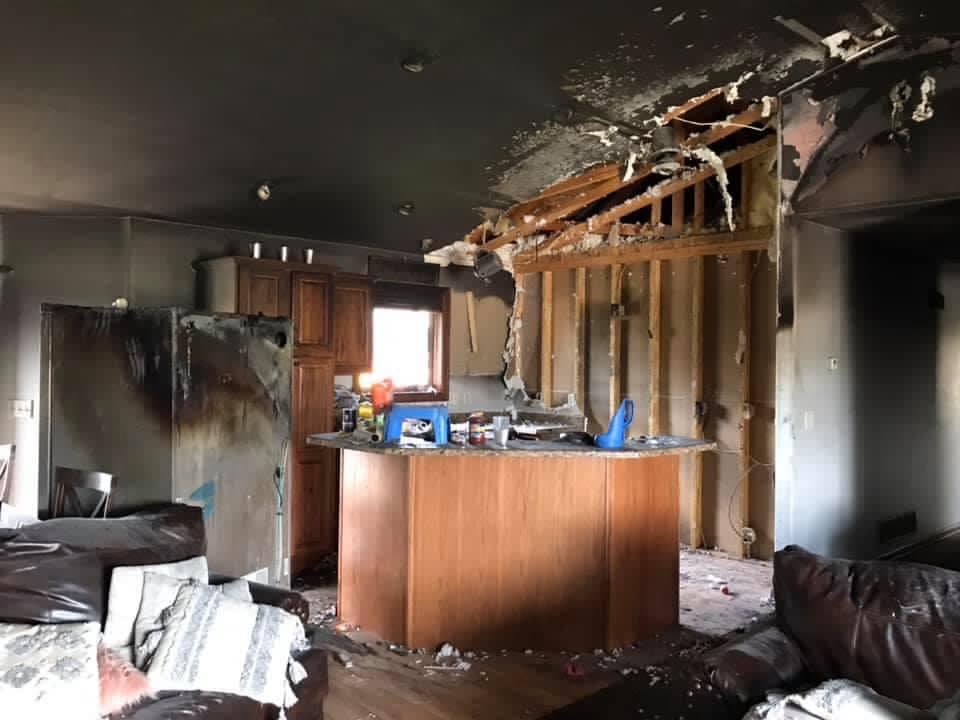
The fast-burning fire was hot and intense – evidenced by a ceiling fan in the living room that melted off its base or the melted hair on her daughter’s American Girl doll.

“It was a crispy, burned-out shell of what was our everything,” grieved Brian.

The upper level of their home had so much smoke damage that the sheetrock had to be replaced down to the studs. “It’s incredible how much damage can happen in a short time with a fire that is ultimately small,” said Anne. There was no structural damage, but the smoke damage was extensive – “it’s mind-blowing how smoke can even enter drawers.”

The man in the red vest

After the fire trucks and insurance adjuster left, the Allen’s sat in their garage contemplating what to do next. They remember an older gentleman in a red vest slowly walking down their driveway towards them – it was a volunteer from the American Red Cross.

“We were surprised the Red Cross showed up – we didn’t realize they responded to home fires,” said Brian. “He couldn’t have been nicer, more compassionate, more understanding – he gave us some supplies and cash cards to help with our immediate needs as well as help pay for a hotel for a few nights. He even brought stuffed animals for our kids.”

Anne vividly remembers his reassuring, calm voice. “He told us that things would get better. I can’t express how meaningful that moment was,” she recalls. “He was there to help us in our darkest hour. He was a godsend!”

As they recalled the day, Brian remembers saying to his wife that “he didn’t know how they were going to repay the Red Cross, but someday they would.”

Although their house was temporarily unlivable and they had to relocate for about five months, the Allen’s were thankful their family was safe, and they had a place to go. “We just lost stuff – it doesn’t compare to the alternative. We were super lucky and we’re grateful it wasn’t worse.”

Turning compassion into action

“You never think it will happen to you and then it does,” Brian said. “Now, when I’m driving to and from work and I see a home fire my heart just breaks, I know exactly what that feels like – it’s just devastating!”

Brian is now turning his compassion into action by serving on the Red Cross Eastern South Dakota board of directors. “I’m fortunate that I’m in a position to be able to help build awareness and inform the people of eastern South Dakota what the Red Cross is doing to help when disasters strike – “I want to thread the message of kindness and let them know what the Red Cross is doing for our community.”

The Allen’s hope people can learn from their misfortune. “We were those people – we didn’t have a plan,” said Anne. “We don’t like to relive our story, but if it can help anyone or encourage families to have conversations about what to do if they have a fire that would make us happy.”

Home fires are considered one of the most frequent disasters in the U.S. For example, in the Minnesota and Dakotas region last year, our disaster action team, 90% of who are volunteers, responded to more than 1,000 home fires that affected more than 4,000 people.  The Red Cross offers people the immediate financial support they require to purchase things like food, shelter, and other essential recovery items, and provides emotional support.

After a home fire, Red Cross volunteers work with local fire departments to connect with families for needs like emergency lodging, food, financial assistance, and emotional support.

DONATE: Thanks to donations, Red Cross services are free and available for all those in need. Visit redcross.org to support our lifesaving work.

VOLUNTEER: The need is constant to help families affected by home fires and other disasters. Visit redcross.org/givetime to become a volunteer.

HOME FIRE SAFETY: Home fires claim seven lives a day in the U.S. but working smoke alarms can cut the risk of death by half. Llearn more about home fire safety and preparedness.

“They Would Ask: What Do You Need?”

Red Cross volunteer welcomed help and hope after devastating home fire

Sterling Molby and his two children survived a home fire experienced a devastating home fire in northern Minnesota. Submitted photo.

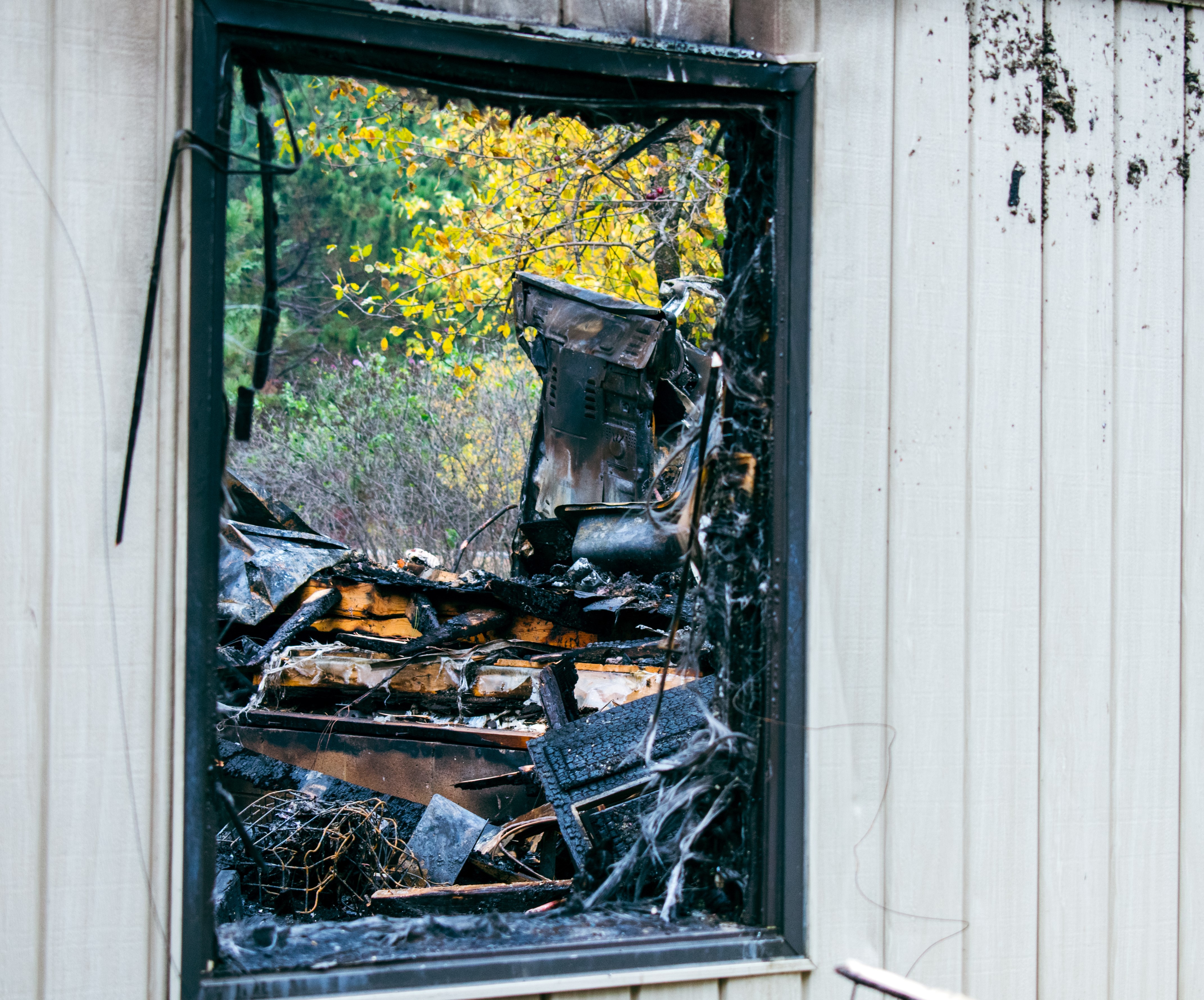
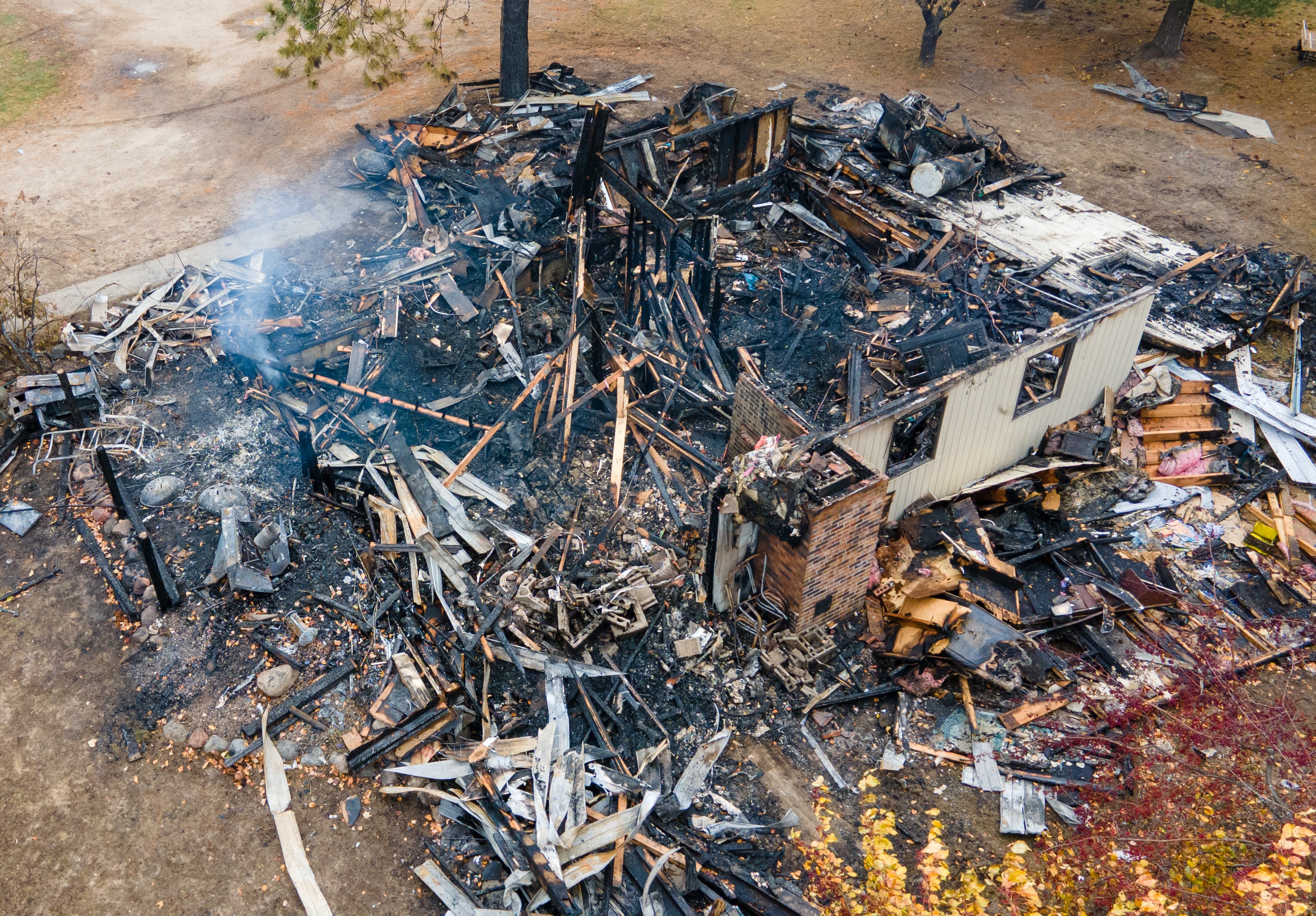
On the day Sterling Molby answered my call he was busy, very busy, searching for anything he could save from the debris being turned over during cleanup of his burned home before winter took hold of northern Minnesota. His dwelling was, for the most part, reduced to ash that needed to be boxed and shipped to a place that would accept it. He hunted for, and found, a small steel box with photos.

“I’m watching to see if anything is salvageable,” Molby said.

Looking through to the remains of Sterling Molby’s home. Photo: Athena Thomsen

The fire happened in October on a Saturday evening after he grilled steaks for his two children who ate up and then went to the basement to watch TV. Molby, upstairs and in a ‘food coma,’ noticed an orange glow outside on the deck and ran to get some blankets that he used to smother the flames of what quickly become an inferno engulfing his home. He ran to his children and together they fled to a neighbor. A 30-mile-an-hour western wind ramped the flames and made looking back a pain he never thought he’d experience.

“I checked on my kids again, sat in the front yard and watched my house burn,” Molby said.

“Local help has made the devastation a little easier,” said Sterling Molby, whose home, in Brainerd, Minnesota, burned down in October, 2022. Photo: Athena Thomsen

Molby knows tough times. He served on two deployments with the U.S. Army in Iraq where he witnessed the impact of explosives. He worked for years finding places to live for homeless veterans. These experiences led him to becoming an American Red Cross volunteer supporting blood collection as a drive coordinator for eleven years. Molby “knows how amazing the Red Cross is,” having been there, especially during his military service, seeing people use Red Cross services and being around it.

“I feel like I’m helping saving lives and what I do has value,” Molby said.

So, when a firefighter told him to call the Red Cross he did without hesitation and spoke to a disaster responder who gathered information and details about the fire and making sure Molby and his children had a place to stay. Within thirty minutes he received financial assistance for temporary lodging and other immediate relief. Red Cross responders followed up in the days after asking what, if anything, his family needed. He’s grateful for support from the Red Cross and other community groups, particularly those for veterans.

“The outreach has been humbling. Local help has made the devastation a little easier,” Molby said.

Since the fire, the ups and down have been as a friend told him they would be. Molby’s doing what he can to be there for his children during this traumatic event and its aftermath while also moving ahead with plans to rebuild. The fire spared his garage and woodworking tools, which he’ll use to start making his home, again

Story by Lynette Nyman/American Red Cross. Click here to learn more about and to support the work of Red Cross in Minnesota and the Dakotas.

Putting life back together ‘slowly but surely’ following a home fire in the northern Black Hills of South Dakota

Stone Street multi-family apartment fire, Lead, SD, July 10, 2021. Photo: Richard Smith/American Red Cross

Every day, the Red Cross helps people affected by home fires big and small. During 2021, for example, the Red Cross in South Dakota responded to more than 200 home fires and helped nearly 800 people.

Among them was Alisha Baudino and her son. On July 10, 2021, they were home and asleep when a fire started in the walls of the building where they rented an apartment on Stone Street in Lead, a small city founded after the discovery of gold in the northern Black Hills.

“I woke at 5 a.m. smelling smoke and just trying to figure out where it was coming from,” said Baudino. “I couldn’t see smoke or anything, but I could smell it.”  

Alisha went outside and still she saw nothing. Miners working across the street saw flames and pointed them out to her. “They yelled there was fire so I turned around to get my son out of the apartment.”

The apartment was already filled with smoke. Thankfully her son, who had recently turned 18, made it out on his own. They then helped account for those living in other units.

“There ended up being 11 different fire companies. After that it was just downhill. There was nothing we could do about it. We just sat there and watched while they tried to get it out.”

The building originally was a single-family house later turned into five apartments. It was declared a total loss and demolished. Only items stored in the garage, like her son’s work tools, were spared from the blaze.

“We’re doing good just working, trying to put life back together slowly but surely,” said Alisha Baudino, pictured with her son. Submitted photo.

Community members rallied to help. The Red Cross responded as well within hours after the fire started. “The Red Cross was there immediately. It was really quick.”

The Red Cross assistance gave everyone options to help themselves do what each needed most. Alisha, for example, used some of the relief to pay for a hotel room for her and her son. From there, they went to a cabin rental found by a friend, and then to a house they’d already planned to move into at the end of July.

Since the fire, life is gradually getting back to normal. She has two full-time jobs and takes each day one at a time going from home to work and back again.

“We’re doing good just working, trying to put life back together slowly but surely.”

To support Red Cross disaster relief through volunteer service or financial donation, click here. To learn more about the Red Cross home fire campaign, click here.

Story by Lynette Nyman/American Red Cross. Photo by Richard Smith/American Red Cross.

What’s truly Precious

Katryna Hunt had a bad feeling the morning of September 20, 2021 in Minot, North Dakota, but she left for work early anyway to make sure she was on time.

Her fiance’ TJ had just gotten home from his night shift and headed to bed. Soon after, the blaring sound of smoke alarms woke him. Maybe, he thought, their roommate Nick was cooking but then he saw the smoke and flames.

TJ called Katryna and all she could make out before they were disconnected was the word “fire”.  She immediately rushed home and when she arrived, she could see her home in flames – a fire had started outside on her porch.

Fortunately, TJ, Nick, her 11-year-old cat Precious and their pet lizard had safely evacuated with a few valuables.

Katryna Hunt’s mobile home in Minot, ND was destroyed by a fire that started on the porch.

Soon the Red Cross was on scene offering comfort and disaster assistance, including financial support, comfort kits, cleaning items and help finding immediate shelter. Red Cross assistance helped cover a two-week hotel stay that allowed for Precious to be with her.

“I was so worried about Precious because she has separation anxiety and would not have done well without being close to me. I was so grateful that they were able to find a hotel that allowed Precious!” said Katryna.

Katryna was happy that 11-year-old Precious made it out of the fire safely.

She credits working smoke alarms with saving their lives. “When I went back to get a few things and clean up I could hear the smoke alarm that was by the back door still faintly beeping –without these things could have ended much worse.”

Katryna feels fortunate everyone was safe. Despite soot covering their belongings, she was able to recover a few meaningful items, including her porcelain doll collection.

Red Cross volunteers were able to refer Katryna to another agency who helped her with a deposit for a new rental unit and the first month’s rent. In October, Katryna moved into her new home. One of her first calls she got was from the Red Cross congratulating her and checking to see if she needed anything.

“Red Cross volunteers followed up with me every day! It was so comforting to have someone check up on me because all my family is in Tennessee. I knew I wasn’t alone.”

Katryna feels lucky and hopes that her story helps raise awareness of the need for working smoke alarms. “Home fires can happen to anyone, anytime – having working smoke alarms is an easy thing we can all do to avoid the unthinkable.”

Make sure you and your loved ones are prepared for home fires, visit soundthealarm.org/mndaks.

Story by Sue Thesenga/American Red Cross. Photos courtesy Katryna Hunt.

Home Fire Relief – Brainerd, Minnesota

Red Cross volunteers assist Brainerd couple after home fire

When a fire broke out at Tom Phillips’s home, he worried he and his fiance, Jenny Tienter, might have to spend the night in his car.

However, a team of volunteers with the Red Cross reached out to Phillips and his fiance to ensure they had a place to stay and provided them with other forms of assistance. In times of need, countless volunteers with the Red Cross assist people like Phillips and his fiance, who have been displaced by house fires.

“Without (the volunteers) I would’ve really been in a hard spot. They helped me out considerably,” Phillips said.

The Jan. 27 fire in Brainerd, Minnesota, began when a camping stove Phillips was using to prepare breakfast blew up. Phillips managed to get his fiance out of their burning home but unfortunately wasn’t able to get out his basset hound, Delilah.

“I miss her dearly,” he said, of Delilah. “That’s one loss I’m still trying to recover from, and I’m sure I never really will.”

Family photo of Delilah

Phillips said the Red Cross volunteers, including Dana Dimit, assisted him and his fiance in getting their lives back on track. He said he’s talked with the volunteers frequently, and they answered his questions and connected him with resources, including a mental health support group to help him cope with the loss of his dog.

Dimit has been volunteering with the Red Cross for nearly five years.

“The minute I retired I joined the Red Cross,” the former technology consultant said.

Dimit said she decided to volunteer in part because she wanted to “do something completely different,” that was “more people-oriented” and didn’t involve technology.

Dimit primarily works as a disaster responder with the Red Cross, but also does orientation for new volunteers and has been assisting with setting up a new internal system for tracking house fires.

Since the COVID-19 pandemic, Dimit has shifted to doing intake for fires that occur in Minnesota, North Dakota and South Dakota, gathering information about the fires and talking with those who have been displaced.

Dana Dimit

Dimit makes herself available, even in the middle of the night. She recalled a recent phone call she received late at night from someone displaced by fire who said they didn’t have any shoes or a place to go, so she helped ensure they had a place to stay.

 “If I don’t know what’s going on, I worry about them,” she said.

Despite losing his house and his belongings, Phillips said he’s trying to remain optimistic. Without the Red Cross, he said, he wouldn’t be where he is today.

“I couldn’t have done it without them,” he said.

Story by Blair Emerson – Red Cross volunteer

Home Fire Relief – Rapid City, South Dakota

‘That’s just what the Red Cross does’

Since Gene Rossman lost his home in a Feb. 27 fire, a volunteer with the Red Cross has called him weekly to check on him.

Rossman said when he last saw his home in Rapid City, South Dakota, it was “a ball of flames.” The fire destroyed his home and his belongings, including items his late mother crocheted and her cookbooks. He said he was left with nothing but the clothes he “had on (his) back.”

“Other stuff I can replace. I can’t replace that stuff,” he said, of his mother’s possessions.

Despite losing his home in the fire, luckily, neither he, his 16-year-old son or his two dogs were home when the fire broke out.

Photo used with permission from Johnson Siding Volunteer Fire Department, Pennington County, South Dakota

Since the fire, Rossman said he’s thankful for the calls he’s received from a volunteer with the Red Cross.

“They’ve done a good job. I guess that’s just what the Red Cross does,” he said.

Red Cross volunteers like the one who helped Rossman and countless other volunteers respond to home and apartment fires, assisting displaced residents. Volunteers make up about 90 percent of the American Red Cross workforce, and they respond to an average of more than 60,000 disasters every year.

Rossman said he is now undertaking the difficult task of trying to build a new home, but said he’s been grateful for the “wonderful” support he’s received from the Red Cross.

Story by Blair Emerson – Red Cross volunteer

Home Fire Relief – Winner, South Dakota

Red Cross assists families affected by Jan. 31 fire in Winner, S.D.

On Jan. 31, 2021, Lorelei Mendoza awoke to news her home of four years had been destroyed by a fire.

Lorelei was among 11 people displaced by a fire that broke out in the early morning hours at a five-plex in Winner, a small rural town located in south-central South Dakota. The American Red Cross provided disaster relief to the tenants.

Lorelei and her one-year-old son and two-year-old daughter were staying at a relative’s house when the fire broke out at the complex. When Lorelei learned of the fire, she went to assess the damage.

“(The fire) pretty much got out of hand, and there was pretty much nothing they could do until the fire department showed up and put it out,” she recalled.

Family photo

Lorelei said most of her belongings at her house were damaged by water used to put out the fire. The five-plex has been deemed a total loss, she said. Lorelei said her sister, who had moved into a unit adjacent to Lorelei’s just two days prior to the fire, was also displaced by the fire.

The item Lorelei misses most that was destroyed in the fire? “My home,” she said.

Lorelei said she’s grateful for the financial support she received from the Red Cross as she moves forward with trying to find new housing suitable for her and her children.

Story by Blair Emerson – Red Cross volunteer