“This is just our passion, it’s part of our DNA— to help people.”

Red Cross Disaster Mental Health volunteer,
Mary Parker, shares her experience

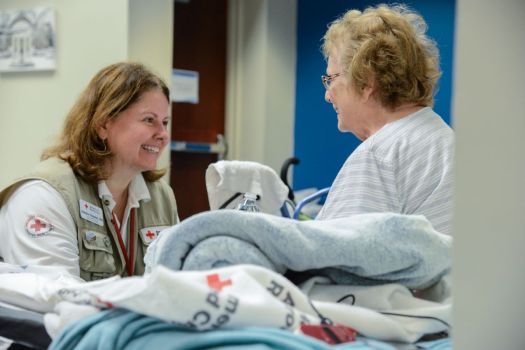
Disasters are traumatic events. And while many Red Cross volunteers are trained in myriad roles, such as staffing shelters, handing out cleanup kits, driving box trucks and the like, there are also volunteers trained specifically to support the emotional health of individuals and families affected.

Mary Parker is one such volunteer, “We’re all trained in the mental health field, either currently working or done working. This is just our passion, it’s part of our DNA— to help people.”

Red Cross disaster mental health volunteer Mary Parker
Red Cross Disaster Mental Health Volunteer Mary Parker from Side Lake, MN at a disaster training conference. Volunteers participate in free training specific to their position.

A Red Cross volunteer for six years, Mary is currently helping people impacted by flooding in Minnesota and South Dakota. Her role is to manage Disaster Mental Health (DMH) services for the response. To reach more people, she says they’ve embedded with other service teams.

“Mental Health has been accompanying crews as they deliver emergency supplies and cleanup kits, talking to clients, providing as much emotional support as we can…We also went out with the damage assessors. As they were going out to assess damage, we did some ride-alongs to talk to people in real time.”

Mary monitors the pulse of the Red Cross relief effort, keen to tap any opportunity that will ensure a Disaster Mental Health presence, “Basically, any activity that’s going on, if I have a mental health provider available, they go. That way there’s more good face-to-face interaction. It’s a good way to determine if we need to do a follow-up call with them.”

Mary continued, “The DMH role really is to be able to listen to their story and have someone to hear their hardships and struggles. We validate their hardships, give them a hug if they need one, remind them that they are resilient, and offer compassion and empathy. We’ve been at fixed sites, we’ve been on the [emergency response] vehicles, we’ve also had DMH at the shelters and alongside caseworkers at resource centers.”
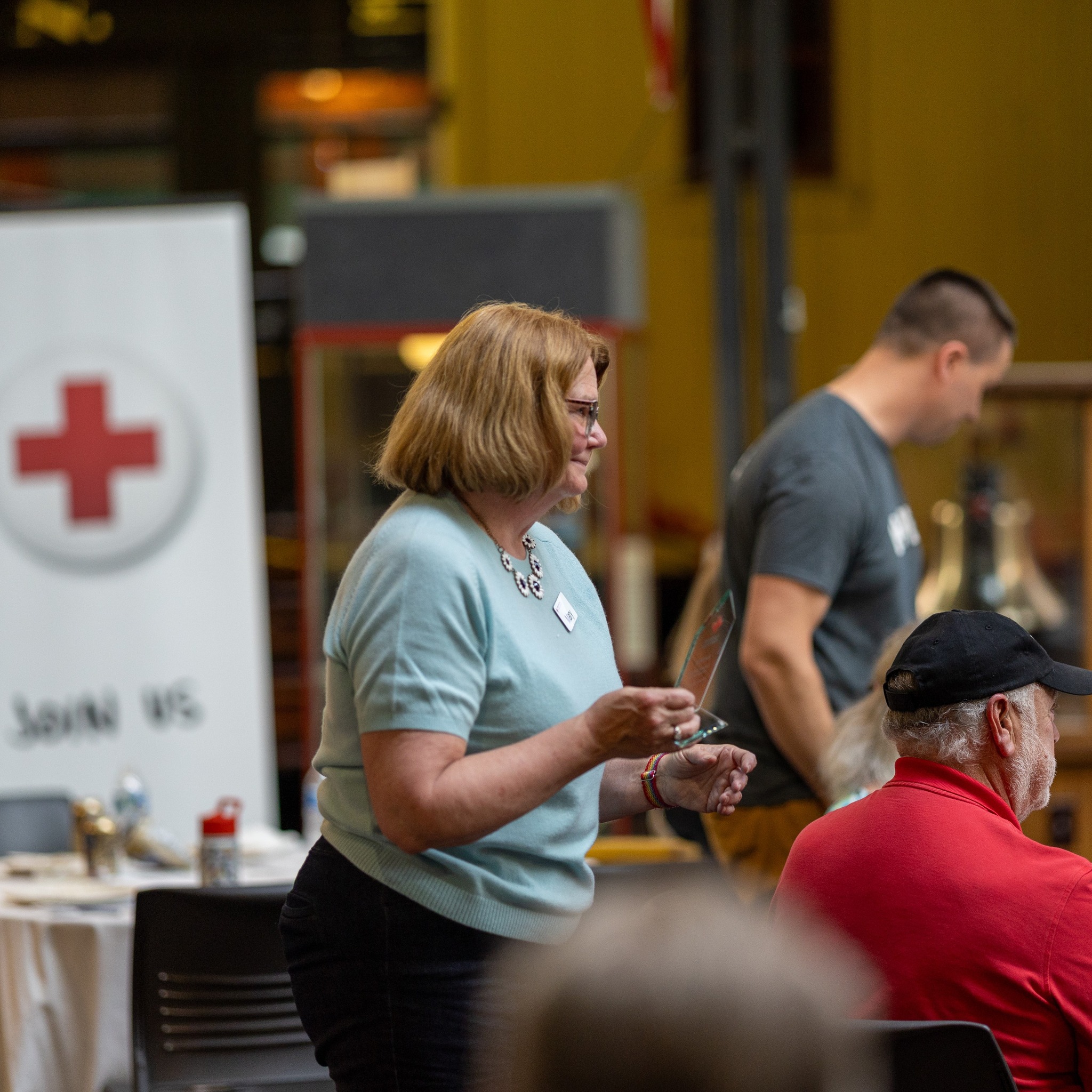
Mary Parker sharing her experiences with fellow Red Cross volunteers at a recent volunteer event.

The Red Cross hosted several resource centers for individuals displaced by recent flooding in Minnesota and South Dakota where trained Red Cross volunteers can open recovery casework for those whose homes sustained major damage or were destroyed. “We’re coordinating health services, mental health and spiritual care, so at least one if not more have been represented at each site.”

In addition to standard Red Cross disaster assistance, individuals and families may of course request to speak with a disaster health, spiritual health, or mental health volunteer about their needs.

“It’s what we do!”

Resources Every eight minutes, the Red Cross responds to a disaster somewhere in the United States. Often it’s a single family home fire. Sometimes it’s a larger disaster like a flood or a tornado. Homes, which are supposed to be places of comfort and stability, can be destroyed, and with them that sense of comfort and stability can be turned on its head at a moment’s notice.

As the physical and emotional impacts of this disaster come into sharper focus for those affected, Red Cross caseworkers and mental health volunteers are on the front lines, providing one-on-one support to individuals and families. Their unwavering commitment helps address the evolving needs of residents during this challenging time.

The Red Cross encourages people to remember to take care themselves, their loved ones, and neighbors:

  • Support Each Other: In difficult times, it’s crucial for people to lean on one another. Reach out to friends, family, and neighbors—your collective strength makes a difference.
  • Be Patient: Floods can evoke a range of emotions and reactions. It’s okay to feel worried or drained. Give yourself the grace to process these feelings.
  • Children’s Needs: Traumatic events impact children differently than adults. Sometimes, their worries manifest in behavior rather than words. Be attuned to their needs and emotions.

If you or someone you know requires assistance, don’t hesitate to contact the free 24/7 multilingual Disaster Distress Helpline at 1-800-985-5990. They’re there to provide support and guidance during challenging times.

Volunteers Needed Do you have a background as a current or former licensed mental health practitioner? Looking for a unique and much needed way to help your community in times of disaster? Consider joining the Disaster Health Services team! Learn more here.

Story by American Red Cross Volunteer Nate Russell.

Red Cross volunteer helps hundreds, deepens purpose while supporting COVID-19 condolence call center

On a Monday in late January, the American Red Cross virtual condolence care center for people grieving loved ones lost to COVID-19 did not stop getting calls. In fact, the center was bombarded with around 25 calls taken by two volunteers, including Rose Olmsted.

“The people who are calling us don’t have a support system,” says Rose, a Disaster Mental Health volunteer who took calls that day from her home in Albert Lea, Minnesota.

The calls come mostly from diverse communities, especially in Texas, California and other states hard hit with COVID deaths. Some have buried two or three family members, while others have had four or even five loved ones sick from the disease.

Established by the Red Cross in 2020 as the pandemic settled in, the Virtual Family Assistance Center (VFAC) provides free emotional, health and spiritual guidance to those most in need. It’s also a source for referrals to other coronavirus assistance.

Rose Olmsted. Submitted photo.

Rose has served as a disaster mental health volunteer since 2009. For this role, she was vetted, and then had an additional two-weeks of orientation. During her shifts, she has a supervisor and manager available to consult with. Since going active with the call center last fall, Rose has spoken to hundreds of people.

“I want to take these calls from the disadvantaged. They are my kind of people, the poor, minorities, people disadvantaged by income, access to technology, access to transportation, limited health care or chronic health conditions.”

Rose spends most of her time listening. People are in a state of grief and incredible anxiety. Some are especially stressed because loved ones died without them at hospitals or suddenly at home. Rose listens without interruption.

At the end of one call Rose remembers a woman, after sharing a deeply personal story of tragic, long-term loss and grief, experienced simple peace and gratitude just because someone, in this case a volunteer named Rose, listened to her story.  

Image from Red Cross condolence card.

Listening can take a toll, even on experienced and trained professionals like Rose. Her regular social activities are limited because of the pandemic so she’s turned to live, online concerts, daily meditation and intentional connecting with friends.  

“People ask, why do you want to keep doing this? If you have to ask me, then…”  Her voice trails off. The work continues to bring Rose great purpose even while the calls get harder and the pandemic’s impact deepens in communities across the country.

Access the American Red Cross Virtual Family Assistance Center. People without internet access can call 833-492-0094 for help between 9 a.m. to 9 p.m., Monday - Friday local time to speak with a trained Red Cross volunteer in English or Spanish. Callers in immediate crisis should call 911 or a hotline like the Suicide Prevention Lifeline. Callers also can find crisis support through the national Disaster Distress Helpline.   
Help and support are available for people from any state, county, territory or tribal nation. Frontline responders, such as healthcare workers, workers at long-term care facilities, and other essential personnel dealing with families of COVID-19 patients, are welcome to call as well for free individual and group support.
Download the American Red Cross Guidebook for Grieving Families. Download Resources for Community Leaders. 

Story by Lynette Nyman/American Red Cross

“The most important tool we all have is a positive outlook.”

Red Cross disaster mental health expert shares mental health insights for times of isolation, stress, and uncertainty.

When disaster strikes or when a crisis develops we can find ourselves challenged physically, emotionally and mentally.  While we are often very good at taking care of our physical needs, in those hard times we often neglect our mental health. 

And that’s where the American Red Cross Disaster Mental Health team comes in.  These volunteers are highly trained and qualified helpers that can assist with keeping us mentally strong and emotionally stable during hard times. 

Terry Crandall knows all too well the challenges we are all facing with COVID-19 related stay-at-home and quarantine orders.  “Our biggest challenge right now is probably isolation and the ongoing effect of not having our usual social support network.” 

Mr. Crandall leads the Disaster Mental Health team for the Minnesota & Dakotas Region of the Red Cross.  Terry, who is a Licensed Professional Counselor and an Adjunct Professor at the University of South Dakota, tells us that he started volunteering with the Red Cross in 2006. 

Since then he says with a laugh that he has now, ‘drank the Kool-Aid’ in reference to his passion for the Red Cross mission and his commitment to helping people in need of mental health help.  “That is sometimes just a shoulder to lean on and someone to tell their story to.”   

Terry believes that not having access to the people we love like our family and friends leaves most people feeling isolated and without their usual support system.  He says that feeling of isolation can lead to despair when facing this pandemic. 

“People are experiencing very normal emotional and mental reactions to this situation.  They are missing their families and friends, they are worried for kids and their studies.  Kids are missing their friends and social networks like their clubs and teams. There is uncertainty about when, or if, school will be back in session.  Proms and senior events will likely not happen for this class.” 

For almost all of us work has changed.  For those left out of work by this virus there are huge amounts of anxiety about the future.  Money concerns seem to touch everyone.   

Compounding these worries are the stressors that can come from having what may feel like, “just too much family time.”  Terry recommends families keep to a regular schedule and try to stay engaged in activities that are creative and can offer some exercise.   

Terry says that using positive imagery, relaxation techniques, and visualization tools can all help make you more resilient and able to cope in a healthier way.  “The most important tool we all have is a positive outlook.  If we can stay focused on the fact that this isn’t forever and that there will be a much better day to come, we can keep all of us mentally strong.”   

The Red Cross guide to recovering emotionally recommends several tools to help keep a positive outlook. ‘Remind yourself of how you’ve successfully gotten through difficult times in the past. Reach out when you need support, and help others when they need it.’ 

You can get disaster tools, information about recovery, and guides to coping with the stress of the COVID-19 crisis at the Red Cross website.  You can start here: shelteringathome. For more about the emotional stresses and tools that can help  you can visit this guide:  recoveringemotionally.

Are you ready to join the team?  The American Red Cross accomplishes our mission with over 90% volunteers.  We need you.  Your community needs you.  You feel the need to help make this better.  Please consider adding your talents to our team. 

If you are interested in joining the Disaster Mental Health team please see the requirements and opportunities by visiting:  mentalhealthvolunteer

To reach out for free 24/7 counseling or support, contact the Disaster Distress Helpline at 1-800-985-5990 or text “TalkWithUs’ to 66746. 

Story by Ray Guest, Red Cross volunteer

Disaster affects mental health, too

Photo by Daniel Cima/American Red Cross

Disasters can be devastating and extremely stressful for those impacted. Disasters can force people from their homes. For some, disaster will claim everything they own.  The American Red Cross offers these steps for people to take care of their emotional health as well as that of their family members and friends during disaster recovery, and everyday.

How you may be feeling

  • Feel physically and mentally drained
  • Have difficulty making decisions or
  • staying focused on topics
  • Become easily frustrated on a frequent basis
  • Argue more with family and friends
  • Feel tired, sad, numb, lonely or worried
  • Experience changes in appetite or sleep patterns
  • Most of these reactions are temporary and will go away over time. Try to accept whatever reactions you may have.
  • Look for ways to take one step at a time and focus on taking care of your disaster-related needs and those of your family.

What you can do

  • Take care of your safety. Find a safe place to stay and make sure your physical health needs and those of your family are addressed.
  • Seek medical attention if necessary.
  • Eat healthy.
  • Get some rest.
  • Stay connected with family and friends. Giving and getting support is one of the most important things you can do
  • Be patient with yourself and with those around you.
  • Recognize that everyone is stressed and may need some time to put their feelings and thoughts in order.
  • Set priorities. Tackle tasks in small steps.
  • Gather information about assistance and resources that will help you and your family members meet your disaster-related needs.

Signs you may need additional support

Many people feel better after a few days. Others find that their stress does not go away as quickly as they would like and it influences their relationships with their family, friends and others. If you find yourself or a loved one experiencing some of the feelings and reactions listed below for 2 weeks or longer, this may be a sign that you need to reach out for additional assistance.

  • Crying spells or bursts of anger
  • Difficulty eating
  • Difficulty sleeping
  • Losing interest in things
  • Increased physical symptoms such as headaches or stomachaches
  • Fatigue
  • Feeling guilty, helpless or hopeless
  • Avoiding family and friends

Photo by Daniel Cima/American Red Cross

Children and Disasters

Children experience traumatic events differently from adults. Experiencing a disaster can leave children feeling frightened, confused and insecure, particularly if this experience is not their first. Because they can’t always talk about their worries, it sometimes comes out in a child’s behavior. Some may react immediately; others may be fine for weeks or months, and then show troubling behavior. Knowing the signs that are common at different ages can help parents recognize problems and respond accordingly.

They may be more agitated or act out. They may be more clingy or cry often. They may need more attention or reassurance from adults they trust. Scary memories become attached to the sounds, sights and smells that happen at the time of the experience. It’s important to remind children that they are remembering the scary thing that happened; that it’s not happening now.

Here are a few tips for talking to children after a traumatic event:

  • Provide children with opportunities to talk
  • Don’t be afraid to admit you don’t have all the answers
  • Allow kids to discuss their fears and concerns
  • Answer questions appropriate for their age.

Additional resources
Contact your local Red Cross Disaster Mental Health or community mental health professional. Please seek immediate help if you or someone you know is feeling that life isn’t worth living or if you are having thoughts of harming yourself or others. You can also contact the National Suicide Prevention Lifeline at 1-800-273-8255 or SuicidePreventionLifeline.org.