By Lynette Nyman/IFRC
“Everything was good until Beryl came,” says Delta Alexander, a lifelong resident of Union Island in St. Vincent and the Grenadines.
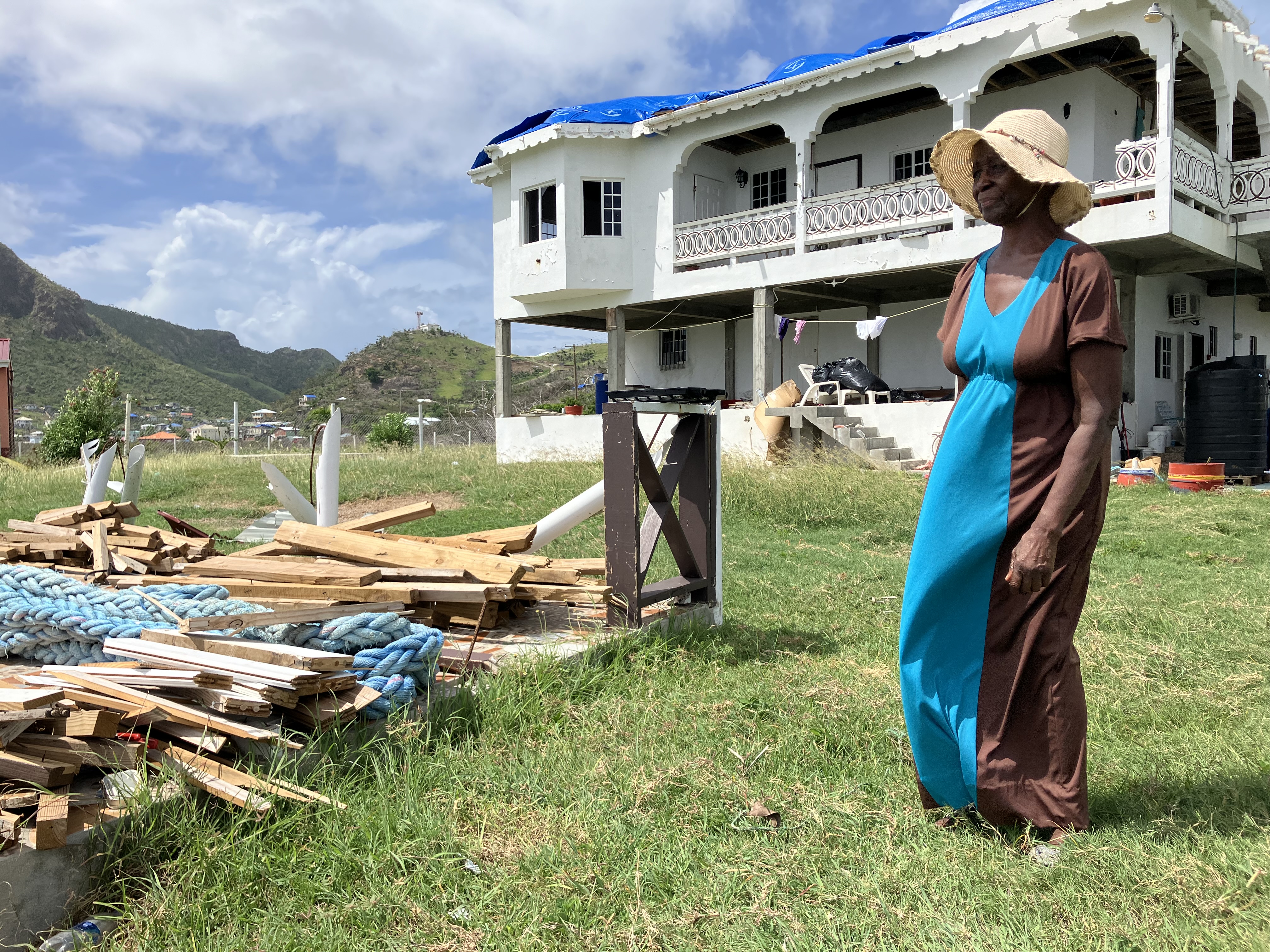
She’s thankful for the care and support the local Red Cross provided after Hurricane.
Beryl. Delta left Union Island in 1969, always planning to return, and in 2015, after retiring from a nursing career in Canada and the U.S., she came back to rebuild her life.
For the next three years, she built a home and continued her humanitarian work in this tight-knit community. The hurricane hasn’t slowed her down.
“The people I’m grieving for are those in shelters. They have no money, nowhere to go. They lost everything, houses, clothing, even underwear,” she says.
Her house, situated on low land near the shore, was quickly surrounded by high water during the category 5 storm that struck parts of the Caribbean on July 1. The winds, too, were a threat. For four hours, she held back a door, dislocating her shoulder. At 78, her strength and generosity are inspiring.
“I saw death right there. How am I going to escape?” she recalls asking herself during the storm.
The trauma connected her with St. Vincent and the Grenadines Red Cross (SVGRC) volunteers who responded to help people on multiple islands and the mainland.
Early in the emergency, Red Cross volunteers set up relief operations at a church on Union Island, distributing non-food items as well as a space for people to share their experiences – it was much-needed and appreciated emotional support.
“Red Cross was wonderful. People were very nice. So soothing. Helpful and encouraging,” says Delta.
Small society, many hazards
The SVG Red Cross is a young national society that gained its independence from the British Red Cross in 1984. Today, the SVGRC is comprised of a nearly 100 percent volunteer workforce, including key leaders like Shaneika Laidlow who manages their disaster and mental health programs. Their aim, she says, is to help people get back to normalcy.

“During these times people can get very frustrated. Does the Red Cross care for them?” says Shaneika, who is based in the nation’s capital on the mainland, St. Vincent. The answer is yes.
“There are so many people we would love to make better, but there are some things we’re unable to do at this time because of restraints. We offer assistance to those who most need it to the best of our ability,” she says.
The scope of the work, and the potential need, is challenging. This small nation and Red Cross society faces multiple hazards, including tropical storms, flooding, hurricanes, and even an active volcano.
In early October, monitoring showed unusual thermal activity of the La Soufriere volcano – activating the government to issue a low-level warning and close the trail to the summit.

The thermal anomaly stopped, but reminded many of past explosive eruptions like the most recent in 2021 when, on April 9, the dome inside the crater blew and for days spewed devastating volcanic ash across communities.
“It was like the sun was out, but not there. It was all dark,” remembers Edwin Joe, who lived in the countryside distant from the ‘red zone’. He remembers ash covering everything. “Just white everywhere, like bright snow with no sun. We didn’t know what was going to happen.”

Edwin evacuated the mainland for two weeks and returned to find some houses that had roofs collapsed from the volcanic ash. Many people stayed in shelters for several months.
The Red Cross formed part of the response with the government and other emergency partners, providing water, relief items and temporary housing assistance.
Help around the corner
The good news is that during challenging times a small Red Cross society like the SVGRC can turn to other national societies for help, primarily through the International Red Cross and Red Crescent (IFRC).
Raziel Uranga, a Mexican Red Cross responder with decades of disaster response experience deployed through the IFRC ‘surge’ program to serve as response operations support in St. Vincent and the Grenadines. His predecessor, he says, arrived just a few days after the hurricane, helping the SVGRC manage a large disaster response.

“Red Cross is the best humanitarian movement in the world, I am convinced, because no other organization has the workforce that we have,” says Raziel, whose passion lies in reducing risks amid the rising frequency of severe disasters.
Responders and donors from around the world – and in their own communities – have provided relief for people affected by Hurricane Beryl.
It’s uplifting for many to see this unified effort. And yet, when something big happens, a small national Red Cross society like the SVGRC needs help to do its best now and beyond.
“They need support from the global Red Cross network in order to grow as fast as they can, especially with the multiple hazards they’re facing,” says Raziel.
These hazards can destroy homes and livelihoods. Building back both is the focus on Mayreau, an islet just a short boat ride from Union. Wheelbarrow by wheelbarrow, people are removing rubble to restore the island’s sole income, tourism.
“We have to clean up this island to get tourism back – to get people back from Martinique – to see the turtles,” says Patrick Forde, a water-taxi driver before the storm.

Patrick rode out the hurricane in a small cupboard with his two children. “I’m lucky to be alive,” he says when looking back.
Tiny but mighty, what he loves about his island is the way people unite. “Whenever there’s a disaster, we all show up and work together.”
Learn more about the work of Red Cross societies around the world, like SVGRC, through the IFRC, click here.
 American Red Cross Minnesota and Dakotas Region