Do You Speak DR?

Hey there, we recently received this digital postcard from one long-time Red Cross disaster relief volunteer Marian Green, who’s in Illinois responding to spring floodingWe’ve inserted a few translations for the layperson and Red Cross disaster rookie readers.

Dear Red Cross Pals,

Marian and Tejas working together during the 2013 Spring Flooding response in the Midwest.

I met Tejas Patel in Baton Rouge, LA, last summer for Hurricane Isaac. He was the Log Chief [logistics boss]. It was great to run into him here as the Assistant Director [the #2 in charge of this disaster relief response]. As soon as he saw me walk into the room, he pointed to me and said “You are the FSI Lead!” [FSI = all things related to tracking numbers for the relief operation like meals & clean-up kits distributed, etc.] “Umm, OK,” I stammered brilliantly! It is great to be back in the field as a new FSI [actually stands for Financial Statistical Information] Supervisor. It was even better when an FSI Manager, Elizabeth Norcross from Hawaii, showed up yesterday. This is the first time I worked a DRO [Disaster Relief Operation] with three regions, each having its own staff, plus a DRO. Trying to get four sets of numbers compiled without duplications is a real challenge, but it’s been a great learning experience and Elizabeth is a great mentor. I plan on being here until May 4th but could be talked into a few more days if needed.

Thanks,
Marian in Peoria, Illinois

Our reply: Take care Marian, Tejas and the others who are responding to the spring flooding. You’re brilliant and for sure you have hearts bigger than three regions. And to our readers, both rookies and veterans, click here to see more about how the Red Cross is helping in Michigan, Illinois, Iowa, Minnesota and North Dakota during the 2013 Spring Floods disaster response.

Notes of Thanks

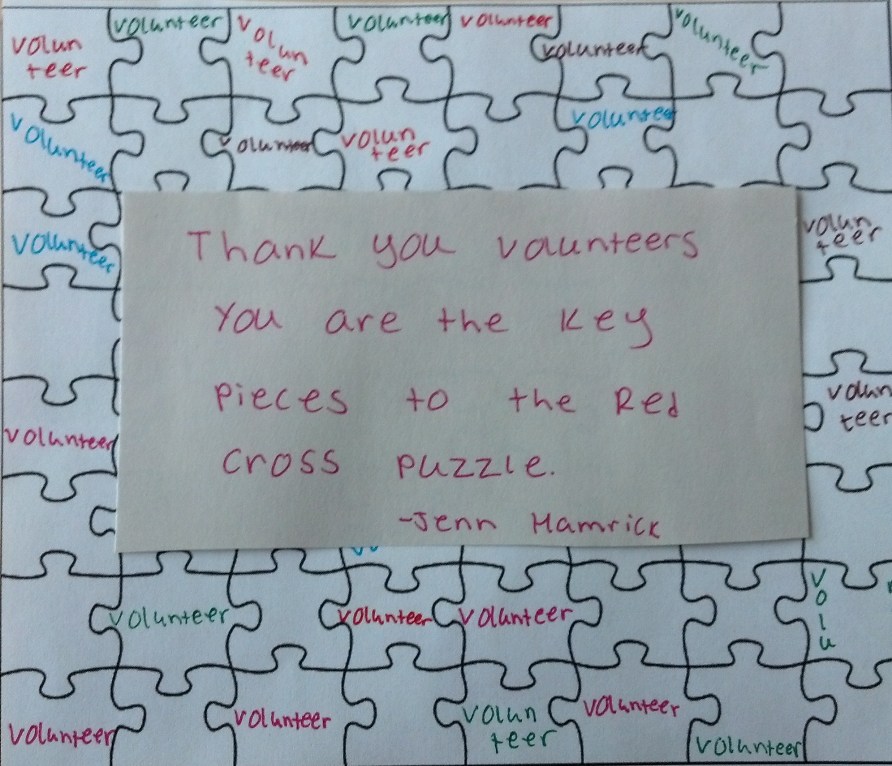
It’s National Volunteer Week, and the staff and board members here in the Northern Minnesota Region have much to be thankful for. This year we decided to write creative thank you notes to volunteers in celebration of their service to the Red Cross. These notes will be compiled into a poster, which we’ll bring to each of the upcoming volunteer appreciation events this spring. But in honor of National Volunteer Week, here’s a preview of how thankful we are for our fabulous Red Cross volunteers.

Megan M note croppedMegan D note croppedBoard note 1 croppedChoua note croppedLisa note croppedNicole note croppedboard note 2 croppedJason note croppedJenn note croppedB Safe note cropped

Disaster Mental Health Supports Red Cross Workers Too

Imagine that you’ve just returned home after being deployed to the American Red Cross Hurricane Sandy disaster relief operation. You worked twelve-hour days for three weeks helping Sandy survivors rebuild their lives. You’re a Red Cross disaster relief worker–most likely you’re a volunteer. You’re exhausted. You’ve seen a lot. Your experiences range from the devastating to the inspiring. You could use a little emotional support, but you’re not sure how or who to ask for it.

sandi_1
Sandi Lindgren was deployed to the American Red Cross tornado disaster relief operation in Joplin, Missouri, May 2011. Photo provided courtesy of Sandi.

The next thing you know, you receive a call from a Red Cross Disaster Mental Health volunteer who’s checking in to see how you’re doing and to assist you in dealing with stress and high impact experiences. The volunteer listens to you, offers support and lets you know that you’re not alone. Sandi Lindgren could be the person who calls.

“Disaster deployments are a special kind of response that I believe calls for increased attention,” Sandi says. “When you return home friends and family usually want to know some of what you’ve experienced, but often they don’t want to know as much as you want to tell.  It’s not because they don’t care – it’s because they don’t understand, and they themselves have had life continue while you were away.  Sometimes it can be helpful to process some of these experiences in a post deployment call, to get support, ideas and sometimes just have someone to listen.”

Sandi–who also deploys to disaster relief operations away from home–most often serves the Red Cross in Minnesota as part of a team of trained and licensed mental health volunteers. Together, the team has made more than one hundred post-deployment calls to Hurricane Sandy relief workers from Minnesota.

sandi_2
Sandi Lindgren gives–and gets–a hug during the tornado disaster relief operation in Joplin, Missouri, May 2011. Photo provided courtesy of Sandi.

Though it’s a service many people aren’t aware of, this kind of outreach can make a world of difference to those it supports. For example, one volunteer says that the the Disaster Mental Health volunteer who contacted her after her return from Hurricane Sandy “went way beyond what I could ever have expected a volunteer to do in the amount of time she devoted to [my post-deployment needs] and the caring for me and the Red Cross.”

Disaster Mental Health responders worry about the negative stigma sometimes associated with mental health and want volunteers to know that talking with someone is a normal and  healthy way to process a deployment experience. Sandi explains that “The Disaster Mental Health Team and its volunteers don’t approach you and talk to you because we secretly think you’re crazy and in need of an intervention! Sometimes, we just want to chat, or meet new people, or find out what’s going on. I like to remind people that we’re the mental HEALTH team…it’s all about how to be your best, so that you can then support others in the most effective manner.”

Thank you to all of the Disaster Mental Health team volunteers for your compassionate support of our regional volunteers. Your work is truly appreciated.

Story by Lisa Joyslin, Volunteer Resources Director, American Red Cross Northern Minnesota Region. Click here to learn more about Red Cross opportunities.

Red Cross Hosts Downtown Council Meeting

councilcropThe Twin Cities Area Chapter was honored to host the April 9 meeting of the Minneapolis Downtown Council. More than 50 local business leaders joined us for lunch and learned more about preparing their families and organizations for disasters, including health and safety training, Ready Rating and AEDs (automatic external defibrillators). Participants also heard from Shane Zahn, with the Minneapolis Downtown Improvement District & Minneapolis Police Department, about personal safety workshops, the SafeZone initiative and more. Even B. Safe Bear got in on the fun with Council President & CEO Mark Stenglein (pictured right with B. Safe Bear, center, and our Northern MN Red Cross Region CEO Phil Hansen, far right). Special thanks to all those who helped make the event a success!

Story and photo by Carrie Carlson-Guest/American Red Cross

Disaster Techies Train Up

Information technology (IT) is essential to modern disaster relief operations. And when the American Red Cross responds, Disaster Services Technology (DST) relief workers are called on to build computer networks often from the ground up. In a recent 3-day training held at the Red Cross in Minneapolis, 24 volunteers from across the Upper Midwest learned how to do just that.

DSC_0907DSTWorking in groups of two, the participants practiced using advanced IT equipment in the most efficient and expedient way possible to establish a computer network during disaster response. Each pair was taught how to set up a computer workstation, most often with one volunteer reading the provided directions, while the other carried out the procedure. “I’ve been deployed a couple times in Minnesota, never nationally. So I don’t often get to ‘play with toys’,” says volunteer Giampaolo Malin.

In a real disaster situation, volunteers like Malin arrive on scene, assess the situation and survey the post that would become a communications hub for reporting, recording, and sharing disaster response information. Then using methods learned about in trainings like this one they contact national Red Cross operations to get technology equipment needed in the field for providing relief to disaster survivors.

As an added training twist, the computers the volunteers used during the training were not Internet capable. Instead, before the training began several active satellite dishes were set up outside the building. The volunteers were trained how to use their computers to sync with those dishes thereby simulating a potential disaster environment where cable access to the Internet would be unavailable.

DSC_0919DSTThe training environment was supportive and helped build rapport between people who would likely work together in serious and intense situations. Here, every volunteer present helped each other learn unfamiliar technology, and of course, the instructors circulated the room offering assistance as needed. For Paul Davidson, the training was worthwhile.

“I come to these trainings because you never know who you’re going to run into out in the field. I also like to see and learn about the equipment we would be using.”

Story and photos by Hayes Kaufman/American Red Cross. To learn more about Red Cross disaster volunteer opportunities click here.

Low drama, big comfort

DSC_0975_web
Jean Fisher (l) meets with Jenn Hamrick (r) in Prior Lake, Minnesota.

Sometimes fires are small, but big. Sometimes flames die quickly, but people have to wait for the all clear from local officials. Sometimes dramatic pictures are few, but American Red Cross disaster responders help anyway because that’s what they do. And that was the case on Friday, April 5, when the Prior Lake Fire Department called for Red Cross help when dozens of people and their pets safely evacuated their homes. Sometimes we like to report on these low drama, big comfort fires because most fire are those not reported on major or local media.

DSC_0999_web
Newbie Jenn Hamrick learns about Red Cross forms from veteran Jeff Skoog in Prior Lake, Minnesota.

Most fires are the small flame, quickly extinguished type that happen around the block, across the street or next door all the time, every day. And while the building in Friday’s fire did not burn to the ground (phew!) and people recovered most of their personal belongings (yay!), Red Cross responders checked in with those who waited to return home, provided food during the hours passed for word of safe re-entry, and listened to people’s fire stories. Most of the time for the Red Cross the every day is just that, the every day.

Story & photos by Lynette Nyman/American Red Cross.