Mickie Mohs- Red Cross Volunteer. Submitted photo.
In 1997, as the dikes broke in Grand Forks, North Dakota, and water flowed across the town and inside homes, people like Mickie Mohs had to flee.
“We ended up leaving during the night about midnight because the water started coming up the street and we didn’t want to be stuck there with our son in a wheelchair and not be able to get out.”
In her view, they ‘got lucky’ because the water stopped short of flooding their entire home. The basement was lost, and the family spent days emptying and mucking it out in the freezing cold of April.
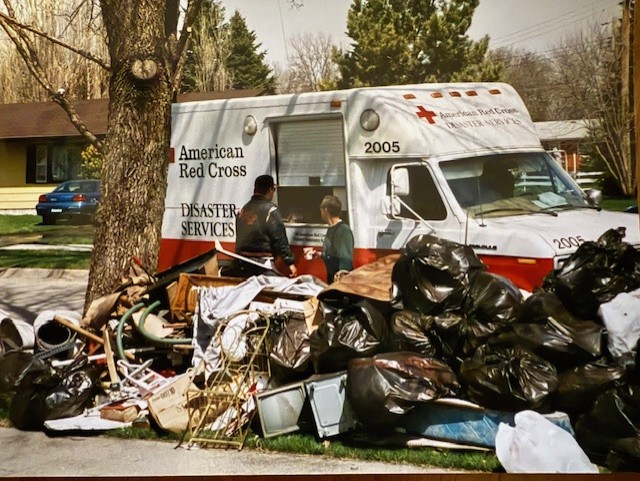
“Well, the cool thing is, and I’ll cry because I cry every damn time, we were cleaning and I looked up the street because I heard something, and it was very quiet in those days because we got in fairly early, and the Red Cross truck was coming down the street.”
Red Cross truck outside home of Mickie Mohs in Grand Forks, 1997. Submitted photo.
The truck carried meals to people in the neighborhood where most were too busy to think much about what or where they could eat. Mickie asked the relief team how much money they wanted for the food, especially because she needed meals for family members and neighbors who were helping them.
“I’m like, I’m going to have to find some cash. And they’re like, no, this is all free. So, we’re all crying because these people are feeding us warm food and we’re so excited and it was good.”
The truck returned over the coming days. The experience stuck with Mickie. She made a promise to herself. “I always said, someday I’m going to drive the truck and I’m going to go feed somebody else who needs that.”
And she did. It took a long time. In fact, decades went by. Her husband and son passed. And yet the promise to herself remained and after finding new love and retiring she fulfilled it in 2024 when she drove a Red Cross truck to help people affected by Hurricane Helene in the southern states.
Now, learning how to drive the truck and everything that comes with it took some training, but once completed it was more a matter of resolve that helped Mickie turn the ignition key and hit the road when the call to help came.
“I sat and sat and asked – is it time? Is this a good thing for me to go? I decided, yeah, I’ve got two weeks right now. This will work. This is what I want to do.”
Mickie Mohs supporting Hurricane Helene relief in 2024. Submitted photo.
Red Cross relief trucks operate in teams of two. Mickie picked up her teammate in Minneapolis and the pair rolled on to North Carolina and Georgia, where they worked long days loading and delivering supper mostly for people gathering at community centers. In one case, the local partner asked Mickie to back in the truck.
“I’m like, I don’t back up. I don’t back up. He says, ’Yes you can Mickie,’ in his southern accent. And so, yes, I backed up. It was fine. And by the end, I was backing in like a champ.”
Being on the delivery side of disaster relief deepened Mickie’s understanding of the impact. It was, she says, about a whole lot more. “You offer hope. And acknowledge that somebody cares, and they’re not going through it alone. It’s not, you know, it’s not just food.”
Story by Lynette Nyman – Red Cross Minnesota and Dakotas Region. Learn more and get involved at RedCross.org/MNDAKS.
When the wind finally stopped and the trees had settled into splintered piles across their yard in Erie, North Dakota, Lexi stood next to Hunter and took a deep breath.
Lexi and Hunter smile with relief, thrilled their wedding plans are still intact — the storm devastated much of the town but spared both their ceremony and reception venues. Photo: Carrie Carlson-Guest/American Red Cross.
“This wasn’t how we imagined the summer before our wedding,” she said.
Just days earlier, the young couple had been finalizing details for their ceremony in September. Now, instead of focusing on a celebration, they were cleaning up.
Then on June 20, storms with hurricane force winds ripped through towns big and small in eastern North Dakota, leaving the tiny village of Erie—population barely 30—reeling.
The storm took their shade trees, littered the road with branches, and left everyone asking the same question: Where do we even begin?
That answer came quickly. First, neighbors and family came to help. Then, church groups and people from across the region who drove for hours turned up. And then, the American Red Cross arrived.
“It went from warm water and silence to trucks, volunteers, and kindness pouring in from every direction,” Lexi said.
In the nearby town of Page, the fire station turned into a hub of comfort. Red Cross volunteers helped serve meals while neighbors gathered around folding tables to share food, stories, and sighs of relief.
In Page, the fire station became a refuge as Red Cross volunteers served meals and neighbors shared food and comfort. Photo: Carrie Carlson-Guest/American Red Cross.
“It wasn’t just about feeding people,” Lexi said. “It was about creating a space where we could breathe. Where we could sit with people who understood.”
Lexi’s dad used a company volunteer day to come and help cleanup in Erie. “He could’ve spent the day anywhere,” she said. “But he chose here. Not just for me—but for our community.”
Hunter spent those days helping others before even touching their own yard. “That’s who he is,” Lexi said quietly. “And that’s why I love him.”
Though many buildings were damaged, two small miracles stood out. The church where Lexi and Hunter plan to marry and the community hall where they’ll hold their reception — were untouched by the storm. “Out of all the places that could’ve been hit,” she said, “ours were spared. That has to mean something.”
The City of Page, ND’s fire station opened its doors as a community gathering place. Knox, who celebrated his his 3rd birthday in the Fire Hall, and his sister Kora, age 5. simply enjoyed being kids, blowing bubbles and zooming trucks. Photo: Carrie Carlson-Guest/American Red Cross
Their wedding is still on. But now, the meaning behind their vows has strengthened.
“We’ve seen what it looks like when people show up for each other,” Lexi said. “People we’ve never met before—just neighbors we hadn’t met yet.”
On his first deployment, Red Cross Health Services volunteer Daniel Odubura of Grand Forks, N.D., pitches in with a smile to serve hot meals to storm survivors in Page, N.D. Photo: Carrie Carlson-Guest/American Red Cross
In a part of the world where towns are small and pride runs deep, asking for help doesn’t come easy. But what Lexi and Hunter discovered is that sometimes, you don’t have to ask—people just come.
And when they do, they bring more than food or rakes or tarps. They bring hope.
Photo Illustration by Jason Colston/American Red Cross
Introducing the Integrated Care Condolence Team (ICCT) for the American Red Cross Minnesota and Dakotas Region, a collective that embodies the organization’s mission to prevent and alleviate human suffering in emergencies by mobilizing the power of volunteers and the generosity of donors.
Tonya Peterson, the Regional Recovery Manager, leads the ICCT for the region. This dedicated team supports families who have lost loved ones due to disasters. Reflecting on her experience, Tonya shares, “It is rewarding when we can help families going through challenging situations. These are some extremely difficult and stressful times.”
Approximately 70 volunteers are trained to perform the specialty services integrated care condolence provides. These volunteers have met qualifications to serve in health services, mental health services, spiritual care services, or casework and undergo further training to participate in the ICCT. When an ICCT is needed, volunteers from each of these services are requested by the coordinator. Each team consists of individuals from the four service lines, and efforts are made to involve local volunteers from the disaster area so that families can meet some of the team members in person.
Disaster Health Services includes licensed health professionals such as nurses, MDs and DOs, PAs, EMTs, and paramedics. Disaster Mental Health encompasses licensed mental health professionals like counselors, psychologists, psychiatrists, and social workers. Recovery caseworkers have extensive experience and provide resources and guide clients through the recovery process.
To break things down further: the Disaster Health Services team is composed of registered nurses, licensed practical nurses, EMTs, medical doctors, physician assistants, and nurse practitioners. The Disaster Mental Health team includes licensed mental health professionals, school psychologists, counselors, and retired professionals. The Disaster Spiritual Care team comprises board-certified/professional chaplains and local faith leaders. Experienced caseworkers help families navigate recovery while coping with the death of a loved one. Volunteers trained in their respective lines of service also receive additional training to handle these sensitive cases.
Highlighting a team member, Bruce Norgaard, an ICCT team member and spiritual care provider, explains his role:
“I am both the Regional Spiritual Care Team lead for the Minnesota and Dakotas Region and the North Central Division Advisor for Spiritual Care. I respond with the ICCT team both regionally and during national disaster responses. One memorable local response was for a family fire where one parent died, and the other was hospitalized. The fire, caused by one of the children involved with meth, also damaged four adjacent units. Providing comfort for the surviving parent as they began their recovery and connecting them with their local faith community was both fulfilling and satisfying.”
On a national level, Bruce recounts, “One memorable interaction was with our team consisting of a mental health care provider and myself. We worked with a survivor who had isolated themselves in their room for days, not even coming out for meals. As a team, we convinced them to come out, get a meal, and receive healthcare for wounds suffered while their spouse was pulled through a window during a tornado. The survivor then opened up to our mental health counselor, who discovered a faith background. This allowed me, as a spiritual care provider, to help them work through issues of self-blame and lack of self-worth. We prayed using their faith traditions, and the ensuing hugs and clinging grasps provided comfort for both of us.”
Katie Gilmore, a volunteer, serves as the regional ICCT coordinator. Her role involves reaching out to volunteers with specific specialties to create teams that assist families. For instance, if a fire occurs in northern Minnesota, she recruits volunteers from that area; if it happens in western North Dakota, she seeks volunteers there. Katie also organizes virtual team meetings to discuss needs and coordinate efforts. Tonya attends these meetings when available. During these discussions, the team identifies which services are necessary for each family. Additionally, the meetings determine support in cases with fatalities. Regional leads in the three specialty areas and casework areas support Katie in finding suitable volunteers.
Tonya and Katie are notified when a disaster-related fatality occurs. They gather information, such as whether the Red Cross responded to the scene. If not, they obtain the identity of the deceased and names of next of kin, generally through law enforcement. If the family wishes to receive Red Cross services, a member of the mental health services initially contacts them. This mental health person remains on the newly formed ICCT and provides an initial assessment to the other team members. If the Red Cross responded to the scene, all information is obtained by those on-site. Tonya and Katie are informed, and a new ICCT is formed.
Volunteering for this team requires more than professional training; compassion plays a large role. The compassion and care that Red Cross volunteers are known for is part of their mission to alleviate human suffering. For example, a client may be assigned a caseworker who provides community resources, financial assistance, and more. If a death occurred in the fire, a caseworker with ICCT training will be assigned to the team. All needed services, including health, mental health, and spiritual care, will be provided by the ICCT. If the death is confirmed to be disaster-related, the mental health or health service team member can provide fatality assistance of $1,000 for each person who perished in the disaster. Most local cases are closed in 30 days, but those involving a death may remain open much longer to meet the client’s needs.
Since January 1, 2024, there have been multiple fire cases in St. Paul, surpassing the total number of cases in 2023. One such case involved the loss of four children. The ICCT supported this family every step of the way. The volunteers were invited by the family to a gathering before one of the memorial services. At the family’s request, the Red Cross provided food and beverages for the gathering to support those in attendance.
The Integrated Care and Condolence Team leads with humility and dedication. We deeply appreciate each member of this special Red Cross team, who provides invaluable support to the communities they serve. Thank you to all ICCT team members!
Story by Lisa and Andrea, Minnesota and Dakotas Red Cross Region Volunteers
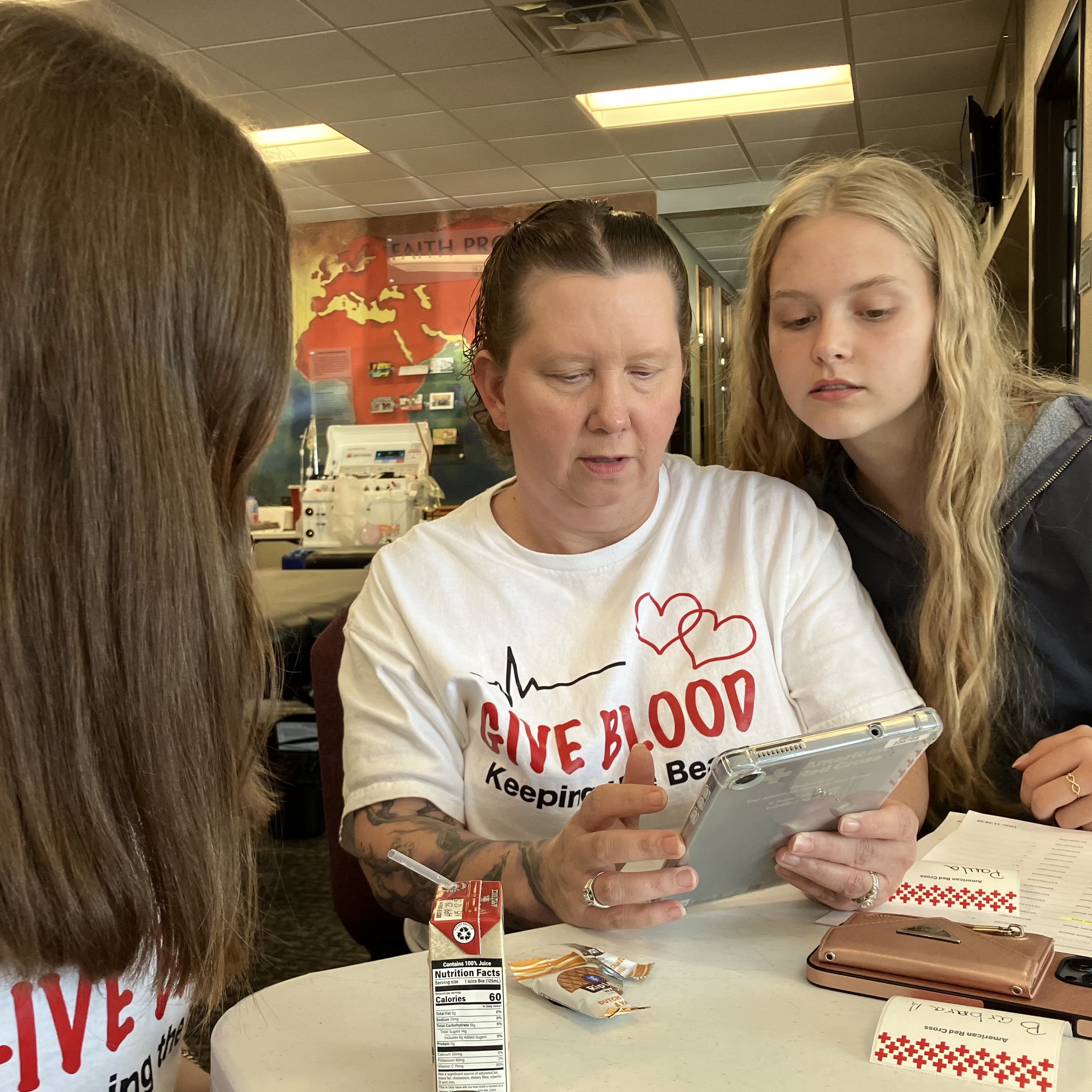
Waterville, Minnesota, a community impacted by recent flooding and still recovering, came together to donate blood on Monday. “We have a lot of helpful people in our small community,” said Barb, a former Red Cross volunteer and blood donor who helped organize blood drives for nearly 24 years.
Barb, former Red Cross volunteer, Waterville, MN, Aug. 12, 2024.
The blood drive filled up quickly and they had to add appointments to accommodate those who wanted to roll up a sleeve. In fact, the community surpassed the blood drive goal – reaching 110% of expected donations.
The drive was sponsored by the high school student Family, Career and Community Leaders of America (FCCLA) group in the Watertown, Elysian and Morristown school district. The group tries to host five blood drives a year, and this was the first drive in Waterville since the flooding in June. The next drive is already scheduled for November.
“We try and make it fun!” exclaimed Tricia, the group’s advisor. Sometimes they have special T-shirts made, special treats for donors, or themes to make it more interesting. “We try to get 16 year-olds to become first-time donors.”
Red Cross volunteers Jocelyn, Tricia and Megan, Waterville, MN, Aug. 12, 2024.
Donors included Megan, a high school senior and Red Cross volunteer, who is already a Certified Nursing Assistant and plans to pursue a career in healthcare. “I started donating because it gave me another way to help people that really need it,” she says. “When someone is nervous about donating I just remind them of how they could be saving someone’s life.” Megan and Jocelyn, a student lead for the blood drive, helped check-in donors.
We’re amazed that people affected by their own disaster have stayed committed to helping others through blood donation this summer as we are facing an emergency shortage. Thank you, Waterville and surrounding areas for giving back in such a meaningful way!
Megan, blood door and Red Cross volunteer, Waterville, MN, Aug. 12, 2024
You can help, too. Click here to make an appointment to give and help patients counting on lifesaving blood products being available.
Red Cross Disaster Mental Health volunteer, Mary Parker, shares her experience
Disasters are traumatic events. And while many Red Cross volunteers are trained in myriad roles, such as staffing shelters, handing out cleanup kits, driving box trucks and the like, there are also volunteers trained specifically to support the emotional health of individuals and families affected.
Mary Parker is one such volunteer, “We’re all trained in the mental health field, either currently working or done working. This is just our passion, it’s part of our DNA— to help people.”
Red Cross Disaster Mental Health Volunteer Mary Parker from Side Lake, MN at a disaster training conference. Volunteers participate in free training specific to their position.
A Red Cross volunteer for six years, Mary is currently helping people impacted by flooding in Minnesota and South Dakota. Her role is to manage Disaster Mental Health (DMH) services for the response. To reach more people, she says they’ve embedded with other service teams.
“Mental Health has been accompanying crews as they deliver emergency supplies and cleanup kits, talking to clients, providing as much emotional support as we can…We also went out with the damage assessors. As they were going out to assess damage, we did some ride-alongs to talk to people in real time.”
Mary monitors the pulse of the Red Cross relief effort, keen to tap any opportunity that will ensure a Disaster Mental Health presence, “Basically, any activity that’s going on, if I have a mental health provider available, they go. That way there’s more good face-to-face interaction. It’s a good way to determine if we need to do a follow-up call with them.”
Mary continued, “The DMH role really is to be able to listen to their story and have someone to hear their hardships and struggles. We validate their hardships, give them a hug if they need one, remind them that they are resilient, and offer compassion and empathy. We’ve been at fixed sites, we’ve been on the [emergency response] vehicles, we’ve also had DMH at the shelters and alongside caseworkers at resource centers.”
Mary Parker sharing her experiences with fellow Red Cross volunteers at a recent volunteer event.
The Red Cross hosted several resource centers for individuals displaced by recent flooding in Minnesota and South Dakota where trained Red Cross volunteers can open recovery casework for those whose homes sustained major damage or were destroyed. “We’re coordinating health services, mental health and spiritual care, so at least one if not more have been represented at each site.”
In addition to standard Red Cross disaster assistance, individuals and families may of course request to speak with a disaster health, spiritual health, or mental health volunteer about their needs.
“It’s what we do!”
Resources Every eight minutes, the Red Cross responds to a disaster somewhere in the United States. Often it’s a single family home fire. Sometimes it’s a larger disaster like a flood or a tornado. Homes, which are supposed to be places of comfort and stability, can be destroyed, and with them that sense of comfort and stability can be turned on its head at a moment’s notice.
As the physical and emotional impacts of this disaster come into sharper focus for those affected, Red Cross caseworkers and mental health volunteers are on the front lines, providing one-on-one support to individuals and families. Their unwavering commitment helps address the evolving needs of residents during this challenging time.
The Red Cross encourages people to remember to take care themselves, their loved ones, and neighbors:
Support Each Other: In difficult times, it’s crucial for people to lean on one another. Reach out to friends, family, and neighbors—your collective strength makes a difference.
Be Patient: Floods can evoke a range of emotions and reactions. It’s okay to feel worried or drained. Give yourself the grace to process these feelings.
Children’s Needs: Traumatic events impact children differently than adults. Sometimes, their worries manifest in behavior rather than words. Be attuned to their needs and emotions.
If you or someone you know requires assistance, don’t hesitate to contact the free 24/7 multilingual Disaster Distress Helpline at 1-800-985-5990. They’re there to provide support and guidance during challenging times.
Volunteers Needed Do you have a background as a current or former licensed mental health practitioner? Looking for a unique and much needed way to help your community in times of disaster? Consider joining the Disaster Health Services team! Learn more here.
Story by American Red Cross Volunteer Nate Russell.
More than two weeks after floodwaters inundated parts of Minnesota and eastern South Dakota, neighbors, local community organizations and government partners continue to work together to help people recover from the extensive damage.
If you need help, please visit redcross.org/mndaks and click “Get Help,” or you can call 1-800-RED CROSS (1-800-733-2767).
Shelters are available for people displaced by recent flooding. Shelters provide essential resources, including food, water, emotional support and information. Click here for info on what to bring, services available and more.
Red Cross Emergency App: To stay informed and prepared during severe weather, download the free Red Cross Emergency app. Customize 40 different weather alerts, toggle between English and Spanish, and ensure accessibility for people with disabilities. Text “GETEMERGENCY” to 90999 or find the app in your app store.
The Emergency app includes an “I’m Safe” feature that help people check on loved ones. Search “American Red Cross” in app stores or go to redcross.org/apps.
Turn around, don’t drown. Stay off the roads. If you must drive and encounter a flooded roadway while driving, turn around and go another way.
How you can help
Support Red Cross Disaster Relief and help people affected by disasters like flooding and countless other crises by making a financial donation today. Your gift enables the Red Cross to prepare for, respond to and help people recover from disasters big and small, like the Minnesota and South Dakota floods.
Donate online at RedCross.org, call 1-800-RED CROSS (1-800-722-2767) or text REDCROSS to 90999 to make a $10 donation.
The Red Cross encourages financial donations, which provide the quickest and most effective way to assist those in need. Please note that the Red Cross is not accepting donations of food, household items, or clothing, as these cannot be distributed by their teams.
Volunteer for disasters Many people have expressed interest in volunteering to support our response efforts, and we are appreciative of the offers to assist. At this time, our trained Red Cross volunteers are working this disaster.
Help us pre-stage valuable volunteers for the next disasters to help your neighbors in need – from home fires to flooding and more. Put on a red vest and join us as a volunteer today to provide relief and hope when it matters most. Visit redcross.org/givetime to check out opportunities with your local chapter.
Donate blood Unfortunately, the American Red Cross continues to address a concerning shortfall in lifesaving donations since late spring. If you are in an area not impacted by a disaster, please keep your appointment or schedule an appointment to roll up a sleeve and donate blood.
To make an appointment simply download the American Red Cross Blood Donor App, visit RedCrossBlood.org, call 1-800-RED CROSS (1-800-733-2767).
CrisisCleanup.org
Home Cleanup Hotlines have been opened by CrisisCleanup.org to help survivors cleanup in Minensota and South Dakota. We anticipate that most volunteer groups will work through Friday, July 5. 2024. Survivors needing assistance can call 218-288-2213 in MN and 605-519-5413 in SD.
“We make a good team after 45 years of marriage,” chuckled Jackie, a Red Cross volunteer who recently journeyed to Sioux Falls with her husband Rick to distribute essential disaster relief items to people affected by flooding. “It’s a great way to spend time together – Rick’s the driver, and I’m the navigator.”
Rick and Jackie Fredricksen loading disaster relief supplies unto a truck at the Red Cross building Minneapolis for transport to the Sioux Falls area June 27, 2024. Photo: Lynette Nyman/American Red Cross
The husband and wife duo, from Long Lake, MN, joined the Red Cross family last August after they both bid farewell to working life. A former volunteer firefighter, Rick, was eager to keep serving the community so helping with Sound the Alarm events seemed a fantastic place to start. “We once made an alarm installation at a deaf person’s house,” shared Rick. “With the help of another volunteer’s sign language skills, we were able to ensure her home was safer. We were so thrilled about it; we exchanged high-fives! It was truly special.”
This past December, Rick happily helped train fellow disaster team members in Houston, TX and even spent a couple of weeks there in May assisting those impacted by flooding and tornadoes. In the meantime, Jackie was finalizing her own training. “As volunteers, we’re truly embraced by the Red Cross family,” said Rick. “You develop friendships with fellow volunteers – I still get friendly check-in messages from time to time – recently a photo from two volunteers that I deployed with that wanted to say hello.”
Last week, was their first Red Cross deployment together.
Jackie and Rick Fredricksen ready to distribute disaster relief supplies including clean up kits in South Dakota. Photo: Turner County South Dakota Emergency Management.
“Hearing people’s heartfelt stories while they were picking up supplies was so touching,” said Jackie. “Just knowing that we could help them a little while they’re going through so much – they were so appreciative of the Red Cross being there.”
Ricks adds, “People are so resilient. We met a young woman who lived on a farm – they thought they were going to have a bumper crop this year but now have lost everything, but she still had a positive outlook. Or another woman who had skin cancer and was going through treatment – but remained hopeful that things would get better.”
Their Sioux Falls deployment wrapped up on Sunday when the last person came to pick up supplies. “We all signed the top of the clean-up kit!”
When asked about retirement and volunteering with the Red Cross, they both agreed, “We recommend it! It’s so rewarding to meet different people and other Red Cross team members.”
Red Cross volunteer team, including Jackie and Rick Fredricksen, meet Mark, a local hero who stepped up to assist not just himself, but also a neighbor impacted by the recent floods. Photo submitted.
“It gives you another level of energy and positive feelings that you can help,” said Jackie. “There’re so many different ways to be involved with the Red Cross – there’s something for everybody!
Rick added, “It’s a great opportunity to meet new people and make new friends. I feel blessed that Jackie and I get to share this journey together. We return home inspired, exchanging stories, and praying for brighter days for those we’ve met.”
Jackie and Rick Fredrickson with fellow Red Cross disaster volunteer Willis Gravning.
Our work is possible because of trained volunteers like Rick and Jackie. Join our volunteer team – to find a role that works for you, visit RedCross.org/GiveTime.
Floodwaters continue to impact our neighbors in southeast South Dakota and southern and northeast Minnesota. The Red Cross is closely monitoring weather updates and river crest forecasts, while trained disaster responders are assisting those in need. Please see below for resources.
If you need help, please visit redcross.org/mndaks and click “Get Help,” or you can call 1-800-RED CROSS (1-800-733-2767).
Nobles County Prairie Justice Center 1530 Airport Road Worthington, MN 56187 4 p.m. – 7 p.m.
Jackson County Red Cross teams are driving around the community today with kits. If you don’t see us, clean-up kits are also available at our shelter in Jackson. Jackson County Community High School (JCC HS) 1128 N Hwy., Jackson, MN 56143
Windom Mobile distribution, 2:30 p.m. to 4 p.m. Teams delivering kits throughout the community.
Turner County County Building 1055 E Sanborn St Parker, SD 57053 10:30 p.m. – 2:30 p.m.
Saturday, June 29, 2024
Davison County Mt. Vernon Public School 500 N Main St Mt. Vernon, SD 57363 10:00 a.m. – 2:00 p.m.
City of Mitchell 612 N Main St Mitchell, SD 10:00 a.m.-2:00 p.m.
Shelters and Temporary Evacuation Point
If you or anyone you know is affected by this situation, safe shelter is available. It’s crucial to have a safe place during emergencies.
Shelters and a Temporary Evacuation Point are available for people displaced by recent flooding. Shelters provide essential resources, including food, water, emotional support and information. Click here for info on what to bring, services available and more
Red Cross Emergency App: To stay informed and prepared during severe weather, download the free Red Cross Emergency app. Customize 40 different weather alerts, toggle between English and Spanish, and ensure accessibility for people with disabilities. Text “GETEMERGENCY” to 90999 or find the app in your app store.
The Emergency app includes an “I’m Safe” feature that help people check on loved ones. Search “American Red Cross” in app stores or go to redcross.org/apps.
Turn around, don’t drown. Stay off the roads. If you must drive and encounter a flooded roadway while driving, turn around and go another way.
How you can help
Support Red Cross Disaster Relief and help people affected by disasters like flooding and countless other crises by making a financial donation today. Your gift enables the Red Cross to prepare for, respond to and help people recover from disasters big and small, like the Minnesota and South Dakota floods.
Donate online at RedCross.org, call 1-800-RED CROSS (1-800-722-2767) or text REDCROSS to 90999 to make a $10 donation.
The Red Cross encourages financial donations, which provide the quickest and most effective way to assist those in need. Please note that the Red Cross is not accepting donations of food, household items, or clothing, as these cannot be distributed by their teams.
Volunteer for disasters Many people have expressed interest in volunteering to support our response efforts, and we are appreciative of the offers to assist. At this time, our trained Red Cross volunteers are working this disaster.
Help us pre-stage valuable volunteers for the next disasters to help your neighbors in need – from home fires to flooding and more. Put on a red vest and join us as a volunteer today to provide relief and hope when it matters most. Visit redcross.org/givetime to check out opportunities with your local chapter.
Donate blood Unfortunately, the American Red Cross continues to address a concerning shortfall in lifesaving donations since late spring. If you are in an area not impacted by a disaster, please keep your appointment or schedule an appointment to roll up a sleeve and donate blood.
To make an appointment simply download the American Red Cross Blood Donor App, visit RedCrossBlood.org, call 1-800-RED CROSS (1-800-733-2767).
CrisisCleanup.org
Home Cleanup Hotlines have been opened by CrisisCleanup.org to help survivors cleanup in Minensota and South Dakota. We anticipate that most volunteer groups will work through Friday, July 5. 2024. Survivors needing assistance can call 218-288-2213 in MN and 605-519-5413 in SD.
Floodwaters continue to impact our neighbors in southeast South Dakota and southern and northeast Minnesota. The Red Cross is closely monitoring weather updates and river crest forecasts, while trained disaster responders are assisting those in need. Please see below for resources.
If you need help, please visit redcross.org/mndaks and click “Get Help,” or you can call 1-800-RED CROSS (1-800-733-2767).
If you or anyone you know is affected by this situation, safe shelter is available. It’s crucial to have a safe place during emergencies.
Shelters and a Temporary Evacuation Point are available for people displaced by recent flooding. Shelters provide essential resources, including food, water, emotional support and information. Click here for info on what to bring, services available and more
Red Cross Emergency App: To stay informed and prepared during severe weather, download the free Red Cross Emergency app. Customize 40 different weather alerts, toggle between English and Spanish, and ensure accessibility for people with disabilities. Text “GETEMERGENCY” to 90999 or find the app in your app store.
The Emergency app includes an “I’m Safe” feature that help people check on loved ones. Search “American Red Cross” in app stores or go to redcross.org/apps.
Turn around, don’t drown. Stay off the roads. If you must drive and encounter a flooded roadway while driving, turn around and go another way.
How you can help
Support Red Cross Disaster Relief and help people affected by disasters like flooding and countless other crises by making a financial donation today. Your gift enables the Red Cross to prepare for, respond to and help people recover from disasters big and small, like the Minnesota and South Dakota floods.
Donate online at RedCross.org, call 1-800-RED CROSS (1-800-722-2767) or text REDCROSS to 90999 to make a $10 donation.
The Red Cross encourages financial donations, which provide the quickest and most effective way to assist those in need. Please note that the Red Cross is not accepting donations of food, household items, or clothing, as these cannot be distributed by their teams.
Volunteer for disasters Many people have expressed interest in volunteering to support our response efforts, and we are appreciative of the offers to assist. At this time, our trained Red Cross volunteers are working this disaster.
Help us pre-stage valuable volunteers for the next disasters to help your neighbors in need – from home fires to flooding and more. Put on a red vest and join us as a volunteer today to provide relief and hope when it matters most. Visit redcross.org/givetime to check out opportunities with your local chapter.
Donate blood Unfortunately, the American Red Cross continues to address a concerning shortfall in lifesaving donations since late spring. If you are in an area not impacted by a disaster, please keep your appointment or schedule an appointment to roll up a sleeve and donate blood.
To make an appointment simply download the American Red Cross Blood Donor App, visit RedCrossBlood.org, call 1-800-RED CROSS (1-800-733-2767).
CrisisCleanup.org
Home Cleanup Hotlines have been opened by CrisisCleanup.org to help survivors cleanup in Minensota and South Dakota. We anticipate that most volunteer groups will work through Friday, July 5. 2024. Survivors needing assistance can call 218-288-2213 in MN and 605-519-5413 in SD.
As we step into a new year, many of us are looking for ways to make a positive impact in our lives and the lives of others. The American Red Cross offers a variety of quick and meaningful ways to make a difference. Here are five resolutions you can accomplish in one hour or less, not only benefiting those in need but also enhancing your own well-being.
Cassie and Ben, parents of 3-year-old Oliver who is battling kidney cancer, recently rolled up a sleeve at a blood drive held in their son’s honor. Oliver has needed multiple blood transfusions during his treatment so they are helping pay it forward. Every donation helps patients like Oliver.
Donate Blood One of the most significant contributions you can make is donating blood – and it’s simple. In just about one hour, you can make a real difference in the lives of patients requiring life-saving transfusions. It may be the only resolution that includescookies. Schedule on our free appand follow your blood donation’s journey every step of the way as it makes its way to a hospital to help patients in need.
Learn Hands-Only CPR Learning hands-only CPR is a quick, vital skill that could save a life. The Red Cross offers online resources and local classes that can teach you this life-saving technique in under 30 minutes. By knowing how to perform hands-only CPR, you can help keep a person alive until professional help arrives. Bonus: have fun practicing the rhythm by checking out these “Next Gen Life Beats” friends at the Australian Red Cross. And yes, it includes a Taylor Swift song.
Check Smoke Alarms and Practice an Escape Plan Ensuring your home is prepared for emergencies is crucial. Take a few minutes to test your smoke alarms and replace any batteries if needed. Then, spend some time with those you live with drafting and practicing a home escape plan. Knowing what to do in the event of a fire can significantly increase your chances of safely escaping. And you probably haven’t checked your smoke alarms since last time you burnt pizza. Check out how-to videos and other resources at SoundTheAlarm.org/MNDAKS.
Find your Fit, Take the Volunteer Quiz The American Red Cross depends on volunteers to carry out its humanitarian work. In less than an hour, you can explore various opportunities online and sign up for something that resonates with your skills and interests. Whether it’s assisting at a local blood drive, helping with disaster response, or supporting military families, your time and effort can make a huge impact. Punch in your zip, take a our quick quiz and we’ll match you up with cool opportunities near you.
Make a Gift in Someone’s Honor Making a charitable donation in honor of a loved one is a meaningful way to recognize special occasions. It’s a simple process that takes just a few minutes online. Your gift can support various Red Cross initiatives, from disaster relief to supporting military families, and it’s a beautiful way to spread kindness and compassion. Bonus, warm and fuzzy feelings for you and them. Visit RedCross.org/MNDAKS to make a gift.
As you consider your resolutions for the year, remember that even the smallest acts can have a significant impact. By dedicating an hour or less to any of these Red Cross activities, you’re not only helping others but also fostering your own health and happiness*.
Here’s to a year filled with kindness, compassion, and community support!
*From the Mayo Clinic Health System, “Kindness has been shown to. increase self-esteem, empathy and compassion, and improve mood. It can decrease blood pressure and cortisol, a hormone directly correlated with stress levels. People who give of themselves in a balanced way also tend to be healthier and live longer.”







 Red Cross Emergency App: To stay informed and prepared during severe weather, download the free Red Cross Emergency app. Customize 40 different weather alerts, toggle between English and Spanish, and ensure accessibility for people with disabilities. Text “GETEMERGENCY” to 90999 or find the app in your app store.




 American Red Cross Minnesota and Dakotas Region