Red Cross + Hope = Safer Neighborhoods

Hope Worldwide Volunteers sorting smoke detectors and batteries to be given to Philips neighborhood homes without proper fire detection.

Armed with Red Cross fire safety tips, seventy Hope Worldwide volunteers hit the streets of the Phillips neighborhood in Minneapolis on Saturday, January 16, to spread the word on household fire safety.

American Red Cross preparedness representatives trained the Hope Worldwide volunteers on fire safety and gave them tip sheets before the volunteers knocked on doors.

(Click here for tip sheet)

Smoke detectors donated by the Minneapolis Fire Department and batteries donated by Home Depot were available to give to homes without them. The volunteers planned to reach out to 1,200 households.

The American Red Cross Twin Area Chapter responds to more than 400 residential fires each year, including house and apartment fires in the Phillips neighborhood. The Red Cross provides people affected by disaster with emergency disaster relief, such as food, clothing, shelter, medical assistance and emotional support. (Click here to learn more.)

Text and images by Andrea Bredow, Red Cross Volunteer

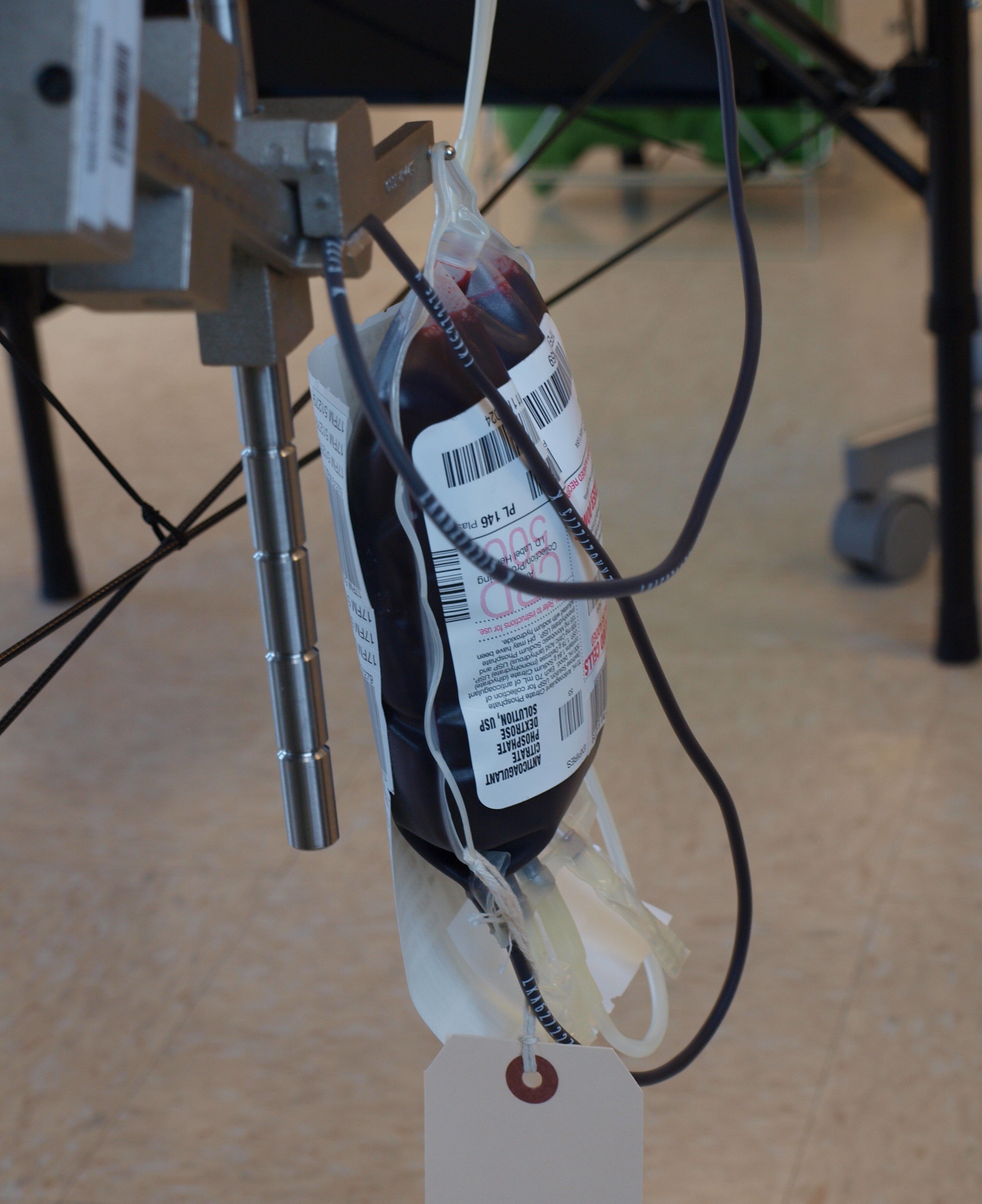
Bashir gives blood in the room with a view

The view from the room with a view:

Bashir excited to be in the room with a view:

Bashir relaxing on a chaise in the room with a view:

A life-giving gift from Bashir in the room with a view:

Thank you, Bashir, for donating to one human from another in the room with a view:Click here to schedule a blood donation appointment in the room with a view.

Star Bank shines on Red Cross Holiday Mail for Heroes

The American Red Cross collected holiday cards throughout the past several weeks for distribution on military bases and hospitals, veterans’ hospitals and other locations in the U.S. and abroad.  More than a million cards were collected this year, bringing the total for Holiday Mail for Heroes to about 4.5 million cards during the past five years. One of the program’s strongest supporters is Star Bank in Eden Prairie. Katie Incantalupo explains why…

Katie Incantalupo (left) and service members helped collect more than 19,000 cards for the 2011 Holiday Mail for Heroes program. Photo courtesy of Star Bank.

The leaders of Star Bank, including both President and CEO Harry Wahlquist and I, have a strong commitment to the mission of the American Red Cross to provide relief to victims of disaster and to help people prevent, prepare for and respond to emergencies.

We’ve been hosting quarterly blood drives at Star Bank in partnership with North Central Blood Services for about 12 months. Harry is a longtime Red Cross Board Member and I’m a Lifetime Member of the Tiffany Circle Society of Women Leaders within the Red Cross. I was elected to be a member of the National Council for Tiffany Circle in 2010, and my participation in that governing body brought forth the opportunity for me to lead the Holiday Mail for Heroes campaign on a national level for the 2011 holiday season.

Katie Incantalupo (right) and Elena Luca (left), sign Holiday Mail for Heroes cards in Washington, DC. Photo by Dennis Drenner/American Red Cross

I have spoken with many service men and women over the past four months about the Holiday Mail campaign and have heard wonderful stories about how much it means to receive a card when you are serving away from home over the holidays. The card campaign makes a real difference in our service members’ lives. Star Bank hosted a card signing event that was well attended by members of the community, including several local “celebs.” I’m so excited that more than 19,000 holiday cards were signed in Minnesota alone this year!

Katie Incantalupo gets ready to donate blood. Photo courtesy of Star Bank.

It has been an honor to assist the Red Cross in growing awareness and participation on behalf of Holiday Mail for Heroes and I’m thankful that I’ve been able to serve the organization in this way, both personally and professionally.

Katie Incantalupo is a Red Cross volunteer and the Director of Marketing for Star Bank in Eden Prairie, Minnesota. The mailbox for the 2011 Holiday Mail for Heroes program is now closed, but Americans wanting to help military members, veterans and their families can visit the Red Cross holiday giving catalog and click on “Help Our Troops.” The online catalog offers symbolic donations to help provide members of the Armed Forces with phone cards and comfort kits as well as assist homeless veterans, among many other options.

Red Cross women on the Russian front during the Great War (WWI)

WHILE browsing the library stacks at one of our local universities, we stumbled across this report from the field. In this case, the field is the Russian front at the onset of The Great War (a.k.a. World War I) in 1914. The reporter is Stanley Washburn, the American war correspondent who saw first hand the work of Red Cross volunteers.

Stanley Washburn's "Field Notes From the Russian Front" references the Red Cross numerous times and includes a chapter on women serving during The Great War.

EVERY cloud, so the proverb runs, has its silver lining. Surely there can be no greater cloud than the ghastly shadow of war which lies all over Europe to-day, but equally true is it that this one also has its silver lining, a side filled with human sympathy, love and the best instincts of which the race is capable. This, of which I would write a few lines, is the world of devotion and beauty supplied by the sisterhood of the Red Cross in Russia at war to-day. For several weeks now we have travelled constantly amidst scenes of war and the wreckage that man has created among his fellows, and there has not been a day in all these weeks that the picture has not been softened by the presence everywhere of the gentle womanhood of this country, ministering to the smitten, and alleviating the suffering of those who have fallen before the tempest of shot and shell that has swept across this great zone in which we have been travelling.

As the troops have responded to the call to the colours, so the women and girls have given themselves broadcast to the work of alleviating the misery of the wounded, and of speaking the last low words of love and sympathy to those whose minutes upon this earth are dragging to their appointed end. Most significant of all to the stranger who has been led to believe that Russia is a land of two classes the aristocrat and the peasant is the democracy of the women. In response to the appeal to womanhood, there is here no class and no distinction, and one sees princess and humble peasant woman clad in the same sacred robe of the Red Cross. On more than one occasion I have discovered that the quiet, haggard-faced sister, whom I have questioned as to her work among the wounded, was a countess, or a member of the elite of Petrograd’s exclusive society.

As my mind runs back over the past days, a number of pictures stands clear in my mind as typical of the class of selfless, high-minded women whom the exigencies of war have called from their luxurious homes to the scenes of war’s horrors. In Lemberg [Lvov, Poland], just at twilight, I spent two hours in one of the huge barracks of misery in which were crystallized all the results of man’s ingenuity to destroy his fellow. There went with me the round of the wards a woman whose pale face and lines of sadness bespoke the drain on nerve and sympathy that weeks in the hospitals had involved. In her uniform frock and white-faced headgear, with the great red cross of mercy on her bosom, she seemed to typify womanhood at its very best. As we entered each ward every head was turned in her direction. At each bed she paused for a moment to pass a smooth, white hand, soft as silk, across the forehead of some huge, suffering peasant. Again and again the big men would seize her hand and kiss it gently, and as she passed down the line of beds every eye followed her with loving devotion such as one sees in the eyes of a dog.

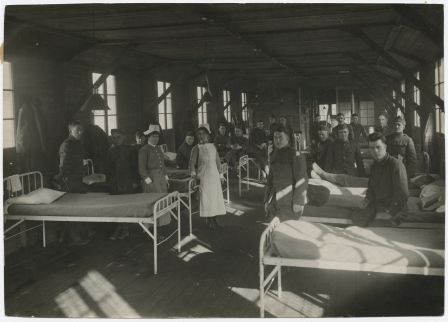
During WWI, in hospitals such as this one in Tours, France, Red Cross Volunteers worked as nurses, nurses aids, and “searchers,” who tried to find information for families whose sons were wounded or had died. Photo courtesy of Minnesota Historical Society.

And in each bed was a story not a detail of which was unknown to the great-hearted gentle woman. Here was a man, she told me, the front of whose head had been smashed in by a shrapnel ball which had coursed down and come out at the back of the neck. “Two weeks ago,” she said,  “I could put two fingers up to my hand in this man’s brain. Yet we have fixed him up and he will recover,” and with an adorable movement she stooped quickly and patted the great, gaunt hand that lay upon the coverlet. And so we went from bed to bed. When she at last left me I asked the attending surgeon of her. “Ah, yes,” he said, “she is here always, and when there is a rush, I have known her to spend fifty hours here without sleep and with little food. Who is she ? Countess. There are many, many like her here.”

Again comes to mind a picture at Rawa Ruska. The street from the station is lined on both sides with hospitals. As I was returning to the hotel last night I paused beside an open window. Inside the room was an operating table, on which, beneath the dull rays of an oil lamp, was stretched the great body of one of Russia’s peasant soldiers. This point is near the battle line now, and many of the wounded come almost directly here from the trenches. The huge creature that now lay on the table was without coat, the sleeve of the left arm was rolled to the shoulder, and over him hovered two girls as beautiful as a man could wish to see. The one sitting on a high stool, held in her aproned lap the great, raw stump of bloody flesh that had been a hand, and even in the dull light one could see the smears of red upon her apron. As she tenderly held the hand, she spoke in a low and gentle voice to the soldier, whose compressed lips showed the pain his wound was costing, although no groan or murmur escaped him. The other girl, kneeling by his side, was sponging the hideous member with the gentleness of a mother handling a baby.

Chapter VIII, “The Women in the War,” Vladimir Valensky, Russia, October, 21, 1914, Field Notes from the Russian Front, by Stanley Washburn, New York: Charles Scribner’s Sons.

Mora fire invites reflection

Once a week Angela Carlson heads to the American Red Cross Central Minnesota Chapter where she supports local disaster action team volunteers. On Thursday, December 8, Carlson received a phone call from a volunteer who said someone might have died that day from fire in the chapter’s local response area.

A Red Cross volunteer told me that her pastor had called and reported a death in an apartment building fire in Mora. The first thing I did was contact the Sheriff’s office to verify that the Red Cross had been asked to respond. When I had confirmed that they wanted us there, I called the volunteer back to dispatch her and a second volunteer responder to the scene. After starting incident paperwork, I called Judy and Dick Pike, long-time Red Cross disaster relief workers. I told Judy that I wasn’t sure why I was calling, and that I just needed some support to process the dispatch. I reviewed my next steps with Judy who was very helpful.

"I have empathy for the individuals involved and understand that it’s difficult to be in any position during a disaster," says Angela Carlson, the client services caseworker who handled the Red Cross disaster dispatch for the tragic fire in Mora, Minnesota. Photo credit: Lynette Nyman/American Red Cross

The Mora fire was the first dispatch involving multiple chapters and multiple deaths that I have been involved in since I started with the Red Cross in October. While I was at the local chapter I felt much support from staff both in St. Cloud and in Minneapolis. Being in St Cloud rather than Minneapolis that day made a huge difference in the disaster response dispatch, giving it a local and community-based feel. People there checked in with me and made sure I was doing all right. In the end, a couple people said that they really looked forward to meeting me at the next Disaster Action Team meeting. I felt the same.

I was exhausted at the end of the day. The Mora fire response left me feeling reflective of the mission and vision of the Red Cross and of the services we provide. While I can’t fully appreciate the devastation families feel after a disaster because I don’t respond on-scene, I have empathy for the individuals involved and understand that it’s difficult to be in any position during a disaster. It’s meaningful to know that our clients are being served with such compassion.

This is a response that I will carry with me, especially after learning details about the people who died. There was a phone call that I took from a volunteer who was helping family members who did not yet know that a loved one had died. There was also a surviving teenager. That has been the hardest for me to process. I’ve been thinking about her a lot and when I do my heart just breaks. But each time that happens my heart mends itself stronger and that, in turn, helps me support our Red Cross volunteers more effectively so that they can continue serving our communities in great ways.

Angela Carlson, is a client services coordinator for the American Red Cross Northern Minnesota Region. She is based in Minneapolis at the Twin Cities Area Chapter.

Stuffing Comfort

Wells Fargo employees, including Emily Wilke (center), stuffing Red Cross comfort kits. Photo credit: Carrie Monroe O'Keefe/American Red Cross

Little things do matter. Take a Red Cross comfort kit. It consists of shampoo, toothbrush, washcloth, and other toiletry essentials. These are small things that add up to big comfort after disaster.

Recently, Minneapolis-based Wells Fargo employees helped make more than 300 comfort kits that Red Cross volunteers will give to families affected by home fires, flooding, and other disasters.

Helping out like this is a darn cool thing to do for your community. Thank you, Wells Fargo, for stuffing a bit of comfort for when people need it the most.

Others can help too by shopping the 2011 Red Cross Holiday Giving Catalog.

Generosity Abounds in Minnesota

Red Cross responder Carrie Carlson-Guest helped promote Give to the Max Day at a giveMN.org event.

We’re not surprised by your generosity even though others around the country might be. Minnesotans have long been givers–of time, wisdom, and money. This was no exception during the 2011 Give to the Max Day.

The American Red Cross in Minnesota ranked 35 out of nearly 4000 and made the Top 100 leader board. YOU donated more than $35,000 to support our mission to provide humanitarian relief during disaster and to help people prevent, prepare for, and respond to emergencies.

And so we extend our appreciation most heartily during this season of giving thanks. We can also say without a doubt that the beneficiaries of your generosity are incredibly grateful as well.

If you missed Give to the Max Day, you can still share with others. Check out our 2011 Holiday Giving Catalog.

“Gray Lady” Uniform Preserves Red Cross History

"If you keep busy and volunteer, you stay alive a little longer," says Terry Dugger, 80, who served as a Red Cross volunteer from 1968 to 1970. Photo credit: Lynette Nyman/American Red Cross

Among the treasures Terry Dugger has kept through the decades is a uniform that she wore as a Red Cross volunteer at the military hospital on Offutt Air Force Base near Omaha, Nebraska.

“We saw the fellas coming in from motorcycle accidents. I went to different rooms and passed out shaving equipment, playing cards, and other things like that. There wasn’t anybody else on the base to do it,” she says.

Dugger’s Red Cross uniform is different from those the Gray Lady Service volunteers used during World Wars I and II. This has blue and white pin stripes. Worn for only two years and in excellent condition, the uniform is now a gift from Dugger as a means to share and preserve Red Cross history.

A "Gray Lady" volunteer uniform circa 1960s preserves Red Cross history. Photo credit: Lynette Nyman/American Red Cross

Dugger, who was an air force wife for twenty years, did volunteer work when her six children were in school, serving in the Red Cross from 1968-70. Now 80 years old, Dugger still shares valuable time doing a variety of volunteer activities.

“I couldn’t wait until I got old and now I’m too old, but rather than sit home I want to get out and help people.”

Being a volunteer has given—and continues to provide—Dugger with a greater sense of purpose. Currently, she’s a volunteer at the Armed Forces Service Center at the Minneapolis-St. Paul airport.

In the late 1960s, Terry Dugger served as a Red Cross volunteer at the military hospital on Offutt Air Force Base near Omaha, Nebraska. Photo credit: Lynette Nyman/American Red Cross

Born in Saint Paul, Minnesota, Dugger attended Saint Mark’s elementary school, located a couple blocks from her residence for thirty years. Growing up, both of her parents worked so she often tended to the “roomers” they had to help pay bills. Dugger says that the experience taught her to be independent, a characteristic she cherishes so much that she would never consider getting herself a boyfriend.

“Are you kidding!?! I had a good husband. I can do what I want. I can eat ice cream for breakfast. I’ve got a lot of things to do,” she says.

Dugger also has no use, she says, for a computer or a cell phone. Instead, she looks forward to getting letters from the postal service everyday.

She advises everyone, including her 40 or so grandchildren, great-grandchildren, and great-great-grandchildren, to stay busy throughout life.

“If you keep busy and volunteer, you stay alive a little longer.”

Story and photos by Lynette Nyman/American Red Cross, Northern Minnesota Region

Local volunteer earns top honors

Tom Meyer (center) received a 2011 Harriman Award at American Red Cross headquarters in Washington, D.C.

Please join us in congratulating Tom Meyer for being a 2011 recipient of the American Red Cross Harriman Award for Distinguished Volunteer Service. Meyer, the Volunteer Board Director with the North Central Blood Services Region and a board member of the Twin Cities Area Chapter, received the Harriman Award for Biomedical Partnership.

The Harriman Awards for Distinguished Volunteer Service are presented to American Red Cross volunteers in direct service, administration or management, with the exception of volunteers currently serving on the Board of Governors. The top honor that the American Red Cross issues, the Harriman Award recognizes extraordinary American Red Cross service that extends to people and places beyond the local community and is awarded on the basis of extraordinary accomplishments rather than length of service.

Congratulations Tom! Thank you for your outstanding service!


Tips for a safer Halloween

As ghosts and vampires get ready to roam the streets, we offer these tips to make this a frightfully safe Halloween:

We like these pumpkins. Have a safe and fun Halloween. (Image credit: Lynette Nyman)

Costume Safety

Whether a child wants to be a princess, a monster or a superhero for Halloween, parents can help keep it safe by:

  • Adding reflective tape to costumes and trick-or-treat bags.
  • Using flame-resistant costumes.
  • Using face makeup instead of masks, which can cover eyes and make it hard to see.

Navigating the Neighborhood

To maximize safety, plan a route ahead of time. Make sure adults know where children are going. If the children are young, a parent or responsible adult should accompany them as they walk through the neighborhood.

Here are more safety tips to follow as children go from house to house:

  • Make sure trick-or-treaters have a flashlight.
  • Visit only the homes that have a porch light on. Accept treats at the door—never go inside.
  • Walk only on the sidewalks, not in the street. If no sidewalk is available, walk at the edge of the roadway, facing traffic.
  • Look both ways before crossing the street, and cross only at the corner.
  • Don’t cut across yards or use alleys. Don’t cross between parked cars.
  • Be cautious around strange animals, especially dogs.

Trick or Treat!

For those who expect to greet trick-or-treaters at their door, they can make sure it’s fun for everyone by following a few tips:

  • Make sure the outdoor lights are on.
  • Sweep leaves from sidewalks and steps.
  • Clear the porch or front yard of any obstacles that a child could trip over.
  • Restrain pets.
  • Use a glow stick instead of a candle in jack-o-lanterns to avoid a fire hazard.