
 In 1910, when Marguerite Grams was born, the American Red Cross was still a fledgling organization of just 29 years. On November 2 Marguerite celebrated her 102nd birthday and friends from the Red Cross were there to join the party. Grams established the Virginia, Minn., office of the Northland Chapter in 1942 and served the organization for the next 35 years. More than 50 board members from the Northern Minnesota Region of the American Red Cross recently signed a t-shirt with best wishes for Grams. Northland Chapter board member Christina Hujanen and chapter Executive Director Judy Hanne Gonzalez presented her with the shirt, a card and a birthday cake during a meeting of the Soroptomists International Club of Virginia, Minn.
Tag: American Red Cross
And The Heroes Are Off
We have in our Red Cross region fabulous people who leave behind their lives and loved ones for days and days to help others in great need. Right now, twenty-five disaster relief workers from our Northern Minnesota region are responding to Superstorm Sandy. Twenty-two of those are volunteers. We’re incredibly grateful to have outstanding responders. We know that they’re doing great work. And, the heroes are off…
 Sheldon Bruce, who will be gone for three weeks, says goodbye to his wife.
 Lori Olsson brings snacks and cereal for the long drive ahead on a
Red Cross emergency response truck.
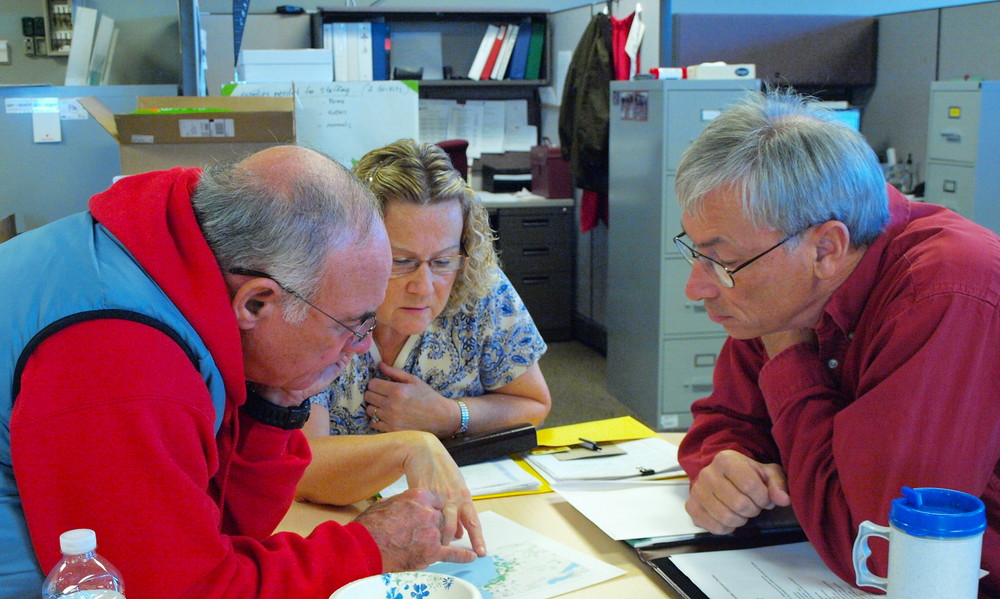 Steve Baltes (r) helps Jeff Skoog (l) and Diane Hofacker (c) map their deployment destinations where they will provide Mass Care and Sheltering assistance.
 Open shelters according to the Red Cross Hurricane App.
 Disaster Mental Health volunteer Larry Larson (r) gets important deployment information from Emergency Staffing Manager Theresa Moerbitz.
 Sheldon Bruce is ready to roll.
 Lori Olsson waves goodbye.
To support American Red Cross disaster relief visit redcross.org, call 1-800-RED CROSS (1-800-733-2767) or text the word REDCROSS to 90999 to make a $10 donation. Your gift enables the Red Cross to provide shelter, food, emotional support and other assistance to those affected. (Story by Lynette Nyman and Megan Barnes; photos by Megan Barnes/American Red Cross)
Gophers Bleed Maroon & Gold for the Red Cross

The Golden Gophers turned out in spades for the Ninth Annual American Red Cross Homecoming Blood Drive at the University of Minnesota. Everyone—students, professors, and alumni came together to save lives.
For Chuck Seymour, a senior and Homecoming King Candidate, it was his first time donating blood (GO CHUCK!). With a lot of reluctance and slight fear of donating and needles, Chuck met Geoff Kaufmann, CEO of the American Red Cross North Central Blood Services Region, who led him through the entire donation process (GO GEOFF!).
Geoff explained that one whole blood donation typically can help save three lives. And with an average of 22-25 blood drives in Minnesota each day, this generates vital help to those who need the gift of life. “It’s so great that this generation is willing to donate,” said Geoff. “The older generation felt a dedication to supplying blood and a lot of these people aren’t able to anymore due to chronic diseases. So, it’s a great thing to see this generation step up and donate their time and blood. The University of Minnesota is a huge support to the American Red Cross and it’s always good to be here.”
To help ease fears, friendly student volunteers (GO GOPHERS!) wearing maroon & gold Legendary U Homecoming t-shirts created an inviting room filled with snacks and festive music for the donors. Gopher student volunteers helped care for people post donation by monitoring how they felt and offering juice, water and snacks. Their volunteer support showed that this generation of students is indeed Legendary.

Kirby Schmidt, another senior and Homecoming King Candidate, was proud to show his Gopher Pride by donating his 9th time (GO KIRBY!). He wants future University donors to know that it’s easy and anyone can do it. “I recommend eating a big bowl of Raisin Bran and drinking 3-4 glasses of water when starting your day of the donation.”
In all, approximately 125 volunteers and 220 potential donors participated, making this drive a major contributor and partner to this cause. This was done by including pre-registration for those on a tight schedule or quick registration for those who just happened to walk by and felt compelled to donate.
Click here to find a blood drive in your area.
M! I! N! N! E! S! O! T! A! MINNESOTA! MINNESOTA! YAAAAAY GOPHERS!
Story and photos by Megan Barnes/American Red Cross
Right now we’re helping someone after a fire

Right now the American Red Cross is helping someone recovering from a fire. Across our Northern Minnesota Region, we respond more than 400 fires each year. (And more than 63,000 across the nation annually.) That does not account for home fires that not requiring Red Cross assistance. In September, we experienced one of the busiest fire response months that Red Cross disaster volunteers have seen in quite a while. There were 48 responses region-wide, including a 12-unit apartment fire in Brainerd where all 12 families needed assistance. To date, October has been no-less busy with 14 incidents. Combined, we’ve assisted 329 people with emergency relief after a fire.
So, we feel compelled to ask: are you prepared for a fire? Are you ready to not return for hours, days, or maybe never to the home you have now? Take a moment to answer those questions. Then what?
The Red Cross recommends two easy steps to help protect your home and loved ones from a fire: get a smoke alarm and create a fire escape plan.
- Smoke alarms save lives. Working smoke alarms cut the risk of dying in a home fire in half.*
- Place smoke alarms on every level of your home, including bedrooms.
- Test smoke alarms once a month and replace batteries at least once a year.
- Fires can spread quickly and every second counts. Having a plan in place can help you escape, but less than one-fourth of Americans have actually made a plan and practiced it.*
- Home fire plans should include at least two ways to escape from every room of your home.
- Select a meeting spot at a safe distance from your home where family members can meet after a fire.
- Discuss the plan with everyone in the household and practice it at least twice a year.
- For more information visit http://www.redcross.org/homefires.
- Download the American Red Cross First Aid App to get access to life-saving information on what to do for common, everyday first aid emergencies. The app is available in the Apple App Store and on Google Play for Android.
* Statistics provided by the National Fire Protection Association (NFPA).
Disaster Training Institute Makes Triumphant Return

The Minnesota North Star Disaster Training Institute made a triumphant return in early October when around 150 volunteers from 9 states turned out for a chance to build their American Red Cross disaster response skills. Both rookie and veteran disaster relief workers attended. This was no surprise for Megan Mrozek who serves as Emergency Services Director for the American Red Cross Northern Minnesota Region. “The disaster institute is a great way to train, network, and practice together.” Mrozek and five others were the key organizers of the training institute. Instructors included experienced disaster responders from across Minnesota and surrounding states.

Long-time responder and instructor Vonnie Thomas faced dozens in a Psychological First Aid course. “Your impact is so important,” she told them. Several shared stories about their personal experiences working with families during disaster response. Sometimes the emotional trauma touches the responder. Vonnie reassured them saying, “It’s okay to cry with a client. I’ve said, I need a Kleenex, too.”
The Institute’s course roster was thorough, offering everything from conducting disaster assessment and learning how to drive a Red Cross mobile feeding truck to managing a shelter and collaborating for success when delivering Red Cross relief services. More than anything, said Mrozek, the training institute gave people a chance to sit next to others. “It helps when you recognize the faces of fellow relief workers when responding to disaster.”
 Grant-funded, the current hope is to hold the North Star Training Institute every two years. Click here to learn more about Red Cross opportunities and services. Click here to see more photos from the training.
Story and photos by Lynette Nyman/American Red Cross
Back Blows and Abominal Thrusts Save Lives

Have you choked on food? Ever needed a back blow to dislodge it? Well, we’re happy to report that if the folks around you when or if it happens are trained like those at Dakota Communities, then you’re likely to get help that could save your life.
Recently, we recognized eight Dakota Communities employees who quickly and adeptly used their Red Cross training to help people at their residences for adults with developmental disabilities who were choking, mostly on food objects. From sausage or cheese to a carrot or granola, the trained employees used back blows and in some cases abdominal thrusts to expel food matter from people who were choking. Such life-threatening emergencies can happen anywhere, anytime. Go here to find a Red Cross class in your area and to learn life-saving skills.
And thank you Dakota Communities!
“Welcome to the Red Cross, Mr. Klingel”
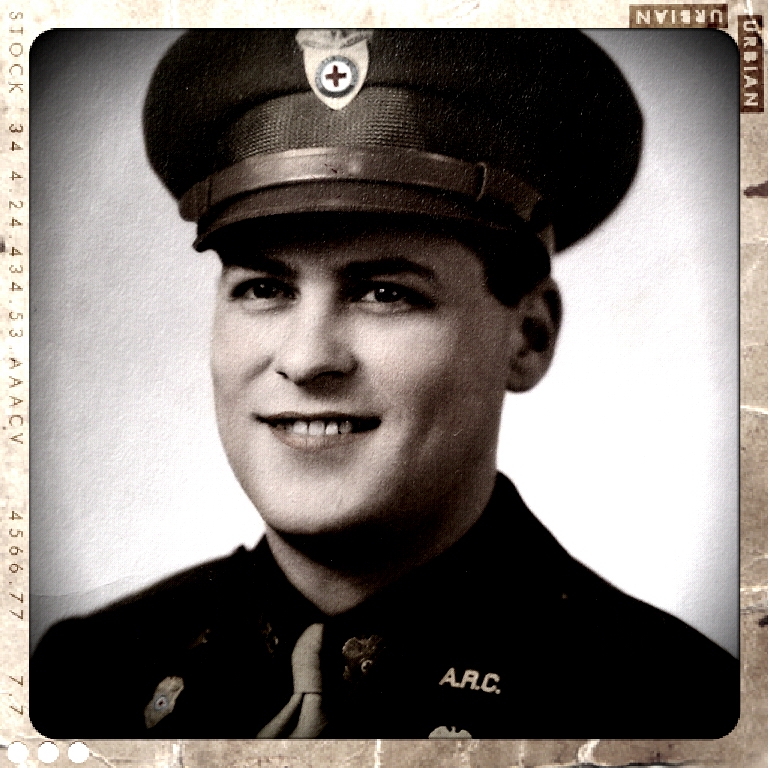 During World War II, Jim Klingel from West St. Paul, Minnesota, wanted to wear a uniform and serve his country. A perforated eardrum made him ineligible for the armed forces. His wife Henny was a Red Cross volunteer who learned about paid jobs working with soldiers and their families. Accepting a Red Cross job like this would mean leaving behind his family for a while and living “for the duration” nearly anywhere in the United States and perhaps overseas. After applications, physical exams, and interviews, the Red Cross offered Jim an Assistant Field Director position, which he accepted. Below we share excerpts from Jim’s correspondence to his wife Henny and their friends. The letters help tell the story of how Jim became a Red Cross Man in uniform when he was needed most.
West St. Paul, Minnesota, July 5, 1943
THE KRONICAL, CHEROKEE AVENUE CHATTER
A week ago today, Henny and I boarded a train for St. Louis, and last Friday morning we returned. It was a rather sudden trip, and resulted from negotiations commenced last January. The result was that, after a couple of interviews, etc., a chap shook hands with me and said “Welcome to the Red Cross, Mr. Klingel”. I’m to report to Washington D.C. August 9th to start my training and schooling, then to some Camp under supervision of several superiors for further training. After three months, I should be a “graduate” Assistant Field Director, and will then be assigned to some Army Camp.
 The work itself, with the Red Cross, sounds very interesting. The Field Director’s job, as I presume many of you know, is to alleviate any troubled circumstances between someone in the service and his home as I understand it. When finally assigned, I will be stationed on an Army Post, and wear a regulation uniform. One thing that I understand will be appreciated is that I don’t have to find my own living quarters in Washington while attending school there. I understand that the Red Cross has sufficient living quarters for their classes there and that as one class completes its course and moves out, the next one moves in. I believe I’ll be in Washington only 15 days or so, but that should be long enough to take in some of the sights. After the three months are up, if possible, Henny and I hope to make some kind of arrangements so that we can live together near whatever Camp I’m at. There’s no way of being sure now, but my hunch is that I will be stationed in Texas someplace. That will be sometime in November.
All of this means that we are about to join the many others who are jumping around from place to place, with ever-changing addresses, living from suit-case, duffle-bag or what-have-you. It also means that, except for perhaps one more issue, the publication of the Kronical will become more irregular and infrequent than ever until the early part of November at least.
From, THE EDITOR
Washington D.C., August 12, 1943
Dearest Honey pie —
I’m down in the lounge after supper as janitor, caretaker, officer of the day or what have you. Primary duty is to take care of Spec. Delivery letters, telegrams, or telephone calls. (I’m hearing a radio program too that is talking about white gabardine pants.)
Seems to me I started to tell you about “My Day” a while back. I started to tell you about our classes, then thought instead I’d briefly outline all classes we have had so far. I think you’re familiar with nearly all of the stuff we have had thus far, but maybe not as thoroughly. First class was history from Henry Dunant’s the Battle of Solferino to 1929 and the Geneva Conference on Prisoners of War. One of our speakers was Vice Chairman of Domestic Service. The 7 primary Domestic Services are:
Disaster Relief & Civ. War Aid
Serv. to Armed Forces
Nursing
Nutrition
First Aid
Blood Donors
Volunteer Spec. Serv. Corps.
(I’m trying to write this without resort to my notes, but I’ve had to peek a couple of times).
We had a long lecture on #2 – S.A.F. That’s the group I’m under – S.A.F. (Serv. Armed Forces). That’s quite a big service these days. We have also had some small talks on Field Director work. The fellow that gave the talk said there had been considerable confusion by many of the enlisted men insofar as Red Cross Men in uniform. He said that one fellow sat beside him on a train and finally asked him what the A.R.C. pin on his collar stood for. When he was told it meant Am. Red Cross he said “Oh, you’re one of those fellows that follows troops and gives them blood?” –
 All next week we spend on Job Instruction (and I’m not fooling, it sounds tough) and Military Post Information and how we should dress, act, etc. One of the fellows was enumerating some of the problems that come up, like a guy that walks in and says “I think my wife is running around with another guy, and what can I do?” or “I’m not married but I just learned that my girl is going to have a baby so can it be arranged that we get married?” I guess there’s practically every kind of situation you can imagine.
They related one story of one soldier in the hospital – a very simple case, — who wasn’t getting better at all and wasn’t eating. The medical officer finally asked that a Red Cross worker take the case – they gave it to a Hosp. worker who finally found out that he had a letter 3 weeks before from his wife who said that the baby was sick & he had not heard from her since. He was sure the baby had died and that his wife didn’t want to write him about it while he was in the Hosp. The R.C. worker checked thru the Home Chapter & found the baby well and that the wife’s mail hadn’t been forwarded to the hospital. The fellow was out of the Hosp. in less than 1 week. There are stories like that one after the other that bring a lump to your throat and tears to your eyes.
Gosh, I’ve been writing so long I’m getting writer’s cramp.
Washington , D.C., August 19, 1943, Wed. Nite — 1:30 A.M.
Dearest Sweetheart —
You can see by the time & hour that this is being written, that it is going to be short & – I hope – sweet. We came home from down-town about 11:30 and I have since packed my box to send home. That took me a long time & I found I forgot one sock. I tucked that in along the side – you will see it if it stays in.
Today I received the letter you mailed yesterday noon – which is why I like air mail. I also received your Sunday Nite letter, so I’m not expecting one tomorrow, but I’m happy anyway. …next week we will be 400 miles apart!! — My whole winter uniform is in the box I’m sending home. Save my ration book (I mean use it but don’t turn it in) as I’m still a civilian. A.R.C. staff men in Military & Naval Welfare wear Army Officers Uniforms for the respect they will then command from the men. I have found out that the major part of our job will be practically social case-work, primarily in psychology. Some job, and I’m not fooling!
All my love — & you’re Wonderfuller
Nite Rascalian –
Jim
I’m at the breakfast table with a few minutes before classes this morning (Thurs.). Yesterday I bought some sox, & two new shirts while I was down town – and also bought a pair of shower slippers – you know, those big soles with a strap over the top.
— Bustle Bustle Bustle —
 Now I’m in class awaiting “last bell” – Think I’ve about covered everything. The weather is wonderful. All the southern boys are shivering – & I guess you would be cold at night too. It’s swell with me. We should get our reservations this afternoon which will get us to Camp Grant by Sunday night. We report for duty (?) at 8:00 A.M. Monday morning.
Tonight, or rather this afternoon at 4:00 we have uniform inspection to be sure we are all dressing correctly, then I have to dash down-down for my pants & reservations. The gang is talking about a boat-ride on the Potomac for tonight. It sure seems funny to think that day after tomorrow we are all going to be split up. Four of us are going to Camp Grant which will keep us together for two weeks more. Chick is one of them. We are looking forward to a good time on the train. There’s the bell darling – Bye for now –
Much Love — Jim
American Red Cross, Camp & Hospital Service Council, Camp Grant, Illinois, August 26, 1943 quote – There’s no time like the present – unquote.
Dear Bee & Jad –
“There’s no time like the present” means in this case that it is 9:30 A.M. and I’m one of five “trainees” here at Am. Red Cross Hdqts. for practical training. One of the fellows permanently stationed here (there are 6) is in charge of our instruction, and as he is very busy at the moment, I have a little free time. The girl just handed me your card, forwarded from Am. Univ. – Wash. D.C….
Here’s the “teacher” again —
Back again in 10 minutes – that was short.
 My health is fine, and I’m holding out o.k. They sure gave us a heavy short course our 2 weeks in Washington. We are to spend 2 weeks here for what is called “continuation training”. Here we are actually in the Field Director’s office, on the Post, observing what actually goes on and “getting the hang” of the business. It is certainly fascinating work. The biggest job, or at least the most common case, is work on emergency furloughs. There are several of them every day. Last night we rushed a fellow to the train. His house is in N.Y. State and about 4:30 we had a wire from the Chapter in his home town that his mother was critically ill and was dying. This information is immediately turned over to the Military who decide whether a furlough should be granted. If a furlough is o.ked, and the soldier hasn’t enough money to get home & back we loan it to him, then help him to get home the quickest possible way. Some of the cases are pathetic. One chap left yesterday in a hurry. His wife had a baby @ 1:00 A.M. that died after three hours. He had to rush home to take care of the funeral etc. as his wife was alone and all broken up. Another’s father had been killed in an auto accident. Another was trying to get home somehow to marry the girl before the 9 months were gone. Some walk in and want to know what to do – They were married here last week and have a wife & family back home. One really runs the gamut of human relations here all right.
Where we go from here is still a mystery. It won’t be Florida though since we are in the mid-western area, and Fla. is in Eastern. It will probably be Texas, Okla., or some such southern state since there aren’t many Camps up north comparatively.
Here we go again with class. Please give my regards to Shirley & I hope she has a good time.
Love,
Jim
Camp Grant, Illinois, September 2, 1943
Darling honey-bun:
By now, how is the sore-throat? Mine is all gone, and has been for a couple of days. Gosh, this ribbon is sure dark isn’t it. It is so darn dark I can hardly see it. I’m punching this machine about as hard as I can too. As yet we have had no word as to when we go where we go. I hope it comes by tomorrow, although we thought sure we would hear today. So it goes in this game I guess – it is as Paul says “You shouldn’t allow yourself to be surprised by anything in the Red Cross—they are apt to wire you Monday and say ‘You left Saturday for so-and-so Texas’”
 Everything goes well – tonight Chick, & I, being on O.D., and being too late getting done with things this afternoon, didn’t go into town for supper, but stayed out here at Camp and ate at the Officers Mess – the first time we tried it for an evening meal. We had soup (that always precedes lunch and supper to everyone even before you order) then roast prime ribs of beef with lyonnaise (fried to me) potatoes, salad, fresh asparagus, cake and iced tea. There was no choice of menu for supper, but there is at noon and at breakfast I guess.
Oh gosh, tomorrow is Friday, and we get three shots. One typhus, one typhoid, and one small pox. I’ll be glad when they are all over, but I guess it will take about three months or so, since there are three of each except small-pox, and they are spaced three weeks apart. We have only had one typhus so far. It will be just my luck to have the darned shots take good effect tomorrow, and then have to lug that heavy suitcase all around Saturday en route to I don’t know where yet.
Don’t you think my winter uniforms look swell? By the way, here is another little “house-wifey” job you can do if you want to. I need, or will need, some arm shields in the coat so I won’t ruin it the first month. If you can get some and put them in it would be fine. I sure think the little “JKs” are swell – and it was an easy matter to send my uniform to be washed yesterday with all the other guys, because I knew I would know mine right away.
Well Chick-a-dee, it is getting later, and I’m fast running out of chatter. Now that you have been down here there’s not so much to write about so far as my surroundings are concerned. I think about how you left here in such a hurry Tuesday afternoon, and sometimes I’m glad it was a hurry and sometimes I’m sorry. In a way it was fine to have you leave in a “whish” of laughs and excitement – but in another it was too darned fast – I hardly got a chance to say good-bye, much less tell you to give my love to everyone home, to say hello to John and Marian, etc. etc. etc. Nite for now darling –
All my love,
J.K.
Tomah, Wisconsin, September, 7 1943
Dearest Chickadee –
Well, I’m in Tomah finally. At the moment it is about 15 minutes to eight and I’m sitting in the Red Cross office. I don’t know whether I’m supposed to be here or not, cause I just walked in and no one is here after 5:00 o’clock in the evening. The Red Cross office is located in the Station Hospital at the moment. It is in the process of being moved to new quarters (probably by Thursday) in a chapel on the Post. The Camp is quite small, and I am the only Assistant – there is Sauerman, the head-man, one stenographer, and Chickadum.
 The job itself sounds awfully big now, darling. Mr. Sauerman has been handling it all alone, and the Post here has grown considerably, as well as the other three stations he handles, so it is more than one guy can do. That’s why it has been so hard for him to be here – etc. etc. I think what will happen, is that he will turn over the work here to me and he will travel to the other camps regularly. That means that probably before the month is out I will be handling this camp practically alone. Gosh, I sure feel like a Rookie – and know that I have an awful lot to learning to do for the next two weeks. For that reason, I’m not going to mind living here on the Post for a while at least.
By the way, my Field Jacket keeps me plenty warm, so there need be no worry on that score. I’m trying to rattle off so fast that I’m sure getting plenty of mistakes. I want to write to Tom & Nat, Milly, and Chick yet tonight though, if I can, and I know I can’t stay here hammering too long, cause it will keep the patients awake.
So, bye now, honey-darling. You’re awfully sweet – did you know that? Thank you, and give my thanks again to everyone else for the fine birthday. Let me know how Janie-Ann likes Humboldt. Good-luck to Mom and the Flower-show.
Love-&some
From
Chickadum…..
After completing his assistant field director probation, Jim Klingel was transferred to Romulus, Michigan, where his wife Henny joined him. He later was promoted to A.R.C. Field Director and assigned to posts in Kansas and Oklahoma. Jim served with the Red Cross until late 1945 when he resigned and returned to Minnesota where he could be close to his family and mother, who was ill. Recently, Jim’s children gave his Army Regulation uniform and the letters he wrote during his service to the Red Cross. Today, Service to the Armed Forces continues to be essential Red Cross work around the world.
Edited story and composed photos by Lynette Nyman/American Red Cross Northern Minnesota Region
We agree with Pawpaw: Storms Affect Families

Disaster responders from our Northern Minnesota Red Cross region are home from Hurricane Isaac. Everyone returned safe, exhausted, and rewarded with the gift of helping people during a time of need.
People like Edward “Pawpaw” Semmes, 62, and his granddaughter Corrie Lee, 5. Ed’s family received food and a clean-up kit from the Red Cross once it was safe to return to his neighborhood in Picayune, Mississippi. With his household contents piled high on the lawn, Semmes recalled that they had about five minutes to escape because the water came from “the north, the south, the east, and the west. It came from all four directions.” Inside the house, his son-in-law pulled up ruined flooring. Ed easily kicked in sodden sheetrock. “We understand what others went through because we went through it.” Only in recent days did he break down and cry. Before he was too stressed about taking care of his family, something he’s always done with great pride, but he was concerned for them, their lost belongings, and the uncertainty of where they’d live. Thankful for Red Cross assistance, Ed (or Pawpaw), said “storms affect families–that’s what it gets down to.”
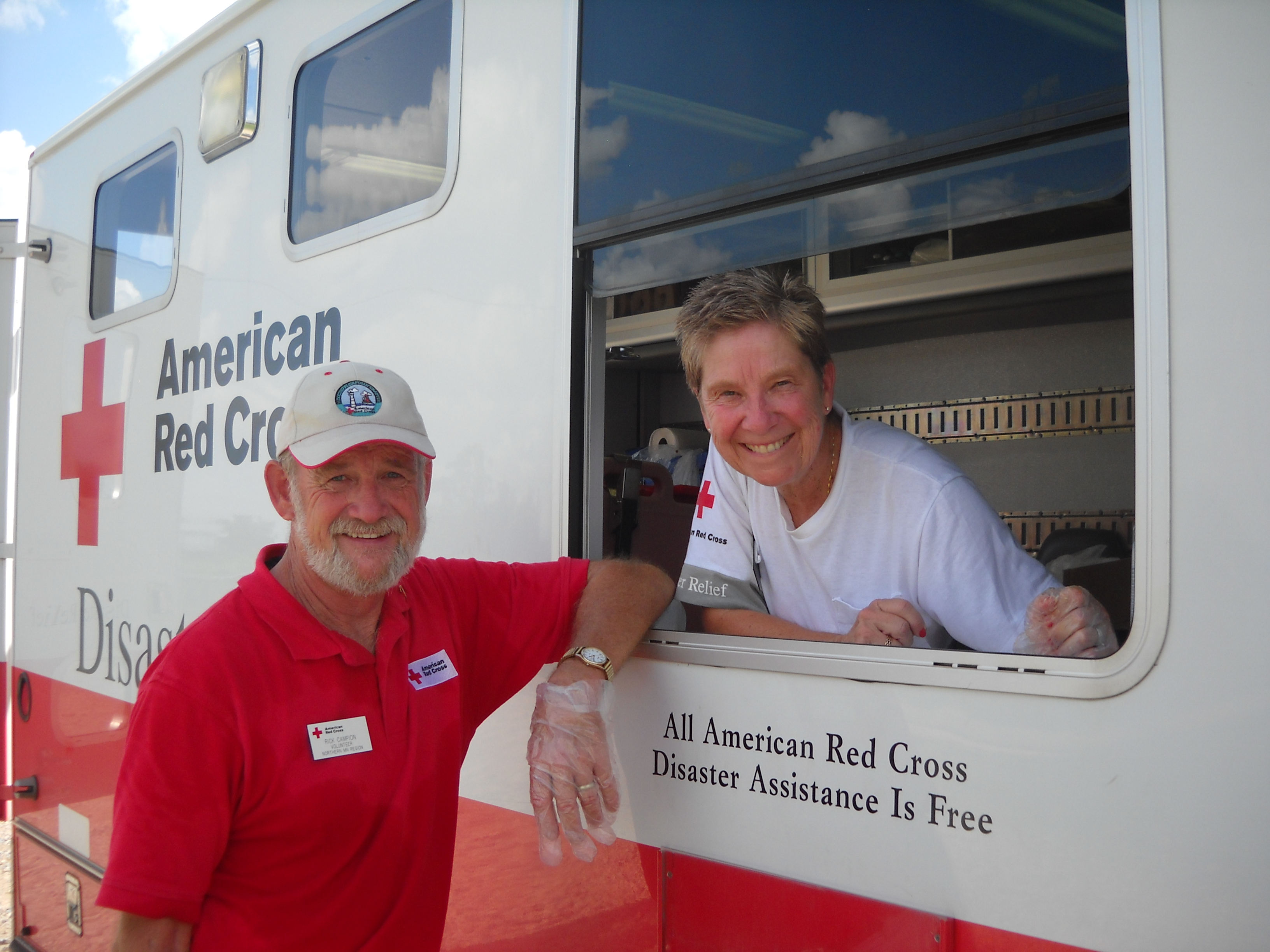
The Red Cross recognizes this truth. We are grateful to everyone within our Northern Minnesota Region who helped–and continue to help–families along the Gulf Coast. A special thanks to local volunteers who worked on this disaster relief response: Mark, Margaret, Marie, Catherine, Mark, Diane, Marty, Dave, Hildred, Judy, Dick, Amanda, Karen, Rick, Harriet, John, Gordie, David, Claudia, Greta, Steve, Richard, Kris, Susan, Debbie, Eric, Brent and Marian.
Click here and learn more about the Red Cross response to Isaac or about how to get involved with the Red Cross.
Story by Lynette Nyman/American Red Cross
Red Cross Volunteers Responding to Isaac

Six American Red Cross volunteers from the Northern Minnesota Region are heading to Florida where Tropical Storm Isaac is expected to make landfall in the next few days. Among those responding are Cathy Miller from Saint Cloud, Minnesota. Miller, a licensed psychologist, has served for four years as an American Red Cross disaster mental health volunteer. “I love the Red Cross,” says Miller, who is retired. “I like to feel like I’m contributing.”And she has. To date, Miller has deployed to numerous disaster, including the devastating tornado that hit Joplin, Missouri, last year. Nicole Anderson, whose job it is to get Red Cross volunteers ready for deployment with few hours notice, says Miller is a “rock star” volunteer because “when I need her she’s on it.” In addition to moving hundreds of trained disaster workers into Florida, the Red Cross has 22 emergency response vehicles already in the state with an additional 78 on stand-by; five truckloads of disaster supplies in route; and more relief supplies ready to ship from warehouses in nearby states. To learn more about the American Red Cross, click here.
Red Cross Pugsley?
 The other day while riding along the Minneapolis Grand Rounds bike path, we stumbled across Blaine Mogren. He loves bikes. He looooooooves bikes. Among the bikes in his collection is this fine (pictured left) Surly Pugsley. He has six of them. This particular one he calls Fire Engine Pugsley. We can see why. For starters, its BRIGHT RED. It also has loud horns, flashing lights, and a fire-fighter rubber duck. And crosses, white ones (like on the Swiss flag). After a minute of chit-chat with Blaine this thought emerges: let’s make a Red Cross Pugsley!
 After all, the Pugsley is (via Wikipedia) revolutionary: In 2005, Surly began selling the Pugsley, the first mass-produced mountain bike with extremely large volume tires, up to 4 inches wide, for deep snow and sand riding. The front and rear wheels share a common hub size and can be interchanged, allowing for additional gearing combinations. Noted bicycle technical authority Sheldon Brown said, “Pugsley is, in its way, as revolutionary as the original mountain bikes were in the early 1980s.” Bicycling Magazine wrote, “It’s not ideal for everyday use, but it can handle a wide variety of demands and conditions well.” Let’s repeat that last bit: a “wide variety of demands and conditions.” Sooooooooo, that could include disaster response in your hometown (or ours where it snows for months except last winter).
Tell us, what do you think? What would your Red Cross Pugsley look like? Would it be red with white? Or white with red? Would you have side bags for water and snacks that you would distribute to people affected by disasters or those responding to them? …..
Story and photos by Lynette Nyman/American Red Cross
 American Red Cross Minnesota and Dakotas Region