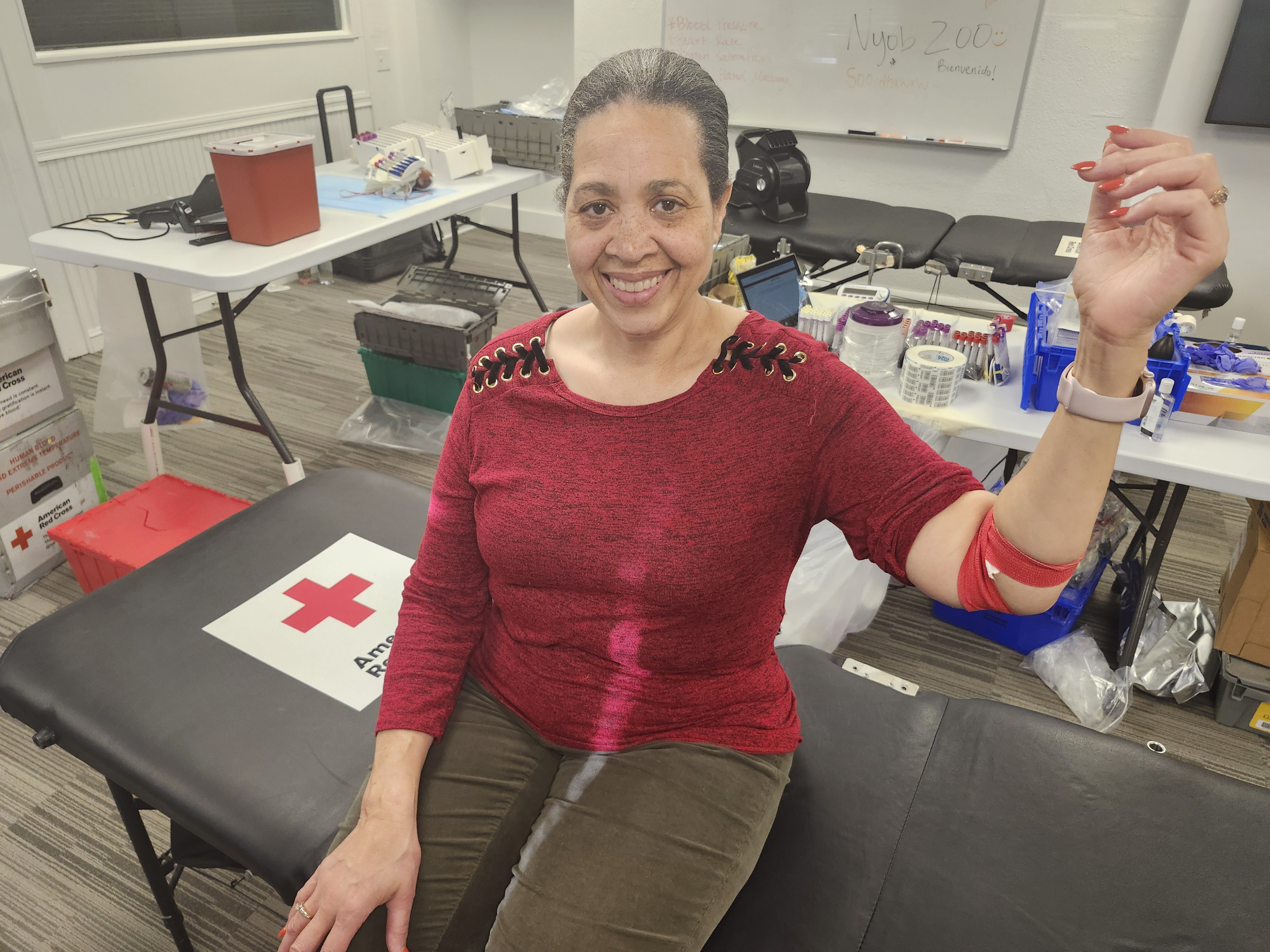
Waterville, Minnesota, a community impacted by recent flooding and still recovering, came together to donate blood on Monday. “We have a lot of helpful people in our small community,” said Barb, a former Red Cross volunteer and blood donor who helped organize blood drives for nearly 24 years.
Barb, former Red Cross volunteer, Waterville, MN, Aug. 12, 2024.
The blood drive filled up quickly and they had to add appointments to accommodate those who wanted to roll up a sleeve. In fact, the community surpassed the blood drive goal – reaching 110% of expected donations.
The drive was sponsored by the high school student Family, Career and Community Leaders of America (FCCLA) group in the Watertown, Elysian and Morristown school district. The group tries to host five blood drives a year, and this was the first drive in Waterville since the flooding in June. The next drive is already scheduled for November.
“We try and make it fun!” exclaimed Tricia, the group’s advisor. Sometimes they have special T-shirts made, special treats for donors, or themes to make it more interesting. “We try to get 16 year-olds to become first-time donors.”
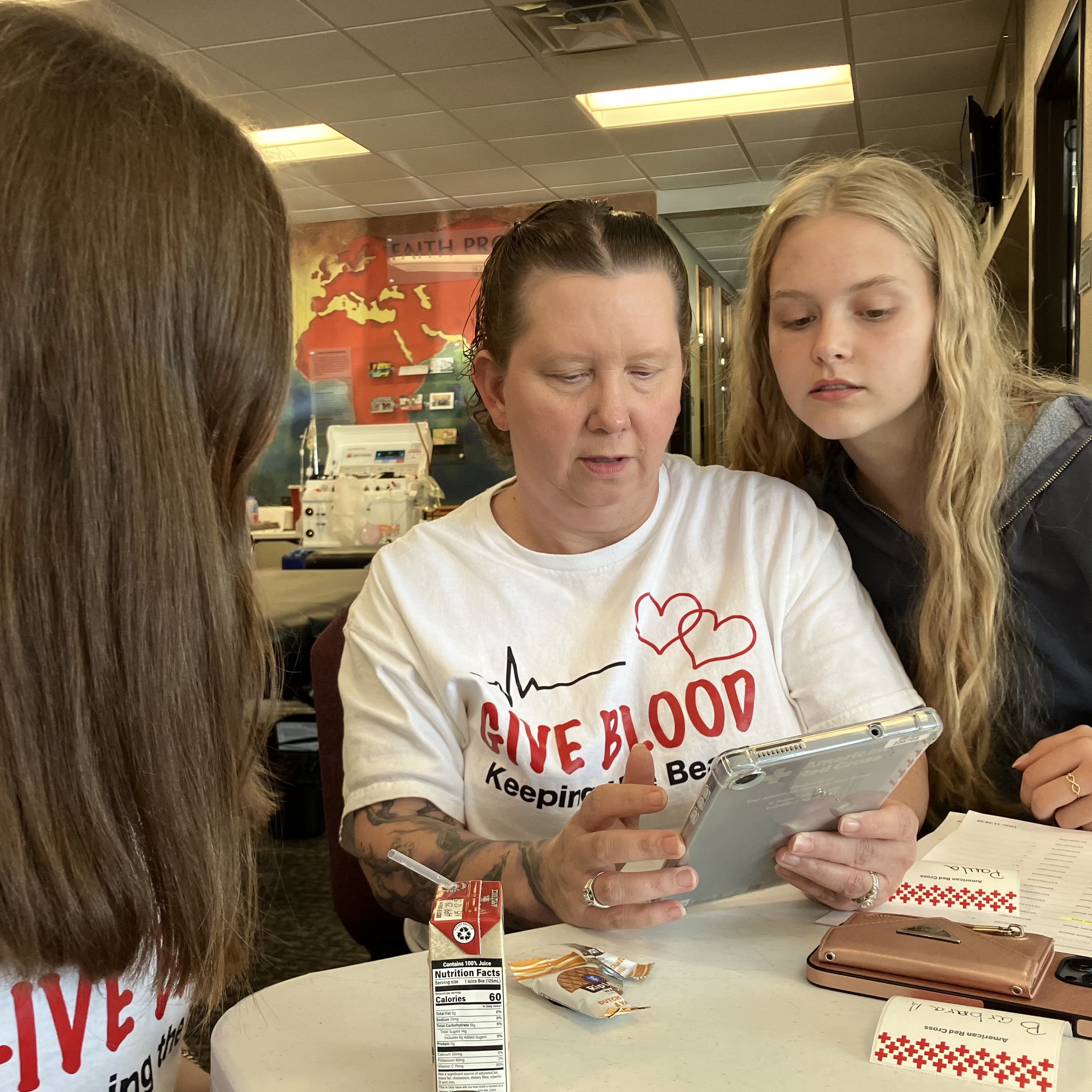
Red Cross volunteers Jocelyn, Tricia and Megan, Waterville, MN, Aug. 12, 2024.
Donors included Megan, a high school senior and Red Cross volunteer, who is already a Certified Nursing Assistant and plans to pursue a career in healthcare. “I started donating because it gave me another way to help people that really need it,” she says. “When someone is nervous about donating I just remind them of how they could be saving someone’s life.” Megan and Jocelyn, a student lead for the blood drive, helped check-in donors.
We’re amazed that people affected by their own disaster have stayed committed to helping others through blood donation this summer as we are facing an emergency shortage. Thank you, Waterville and surrounding areas for giving back in such a meaningful way!
Megan, blood door and Red Cross volunteer, Waterville, MN, Aug. 12, 2024
You can help, too. Click here to make an appointment to give and help patients counting on lifesaving blood products being available.
One year ago, the American Red Cross implemented updated Food and Drug Administration guidance that eliminated donor eligibility questions based on sexual orientation.
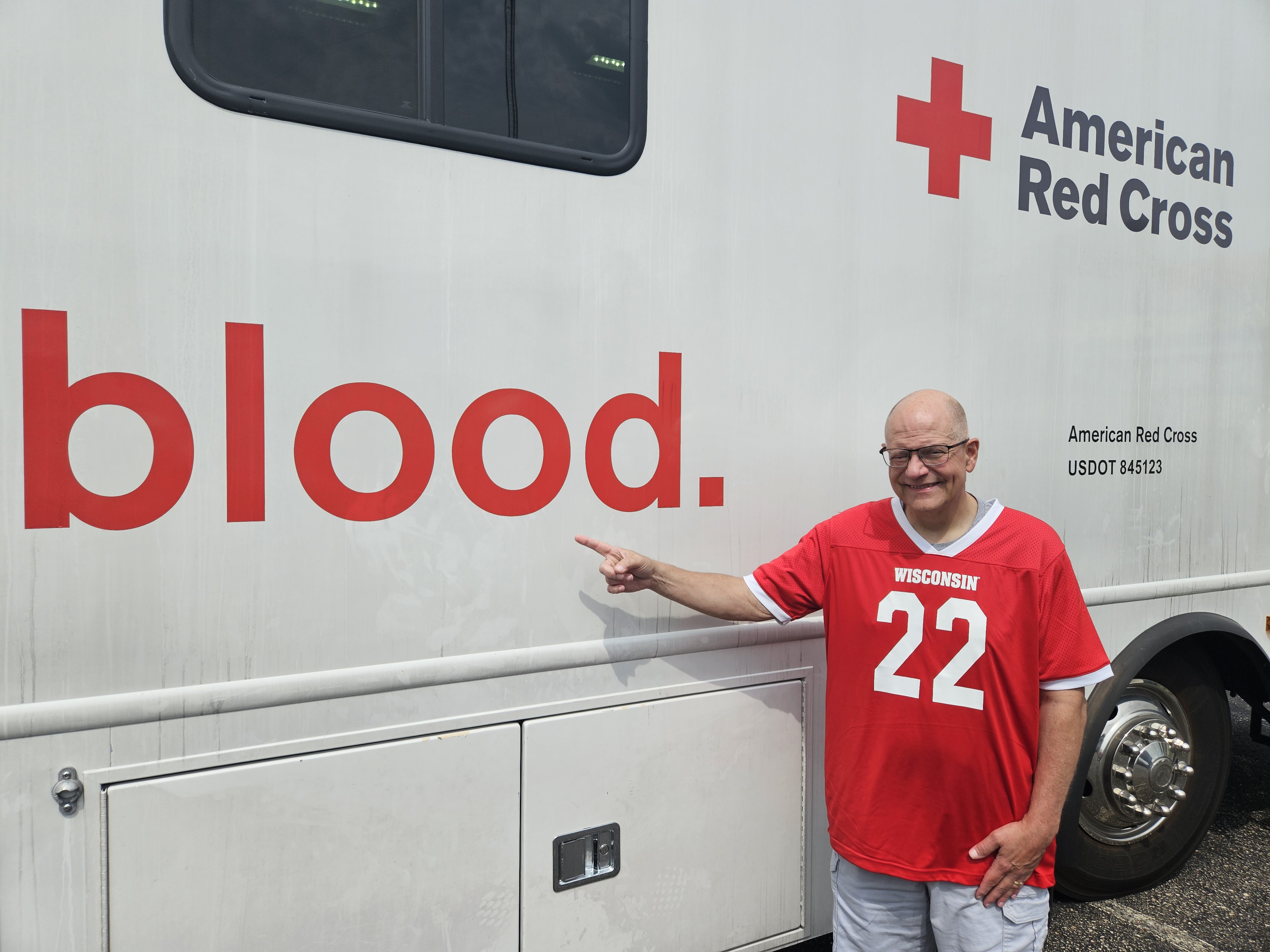
Meet Kaleb, an amazing Red Cross blood collection technician in the Minnesota and Dakotas Region. As a proud member of the LGBTQ+ community, he’s on a mission to spread the word about how blood donation rules have changed to be more inclusive while keeping the blood supply safe. His rally call to action is loud and clear – “Roll up a sleeve and let your pride shine through every drop, show your rainbow strength and help save lives by donating blood,” he says.
“Roll up a sleeve and let your pride shine through every drop, show your rainbow strength and help save lives by donating blood.”
First inspired by his grandmother, a Red Cross nurse in the early 2,000’s, Kaleb became a blood donor when he was 17 years old and now donates blood and platelets. “I’m passionate about helping others, and blood donation is one great way to do that – I’ve donated 15 units so far,” he says.
Kaleb has turned his passion for helping others into a dream job where he quite literally helps save lives every day. “I know the blood we’re collecting helps save lives or gives patients more time with their loved ones,” says Kaleb, whose best friend’s mother needed blood during her battle with cancer. “I also love interacting with donors, especially first-time donors, who I can walk through the blood donation process and make them less nervous.”
Kaleb outside a Red Cross bloodmobile advocating for blood donation. Photo submitted.
Thanks to updated FDA guidelines, more people are now eligible to donate blood through a new inclusive screening process that expands donor eligibility and eliminates questions based on sexual orientation. “I hope that I am able to build awareness of this change so more people in the LGBTQ+ community know that they might be eligible to donate and make a difference too.”
Since the Red Cross implemented this change on August 7, 2023, countless newly eligible individuals have rolled up their sleeves to give blood, host blood drives and volunteer in the blood services mission of the American Red Cross.
A very excited Kaleb finishes his blood donation. Photo submitted.
Check out stories, including Kaleb’s, of the newly eligible donors who are now giving blood and hosting blood drives with the Red Cross on the Red Cross LGBTQ+ Blood Donor page. Be sure to check out the Interactive Story Map.
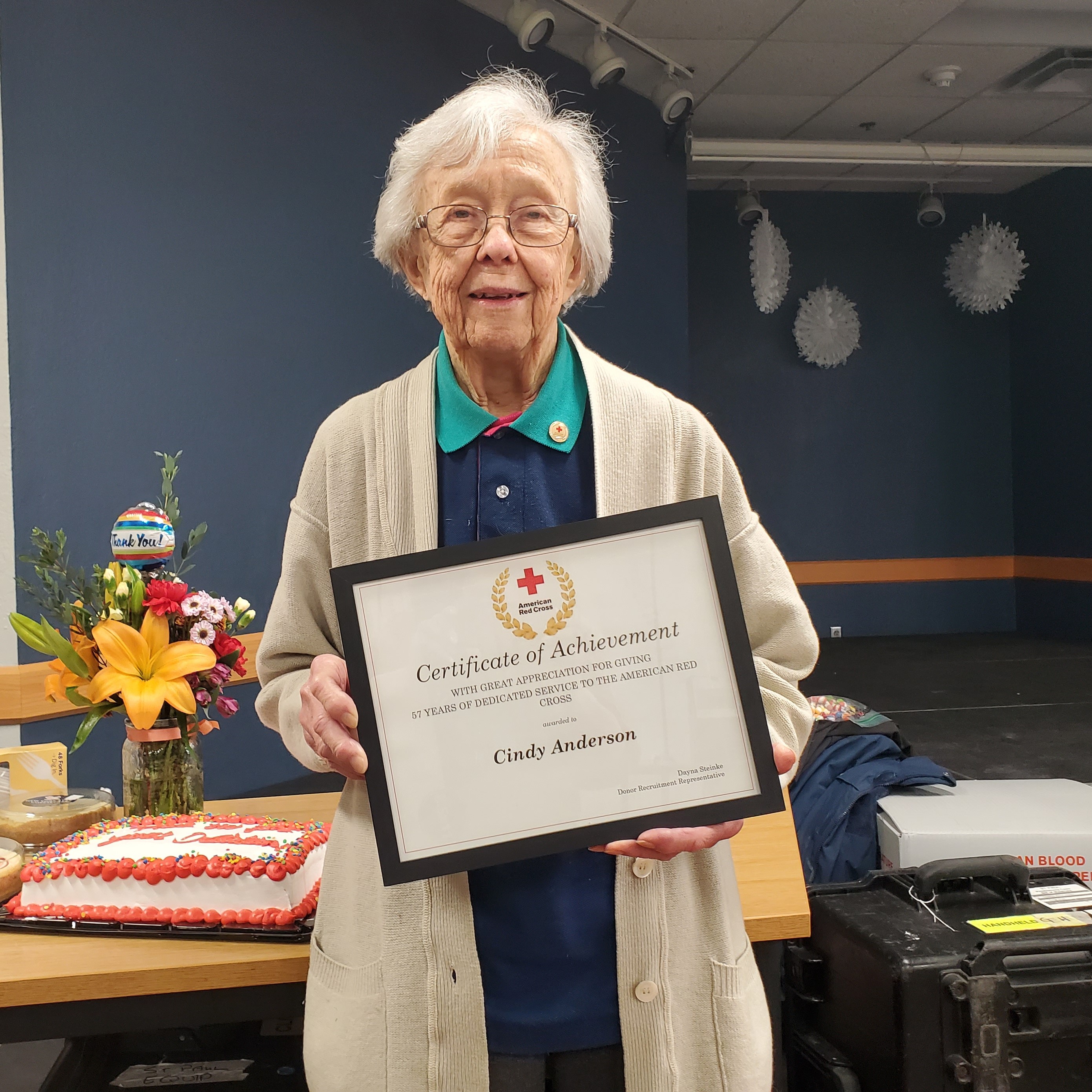
After nearly six decades of volunteering for the American Red Cross, Cindy Anderson from Northfield, Minnesota, is passing the baton. When asked why now, Cindy, 90, said, “It’s time for a change. My mind is good, but my body is feeling its age – that pretty much sums it up!”
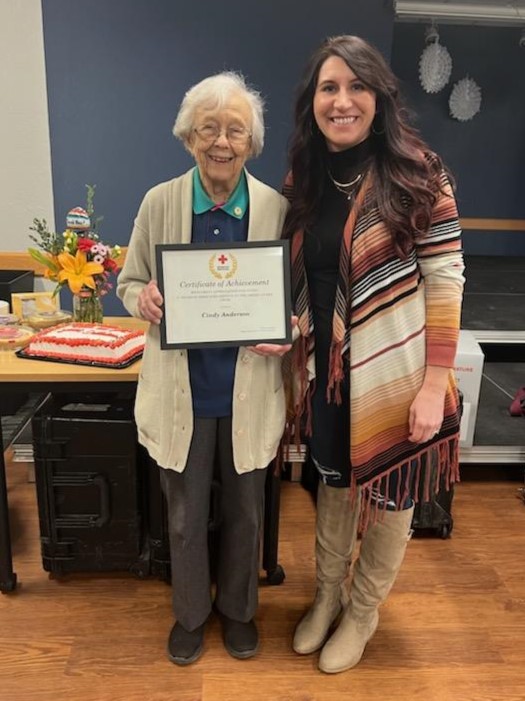
Cindy Anderson celebrates 57 years of volunteering with the Red Cross!
Not many people can say they’ve been with an organization for nearly 60 years, but Cindy can.
Recruited as a Red Cross volunteer in 1967 when she first moved to Northfield, she has since helped organize blood drives and recruit volunteers. With a background in pediatric nursing, she found a fit as a nurse volunteer at Red Cross blood drives, taking donors’ vital statistics like blood pressure and temperature. She continued to recruit other nurse volunteers until the Red Cross transitioned this role to a staff position.
Cindy’s role within the Red Cross evolved over the years, but one constant remained – the need for blood and volunteers. “Blood is always needed,” Cindy emphasizes. What began as two blood drives a year turned into 16 blood drives at multiple Northfield locations, including Culver’s, the Northfield Ballroom, various churches, and FiftyNorth Senior Center. “My husband has been encouraging me to step back for a couple of years,” Cindy shares with a giggle. “It’s finally time.”
The blood drives Cindy has helped organize have undoubtedly been responsible for thousands of blood donations helping countless patients in need of lifesaving blood products. One of her most memorable experiences was meeting a local blood donor whose wife and daughter both relied on monthly infusions that provided antibodies from the blood of healthy donors. “It’s so important. Someone right in our community relies heavily on blood donation every month,” she says.
When asked about the number of blood drives she’s helped organize and the number of volunteers she’s recruited, she chuckled and said, “I don’t want to take the time to figure that out!”
Cindy with fellow volunteers Sandy and Merilyn (Pictured left to right: Sandy Pieri, Cindy Anderson, and Merilyn Calcutt)
Merilyn Calcutt, who has served as a greeter for blood drives at FortyNorth and worked alongside Cindy for the past 12 years since her own retirement, is now taking over as the blood program leader for that location. “It literally took three people to replace Cindy,” she exclaimed.
Sandy Pieri, another Red Cross disaster and blood drive volunteer, seconds that. “Cindy will be missed – it took three of us to cover what she did.”
But Cindy humbly replies, “It really doesn’t seem like much.”
Cindy’s third replacement, Barb Garbowski, will take over the drives at Culver’s. “Culver’s is a great partner and helps maintain a strong donor base in Northfield because were able to hold blood drives there every month,” Cindy adds. “And the ‘pint for a pint’ coupon is such a sweet way to thank the blood donors.”
Cindy pictured with blood donor and long-time friend, Barbara Swartwoudt.
Barbara Swartwoudt, a blood donor, and long-time friend of Cindy’s, agrees. “We will miss Cindy at the blood drives – she was always pleasant and welcoming.”
Cindy and her husband recently sold their home and moved to an assisted living facility in Northfield. Cindy looks forward to doing crossword puzzles and reading more now that she’ll have some extra time on her hands. She also hopes to spend more time with her four children, four grandchildren, and five great-grandsons.
“I will miss the people,” says Cindy.
“We’re so grateful for Cindy’s 57 years of service with the Red Cross,” says Dayna Steinke, donor recruitment account manager, Red Cross Minnesota and Dakotas Region. “Cindy is an exceptionally generous person. Without dedicated volunteers like Cindy, we would not be able to fulfill our lifesaving mission.”
Cindy is thanked for her years of service by Dayna Steinke, donor recruitment account manager, at the blood drive held at FiftyNorth Senior Center on Feb. 21, 2024.
Join us in sending Cindy off with warm wishes and immense gratitude for her dedicated years of service!
Be like Cindy! You can support the lifesaving mission of the Red Cross by becoming a blood drive volunteer. Blood donor ambassadors help greet, check-in, and thank blood donors to ensure they have a positive donation experience. Visit RedCross.org/GiveTime to sign up today!
Make an appointment to give blood or platelets now by using the Red Cross Blood Donor App, visiting RedCrossBlood.org, or calling 1-800-RED CROSS (1-800-733-2767).
Story by Sue Thesenga, Communications Manager, Minnesota and Dakotas Region.
Before undergoing surgery for a routine ear procedure in November 2021, Matt Alford’s doctor wanted the 35-year-old father to have a pre-surgery physical. Concerns about anesthesia and a potential hereditary heart condition that his mother had led his doctor to take the extra precaution.
Despite being evaluated for a congenital heart defect as a child, and asymptomatic growing up, tests revealed Matt did indeed have a heart valve that needed to be repaired without delay.
“It was a big shock to us that he would need surgery to repair it,” says his wife, Katie Alford.
Matt, a farmer from south central Minnesota, hoped that he could get past the spring planting season and have surgery that summer. However, doctors were not comfortable delaying surgery due to the severity of his condition.
Matt, amidst severe fatigue, gave a reassuring thumbs up to Katie right before he received a blood transfusion. (Photo submitted)
On March 22, 2022, Matt, underwent bicuspid aortic valve replacement surgery. Following surgery, Matt’s condition deteriorated quickly due to excessive blood loss and doctors were concerned his vital organs were in jeopardy. He received two units of blood that evening and was closely monitored by doctors until his condition stabilized.
The following days Matt was terribly weak and tired. Four days post-op he needed an additional blood transfusion for symptomatic anemia to give him the strength his body needed to recover.
Katie an avid blood donor herself, recalls thinking “wow, I’m actually going to see how all of this works!”
Within a couple of hours Katie could visually see the difference. “I kid you not – he went for a walk for his therapy and the staff had to hold him back from walking further!”
A determined Matt walked out of the hospital following heart valve repair surgery on his own. (Photo submitted)
Matt was discharged from the hospital just five days after surgery and was able to walk out to the car on his own. “We were concerned about the kids bumping him too much and forgetting that daddy was still recovering,” says Katie. So, Matt spent the next three weeks rehabbing at Katie’s grandparent’s house who were away for the winter months in a warmer climate.
Matt is grateful to be alive and currently has no physical restrictions. “Without the generosity of blood donors, Matt might not be here to be a husband, and father to our three children,” says Katie. “We are so thankful for God’s provision throughout his whole journey and are forever indebted to the doctors, nurses, and blood donors who all have forever impacted our lives.”
Reunited with his family following heart surgery, Matt, along with wife Katie, enjoyed reading stories with their children Ben (5), Noah (2) and Allie (3 months). (Photo submitted)
“I’ve witnessed how blood has made a difference,” says Katie. “I started donating blood in high school because my grandfather needed it while being treated for leukemia. It gave us more time with him – and now, it helped save my husband’s life!”
The Alfords are both motivated to help pay it forward. “This is something near and dear to our hearts,” says Katie, who is organizing a blood drive in her community. Although blood donation wasn’t on Matt’s radar before his heart surgery, he has since become a donor and will be making his second blood donation at Katie’s blood drive.
“In my case having blood on the shelves was the difference between life and death.”
– Matt Alford, blood recipient
“In my case having blood on the shelves was the difference between life and death,” says Matt. “We’re all busy but taking a small amount of time to donate is an incredible way to really change someone’s life – like someone did for me.”
Every two seconds someone in the U.S. needs blood. The American Red Cross must collect enough blood and platelets every day to meet the needs of mothers experiencing complications following childbirth; premature babies; accident, trauma and burn victims; heart surgery and organ transplant patients; and those receiving treatment for leukemia, cancer or sickle cell diseases.
You can make a lifesaving difference by donating blood. Make an appointment to give blood or platelets now by using the Red Cross Blood Donor App, visiting RedCrossBlood.org or calling 1-800-RED CROSS (1-800-733-2767).
Story by Minnesota and Dakotas communications manager Sue Thesenga
As we step into a new year, many of us are looking for ways to make a positive impact in our lives and the lives of others. The American Red Cross offers a variety of quick and meaningful ways to make a difference. Here are five resolutions you can accomplish in one hour or less, not only benefiting those in need but also enhancing your own well-being.
Cassie and Ben, parents of 3-year-old Oliver who is battling kidney cancer, recently rolled up a sleeve at a blood drive held in their son’s honor. Oliver has needed multiple blood transfusions during his treatment so they are helping pay it forward. Every donation helps patients like Oliver.
Donate Blood One of the most significant contributions you can make is donating blood – and it’s simple. In just about one hour, you can make a real difference in the lives of patients requiring life-saving transfusions. It may be the only resolution that includescookies. Schedule on our free appand follow your blood donation’s journey every step of the way as it makes its way to a hospital to help patients in need.
Learn Hands-Only CPR Learning hands-only CPR is a quick, vital skill that could save a life. The Red Cross offers online resources and local classes that can teach you this life-saving technique in under 30 minutes. By knowing how to perform hands-only CPR, you can help keep a person alive until professional help arrives. Bonus: have fun practicing the rhythm by checking out these “Next Gen Life Beats” friends at the Australian Red Cross. And yes, it includes a Taylor Swift song.
Check Smoke Alarms and Practice an Escape Plan Ensuring your home is prepared for emergencies is crucial. Take a few minutes to test your smoke alarms and replace any batteries if needed. Then, spend some time with those you live with drafting and practicing a home escape plan. Knowing what to do in the event of a fire can significantly increase your chances of safely escaping. And you probably haven’t checked your smoke alarms since last time you burnt pizza. Check out how-to videos and other resources at SoundTheAlarm.org/MNDAKS.
Find your Fit, Take the Volunteer Quiz The American Red Cross depends on volunteers to carry out its humanitarian work. In less than an hour, you can explore various opportunities online and sign up for something that resonates with your skills and interests. Whether it’s assisting at a local blood drive, helping with disaster response, or supporting military families, your time and effort can make a huge impact. Punch in your zip, take a our quick quiz and we’ll match you up with cool opportunities near you.
Make a Gift in Someone’s Honor Making a charitable donation in honor of a loved one is a meaningful way to recognize special occasions. It’s a simple process that takes just a few minutes online. Your gift can support various Red Cross initiatives, from disaster relief to supporting military families, and it’s a beautiful way to spread kindness and compassion. Bonus, warm and fuzzy feelings for you and them. Visit RedCross.org/MNDAKS to make a gift.
As you consider your resolutions for the year, remember that even the smallest acts can have a significant impact. By dedicating an hour or less to any of these Red Cross activities, you’re not only helping others but also fostering your own health and happiness*.
Here’s to a year filled with kindness, compassion, and community support!
*From the Mayo Clinic Health System, “Kindness has been shown to. increase self-esteem, empathy and compassion, and improve mood. It can decrease blood pressure and cortisol, a hormone directly correlated with stress levels. People who give of themselves in a balanced way also tend to be healthier and live longer.”
On September 24, 2023, Travis Muller faced a life-altering event. It was fall harvest time and while working in a grain bin in Windom, Minnesota, his legs got trapped in the machinery. “I knew instantly my legs were in trouble,” Travis shared, recalling the harrowing moment.
The main arteries in his legs had been severed and blood began pouring from his injuries. His quick-thinking uncle, who was working alongside him, yelled to Travis’ brother outside the grain bin to shut it down. They leaped into action and made makeshift tourniquets from their belts to stop the bleeding – a crucial first step in saving his life.
Local first responders arrived almost immediately. Travis received two units of blood from an ambulance onsite. A helicopter, equipped with additional units of blood, arrived to airlift him to a regional trauma hospital. Midway to the hospital, the pilot landed for more units of blood because he calculated that they didn’t have enough for the entire flight to keep Travis alive. “I think I received at least seven pints of blood before I even arrived at the hospital,” says Travis.
Travis’ situation was grave and time was of the essence. “I was hemorrhaging so bad that the doctor figured at one point I was down to two units of blood left in my body,” recalls Travis. “They had to replace the majority of my blood volume.”
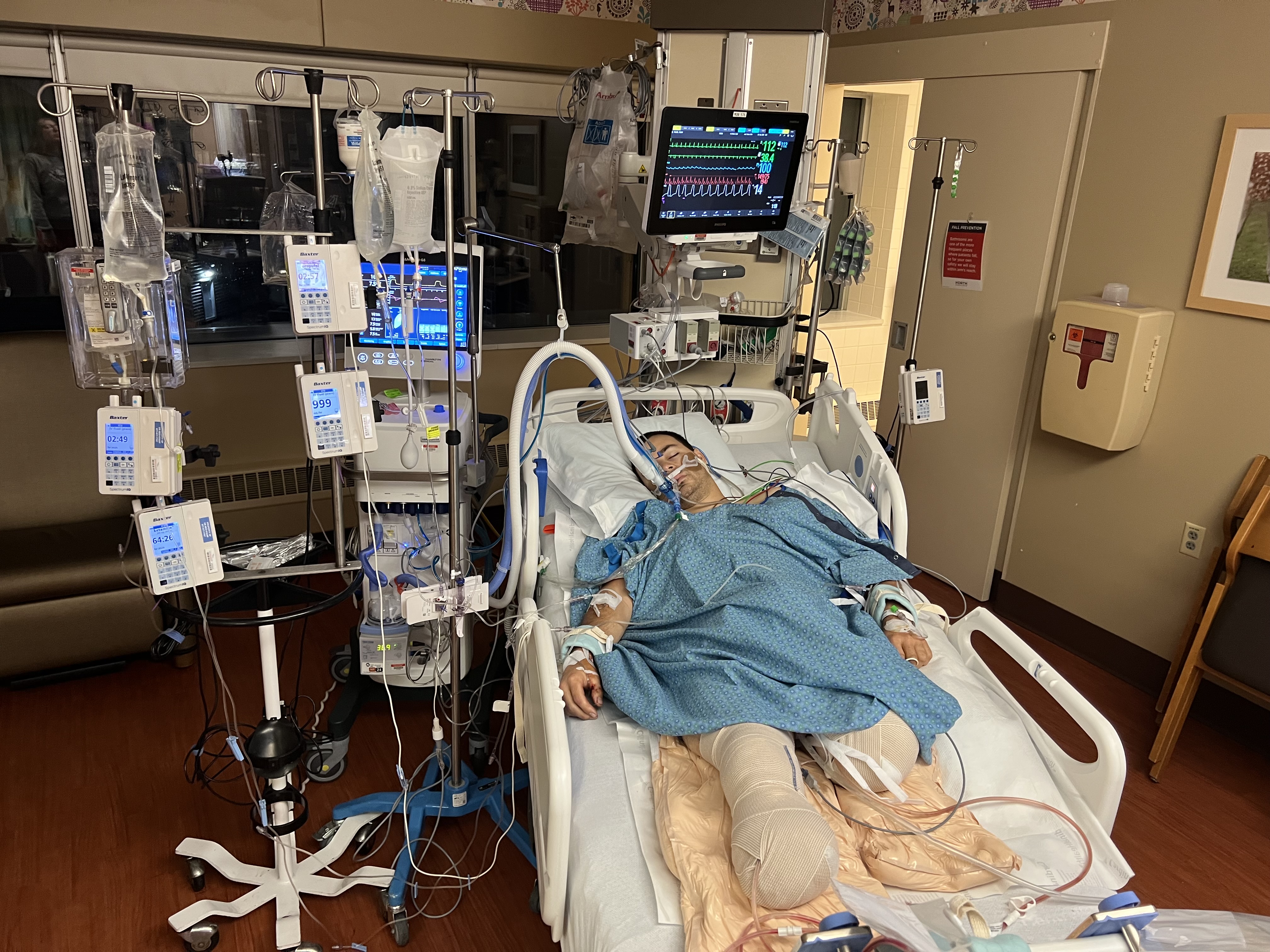
Travis Muller in the hospital following a tragic farm accident that lead to both of his legs being amputated (photo submitted).
Upon arrival at the hospital, Travis faced the unimaginable. Emergency surgery revealed the extent of his injuries to save his life: both legs had to be amputated. Six additional surgeries soon followed. “I believe I received blood in at least five of those surgeries,” he says.
As Travis reflects, he’s filled with gratitude for the first responders and the blood donors who never knew they’d be saving his life that day. His wife Jasmine, and their toddler daughter Shaylie, are thankful for every additional moment they now share with Travis. “As life changing as this injury is, and heartbreaking to lose his legs, the doctor said just a few more seconds without blood transfusions and he would no longer be with us,” says Jasmine.
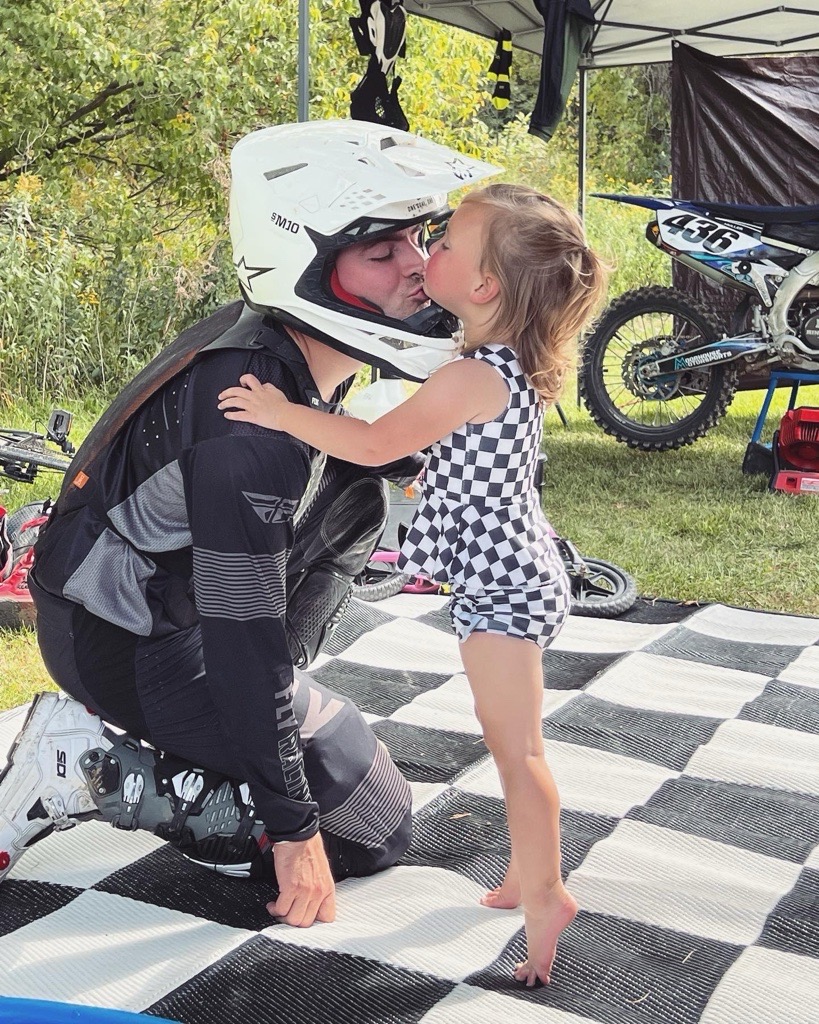
Travis, and daughter Shaylie, prior to the accident (photo submitted).
Travis agrees and adds, “What can you say except thank you to everyone – thank you for thinking of other people and taking time out of your day to make a difference.”
To raise awareness about the need for blood donations to help patients like Travis, his aunt, Monica Muller, a long-time Red Cross volunteer, organized a blood drive in his honor in his hometown of Windom, Minnesota.
“I’ve been a Red Cross volunteer for 15 years because I believe that when you donate you give the gift of life – and that’s what happened in Travis’ situation,” says Monica. “You just don’t realize the importance until it hits home. Whether it’s a serious illness or an accidental injury, people never know when they’ll be on the receiving end of a simple act of kindness.”
Monica adds, “this blood drive in honor of Travis is a call to action! It really makes a difference. Blood can’t be manufactured. There’s no other way than donating to ensure our hospitals have blood on the shelves.”
Holiday tree decorated with hand-made Red Cross blood bag ordaments to help promote the blood drive in January in honor of Travis (photo submitted.)
January is National Blood Donor Month, and the American Red Cross celebrates those who give blood to help save lives – especially now as we work to ensure a stable blood supply after a busy holiday season. The new year is a great time for people to donate for the first time or get back into giving, if it’s been awhile. Make a resolution to help save lives in 2024!
To schedule an appointment, download the Red Cross Blood Donor App, visit RedCrossBlood.org, or call 1-800-RED CROSS (1-800-733-2767).
Family rallies to support blood donation in honor of their son
The Wadd family – pictured left to right, Kloe, Trent, Kari and Mason (photo submitted)
Seventeen-year-old Mason Wadd is not your typical 11th grade high school student. Not only is he active in his school’s speech, theatre and drama clubs, a member of 4-H and Future Farmers of America, he’s also an entrepreneur who owns and co-operates a 5-acre sweetcorn business with his sister Kloe. A strapping young man with a bright future ahead, you would never know that Mason was born extremely premature at 26 weeks due to a rare blood antibody disorder and needed multiple blood transfusions to help save his life.
At just 18 weeks it was discovered that Mason had inherited an antigen (Kell) that caused antibodies to destroy his red blood cells – leading to severe fetal anemia. Even before he was born, Mason received his first blood transfusion through his umbilical cord. Two more transfusions followed and soon after, Mason was born at 26 weeks weighing just 2.8 pounds and 14” long.
Mason had a rough start. The preemie was in the NICU on a ventilator for the first 5 days of his life. During his 77-day stay in the NICU, Mason required surgery to have a blood clot removed from his brain and also received an additional 8 blood transfusions due to being anemic before he was strong enough to go home. Remarkably, the Wadd’s were able to take Mason home from the hospital just days before his original due date.
Mason and his sister Kloe pictured amongst their a-maize-ing sweetcorn crop (photo submitted)
“We credit blood with helping save our son’s life,” says his mother, Kari Wadd. “Without blood being available when Mason needed it, he may not have survived.”
In November 2022, Mason faced the possibility of needing more blood products during a mechanical heart valve replacement surgery. The hospital had to ensure they had blood available if a transfusion was required, but they were able to use Mason’s own recycled blood.
When Kari heard the Red Cross had a blood shortage this fall, she felt compelled to help by hosting a Red Cross blood drive in honor of Mason. “It’s the perfect time to do our part now that Mason is old enough to understand the importance that blood has played in his life,” Kari says. “This blood drive is a celebration of Mason’s one year post heart surgery and a way to help raise awareness of the need for blood donations.”
Why the Red Cross?
The Red Cross has always held a special place in Kari’s heart. In 1998, when her family’s farm was hit by a tornado that ravished the St. Peter, Minnesota community, the Red Cross was there to help. “The only thing that was left on our farm was the house and the Red Cross came and asked us what we needed,” Kari vividly recalls.
In college, Kari went on to help organize Red Cross blood drives and still helps at community blood drives. Even Mason’s sister Kloe, advocates for blood donations through her Miss Southern Minnesota platform and Community Service Initiatives while competing in the Miss Minnesota competition. “It’s so much part of our lives – she knows how important it is too,” says Kari.
The Wadd’s are grateful to blood donors and encourage others to give to help ensure a stable blood supply. “When it’s something so simple to do – it doesn’t cost you a thing, just time – we want to encourage others to donate so if their family was ever in need, they wouldn’t have to worry about blood being there.”
Mason is thankful for blood donors too. “I feel guilty even asking others to donate because I can’t myself, but it is so important,” he says.
“What’s next for me? I have my junior and senior years of high school ahead of me; without blood donations I wouldn’t be able to say that.”
Mason Wadd (photo submitted)
Blood drive in honor of Mason Wadd
Farmamerica Community Room 7367 360th Ave. Waseca, MN Friday, December 29, 2023 11 a.m. to 4 p.m.
Please call 1-800-RED CROSS (1-800-733-2767) or visit RedCrossBlood.org and enter: Farmamerica to schedule an appointment.
If you can’t join the blood drive in Mason’s honor and wish to help patients like him receive lifesaving transfusions, pleasebook a blood donation appointment by using the Red Cross Blood Donor App, visiting RedCrossBlood.org or calling 1-800-RED CROSS (1-800-733-2767).
“I’m so grateful for blood donors who gave the gift of life to Addi and Rachel who also needed blood following complications from the childbirth.”
Pastor Joseph Naumann recalls the evening of Saturday, June 5, 2021, when his wife’s water broke at 22 weeks pregnant while at church. Following a visit to the emergency room, Naumann’s wife Rachel was hospitalized in Minneapolis to help keep the baby in the womb as long as possible so it could develop as much as possible before birth. Nine days later, Adelaide (Addi) Hope Naumann came into this world weighing just 1 pound, 8 ounces.
“It was touch and go if Addi would survive,” said Naumann. “Lots of hope was needed – we baptized her right away.”
Newborn Addi weighing 1 pound 8 oz. (photo provided).
Addi was immediately intubated because her lungs were not strong enough to breathe on her own. Her left lungs began leaking air into her chest cavity, so a chest tube was inserted in her small chest to release air building up. “Her skin was thin and transparent,” Naumann says. Addi needed two blood transfusions to help her survive.
There were lots of difficulties that Addi encountered, and the new mom and dad weren’t able to hold their daughter for a week. For 164 days, the Naumann’s traveled back and forth to the hospital to be with Addi, while also caring for their older three children. On Thanksgiving Day, they finally took their sweet new baby Addi home.
The Naumann family (photo provided).
“I’m so grateful for blood donors who gave the gift of life to Addi and Rachel who also needed blood following complications from the childbirth,” Naumann said. “I think showing love and care to others is something all of us want to do. I encourage people to give – it could be your own family member in need. Giving the gift of life is the ultimate gift – a gift out the goodness of your heart – expecting nothing in return.”
Addi just turned two years old this summer and is talking and growing up just like other 2-year-olds. She loves to play with her sisters and brother and enjoys being outside in the sandbox or playing with her baby dolls. Naumann jokes, “I might be biased, but I think Addi may the cutest baby of all time!”
Two-year-old Addi loves to play outside (photo provided).
The Naumann’s have both donated blood in the past and plan on continuing to pay-it-forward. “It’s definitely something that is easy to be taken for granted as just being there when you need it, but I am so very thankful that there was blood available for both me and Adelaide when we needed it most,” said Rachel.
The American Red Cross is experiencing a national blood shortage. Fewer donors than needed gave blood this summer, drawing down the national blood supply and reducing distributions of some of the most needed blood types to hospitals. Donors of all blood types are urgently needed, and there’s an emergency need for type O blood donors, as well as platelet donors. More donors are needed now to ensure patients at hospitals across the country continue to receive critical medical care.
Help ensure lifesaving blood products are available for patients like Addi! Schedule a blood donation today. Visit redcross.org/mndaks to make an appointment or for more information.
Bradley Arnold is a sweet, fun-loving 10-year-old boy who loves fishing, farming and searching for treasures with a metal detector. But five years ago, unlike other kids his age, Bradley was diagnosed with kidney cancer.
Bradley Arnold, 10.
“It just appeared all of the sudden,” said Mandy Arnold, who noticed a bulge under her son’s shirt. She knew something wasn’t right, so she took Bradley to an emergency room. After four hours, they were sent home with a diagnosis of severe constipation.
But nothing changed overnight – the bulge was still there. That day, they were lucky enough to get an appointment with his pediatrician who ordered several tests.
Mandy recalls the look on the doctor’s face and knew right away something was wrong. “Our world turned upside down when I heard the doctor say she was confident it was kidney cancer.”
They went straight to a regional hospital, where they went through a in-depth series of questions and tests. That night, Bradley had an ultrasound, showing an 8-inch tumor, weighting more the three pounds. “It was the size of a cantaloupe – I couldn’t believe it got so big, so fast,” said Mandy. Bradley was scheduled for surgery the next morning to have his left kidney and a Wilms tumor removed.
Bradley recovering in the hospital following surgery. Submitted photo.
“I never thought I would have a child with cancer,” said Mandy. “It’s just not our nature to think of worst case scenarios.”
Thankfully, doctors were able to remove the entire tumor – it had not spread to other parts of Bradley’s body. Following surgery, Bradley required blood and platelet transfusions to help his body recover and heal.
Every Friday for the next 19 weeks, Bradley had chemotherapy treatments. “He never complained – he blew me away with how resilient he was,” Mandy said.
Witnessing her son’s bravery and cheerful outlook through his cancer journey, brought a new perspective to Mandy. “I’m a changed person – our family all went through this together – and we look at life differently now.”
“When your struck with a nightmare, the last thing you want to do is to worry about what you need,” said Mandy. “We’re so grateful the blood that Bradley needed was available when he needed it most.”
It wasn’t the first time the Arnold family was helped by the generosity of blood donors. Mandy needed transfusions after complications when her first and third children were born.
Mandy now serves as a Red Cross blood program volunteer leader with the Minnesota and Dakotas Red Cross Region. To celebrate Bradley’s five-year cancer free milestone and to raise awareness of the need for blood products to be readily available for cancer patients, the Arnold family hosted a blood drive on Monday, June 5, 2023. Family, friends and the community came together and rolled up a sleeve to honor Bradley. Forty nine blood donations were made in honor of this brave cancer warrior.
Bradley Arnold at the blood drive held in his honor, thanking donors for their “roll” in helping save lives with a Tootsei Roll goody bag!
You can help patients like Bradley! Schedule a blood donation today to help ensure lifesaving blood products are available whenever and wherever they are needed most. Visit redcross.org/mndaks to make an appointment or for more information.
I’ve been donating blood to the American Red Cross ever since I was 17 years old.
I’m not sure what attracted me initially to contributing to this non-profit that has been around since 1881. It may have been a desire to give something essential that wasn’t simply money.
I was just a high schooler after all, working at a Save-A-Lot supermarket in upstate Pennsylvania on the weekends at the time. I wasn’t exactly flush with cash.
It may have been a desire to finally overcome my fear of needles. I’d suffered a crippling syringe-phobia ever since I was five and had to be strapped down to the examination table for a booster shot.
Certainly not a preferred early childhood memory.
Probably it had to do with the idea that the simple action of giving a pint of my blood could help someone’s life, or even several people’s lives. That appealed to me more than giving other things, like money, time, or labor. As the Red Cross states, “Blood and platelets cannot be manufactured; they can only come from volunteer donors.”
Since that initial decision to donate blood, I’ve given 23 times.
If I’m able to donate about four times a year for, say, the next 30 years or so, that means I could potentially donate up to almost 15 gallons of blood. I’ve given nearly three so far. You can donate whole blood every 56 days. While it would be great to be able to make it in perfectly on cue, it doesn’t always work out that way.
I’d like to donate 20 gallons of blood over my lifetime. I think that’s a reasonable goal.
When I lived in Philadelphia I donated like clockwork every two months at the donation center on Spring Garden street near Center City. On the way back home, I’d drive past John F. Kennedy Plaza, aka Love Park, and admire the famous red sign with the swooning letter “O.”
After moving to Williston, ND during the oil boom my donations became less frequent. Sometimes, when my work schedule allows, I’m able to make the blood drives that take place on occasion in nearby Sidney or Fairview, MT.
Other times in the past, I’ve actually driven six hours to Saint Cloud, MN to donate at the Red Cross center located in town. The phlebotomists there are friendly, and often they ask where I’m coming from. So when I mention Williston, they give me these weird looks. You drove six hours just to donate blood? At the Red Cross? Aren’t there places closer you can donate? Yeah. There’s United Blood Services, but I don’t give there. I’m a bit of a loyalist. The Red Cross takes me back to high school.
Hey, everyone’s sentimental about something. Music, movies, wine. You stick a Red Cross needle in my arm to draw blood, and suddenly I’m feeling nostalgic.
– Dean Brooks, a loyal and dedicated Red Cross blood donor
While it’s nice to donate blood and know I may have helped save somebody’s life, I also do it because it makes me feel good. I follow a strict dietary ritual the day before, eating foods rich in iron. Lots of fruits and vegetables. A big breakfast.
And, of course, drinking plenty of water. Always make sure you are well-hydrated before donating blood.
Seriously, I’m like an athlete prepping for a big game before I give blood. You’ve probably never met someone as excited to have their blood drained as me the day before a draw.
Giving blood compels me to stay active and in shape. When you donate you receive a mini-physical. They take your temperature, measure your hemoglobin levels, and take your pulse. When you go in for your appointment, the technicians there will have you fill out a lengthy health screening questionnaire.
While the Red Cross check-up is not a substitute for a full-body one by your doctor, it’s a good, cheap way to keep an eye on your health.
The Red Cross screens your blood before giving it to anybody, so if you have a disease or some kind of health problem, they’ll tell you. In my last donation, the Red Cross informed me that I had developed reactive+ Covid-19 antibodies. This means, according to the Red Cross anti-body test results page, that, “Antibody levels were detected at levels high enough that your plasma may be used as convalescent plasma.”
So, hopefully my blood went to someone who needed a leg up fighting that virus.
I have been told by several doctors that I have “great blood.” Which is no surprise. I work hard eating right and staying fit. I expect my crimson essence to be premium 94 octane.
I also think those who donate like me do so out of some unconscious need to affirm their own health and vitality. Some guys rip down the highway at 80 MPH on a Kawasaki motorcycle to “feel alive.” Me, I have a needle stuck in my arm to drain off a pint. It may not make for a Red Bull commercial, but donating blood is essential for millions of people every year who need transfusions or blood components to survive.
There’s also a very cool thing the Red Cross does that makes the ordeal worth it. They let you know where your blood donation went.
Usually just a few weeks or so after your donation, the Red Cross will send you an email with a message like the one above. It’s uplifting to know not just that your donation helps, but specifically where it did so.
Have you donated blood before? Or given thought to doing so? I know a lot of people are held back due to fear of needles, or concerns they’ll pass out or get sick.
Yeah, I’ve been there myself.
The whole blood donation process is mostly painless. I won’t lie, though. Sometimes it can hurt. It usually depends on the person sticking the needle in your arm. There’s a lot of finesse to finding the vein and inserting the syringe just right. I’ve had experiences where I barely felt anything. Other times the technician had to go digging around to find the right spot, and left me with black and blue marks. That sucked.
But look at it this way. You’re almost certainly going to have to have blood drawn at some point in your life anyway. Especially as you get older. You’ve probably already had blood work done up after an appointment.
At least if you get into the habit of donating regularly, you’ll get used to it. And you’ll be saving lives along the way. You might even become a freak like me and actually enjoy giving blood.
The technicians at the Red Cross are considerate professionals. They’ll make sure everything goes smoothly. It’s normal to feel light-headed after a blood draw. Having blood taken effects everyone differently. I’ve only had one instance where I felt like I was going to faint. That was likely due to being underfed and dehydrated before going in for my appointment. But the process has generally been a smooth one for me over my twenty-plus year Red Cross blood donation career.
This is why it’s so important to eat right and drink plenty of water before going in. Check out the Red Cross page on Tips for a Successful Blood Donation for more important details.
Republished with permission from Dean Brooks, novelist. His original post was dated June 14, 2022, on World Blood Donor Day, when Brooks completed his 25th blood donation. World Blood Donor Day is a day the American Red Cross joins blood collection organizations around the world to recognize the importance of a safe and stable blood supply and the donors who generously give to help save lives and enhance solidarity in communities.