What does a Red Cross nurse do during disaster?

Story and photos by Vivi Engen, American Red Cross Intern, Minnesota Region

The Disaster Health Services Nursing kit is condensed into one duffle bag and can serve up to 50 people at a shelter.

During large-scale disasters, Red Cross nurses serve as the initial medical response at a shelter. They assess basic medical needs of clients and address quick and easy fixes, such as a cut or sprain. Anything more severe is treated at a hospital.

To speed nursing response during disaster, the Disaster Health Services team in Minnesota recently introduced a nursing kit that will be used at shelters during responses across the state.

The kit, which is condensed inside a single duffle bag, provides a quick-response supply for up to 50 individuals. Supplies include over-the-counter medication, wound dressings, CPR masks, bandages, protective gear and more.

Kami Buccellato goes through the supplies inside the Nursing Kit.

“The kit provides the nursing staff with the materials needed to serve as a starting point for clients,” says Kami Buccellato, the Twin Cities Deputy Lead for Disaster Health Services and one of the creators of the nursing kit. “It’s still a work in progress, but we have already seen good results.”

Earlier this year, the kit was used for the first time at a shelter after an apartment fire. Disaster Health Services received positive feedback on the condensed bag and was happy to report that the kit contained its critical response supplies.

The idea for a nursing kit surfaced when responders showed up to shelters with duplicated supplies. “Duplicated supplies decreases efficiency,” says Buccellato. “In a disaster setting, everything is already chaotic, so anything that we can do to increase organization helps.”

A look at the contents inside the Nursing Kit.

The American Red Cross is always looking for new nurses who are ready to be put on the disaster scene. “Any nurse looking to gain experience, meet new people, and share knowledge is welcome in Disaster Health Services,” says Buccellato.

Are you a nurse? Have you ever thought about volunteering? If so, the Red Cross wants you. To apply, click here.

About the American Red Cross
The American Red Cross shelters, feeds and counsels victims of disasters; provides nearly half of the nation’s blood supply; teaches lifesaving skills; and supports military members and their families. The Red Cross is a charitable organization — not a government agency — and depends on volunteers and the generosity of the American public to perform its humanitarian mission. The Minnesota Region serves 5.2 million people across Minnesota and part of western Wisconsin with offices in Duluth, Mankato, Minneapolis, Rochester and St. Cloud. For more information, please visit redcross.org/mn.  Like us on Facebook: American Red Cross Minnesota Region. Follow us on Twitter: @mnredcross
In Photos: Red Cross responds to Brainerd Lakes windstorm

Red Cross disaster relief workers have been on-the-ground in the Brainerd Lakes, Minnesota, area since a severe windstorm struck on July 12, 2015. Red Cross support currently includes providing water, ice and relief supplies to families and clean-up crews, and assessing damage of neighborhoods. The Red Cross continues to coordinate its relief efforts with local and regional partners that are responding to the disaster.

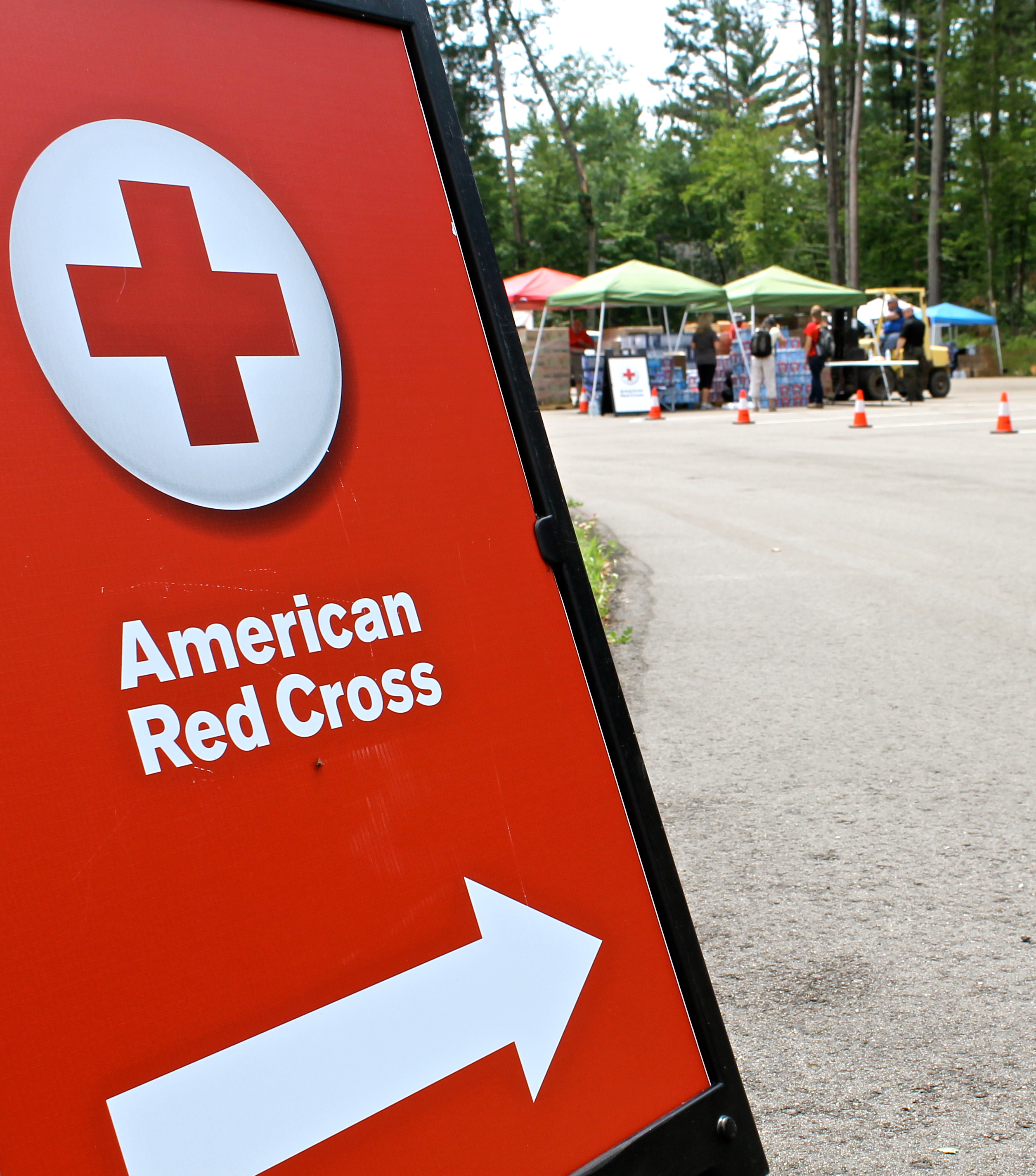
The Red Cross, along with the Salvation Army and the local sheriff department, set up a relief station at Timberwood Church, just South of Nisswa. Red Cross support includes assessing damage of neighborhoods, providing water and relief supplies to affected families and others on-the-ground cleaning up, and coordinating with local and regional relief partners on the response efforts.
The American Red Cross, along with the Salvation Army and the local sheriff department, distributed water, ice, and other relief supplies from a shared field station at Timberwood Church, south of Nisswa, Minn., July 15, 2015. Photo credit: Vivian Engen/American Red Cross.
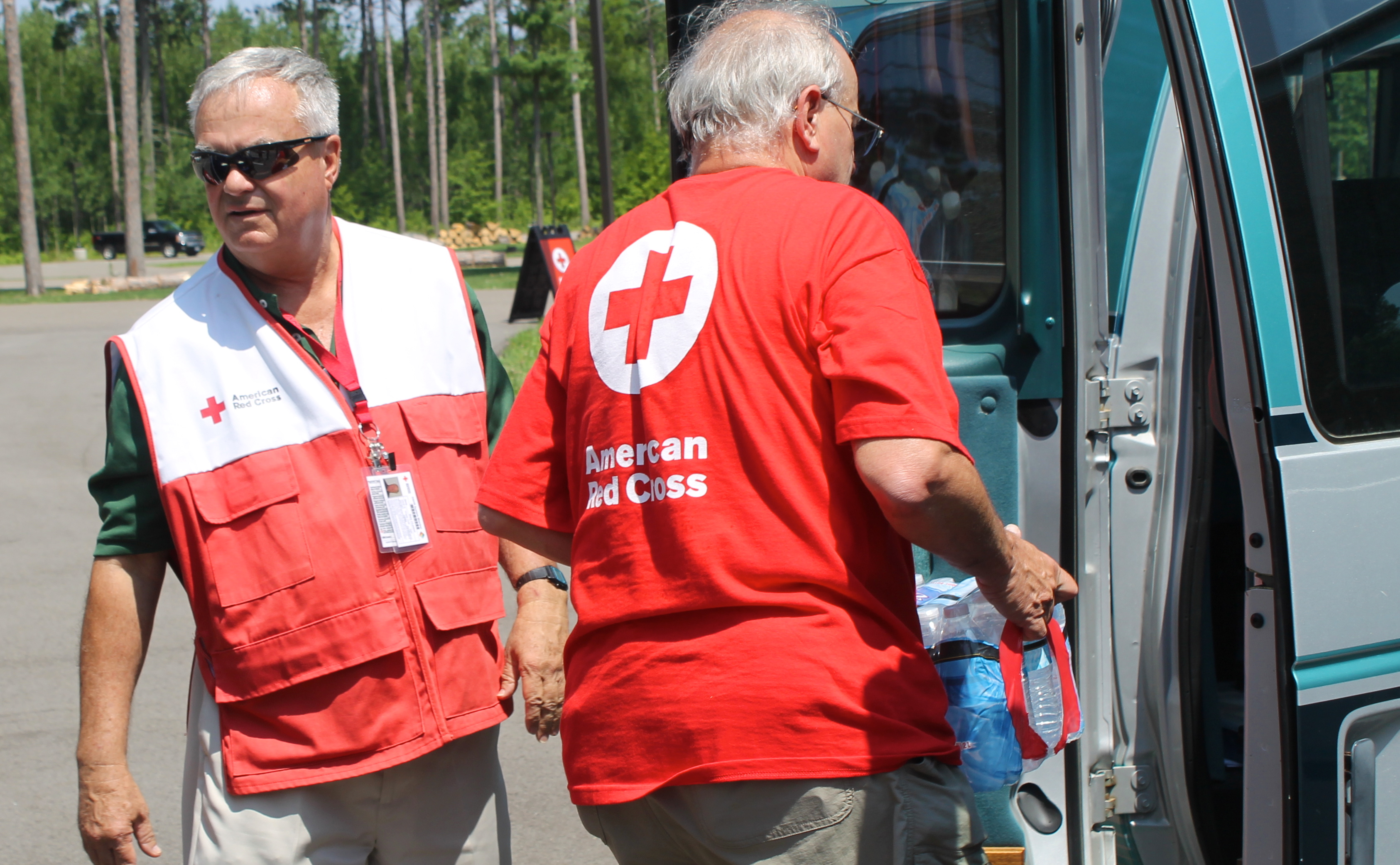
The Red Cross provided water, ice and relief supplies at the relief station. Like many Red Cross volunteers, Gary Larson and Ken Vertin spent the day loading cases of water into vehicles.
Red Cross volunteers Gary Larson (l) and Ken Vertin (r) spent the day in Nisswa, Minn., loading cases of water into local residents’ vehicles on, July 15, 2015. Photo credit: Vivian Engen/American Red Cross.
 Red Cross volunteer Connie Barsness carried bottled water to the car of a local resident who was still without running water. The power is expected to return to the area in the next few days, but until then, local residents will continue to rely on alternative water sources.
Red Cross volunteer Connie Barsness carried bottled water to the car of a local resident who has been without running water since the storm on Sunday. The power is expected to return to the area in the next few days, but until then, local residents will continue to rely on alternative water sources, July 15, 2015. Photo credit: Vivian Engen/American Red Cross.
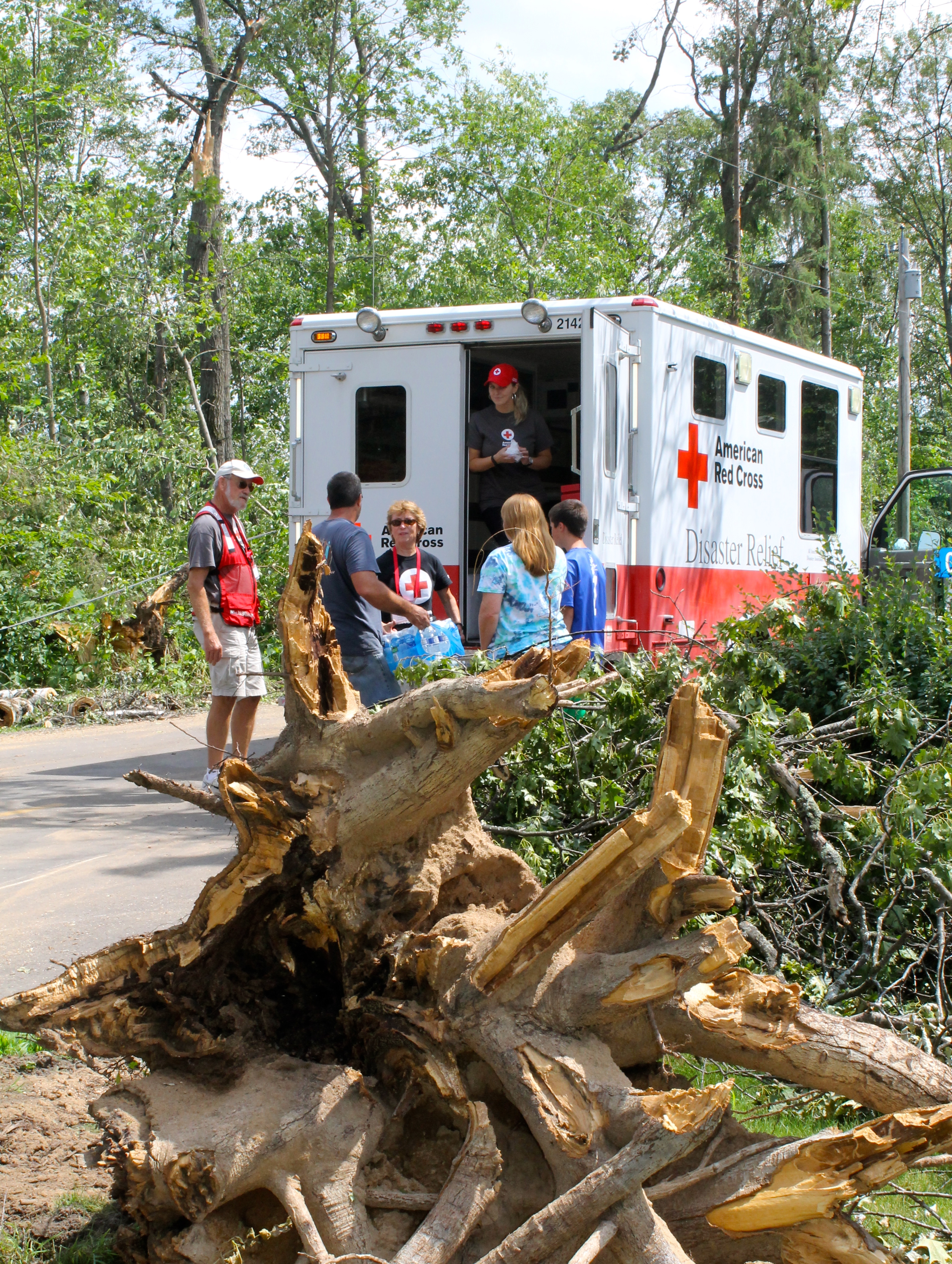
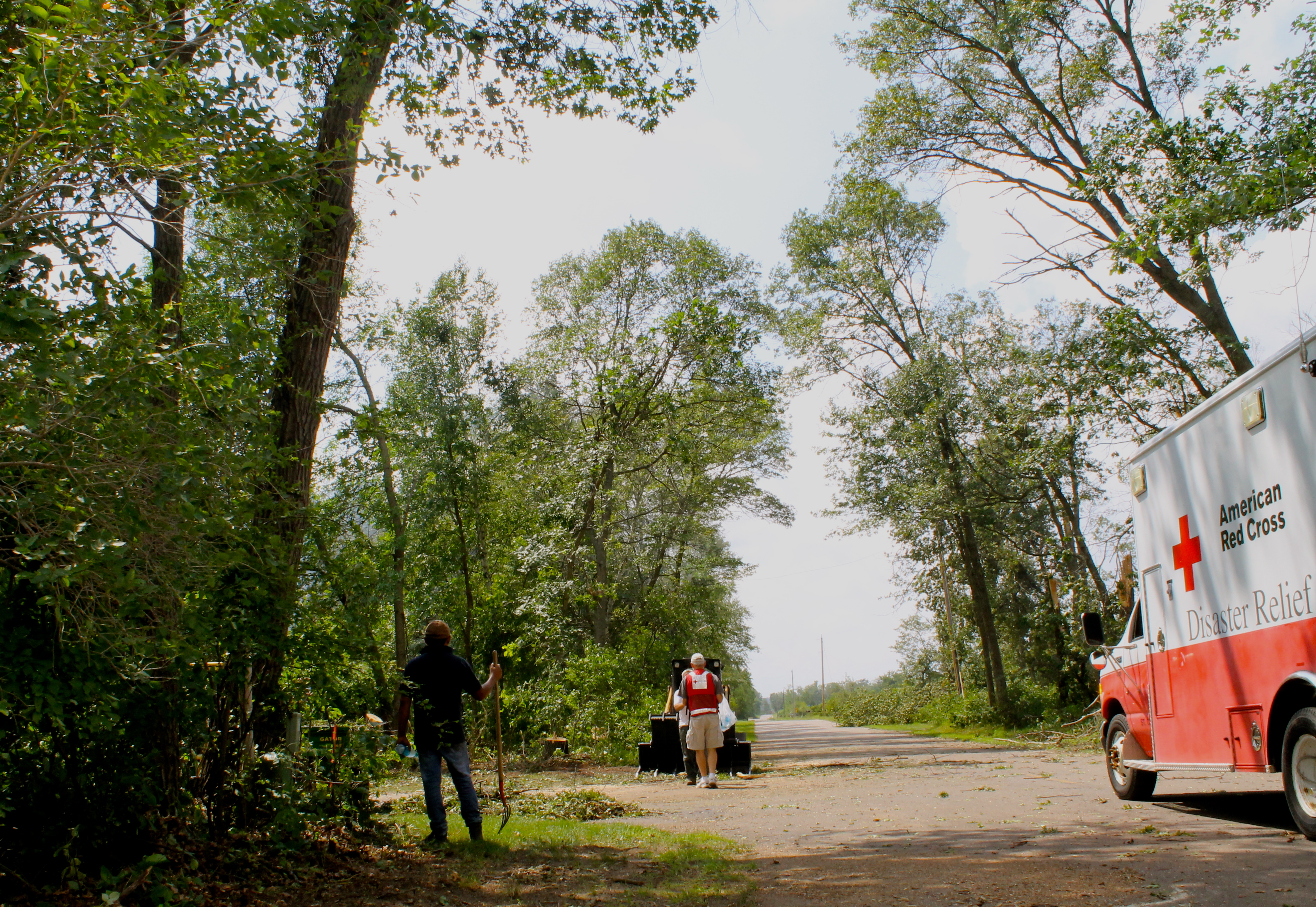
 Two Red Cross Emergency Response Vehicles (ERVs) are canvassing the hardest hit areas and bringing aid to those without power and cut-off from other resources by downed lines and trees.
Two Red Cross Emergency Response Vehicles (ERVs) are canvassing the hardest hit areas and bringing aid to those without power and cut-off from other resources by downed lines and trees, Gull Lake Dam Road, July 15, 2015. Photo credit: Vivian Engen/American Red Cross.
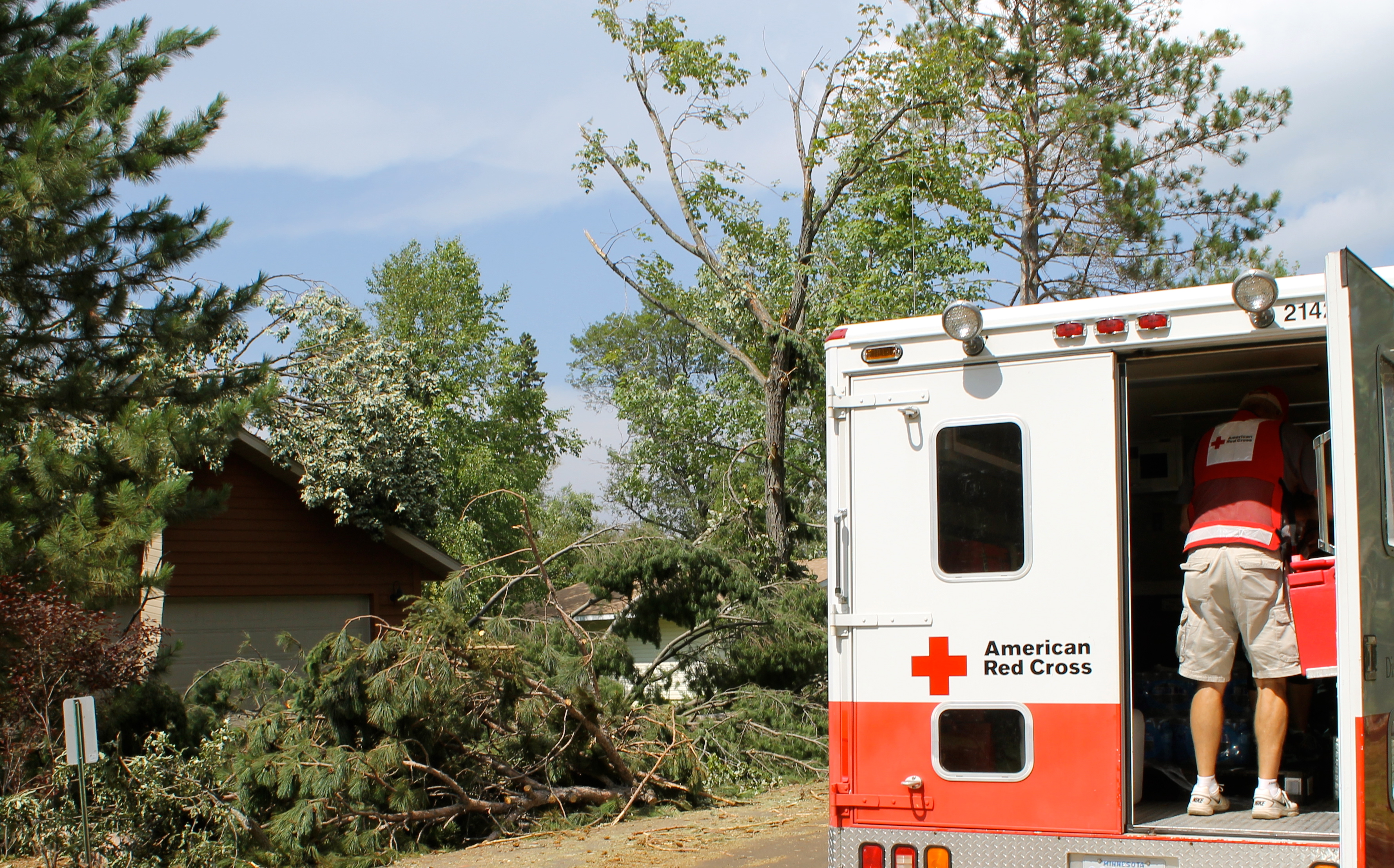
The storm that ravaged the Brainerd Lakes area is being compared to a stage one hurricane. Debris littered the street, at times making it difficult for the ERV to get through.
The storm that ravaged the Brainerd Lakes area on Sunday, July 12, 2015, is being compared to a stage one hurricane by local officials. Debris littered the street, at times making it difficult for the Red Cross Emergency Response Vehicle (ERV) to get through to affected areas, Gull Lake area, July 15, 2015. Photo credit: Vivian Engen/American Red Cross.
Red Cross volunteer Rick Campion distributes cold water to local residents Lloyd Baakkonen and Ronald Hines from the ERV.  “We heard your horn and came running,” said Baakkonen, who despite having a tree through his roof had a huge smile on his face. “There’s nothing better than cold water.”
Red Cross volunteer Rick Campion (l) distributed cold water to local residents Ronald Hines (c) and Lloyd Baakkonen (r) from a Red Cross Emergency Response Vehicle (ERV). “We heard your horn and came running,” said Baakkonen, who, despite having a tree through his roof, had a huge smile on his face. “There’s nothing better than cold water.” July 15, 2015. Photo credit: Lanet Hane/American Red Cross.
Hines then emphasized the importance of being prepared. “I had a generator in the basement that I’d never used it before, but figured it would come in handy if something bad were to happen,” he said. “I was right.” For more information on being prepared for different types of emergencies, click here.
Red Cross volunteers Rick Campion (l) and Vivian Engen (c) spoke with Ronald Hines (r), who was cleaning up following the windstorm. “I had a generator in the basement that I’d never used before, but figured it would come in handy if something bad were to happen,” Hines said. “I was right.” July 15, 2015. Photo credit: Lanet Hane/American Red Cross.
Many homes were hit hard by the storm. Amidst uprooted trees and debris, this family told the ERV crew that a tree went through their roof and their entire home will be torn down before the weekend is over because the damage was so extensive.
Many homes in the Brainerd Lakes area were hit hard by the storm on July 12, 2015. Amidst uprooted trees and debris, one family told Red Cross volunteers that a tree went through their roof. Their entire home will be torn down because the damage was so extensive. July 15, 2015. Photo credit: Vivian Engen/American Red Cross.
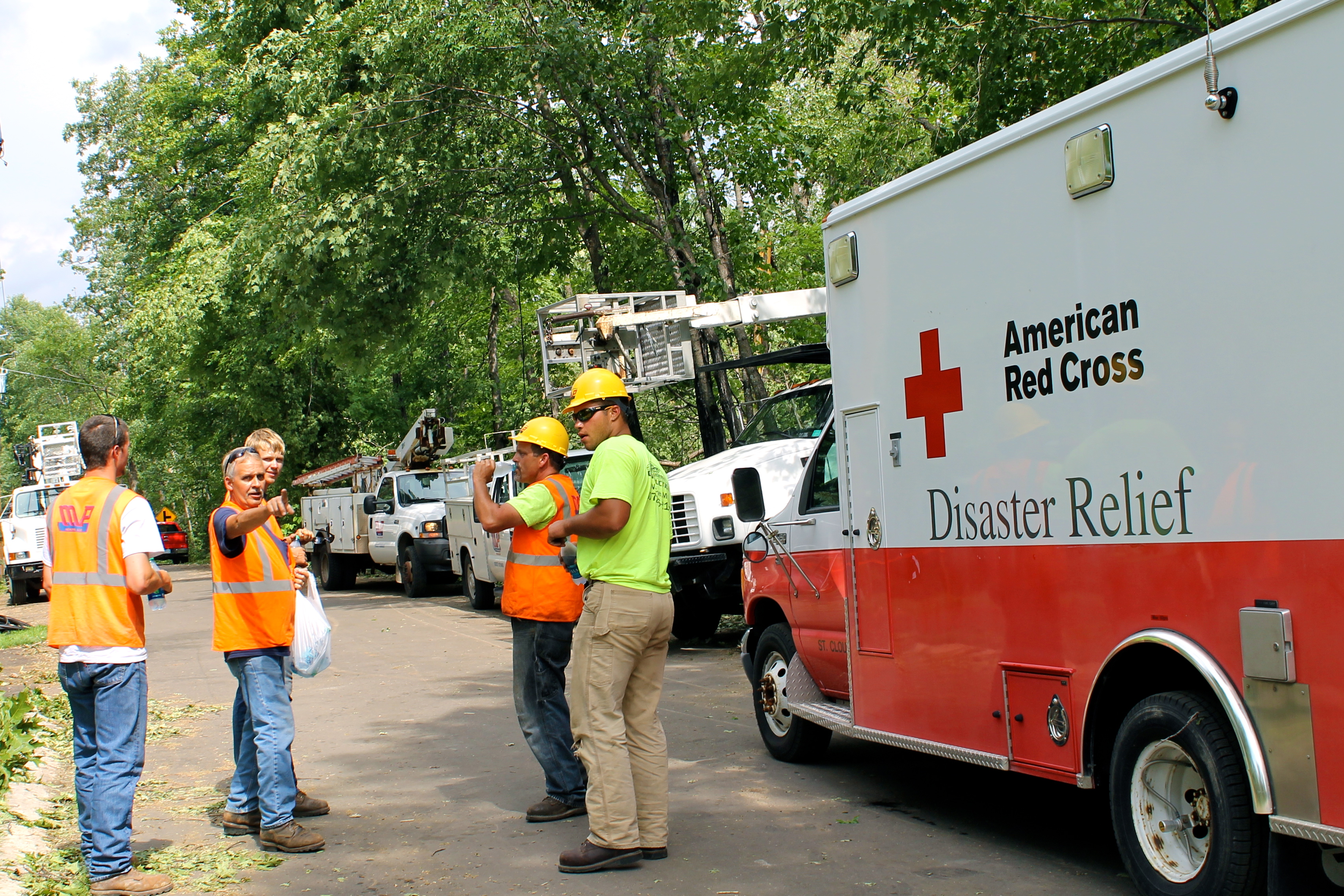
To date, the Red Cross has distributed thousands of bottles of water and hundreds of pounds of ice to Brainerd Lakes area residents and work crews cleaning up in hot and humid conditions following the windstorm. July 15, 2015. Photo credit: Vivian Engen/American Red Cross.
Red Cross volunteer Rick Campion walked through an storm affected neighborhood  in the Brainerd Lakes area on July 15, 2015. Photo credit: Vivian Engen/American Red Cross.
Red Cross volunteer Rick Campion walked through an storm affected neighborhood in the Brainerd Lakes area on July 15, 2015. Photo credit: Vivian Engen/American Red Cross.

What You Can Do: Download today the Red Cross Emergency App for real time access to weather alerts, preparedness information, safety tips and shelter locations. The Emergency App provides expert advice on what to do during and after, tornadoes, wildfires and other disasters. The app provides lifesaving information on emergency first aid for various situations such as what to do for heart attacks, heat-related emergencies and includes water safety tips. Pre-loaded content ensures that guidance from Red Cross experts is available anytime, anywhere – even without mobile connectivity.

Four Days on an Emergency Response Vehicle

Story and photos by Jerry Eiserman, Red Cross Volunteer

Jerry's Red Cross "Emergency Response Vehicle" (ERV)
Jerry’s Red Cross “Emergency Response Vehicle” (ERV)

After I retired, I wanted to find a worthwhile way to spend my new-found free time. I remembered hearing about volunteers who packed up when various disasters occurred and served with the American Red Cross. And I decided that was what I wanted to do.

As soon as I began my training, I learned that the first Red Cross relief workers to to arrive on-scene at a local disaster are Disaster Action Team (DAT) members.  These response teams are trained to be efficient and effective in their efforts helping people, and I quickly joined the squad.

After becoming a disaster relief volunteer I started to ask, what happens when the disaster gets bigger?  There are many different jobs when large-scale disasters, such as a tornado or hurricane, hit a community. I learned that my experience driving trucks and managing computer networks could be useful. I expressed my interest in and willingness to be on-call in this response activity if needed.

Day One

On June 29th I got a call that the Red Cross needed the Minneapolis Emergency Response Vehicle (ERV) to help out in Illinois, and for the first time I was able to say yes. I partnered up with another volunteer named Bill Craig, a delightful gentleman from St. Cloud, MN, who had disaster experience after being deployed to Hurricane Sandy. We took off from Minneapolis on June 30th and arrived at the Red Cross chapter in Romeoville, IL, on morning of July 1st ready to receive our assignments.

Red Cross Volunteers help out in Cole City

We were dispatched to the Bourbonnais and Kankakee, IL, office where severe flooding and tornadoes damaged the surrounding area. We loaded our ERV with cleaning supplies, drinks, snacks and shovels, and headed for Cole City, IL.  Cole City is a small, rural town that a recent tornado had ripped through, leveling several neighborhoods and wreaking havoc throughout the town.

After several hours distributing relief supplies to people in Cole City, we returned to Kankakee where we helped open a Multi-Agency Resource Center (MARC).  A MARC is where different service agencies congregate to provide a one-stop service center for folks affected by local disaster.  I quickly learned that as a volunteer, I was there to help with whatever needed to be done. One minute I was in the gym setting up tables and chairs, and the next I was being asked to set up a small computer network to serve the folks that would be coming in the next day.

Day Two

The MARC set up in Kankakee

Our second day started at 6 a.m. The MARC ran ten computers and two laser printers to service the needs of affected residents. Once the network was up and operating, the local volunteers had everything under control and I moved back to my ERV role. We spent the morning loading relief supplies into people’s cars and handing out drinks and food. There was a flood of people that came to the MARC after lunch, so my job transitioned to walking families through the in-take process. By the time the doors closed at 6 p.m., we had processed 160 families.

Day Three

On day three, we met at the Bourbonnais office at 10 a.m. and loaded flood clean-up supplies and headed for a small, rural town called Momence, IL.  We paired up with a case worker from Pennsylvania and drove around the town to see where help and supplies were needed. We soon ran out of cleaning supplies and had to call for back up because so much damage had been done.

We out-processed at the Romeoville office about 7 p.m. and started the drive back to Minneapolis.

Day Four

We finished our journey back in Minneapolis on the 4th of July and got in about noon.

The biggest lesson I took from my four days on an ERV is that the world is not as bad as we make it out to be. Today, the news is full of terrible accidents, criminals and disasters. But what I found was that there is some beauty left in the world. The vast majority of Americans are kind and compassionate people. When our neighbors get hit hard most of us don’t just drive by, we stop and help. Almost everyone that I put my hand out to was unbelievably grateful and had the “I may be down but I’m not out” look in their eyes. Lee Greenwood is correct: I’m proud to be an American.

To learn more about becoming a Red Cross volunteer, click here.
To browse more ways to help fulfill the Red Cross mission, click here.

Volunteer Spotlight: Barb Page and Disaster Health Services

Teaching a CPR class,
Leading or supporting committee work,
Being on-call to assist with small disasters,
Helping in a shelter on larger disaster responses,
Reviewing health forms for the staff and volunteer workforce,
Speaking to nursing students about volunteer opportunities at the Red Cross…

Linked in photo small jpeg Barb PageThere are many ways for those in the medical field to share their time and talents with American Red Cross Humanitarian Services. One nurse doing just that is Barb Page. Barb is celebrating her five-year anniversary with the Red Cross and is nearing the end of her second year as Disaster Health Services (DHS) Lead for the Twin Cities Area Chapter. For Barb, volunteering as a nurse for the American Red Cross is about compassion and community.

COMPASSION
As a DHS volunteer, Barb has enjoyed sharing her gift of compassion with clients when called upon to assist during disaster response.

Asked why nurses have always played such an important role for the Red Cross, Barb replied, “Everybody at the Red Cross has a lot of care and compassion, but I think it’s just innate for nurses, and that comes through in our work and is an important piece of recovery. We are a big part of getting people back on their feet.”

DHS volunteers are able to offer both practical assistance and emotional support to clients in their times of need. “When someone has lost everything or has been hurt because of a disaster, they need help in so many ways. They need help navigating how to get their life back together,” Barb explained. “In almost every disaster response, there is someone with medication or someone with medical needs who needs help.” With DHS volunteers like Barb standing at the ready to share not just her professional skills but also her caring spirit, the Red Cross is able to more completely meet the needs of clients.

COMMUNITY
As DHS Lead for the Twin Cities Area Chapter, Barb has enjoyed fostering a sense of community among the DHS volunteer team.

In the beginning of Barb’s tenure, Barb focused on understanding what interested and motivated different volunteers in order to best engage them in ways they would find satisfying. As Barb described, with the variety of activities there is to participate in at the Red Cross, “We need all kinds of people with all kinds of interests.” Barb’s inclusive message is that anyone can find a way to contribute at the Red Cross that will be fulfilling and that will fit his/her unique schedule and strengths.

BarbBarb is now focusing her time as Twin Cities Area DHS Lead on maintaining a mentorship program and four committees centered on sheltering, national deployment, welcoming new volunteers, and external recruitment and education. The mentorship program has helped more than a handful of new volunteer nurses become acquainted and comfortable with responding to local disasters over the past year. Choua Yang, Regional Recovery Program Support Specialist, explained the impact Barb is having locally: “She is a great leader for the DHS group. The mentorship program helps new volunteers navigate the Red Cross and brings them into the DHS community.”

In addition, the more recently established committees are creating new ways for DHS volunteers to get involved and get to know each other, all the while making the Red Cross well positioned and prepared to take action when called upon.

Thinking holistically, as nurses so often do, Barb stated, “You never know if the client you just helped is going to become a volunteer or a donor or help out at the next disaster. It’s a circle.”  The Red Cross community is a growing, more encompassing circle because of wonderful volunteers like Barb. Thank you, Barb!

Story by Kelly Clark, Volunteer Services, American Red Cross Minnesota Region. If you or someone you know would be interested in joining this compassionate community of Disaster Health Services volunteers in Minnesota, please contact Volunteer Services.

Thanks following West Broadway Fire response

Red Cross volunteers Jennifer Pluhar and Mark Steffer responding on location to the W. Broadway Fire in North Minneapolis on April 15, 2015. Photo credit: Lynette Nyman/American Red Cross

On Wednesday, April 22, we wrapped up our Red Cross sheltering operation following the devastating fire at West Broadway and Emerson in Minneapolis on April 15. On any evening during the week that that the shelter was open there were between three to six residents in who did not have their own resources to find safe shelter elsewhere. In addition to providing shelter, the Red Cross worked all affected by the fire to assess and meet immediate disaster relief needs and to start them on a path to long-term recovery. This important disaster response work happened both on location moments after the fire or later at the shelter or the temporary resource center established with community partners.  To date, the Red Cross has helped 27 people who were displaced by this fire.

W. Broadway Fire victim Cliff Garrett shares his story with Red Cross volunteers in North Minneapolis on April 15, 2015. Photo credit: Lynette Nyman/American Red Cross
West. Broadway Fire victim Cliff Garrett shares his escape story with Red Cross volunteers in North Minneapolis on April 15, 2015. Photo credit: Lynette Nyman/American Red Cross

We are grateful to have organization partners in the West Broadway and North Minneapolis community that have resources for these residents.  We’re also thankful for the outstanding response from local businesses that helped us provide food to shelter residents. Working together, our community provided a strong safety net that many fire victims need to rebuild their lives. And most important to say is this: the Red Cross cannot do any of this relief work without the volunteers who shared their time and expertise during this response effort. Red Cross volunteers are the ones step into the gap left by disasters big and small, holding a hand, giving a hug, and doing the deep dive that helps get people going again after disaster strikes. Once again, our Red Cross volunteers were dedicated to helping others in our community during a time of great need and suffering.

To become a volunteer, click here. To give a financial donation, click here.

Awesome home fire preparedness day in Lake City, Minnesota

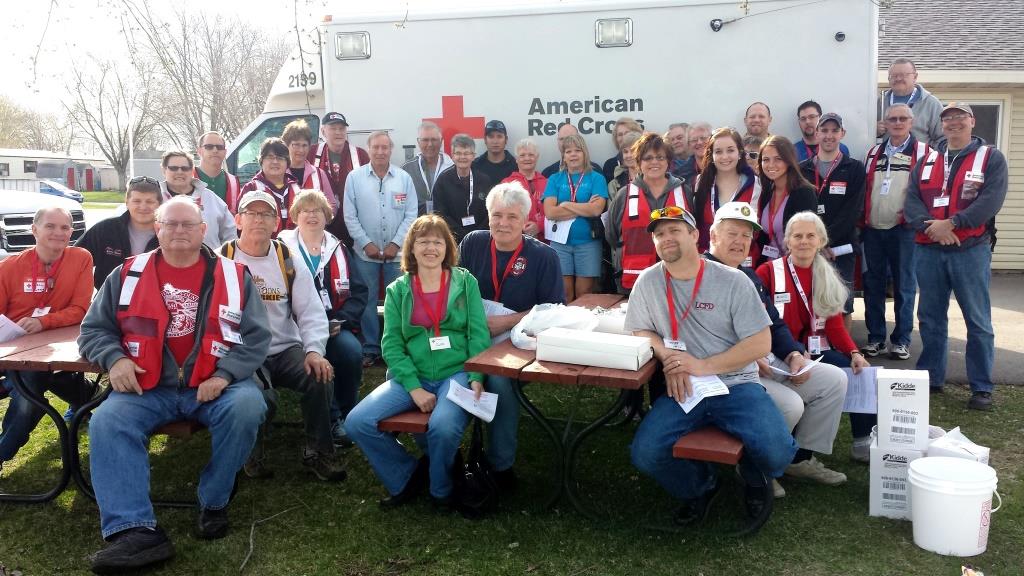
Home Fire Preparedness Campaign volunteers, Lake City, MN, April 18, 2015

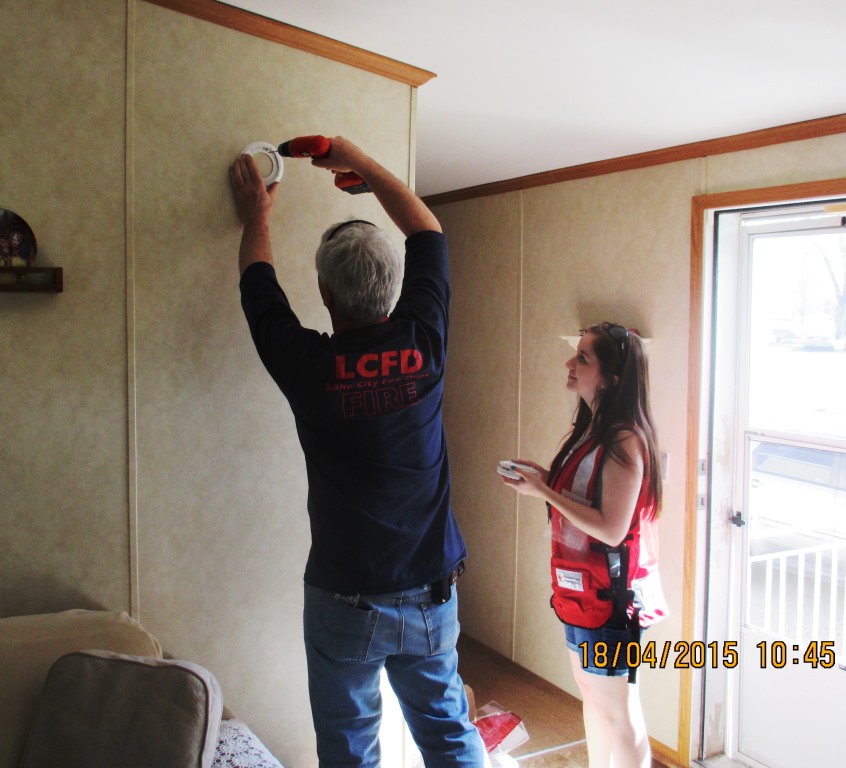
We had an awesome day in Lake City, Minnesota, on Saturday, April 18, installing smoke alarms and talking fire safety.  As part of the national American Red Cross Home Fire Preparedness Campaign, a local team of 25 Red Cross volunteers and volunteer partners canvassed 400 homes the previous week and gathered 115 smoke alarm installation requests. Three mobile home parks and a small area on the south side of the town were the designated areas. Then, this past weekend, 40 volunteers returned to homes that had no answer the week before, and to those with scheduled requests and installed smoke alarms. The teams installed a total of 164 alarms!! Volunteers also provided safety information, helped with creating fire escape plans, and handed out a tornado safety checklist. It was a great day and everyone did an amazing job.

Smoke alarm installation during Home Fire Preparedness Campaign, Lake City, MN, April 18, 2015

Volunteers were made up of Red Cross volunteers, firefighters, Kiwanis members, and local community members. We had three Spanish language speakers who used their talent helping interpret for a few families. Everyone met at 8:30 a.m. for coffee, rolls, and training. Lake City’s fire chief Jeff Diepenbrock, and his wife Julie, came out Saturday to help install alarms. Jeff started off the day thanking the volunteers for their dedication and time. He also talked about fire safety and the importance of smoke alarms. Everyone set out about 9 a.m. and finished around noon. When everyone returned, it was great to hear some of the appreciation stories that families told where alarms were installed.

I am soooo thankful for the group of Red Cross volunteers in my areas!! This could not have been attempted, and become such a success, if it were not for the support of those who continue to be there when they can to lend a hand! Our smoke alarm installation event coordinators for the Lake City were Shar Yorde and Ann Nibbe who put in a lot of hours to make this happen.  A few of my experienced smoke alarm installation event volunteers from Winona, including Joe Whetstone, Mike Papke and Beth Lindholm from Winona, were instrumental in organizing the Lake City event and keeping things on track. Thank you to everyone who came out for this awesome day!! The Red Cross and our community are lucky to have you 🙂

Post and photos by Dianne Thompson, Disaster Program Specialist, American Red Cross serving Southeast Minnesota. The American Red Cross Home Fire Preparedness Campaign seeks to reduce home fire deaths by 25 percent in five years. To learn more, click here.

Volunteer Spotlight: Melinda Wittmer

MelindaMeet Melinda Wittmer, a Disaster Services volunteer for the American Red Cross serving Northern Minnesota.

Melinda has been a Disaster Services volunteer since 2011, and is part of the Disaster Action Team (DAT). She also has recently taken on a new role with Volunteer Services – she’ll be interviewing prospective volunteers to introduce them to the volunteer opportunities at the Red Cross and help them find a good fit.

As a child, Melinda was introduced to the Red Cross as part of her home-school curriculum, in which her mother made the Red Cross a recurring theme. What Melinda took away from that was that the Red Cross “is a solid entity that is always there to help.”

Fast forward to Melinda’s adult life when she was working at a group home and became very close to an individual who turned into one of her favorite clients. His health declined and he was put on life support, and then eventually taken off. At that moment Melinda decided she wanted to do something good and help people. She went to the Red Cross office in Duluth, Minnesota, to ask a few questions, and was immediately “roped in.” Within minutes she was filling out an application, and the rest is history!

Melinda went on her first home fire call with one of the chapter’s most experienced volunteers.  Since then Melinda has responded to over 30 home fires.  Melinda says that the most satisfying part of being a disaster volunteer is “helping people who have experienced a devastating loss and seeing how grateful clients always are for the services of the American Red Cross.”

A few months ago Melinda went through the difficult experience of responding to an incident that involved a fatality. Additionally, it turned out that she was familiar with the person who died. Despite the difficulty involved in this response, Melinda took away the feeling that she was there for the family to help them with the “begin-again phase” of their lives.

The Red Cross has made Melinda more confident, and through her interactions and meeting other volunteers she has become interested in pursuing a career in Emergency Management.

Melinda certainly embodies the mission and fundamental principles of both the American Red Cross and Red Cross and Red Crescent Movement around the globe.  She’s always ready, willing and able to assist and a great comfort to those who have suffered a loss because of home fires and other disasters.

Story and photo by Nancy Rogers, Volunteer Services Coordinator for the American Red Cross serving Northern Minnesota.

To learn more about becoming a Red Cross volunteer, click here.

This year, resolve to be more prepared for emergencies

What are your 2015 resolutions? Losing weight? Yep. Eating healthy? For sure. Preparing for emergencies? Um, no, you’d not thought of that, right? We ask that you do because we see every day the impact disasters–mostly house fires–have on people. So, below are 12 actions, one for each month, that you can take to become more prepared by the end of 2015!

  1. Download a Red Cross mobile app.m40340177_everyday_apps_763x260
  2. Learn about how to prevent fires in your kitchen (the number one cause of house fires).
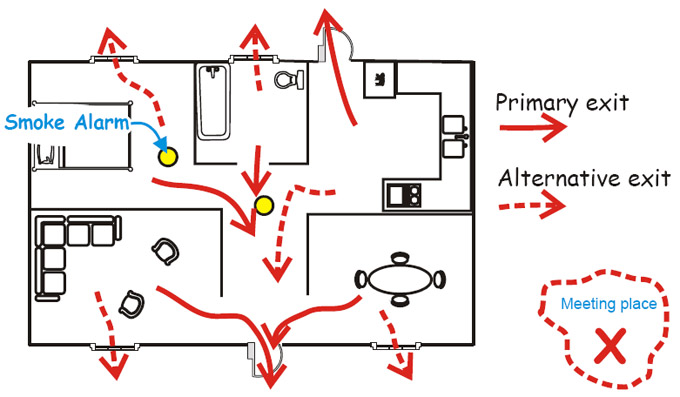
  3. Talk with your family about having two ways out of every room in the house to ensure that each of you knows how to get out in case of a fire.
  4. Make a disaster plan with your family. By having a disaster plan each member of your family will know where to go if there is a disaster as well as having other important information on hand.fireescape_image
  5. Check your smoke detectors twice a year to ensure that they are in working condition.
  6. Complete the home fire preparedness checklist.
  7. Build a disaster kit, so you have the items you would need in case you have to evacuate.
  8. Learn how to prepare for members of your family with special needs like children, pets, individuals with disabilities and seniors.
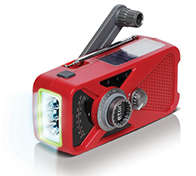
  9. Purchase a weather radio so you can be informed during weather related disasters.
  10. Learn about the weather warning systems and what each warning means.m37640104_196x176-emergency-radio
  11. Put together a car kit that has items you might need if you get stuck during a winter storm.
  12. Tell your family and friends about the importance of being prepared and challenge them to take the steps above.

Report back about your success as you move forward. Want additional guidance? We’re here for you. Call us at (612) 871-7676 and ask for Jenn in Disaster Cycle Services.

Have a fabulous 2015!

2014 Disaster Cycle Services Highlights

By Megan Mrozek, Regional Disaster Officer, American Red Cross Minnesota Region

During 2014, a year when disasters were not major headlines in Minnesota, our region’s Disaster Cycle Services team was hard at work. The team responded to 716 disasters and delivered humanitarian aid to more than 1,104 families, helped prepare 22,180 people for emergencies, and trained to make sure we’re ready to respond to disasters big and small here in Minnesota and, when needed, across the nation. Highlights of our year include:

  • January:
    • Cedar-Riverside Apartment Fire: Response teams worked with people in the affected community with recovery immediately after the fire and preparedness throughout year.NDSI_2
    • Round-Tables: We started monthly response and recovery round-tables with disaster leaders across the state, sharing best practices and lessons learned from responses throughout the region.
    • DAT Captain Training: We established an initiative to refine and develop the role of Disaster Action Team (DAT) captains, culminating in new training simulation for disaster response captains in December.
  • March:
    • Casework for DATs: We implemented a training course that enables Disaster Action Team members to help clients begin their recovery immediately after a disaster.
  • April:
    • Leadership Summit: Around 100 disaster leaders came together for two days of training, team building, and direction-setting for the year to come.
    • Board Preparedness Challenge: 100% of our regional board members took an action to become more prepared for emergencies.
    • CAS 2.0: We rolled out the new CAS 2.0 database for recovery information, as well as new forms and procedures for response and recovery.
  • May:
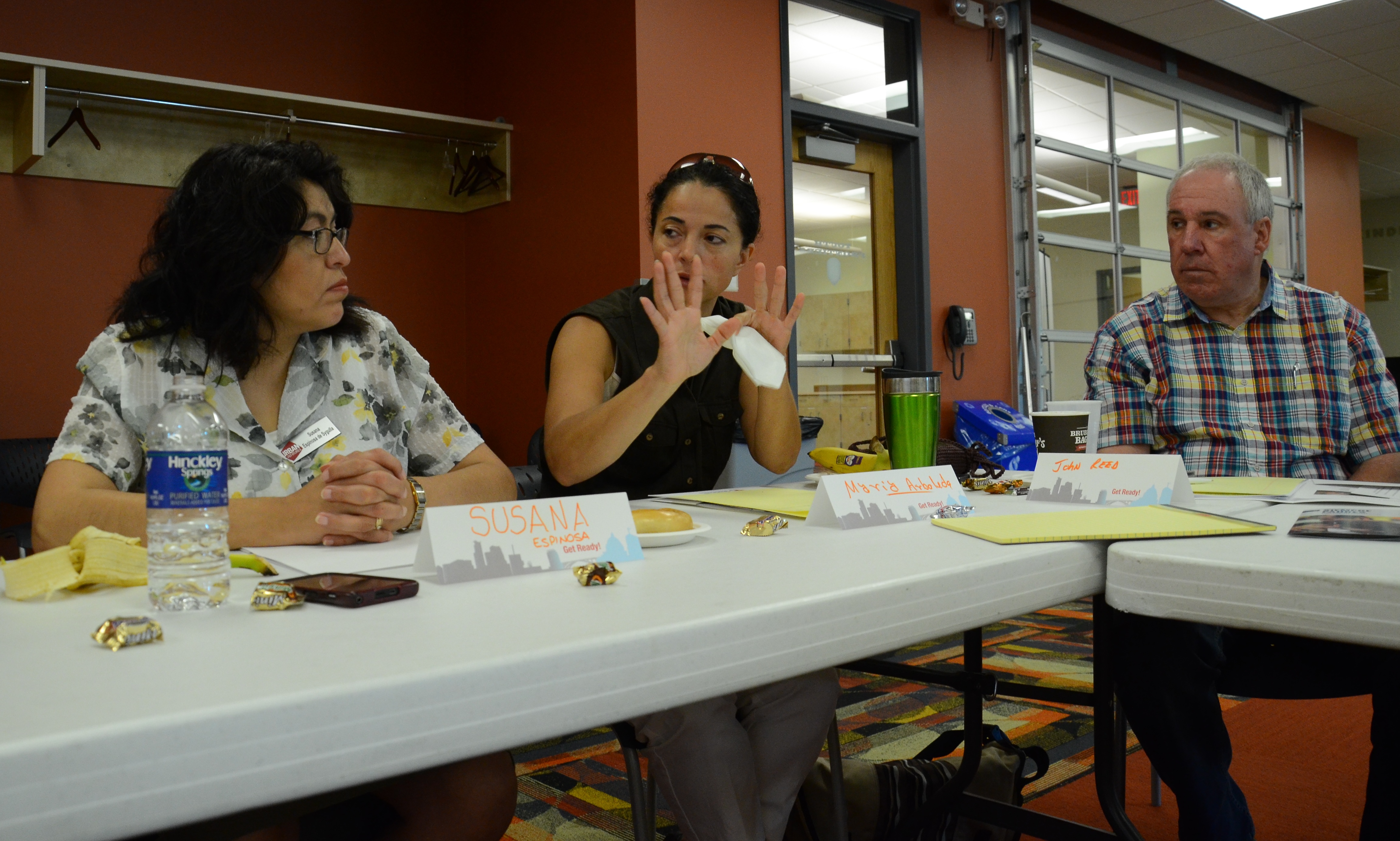
    • DSC_3633_cropLatino Community Partnership and Leadership Summit: We held our first partnership and leadership summit with Latino community leaders and advocates in the Minneapolis and St. Paul metro area.
    • Under One Roof: Co-sponsored the “Under One Roof” sheltering conference that included 250 participants from 5 states and Canada. Fifty-four Red Crossers attended. Our conference mission was to establish new relationships, to strengthen sustainable partnerships, and to learn about the latest developments, trends, and best practices related to sheltering and emergency preparedness.
  • June and July:
    • Flooding Response: On the US-Canadian border, 66 Red Cross volunteers served 1058 meals and 27,116 snacks; distributed 85 clean up kits; and provided 23 health services contacts to flood affected communities in 13 counties. In addition, disaster relief workers responded to flooding relief efforts in the Twin Cities metro area and southwest Minnesota.
  • August:
    • National Night Out: On this night, more than 1600 people were reached with preparedness messages from their neighbors.DSC_4013
    • Vigilant Vortex: At least 50 Red Cross workers took part in a 5-day, statewide exercise with the Minnesota National Guard and more than 30 other agencies practicing response to an epic string of devastating tornado touchdowns.
    • Minnesota State Fair: This year at the fair, 2,735 people completed disaster preparedness plans. Also, 12,876 people were reached through preparedness planning and blood pressure screening.
  • October:
    • North Star Disaster Training Institute: Our signature, annual disaster training program included 39 courses offered to 160 attendees during a 4-day period.
    • Shelters Mobilized: Disaster relief teams mobilized two shelters for people displaced by disaster in the Twin Cities and Marshall, MN.
  • November:
    • Statewide Meet-Up: For the first time, our former southern and northern region teams came together as the new combined Minnesota Region team.

IMG_0580I am incredibly thankful for the tireless effort from our Disaster Cycle Services volunteers and employees. Day and night, 365 days-a-year, they bring compassion, flexibility, and dedication to the important work of helping others during great times of need and making our communities more resilient before, during, and after emergencies. Here’s to 2015!

To learn more about getting involved with the Red Cross, click here.

This Holiday Give the Gift of Preparedness

fireescape_imageAs Red Crossers, we know disasters can strike at any moment and being prepared before they happen is vital for reducing their impact. We also know the most effective way to engage people with disaster preparedness is for them to hear the message from someone they know.

So, this holiday season we ask you to take the steps below and show your loved ones that you care by helping them prepare for emergencies.

  1. Take 30 minutes to talk through your family disaster plan with household members and that everyone has the same understanding of what to do if there is a disaster.
  2. Once your plan is complete, share with others outside your household the importance of being Red Cross Ready and having a family disaster plan, a disaster kit and downloading the free Red Cross First Aid App to their mobile device. You can use this list of disaster preparedness talking points to get the conversations started.
  3. Keep track of the people you talk with here. There will be a prize for the person who has the most conversations about disaster preparedness between now and January 2!

As a friend, neighbor, community member and Red Crosser, this is a great chance to join together and educate your neighbors, friends and family members about a topic that is very important. For additional preparedness materials and support, contact Jenn Hamrick at 612-604-3290 or jenn.hamrick@redcross.org.