Among the many roles that volunteers can fill on a Red Cross mission, one of the most rewarding is that of the ERV Driver. These teams, which often consist of two individuals, drive Red Cross Emergency Response Vehicles and deliver food from community feeding partners to points of distribution after a disaster so that displaced families can pick up a hot meal.
Jennie and Jezzalyn Ringler serve up meals from the ERV in Asheville, North Carolina. (Photo: Nate Russell)
This crucial role helps individuals and families feel a semblance of comfort and normalcy so that they have the energy needed to plan their next steps towards recovering from a disaster.
Often this role is filled by married couples, sometimes by strangers who become friends over the course of their mission, but very rarely do we see a team that consists of a parent and child. Jennie and Jezzalyn Ringler from central Minnesota are one such dynamic duo!
This is Jezzalyn’s first deployment as a Red Cross volunteer, “I don’t think she’s sick of me yet!” remarked her mother Jennie.
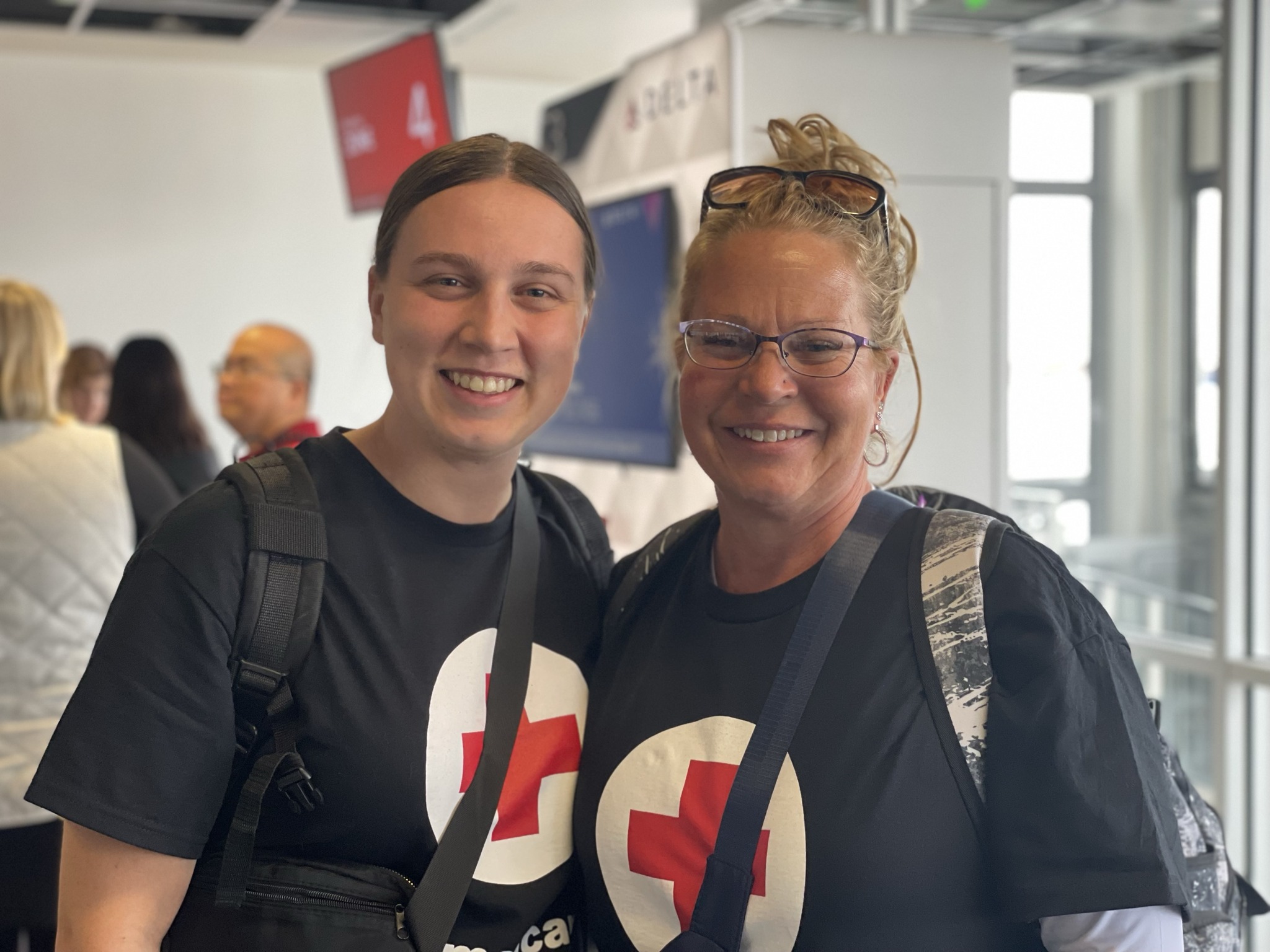
Jennie and Jezzalyn starting out their deployment journey at the airport. (Photo submitted)
This is not Jennie’s first deployment, she’s been an ERV driver since about 2011. She loves working on a team “You get a groove going and you can keep it that way.”
Jezzalyn says her favorite part of being on an ERV Team is the people and the stories. “We’ve got regulars, we see them every day. We get to hear about their lives, about their recovery. Many of them are military veterans.”
Mother/daughter duo work hand-in-hand serving meals to those affected by Hurricane Helene in Asheville, North Carolina. (Photo: Nate Russell)
The Ringlers’ ERV is parked at the Buncombe County Sports Park, at one of our Community Care Centers. Here, hurricane impacted individuals and families can do their laundry, take a shower, pick up supplies such as jugs of potable water, and of course pick up a hot meal. “We’ve served close to 100 meals today,” says Jezzalyn.
Visit here to find a Community Care Center and other resources.
Story by American Red Cross volunteer Nate Russell.
Story and photos by Jerry Eiserman, Red Cross Volunteer
Jerry’s Red Cross “Emergency Response Vehicle” (ERV)
After I retired, I wanted to find a worthwhile way to spend my new-found free time. I remembered hearing about volunteers who packed up when various disasters occurred and served with the American Red Cross. And I decided that was what I wanted to do.
As soon as I began my training, I learned that the first Red Cross relief workers to to arrive on-scene at a local disaster are Disaster Action Team (DAT) members. These response teams are trained to be efficient and effective in their efforts helping people, and I quickly joined the squad.
After becoming a disaster relief volunteer I started to ask, what happens when the disaster gets bigger? There are many different jobs when large-scale disasters, such as a tornado or hurricane, hit a community. I learned that my experience driving trucks and managing computer networks could be useful. I expressed my interest in and willingness to be on-call in this response activity if needed.
Day One
On June 29th I got a call that the Red Cross needed the Minneapolis Emergency Response Vehicle (ERV) to help out in Illinois, and for the first time I was able to say yes. I partnered up with another volunteer named Bill Craig, a delightful gentleman from St. Cloud, MN, who had disaster experience after being deployed to Hurricane Sandy. We took off from Minneapolis on June 30th and arrived at the Red Cross chapter in Romeoville, IL, on morning of July 1st ready to receive our assignments.
Red Cross Volunteers help out in Cole City
We were dispatched to the Bourbonnais and Kankakee, IL, office where severe flooding and tornadoes damaged the surrounding area. We loaded our ERV with cleaning supplies, drinks, snacks and shovels, and headed for Cole City, IL. Cole City is a small, rural town that a recent tornado had ripped through, leveling several neighborhoods and wreaking havoc throughout the town.
After several hours distributing relief supplies to people in Cole City, we returned to Kankakee where we helped open a Multi-Agency Resource Center (MARC). A MARC is where different service agencies congregate to provide a one-stop service center for folks affected by local disaster. I quickly learned that as a volunteer, I was there to help with whatever needed to be done. One minute I was in the gym setting up tables and chairs, and the next I was being asked to set up a small computer network to serve the folks that would be coming in the next day.
Day Two
The MARC set up in Kankakee
Our second day started at 6 a.m. The MARC ran ten computers and two laser printers to service the needs of affected residents. Once the network was up and operating, the local volunteers had everything under control and I moved back to my ERV role. We spent the morning loading relief supplies into people’s cars and handing out drinks and food. There was a flood of people that came to the MARC after lunch, so my job transitioned to walking families through the in-take process. By the time the doors closed at 6 p.m., we had processed 160 families.
Day Three
On day three, we met at the Bourbonnais office at 10 a.m. and loaded flood clean-up supplies and headed for a small, rural town called Momence, IL. We paired up with a case worker from Pennsylvania and drove around the town to see where help and supplies were needed. We soon ran out of cleaning supplies and had to call for back up because so much damage had been done.
We out-processed at the Romeoville office about 7 p.m. and started the drive back to Minneapolis.
Day Four
We finished our journey back in Minneapolis on the 4th of July and got in about noon.
The biggest lesson I took from my four days on an ERV is that the world is not as bad as we make it out to be. Today, the news is full of terrible accidents, criminals and disasters. But what I found was that there is some beauty left in the world. The vast majority of Americans are kind and compassionate people. When our neighbors get hit hard most of us don’t just drive by, we stop and help. Almost everyone that I put my hand out to was unbelievably grateful and had the “I may be down but I’m not out” look in their eyes. Lee Greenwood is correct: I’m proud to be an American.
To learn more about becoming a Red Cross volunteer, click here.
To browse more ways to help fulfill the Red Cross mission, click here.
One destroyed house along the route where Red Cross volunteers are providing meals and snacks following the Pennsylvania flooding. Photo credit: Rick Campion/American Red Cross
It’s now day 11 in our Pennsylvania flood deployment with the Red Cross and we’ve settled into a regular mobile feeding route in the mobile feeding truck (ERV). We travel about 2 hours to get to our first scheduled stop and then serve between 100-150 meals. Our route follows the river and some of the homes that were very close to the river bank (see pic). We recognize our “regulars” and it’s fun to give and get hugs from people who really appreciate the help that the Red Cross provides. Ah, this our reward.
When people see “Minneapolis, MN” on the side of our truck, they’re always surprised and grateful at how far we’ve traveled to serve them.
The Red Cross disaster relief effort in Pennsylvania has served more than 221,000 meals/snacks and it is now down to 4 open shelters. We can see that people are slowly getting back on their feet. Many of the original shelters were opened in schools and it causes some logistical problems with the school’s now regularly scheduled activities. So after 3 weeks, those affected by the floods are encouraged to find alternate housing arrangements.
We expect to be released from the operation next week and look forward to coming home.



 American Red Cross Minnesota and Dakotas Region