Witnessing Resilience and Hope: My Red Cross Deployment to Asheville After Hurricane Helene 

Every deployment with the Red Cross is unique. Each one brings new challenges, new faces, and new lessons. My recent deployment to Asheville, North Carolina, after Hurricane Helene was no different. Walking through the aftermath of the storm, I was struck by the immense power of water and its capacity for destruction. But even more impactful was witnessing the resilience of the people and the power of collective action as volunteers, first responders, and neighbors came together to rebuild.

“Walking through the aftermath of the storm, I was struck by the immense power of water and its capacity for destruction.” – Brice Johnson

Responding to a disaster like this is always humbling. It’s a privilege to see the Red Cross mission in action firsthand, to be part of immediate relief efforts, and to know that our work will support long-term recovery for those impacted. This deployment, in particular, left me with lasting memories of strength, compassion, and the incredible difference we can make when we work together.

Finding Hope in Housing 

One of the most remarkable aspects of this deployment was the success of our shelter resident transition teams. These teams worked tirelessly to help shelter residents move into sustainable, long-term housing solutions. By the end of the deployment, almost every shelter resident had a more stable housing solution.

I’ll never forget a moment that brought this work to life for me. After a long day, I stopped at a fast-food restaurant for dinner. At a table near me, I overheard two men filling out job applications. One turned to the other and said, “The Red Cross got me a place to live, so now I can get a job.”

It was such a simple statement, but it carried so much weight. Having a safe and stable place to live gave this man the chance to rebuild his life. It struck me how transformative our work can be. This wasn’t just about housing; it was about hope and opportunity.

Sylvia’s Backyard Operation 

Another unforgettable moment came when I received a call from Sylvia, a local community member who had been supporting nearly 300 people camping in the woods after the storm. With no formal resources, Sylvia set up a makeshift shower in her backyard and provided food and supplies to help them survive.

Her selflessness and determination were extraordinary. She had been doing everything she could with what little she had, but when she contacted us, we knew we could amplify her efforts. Almost immediately, we dispatched one of our emergency response vehicles to her area, initiating a feeding mission that continued long after my deployment ended. Each night, nearly 300 people were served a hot meal.

Sylvia’s story is a testament to the power of individual action and the strength of community. Her willingness to step up in a moment of crisis inspired everyone involved and reminded me how much one person can accomplish with compassion and determination.

The Long Road Ahead 

Disasters like Hurricane Helene leave a lasting impact, and recovery is never quick or easy. While the immediate relief we provide is critical—sheltering families, serving meals, distributing supplies—it’s just the beginning. The road ahead for Asheville and the surrounding areas will be long, but the Red Cross’s commitment to being there for the entire journey is a source of hope for so many.

This deployment reinforced what I’ve always believed about disaster response: It’s a collective effort. From our volunteers on the ground to local community members and first responders, every person plays a role. Together, we help restore not just homes and livelihoods but also dignity and hope.

“This deployment reinforced what I’ve always believed about disaster response: It’s a collective effort.” – Brice Johnson

The Privilege of Service 

Being deployed to a disaster like Hurricane Helene is a profound experience. It’s a chance to witness resilience in action, to be part of something bigger than yourself, and to see firsthand how compassion and dedication can transform lives.

I carry with me the memories of this deployment—the resilience of the people we served, the commitment of our teams, and the extraordinary kindness of individuals like Sylvia. These moments remind me why the work we do is so important and why I’m so grateful to be part of the Red Cross.

As I reflect on my time in Asheville, I’m reminded that every disaster is different, but what remains constant is the spirit of service and the power of hope. To all who serve, thank you for being the light in someone’s darkest moment. And to the communities impacted by Hurricane Helene, know that the Red Cross will be there for you—not just during the storm, but for as long as it takes to recover.

By Brice Johnson
Regional CEO of the American Red Cross Minnesota and Dakotas Region
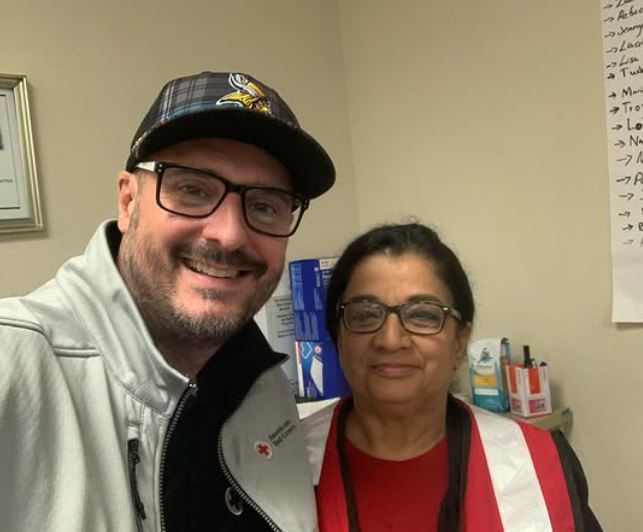
Brice Johnson with regional executive assistant Neela in North Carolina, 2024.

Rutherford family embarks on their first Red Cross disaster response journey

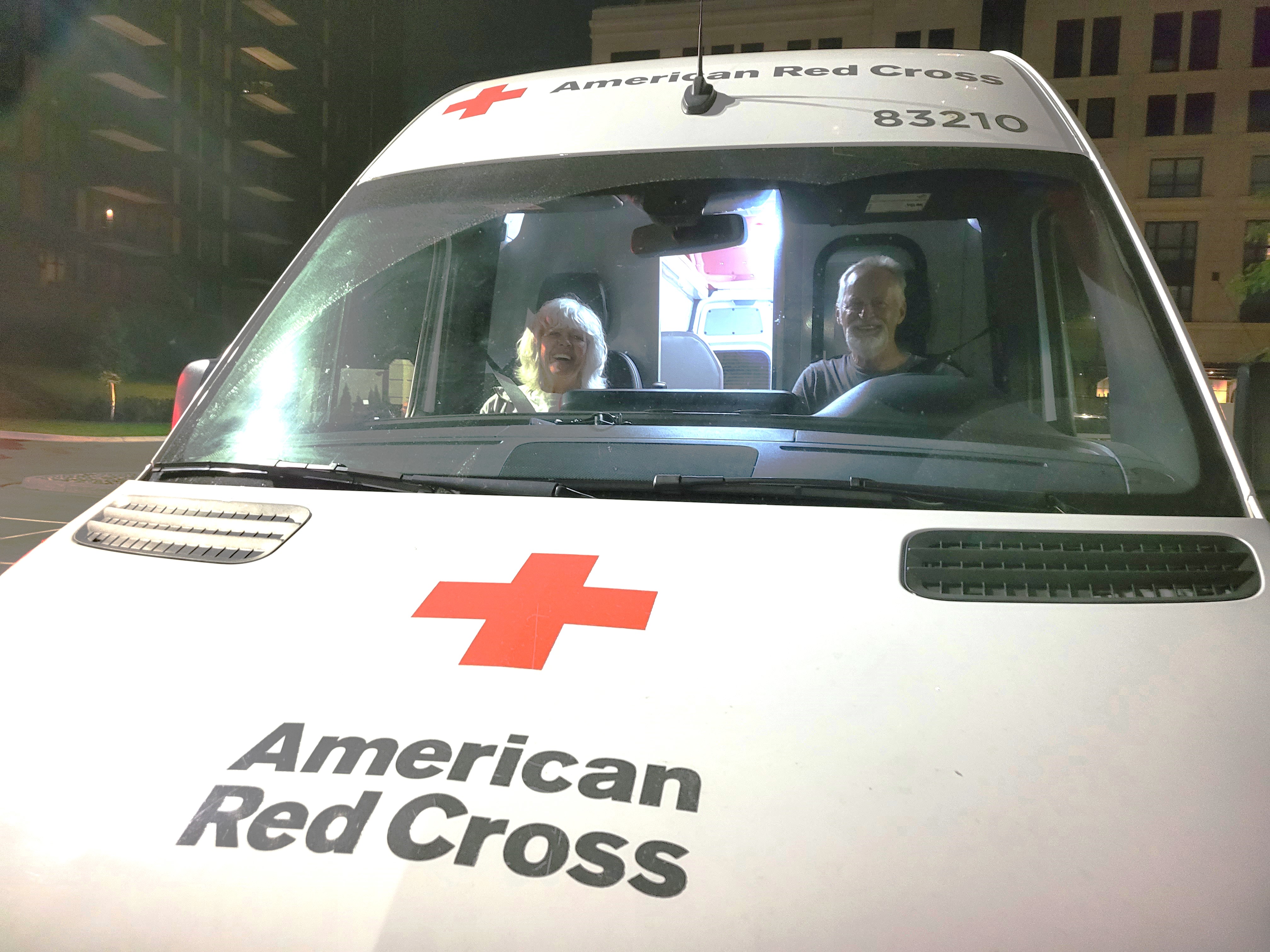
In the early hours of September 28, 2024, Susie and Charles Rutherford from Apple Valley, Minnesota, set out on an important mission. Driving a Red Cross emergency response vehicle, they left the Minneapolis Chapter building bound for Tallahassee, Florida, to support communities affected by Hurricane Helene.

Susie and Charles Rutherford began their journey to support Hurricane Helene relief efforts by driving a Red Cross emergency response vehicle from the Minneapolis Chapter building to Florida – September 28, 2024. (Photo – Carrie Carlson-Guest, American Red Cross)

This marked Susie and Charles’s first national deployment as Red Cross disaster volunteers. For their daughter, Lindsey Heald, a regional philanthropy officer for the Minnesota and Dakotas Region, it felt natural. “I’m so proud of them,” Lindsey shared. “Growing up, they taught me the meaning of compassion. Now, seeing them bring that same spirit to the Red Cross is incredible.”

For Susie and Charles, the chance to serve together was a gift. “What better way to serve others than side by side with my husband?” Susie said. Both felt a mix of excitement and a reassuring sense of readiness. “The Red Cross prepared us so well,” Susie explained. “Even if we didn’t have every answer, there was always a supervisor on call to guide us. Flexibility was key; we had to embrace the ‘Semper Gumby’ (always flexible) spirit because roles change constantly in disaster zones.”

Over 19 days, the Rutherford’s witnessed both devastation and resilience as they navigated towns transformed by the storm. “Thousands of trees were down, and buildings were damaged or destroyed,” Susie recalled, painting a powerful picture of the scene. Amidst the destruction, there was an unbroken rhythm of recovery—state workers clearing roads, power trucks restoring electricity, and community members coming together.

Susie and Charles Rutherford pictured outside the emergency response vehicle they drove to Florida for Hurricane Helene and Milton relief efforts. (Photo submitted.)

Their role was to deliver hundreds of hot meals daily to shelters, community centers, and other gathering spots for those affected. For the Rutherford’s, the appreciation they saw in the people they served was unforgettable. “The heartfelt gratitude in their eyes will always stay with us,” Susie reflected.

Example of damage caused by Hurricane Helene is a neighborhood the Rutherford’s drove through. (Photo submitted.)

The community’s gratitude was evident at every turn. “People would honk and give us a thumbs-up when they saw the Red Cross logo on our vehicle,” Susie smiled. “Even police officers stopped to thank us as we refueled.”

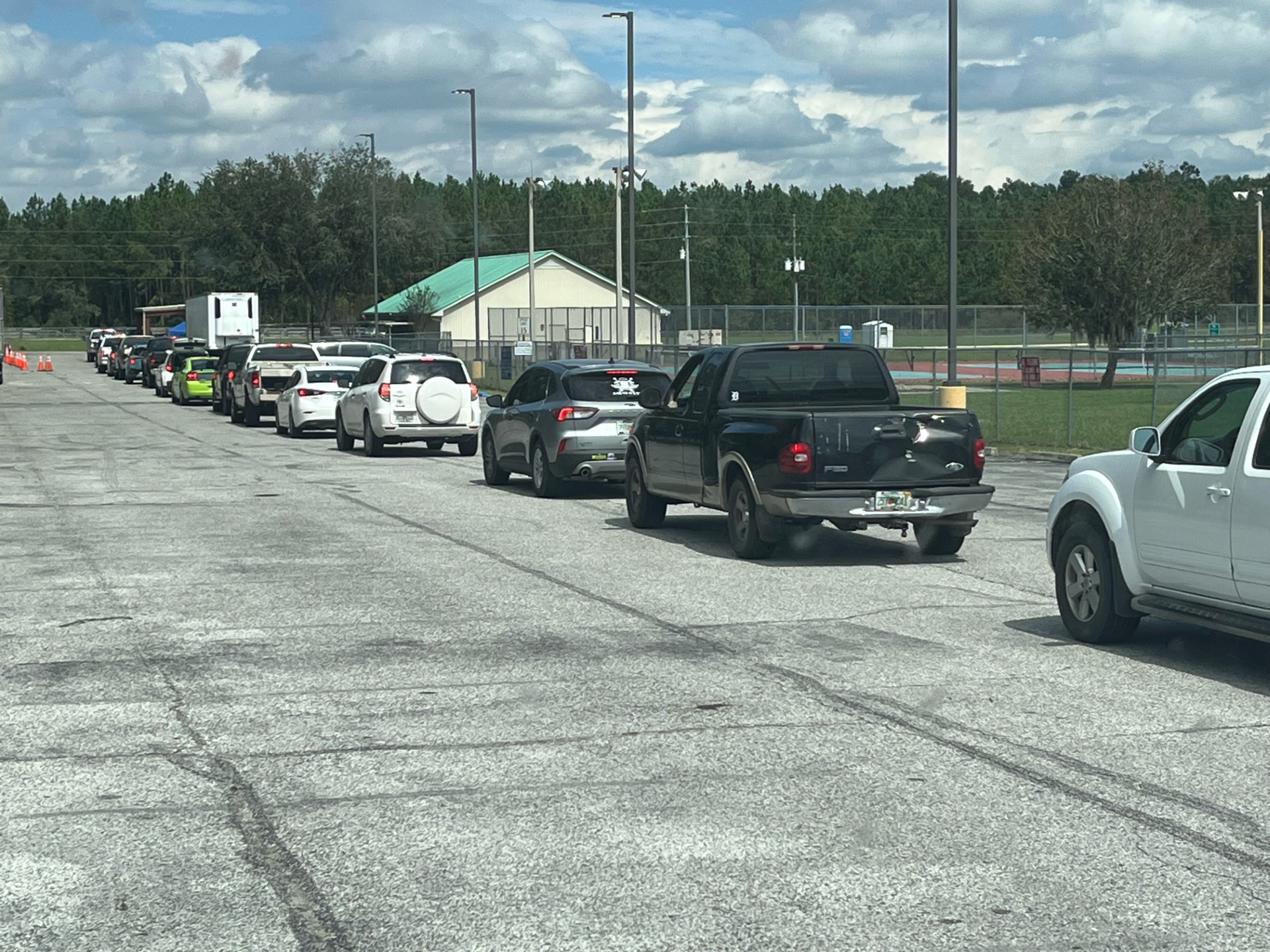
Line up of cars coming to the shelter where the Rutherford’s were serving food near Tallahassee, Florida. (Photo submitted.)

The hurricane response gave Lindsey a meaningful opportunity to contribute. “I was grateful to step up and support my colleagues in Asheville, North Carolina, for my first virtual deployment!” she shared. “This experience has left me with an extra soft spot for my Red Cross friends in the Carolinas.” Lindsey adds, “I’ve chosen to focus my career here at the Red Cross because I love this work. With my parents now volunteering, it has brought our family closer, strengthening our dedication to helping others through the Red Cross mission.”

The Rutherford’s journey left them with a deep sense of pride and fulfillment. “Helping people in their hardest moments is an honor,” Susie said. “If you’re thinking about volunteering, there’s a place for you here.”

Susie and Charles Rutherford pictured with their children at their surprise 50th wedding anniversary celebration, June 2024. (Pictured left to right – Charles, Susie, Lindsey, Briana, and Charlie – photo submitted.)

Join the Red Cross and make a difference. Sign up at redcross.org/givetime or donate at redcross.org or by texting HURRICANES to 90999.

Minnesota woman honors parents while helping her country

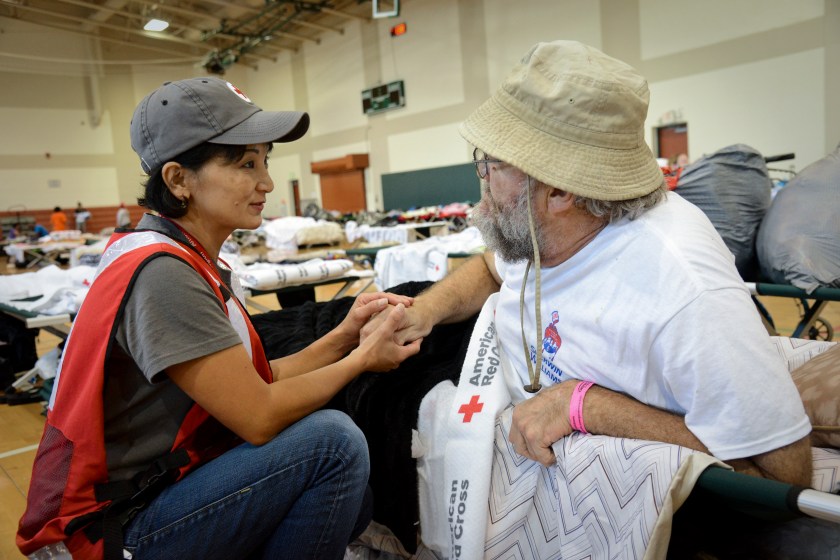
Red Cross volunteer Dun Bui talks with a Hurricane Irma survivor at the Red Cross shelter in Estero, Florida. Photo credit: Daniel Cima for the American Red Cross

Dun Bui is following the example of her mother and father by supervising an American Red Cross shelter for people in Estero, Florida, affected by Hurricane Irma. “Mom and Dad did charity work back home (in Vietnam),” she says.

Though they live in the United States, Dun’s parents went back to Vietnam to buy food and water to help an orphanage and others in need. “That’s what they did in the past so I thought it would be a wonderful idea to do,” she says. “America’s my home, so I want to volunteer here.”

A volunteer from the Twin Cities Chapter of the Red Cross in Minnesota, Dun has been working as night supervisor in a shelter for more than 450 displaced people, making sure people temporarily living there have food and other services – “that everything that’s needed is available and ready.” She also translates for those who speak Vietnamese and need disaster relief.

She started with the Red Cross after the terrorist attacks on Sept. 11, 2001, took a break for a while and then reactivated, deploying to help last year after flooding in North Carolina. Dun is one of more than 2,700 Red Cross workers who are responding to Irma. “Giving back to the community … really inspires me,” she says.

Story by Pauline Jelinek. Click here to learn more about the Red Cross response to hurricanes Harvey, Irma and Maria.

Red Cross for life after Katrina

IMG_8628_2
It’s been ten years since Katrina, and Dan Hoffman is still a dedicated Red Cross volunteer. Photo provided courtesy of Dan.

“I became a Red Crosser for life after Katrina.” Ten years ago, Dan Hoffman, from New Brighton, Minnesota, was one of 245,000 Red Cross disaster workers who responded to Hurricane Katrina, which hit the Gulf Coast on August 29, 2005. Dan recently sat down with Red Cross intern Vivi Engen to look back on his experience.

Tell me about how you got involved with Katrina.

Katrina was my first national deployment. At the time, I was an employee for the Red Cross at the St. Paul Chapter and a trained disaster volunteer. I got a phone call on the day the storm hit asking if I wanted to deploy, and I accepted. I was on a plane later that afternoon headed down to Houston. From Houston, I was assigned to work at a 6,000 person American Red Cross shelter at the Convention Center in Baton Rouge, Louisiana.

The Convention Center in Baton, Rouge, LA where Dan worked during is deployment.
The Convention Center in Baton, Rouge, LA where Dan Hoffman worked during is deployment. Photo provided courtesy of Dan.

What was it like to be at the shelter?

The first few days I would describe as organized chaos. Buses and helicopters unloaded a steady flow of scared, mud-covered people just pulled from disaster. We knew what we needed to do–what the Red Cross always does–everything from setting up portable showers outside the convention center, to providing clothes and hygiene kits, and registering people and contacting other shelter locations to find lost loved ones. We did this for 12 hours a day, and just like the refugees, slept on cots. We saw, and lived it all. I knew that I was part of something big and wouldn’t have wanted to be anywhere else.

Tell me about what you did there.

I think a better question is what didn’t I do. I worked the floor so I did whatever needed to be done. I did everything from giving teddy bears to kids, diapers to moms, to taking down names of people sleeping on cardboard boxes because we ran out of cots early on and pushing people around in wheelchairs who couldn’t walk. But more than anything I would just listen. These people were hurting and needed to tell their story.

What were some of the stories that had an impact on you?

Red Crossers busy at work in the shelter.
Red Cross relief workers busy at the shelter in Baton Rouge, Louisiana. Photo provided courtesy of Dan Hoffman.

I’ll tell you a few of my favorites…

Miss Evelyn was one of our shelter residents. Her home had been destroyed by the storm, and when the rescue crew came to save her, they told her she had to leave her dog, Pepper, behind. Pepper was Miss Evelyn’s only family, and she was heartbroken without him. There was a pet shelter set up at Louisiana State University, and a couple of days after talking to Miss Evelyn, I stopped over there while on a supply run to see if I could find her dog. I found a Red Cross worker and asked her if she had seen Pepper and she said she would be in touch. A few days later, I received a few photos of different dogs at the shelter. I showed them to Miss Evelyn and, wouldn’t you know, there was Pepper smiling back at her in one of the photos.

Another woman, Hattie Mae, came to the Red Cross shelter unable to walk, and unable to fit into a wheel chair. A day later I stopped by the local hospital and “commandeered” an over-sized wheelchair to lend to Hattie Mae because she needed something to get around in. I will never forget the look on her face, or the hug that she gave me, when I came back with that chair.

Cots were set up all through the Convention Center for refugees who lost their homes.
Cots were set up all through the convention center in Baton Rouge, Louisiana, for Hurricane Katrina refugees who lost their homes. Photo provided courtesy of Dan Hoffman.

Miss Amelia, another refugee, who was a kind of matriarch over a large family community, introduced me to her family. “This is Mr. Dan, he’s Red Cross, so listen to him.” It sure gave me instant credibility. Then she turned to me and said “You came all the way form Minnesota to help us, you must be an angel.” I am no angel, but I do share the gratitude that the refugees had for my work, for the experience that they gave me. The people at the shelter who had lost everything were so gratified, so appreciative for the smallest things that it changed the way I see life today. And that’s something I will never be able to repay them for.

How did this experience transform your commitment to the Red Cross?

After Katrina, I realized that the work that the Red Cross does is my calling. Once I came home, I shared all of the incredible stories I had been told, what the Red Cross did and how the Red Cross helped all these people.  Just like the stories of the shelter refugees needed to be shared, so did the Red Cross’.

Katrina Pix 027_2
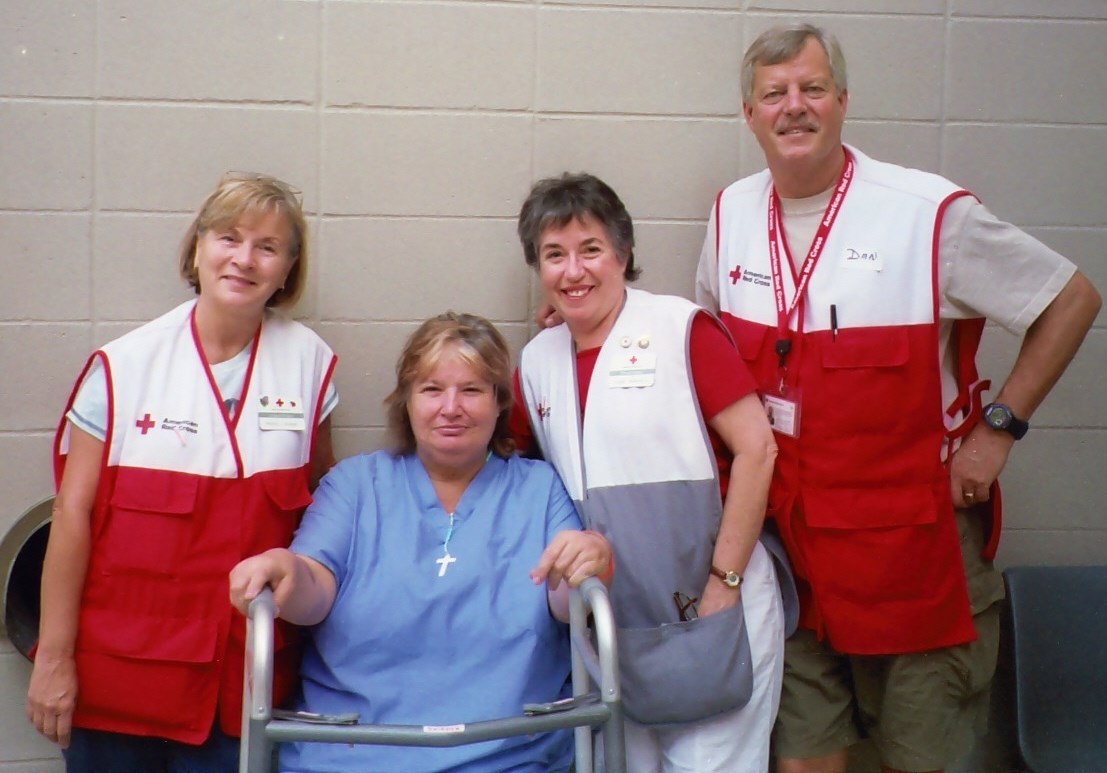
Dan Hoffman (far right) with other Red Cross disaster relief workers and a Hurricane Katrina refugee in Baton Rouge, Louisiana. Photo provided courtesy of Dan.

Is there anything you’d like to add?

I’d like to finish up with a woman named Misty. While working at a shelter as a volunteer, you half adopt people while you are there, meaning there are certain individuals that you go in to check on or eat with them on a regular basis. Misty was one of those people for me. Misty is a poet, and on the day of the storm she wrote a poem that was angry. Angry at Katrina and all of the destruction it had caused and how it impacted her–she lost her dog and everything she owned. A few weeks after I got home, I received a letter in the mail. It was another poem from Misty titled “Thank You”. The last line of the poem read “memories of you will never leave my heart.”  Now I ask you, how could an experience like that not change your life?

To learn more about how you can volunteer with the Red Cross, chick here.