Small but mighty Red Cross societies, working hard and not alone

 By Lynette Nyman/IFRC 

“Everything was good until Beryl came,” says Delta Alexander, a lifelong resident of Union Island in St. Vincent and the Grenadines.
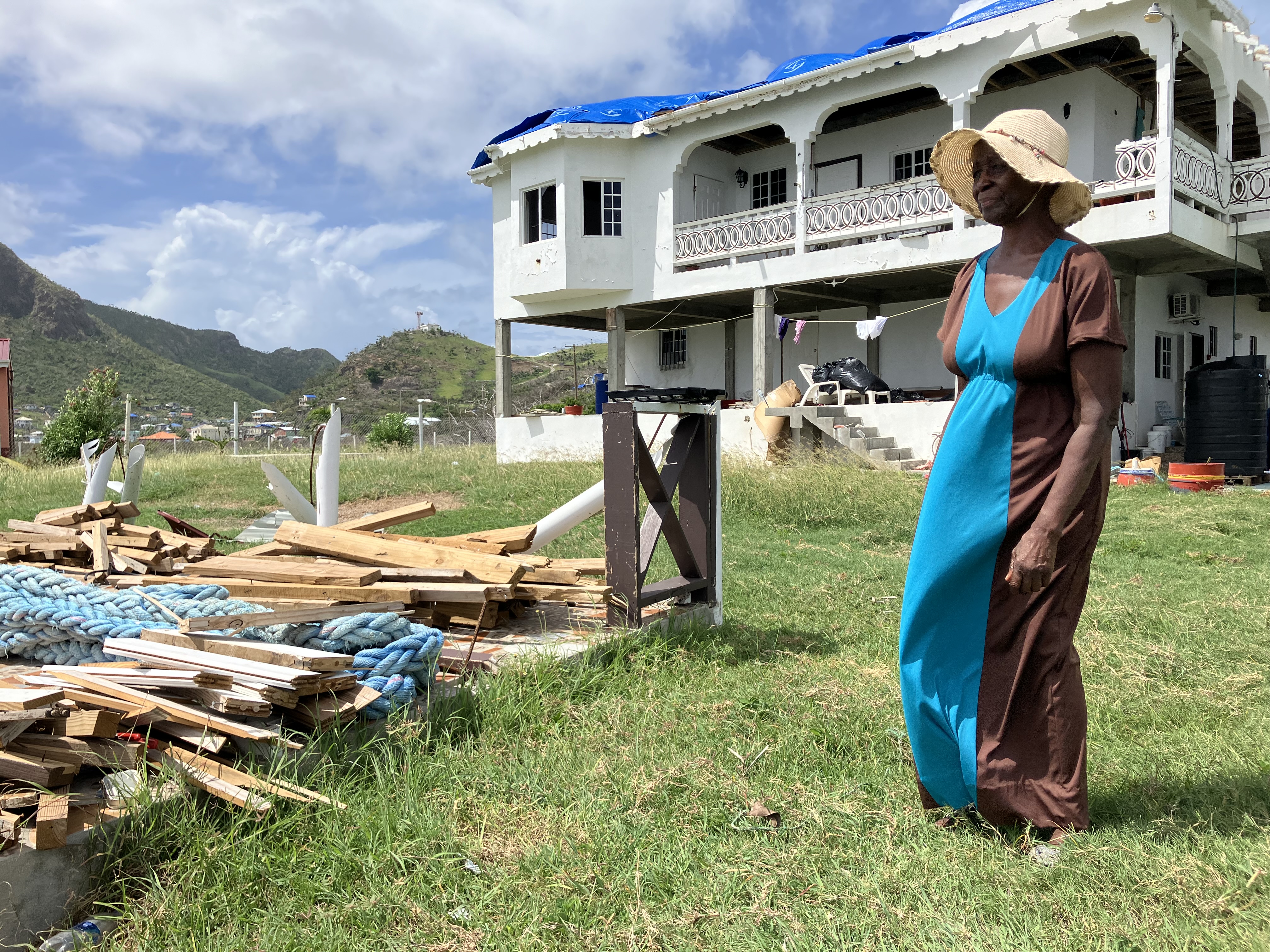
“Everything was good until Beryl came,” says Delta Alexander, who was born and raised on Union Island in St. Vincent and the Grenadines. She is grateful for the care and support that the local Red Cross provided following Hurricane Beryl. Photo: Lynette Nyman/IFRC 


She’s thankful for the care and support the local Red Cross provided after Hurricane.

Beryl. Delta left Union Island in 1969, always planning to return, and in 2015, after retiring from a nursing career in Canada and the U.S., she came back to rebuild her life.

For the next three years, she built a home and continued her humanitarian work in this tight-knit community. The hurricane hasn’t slowed her down.

“The people I’m grieving for are those in shelters. They have no money, nowhere to go. They lost everything, houses, clothing, even underwear,” she says.  

Her house, situated on low land near the shore, was quickly surrounded by high water during the category 5 storm that struck parts of the Caribbean on July 1. The winds, too, were a threat. For four hours, she held back a door, dislocating her shoulder. At 78, her strength and generosity are inspiring.  

“I saw death right there. How am I going to escape?” she recalls asking herself during the storm.   

The trauma connected her with St. Vincent and the Grenadines Red Cross (SVGRC) volunteers who responded to help people on multiple islands and the mainland. 

Early in the emergency, Red Cross volunteers set up relief operations at a church on Union Island, distributing non-food items as well as a space for people to share their experiences – it was much-needed and appreciated emotional support.   

“Red Cross was wonderful. People were very nice. So soothing. Helpful and encouraging,” says Delta.  

Small society, many hazards 

The SVG Red Cross is a young national society that gained its independence from the British Red Cross in 1984. Today, the SVGRC is comprised of a nearly 100 percent volunteer workforce, including key leaders like Shaneika Laidlow who manages their disaster and mental health programs. Their aim, she says, is to help people get back to normalcy.  

“We offer assistance to those who most need it, to the best of our ability,” says Shaneika Laidlow, who manages disaster and mental health programs for the St. Vincent and the Grenadines Red Cross. Photo: Lynette Nyman/IFRC

“During these times people can get very frustrated. Does the Red Cross care for them?” says Shaneika, who is based in the nation’s capital on the mainland, St. Vincent. The answer is yes. 

“There are so many people we would love to make better, but there are some things we’re unable to do at this time because of restraints. We offer assistance to those who most need it to the best of our ability,” she says.  

The scope of the work, and the potential need, is challenging. This small nation and Red Cross society faces multiple hazards, including tropical storms, flooding, hurricanes, and even an active volcano.  

In early October, monitoring showed unusual thermal activity of the La Soufriere volcano – activating the government to issue a low-level warning and close the trail to the summit.  

La Soufriere, shrouded in clouds, is an explosive volcano that most recently erupted in 2021. It’s one of several hazards facing the St. Vincent and the Grenadines Red Cross. Photo: Lynette Nyman/IFRC 

The thermal anomaly stopped, but reminded many of past explosive eruptions like the most recent in 2021 when, on April 9, the dome inside the crater blew and for days spewed devastating volcanic ash across communities. 

“It was like the sun was out, but not there. It was all dark,” remembers Edwin Joe, who lived in the countryside distant from the ‘red zone’. He remembers ash covering everything. “Just white everywhere, like bright snow with no sun. We didn’t know what was going to happen.”  

Edwin Joe evacuated the St. Vincent, the mainland, for two weeks following the eruption of the volcano La Soufriere in 2021 and returned to find houses that had roofs collapsed from the volcanic ash. Photo: Lynette Nyman/IFRC 

Edwin evacuated the mainland for two weeks and returned to find some houses that had roofs collapsed from the volcanic ash. Many people stayed in shelters for several months. 

The Red Cross formed part of the response with the government and other emergency partners, providing water, relief items and temporary housing assistance.  

Help around the corner 

The good news is that during challenging times a small Red Cross society like the SVGRC can turn to other national societies for help, primarily through the International Red Cross and Red Crescent (IFRC).  

Raziel Uranga, a Mexican Red Cross responder with decades of disaster response experience deployed through the IFRC ‘surge’ program to serve as response operations support in St. Vincent and the Grenadines. His predecessor, he says, arrived just a few days after the hurricane, helping the SVGRC manage a large disaster response. 

Photo 4 – Small Red Cross societies “need support from the global Red Cross network in order to grow as fast as they can, especially with the multiple hazards they’re facing,” says Raziel Uranga from the Mexican Red Cross, now deployed to support the SVG Red Cross provide relief for people affected by Hurricane Beryl. Photo: Lynette Nyman/IFRC

“Red Cross is the best humanitarian movement in the world, I am convinced, because no other organization has the workforce that we have,” says Raziel, whose passion lies in reducing risks amid the rising frequency of severe disasters.

Responders and donors from around the world – and in their own communities – have provided relief for people affected by Hurricane Beryl.  

It’s uplifting for many to see this unified effort. And yet, when something big happens, a small national Red Cross society like the SVGRC needs help to do its best now and beyond.  

“They need support from the global Red Cross network in order to grow as fast as they can, especially with the multiple hazards they’re facing,” says Raziel.  

These hazards can destroy homes and livelihoods. Building back both is the focus on Mayreau, an islet just a short boat ride from Union. Wheelbarrow by wheelbarrow, people are removing rubble to restore the island’s sole income, tourism.  

“We have to clean up this island to get tourism back – to get people back from Martinique – to see the turtles,” says Patrick Forde, a water-taxi driver before the storm.  

“We have to clean up this island to get tourism back – to get people back from Martinique – to see the turtles,” says Patrick Forde, a water-taxi driver before the storm devastated Mayreau, an islet in the Grenadines. Photo: Lynette Nyman/IFRC 

Patrick rode out the hurricane in a small cupboard with his two children. “I’m lucky to be alive,” he says when looking back. 

Tiny but mighty, what he loves about his island is the way people unite. “Whenever there’s a disaster, we all show up and work together.” 

Learn more about the work of Red Cross societies around the world, like SVGRC, through the IFRC, click here.

I Went to Cuba!

By Kathryn Schmidt/American Red Cross Volunteer

Cuban Red Cross (Cruz Roja Cubana) is one of 189 national Red Cross Red Crescent national societies around the globe. Photo courtesy of the author.

Few Americans can say that they’ve traveled to Cuba. I am one of them. One of our closest neighbors geographically, but a nation without diplomatic relations with the United States, travel to Cuba is limited for U.S. citizens. There are select organizations and professions that can obtain special permits for travel to Cuba. One such organization is where I work: Global Volunteers, which allowed me to take part in its Cuba People-to-People program in April. I was eager to meet the Cuban people, and learn something about their history, culture and lifestyle.

In the weeks before our departure, I learned that there was an opening in our schedule. I suggested to our group that we might visit the Cuban Red Cross (or Cruz Roja Cubana). After searching for a Cuban Red Cross contact via the American Red Cross national headquarters in D.C., my travel group wrote and received an email reply that our Global Volunteers group of sixteen Americans and one Cuban tour guide were welcome to visit the Cuban Red Cross headquarters in Havana at the designated date and time.

Our visit came on the third full day in Cuba. So, already we had seen how few goods were available to most people, how many lived in shabby housing, how they lacked resources to repair beautiful, but crumbling buildings since 1959, and how most people had warm smiles and expressed themselves through art and music. We hoped our presence would contribute to better relations between our countries in the future, and we knew our new Cuban friends hoped the same thing – they said so with words and hugs.

Red Cross volunteer Kathryn Schmidt (l) and Dr. Luis Foyo Ceballos, Director of the Cuban Red Cross (r) in Havana, April 2014. Photo provided courtesy of the author.

En route to our meet-up, I gave an introductory presentation about the Red Cross to our group comprised of people from Washington, Massachusetts, Florida, Arizona, and states in-between. My crash course included the story of Henry Dunant and how he founded the International Red Cross and Red Crescent Movement, the Geneva Conventions, the International Red Cross and Red Crescent Federation (IFRC) and its 189 national societies around the world, and what our local chapters do to support the American Red Cross mission to prevent and alleviate human suffering in the face of emergencies.

Upon our arrival, Dr. Luis Foyo Ceballos, Director of the Cuban Red Cross, welcomed us. He gave a great presentation in Spanish, which our tour guide interpreted into English. At times, I was able to connect some of his presentation to mine for the group, especially regarding the 7 Red Cross Fundamental Principles and our work responding to natural disasters. I shared brochures and pins with our local Red Cross hosts. Then, we took a couple pictures together and parted with hearty handshakes.

To me, our visit was Red Cross neutrality and independence in action. Our two countries are about as far apart politically as two countries can be, and yet we talked in this place about our common pursuit of serving humanity with volunteers when disasters strike. Even though commerce is not possible, the American Red Cross was able to support the Red Cross disaster response to Hurricane Sandy in Cuba.

Before our visit, my group had seen stark differences between our countries. Now, we had experienced one humanitarian movement in two nations transcending political boundaries.

On May 8, people around the globe will celebrate World Red Cross Red Crescent Day. Click here to learn more about the Red Cross story and how you can share yours.

What is World Red Cross Day?

Henry Dunant, Founder of the Red Cross
Red Cross founder Henri Dunant.

More than 150 years ago, a single man inspired a movement to alleviate suffering around the world.  This week, on May 8, we celebrate Henri Dunant’s birthday and honor his legacy.

In 1859, in what was known as the Battle of Solferino (in modern Italy), Henri Dunant, a social activist from Switzerland, and winner of the first ever Nobel Peace Prize, worked tirelessly to bring food, shelter, and medical aid to the tens of thousands of wounded soldiers on both sides of that battle.

Five years later, the First Geneva Convention was signed, establishing a neutral organization that would care for sick, wounded, displaced, and even imprisoned, regardless of race, religion, ethnicity, or military affiliation in armed conflict. That organization would become known as the Red Cross.

In 1948, after it was suggested that an annual “Red Cross Truce Day” be held between the Czech Republic and Slovakia, once Czechoslovakia. This initiative became broadened to encompass countries from across the globe and evolved into what we now call the World Red Cross & Red Crescent Day, which celebrates the International Red Cross and Red Crescent Movement. Today, the Red Cross is comprised of more than 13 million volunteers. It assists more than 300 million people worldwide each year. May 8 also marks Henry Dunant’s birthday (born in 1828). We celebrate his vision for a more peaceful world and what it’s meant for all future generations.

–Hayes Kaufman/American Red Cross

Why Do We Share Disaster Survivor Stories?

Image
Tornado survivor Martha Hall, 65, had no time to escape her house in West Liberty, Kentucky, on March 2, 2012. "We heard the roaring," says Hall. "It kept going and going and never stopped."

“…the brain prioritizes stories over statistics, and the more personalized the stories, the more powerful the imprint,” writes TIME contributor Amanda Ripley in her introduction to the magazine’s current special issue Time: Disasters that Shook the World. “…there is great practical value in telling stories, particularly when they are told with useful lessons attached.”

The TIME special issue marks the 100th anniversary of the RMS Titanic sinking on April 15, 1912. New research continues to teach us more about how the accident happened and why many died. Much of what we know—and what moves us emotionally to take action—comes from disaster survivor stories.

Image
In this corner, covered with a mattress and blankets, Martha Hall and her brother survived the the tornado. "It went BOOM," says Hall. "We could feel the house move."

The Red Cross knows this. We provide essential disaster relief to the most vulnerable among us. During relief response, we have the privilege of serving as listeners while people talk to us about remarkable acts of courage, strength, and resilience. We share their stories because personal accounts inspire you to give money for disaster relief, to take steps for being prepared for emergencies, and to become a Red Cross volunteer who makes disaster relief happen.

Image
Red Cross disaster relief worker Anita Foster hugs Martha Hall, who was recovering personal items from her home destroyed by the March 2 tornado in West Liberty, Kentucky.

During this time of remembering the Titanic, we encourage you to continue to learn about people affected by disasters here and around the world. Additional ready resources include redcross.org, ifrc.org, and icrc.org.

Post and images by Lynette Nyman, American Red Cross. Amanda Ripley is the author of The Unthinkable: Who Survives When Disaster Strikes–and Why.

Red Cross Family Tracing Helps Husband and Wife Live Again

With Red Cross help, Abdiaziz Warsame, 35, learned that his wife is alive after being abducted by militia six years ago in Mogadishu, Somalia. He now lives in Minneapolis, Minnesota, with his son. Photo credit: Lynette Nyman/American Red Cross

Abdiaziz Warsame has lived in Minneapolis for the past six years taking care of his son and anticipating a life without his wife, his son’s mother. That was until he reached out to the Red Cross and its family tracing services.

“I am really thankful to the Red Cross for the job they did for me and my family,” says Warsame. “I gave up until the Red Cross found her alive.”

Abducted by militia in Mogadishu, Somalia, there was little reason for Warsame to believe that his wife was anything but dead. He fled with his son to Cairo, Egypt, where he sought refuge with the United Nations. His son’s condition, which includes brain damage and some paralysis, prompted a quick departure for an operation in the United States.

“I will not forget how the Red Cross helped me find my wife and how the Americans have been good to us,” says Warsame.

Abdiaziz Warsame, 35, fled Mogadishu, Somalia, with his son Shamusdin, 10, who has brain damage and paralysis. Red Cross family tracing services helped find Warsame’s wife alive in Somalia. Photo credit: Lynette Nyman/American Red Cross

The Red Cross sent a message from Minneapolis to Washington D.C., to Geneva, Switzerland, and then to the Red Cross in Nairobi, Kenya. From there, the Somali Red Crescent conducted a field search and found Warsame’s wife, Ayan Mohamed, in Mogadishu. They returned a message in the opposite direction that the Red Cross delivered to Warsame in Minneapolis.

The message came with a phone card, which Warsame immediately used to call his wife who had no idea her husband was living in America. Now, Warsame talks on the phone with his wife every day.

“We married for love,” says Warsame. “These six years are like 60 years. For that reason we live when we talk to each other.”

Warsame wants to be reunited with his wife—who also survived a bullet wound with Red Cross medical services in Somalia. “My son always says ‘where’s my mom,’ but I am so happy,” says Warsame. “I have found her now and hope to bring her here.”

Learn more about Red Cross family tracing and international services. Story and photos by Lynette Nyman/American Red Cross, with assistance from Yahye Mohamed/American Red Cross. Posted February 22, 2012

Help the Red Cross and the Red Cross Helps You

For Liz, not working for the Red Cross is like not breathing. Wherever she goes, she wants to know: “Où est la Croix Rouge?”… “Where is the Red Cross?”

Let’s start with a war in east Africa in the 1990s. We know this war that happened in Rwanda and how people fled to nearby Democratic Republic of the Congo (DRC).

“Help the Red Cross and the Red Cross helps you,” says Liz, who started with the Red Cross in the Democratic Republic of the Congo. “I am going to help the Red Cross until my death.” Photo credit: Lynette Nyman/American Red Cross

Some know this war better than others. Among them is Liz, a former Red Cross nurse who lived in a DRC border town with Rwanda.

“We gave food to refugees, put up tents, gave medical care, sent messages to families,” says Liz.

Liz responded for four years. As a Red Cross nurse, she tended to the war wounded, or in French “les blessés de guerre.” She helped until it was time to leave.

“Soldiers came and they tried to recruit my sons for the war,” she says.

She fled when her family left for Zambia and became a refugee. Even so, she turned to the Red Cross and started helping others.

“We helped friends and when others arrived from the Congo. We helped them with food, blankets, dishes, and pots. We approached them, to help them.”

Then she flees again. This time to South Africa where her passion for the Red Cross was put aside for getting food and money to support her children.

“Life there was hard. I could not work for the Red Cross in South Africa,” explains Liz.

Jump ahead several years to 2009 when she lands in the United States. One day while riding a bus in Minneapolis, she exits at a wrong (or perhaps a right) bus stop. That’s when she saw the Red Cross flag flying near the Mississippi River.

Dozens of manikin face masks need cleaning everyday for the next CPR + First Aid training classes. Photo credit: Lynette Nyman/American Red Cross

“I went there and I spoke to someone who asked me ‘what do you do?’ I told them and they said I will find a place for you.”

We could in this brief story dwell on the horror and trauma of war, but we will not. Instead, let’s turn to Liz and what inspires her to look for and serve with the Red Cross.

“The Red Cross helps me. It helps me to help people, to reduce suffering, to rescue people. They help me everywhere, not just in the Congo. They help people even back in the forest, sharing information. They go deep in the forest, even by foot, to help people.”

Like Red Cross people around the world, Liz serves without boundaries. In her country, she says, there’s a Red Cross song: “Night or day, blood or wound, always we serve.”

For Liz, this means serving for a lifetime, “I am going to help the Red Cross until my death.”

Liz is currently serving as a Red Cross volunteer cleaning manikins used in health and safety training classes such as CPR and First Aid for the American Red Cross Twin Cities Area Chapter in Minneapolis-St. Paul, Minnesota.

Story, photo, & video credit: Lynette Nyman/American Red Cross