Meet one of our 2012 Heroes

Elizabeth Estepp, of Ham Lake, Minnesota, is a 2012 American Red Cross Heroes Awards recipient.

One Sunday morning in Ham Lake, Minnesota, Elizabeth Estepp was at church when her pastor challenged everyone.  “He asked us to ask ourselves, if our church disappeared would the community even miss us.” Estepp and some others realized that the answer was no.  To change this, they decided to focus community outreach on bringing clothing to people. But how? Estepp slept, thought, and prayed until an idea formed. “I told my husband, we have a trailer full of junk parked outside. Let’s clean it out.” That was more than two years ago. Since then Friend2Friend, a mobile clothing ministry, has put hundreds of pounds of wear-able used clothing into the hands of people who can’t afford to buy their own.

Friend2Friend, a mobile clothing ministry based in Ham Lake, Minnesota, reaches hundreds of people across the Minneapolis-St. Paul metropolitan area.

For us, Estepp is a hero, helping to provide for people in the face of emergencies. For example, last year on May 22, Friend2Friend responded to the Minneapolis tornado, bringing clothing, toiletries, and water to people who were forced to flee their homes with little or nothing. During regular, non-disaster hours, volunteers are gathering, sorting, and hanging the clothes on racks that will later be transported to twenty church locations across the Minneapolis-St. Paul metro area. On some nights, says Estepp, more than one hundred people show up. In no time, the racks are empty and ready for new donations. “We have seen so many people struggling for the first time in their lives.” Sometimes, she says, people have found clothes to use for job interviews. “They get jobs and then come back to help.”

Pants on a mobile clothing rack hang from the upper left side, making it easy for people to find a fit.

Watching volunteers prepare donated clothing items for distribution serves as a reminder that helping others takes time and effort. Simply, it’s work. And Estepp recognizes this. “If we didn’t see the definite impact we wouldn’t be able to keep it going.” The impact extends from a homeless person needing a jacket to a widower finally feeling good enough about emptying his deceased wife’s closet. Or to a volunteer feeling worth-less until putting his trailer-pulling skills to work for a worth-full cause. Or to Estepp listening to a question and finding an answer because “this is what energizes me.” She’s making plans too: getting Friend2Friend’s food pantry on wheels.

Estepp and the other 2012 Heroes will be honored at the annual American Red Cross Heroes Breakfast on Thursday, May 24, at Target Field in Minneapolis. The public is invited to attend, help recognize local heroes, and support their local American Red Cross. Tickets and table sponsorships are available online at redcrossmn.org.

Story and photos by Lynette Nyman/American Red Cross

Wildfire Risk High For Much of Minnesota

Image
Samantha Schmidt, 9, spent the night at a Red Cross shelter for wildfire evacuees in Colorado. (Photo credit: RJ Sangosti / The Denver Post).

The American Red Cross is providing food and shelter in Colorado where a fast-moving wildfire has already forced hundreds of people from their homes with thousands more put on notice that they may also have to evacuate.

Wildfires in Minnesota are unlikely to occur in high density population areas, but state officials say that much of Minnesota is at increased risk of wildfires because of continued snow melt, warming weather, and dry vegetation. The risk will remain high, state officials say, until green vegetation emerges. (Source: Minnesota Department of Natural Resources)

The Red Cross encourages everyone who might be at risk or in a path of possible evacuation because of wildfires to prepare now.

IF A WILDFIRE THREATENS your neighborhood, back your car into the garage or park it in an open space facing the direction of escape. Wildfires can spread quickly, igniting brush, trees and homes. The Red Cross has important steps people can follow to lessen the threat of a wildfire. Confine your pets to one room so you can find them if you need to get out quickly. Listen to local radio and television stations for updated information, and be ready to leave at a moment’s notice. These steps will help limit exposure to smoke:

  • Keep indoor air clean by closing windows and doors to prevent outside smoke from getting in.
  • Use the recycle or re-­circulate mode on the air conditioner in your home or car. If you do not have air conditioning and it is too hot to stay inside with closed windows, seek shelter elsewhere.
  • When smoke levels are high, do not use anything that burns and adds to indoor air pollution, such as candles, fireplaces and gas stoves. Do not vacuum because it stirs up particles that are already inside your home.
  • If you have asthma or another lung disease, follow your health care provider’s advice and seek medical care if your symptoms worsen.

BEING PREPARED can be your best offense when it comes to wildfires. You should plan two ways out of your neighborhood in case one is blocked. Set up a place for family members to meet outside your neighborhood in case you can’t get home or need to evacuate. Arrange for temporary housing at a friend or relative’s home outside the area. Post emergency phone numbers by every phone in your home and in everyone’s cellphone.

Other steps you can take include:

  • Make sure driveway entrances and your house number or address are clearly marked.
  • Identify and maintain an adequate water source outside your home, such as a small pond, cistern, well or swimming pool.
  • Set aside household items that can be used as fire tools: a rake, ax, hand saw or chain saw, bucket and shovel. You may need to fight small fires before emergency responders arrive.
  • Select building materials and plants that resist fire.
  • Regularly clean roofs and gutters.

More wildfire steps and tips are available. Check out The Denver Post for more on the ongoing wildfire and response in Colorado. You can text REDCROSS to 90999 to give $10 and support Red Cross disaster relief.

Volunteers are the heart of the Red Cross

Below, a note of thanks from Jill Hallonquist, Emergency Services Director, American Red Cross Northern Minnesota Region, who is now enjoying a well-deserved vacation.

This morning I woke up thinking about the Governor’s emergency management training conference that I’m attending this week.  Many of our partners throughout our response region are in St Paul for this training. I have been chatting with Emergency Managers, Public Health, Homeland Security, Salvation Army, NECHAMA, and other friends of ours from across the Minnesota. Many of them ask how the Red Cross is doing these days.  Most know that we have a new region structure and wonder how that’s going.

Red Cross volunteers answered questions from attendees of the 2012 Governor’s Homeland Security and Emergency Management Conference. Photo credit: Andrea Bredow/American Red Cross

Here’s what I tell them: I am so grateful that we have you, the incredible volunteers in their communities.  You are the heart of the Red Cross.  The restructuring that we did changed the way that staff supports the volunteers.  It did not change the fact that the person they see responding in their community is a volunteer, teaching people to be prepared and to prevent disasters, comforting those affected, and helping to connect them with the local resources they need to get back on their feet.  Your passion for helping your neighbors is as strong as ever and you’re there to help!

Do you ever catch yourself telling someone how much you like a certain person…and then you wonder if you have told THEM?  I didn’t want to let another day pass without telling you how much I appreciate each and every one of you.  You are treasured.

Click here to learn more about the 2012 Governor’s emergency management conference and click here to learn more about how the Red Cross helps in Minnesota and beyond.

Red Cross Trains Mille Lacs Band on How to Set Up a Shelter

Last fall the American Red Cross trained members of the Mille Lacs Band of Ojibwe in emergency sheltering. Below is the article about the training published in the Mille Lacs Band newspaper Ojibwe Inaajimowin and written by Jamie Edwards, public information
officer of the Mille Lacs Band of Ojibwe Tribal Emergency Response Committee.

A baby on a Red Cross cot during the Minneapolis tornado response May 2011. Photo credit: Lynette Nyman/American Red Cross

Red Cross officials were on the Mille Lacs Reservation on November 17 [2011] to train the Band’s Tribal Emergency Response Committee (TERC) on how to set up a temporary shelter. This training session helped TERC members understand the Band’s role and each of their roles in setting up an emergency shelter in partnership with the Red Cross.

After the storm in District III this past summer, committee members requested training on how to set up temporary shelters at each District’s Community Center. If any future disasters should leave Band members temporarily homeless or without basic necessities, a shelter would be the most efficient way to respond.

“Setting up a temporary shelter takes a lot of teamwork since an emergency shelter can be needed any time during the year and at all hours of the day,” said Monte Fronk, Mille Lacs Band emergency management coordinator. “TERC requested this additional training because we want to be prepared in the event that we need to set up a temporary shelter.”

In general, the process would involve the Band preparing a shelter site (such as one of the community centers) for the Red Cross to bring cots, blankets and meals. Since government entities do not normally keep these supplies in their inventories, the Duluth Red Cross [American Red Cross Northern Minnesota Region] would provide these resources under the direction of TERC. The Band would also be responsible for operating the shelter as well as services such as transportation, medical care, and mental health services.

Mii gwech to the Red Cross’s Duluth office for providing the training session…

Click here to learn more about the Mille Lacs Band of Ojibwe.

Emergency Sheltering Under One Roof

When a devastating EF-5 tornado slammed into Joplin, Missouri on May 22, 2011, St. John’s Mercy Regional Medical Center stood directly in its path. Over 180 patients – including some in operating rooms, intensive care, or the emergency room – were being treated. Dennis Manley, Director of Quality and Risk Management, returned to the hospital to help lead the evacuation of patients and staff that afternoon.

“Because of the dirt and debris blown by 200 mile per hour winds, we had difficulty identifying some of the people we treated. One doctor, in fact, treated his assistant – but didn’t realize it until much later,” Manley says.

The complete destruction of the hospital and surrounding buildings required evacuation of everyone in the facility. It took over 90 minutes, because virtually every window was shattered, corridors were blocked with debris, and doors were jammed. Fortunately, Manley observed, previous emergency drills had helped to prepare the hospital staff for many of the situations they faced that day. Advance preparation and close working partnerships with a wide variety of governmental and non-governmental organizations helped deal with the need for swift and effective emergency response.

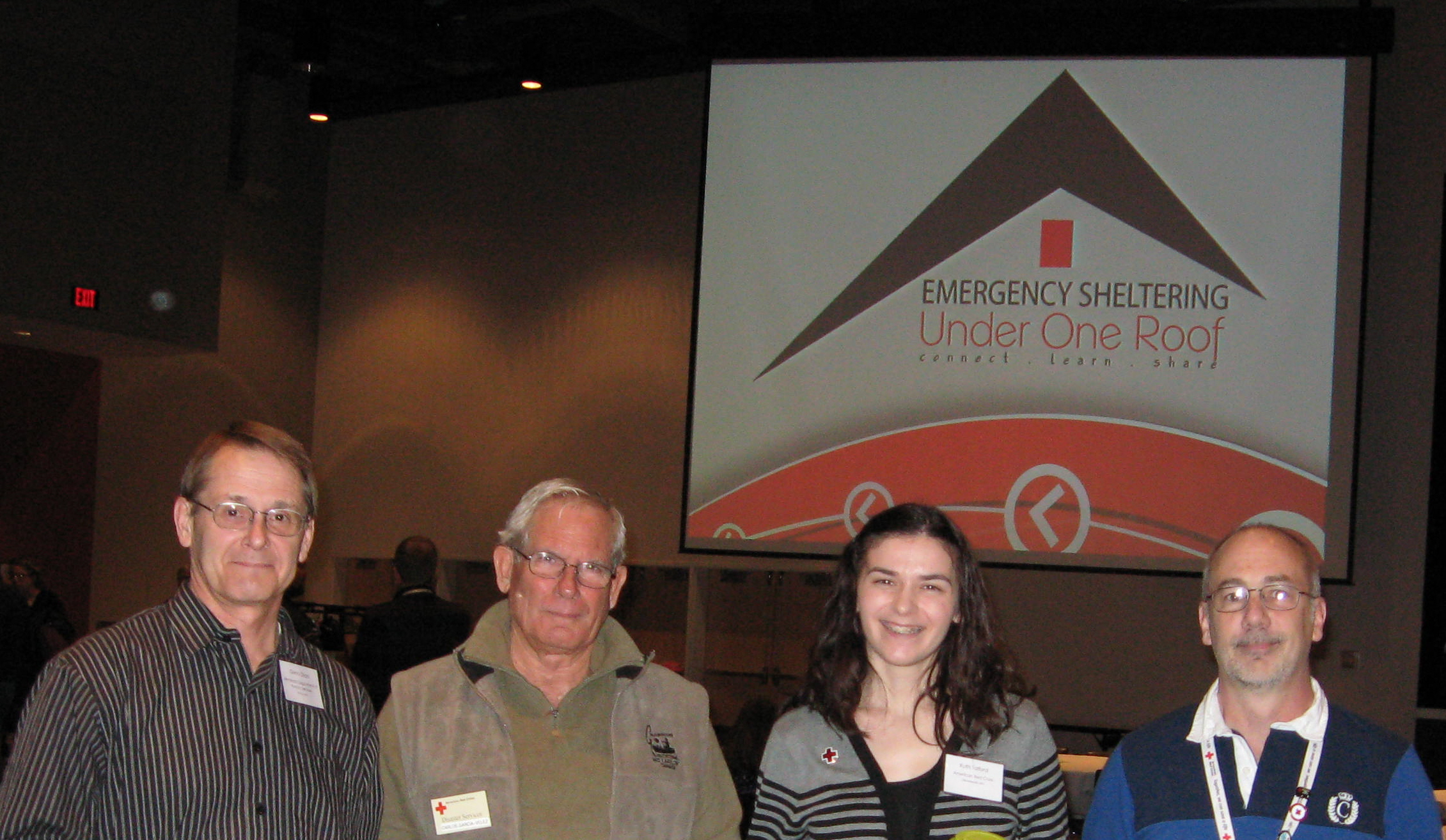
Attending the conference were (L-R) Glen Olson, Minnesota Department of Public Health, Carlos Garcia-Valez, Red Cross Northland Chapter volunteer and keynote speaker, Ruth Talford, Red Cross Readiness Manager, and Eric Nikolai, Red Cross St. Croix Valley Chapter volunteer.

Building partnerships continued when more than 275 representatives from local, state and national government public health, human services, health care, and emergency response organizations, along with community volunteer emergency responders, shared updates, networked, and heard experts at the second annual “Emergency Sheltering: Under One Roof “ Conference. Participants came from five states and Canada.

“We are focusing on mass care events such as major wildfires, tornadoes, floods, or winter storms that could displace hundreds of people,” says Tony Guerra, a Red Cross Readiness Manager based in Duluth, Minnesota.  “The goal is to strengthen and create local, regional, and national networks which help people increase collaboration.”

The American Red Cross Northern Minnesota Region and the Community Health Information Collaborative (CHIC) hosted the conference, which was held January 31-February 2 at the Black Bear Otter Creek Convention Center in Carlton, MN, and was funded by the Fred C. and Katherine B. Andersen Foundation in Bayport, MN.

During 2011 the Red Cross responded to hundreds of disasters, including the May 22 tornado that swept through north Minneapolis and left hundreds homeless. Photo credit: Jason Viana/American Red Cross

Janice Springer of St. Cloud, Red Cross Disaster Health Services Advisor for Minnesota, discussed meeting the access and functional needs of people in shelters.

”In 2011, the Red Cross opened 978 shelters in the U.S., serving more than 41,000 people with over 125,000 overnight stays,” says Springer.

Red Cross volunteer Carlos Garcia-Velez was among those who responded to disasters last year. Garcia-Velez has served as an American Red Cross volunteer in multiple roles since 1992, including leading the Partner Services and Government Operations activities through many disaster relief operations. Most recently Garcia-Velez responded in North Carolina following Hurricane Irene. Garcia-Velez challenged the sheltering conference participants to work more closely together and collaborate on all levels.

“We have to approach disasters as a whole community,” says Garcia-Velez. “Experience has taught us that we must do a better job of providing services for the entire community, regardless of their background, demographics, or challenges,” says Garcia-Velez. “This means planning for the actual makeup of a community, making sure we meet the needs of every disaster survivor regardless of age, economics, or accessibility requirements.”

Story by David Schoeneck, Red Cross Volunteer

Star Bank shines on Red Cross Holiday Mail for Heroes

The American Red Cross collected holiday cards throughout the past several weeks for distribution on military bases and hospitals, veterans’ hospitals and other locations in the U.S. and abroad.  More than a million cards were collected this year, bringing the total for Holiday Mail for Heroes to about 4.5 million cards during the past five years. One of the program’s strongest supporters is Star Bank in Eden Prairie. Katie Incantalupo explains why…

Katie Incantalupo (left) and service members helped collect more than 19,000 cards for the 2011 Holiday Mail for Heroes program. Photo courtesy of Star Bank.

The leaders of Star Bank, including both President and CEO Harry Wahlquist and I, have a strong commitment to the mission of the American Red Cross to provide relief to victims of disaster and to help people prevent, prepare for and respond to emergencies.

We’ve been hosting quarterly blood drives at Star Bank in partnership with North Central Blood Services for about 12 months. Harry is a longtime Red Cross Board Member and I’m a Lifetime Member of the Tiffany Circle Society of Women Leaders within the Red Cross. I was elected to be a member of the National Council for Tiffany Circle in 2010, and my participation in that governing body brought forth the opportunity for me to lead the Holiday Mail for Heroes campaign on a national level for the 2011 holiday season.

Katie Incantalupo (right) and Elena Luca (left), sign Holiday Mail for Heroes cards in Washington, DC. Photo by Dennis Drenner/American Red Cross

I have spoken with many service men and women over the past four months about the Holiday Mail campaign and have heard wonderful stories about how much it means to receive a card when you are serving away from home over the holidays. The card campaign makes a real difference in our service members’ lives. Star Bank hosted a card signing event that was well attended by members of the community, including several local “celebs.” I’m so excited that more than 19,000 holiday cards were signed in Minnesota alone this year!

Katie Incantalupo gets ready to donate blood. Photo courtesy of Star Bank.

It has been an honor to assist the Red Cross in growing awareness and participation on behalf of Holiday Mail for Heroes and I’m thankful that I’ve been able to serve the organization in this way, both personally and professionally.

Katie Incantalupo is a Red Cross volunteer and the Director of Marketing for Star Bank in Eden Prairie, Minnesota. The mailbox for the 2011 Holiday Mail for Heroes program is now closed, but Americans wanting to help military members, veterans and their families can visit the Red Cross holiday giving catalog and click on “Help Our Troops.” The online catalog offers symbolic donations to help provide members of the Armed Forces with phone cards and comfort kits as well as assist homeless veterans, among many other options.

Mora fire invites reflection

Once a week Angela Carlson heads to the American Red Cross Central Minnesota Chapter where she supports local disaster action team volunteers. On Thursday, December 8, Carlson received a phone call from a volunteer who said someone might have died that day from fire in the chapter’s local response area.

A Red Cross volunteer told me that her pastor had called and reported a death in an apartment building fire in Mora. The first thing I did was contact the Sheriff’s office to verify that the Red Cross had been asked to respond. When I had confirmed that they wanted us there, I called the volunteer back to dispatch her and a second volunteer responder to the scene. After starting incident paperwork, I called Judy and Dick Pike, long-time Red Cross disaster relief workers. I told Judy that I wasn’t sure why I was calling, and that I just needed some support to process the dispatch. I reviewed my next steps with Judy who was very helpful.

"I have empathy for the individuals involved and understand that it’s difficult to be in any position during a disaster," says Angela Carlson, the client services caseworker who handled the Red Cross disaster dispatch for the tragic fire in Mora, Minnesota. Photo credit: Lynette Nyman/American Red Cross

The Mora fire was the first dispatch involving multiple chapters and multiple deaths that I have been involved in since I started with the Red Cross in October. While I was at the local chapter I felt much support from staff both in St. Cloud and in Minneapolis. Being in St Cloud rather than Minneapolis that day made a huge difference in the disaster response dispatch, giving it a local and community-based feel. People there checked in with me and made sure I was doing all right. In the end, a couple people said that they really looked forward to meeting me at the next Disaster Action Team meeting. I felt the same.

I was exhausted at the end of the day. The Mora fire response left me feeling reflective of the mission and vision of the Red Cross and of the services we provide. While I can’t fully appreciate the devastation families feel after a disaster because I don’t respond on-scene, I have empathy for the individuals involved and understand that it’s difficult to be in any position during a disaster. It’s meaningful to know that our clients are being served with such compassion.

This is a response that I will carry with me, especially after learning details about the people who died. There was a phone call that I took from a volunteer who was helping family members who did not yet know that a loved one had died. There was also a surviving teenager. That has been the hardest for me to process. I’ve been thinking about her a lot and when I do my heart just breaks. But each time that happens my heart mends itself stronger and that, in turn, helps me support our Red Cross volunteers more effectively so that they can continue serving our communities in great ways.

Angela Carlson, is a client services coordinator for the American Red Cross Northern Minnesota Region. She is based in Minneapolis at the Twin Cities Area Chapter.

Generosity Abounds in Minnesota

Red Cross responder Carrie Carlson-Guest helped promote Give to the Max Day at a giveMN.org event.

We’re not surprised by your generosity even though others around the country might be. Minnesotans have long been givers–of time, wisdom, and money. This was no exception during the 2011 Give to the Max Day.

The American Red Cross in Minnesota ranked 35 out of nearly 4000 and made the Top 100 leader board. YOU donated more than $35,000 to support our mission to provide humanitarian relief during disaster and to help people prevent, prepare for, and respond to emergencies.

And so we extend our appreciation most heartily during this season of giving thanks. We can also say without a doubt that the beneficiaries of your generosity are incredibly grateful as well.

If you missed Give to the Max Day, you can still share with others. Check out our 2011 Holiday Giving Catalog.

“Gray Lady” Uniform Preserves Red Cross History

"If you keep busy and volunteer, you stay alive a little longer," says Terry Dugger, 80, who served as a Red Cross volunteer from 1968 to 1970. Photo credit: Lynette Nyman/American Red Cross

Among the treasures Terry Dugger has kept through the decades is a uniform that she wore as a Red Cross volunteer at the military hospital on Offutt Air Force Base near Omaha, Nebraska.

“We saw the fellas coming in from motorcycle accidents. I went to different rooms and passed out shaving equipment, playing cards, and other things like that. There wasn’t anybody else on the base to do it,” she says.

Dugger’s Red Cross uniform is different from those the Gray Lady Service volunteers used during World Wars I and II. This has blue and white pin stripes. Worn for only two years and in excellent condition, the uniform is now a gift from Dugger as a means to share and preserve Red Cross history.

A "Gray Lady" volunteer uniform circa 1960s preserves Red Cross history. Photo credit: Lynette Nyman/American Red Cross

Dugger, who was an air force wife for twenty years, did volunteer work when her six children were in school, serving in the Red Cross from 1968-70. Now 80 years old, Dugger still shares valuable time doing a variety of volunteer activities.

“I couldn’t wait until I got old and now I’m too old, but rather than sit home I want to get out and help people.”

Being a volunteer has given—and continues to provide—Dugger with a greater sense of purpose. Currently, she’s a volunteer at the Armed Forces Service Center at the Minneapolis-St. Paul airport.

In the late 1960s, Terry Dugger served as a Red Cross volunteer at the military hospital on Offutt Air Force Base near Omaha, Nebraska. Photo credit: Lynette Nyman/American Red Cross

Born in Saint Paul, Minnesota, Dugger attended Saint Mark’s elementary school, located a couple blocks from her residence for thirty years. Growing up, both of her parents worked so she often tended to the “roomers” they had to help pay bills. Dugger says that the experience taught her to be independent, a characteristic she cherishes so much that she would never consider getting herself a boyfriend.

“Are you kidding!?! I had a good husband. I can do what I want. I can eat ice cream for breakfast. I’ve got a lot of things to do,” she says.

Dugger also has no use, she says, for a computer or a cell phone. Instead, she looks forward to getting letters from the postal service everyday.

She advises everyone, including her 40 or so grandchildren, great-grandchildren, and great-great-grandchildren, to stay busy throughout life.

“If you keep busy and volunteer, you stay alive a little longer.”

Story and photos by Lynette Nyman/American Red Cross, Northern Minnesota Region

Out processed and headed home

Our Red Cross chapter mobile feeding on the road in Pennsylvania after the flooding. Photo credit: Rick Campion/American Red Cross

(from Rick and Karen Campion, Red Cross Emergency Services Volunteers based in Minneapolis, Minnesota)

Today is day 16 of our Red Cross deployment to the Pennsylvania flood response and we’re on our way home to Minneapolis.  This morning we cleared the final mobile feeding truck inspection and out-processing without a hitch.

This Red Cross national disaster response was well organized with a full complement of volunteers covering nearly 12,000 sq. miles of flood ravaged territory. Rick and I had a mobile feeding route in some of the hardest hit areas right along the banks of the Susquehanna River. We went from house to house to deliver meals.  Many of the recipients said we were the first disaster relief people they had seen.
It was difficult to not get teary eyed when they expressed their sincere
appreciation.

We have traveled nearly 4000 miles since we left home on 9/11 and today was
a quiet ride allowing us time to reflect on our Pennsylvania experience.  It’s easy to
be grateful for your blessings when you see the huge loss of so many.

We plan to be home this week and will see many of you soon.

Take care,
Karen and Rick