Red Cross flooding clean-up kits in Minneapolis. Photo by Jill Hallonquist.
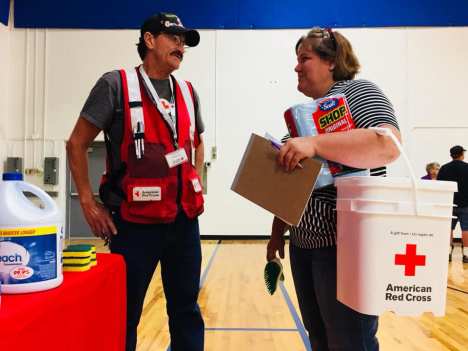
It’s officially “that” season as we unload Flood Clean-up Kits at the Minneapolis Red Cross office. Those pictured above will head to Carver and Scott Counties. More will go to Ramsey County and other places soon. Many more will stay here in our warehouse for distribution to individuals and our partners who will be helping others during this spring flood season.
For example, we partnered with Scott County Emergency Management to open a shelter for people who evacuated their homes in a community in Jordan. Local Red Cross volunteers arrived quickly to set up cots and other shelter necessities. We’ll continue to be there until the need passes.
Red Cross volunteers at the shelter for flooding evacuees in Jordan, Minnesota, March 15, 2019. Photo provided by Jennifer P.
This is going to be a huge response not only in Minnesota, but also in many parts of the country. To those fighting their own basement flood fight, we wish you strength and at least a little sleep here and there. We’re all in this together in whatever way we can help!
By Jill Hallonquist, Disaster Program Manager, Twin Cities Area of the American Red Cross Minnesota Region. Click here for flood prep and response safety tips and resources. For relief assistance related to this disaster please call (612) 871-7176.
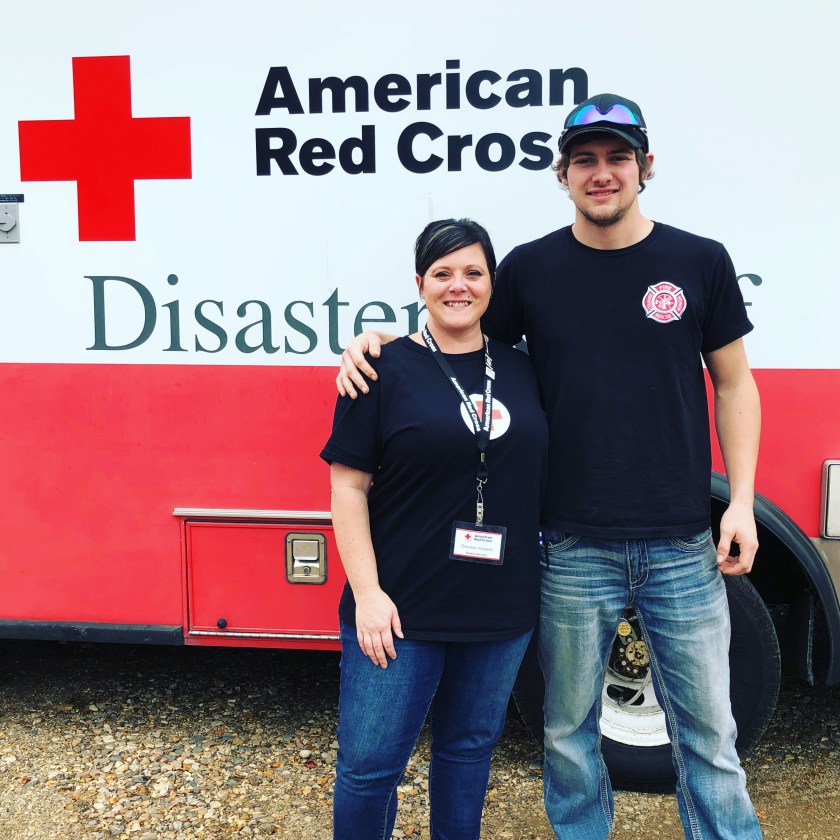
Desiree with her son, Dylan, volunteering at Home Fire Campaign event in Marshall, MN. Photo courtesy of Desiree Haupert.
“This is an excellent way to give back to the same community and with our surrounding communities.” —Desiree Haupert, Red Cross Home Fire Campaign volunteer team lead for Marshall, Minnesota
Story by Zabiba Sameru/American Red Cross
When I listen to Desiree Haupert, a mom and volunteer, speak about her experience with the American Red Cross, I can hear the excitement in her voice as she tells her story about being fulfilled as she continues to give her time to the Red Cross.
What started out as future planning to keep busy for Desiree in April of 2018 is turned into a lifetime rewarding experience. In her time volunteering at the Red Cross, she has been involved in many activities, such as Sound the Alarm by installing home smoke alarms and sharing fire safety tips in Slayton.
Red Cross volunteers responded to flooding in southwest Minnesota during 2018. Photo: Lynette Nyman/American Red Cross
During the flood in Tracy, Desiree also was involved in helping residents find shelter, food and additional resources that could support them during their recovery from the flooding. She also is involved with the Pillowcase Project, campaign that teaches kids in grades 3 to 5 how to prepare for home fire emergencies and other disasters like tornadoes and blizzards.
As a duty officer, she takes calls for assistance requests, and then responds by reaching out to local Red Cross volunteers who give assistance to people who are affected by disasters. To top it all off, Desiree attends youth preparedness conferences to learn about engaging communities and provide support to them in the face of a disaster.
This year Sound the Alarm takes place April 27 – May 12.
It’s important and rewarding for Desiree to give back to her community and be an example for her kids with all the work that she’s doing with the Red Cross. Being a Red Cross volunteer gives you an opportunity to help your local community, says Desiree. “It gives me the opportunity to take ownership of something and grow in a way that I didn’t know I was needing. It’s amazing.”
On Saturday May 4, 2019, Red Cross volunteers and their partners will be installing free smoke alarms in Worthington. Join us! Click here to learn more about the campaign. Click here to become a Red Cross volunteer.
That’s a spot-on adage when we consider fulfilling our Red Cross mission to alleviate human suffering in the face of emergencies.
For example, one hundred years ago Junior Red Cross volunteers in Duluth made care packages for World War I veterans overseas.
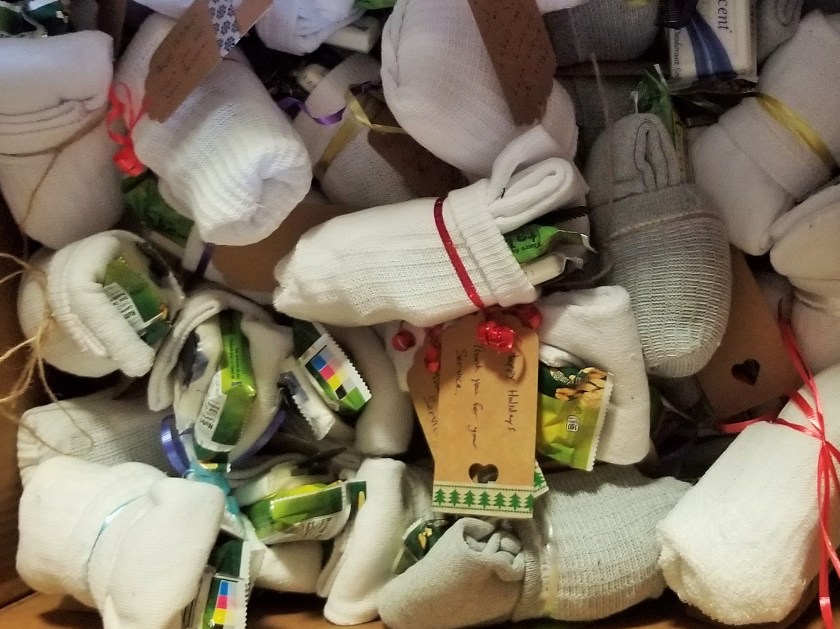
This year our Service to the Armed Forces volunteers will distribute donated socks to veterans who are homeless or at risk of becoming homeless.
Donated socks ready for distribution to military veterans in nursing homes. Photo by Jennifer Landeros
There are more examples and yet, whatever the year of the new year, the basics of life remain the same.
People need shelter, food and clothing. People need blood and blood products. People need to reach loved ones during emergencies.
The Red Cross helps meet these and other basic needs within the context of being impartial and neutral, of empowering volunteer service, and keeping an eye on preserving and promoting human dignity in all of our work.
With those thoughts in mind, this year we encourage you to look to the stars while keeping your feet on the ground. Make a regular commitment to:
The arrival of the holiday season often means spending time and exchanging gifts with family and friends. But what if the gift you needed couldn’t be bought? For patients like Mike McMahon, the generosity of blood donations was the perfect gift and didn’t cost anything other than a bit of someone’s time.
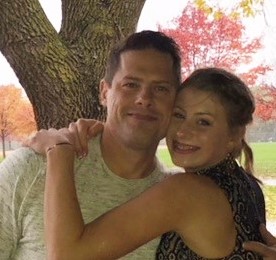
Following a tragic tree felling accident on Nov. 10, 2016, McMahon, a Stillwater, Minnesota resident, suffered life-threatening injuries. He needed 11 units of blood during emergency surgery to keep him alive.
He spent the next six weeks in the intensive care unit and inpatient rehab, including three weeks during which he had to be intubated as he was unable to breathe on his own.
During his hospital stay, he also experienced an ulcer on a major artery in his intestines. The ulcer was so severe that he needed an additional seven units of blood and the artery was coiled to stop the hemorrhaging.
Mike McMahon
“I remember clearly as my nurse hooked me up to the first bag of blood,” said McMahon. “The thought of blood passing through another person’s heart and now into me, to keep me alive, was very emotional. From the first pint to the last, each one was equally moving.”
McMahon was told that he might not be able to do a lot of things ever again – his future was uncertain. However, just a few days before Christmas he was released from the hospital.
McMahon is thankful for blood donors and credits blood donation with helping save his life. “I’m grateful for the donors who gave me such an amazing gift – to spend Christmas and more holidays with my family. I was an occasional blood donor before the accident – today I donate as often as I can to help ensure others receive the same gift of life.”
You can give patients like McMahon more time and memories this holiday season by donating blood at the American Red Cross 6th annual 12 Hours of Giving Blood Drive at Inwood Oaks in Oakdale, Minnesota. As a special thanks, all who come to give will be treated to free parking, complimentary gift wrapping, a special gift bag, a long-sleeved Red Cross T-shirt, and holiday food and entertainment and will be automatically entered into hourly prize drawings including grand prizes – a large flat panel TV and a HP laptop computer.
To make an appointment to give blood at the 12 Hours of Giving Blood Drive, donors can click here or use sponsor code 12 hours on the Red Cross Blood Donor App, online at redcrossblood.org or by calling 1-800-RED CROSS (1-800-733-2767).
We hope to see you at the 12 Hours of Giving Blood Drive. Happy holidays from your friends at the Red Cross!
Story and photo by Sue Thesenga/American Red Cross
Red Cross volunteer Willen Korkowski. Photo: Carrie Carlson-Guest
Recently we were pleased to speak with Willen Korkowski about her volunteer experience. A transcript of the conversation is below. To see Willen tell it, click here. Thanks Willen for your service helping others!
Please introduce yourself and your role with the Red Cross.
Hi. I am Willen Krokowski. I am a Disaster Action Team volunteer with the Red Cross since 2004.
What do you do as a Red Cross volunteer?
As a volunteer I respond to local disasters such as house fire, could be a single house unit or multiple units in an apartment. What we do when we respond to a fire is we make sure that the clients have what they need. Is there an immediate need that we are so concerned for; could be a safe place to stay for the night, food and clothing, or for the kids to let them know that there is someone there that cares for them especially when they are in need.
What’s your favorite part or memory of volunteering?
My favorite part is when the clients smile and you see the hope in their eyes. So it’s, to me, it’s giving back to my community.
Would you recommend volunteering with the Red Cross to others?
If you care about your community, you care about your neighbor, if you want to live in a place where it is safe and loving then I would suggest you volunteer for the Red Cross. You would love it too.
We’re always looking for volunteers to help their neighbors in need after disasters like home fires. To volunteer or for more information, click here. Or join us during upcoming 30-minute “Call to Serve” conferences calls.
Minnesota Red Cross volunteers supported World War I efforts. Photo courtesy of the Minnesota Historical Society
By Nancy O’Brien Wagner
This Sunday morning, at eleven o’clock, you may hear the ringing of church bells pealing out over the state. This tribute marks the centennial of Armistice Day – the end of World War I, which occurred on the eleventh hour of the eleventh day of the eleventh month– November 11, 1918.
Nowadays, we celebrate November 11 as Veteran’s Day – a holiday to acknowledge the impact and efforts of all of our nation’s veterans. This year, however, it seems appropriate to draw special attention to the history and legacy of World War I – or the Great War as it was called then.
It is impossible to over-state how significant World War I was to our country. Beyond the military events, the War impacted our economy, our transportation system, our politics, and our culture. One of the greatest legacies of the War was the impact on the development of the American Red Cross.
Though the American Red Cross was founded in Washington D.C. in 1881, its presence and impact throughout the nation had been sporadic. During its first three decades, local and national Red Cross volunteers had responded to floods, droughts, fires, earthquakes, and the Spanish-American war of 1898. By the 1910s, the organization was muted – and the Minnesota Red Cross chapters were frail- if they existed at all. World War I changed that.
Within weeks of the U.S entering the war, the critical importance of the Red Cross was evident. In May 1917, the Red Cross was placed under the direction of President Woodrow Wilson’s War Council, which directed organizations and industries needed in the war effort. Across the nation, millions of people donated and signed up to volunteer for the Red Cross. In Minnesota, hundreds of thousands joined the Red Cross. They stepped forward in a spirit of can-do optimism, loyalty, and sacrifice. Most of those worked locally, but others served overseas.
“I summon you to comradeship in the Red Cross” – U.S. President Woodrow Wilson’s call to service. Poster by Harrison Fisher, 1918. Courtesy of the Library of Congress
Locally, Red Cross volunteers operated canteens for soldiers at the railroad depots, offered support to soldiers’ families, and organized recreation events for soldiers at Fort Snelling. They offered classes in First Aid, Elementary Hygiene, and Home Dietetics. For overseas, Minnesota members sponsored Base Hospital No. 26 in Allerey, France, and raised nearly $50,000 to supply the hospital with equipment and bandages. Members sent new and used trucks, ambulances, and cars to Europe. In addition, volunteers produced 5,842,078 surgical dressings, knitted 94,439 sweaters, produced 14,522 garments for refugees, and packed 38,551 “comfort kits” with shaving supplies, cigarettes, chewing gum, and other essentials.
For many local volunteers (who were mostly women), this effort expanded their social circles and built up their sense of community: As one Red Cross scholar said, “The big thing…in this Red Cross work has been the bringing together of women of all nationalities, all social strata, all creeds, and all religions onto a common, harmonious unit.”
In addition to local efforts, hundreds of Minnesotans served as Red Cross volunteers in Europe. Red Cross volunteers established and offered service from 551 stations, including 24 hospitals and 12 convalescent homes for soldiers and 130 canteens. They established emergency depots of medical supplies for the American Army and for French hospitals. The Red Cross also produced and supplied all necessary splints, nitrous oxide anesthetic, and oxygen for the Army. There were also reconstruction and re-education efforts for crippled and disabled men, recreation and welfare service, hospital service, hospital farms and gardens, moving pictures for hospitals, grave photography, civilian relief, relief of French soldiers’ families, children’s relief, and anti-tuberculosis relief. The largest group of Red Cross volunteers was nurses, who faced particular dangers. Nurses Miss Anna M. Dahlby of St. Paul and Miss Mary H. Cummings of North St. Paul both died while on duty.
The red poppy is the flower symbolic for remembering those who fought in WWI and the wars following, especially overseas. Photo by Lynette Nyman
After the war ended on November 11, 1918, the Red Cross continued to its war-related work. Overseas, the Red Cross helped at hospitals, camps, and transportation depots. Locally, Red Cross volunteers continued to staff booths at train depots to assist soldiers as they traveled home, and completed paperwork to apply for support services. While many Red Cross chapters shuttered or closed completely, other chapters in larger cities began to shift their attention to address issues such as public health (the Spanish Flu) and natural disasters (the Cloquet Fire). Both the St. Paul and the Minneapolis Chapters offered continuous service from 1917 on- and mark that year as their true foundation date.
In Minnesota, many of the women who served overseas and lead local Red Cross efforts used their strengthened problem-solving, organizational, and networking skills to tackle local needs. Many became active in the Women’s Overseas Service League, and others took an active role in promoting the women’s right to vote and the passage of the 19th Amendment to the U.S. Constitution. Local museums, hospitals, libraries, schools, orchestras, and charities all benefited from this generation of generous and civic-minded women.
In the decades since, the Minnesota Red Cross has continued to respond to both international and local needs, evolving to fulfill new roles such as blood services, and shifting out of old ones — no more knitting sweaters.
When you hear the bells toll this Sunday, recall both the relief and joy at the conclusion of the Great War, but also mark the creation of the Minnesota Red Cross – and the spirit of optimism, loyalty, and sacrifice that continue to define us as Minnesotans.
2018 Heroes of the American Red Cross Minnesota Region
Heroes inspire us. They help others. They show us how courage, strength, and bravery can save the day. Each year, the Minnesota Red Cross honors local people who went above and beyond to help others — either by saving a life or enriching and transforming lives over years of service. Our heroes are ordinary people who do extraordinary things. Through January 4, we’re accepting nominations for the 2019 Heroes Awards. To learn more and to be inspired, check out our 2018 Heroes stories below.
Lori McDougal, Scott Bissen
2018 Community Hero | Scott Bissen, Orono
Sponsored by Minnesota Tiffany Circle
As the Co-Founder and Board member of the Pay It Forward Fund (PIFF), Scott Bissen was awarded Community Hero for his 13 years of committed service to aid with the demanding financial pressures many cancer patients face during their treatment period. Since inception, PIFF – a Minnesota non-profit fund of Ridgeview Foundation—has paid in total over $2.2M in household bills to support nearly 2,000 Minnesota patients who are undergoing cancer treatment.
Scott and his wife understand the pressure that families go through in such a difficult time. Through the PIFF, they can take some of the weight off for those families who struggle paying bills due to illness. For many families, even with insurance, it’s hard to maintain financial stability due to the medical bills and loss of work hours some people face through cancer treatment.
“Scott has been a devoted and passionate Pay It Forward Fund (PIFF) Board Member, thought leader, and fundraising volunteer throughout the fund’s 13-year history,” nominator Leslie Glaze mentions. His devotion to PIFF is also exemplified by the numerous successful fundraising events he’s organized. See his full story here: http://bit.ly/RedCrossHero_Community
Left to right: Matthew Aeschliman, Kenny Larson, Joshua Guyse, Lee Strom
2018 Military Hero | Matthew Aeschliman, Baxter| Joshua Guyse, Royalton
Sponsored by Slumberland
When Joshua Guyse received a call from the distressed soldier, he immediately contacted his supervisor, Matthew Aeschliman, and the two traveled together from the St. Cloud, MN area to meet with the Soldier in the Twin Cities. Upon arrival, they implemented their training on Suicide Prevention—actively listened and calmly controlled the situation. Through their effort and care, Josh and Matt gained the Soldier’s agreement to be escorted to the Minneapolis Veterans Affairs Medical Center (VAMC).
“Suicide Prevention training is mandatory for Soldiers at all levels and across all organizations. Nevertheless, military units continue to experience suicide within their ranks. I am certain that on January 3, 2018, my unit narrowly avoided such a suicide event. It was no accident that my Soldier contacted Josh Guyse as a final effort to ask for help.” Unit Commander John Zillhardt states. “[Josh and Matts] actions directly saved a life and highlighted the training they receive in the military.” See their full story here: http://bit.ly/RedCrossHero_Military
Beverly Bartz and Barb Tretheway
2018 Give Life Hero | Beverly Bartz, Sleepy Eye
Sponsored by Health Partners
Beverly Bartz has been a Red Cross volunteer for 65 years. She was awarded as the Give Life Hero for the incredible impact she’s made at the Sleepy Eye, MN blood drives. She’s helped give the gift of life to others by coordinating blood drives since 1964, collecting 88,000 units of blood and impacting potentially more than 24,000 lives.
For many years, she’s mobilized her community to help and promote the importance of donating blood. She herself was an avid blood donor and along with her late husband, instilled that same commitment in their children. “It is an important part of the community and part of our lives,” Bev states. See her full story here: http://bit.ly/RedCrossHero_GiveLife
left to right: JoAnn Birkholz, Zack Houle, Lee Strom
Vernon Taplet was moving his car in the garage when it hit something that caused a gas spill and the fire took over. Brady and Zack Houle noticed a dark cloud of smoke and ran out to help Vernon who was on the ground crying out for help. Thanks to their courage they were able to move their neighbor to safety.
Brady is currently studying law enforcement at Century Lake College. He said, “I always wanted to help people and had the opportunity to do it…At the time I didn’t realize I was falling back on my training.” He and Zack were able to convince Vern to be moved to safety despite the pain he was in from the fall. “It was an adrenaline thing. I put my shirt over my nose as I went running. We just wanted to get [Vernon] out of there. There was stuff with gas on it, things that could have blown up,” Zack explained.
They’re selflessness and bravery prevented a tragedy that day. “They pretty much saved my life and put their lives in danger to save me,” Vern stated. See their full story here: http://bit.ly/RedCrossHero_YouthGoodSam
left to right: Bran Tutunjian, Van Dickerson, Tim Walsh
2018 Good Samaritan Hero | Van Dickerson, Minneapolis
Sponsored by CenterPoint Energy
Friends Tim Walsh and Van Dickerson were enjoying the day with a friendly tennis match when suddenly Tim began feeling ill. In a dark turn of events, Tim fell motionless onto the floor, his heart had stopped due to cardiac arrest. Van’s immediate response is one of the reasons why Tim is here today.
Van is trained on CPR for his work at Minnesota Adult and Teen Challenge, who utilizes the Red Cross CPR class. He never imagined that those skills would save his friends life one day. Van effectively handled a critical situation and took every necessary step: dialing 911, checking his vitals and performing CPR.
Tim later learned that the survival rate for someone who has a cardiac arrest under such conditions is less than 5%. “Van is my hero and I believe he should win the Good Samaritan Hero award because he is ultimate example of the everyday heroes that are equipped by Red Cross training to save lives,” Tim mentions. See the full story here: http://bit.ly/RedCrossHero_GoodSam
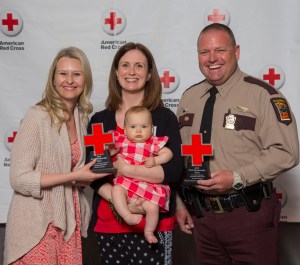
left to right: Kristin Lonsbury, Virginia Walsh (holding baby Elise), Lt. Paul Stricker
2018 First Responder Hero | Virginia Marsh, Crystal | Lt. Paul Stricker, Inver Grove Heights
Sponsored by Abbott
Virginia Marsh and Lt. Paul Stricker stopped on the side of Highway 394 to save the life of 6-week old Elise. Kristin Lonsbury was driving her premature daughter Elise to the doctor when Elise began choking on her vomit. She quickly stopped on the side of the road and tried to figure out what was wrong. That’s when nurse Virginia Marsh came over and began conducting CPR. Lieutenant Paul Stricker also happened to be driving by when he saw the women. He quickly got out of his car and assisted with CPR and communicating with 911 dispatch.
Out of all the people that where driving by that day on Highway 395, these two heroes didn’t think twice about stopping and rushed to help a mother and child. “Virginia ran a fair distance to get to us, arrived on scene with such grace, compassion, and confidence, and then was able to save my child’s life because she just knew what to do,” Kristin says. “Paul’s presence on-scene was one of the main reasons why my daughter is alive today. He was calmly assertive and knew exactly what needed to happen in what order.
With Elise’s every milestone, Kristin is reminded of these two heroes who stopped on the side of the road and selflessly helped her and her daughter out. They provided comfort and checked up on her after the incident. See their full story here: http://bit.ly/RedCrossHero_1stRespond
Steve with his daughter Sophie — who’s going to be a first-time driver next year and already has an emergency kit.
Personal experiences push forth the importance of being prepared. Take Twin Cities resident Steve Davis who experienced the 1996 snow storm that brought Philadelphia to a standstill. He laughingly recounts “perhaps I was the only one in Philly who had a shovel on that cold, freezing night.” Stuck in slush and not any help in the offing, Steve’s kit came to his rescue.
Steve always carries an emergency kit in his car, a habit instilled in him since his late teens by his father. Perhaps Steve’s dad knew, like we do, that disaster can happen to anyone, anytime and anywhere. Being proactive helps lessen the impact of emergencies during times of adversity.
The good news is that preparing is easier than it sounds. These three steps will get you going:
We urge everyone to be proactive when it comes to disaster preparedness. Your readiness helps you, your loved ones, and in many cases your neighbors, especially those who are especially vulnerable. Resist waiting until an emergency occurs because by then it can be too late to help.
A Red Cross volunteer since 2000, Rachel Olmanson, from Cleveland, MN, has deployed to two national responses – Hurricanes Matthew and Katrina – where her involvement was working mostly to distribute meals and relief supplies to people living in neighborhoods.
Recently, Rachel got a new perspective on disaster relief compared to her past experiences. After multiple tornadoes hit southern Minnesota communities on September 20, Rachel took on the role of photographer and traveled with damage assessment and client casework teams in the towns of Waterville, Faribault and Morristown.
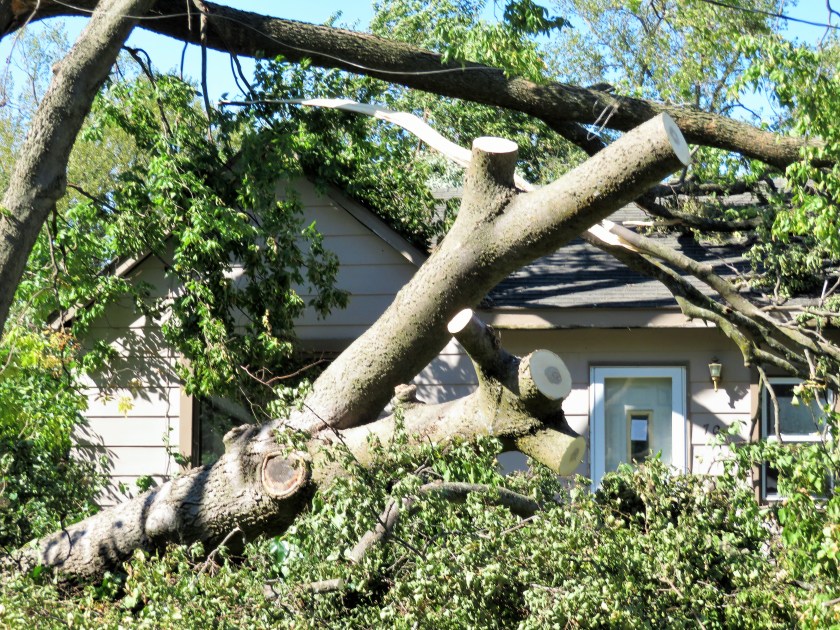
Rachel documented damage assessment teams reviewing general damage and caseworkers meeting with residents to provide relief and recovery support. While visiting one Waterville residence, Rachel took pictures showing a hole in the wall and ceiling of an upstairs bathroom that was caused by a tree limb. Homeowner Bernice was home when it happened. “We were sitting right here and Farrell said it sounds like it busted a window.”
Rachel’s pictures depict volunteers action planning, assessing overall damage, community members coming together to clear fallen trees and other debris, and residents assessing home damage while trying to figure out next steps. “I really could see a sense of community with neighbors outside helping each other to remove brush and trees off and around homes,” she says.
The American Red Cross continues its effort to assist affected families since devastating tornadoes ravaged parts of central Iowa on July 19. The tornadoes leveled homes, overturned cars, and injured people.
Jeff Thelen (on the right) from Minnesota is responding to the Iowa tornado relief efforts with Red Cross volunteers from nearby states, including Ernesto Lindsey from Illinois. (Photo courtesy of Jeff), July 2018
Red Cross aid workers from Minnesota were among some of the first to reach people in the affected communities. The team has deployed 15 aid workers including six employees and volunteers in senior disaster management roles.
Disaster assessment shows hundreds of homes have suffered major damage. The team is working extensively on first-hand activities in the field as well behind-the-scenes relief to bridge from emergency relief to long- term recovery.
Marshalltown is the most affected area and is serving as the recovery hub for the response. In that area, Jeff Thelen, a Red Cross volunteer from Farmington, MN, has been instrumental in distributing relief supplies. Along with his friend Ernesto from Illinois, Jeff has been going home-to-home. Already they’ve reached more than 150 households.
Multi-agency recovery center for people affected by tornadoes, Marshalltown, Iowa, July 2018. Photo: Steve Bonine/American Red Cross
“It’s very easy to spot homes in need by mere sight,” Jeff says. Emphasizing the level of destruction, he says they sometimes exhaust their truckload relief supplies mid-way through the day due to the demand and eagerness of the people to reaching out to Red Cross for disaster relief.
Nearly 400 Red Cross workers have mobilized to deliver relief and
hope. This includes 15 aid workers from the Red Cross in Minnesota.
As of July 30, Red Cross cumulative response efforts include:
The Red Cross will continue helping affected communities on the long road ahead that comes with rebuilding life after a tornado. We will provide support as long as it’s needed. Click here to learn more about the response.










 American Red Cross Minnesota and Dakotas Region