Nolan the Heart Warrior: A Story of Strength, Survival, and Giving Back

Nolan arrived 2.5 weeks early, a healthy, 8-pound, 10-ounce baby boy. But within hours, the joy of his birth turned to fear. His mother, Sara Jutz, sensed something wasn’t right. Together with her husband, Joe, they pushed for closer observation. Trusting their instincts and speaking up made all the difference, that decision ultimately saved Nolan’s life.
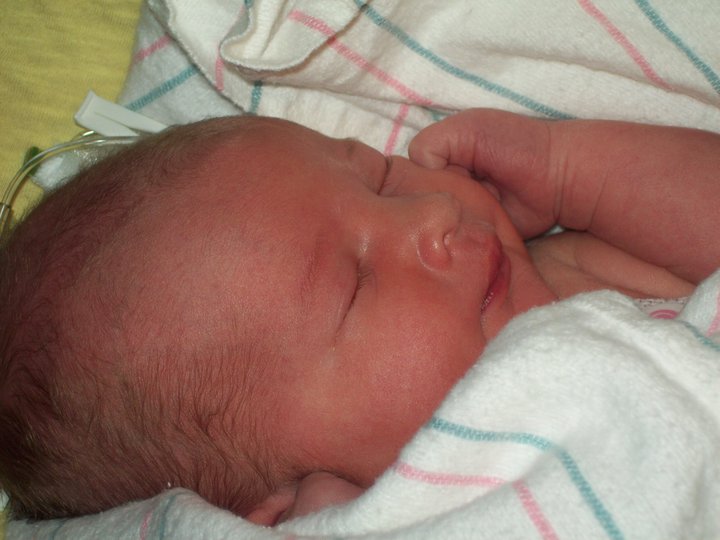
Newborn Nolan made an early entrance, arriving 2.5 weeks ahead of schedule and weighing in at a healthy 8 pounds, 10 ounces. Photo submitted.

Doctors diagnosed Nolan with a serious congenital heart defect: a coarctation of the aorta, a narrowing of one of the heart’s main arteries. Just 10 hours after birth, he was rushed by ambulance to Children’s Hospital in Minneapolis. At only four days old, Nolan underwent his first major surgery. Surgeons accessed his heart through his back and used a Gore-Tex (synthetic) patch to widen the narrowed artery. During that operation, Nolan received his first blood transfusion, one of many he would need. That donated blood played a critical role in saving his life.

Nolan recovered quickly and was able to go home on his ninth day of life. As he grew, his spirited personality and big heart, both literally and figuratively, became his trademarks. At age six, he underwent a second procedure. Since the synthetic patch placed earlier couldn’t grow with him, doctors used a balloon catheter to stretch it and improve blood flow. The minimally invasive procedure was a success, and Nolan bounced back to his usual self within days.

By the time he was 11, Nolan was thriving. Though he saw his cardiologist regularly and understood he’d never “outgrow” his condition, that never held him back. Active, strong, and fiercely determined, Nolan proudly embraced life as a heart warrior. He even led his elementary school in fundraising for the American Heart Association, raising more money than anyone else.

Nolan, Eli, and Katelyn were each born with different heart defects. Only Nolan needed surgery, but their resilience unites them. Photo submitted.

His journey is made even more remarkable by his family’s story. Nolan’s two younger siblings were also born with congenital heart defects, each different, each unique. While Nolan required surgeries, his siblings have not needed medical interventions. Doctors remain unsure why all three children were affected, but what is clear is the strength and resilience of the family.

The Jutz family has long been dedicated to supporting their community, but Nolan’s experiences ignited a deeper sense of purpose: a personal commitment to give back. Watching his mom organize a blood drive, motivated in part by her own father’s need for weekly transfusions, Nolan jumped in to help. He manned the registration table, witnessed firsthand the importance of blood donation, and knew he wanted to do more.

Following the success of last summer’s blood drive, Nolan and Sara set out to organize another, this time at Nolan’s middle school. They transformed his personal journey into a powerful mission to raise awareness and inspire others to make a life-saving difference.

There is a lot that goes into organizing a blood drive, but Nolan’s greatest test came on April 18.
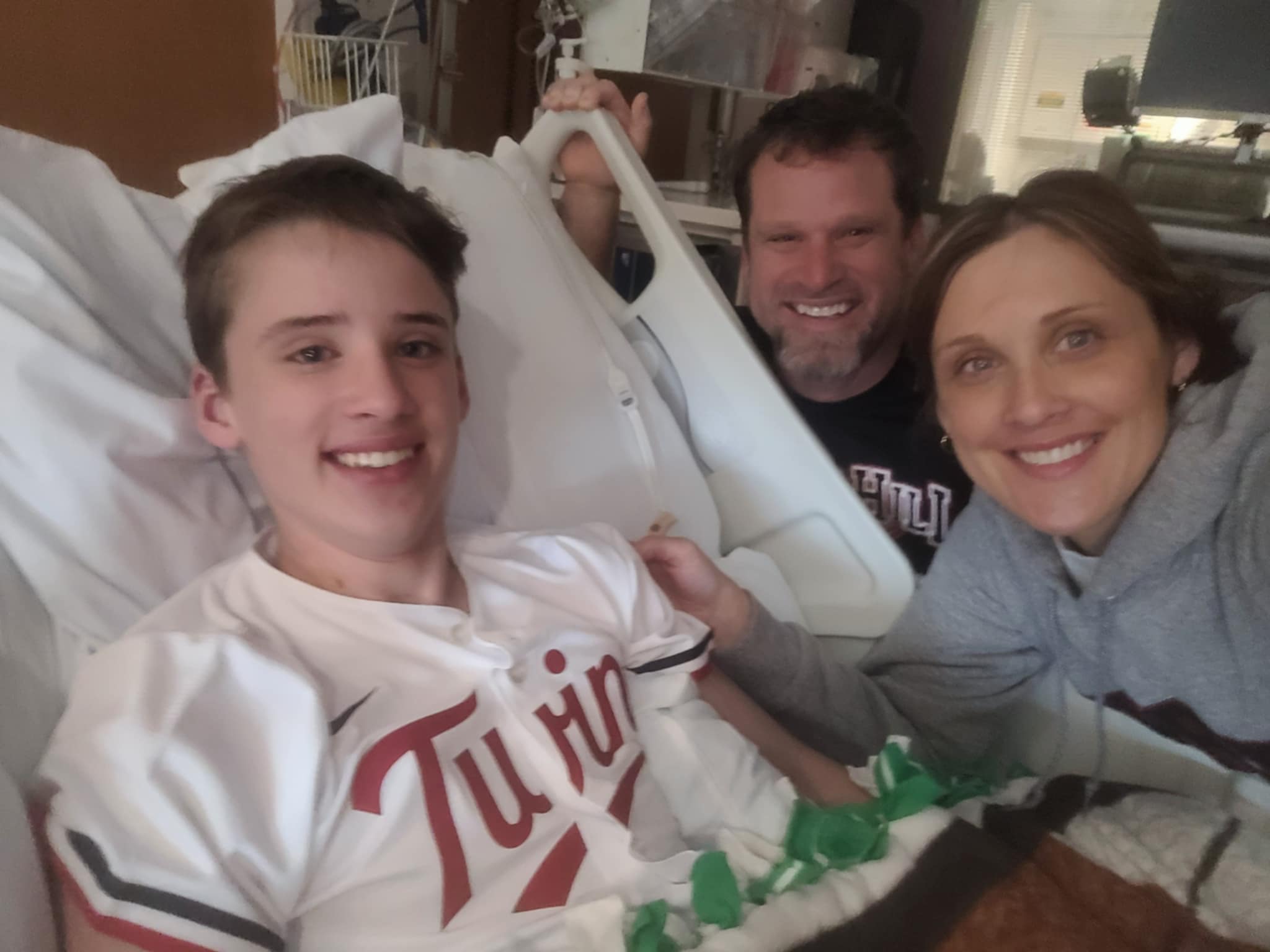
Pictured with his parents, Nolan recovered in the hospital after a lifesaving procedure that required 18 units of blood – April, 2025. Photo submitted.

During what was expected to be a routine stent placement, Nolan’s aortic valve ruptured, triggering cardiac arrest that lasted nearly 20 minutes. As blood rapidly filled his chest cavity, his left lung collapsed. In an urgent fight to save his life, doctors performed emergency surgery, relying on chest compressions to place the seven stents needed to repair the valve. Nolan required 18 units of blood that day, blood made available thanks to the selfless donations of others. That generosity is what saved his life.

Incredibly, just six weeks later, Nolan was back on the baseball field with his friends. His family, still overwhelmed by that day, speaks of how the experience changed them. “When you hear ‘18 units of blood,’ it hits different when it’s your child,” Sara said. “You don’t realize how much one small body can need, or how vital it is that the blood is there.”
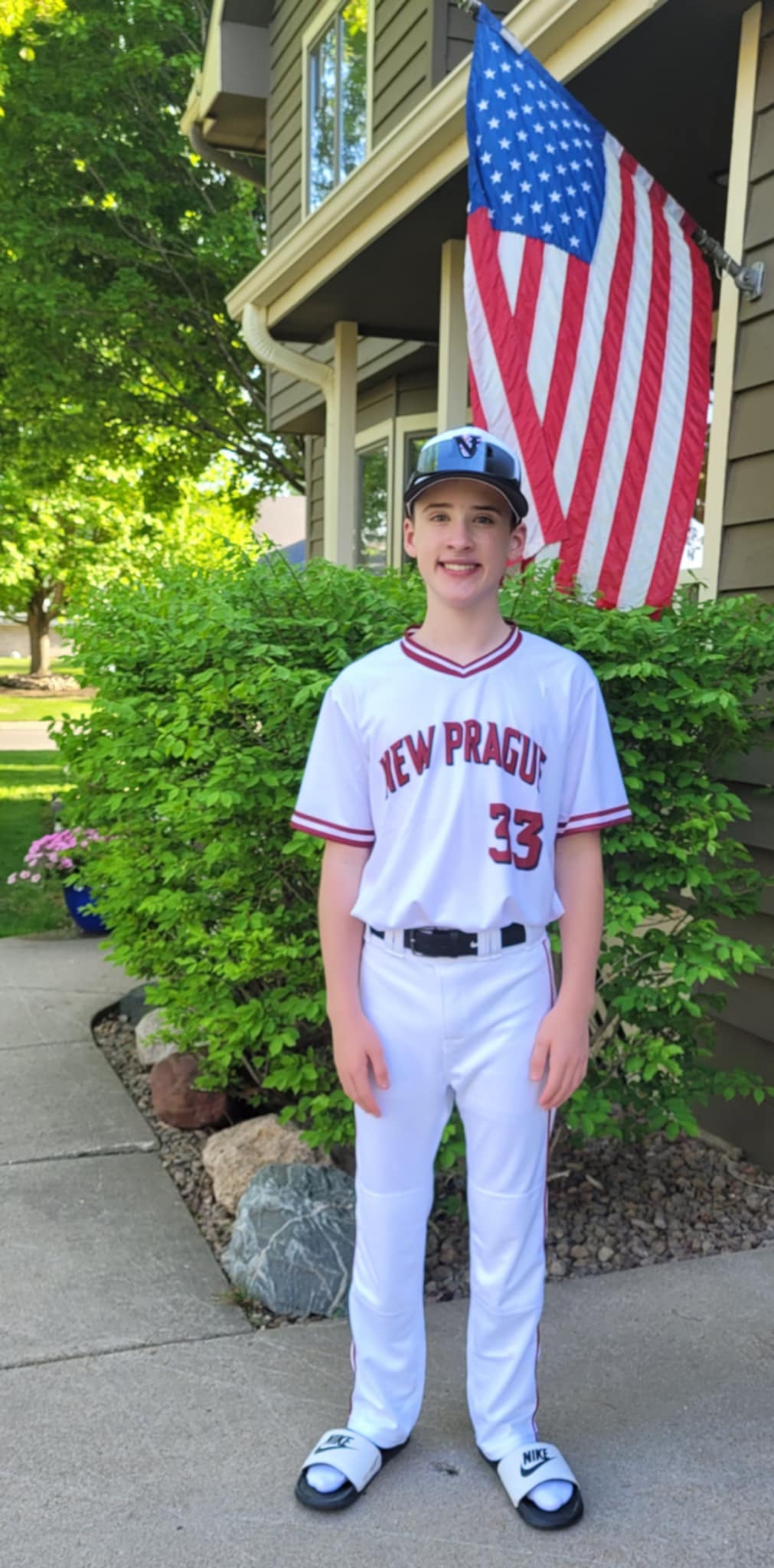
Just six weeks after emergency surgery and 18 units of blood, Nolan is back and ready to hit the baseball field! Photo submitted.

Today, at 14 years old, Nolan is more than a survivor. He’s a fighter, an advocate, and a leader. He’s a student, a friend, an athlete, a big brother, and a boy whose strength has already changed so many lives. And he’s not done yet.

On June 30, family and friends supported a blood drive organized by Nolan and his mother at his middle school. Nolan greeted donors at the registration desk before joining his siblings for a well-earned lunch break. Each donor received a copy of Nolan’s story and was encouraged to share it to help raise awareness about the ongoing need for blood donations.

On June 30th, family and friends came together to donate blood at the drive Nolan and his mother organized at his middle school. Their hope was to collect enough to give back, to pay it forward for the many donations that once helped save Nolan’s life. They collected 41 pints of lifesaving blood – each one a testament to the power of giving and the impact of Nolan’s story.

Nolan continues to raise awareness and encourage others to donate blood, to give the gift of life, because he understands better than most just how vital it truly is.

He is, and always will be, a heart warrior.
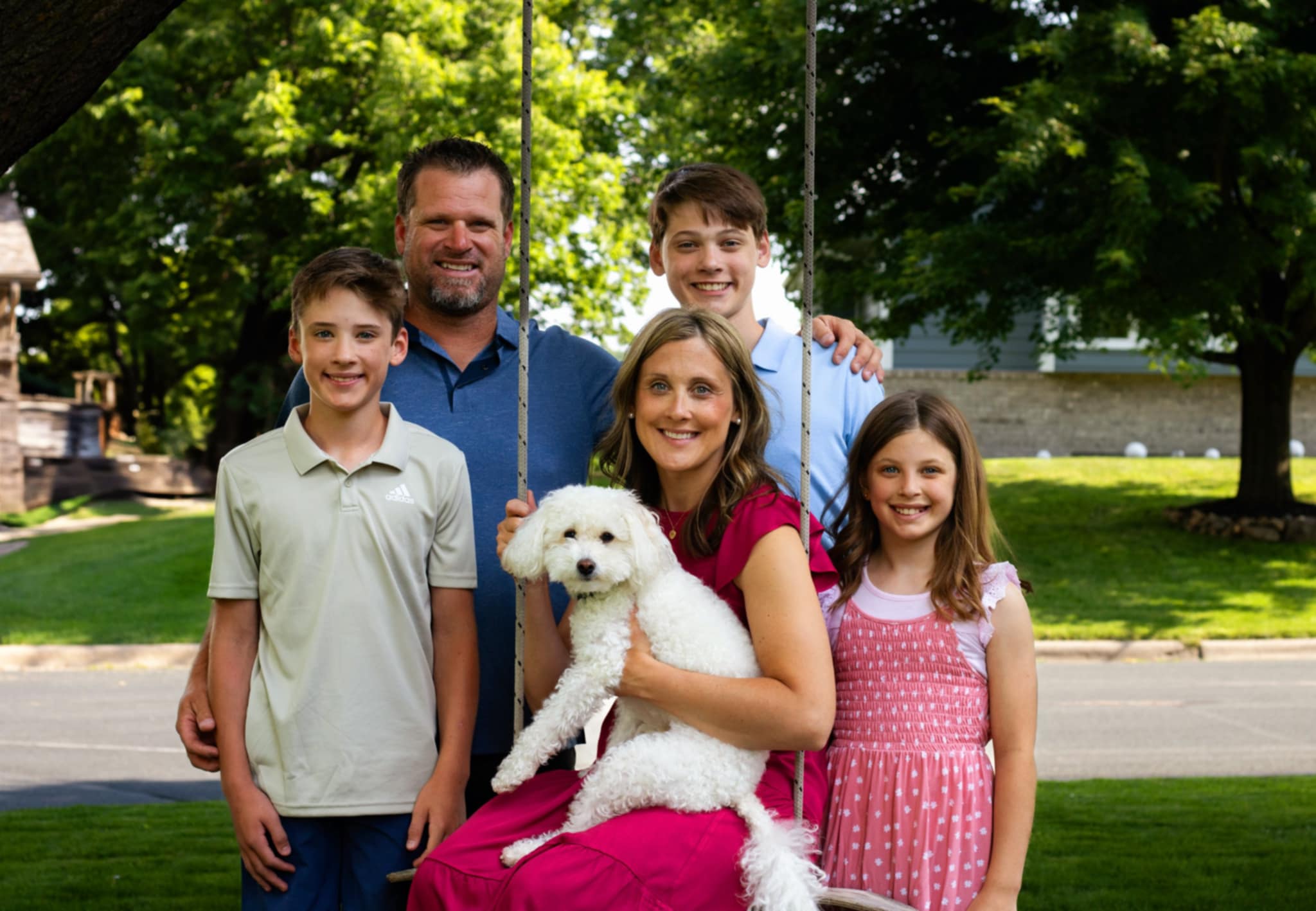
The Jutz family. Photo submitted.

Make an appointment to give blood or platelets now by using the Red Cross Blood Donor App, visiting RedCrossBlood.org or calling 1-800-RED CROSS (1-800-733-2767).

“This Is Just What We Do” – Red Cross Nurse Receives National Recognition for Exceptional Disaster Response Leadership

When disaster strikes, the Red Cross steps in to help — and so do the people behind the mission. Karen Younger, a retired military nurse, college professor and dedicated volunteer with the American Red Cross Eastern South Dakota chapter, is one of those people whose compassionate heart have brought hope to countless individuals in their darkest moments.

Karen’s journey with the Red Cross began in 2013. Since then, she has become a vital leader in Disaster Health Services, bringing her experience in adult and critical care nursing, military service, and higher education to the frontlines of disaster response. Her approach combines clinical expertise with an unwavering commitment to dignity, respect, and service.

Karen Younger pictured with fellow Red Cross volunteers Katie Gilmore and Patti Vaska when they received their Red Cross nursing pins. The three trained together for Disaster Health Services and have remained close friends ever since. Now retired, they continue to stay actively involved with the American Red Cross in the Sioux Falls, South Dakota area. Also pictured is Tim Klein (far left), an EMT who received his EMT pin during the ceremony. Photo submitted.

A Story of Compassion During Hurricane Helene

When asked to share one of her most memorable moments as a Red Cross nurse, Karen reflects on her deployment during Hurricane Helene.

“It was a chaotic, emotional time for many,” she recalls. “Especially those who turned to Red Cross shelters as a last resort.”

One story, in particular, has stayed with her. A woman arrived at the shelter with young children and a family pet. She was sick, scared, and had no one else to turn to. On top of flu-like symptoms and needing an urgent prescription refilled, she was overwhelmed by the thought of navigating a hospital visit alone and leaving her kids behind.

She asked Karen if she would go to the hospital with her while a social worker watched the children. Karen agreed without hesitation.

At the hospital, Karen acted not just as a nurse, but as a calm and supportive advocate. She helped explain the woman’s medical history to the doctor and ensured her concerns were addressed. “That extra support made all the difference,” Karen said.

When the visit was over, the woman turned to her and said, “You’re a miracle worker.” Karen just smiled and replied, “No, I’m a Red Cross nurse. This is what we do.”

It’s a phrase she’s said many times, because for Karen, helping people through fear, confusion, and uncertainty is more than a duty — it’s a calling.

A National Honor for Outstanding Service

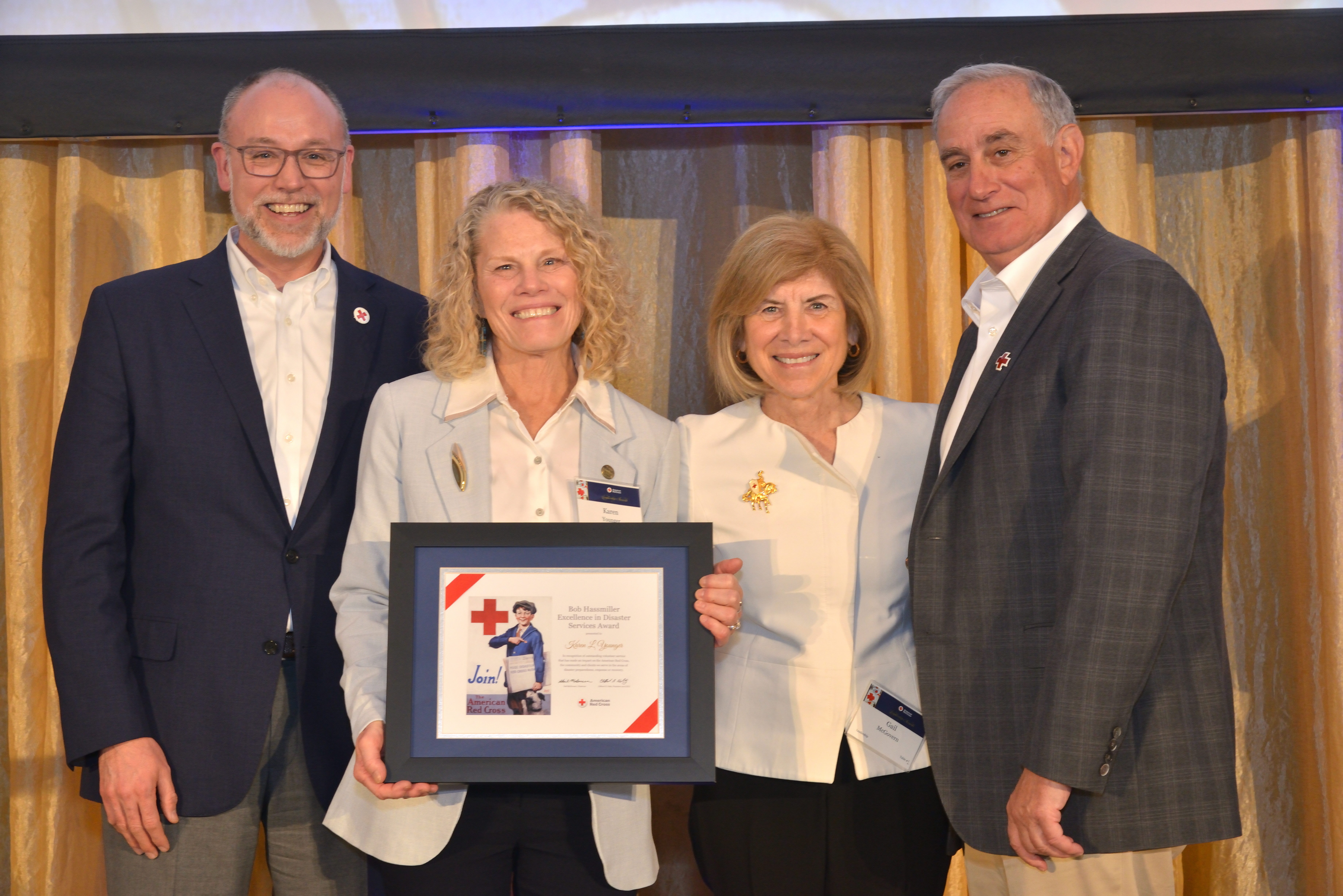
On April 3, 2025, Karen’s exceptional service was recognized on a national stage. During the Leadership Awards Luncheon at the American Red Cross National Headquarters in Washington, D.C., she received the Bob Hassmiller Excellence in Disaster Services Award.

Karen Younger at the Leadership Awards Luncheon on April 3, 2025, held at the American Red Cross National Headquarters in Washington, D.C. Pictured left to right: Trevor Riggins, President of Humanitarian Services, American Red Cross; Karen Younger; Gail McGovern, Chairman of the Board of Governors, American Red Cross; and Cliff Holtz, CEO, American Red Cross.
Photo by Dermot Tatlow/American Red Cross

This award celebrates a volunteer who has demonstrated extraordinary leadership and commitment, improving disaster response through innovation, collaboration, and impact.

One of her most notable achievements was leading a regional initiative that aligned Red Cross health services with each state’s nursing licensure laws across South Dakota, North Dakota, and Minnesota. Thanks to her efforts, Red Cross nurses are now able to provide care seamlessly and legally across state lines. This groundbreaking effort not only improved care for disaster survivors in the region but also established a new national model for delivering disaster health services in rural and underserved areas.

Tonya Peterson, Senior Community Disaster Program Manager for the Red Cross Minnesota and Dakotas Region, praised Karen’s work:

“Karen’s work has made a lasting difference – whether she’s helping someone manage a medical condition in the middle of a disaster or mentoring new volunteers stepping into this work for the first time. She doesn’t just show up – she listens, she leads, and she lifts others up.”

Tonya Peterson and Karen Younger at the April 3, 2025, Leadership Awards Luncheon held at the American Red Cross National Headquarters, Washington, DC.
Photos by Dermot Tatlow/American Red Cross

As part of the award, a $1,000 grant will be donated to the Red Cross of Eastern South Dakota, further supporting the lifesaving mission that Karen holds so close to her heart.

A Legacy of Service and Humanity

Karen describes her time with the Red Cross as both meaningful and humbling. “I consider it an incredible privilege to be part of the Red Cross,” she says. “When I retired, I wanted to keep using my skills to serve others. The Red Cross has been a perfect fit.”

For Karen, the transition from her nursing career to  to the Red Cross was seamless thanks to the shared values of humanity, impartiality and neutrality. “We treat everyone with dignity and respect. That’s what our profession is built on. We don’t engage in the noise, we can stay focused on the mission,” she explains.

She also speaks passionately about the power of teamwork. “There’s real power in doing this work alongside others who share the same purpose. I’ve made lifelong friends and shared unforgettable moments with people I may never see again. But we supported each other, and we knew we were making a difference. That’s incredibly rewarding.”

In Hawaii for the Lahaina fire response, January 2024. Pictured left to right Trisha Mims, then DHS Senior Program Manager, Karen Younger, and Denise Cohen, Client Care Chief for the DRO and a dedicated nurse. Photo submitted.

Congratulations, Karen. Your leadership, heart, and service are an inspiration. Your legacy is already making a lasting impact in communities across the country — and we’re all better for it. Thank you!

My Blood Donation Story – The Power of Red

By Mary Patterson, Minnesota and Dakotas Region digital communications volunteer

When I first started high school, a banner in our cafeteria for the school’s fall blood drive caught my eye. I wasn’t old enough to donate, and I wasn’t yet part of the student groups organizing it. By my junior year, all that changed.

In the fall of 2021, I joined the Student Council and become a member of the National Honor Society. My math teacher, Ms. Arnold, was the advisor for both of these groups. On the agenda of the first student council meeting was the topic of the fall blood drive. Ms. Arnold shared her personal story about donating blood in memory of her father, who had been a lifelong blood donor after receiving a blood transfusion following a motorcycle accident.

I had volunteered in various ways before but never felt a spark or drive to a specific cause. However, I was eager to complete my service hours, and the blood drive sounded like a great way to get started.

Mary Patterson gives a thumbs up during a successful blood donation – December, 2024. (Photo submitted.)

Having turned 16 in 2020, I had to ask my parents’ permission to donate at the drive. Minnesota is one of 37 states to allow 16-year-old blood donors! With their blessing, I registered to donate and signed up to volunteer at the drive.

I woke up nervous the day of the drive. I had made sure to sleep well the night before and eat a good meal before heading to school. But what if the needle hurt a lot? What if I fainted? In the end, I felt completely well after my donation. We wrapped up the day with 71 donors and 217 lives saved!

“Besides the ‘good feels’ of being a teacher, this is one of the things I am most proud of – teaching the next generation to help people around them, even those they don’t know, is so important,” said Ms. Arnold. “Donating blood is something almost everyone can do so I encourage all my eligible students to do it. I know some students volunteer just so they can get out of class, but hopefully a habit is starting to form.”

I was eligible to donate again at the Spring 2022 blood drive, no longer requiring parental permission at age 17. This time, however, I ended up on a mat on the gym floor, dizzy and pale. A few weeks later, a letter from the Red Cross arrived in the mail explaining that I had an iron deficiency and was now ineligible to donate for one year. While this did explain the drastic difference in my donations, I was incredibly disappointed, as I had just been eligible to donate a few short months before. Not only that, what if this deficiency lasted so long I couldn’t donate again? Despite this, I knew how it had felt to give my time as well as my blood, so I was determined to remain involved in the school drives, taking volunteer shifts during my lunch hour at the sign-up table and helping donors at the drives feel at ease both during and after donating.

From my first two donations, I learned three valuable things: I had a health condition, but it was treatable, and, most importantly, I wouldn’t have known if I hadn’t tried to donate blood. I was committed to donating again: I adjusted my diet to include higher iron intake, got cleared by my physician, and fulfilled the one year waiting period, I signed up to donate again, and was successful! I was so relieved to know I was healthy enough to donate again, as I went into this donation attempt even more nervous than my first. Since regaining eligibility, I donate close to every 56 days as possible.

Miss Dakota County volunteers at the University of Minnesota Red Cross Club blood drive, lending her support to this important cause. (Photo submitted.)

In my first year of college, I got involved with the University of Minnesota Red Cross Club as a blood donor. In my second year, I got more involved by volunteering at four on campus drives in the fall semester. Then, in October 2024, at age 19, I ran for a local title to the Miss Minnesota Scholarship Program, through the Miss America Opportunity. As a contestant, I needed to create a Community Service Initiative to focus on during my candidacy and potential year of service. For me, it was a no-brainer: my passion for blood donation had only grown since I started. After seeing the critical need for blood in our nation, having learned from the representatives that spoke to my school and from Ms. Arnold, I was finally feeling that spark towards a cause. To run for Miss Dakota County, I created The Power of Red: Blood Donation and Blood Health Awareness.

The Power of Red aims to enhance donor accessibility as well as create awareness about the critical need for blood. This is accomplished through my social media campaign that features weekly blood drive locations, fun facts about donation and blood health, and provides resources to help individuals schedule and prepare for donation appointments. This platform shows the benefits to both the donor and recipient: the urgent need for blood is combined with the knowledge that donors receive about their health. My personal experience showed me that blood donation has benefits beyond saving others: it just may help you save yourself.

Miss Dakota County, Mary Patterson, shares exciting news on Instagram: she’s now a Red Cross digital volunteer! Mary is using her platform to raise awareness and educate her followers about the critical need for blood donations.

Today, at age 20, I am honored to share that I won the title of Miss Dakota County 2025 this past October. I’ve started 2025 by becoming an official American Red Cross volunteer. I am eager to take The Power of Red to the Miss Minnesota stage this summer and show this great state the impact we can make by rolling up a sleeve to give the gift of life! I will be continuing my work by keeping my social media campaign up to date, continuing my volunteering with the U of M Red Cross Club in addition to regular donation, and finally, hosting my first blood drive in early June.

I recently asked Ms. Arnold what she would say after seeing me go from a first-time blood donor to an advocate volunteering with the Red Cross, and raising awareness for this cause on a state level as a Miss Minnesota candidate. She replied, “Thank you! Any way to bring attention to this lifesaving opportunity is a great one!”

Blood donation appointments can be scheduled by downloading the free Red Cross Blood Donor App, visiting RedCrossBlood.org or calling 1-800-RED CROSS (1-800-733-2767). 
25 Gallons and Counting: Larry Peterson’s Lifesaving Legacy

“That was good stick, kid,” said Larry Peterson with a laugh to phlebotomist Andrea Mason as she poked his arm. Larry came into the Wilmar Community Center to donate his 25th gallon of blood on Tuesday, January 28. The previous week, he had attempted to donate, but his blood pressure was too high – a sign of his excitement for the special occasion.

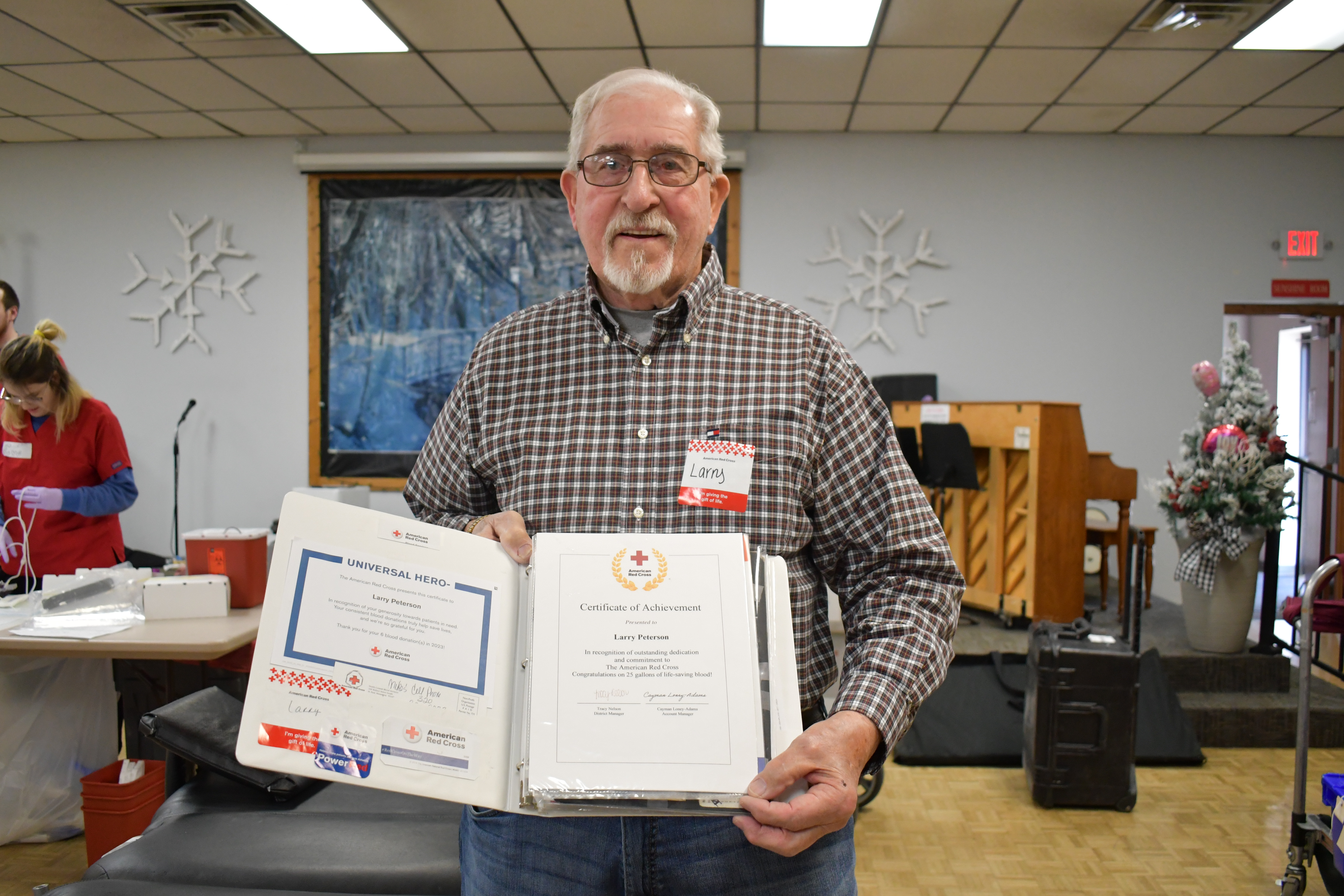
Dedicated blood donor Larry Peterson reaches his 25-gallon blood donation milestone on January 28, 2025, at the Willmar Community Center blood drive!

On December 7, 1960, Larry, who was 19 years old at the time, came to a Red Cross blood drive in his hometown of Montevideo, Minnesota, with his father to donate blood together. It was his father’s 10th gallon that day, and Larry decided to donate his first pint on the next bed over from his dad. Larry didn’t know it at the time, but this was the beginning of a lifelong adventure. Over the course of his lifetime, Larry has donated well over 200 pints of blood, with many of his donations being Power Red donations. Larry’s gifts of life have potentially helped save hundreds of lives.  

Larry’s binder documents a lifetime of giving. From his first donation in 1960 to his 25th gallon milestone — each article, letter, and card tells the story of a life dedicated to saving others.
(Photo by Red Cross volunteer Nate Russell.)

He carries a binder with him that contains newspaper articles detailing his blood donation, letters of notification for when his blood was used to save a life, and his blood donor cards dating back to the very first one in 1960. Now it has a new front page, which is his certificate congratulating him on reaching his 25th gallon milestone. 

Larry Peterson proudly marks his 25-gallon blood donation milestone with his Certificate of Appreciation now gracing the first page of his remarkable journey.
(Photo by Red Cross volunteer Nate Russell.)

Larry’s blood type is O negative, which is the most universal blood type – which can be transfused to anyone. It is often used in emergencies, trauma and surgery when a patient’s blood type is unknown.

Larry plans to continue donating lifesaving blood for many more years and many more gallons to come. And as it happens, his son is also O negative, so the family tradition of saving lives can continue.

Larry Peterson celebrates his 25th gallon of blood donated at the Wilmar Community Center on Tuesday, January 28 — honoring a lifetime of giving and saving lives.
(Photo by Red Cross volunteer Nate Russell.)

To learn more about donating Type O blood, click here

Story by American Red Cross volunteer Nate Russell.

Discovery of his rare blood type leads Pastor Riley to join the Red Cross mission

Originally published on the American Red Cross Northern California Coastal Region blog January 17, 2025 – by Michelle Limpe (American Red Cross communications volunteer).

As the largest non-profit humanitarian international organization, the American Red Cross unites volunteers globally in a common mission of service to others — a mission that blood donor Frank Riley strongly believes in. From his time serving in the U.S. Navy Chaplain Corps to serving his communities as a pastor, Frank has made it a priority to live out the Red Cross mission in every aspect of his life.

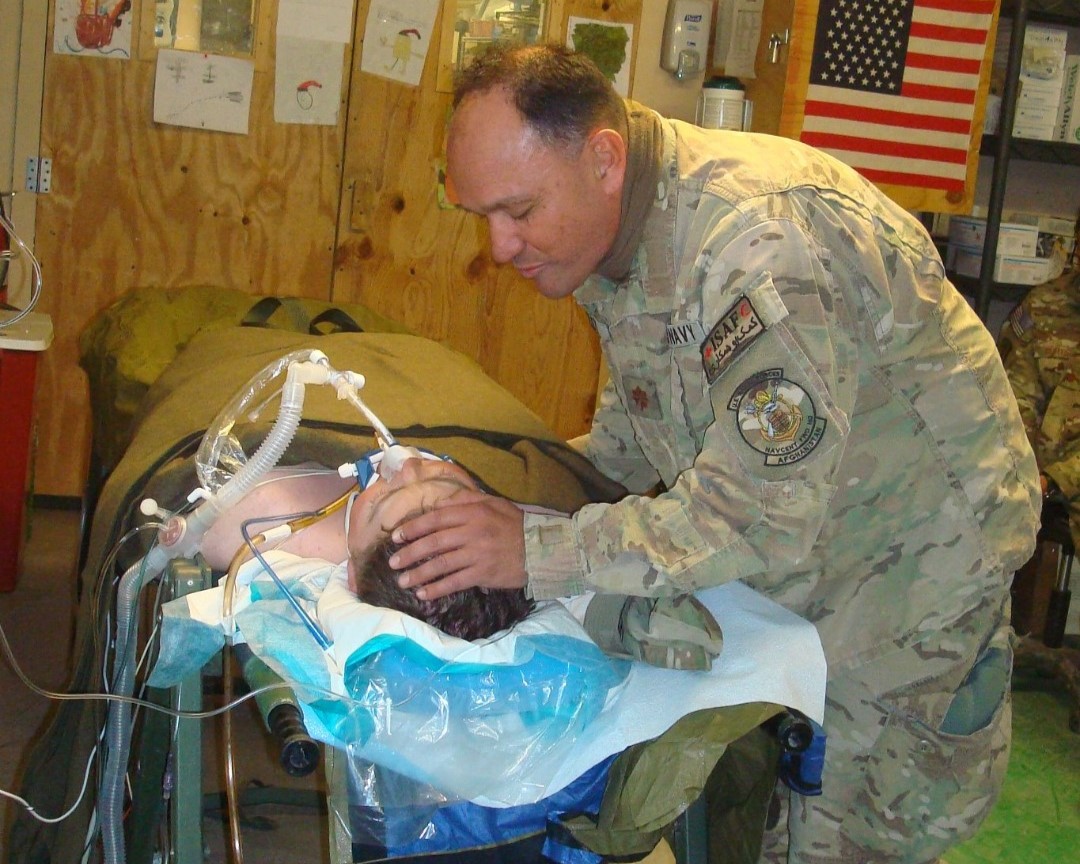
Pastor Riley praying over a wounded service member in Afghanistan.
Photo courtesy of Frank Riley

Frank has been a consistent blood donor since 2008 after learning that he has cytomegalovirus (CMV) negative blood, a rare blood type needed by premature babies and children with weakened immune systems. He was informed of his rare blood type during his first donation at a drive hosted by the Children’s Hospital of Orange County.

“I didn’t know about my blood type before,” he said. “When I got my donation card back, they said you’re CMV negative and that means my blood can help premature babies and kids who are fighting cancer. I realized that while my A+ blood was common, having CMV negative blood made me a part of less than 15% of the population.”

CMV is a very contagious, flu-like virus that can be deadly for babies and those who are immunocompromised. For babies with serious cases of CMV, some of the symptoms include premature birth, low birthweight and developmental conditions. While most adults who are infected with CMV have mild to no symptoms, they end up with CMV positive blood after their bodies develop the antibodies against the virus.

Those who have never caught CMV, like Frank, are considered to have CMV negative blood. Babies who need blood transfusions should only receive CMV negative blood, since their immune systems are not strong enough to fight the virus.

“I donated for the first time because I heard of a blood shortage at the children’s hospital,” Frank said. “Of course, I was kicking myself afterwards that I hadn’t started much earlier in my life, especially having CMV negative blood, but hey we start where we are.”

Since then, Frank has continued to donate blood wherever his life has taken him. While he was serving as a pastor of Grace Hill Church in Morgan Hill, Frank would donate blood regularly through Red Cross blood drives.

Recently, he moved to Minnesota and became the new pastor of Excelsior Covenant Church. In his new community, it is even easier for Frank to donate since the Red Cross has been running their blood drives at his church.

“As I give blood, I realize that I’m giving blood to people that I love in my community and people I haven’t met yet. It could be that today my blood is needed for somebody that I desperately care about,” Frank said. “As a Christian, which I am, there’s a reminder for me that centuries ago someone gave His blood for me. Keeping with my own Christian faith, I too have the ability to give blood for others. It doesn’t have the same impact, yet it is lifesaving.”

During his 18 years serving in the U.S. Navy Chaplain Corps, Frank experienced firsthand the lifesaving potential of blood donations. He has been deployed a few times internationally serving marines and sailors.

Upon reflecting on his deployment, he recalled a particular memory in Ghanzi, Afghanistan that impacted his perception of donating blood.

“A terribly wounded service member was coming in and there was a need for blood. Throughout the operating base, the call went out over loudspeakers and everywhere for people with a certain type of blood. I watched as people ran from different parts of the base to get there ahead of the helicopter evacuation. It was desperate. It was urgent. It was in the moment. That was somebody that was coming in now,” Frank said. “I realized that while I might be more distant from it in my donations here, it is no less imminent for the family and loved ones that are hoping. The urgency is always there.”

As a non-combatant in the military, Frank’s military identification carried the Red Cross symbol on it. He highlighted that the Red Cross was very active throughout the combat area as a resource.

“There are these emotional ties. Part of that impact was coming back and continuing that partnership. In some ways, I was even carrying the symbol of the Red Cross with me wherever I went, even on my uniform, as I struggled to serve the country,” he said.

As a proud representative of the Red Cross, Frank continues to advocate to his family, friends and congregation on the importance of donating blood.

Frank affirmed his dedication to partnering with the Red Cross to continue providing blood drives at his church. He also shares images of himself donating on his social media pages as a way of encouraging others.

“It’s important, and I don’t hesitate to talk to people about it. My encouragement would be to understand this: You’re potentially about to save a life. You’re about to make a difference in ways that most people never do,” he said. “My encouragement to you is to overcome fear, to overcome anxiety, take a deep breath and try and give at least once. A lot of times, it’s that first barrier that keeps us from giving.”

According to Frank, everyone who plays a role in the blood donation process is joined by their belief and commitment to the Red Cross mission. He calls on more people to join the mission and share their gifts with those in need. “As you come to a drive, the volunteers andthe phlebotomists are there taking your blood and welcoming you warmly. You are in a room where every person is dedicated to saving other lives. How many rooms do you enter where all of you are part of that?” he said. “You might be a stranger giving blood across from me, but we’re in mission together. You might be the one checking me in and taking my blood, but we’re in mission together. Even if you’re the person offering cookies, we’re in mission together. Every person is dedicated to saving lives, and that’s a rare thing.”

Learn more about the importance and need for CMV negative blood here and make your appointment to donate blood like Frank here: redcrossblood.org.

✨ HERO SPOTLIGHT! ✨ Amber Lawrence Honored with Red Cross Lifesaving Award for Heroic Rescue

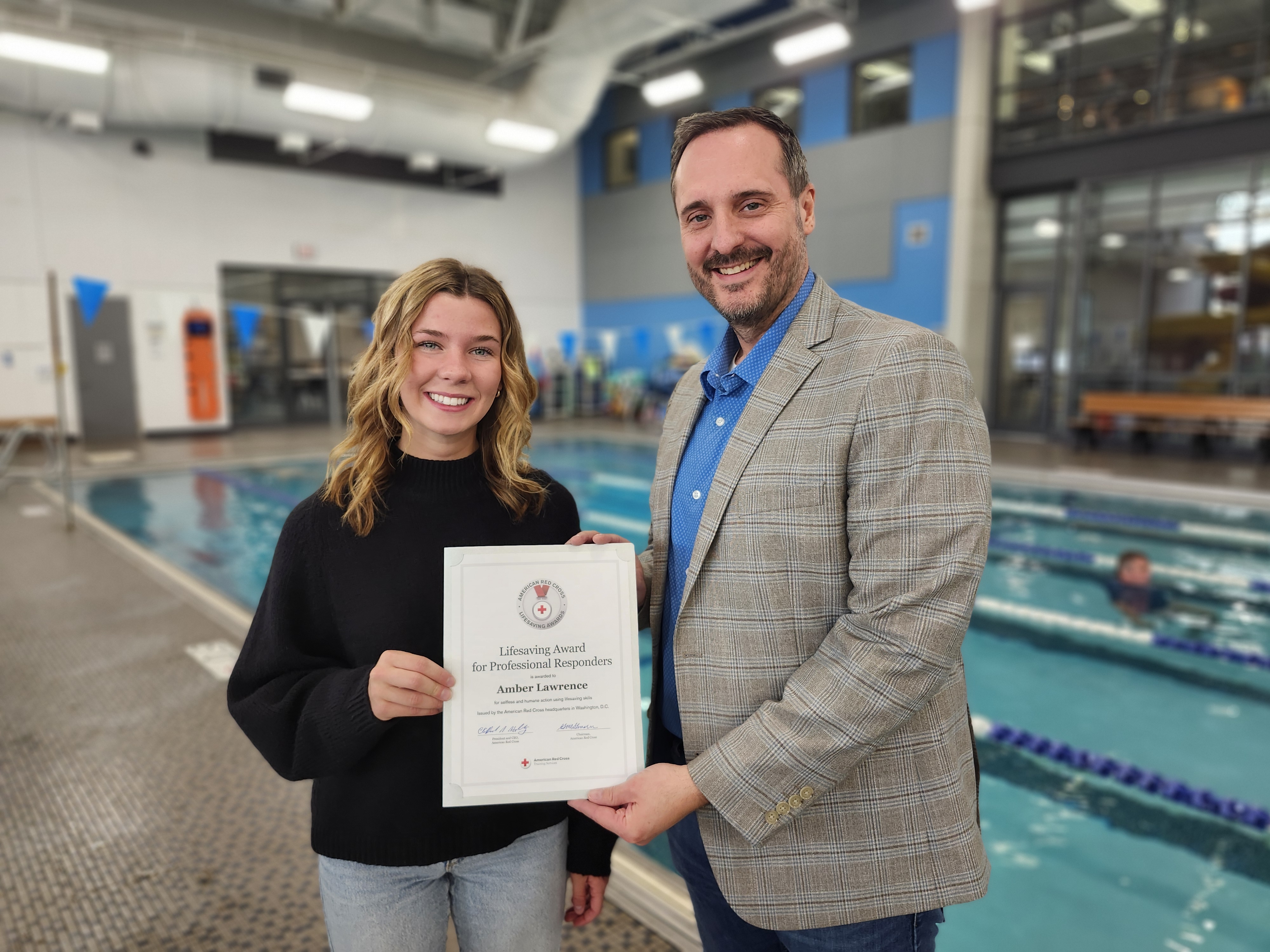
On January 7, 2025, we were thrilled to honor Amber Lawrence with the prestigious Lifesaving Award for Professional Responders, one of the highest accolades from the American Red Cross. This award recognizes individuals who save or sustain lives using skills gained through Red Cross Training Services.

Brice Johnson, Regional CEO of the Red Cross Minnesota and Dakotas Region, proudly presents Amber Lawrence with the Lifesaving Award, recognizing her heroic actions in saving a life through her Red Cross training. Photo: America Red Cross/Sue Thesenga

On August 8, 2024, at the Andover YMCA, Amber’s Red Cross training in Lifeguarding, CPR/AED, and First Aid was put to the ultimate test. While on duty, Amber witnessed a stroller with an infant strapped inside accidentally roll into the deep end of the lap pool. Without hesitation, Amber dove into action, jumping into the water and lifting the stroller just high enough for the baby’s head to break the surface. The infant cried out, and with the help of bystanders, both the child and stroller were safely pulled from the water.

Brice Johnson, regional CEO for the Red Cross Minnesota and Dakotas Region, praised Amber’s heroic actions, stating, “We are immensely proud to present the Lifesaving Award for Professional Responders to Amber. Her actions embody our commitment to enabling people to prevent, prepare for, and respond to emergencies.”

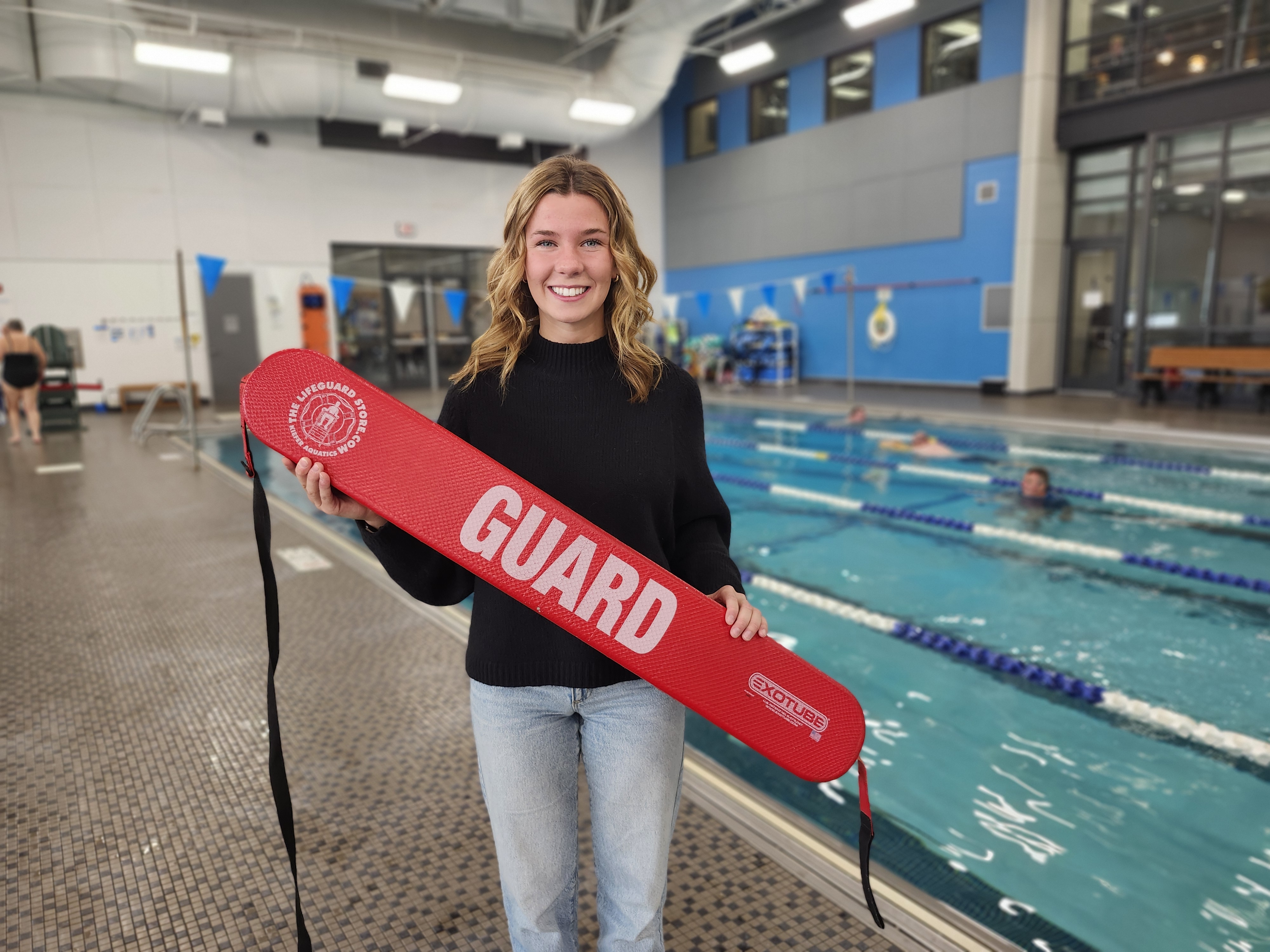
Amber Lawrence, honored with the Red Cross Lifesaving Award, stands by the pool where her quick thinking and Red Cross training saved an infant’s life. Her heroic actions exemplify the power of preparedness and courage in emergency situations.

Amber, a freshman at the University of Wisconsin River Falls studying Psychology, has been passionate about swimming since she was three years old. She earned her lifeguard certification in 2021 and now works as a lifeguard at the YMCA in Hudson, Wisconsin, balancing her duties with her academic commitments.

YMCA of the North’s aquatics team congratulate Amber Lawrence on her prestigious award. Photo: American/Red Cross/Sue Thesenga

Reflecting on the event, Amber shared, “It was scary. I am grateful for my Red Cross training, which gave me the confidence to handle the situation. My heart was relieved, and I was happy as soon as the child was safe.”

Amber Lawrence, receiving a big congratulatory hug from her grandfather at the Lifesaving Award presentation on January 7, 2025. Photo: American Red Cross/Sue Thesenga

Let’s all take a moment to recognize Amber for this heroic accomplishment! 👏

Inspired by Amber’s story? Empower yourself with lifesaving skills by enrolling in a Red Cross training course today! Find a class near you: Red Cross Training ▶️

Know someone who deserves recognition? Nominate them for a Lifesaving Award and help us honor their courage. Learn more about the awards: Red Cross Lifesaving Awards ▶️

Witnessing Resilience and Hope: My Red Cross Deployment to Asheville After Hurricane Helene 

Every deployment with the Red Cross is unique. Each one brings new challenges, new faces, and new lessons. My recent deployment to Asheville, North Carolina, after Hurricane Helene was no different. Walking through the aftermath of the storm, I was struck by the immense power of water and its capacity for destruction. But even more impactful was witnessing the resilience of the people and the power of collective action as volunteers, first responders, and neighbors came together to rebuild.

“Walking through the aftermath of the storm, I was struck by the immense power of water and its capacity for destruction.” – Brice Johnson

Responding to a disaster like this is always humbling. It’s a privilege to see the Red Cross mission in action firsthand, to be part of immediate relief efforts, and to know that our work will support long-term recovery for those impacted. This deployment, in particular, left me with lasting memories of strength, compassion, and the incredible difference we can make when we work together.

Finding Hope in Housing 

One of the most remarkable aspects of this deployment was the success of our shelter resident transition teams. These teams worked tirelessly to help shelter residents move into sustainable, long-term housing solutions. By the end of the deployment, almost every shelter resident had a more stable housing solution.

I’ll never forget a moment that brought this work to life for me. After a long day, I stopped at a fast-food restaurant for dinner. At a table near me, I overheard two men filling out job applications. One turned to the other and said, “The Red Cross got me a place to live, so now I can get a job.”

It was such a simple statement, but it carried so much weight. Having a safe and stable place to live gave this man the chance to rebuild his life. It struck me how transformative our work can be. This wasn’t just about housing; it was about hope and opportunity.

Sylvia’s Backyard Operation 

Another unforgettable moment came when I received a call from Sylvia, a local community member who had been supporting nearly 300 people camping in the woods after the storm. With no formal resources, Sylvia set up a makeshift shower in her backyard and provided food and supplies to help them survive.

Her selflessness and determination were extraordinary. She had been doing everything she could with what little she had, but when she contacted us, we knew we could amplify her efforts. Almost immediately, we dispatched one of our emergency response vehicles to her area, initiating a feeding mission that continued long after my deployment ended. Each night, nearly 300 people were served a hot meal.

Sylvia’s story is a testament to the power of individual action and the strength of community. Her willingness to step up in a moment of crisis inspired everyone involved and reminded me how much one person can accomplish with compassion and determination.

The Long Road Ahead 

Disasters like Hurricane Helene leave a lasting impact, and recovery is never quick or easy. While the immediate relief we provide is critical—sheltering families, serving meals, distributing supplies—it’s just the beginning. The road ahead for Asheville and the surrounding areas will be long, but the Red Cross’s commitment to being there for the entire journey is a source of hope for so many.

This deployment reinforced what I’ve always believed about disaster response: It’s a collective effort. From our volunteers on the ground to local community members and first responders, every person plays a role. Together, we help restore not just homes and livelihoods but also dignity and hope.

“This deployment reinforced what I’ve always believed about disaster response: It’s a collective effort.” – Brice Johnson

The Privilege of Service 

Being deployed to a disaster like Hurricane Helene is a profound experience. It’s a chance to witness resilience in action, to be part of something bigger than yourself, and to see firsthand how compassion and dedication can transform lives.

I carry with me the memories of this deployment—the resilience of the people we served, the commitment of our teams, and the extraordinary kindness of individuals like Sylvia. These moments remind me why the work we do is so important and why I’m so grateful to be part of the Red Cross.

As I reflect on my time in Asheville, I’m reminded that every disaster is different, but what remains constant is the spirit of service and the power of hope. To all who serve, thank you for being the light in someone’s darkest moment. And to the communities impacted by Hurricane Helene, know that the Red Cross will be there for you—not just during the storm, but for as long as it takes to recover.

By Brice Johnson
Regional CEO of the American Red Cross Minnesota and Dakotas Region

Brice Johnson with regional executive assistant Neela in North Carolina, 2024.

Three Heroes of Compassion: Rebekah, Sharon, and Tracy – Blood Donors Making a Difference

At Sabathani Community Center, three remarkable women – Rebekah, Sharon, and Tracy – recently stepped up to give the gift of life, each with a personal story and a shared mission: to make a difference in the lives of those in need of blood donations.

Rebekah: Leading by Example

As the Community Health Navigator at Sabathani, Rebekah is no stranger to encouraging others to take action for their health and well-being. When the call went out for blood donations, she knew she couldn’t ask others to do something she wasn’t willing to do herself.

Leading by example, Rebekah rolls up a sleeve for the first time at Sabathani Community Center’s first blood drive.

“I believe in leading by example,” she said, reflecting on her decision to donate. Despite some initial nerves, Rebekah’s jitters were quickly put to rest by the phlebotomist, who guided her through the process with care and ease.

What made her donation even more meaningful was her understanding of the critical role blood transfusions play for patients, particularly those with sickle cell disease. While sickle cell hadn’t personally impacted her family, Rebekah felt deeply passionate about the cause, especially when considering the importance of matching ethnicities in blood donations for those affected by the disease.

Sharon: Returning to a Lifesaving Tradition

Sharon, a former Red Crosser, hadn’t donated blood in several years, but when her niece Rebekah called on her to help with the drive, she knew it was time to get back into the fold. Sharon’s return to the blood donation chair wasn’t just a personal milestone, it was a heartfelt way to support her community.

Former Red Crosser and blood donor, Sharon, returned to donating blood at the Sabathani Community Center’s blood drive, November 11, 2024.

“I knew it was time,” Sharon shared. “When Rebekah reached out, I couldn’t say no. It feels good to be able to help others in such a simple yet profound way.”

Her decision to donate wasn’t just about family – it was about making a difference in her community and giving back to a cause that had always been close to her heart.

Tracy: From Volunteer to First-Time Donor

Tracy’s story is one of transformation and inspiration. She began as a volunteer at Sabathani’s blood drive, helping organize and assist others who came to donate. But today, she took the next step: she became a first-time blood donor herself.

Tracy donates blood for the first time and encourages others to roll up a sleeve.

Tracy’s mantra that is etched on her arm, “Each day is a gift,” is a reminder to live life with gratitude and purpose – and today, she was able to share that gift of life by donating blood.

“I want to encourage others to donate too,” Tracy said with a smile. “It doesn’t take long, and you’re helping save lives. If more people knew how easy it is, we’d have more donors for sure!”

A Community Coming Together

These three incredible women – Rebekah, Sharon, and Tracy – show us the power of compassion and the difference one person can make in the lives of others. Their stories are a testament to the power of community, the importance of blood donation, and the lives that can be saved with a simple act of kindness.

A heartfelt thanks goes to Sabathani Community Center for organizing their very first blood drive and for continuing to raise awareness about the critical need for blood donations. Together, we can ensure that patients with sickle cell disease and others in need of transfusions have access to this life-saving resource.

Here’s to many more inspiring stories and to the continued partnership with Sabathani, as we work together to make a lasting impact on the health and well-being of our community.

Visit here to learn more about the importance of a diverse blood supply here.

A dynamic mother/daughter duo: Jennie and Jezzalyn Ringler deliver hope as Red Cross ERV team

Among the many roles that volunteers can fill on a Red Cross mission, one of the most rewarding is that of the ERV Driver. These teams, which often consist of two individuals, drive Red Cross Emergency Response Vehicles and deliver food from community feeding partners to points of distribution after a disaster so that displaced families can pick up a hot meal.

Jennie and Jezzalyn Ringler serve up meals from the ERV in Asheville, North Carolina.
(Photo: Nate Russell)

This crucial role helps individuals and families feel a semblance of comfort and normalcy so that they have the energy needed to plan their next steps towards recovering from a disaster.

Often this role is filled by married couples, sometimes by strangers who become friends over the course of their mission, but very rarely do we see a team that consists of a parent and child. Jennie and Jezzalyn Ringler from central Minnesota are one such dynamic duo!

This is Jezzalyn’s first deployment as a Red Cross volunteer, “I don’t think she’s sick of me yet!” remarked her mother Jennie.

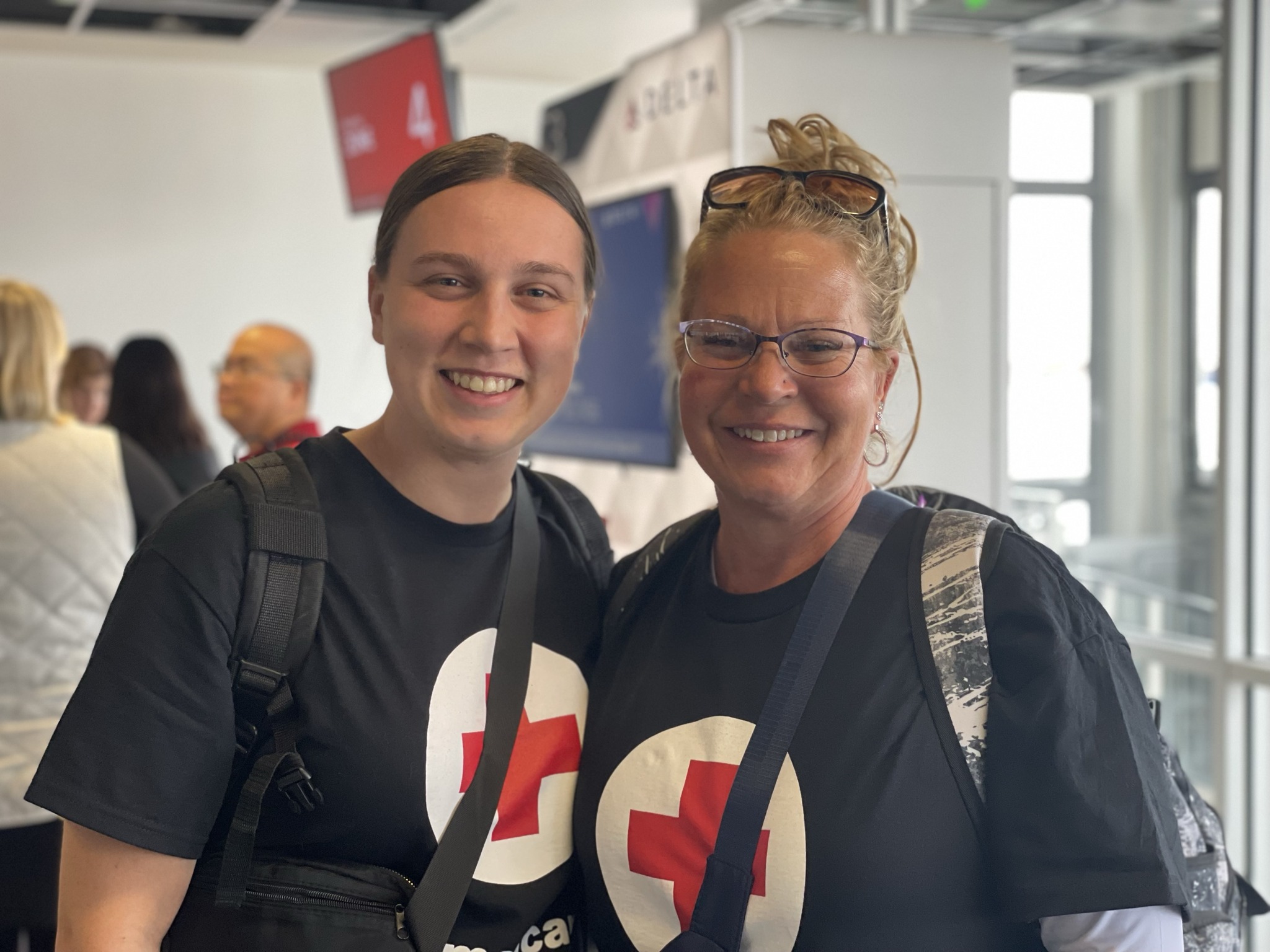
Jennie and Jezzalyn starting out their deployment journey at the airport. (Photo submitted)

This is not Jennie’s first deployment, she’s been an ERV driver since about 2011. She loves working on a team “You get a groove going and you can keep it that way.”

Jezzalyn says her favorite part of being on an ERV Team is the people and the stories. “We’ve got regulars, we see them every day. We get to hear about their lives, about their recovery. Many of them are military veterans.”

Mother/daughter duo work hand-in-hand serving meals to those affected by Hurricane Helene in Asheville, North Carolina. (Photo: Nate Russell)

The Ringlers’ ERV is parked at the Buncombe County Sports Park, at one of our Community Care Centers. Here, hurricane impacted individuals and families can do their laundry, take a shower, pick up supplies such as jugs of potable water, and of course pick up a hot meal. “We’ve served close to 100 meals today,” says Jezzalyn.

Visit here to find a Community Care Center and other resources.

Story by American Red Cross volunteer Nate Russell.

Small but mighty Red Cross societies, working hard and not alone

 By Lynette Nyman/IFRC 

“Everything was good until Beryl came,” says Delta Alexander, a lifelong resident of Union Island in St. Vincent and the Grenadines.

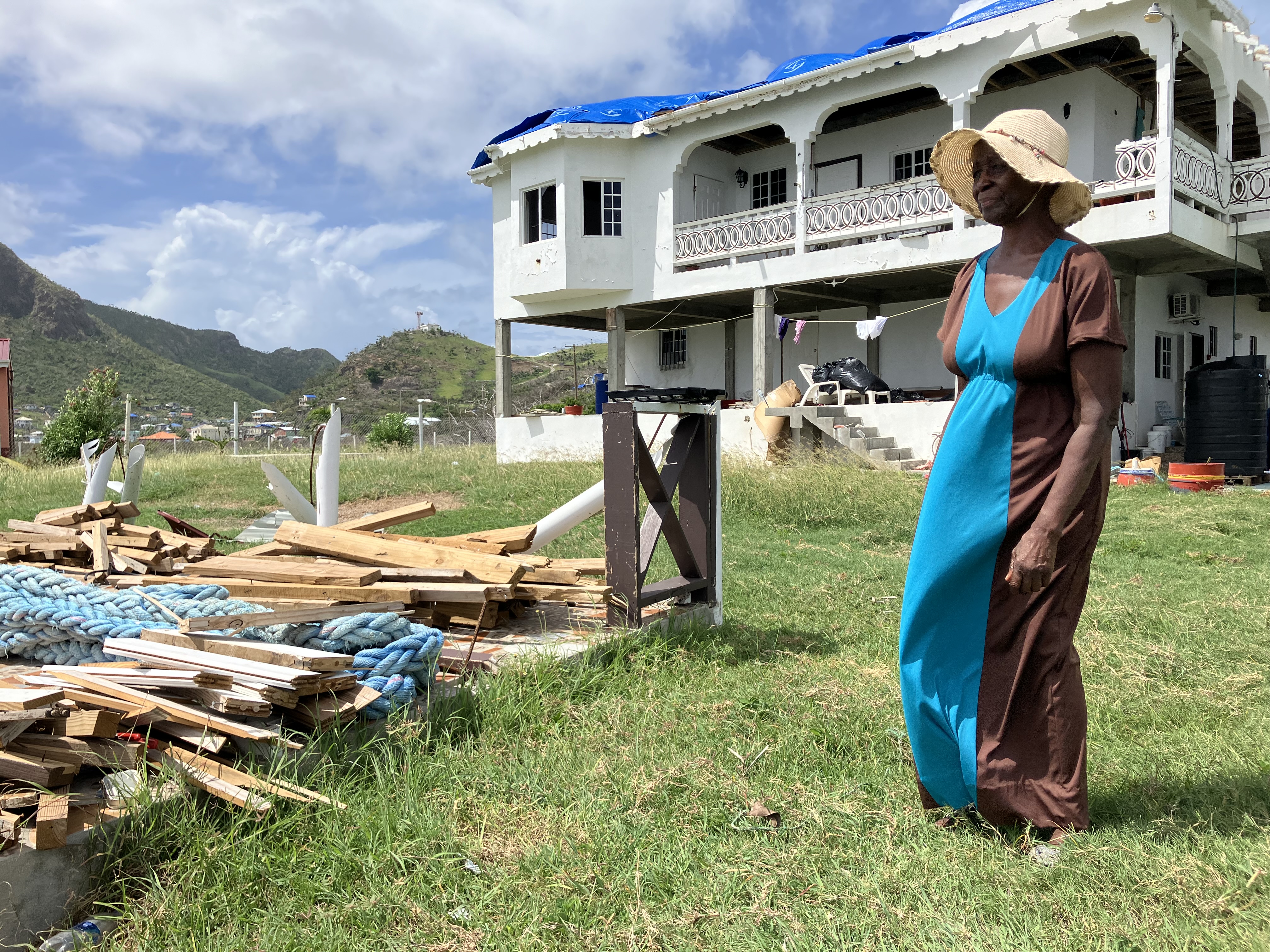
“Everything was good until Beryl came,” says Delta Alexander, who was born and raised on Union Island in St. Vincent and the Grenadines. She is grateful for the care and support that the local Red Cross provided following Hurricane Beryl. Photo: Lynette Nyman/IFRC 


She’s thankful for the care and support the local Red Cross provided after Hurricane.

Beryl. Delta left Union Island in 1969, always planning to return, and in 2015, after retiring from a nursing career in Canada and the U.S., she came back to rebuild her life.

For the next three years, she built a home and continued her humanitarian work in this tight-knit community. The hurricane hasn’t slowed her down.

“The people I’m grieving for are those in shelters. They have no money, nowhere to go. They lost everything, houses, clothing, even underwear,” she says.  

Her house, situated on low land near the shore, was quickly surrounded by high water during the category 5 storm that struck parts of the Caribbean on July 1. The winds, too, were a threat. For four hours, she held back a door, dislocating her shoulder. At 78, her strength and generosity are inspiring.  

“I saw death right there. How am I going to escape?” she recalls asking herself during the storm.   

The trauma connected her with St. Vincent and the Grenadines Red Cross (SVGRC) volunteers who responded to help people on multiple islands and the mainland. 

Early in the emergency, Red Cross volunteers set up relief operations at a church on Union Island, distributing non-food items as well as a space for people to share their experiences – it was much-needed and appreciated emotional support.   

“Red Cross was wonderful. People were very nice. So soothing. Helpful and encouraging,” says Delta.  

Small society, many hazards 

The SVG Red Cross is a young national society that gained its independence from the British Red Cross in 1984. Today, the SVGRC is comprised of a nearly 100 percent volunteer workforce, including key leaders like Shaneika Laidlow who manages their disaster and mental health programs. Their aim, she says, is to help people get back to normalcy.  

“We offer assistance to those who most need it, to the best of our ability,” says Shaneika Laidlow, who manages disaster and mental health programs for the St. Vincent and the Grenadines Red Cross. Photo: Lynette Nyman/IFRC

“During these times people can get very frustrated. Does the Red Cross care for them?” says Shaneika, who is based in the nation’s capital on the mainland, St. Vincent. The answer is yes. 

“There are so many people we would love to make better, but there are some things we’re unable to do at this time because of restraints. We offer assistance to those who most need it to the best of our ability,” she says.  

The scope of the work, and the potential need, is challenging. This small nation and Red Cross society faces multiple hazards, including tropical storms, flooding, hurricanes, and even an active volcano.  

In early October, monitoring showed unusual thermal activity of the La Soufriere volcano – activating the government to issue a low-level warning and close the trail to the summit.  

La Soufriere, shrouded in clouds, is an explosive volcano that most recently erupted in 2021. It’s one of several hazards facing the St. Vincent and the Grenadines Red Cross. Photo: Lynette Nyman/IFRC 

The thermal anomaly stopped, but reminded many of past explosive eruptions like the most recent in 2021 when, on April 9, the dome inside the crater blew and for days spewed devastating volcanic ash across communities. 

“It was like the sun was out, but not there. It was all dark,” remembers Edwin Joe, who lived in the countryside distant from the ‘red zone’. He remembers ash covering everything. “Just white everywhere, like bright snow with no sun. We didn’t know what was going to happen.”  

Edwin Joe evacuated the St. Vincent, the mainland, for two weeks following the eruption of the volcano La Soufriere in 2021 and returned to find houses that had roofs collapsed from the volcanic ash. Photo: Lynette Nyman/IFRC 

Edwin evacuated the mainland for two weeks and returned to find some houses that had roofs collapsed from the volcanic ash. Many people stayed in shelters for several months. 

The Red Cross formed part of the response with the government and other emergency partners, providing water, relief items and temporary housing assistance.  

Help around the corner 

The good news is that during challenging times a small Red Cross society like the SVGRC can turn to other national societies for help, primarily through the International Red Cross and Red Crescent (IFRC).  

Raziel Uranga, a Mexican Red Cross responder with decades of disaster response experience deployed through the IFRC ‘surge’ program to serve as response operations support in St. Vincent and the Grenadines. His predecessor, he says, arrived just a few days after the hurricane, helping the SVGRC manage a large disaster response. 

Photo 4 – Small Red Cross societies “need support from the global Red Cross network in order to grow as fast as they can, especially with the multiple hazards they’re facing,” says Raziel Uranga from the Mexican Red Cross, now deployed to support the SVG Red Cross provide relief for people affected by Hurricane Beryl. Photo: Lynette Nyman/IFRC

“Red Cross is the best humanitarian movement in the world, I am convinced, because no other organization has the workforce that we have,” says Raziel, whose passion lies in reducing risks amid the rising frequency of severe disasters.

Responders and donors from around the world – and in their own communities – have provided relief for people affected by Hurricane Beryl.  

It’s uplifting for many to see this unified effort. And yet, when something big happens, a small national Red Cross society like the SVGRC needs help to do its best now and beyond.  

“They need support from the global Red Cross network in order to grow as fast as they can, especially with the multiple hazards they’re facing,” says Raziel.  

These hazards can destroy homes and livelihoods. Building back both is the focus on Mayreau, an islet just a short boat ride from Union. Wheelbarrow by wheelbarrow, people are removing rubble to restore the island’s sole income, tourism.  

“We have to clean up this island to get tourism back – to get people back from Martinique – to see the turtles,” says Patrick Forde, a water-taxi driver before the storm.  

“We have to clean up this island to get tourism back – to get people back from Martinique – to see the turtles,” says Patrick Forde, a water-taxi driver before the storm devastated Mayreau, an islet in the Grenadines. Photo: Lynette Nyman/IFRC 

Patrick rode out the hurricane in a small cupboard with his two children. “I’m lucky to be alive,” he says when looking back. 

Tiny but mighty, what he loves about his island is the way people unite. “Whenever there’s a disaster, we all show up and work together.” 

Learn more about the work of Red Cross societies around the world, like SVGRC, through the IFRC, click here.