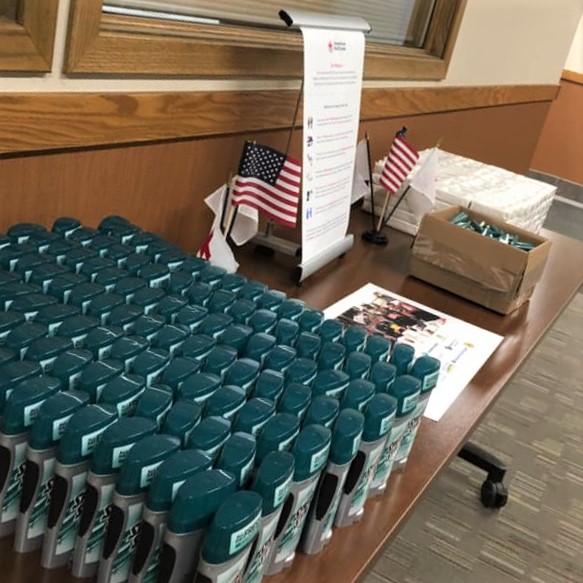
On July 23, 2019, at the Women in Manufacturing conference in Cloquet, women made hygiene kits that American Red Cross volunteers will distribute to people in need of humanitarian aid. Photo by Jamie Lund with Pine Journal and published with permission.
USG Corporation hosted more than 50 women during the conference, which was held July 23 and 24. Part of the program included a day of service activity, which focused on supporting the Red Cross mission to prevent and alleviate human suffering in the face of emergencies.
To support service day, USG donated the kit supplies, including pillowcases, that turned into 250 comfort and hygiene kits. The kits will help at-risk military veterans and families affected by disasters, mostly home fires in northern Minnesota and northwest Wisconsin.
The service day event showed great leadership, teamwork and camaraderie. Special thanks go to local Red Cross volunteers Kyra, Penny, Mattie, Diane and Sophia, as well as Northern Minnesota Red Cross executive director Dan Williams.
For more about the conference, read this Pine Journal article by Jamie Lund. Click here to help the Red Cross provide shelter, food, and other relief during disasters. To learn more about Red Cross support for military families and veterans, click here.
Unless otherwise noted, all photos are provided by Dan Williams with the American Red Cross Minnesota Region. Thanks Dan!
American Red Cross staff member Deshayla Tran finishes collecting a whole blood donation from Terry Smith, who has been regularly donating blood for the last five to 10 years. Amanda Romney/American Red Cross
Donors of all blood types, especially type O, are needed to help replenish the blood supply as the Red Cross faces an emergency need right now. Blood from generous volunteer donors helps families like the Jolliffes.
In February 2018, Meghan Jolliffe suffered an amniotic fluid embolism. During childbirth her heart stopped beating for 14 minutes resulting in the need for an emergency cesarean section. Her organs began to shut down, and her blood would not clot.
Meghan received nearly 100 units of blood within a seven-hour period during her procedures. The doctors were able to stop the bleeding and stabilize Meghan’s condition. Over the next several days, Meghan underwent five surgeries, dialysis and more to repair the damage to her body.
Type O negative red blood cells are kept in a Red Cross storage refrigerator before being distributed to a hospital. Type O negative is the universal blood type and what emergency room personnel reach for when there is no time to determine the blood type of patients in the most serious situations. Amanda Romney/American Red Cross
After her son Sullivan was delivered, he went without oxygen for seven minutes. Doctors performed a process called therapeutic hypothermia, or whole-body cooling, to preserve his neuro function, and he also received several units of blood.
In all, Meghan and Sullivan received 109 units of blood.
Meghan and Sully
“My family and I are forever grateful for the generosity of Red Cross volunteer blood donors,” says Meghan. “Donating blood is so important. You or a loved one may never need these lifesaving products, but I can assure you that someone, somewhere will.”
Please don’t wait to donate. You can make an appointment now to give blood or platelets by downloading our free Blood Donor App, visiting RedCrossBlood.org or calling 1-800-RED CROSS (1-800-733-2767).
Thank you!
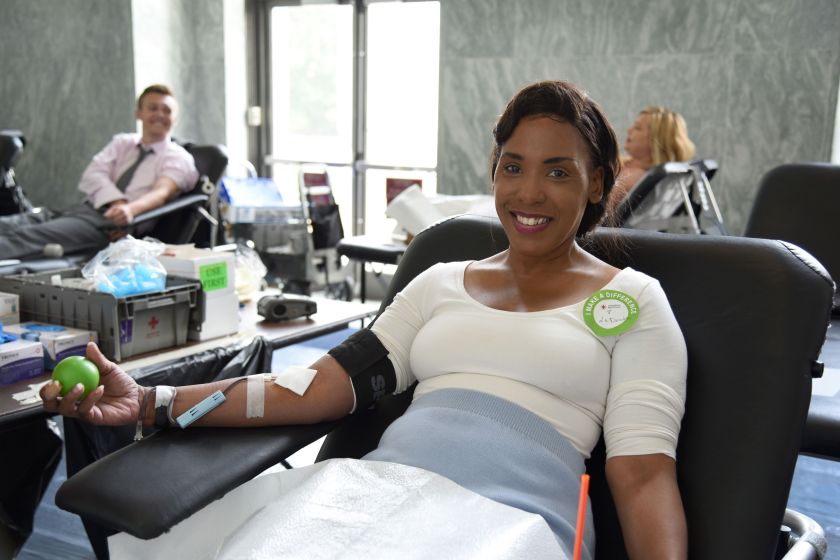
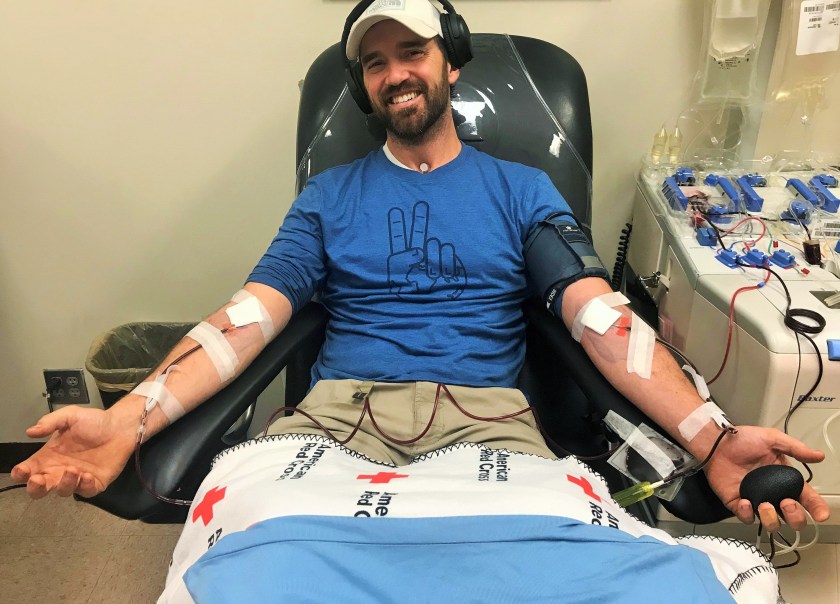
LaDeodra Drummond donates blood. Jeanette Ortiz-Osorio/American Red Cross
Do you know that only 3 out of 100 Americans donate blood each year, but every two seconds someone in the U.S. needs blood? Here’s another surprise: blood donation can be super easy. Once you’re seated comfortably, the actual donation time takes only 8 to 10 minutes. To help bring more ease for new and continuing donors, below are six things we’d like you to know before donating blood.
You do not need to know your blood type. A national survey conducted earlier this year for the Red Cross revealed that54%of people believe they need to know their blood type to donate blood. Find more eye-popping results here.
You should be well-hydrated. Blood has a lot of water. To promote a good flow during donation and to prevent dizziness during or after, we recommend drinking an extra16 oz.of liquid before donating. Hydrate after, too. Check out our fave water bottle that will help keep you hydrated on the go.
You should eat a healthy meal rich iniron and vitamin Cwhile avoiding high-fat foods just prior to donation. Your body needs iron to make new blood cells, replacing the ones lost through blood donations. Vitamin C promotes iron absorption. Find a list of iron rich foods here. Yum!
You should wearcozy clothes. Whatever’s on top should be loose and comfortable with short sleeves or sleeves that can be easily rolled up above the elbow during your donation. Find our classic T-shirt here in many colors.
You can speed up your appointment time. Complete aRapidPass® on the day of your donation, prior to arriving, and you’ll save time completing your health history that’s required before your donation can begin. Click here for more.
You should remember to bring apicture ID. Your ID can be one primary ID, such your Red Cross blood donor card or state driver’s license; or two other forms of secondary ID. Click here to check for acceptable forms of ID.
Now that you’re feeling more confident about blood donation, click here to schedule an appointment near you. Need more tips? Watch this video of some pro blood donors. They make it look easy, because it is. Thanks!
Congratulations to our 2019 Heroes Awards recipients. They’ve made the world a better place and we’re thankful for that. Check out their stories.
Good Samaritan Hero
Melissa Goble and Kimberly Hartung did not know each another when they encountered a man in cardiac arrest along the path of 10K race in Nisswa in April 2018, but they both stepped up and put their training as nurses into action. Click here to watch Melissa’s and Kimberly’s story. Our 2019 Good Samaritan Hero Award is presented by CenterPoint Energy.
First Responder Hero
Paul VanVoorhis and Steve Kritzeck found an injured man in the Boundary Waters Canoe Area Wilderness and traveled about a mile with him to get to safety. They provided him with crucial lifesaving first aid until emergency help arrived. To watch Paul’s and Steve’s story click here. Our 2019 First Responder Hero Award is presented by Abbott.
Give Life Hero
Kirk Albright has donated platelets every other week for nearly thirty years. He doesn’t do it for recognition or for awards, but simply because he knows there is a great need. To watch Kirk’s story click here. Our 2019 Give Life Hero Award is presented by Deluxe Corporation.
Community Hero
Cassandra Holmes is a vital part of the Little Earth United Tribes and East Philips neighborhoods in Minneapolis, serving in many roles that illustrate her commitment to the Native-American communities. Click here to watch Cassandra’s story. Our 2019 Community Hero Award is presented by Eide Bailly LLP.
Youth Hero
Thirteen-year-old Ella and fourteen-year-old Collin Hintze-Belland were watching their six-year-old sister at their home in Stillwater in August 2018 when a fast-moving fire swept through their house. Watch Ella’s and Collin’s story here. Our 2019 Youth Hero Award is presented by Medica Foundation.
Military Hero
Dan Couture, 20-year veteran of the Minnesota Army National Guard. Couture puts his military experience to work everyday fighting tirelessly to reduce veteran homelessness in St. Louis County, Minnesota. Click here to watch Dan’s story. Our 2019 Military Hero Award is presented by APi Group, Inc.
The 2019 Heroes Awards were given at our 2019 Heroes Breakfast, which was presented by Land O’Lakes, Inc., and held at Radisson Blu, Mall of America, on May 3. Many thanks to Slumberland Furniture for sponsoring and producing this year’s Heroes videos. Click here for the complete playlist. Thank you to Marathon for supporting our Heroes VIP Reception. All photos are by Lara Leimbach for the American Red Cross Minnesota Region.
From serving meals to disaster victims to briefing soldiers before deployments, Red Cross volunteers contribute throughout our communities in many ways. Flora Holmberg serves in another important role: Blood Donor Ambassador at blood drives and fixed donation centers.
Flora Holmberg
What do you do as a Red Cross volunteer? I work as a Donor Ambassador in Minneapolis, St. Paul and Stillwater areas. I greet people who are coming to donate, thank them for coming in, and register them for their donation appointment.
What’s your favorite part or memory of volunteering? I enjoy meeting and visiting with all the great people who come in to donate.
Would you recommend volunteering with the Red Cross to others? Yes! Very much so!! It’s a great organization to volunteer for – it gives you such a great feeling to know that you are a part of something that helps so many people.
How does it feel to help save a life? Watch this video:
We’re always looking for volunteers to help their neighbors in need after disasters like home fires. To volunteer or for more information, click here. Or join us during upcoming 30-minute “Call to Serve” conferences calls:
Barb Billmeier (center) received the Ann Magnussen Award at American Red Cross national headquarters in Washington, DC, on March 27, 2019. Photo by Dennis Drenner/American Red Cross
Congratulations! to Barb Billmeier for receiving the 2019 Ann Magnussen Award, the highest honor of nursing achievement in the American Red Cross.
Barb served as the Regional Nurse Lead in Minnesota until her recent retirement from this volunteer position. She also led the Minnesota Health Professionals Network as we strove to optimize volunteer engagement and increase capacity. Barb also serves as a volunteer disaster health services (DHS) responder helping people who need disaster assistance.
Award nominees were evaluated on four criteria: (1) provides service to others; (2) teaches and involves others; (3) exhibits compassion, professionalism, and a humanitarian spirit; and (4) demonstrates outstanding contributions to strengthening Red Cross programs and services.
Previous recipients from the American Red Cross Minnesota Region include Janice Springer in 2014. Click here to learn more about Ann Magnussen – a graduate from the University of Minnesota. Click here to learn more about becoming a Red Cross volunteer.
The American Red Cross relies on more than 20,000 nurses and other health professionals who bring our mission to life each day. If you’re a nurse, nursing student or other health professional, we need your help! There are volunteer opportunities in direct service, leadership and behind-the-scenes. A few examples are:
• Disaster Health Services –team members and leaders
• Disaster Mental Health Services –team members and leaders
• Pillowcase Project Instructor (educating 3rd-5th graders about disasters)
• Blood Donor Ambassador Leader
• Nursing Network Regional Nurse Leaders and team members
• Service to the Armed Forces Hero Care Case Management
We hope that you consider volunteering with the Red Cross – you can have a meaningful impact by serving individuals and communities.
That’s a spot-on adage when we consider fulfilling our Red Cross mission to alleviate human suffering in the face of emergencies.
For example, one hundred years ago Junior Red Cross volunteers in Duluth made care packages for World War I veterans overseas.
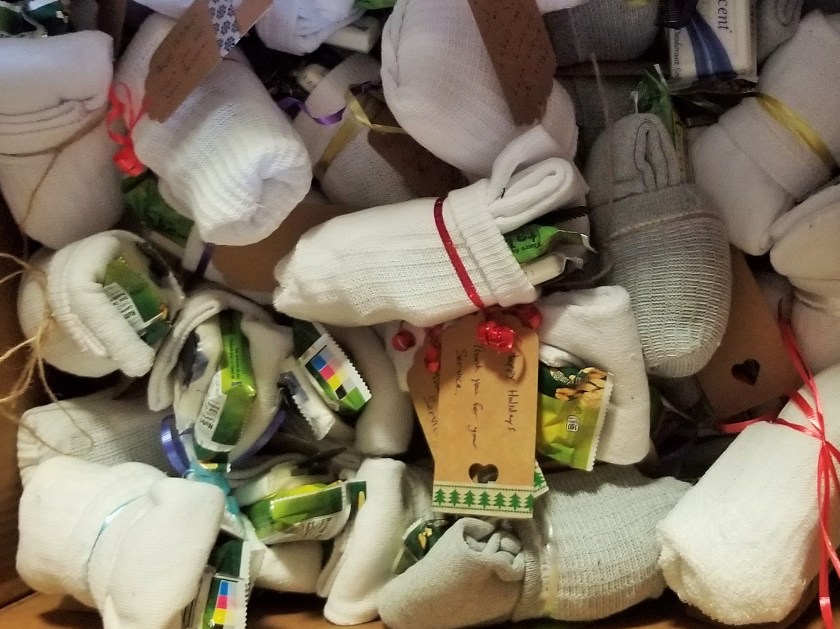
This year our Service to the Armed Forces volunteers will distribute donated socks to veterans who are homeless or at risk of becoming homeless.
Donated socks ready for distribution to military veterans in nursing homes. Photo by Jennifer Landeros
There are more examples and yet, whatever the year of the new year, the basics of life remain the same.
People need shelter, food and clothing. People need blood and blood products. People need to reach loved ones during emergencies.
The Red Cross helps meet these and other basic needs within the context of being impartial and neutral, of empowering volunteer service, and keeping an eye on preserving and promoting human dignity in all of our work.
With those thoughts in mind, this year we encourage you to look to the stars while keeping your feet on the ground. Make a regular commitment to:
This past fall volunteer Deb Thingstad Boe responded for the first time to a Red Cross call for nurses to support Hurricane Florence relief efforts. Deb deployed to North Carolina where she worked in a shelter. Below is an excerpt of Deb’s experience originally published in the December 2018 Minnesota Metro Medical Reserve Corps newsletter. Thank you to Deb for responding to the call to serve when you’re needed most!
Deb at Smith shelter in Fayetteville
I found out the deployment process moves fast! I spoke with the Red Cross on September 25, which was almost three weeks after Hurricane Florence made landfall, and six days later I was on the ground in Fayetteville, North Carolina. I was deployed through what is called Direct Deployment (DD), which is a rapid process used to ready healthcare workers for disaster work.
Once I received a call from Red Cross staff affirming my desire to deploy, I completed forms and about 15 hours of required online training and attended a deployment training in-person. At this training I received my disaster response ID, and mission and procurement cards. The mission card was used for my expenses and the procurement card was used to help clients (there is training on this!).
Along the way I also received a suggested packing list that was invaluable. Among those items were a stethoscope and blood pressure cuff. I found out later that it’s more difficult if you do not own these items when you arrive on assignment without them. The best thing I purchased to prepare was a self-inflating air mattress that fit on the cot I slept on. Ear plugs are a must! If I didn’t wear them, then I worried about whether the next breath is coming for some people. I wasn’t the only healthcare volunteer that talked about that.
Red Cross volunteer staff shelter (a.k.a. home)
Although it felt like everything was moving fast, I knew this was what I wanted to do. I decided I would go with the flow, take things as they come and try to do my best.
My assignment was to work 12-hour shifts at Smith Recreation Center. This Red Cross shelter was planned to be the last to close in Fayetteville. This meant that as other shelters closed people who had not been able to find housing were relocated to Smith. The shelter had about 150 people in residence, many who were among the most vulnerable people in the city: people with mobility issues, unstable chronic conditions exacerbated by displacement, chronic untreated mental illness, addiction, in hospice care, and (previous to the disaster) long-term homelessness.
Every day was different and yet alike. Within the first fifteen minutes of the first day, I was instructed on how to administer Narcan and safety precautions related to the environment. I was informed that public health obtained Narcan for the shelters because there was a death due to opioids. The shelter had many residents who accessed Disaster Health Services on a daily basis. I learned about “shelter cough.” When I arrived many residents and staff had upper respiratory symptoms, and I wondered about influenza and whether residents had been offered flu vaccinations. Just listening was an important component of care.
Visiting rural communities in North Carolina
My experience with Public Health came in very handy. Part of the plan to help one woman in the shelter included food as a prescription for her chronic health needs. Listening and choices were critical to helping her. During my three hours with her, I managed to work in stress management tips and the power of positive-thinking and being forward-moving in thought and actions.
I finished my time working in rural North Carolina working with the community to identify unmet needs, assess how migrant farm workers were managing, and identify where the Red Cross could help. We partnered with Spanish-speaking restaurant owners to inform the area churches of our presence. They opened up an area of their restaurant for Red Cross services and allowed a food truck to be positioned in their parking lot. People came for blood pressure and glucose level checks, OTC meds, blankets, diapers, and TLC (tender-loving care). Staff assigned included an interpreter, disaster mental health, and disaster healthcare. Listening and caring were critical elements of care.
Deb and her new friend Lois
One of the things I enjoyed the most was meeting volunteers from other places. The first night a few of us who had met at the shelter gathered together and headed out to dinner. None of us were assigned to the same place, which meant we met more people the next day. I met a retired pulmonologist and two EMTs, and we had dinner together every night starting on night two of a ten-day deployment. We had fun, and it was a good transition to sleep and the next day.
Deb Thingstad Boe is an American Red Cross Volunteer and a Dakota County Minnesota Medical Reserve Corps Volunteer (MRC). Photos provided by Deb. Click here to learn more about becoming a Red Cross volunteer.
The arrival of the holiday season often means spending time and exchanging gifts with family and friends. But what if the gift you needed couldn’t be bought? For patients like Mike McMahon, the generosity of blood donations was the perfect gift and didn’t cost anything other than a bit of someone’s time.
Following a tragic tree felling accident on Nov. 10, 2016, McMahon, a Stillwater, Minnesota resident, suffered life-threatening injuries. He needed 11 units of blood during emergency surgery to keep him alive.
He spent the next six weeks in the intensive care unit and inpatient rehab, including three weeks during which he had to be intubated as he was unable to breathe on his own.
During his hospital stay, he also experienced an ulcer on a major artery in his intestines. The ulcer was so severe that he needed an additional seven units of blood and the artery was coiled to stop the hemorrhaging.
Mike McMahon
“I remember clearly as my nurse hooked me up to the first bag of blood,” said McMahon. “The thought of blood passing through another person’s heart and now into me, to keep me alive, was very emotional. From the first pint to the last, each one was equally moving.”
McMahon was told that he might not be able to do a lot of things ever again – his future was uncertain. However, just a few days before Christmas he was released from the hospital.
McMahon is thankful for blood donors and credits blood donation with helping save his life. “I’m grateful for the donors who gave me such an amazing gift – to spend Christmas and more holidays with my family. I was an occasional blood donor before the accident – today I donate as often as I can to help ensure others receive the same gift of life.”
You can give patients like McMahon more time and memories this holiday season by donating blood at the American Red Cross 6th annual 12 Hours of Giving Blood Drive at Inwood Oaks in Oakdale, Minnesota. As a special thanks, all who come to give will be treated to free parking, complimentary gift wrapping, a special gift bag, a long-sleeved Red Cross T-shirt, and holiday food and entertainment and will be automatically entered into hourly prize drawings including grand prizes – a large flat panel TV and a HP laptop computer.
To make an appointment to give blood at the 12 Hours of Giving Blood Drive, donors can click here or use sponsor code 12 hours on the Red Cross Blood Donor App, online at redcrossblood.org or by calling 1-800-RED CROSS (1-800-733-2767).
We hope to see you at the 12 Hours of Giving Blood Drive. Happy holidays from your friends at the Red Cross!
Story and photo by Sue Thesenga/American Red Cross







 American Red Cross Minnesota and Dakotas Region