Red Cross prepares for disasters that could cross the northern border

Across northern Minnesota, American Red Cross disaster relief responders are working towards hosting a disaster shelter workshop in each county and tribal community. Most recently, the Red Cross teamed up with Koochiching County employees. In addition, the Red Cross connected with response partners across the U.S.-Canadian border because, as we know, ‘disasters don’t go through customs.’

Nancy Johnson with
Nancy Young with the American Red Cross Dakotas Region guides shelter training participants during a workshop in Koochiching County, March 2016. Photo credit: Richard Johnson/International Falls Journal

The training week started with a shelter set-up that included twenty-four Koochiching County employees. (The workshop was a smaller version of what was used for the statewide Vigilant Guard exercise in Duluth in the fall of 2015.) Before the participants arrived they completed the American Red Cross Shelter Fundamentals course online. During the on-site part of the training, a Red Cross team of three volunteers from the Minnesota and North Dakota guided the shelter participants. (The cross-border collaboration between states has been in place for more than two years because we’re often called to respond together.) The workshop was set-up in three stations: registration, dormitory, and feeding. There was also a training for disaster nursing. After the two-hour workshop there was an open-house for the community members who were not in the training to ask questions and to see how the Red Cross and Koochiching County can work together to shelter displaced people during disaster relief response. The Salvation was also on hand serving lunch to all who participated. (Thanks!)
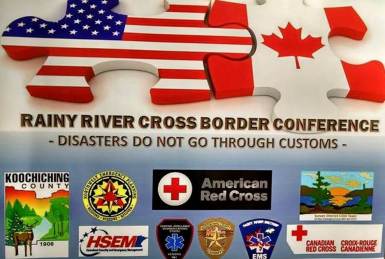
rco_blog_img_CrossBorderConference2016A cross-border conference called “Disasters Do Not go Through Customs” followed the shelter training. Sponsored by the Rainy River Cross Border Planning Group, the conference  brought together around one hundred people from both sides of the U.S.-Canadian border who could work together during major disasters affecting both sides of the international border. Presentations included managing potential threats, such as train derailments, floods, tornadoes, biological outbreak, communication failures, quarantine, wild fires and terrorism. All levels of government were represented from both Canada and the United States. Railroad representatives addressed one of the biggest concerns throughout the emergency management world: train derailments involving large amounts of oil carried by rail.

Less than twenty fours after the end of the conference there was a train derailment in Callaway, Minnesota. The accident forced the town of more than 200 people to be evacuated. Red Cross volunteers from North Dakota and Minnesota as well as Salvation Army relief workers were on-scene, providing the care and sheltering that we have trained for and do so well.

Story by Tony Guerra, Disaster Program Manager for the American Red Cross Serving Northern Minnesota. You can be a Red Cross disaster relief volunteer.

Red Cross workers: Tirelessly delivering disaster relief services

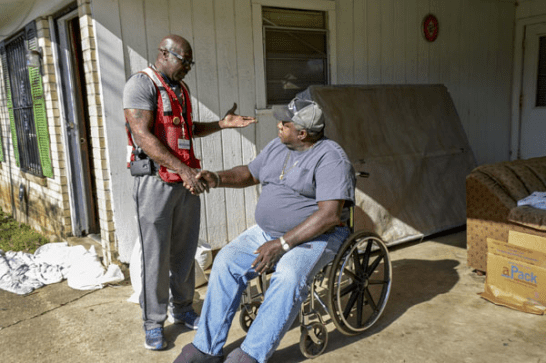
"I am so thankful to this community, my neighbors, and the Red Cross," says Monica Smith lost nearly everything when her home in floods in Deweyville, Texas. Photo Credit: Danuta Otfinowski/American Red Cross
“I am so thankful to this community, my neighbors, and the Red Cross,” says Monica Smith lost nearly everything when her home in floods in Deweyville, Texas. Photo Credit: Danuta Otfinowski/American Red Cross

As much of the country looks forward to Easter weekend, thousands of people in Louisiana, Texas and Mississippi are still dealing with the impacts of severe and widespread flooding.

For more than two weeks, communities across the South and Gulf Coast have endured intense rainfall and record-breaking flooding. The Sabine River flooding on the Texas and Louisiana border has broken records held since the 1880s and the Red River in Louisiana hit its highest level in more than 70 years. And this week, portions of the southern U.S. will face the return of severe thunderstorms and flooding, raising additional flooding concerns for already drenched terrain throughout the lower Mississippi Valley.

The American Red Cross is there on the ground, working around the clock to support individuals and families in need. On Tuesday, March 22, more than 270 people spent the evening in 16 Red Cross and community shelters in Texas, Louisiana and Mississippi.

Since severe storms and flooding began earlier this month, more than 1,500 Red Cross disaster relief workers, both staff and volunteers have:

  • Opened 60 shelters which have provided more than 4,000 overnight stays;
  • Distributed more than 70,000 relief items; and
  • Served more than 170,000 meals and snacks for impacted residents.

As people return to their neighborhoods, many are finding their homes inundated with muddy brown water and sewage, and their property strewn with heavy piles of debris. Even if their homes don not appear destroyed from the outside, some people have mobile homes that were immersed in several inches or a foot of water and inaccessible for over a week—many of those homes are a total loss because of the duration they spent with water inside.

Monica and Robert Smith lost nearly everything when their Deweyville, Texas home filled with five feet of water last week. “Everything that we own is now in the yard. We only had a few hours to evacuate, so we left it all behind,” says Monica who has lived with her family in Deweyville her entire life and has never seen a flood of this magnitude. In the photo above, Monica shows a Red Cross volunteer just how high the water was. “I am so thankful to this community, my neighbors, and the Red Cross,” says Monica. “I am not sure how I would have handled this situation without help.”

DanutaOtfinowski_2
“Everyone here is so friendly and kind,” says Maybel Bordelon who received Red Cross relief supplies in Orange, Texas. Photo Credit: Danuta Otfinowski/American Red Cross

In addition to sheltering, the Red Cross is also helping to operate Multi-Agency Resource Centers (MARC) throughout impacted areas. At these resource centers people can sit down a with Red Cross caseworker, as well as with government and community partner organizations that are offering assistance. Recovering from a disaster can be a confusing and trying process; resource centers help streamline relief information and aid so people can more easily find the help they need.

Impacted residents visit MARCs for cleanup supplies, hot meals, emotional counseling and health services, including 75-year-old Maybel Bordelon (pictured above) from Orange, Texas. “Everyone here is so friendly and kind. Everyone is town is talking about the help that Red Cross is providing. We are so thankful you are here.”

You can help
We need your continued support now to help people affected by disasters big and small. Those who would like to help people affected by disasters like flooding and countless other crises can make a donation to Red Cross Disaster Relief. People can donate by visiting redcross.org, calling 1-800-RED CROSS or texting the word REDCROSS to 90999 to make a $10 donation. These donations enable the Red Cross to prepare for, respond to and help people recover from disasters big and small.

Thank you!

In pictures : Red Cross responds to flooding in Louisiana

Hundreds of Red Cross workers are operating shelters and providing meals, relief supplies and health and mental health services in four southern states where thousands of people have been forced from their homes by floodwaters, many leaving with little but the clothes on their backs. More than 380 people spent Sunday, March 13, in 30 Red Cross and community shelters in Louisiana, Mississippi, Arkansas, and Texas.

Volunteers like Ethel Payne of Monroe, Louisiana, help provide comfort for families staying at Red Cross shelters. Volunteers often come prepared with toys and activities for children at shelters, which helps make them feel safe during difficult times. Flooding_LouisianaCima1


When Terina Smith, Michael Stevenson and their three small children were rescued from floodwaters in Monroe, Louisiana, they found safety at a Red Cross shelter. Volunteer Ethel Payne has helped provide comfort and lifted their spirits during their time at the shelter. Flooding_LouisianaCima2


Clifton Winsor has lived by himself in his Rayville, Louisiana, home since his wife’s passing in 2013. At 87, he’s lived through a lot, but this is the first time his home has flooded. Now, he looks toward the future. “At my age, it’s hard enough to think about what happens next after something like this,” he says with tears in his eyes, “but facing it alone without my wife makes it even harder.”Flooding_LouisianaCima5


The American Red Cross delivered water and snacks to neighborhoods affected by flooding in Rayville, Louisiana. For many residents, it was the first day they were able to get back into their homes to assess damage.
Flooding_LouisianaCima6


When Carroll Taylor saw the water rising in the backyard of her West Monroe, Louisiana, home, she knew she had to leave. When she came back the next night, she found about 6 inches of water had entered her living room. When the Red Cross came through her neighborhood, she had spent two days pulling carpeting out of her home, bleaching her walls and cleaning the concrete floor below. “I was mad that this happened to me at first, but then I realized I was lucky,” she says. “I didn’t get it as bad as others – and I won’t need as much as others – but I’m so grateful that the Red Cross is here to help those who will need it.”Flooding_LouisianaCima7


You can help people affected by disasters, such as the current flooding and countless other crises, by making a donation to Red Cross Disaster Relief. You can donate by visiting redcross.org, calling 1-800-RED CROSS or texting the word REDCROSS to 90999 to make a $10 donation. These donations enable the Red Cross to prepare for, respond to and help people recover from disasters big and small. To learn more about the Red Cross relief effort across flood-affected areas, click here.

Photos by Daniel Cima. Captions by April Phillips.

Red Cross blood donor ambassador makes pay back a great act of service

BloodDonorAmbassador_PhotoSteveSanfordDuring the Vietnam War, Steve Sanford was seriously injured. The Red Cross helped him communicate what was happening to his family back home. He later was decorated with the Purple Heart for being wounded during military service.

This early connection with the Red Cross, and its work supporting American soldiers, helped Steve decide that he wanted to pay back a decades-old good deed. So after he retired from a career in food and mail services, Steve became a Red Cross volunteer.

“I’ve gotten to know the donors and staff very well, and it’s my honor to ensure donors have the best experience possible when they come to give,” says Steve. “I love meeting new people, and I’ve made a lot of great friendships by volunteering with the Red Cross!”

Since 2011, Steve has served as a blood donor ambassador at blood drives in the Minneapolis and St. Paul metro area. Blood donor ambassadors have an important role welcoming and guiding blood donors during drives, ensuring donor wellness after blood donation, and providing friendly, courteous and knowledgeable assistance to blood donors, staff, community partners and visitors.

Sanford has served as a donor ambassador at numerous blood donation centers and area blood drives including the Minnesota State Fair, 12 Hours of Giving, KARE 11 and many others. He has logged nearly 3,000 volunteer hours to date! Currently, he greets and assists donors at the North Suburban Blood Donation Center in Arden Hills twice a week, and always with a big, cheery smile on his face.

“We’re incredibly fortunate to have dedicated volunteers like Steve who are so generous with their time,” says Arika Quick, manager of volunteer resources for Red Cross blood services in Minnesota. “Steve is a role model for new volunteers and has been instrumental in helping train and mentor new volunteers. He’s a great example of someone who truly wants to make a difference by supporting the lifesaving mission of the Red Cross.”

133903-March-is-Red-Cross-Month-Facebook-FINAL3Sanford is also a dedicated blood donor, having reached 22 gallons. His first blood donation was May 6, 1966, at St. Paul College. Since that time he has donated whole blood, double red cells, platelets and white cells as often as possible. Health issues have prevented him from donating since last summer, but he hopes that in the near future he’ll donate again.

“When you volunteer with the Red Cross you become part of a group of people who truly make a difference in the lives of people in serious medical need,” Steve says. “You just don’t know when you or a loved one will be the one in need.”

Everyday the Red Cross relies on the dedicated efforts of volunteers like Steve to collect the blood products needed to treat patients across the country. You, too, can help others in a way that makes a real difference in people’s lives. Become a Red Cross blood donor ambassador and #BeAHero during Red Cross Month and for months to come. For more information, contact (651) 291-3360 or ncvolunteerresouces@redcross.org.

Story by Sue Thesenga, Communications Manager for American Red Cross North Central Blood Services

These internet stars can do it in two minutes – can you?

What’s Trending has teamed up with the American Red Cross and your favorite social media celebs to help save lives.

By Christine Linnell, What’s Trending

Shira Lazar and Bart Baker can totally do it in two minutes. Destorm Power couldn’t do it back in high school, but by college he was doing it like a pro. GloZell? Under two minutes.

It’s not what it sounds like, but we’re glad we’ve got your attention.

The American Red Cross is reaching out to the online community and partnering with What’s Trending, iHeart Media, the Charity Network and the Reveal Project to launch #2Steps2Minutes, a campaign to promote home fire safety and help reduce deaths and injuries associated with home fires by 25%.

The two steps are simple: 1) practice your home fire drill until you can get out the door in less than two minutes, and 2) check your smoke alarms each month to see if the batteries need replacing.

It’s common sense stuff, but it could be the difference between life or death. On average, 7 people die every day and 36 are injured from a home fire. Having a working fire alarm alone can reduce your chances of death or injury by 50%

Here to remind you to stay prepared are some of your favorite social media stars and friends of What’s Trending. Directed by the Brothers Riedell, this PSA features Glozell Green, Frankie Grande, Bart Baker, Shira Lazar, Brodie Smith, Brittany Furlan, Destorm Power, Twan Kuyper, comedy duo Gaby Dunn and Alison Raskin, Teni Panosian, Amanda Cerny, 80fitz, Trisha Hershberger and Nick Riedell.

And there’s a lot more to come – throughout the campaign, celebrities and influencers will be supporting the Red Cross through your favorite social media platforms, special merch, exclusive auction items and one-of-a-kind experiences, all benefitting the non-profit.

It culminates with the fourth annual What’s Trending Tube-A-Thon fundraising event, taking place in April at the iHeart Theater in Burbank. Stay tuned for updates – you won’t want to miss it!

For more information about the campaign, visit RedCross.org/2steps2minutes.

Also, check out our exclusive behind-the-scenes video featuring bloopers and off-camera moments from your favorite stars!

This story is posted with permission. The original post was published on What's Trending

What’s a Red Cross dispatcher?

By Kaylee Beevers, American Red Cross intern

Across the United States, the American Red Cross has people who volunteer their time as dispatchers during Red Cross disaster responses. These volunteers help fulfill the Red Cross mission to reduce human suffering during emergencies. Red Cross dispatchers coordinate response teams that provide basic comfort and care to families after home fires and other disasters. These dispatchers serve their communities with care. This volunteer role is one of the most worthwhile ways to get active in the Red Cross. Below are brief portraits of five volunteers who serve as disaster response dispatchers for the Minnesota Red Cross region.

OLYMPUS DIGITAL CAMERA

Mike and Deb Hofmann, St. Cloud 
Based in central Minnesota, Mike and Deb Hofmann proudly serve together as Red Cross volunteer dispatchers. The couple met in high school and they currently living in Cold Spring. Mike has served the American Red Cross for 40 years through multiple volunteer positions and Deb has been with the organization as a dispatcher for 10 months. Some of the most rewarding parts of the job for the couple is knowing you can help people during their time of need and offer services. Deb says, “When they’re looking for a way to go, we give them a direction.” Their advice? If you want to get involved, connect with your local Red Cross chapter.

Dunder 1Diane Dunder, Duluth
After retiring as a health and physical education teacher, Diane Dunder decided to take on the volunteer role as a Red Cross disaster relief dispatcher. Dunder says she was graced with “the best instructors who knew what they were doing and were very well informed about the job.” Some of the role’s challenges in her area,  she says, are not having enough field responders as well as other dispatchers. “We all have other things going on in our lives and yet more help would be appreciated.” One of Dunder’s greatest rewards while serving as a dispatcher was helping an elderly woman after a house fire. The victim had health issues and Dunder spent several days following up and working with healthcare and mental healthcare professionals to make sure that the woman was safe. “Being a dispatcher is a great way to volunteer and keeps you educated,” says Dunder.

Joe ReinemannJoe Reinemann, Mankato
Stationed in the southwest Red Cross chapter in Mankato, Joe Reinemann has been a volunteering dispatcher for more than a year. Reinemann usually works as a dispatcher during night shifts that start from 4:30 to midnight or from midnight to 8 am. Reinemann, who helped create the most recent dispatcher training materials, says “we’re upgrading our dispatcher manual. It’s extremely hands-on. It’s also one-on-one.” Reinemann felt nervous when he received his first dispatch call for Red Cross disaster response. He wanted to make sure that everything went well, but he says “the help and training are so great that sometimes you don’t even need any assistance from other dispatchers.” Reinemann’s advice to future volunteers is to “DO IT! It may be imitating to sign up, but it’s not complicated at all.”

Jan Reyers, Mpls-St.Paul Metro
Jan Reyers has served as a volunteer with the Red Cross for more than 35 years. Most currently, he’s disaster response dispatcher based in the Minneapolis-St. Paul metro area. Originally from White Bear Lake, Jan is proud to serve with the Red Cross alongside his wife Bonnie, who is also a dispatcher. “It’s always nice to have your wife as a dispatcher to help coach you along.” Being a dispatcher has taught Jan how to prioritize what he’s doing and to get it done correctly. Jan says the skills you need in order to become a dispatcher are communication, organization of information and people, and demonstration of empathy. Having served as a disaster responder in the field helps. “Get involved, sign up and be available to serve,” is Reyers’ advice to all anyone who wants to participate with Red Cross disaster relief teams.

Learn more
The need for Red Cross volunteer dispatchers is great. Last year the Red Cross supported more than 2,500 people affected by local disasters, which were mostly home fires. It’s a great way to serve and to meet new people. The current Red Cross dispatchers need to you step up and to get involved! More importantly, your neighbors, friends, family and thousands of others across this region need you. You never know when hard times will strike and you could lend a hand to someone who needs it the most. You could be the person who gives someone hope during a time of despair and a way to look toward a brighter tomorrow. To learn more, click here.

Top ten reasons to learn how to save a heart

By Cassie Sage, an American Red Cross Intern in Minnesota

Valentine1_TWIt’s February, the month of love. A month that is centered on valentines and as we are out and about we see hearts and decorations everywhere we go. We are focused on loving the most important people in our lives and we go out and buy them chocolate and other Valentine’s Day inspired gifts.

Although Valentine’s Day is in February, it is also National Heart Month, which is quite fitting. It is a month that focuses on educating people on how to react and respond if a person suffers from a cardiac arrest. Every year more than 300,000 people die of sudden cardiac arrest but when CPR is performed or an automated external defibrillator can help save the lives of victims.

The American Red Cross offers in person or in class training courses to the public and teaches people how to respond to sudden cardiac arrest, along with first and CPR. So in the spirit of love and hearts here are the Top Ten Reasons to take a CPR class:

  1. You are prepared in an emergency situation.
  2. If an emergency occurs and you perform CPR a person is three times more likely to survive.
  3. You are able to help save a loved one.
  4. You can help save someone else’s loved one.
  5. You become knowledgeable about something that is very important.
  6. CPR is a skill that cannot be learned online, the Red Cross offers in depth classes that will teach an invaluable skill.
  7. Out of 200,000 cardiac arrest deaths a year almost 50,000 are preventable. CPR will lessen this number.
  8. You can be confident that you will be prepared to help if an accident occurs.
  9. You will learn to use life-saving technology, such as an AED, which are available in almost all public places.
  10. This is a skill that can be valuable for a lifetime and you will never know when it will be useful, but when it is everyone will be glad you know CPR.

There are many other reasons why everyone should take a CPR class no matter what month it is. You may have your own personal reasons or stories as to why knowing CPR is important but lets all take the time to take care of everyone’s hearts.

Fires do more than burn

12644776_10153965832388846_9172351190049117918_n
As part of a Red Cross disaster relief team, Rose Ingebrigtsen has responded to several house fires in northern Minnesota, including one in Virginia on January 26, 2016. Photo credit: Nancy Rogers/American Red Cross

By Rose Ingebrigtsen, an American Red Cross intern serving in northern Minnesota

When I saw that the American Red Cross serving Northern Minnesota was looking for a disaster services intern I was immediately interested. Even though I did not have any prior experience with the Red Cross personally, I knew it must be a great place to work. Why else would 330,000 volunteers nationwide serve for free? At this point I am mostly learning about disaster response and capacity building for The Pillowcase Project (a youth disaster preparedness program that the Red Cross is doing in partnership with Disney), which is great because I love doing hands on work and working directly with people.

That changed on Friday, January 22, when I was able to go on my first D.A.T. (Disaster Action Team) response with the Red Cross. I was a little nervous due to the fact I had never done anything like this before, but I was lucky enough to be accompanied by our local disaster program manager and seasoned D.A.T. captain Tony Guerra.

Before meeting with the affected resident, we drove to the address to see first-hand the condition of the burned house. Due to sketchy cell service and an unreliable maps app we couldn’t find the house, but it turned out there wasn’t much of a house left to find. Later, when we met our client, I quickly learned how hard it is to be really prepared for a house fire, and that no one knows exactly what to do after and much of their belongings are damaged or gone. This client was no different: all she had now were the clothes on her back and, luckily, her purse.

11039083_10153208300863846_9044158130483480805_o
In northern Minnesota local community members help the Red Cross provide basic comfort and care to people who have suffered a tremendous loss because of home fire and other disasters. Photo credit: Nancy Rogers/American Red Cross.

After we assessed our client’s needs and determined what steps she needed to take next we brought her a donated quilt, which she appreciated so much. Typically these quilts are made by local church groups, and then they are donated to disaster victims and military veterans through the Red Cross. Giving someone in need a quilt is, I think, fitting. Back in the day, imported fabric was expensive for the average person in America and it was difficult to find sufficient, affordable fabric locally. The solution was to salvage scraps of fabric and to sew together into a quilt. Today, after someone has a house fire family, friends, strangers, and the Red Cross come together like small pieces of fabric to help people rebuild their lives.

Before beginning this internship, I had no idea how many house fires there were in our area and the damage they do besides burning up the contents of your house: think smoke damage or water damage. Since my first response in January, I’ve had the opportunity to respond to two more fire disasters in northern Minnesota. I was struck by the devastation residents feel after losing much to all of their belongings, and how much Red Cross disaster relief is necessary and appreciated. I hope there will be fewer house fires in the area. But if there are more I hope I have the opportunity respond again, because I have enjoyed lending a hand and making a direct positive difference in someone’s life.

Help prevent a blood donation shortage

January 2016 Urgent Need_Stamp GraphicUpdate: On January 25 the American Red Cross issued an emergency appeal for blood and platelet donations following recent severe weather that has forced the cancellation of more than 300 blood drives across 20 states. The result is more than 9,500 donations uncollected, further depleting an already low winter supply. Blood donation appointments can be quickly and easily scheduled by using the Red Cross Blood Donor App, visiting redcrossblood.org or calling 1-800-RED CROSS (1-800-733-2767).

12 January 2016 — Every day in January hundreds of additional donations of blood and platelets are urgently needed for patients across the United States.

Severe winter weather in some areas of the country has already forced the cancellation of approximately 30 blood drives this month, resulting in over 1,100 uncollected donations. More cancellations are likely.

Hectic holiday schedules in November and December contributed to about 1,700 fewer blood drives held, and 50,000 less donations collected, than the two previous months.

Charilie_BloodMeanwhile, blood products are being distributed to hospitals as quickly as they are coming in for patients like 2-year-old Charlie who has leukemia. Click here to meet Charlie and her mom.

Blood and platelet donors of all types are needed to reverse the declining supply and help ensure blood products continue to be available. A shortage can be avoided if at least two more donors – above what’s currently expected – come to donate at every Red Cross blood drive in January.

January 2016 Urgent Need_InfographicOn average, the Red Cross must collect 14,000 blood and platelet donations every day for patients at about 2,600 hospitals and transfusion centers across the country. Blood and platelets are often needed to respond to emergencies large and small, including the personal ones that occur in communities across the country every day involving accident and burn victims, heart surgery and organ transplant patients, and those receiving treatment for leukemia, cancer or sickle cell disease.

January 2016 Urgent Need_Empty bedEligible blood donors with types O, B negative and A negative blood are encouraged to donate double red cells where available. During a double red cell donation, two units of red blood cells are collected while most of the plasma and platelets are returned to the donor.

Make an appointment now to help replenish the blood supply by downloading the Red Cross Blood Donor App, visiting redcrossblood.org or calling 1-800-RED CROSS (1-800-733-2767).

Make 2016 the year of no more excuses

By Cassie Sage, American Red Cross Intern

Flood survivor Marcia Walsh welcomes hot meals from Red Cross volunteers James Brown; Sherri Brown and Devyn Brown in Missouri, January 4, 2016. Photo credit: Daniel Cima
Flood survivor Marcia Walsh welcomes hot meals from Red Cross volunteers James Brown, Sherri Brown and Devyn Brown in Missouri, January 4, 2016. Photo credit: Daniel Cima

It’s once again a new year and probably 2016 already has seen broken resolutions. This year the Red Cross wants to encourage you to do something that will truly make you happy: help others.  This may be the best way to bring happiness not just to others but to you as well.  Instead of a spin class, maybe a CPR class would benefit the mind, body and soul.

How can you be healthy if you’re not internally happy? It’s supposed to be the little things in life that make us the happiest and by doing something for others, you’re not just helping someone else but inspiring a change for the better in the world. In a time like this there is nothing more important than shining bright with a positive light.

Step One: Donate blood
Donors of all blood types are needed to give blood to help ensure a sufficient supply throughout the year. During winter seasonal declines often occur because of severe winter weather and illnesses, like the flu.  Click here to find blood donation appointments near you.

Step Two: Donate time
Everyone is welcome to volunteer and make a difference. The Red Cross encourages you to volunteer, assisting during home fires responses and other disasters all across the United States. Click here to learn about volunteer opportunities. (Click here to see the latest about volunteers responding to disasters in Missouri and Texas.)

Step Three: Donate money
The Red Cross depends on the generous support of the American public to assist people affected by disasters. Consider making a donation today by visiting redcross.org, calling 1-800-RED CROSS (1-800-733-2767) or texting the word REDCROSS to 90999 to make a $10 donation.

Step Four: Take a class
Next on your resolution list should be taking a Red Cross class. These classes include CPR, First Aid, Lifeguard Training and Disaster Preparedness. We can’t think of a better way to keep a happier you new year’s resolution than to learn lifesaving skills that could help you and your family. Click here to find classes near you.

Make this year the year that you begin taking positive steps that bring happiness to you and assistance to others. The new year brings a new you and finding a resolution that really sticks can be hard, but helping others may be the perfect way to start!