Healthy and able blood donors are called to keep blood on the shelves for patients in need

Thousands of blood drives canceled, resulting in tens of thousands of uncollected blood donations during Coronavirus Pandemic

The American Red Cross is working to continue delivering our mission, including the collection of lifesaving blood, but we have had a staggering number of scheduled Red Cross blood drives canceled as more workplaces, college campuses and other venues send people home and encourage social distancing. Disruptions to blood donations can lead to shortages and cause delays in essential medical care.

As of March 26, about 9,000 blood drives, representing more than 300,000 fewer blood donations, have been canceled in the U.S. due to COVID-19 concerns. In our Minnesota and Dakotas blood services region, cancellations include 311 blood drives, resulting in more than 10,360 uncollected donations. As the number of COVID-19 cases grow in our region, we expect that number to increase unfortunately.

Those who are healthy, feeling well and eligible to give blood or platelets, are urged to make an appointment to donate as soon as possible by using the Red Cross Blood Donor App,
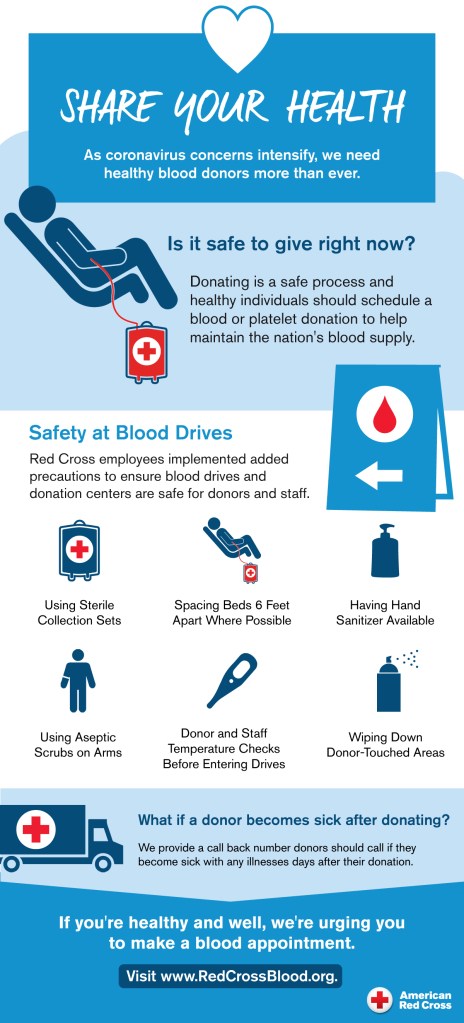
As concerns about the coronavirus pandemic rise, please know:

•             Donating blood is a safe process and people should not be concerned about giving or receiving blood during this challenging time.

•             More healthy donors are needed to give now to prevent a blood shortage.

•             Keep scheduled blood drives, which will allow donors the opportunity to give blood. 

As an emergency preparedness organization, the Red Cross has also taken additional steps to ensure the safety of staff and donors at each Red Cross blood drive.

•             The Red Cross only collects blood from individuals who are healthy and feeling well at the time of donation – and who meet other eligibility requirements, available at RedCrossBlood.org. 

•             We are now pre-screening all individuals by checking their temperature before they enter any Red Cross blood drive or donation center, including our own staff and volunteers. 

•             At each blood drive and donation center, Red Cross employees follow thorough safety protocols including wearing gloves, routinely wiping down donor-touched areas, using sterile collection sets for every donation, and preparing the arm for donation with an aseptic scrub. 

•             Additional spacing has been implemented within each blood drive set up to incorporate social distancing measures between donation beds and stations within the blood drive.

•             The average blood drives are only 20-30 people and are not large gatherings. 

These mitigation measures will help to keep blood recipients, staff and donors safe.

Thank you for being lifesavers for patients in need in Minnesota and across the country!

7 Healthy Habits to Help Prevent Flu

Every year on average 8% of people in the U.S. get the flu – don’t let it be you!

  1. Get vaccinated. Everyone 6 months of age an older should get a flu vaccine every season, especially people at high risk.
  2. Avoid close contact. Avoid close contact with people who are sick. If you are sick, keep your distance from others.
  3. Stay home when you are sick. Stay home from work, school and errands when you are sick to prevent spreading your illness to others.
  4. Cover your mouth and nose. Cover your mouth and nose with a tissue when coughing or sneezing to prevent those around you from getting sick.
  5. Clean your hands. Washing your hands often will help protect you from germs. If soap and water are not available, use an alcohol-based hand rub.
  6. Avoid touching your eyes, nose or mouth. Germs are often spread when a person touches something that is contaminated with germs and then touches their eyes, nose or mouth.
  7. Practice other good health habits. Clean frequently touched surfaces at home, work or school. Get plenty of sleep, be physically active, manage your stress, drink plenty of fluids, and eat nutritious food.

BONUS! Flu vaccination does not prevent blood donation. Yeah!

Download our new Flu (Influenza) Checklist that’s available in eight languages. Stay informed about public health recommendations related to flu and other health threats by visiting the Centers for Disease Control and Prevention (CDC). For more information on disaster and emergency preparedness, visit redcross.org.

Minnesota nurse receives highest international Red Cross award

This year, our own Janice Springer is among the selected recipients of the prestigious Florence Nightingale Medal. This honor from the International Committee of the Red Cross is the highest international distinction a nurse can receive.

Janice Springer, DNP, RN, PHN, received this prestigious recognition for extraordinary service in disaster situations and in public health and nursing education.
Dr. Springer co-authored the American Red Cross Disaster Health and Sheltering course, used to teach more than 18,000 nursing students nationwide how to serve as Disaster Health Services volunteers. Students who complete the course may go on to become official Red Cross nurses after graduation, expanding the pool of prepared Disaster Health Services volunteers. She also created the evidence-based Cot-to-Cot© model to assist clients with functional and access needs in American Red Cross shelters.

Dr. Springer is a Red Cross volunteer who has deployed to 15 disaster relief operations since 2005, often as a leader. Having held several Red Cross leadership roles within Disaster Cycle Services and the International Services Department, she is currently serving as Volunteer Partner for International Recovery, expanding her public health nursing expertise internationally.

Dr. Springer serves as a disaster public health and disability integration subject matter expert for the North American Humanitarian Response Summit, a coalition of U.S. and international government and humanitarian response organizations, helping plan for international cross-border catastrophic disasters. She has published extensively in nursing textbooks and professional journals and has presented papers and posters on her research and best practices throughout the world.

Dr. Springer’s contributions to public health nursing, disaster nursing and the Red Cross are exceptional. The effects of her dedication, leadership and work will continue to spread their positive impact on Red Cross nursing and support individuals affected by disasters around the world.

Click here for more about becoming a Red Cross volunteer.

For one woman seeking refuge from Hurricane Dorian, a Red Cross vest evokes memories of Minnesota childhood

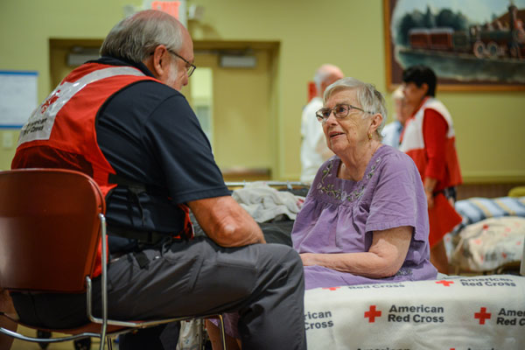
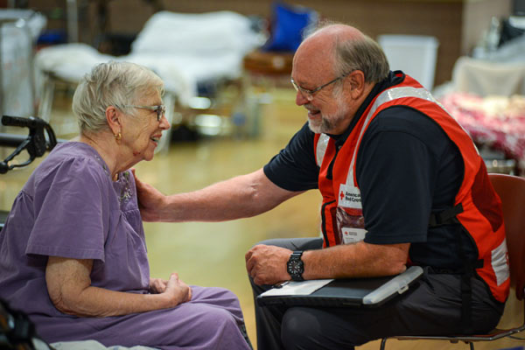
Pretty in purple:  Virginia Marciniak chats with Bob Wallace.

Among the more than 9,000 people seeking refuge from Hurricane Dorian is Virginia Marciniak, a shelter resident at the St. Cloud Senior Center in Florida.

Virginia offers a hand and takes great delight in sharing that she grew up in Minneapolis, Minnesota, and attended Clara Barton Elementary School (now Open School) that was named after the founder of the American Red Cross.

“Her picture was everywhere,” says Virginia. “They told us all about her … she was really a remarkable woman … I bet no one else in here can tell you a story like that,” she says with a smile.

Although she is residing in the shelter to escape the expected wind and water wrath of Hurricane Dorian, Virginia retains an insuppressible sense of humor.

“One of the nurses here, one named Jane, has a vest with ‘Nurse Jane’ on the back followed by ‘Disaster Relief.’ I think that could be a great TV serial,” she says with a chuckle.

The shelter at the senior center is for residents of Good Samaritan Retirement Village. It’s operated by the Osceola County Health Department and supported by the American Red Cross.

Shelter resident Virginia Marciniak and Red Cross volunteer Bob Wallace.

Story by Bob Wallace with photos by Daniel Cima for the American Red Cross. Click here for more stories and photos. Click here to make a financial gift helping people affected by Hurricane Dorian.

Responding to disasters: “Flexible is the word”

Rick’s got to get on a plane soon. So, let’s get right to this. Rick Emanuel (in the video below) is going south to support people affected by the powerful storm approaching the Gulf Coast.

This will be Rick’s third deployment to a major disaster response in just over a year. His first, last fall, was Hurricane Florence, where he worked at a shelter in Havelock, North Carolina. “Feeding, setting up cots, making sure everybody has what they need,” he says were the main things he did in his volunteer role supporting shelter operations for the American Red Cross. “And getting people to the right resources when they’re in crisis.”

Rick Emanuel

In North Carolina, the water rose so fast in some areas that first responders, national guard soldiers and community helpers were bringing in people, especially the elderly, in massive dump trucks because those vehicles could reach them through the flood waters. “They were bringing in people as fast as they could,” he says. Supplies arrived anytime and needed to be off-loaded as fast as possible. Sometimes this was in the middle of the night when volunteers like him might get some sleep. “That was the biggest part of the deal, finding down time.”

With this deployment to Louisiana he’s even more ready to help others because he knows that “flexible is the word” when it comes to providing disaster relief.

If you would like to support disasters big and small, including training and deploying volunteers like Rick, visit redcross.org/mn.

Story by Lynette Nyman/American Red Cross

Responding to disasters: Opioid overdose has no boundary

September 13, 2018. Strong winds and rain from the outer bands of Hurricane Florence begin impacting the Cape Fear River and Wilmington, NC. Photo by Daniel Cima for the American Red Cross.

During Hurricane Florence, John Decker was not at the shelter in North Carolina the night a woman died from an opioid overdose in September of 2018.

But he heard about the death almost as soon as it happened because for one month, at the onset of the response, Decker was in North Carolina serving as Disaster Health Services chief for the Red Cross relief effort. The young woman who died was her mother’s care-taker, he recalls.

Decker is a Red Cross volunteer who responds to major disasters across the United States. When home in Minnesota, he’s a registered nurse. Now, after ten years with the Red Cross, he’s often at the front lines of providing disaster relief in shelters.

September 15, 2018. Red Cross shelter relief supplies at Farmville Middle School, NC. Photo by Adam Jennings for the American Red Cross.

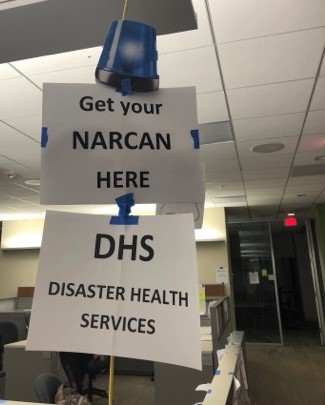
That night in North Carolina their first concern, Decker says, was to support the young woman’s mother. Their second was to prevent more deaths. Decker connected with national Red Cross disaster leadership that was supporting field activities. Together, they set two immediate priorities: find naloxone and train shelter workers.

The CDC reports that around 130 people die from opioid overdose every day in the United States. During 2017, 47,600 people died from overdoses involving opioids. Those deaths were 68% of drug-related overdoses.

John Decker

Decker found a local source for Narcan, one type of naloxone medicine that reverses overdose.  There were only a couple boxes. Not enough, he figured. Plus, they were expensive. Then, his phone rang.  On the line was a woman who worked with a relief partner. She had 2,500 – 3,000 doses. With help, Decker picked them up and got them distributed to more than 400 shelters.

The Red Cross and its partners supported more than 129,700 overnight stays for people displaced because of Hurricane Florence across North Carolina, South Carolina and Virginia. During Fiscal Year 2018, the Red Cross and its partners provided more than 1 million overnight shelter stays for people affected by disasters.

A sign at the Red Cross relief headquarters in North Carolina. Courtesy of John Decker.

Next up was teaching shelter workers the signs of opioid overdose and the steps to respond. Initially, some people resisted. They were comfortable delivering relief supplies, not giving someone a medicine requiring injection.  The training transformed their feelings and their skills. At first it’s scary, and then we learn, and then it’s nothing, Decker says. “It’s good to get rid of the mystery. It’s no more complicated than a kid’s Legos.”

September 17, 2018. The Red Cross shelter at the University of North Carolina Friday Center in Chapel Hill. Photo by Daniel Cima for the American Red Cross.

Since then, the Red Cross released an online class that helps people respond to opioid overdose emergencies. I took the course and learned a lot. It removed my anxiety and strengthened my confidence about helping someone during an opioid overdose emergency. Check out and take the class here. For a quick understanding of opioid overdose, watch this new video.

Story by Lynette Nyman for the American Red Cross Minnesota Region.

Volunteer spotlight: Desiree Haupert

Desiree with her son, Dylan, volunteering at Home Fire Campaign event in Marshall, MN. Photo courtesy of Desiree Haupert.

“This is an excellent way to give back to the same community and with our surrounding communities.”  Desiree Haupert, Red Cross Home Fire Campaign volunteer team lead for Marshall, Minnesota 

Story by Zabiba Sameru/American Red Cross

When I listen to Desiree Haupert, a mom and volunteer, speak about her experience with the American Red Cross, I can hear the excitement in her voice as she tells her story about being fulfilled as she continues to give her time to the Red Cross.

What started out as future planning to keep busy for Desiree in April of 2018 is turned into a lifetime rewarding experience. In her time volunteering at the Red Cross, she has been involved in many activities, such as Sound the Alarm by installing home smoke alarms and sharing fire safety tips in Slayton.

Red Cross volunteers responded to flooding in southwest Minnesota during 2018. Photo: Lynette Nyman/American Red Cross

During the flood in Tracy, Desiree also was involved in helping residents find shelter, food and additional resources that could support them during their recovery from the flooding. She also is involved with the Pillowcase Project, campaign that teaches kids in grades 3 to 5 how to prepare for home fire emergencies and other disasters like tornadoes and blizzards.

As a duty officer, she takes calls for assistance requests, and then responds by reaching out to local Red Cross volunteers who give assistance to people who are affected by disasters. To top it all off, Desiree attends youth preparedness conferences to learn about engaging communities and provide support to them in the face of a disaster.

This year Sound the Alarm takes place April 27 – May 12.

It’s important and rewarding for Desiree to give back to her community and be an example for her kids with all the work that she’s doing with the Red Cross. Being a Red Cross volunteer gives you an opportunity to help your local community, says Desiree. “It gives me the opportunity to take ownership of something and grow in a way that I didn’t know I was needing. It’s amazing.”

On Saturday May 4, 2019, Red Cross volunteers and their partners will be installing free smoke alarms in Worthington.  Join us! Click here to learn more about the campaign. Click here to become a Red Cross volunteer. 

The more things change …

…. the more they stay the same.

That’s a spot-on adage when we consider fulfilling our Red Cross mission to alleviate human suffering in the face of emergencies.

For example, one hundred years ago Junior Red Cross volunteers in Duluth made care packages for World War I veterans overseas.

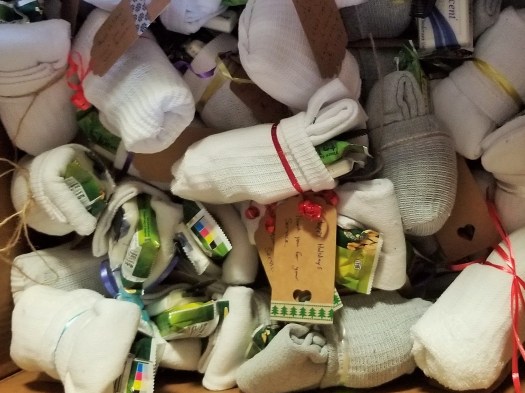
This year our Service to the Armed Forces volunteers will distribute donated socks to veterans who are homeless or at risk of becoming homeless.

Donated socks ready for distribution to military veterans in nursing homes. Photo by Jennifer Landeros

There are more examples and yet, whatever the year of the new year, the basics of life remain the same.

People need shelter, food and clothing. People need blood and blood products. People need to reach loved ones during emergencies.

The Red Cross helps meet these and other basic needs within the context of being impartial and neutral, of empowering volunteer service, and keeping an eye on preserving and promoting human dignity in all of our work.

With those thoughts in mind, this year we encourage you to look to the stars while keeping your feet on the ground. Make a regular commitment to:

  • supporting people affected by disasters
  • providing safe lifesaving blood and blood products
  • helping military members of our armed forces and their families
  • being trained in life-saving skills for emergency response
  • giving resources that help neighbors around the world

This quiz will help you choose which action is best for you.

Story by Lynette Nyman — pictured above last year with women living in Bangladesh in camps for people who have fled violence in Myanmar.  

Volunteer spotlight: Disaster responder Willen Korkowski

Red Cross volunteer Willen Korkowski. Photo: Carrie Carlson-Guest

Recently we were pleased to speak with Willen Korkowski about her volunteer experience. A transcript of the conversation is below. To see Willen tell it, click here. Thanks Willen for your service helping others!

Please introduce yourself and your role with the Red Cross.
Hi. I am Willen Krokowski. I am a Disaster Action Team volunteer with the Red Cross since 2004.

What do you do as a Red Cross volunteer?
As a volunteer I respond to local disasters such as house fire, could be a single house unit or multiple units in an apartment. What we do when we respond to a fire is we make sure that the clients have what they need. Is there an immediate need that we are so concerned for; could be a safe place to stay for the night, food and clothing, or for the kids to let them know that there is someone there that cares for them especially when they are in need.

What’s your favorite part or memory of volunteering?
My favorite part is when the clients smile and you see the hope in their eyes. So it’s, to me, it’s giving back to my community.

Would you recommend volunteering with the Red Cross to others?
If you care about your community, you care about your neighbor, if you want to live in a place where it is safe and loving then I would suggest you volunteer for the Red Cross. You would love it too.

We’re always looking for volunteers to help their neighbors in need after disasters like home fires. To volunteer or for more information, click here. Or join us during upcoming 30-minute “Call to Serve” conferences calls.

Dates and times:

  • Thursday, Dec. 6 at 8:00 a.m.
  • Saturday, Dec. 8 at 12:00 p.m.
  • Tuesday, Dec. 11 at 6:00 p.m.
  • Wednesday, Dec. 12 at 3 p.m.

RSVP to MNRecruit@redcross.org or call 612-460-3670 for details. 

Hurricane Florence: People appreciate the help

Red Cross volunteer Elaine with a family at a shelter in North Carolina. Photo: Daniel Cima/American Red Cross

“…all is well. I am loving this, so satisfying. The people have been so appreciative…” — Elaine, Red Cross volunteer

Many thanks to Elaine (in photo) and around 3,000 Red Cross disaster relief workers, including 62 from the Minnesota Red Cross, who are helping people affected by Hurricane Florence in North Carolina and South Carolina.

More national American Red Cross fast facts about our help:

  • Sunday night, more than 15,000 people sought refuge in more than 150 Red Cross and community shelters across the impacted region. This includes 14,200 people in 137 shelters in North Carolina.
  • Working with partners, the Red Cross has served 150,700 meals and snacks. We’re also working with the Southern Baptists to deploy field kitchens that together can produce 170,000 meals per day.
  •  The Red Cross is mobilizing more than 130 emergency response vehicles and more than 70 trailers of equipment and supplies, including ready-to-eat meals and enough cots and blankets for more than 100,000 people.
  • The storm has forced cancellation of more than 170 blood drives, resulting in more than 4,600 uncollected blood and platelet donations.

The Red Cross will continue to work around-the-clock to do everything possible to provide shelter, food, comfort and other emergency support to victims of Hurricane Florence.

Fast Facts are as of September 17, 2018