Four Days on an Emergency Response Vehicle

Story and photos by Jerry Eiserman, Red Cross Volunteer

Jerry's Red Cross "Emergency Response Vehicle" (ERV)
Jerry’s Red Cross “Emergency Response Vehicle” (ERV)

After I retired, I wanted to find a worthwhile way to spend my new-found free time. I remembered hearing about volunteers who packed up when various disasters occurred and served with the American Red Cross. And I decided that was what I wanted to do.

As soon as I began my training, I learned that the first Red Cross relief workers to to arrive on-scene at a local disaster are Disaster Action Team (DAT) members.  These response teams are trained to be efficient and effective in their efforts helping people, and I quickly joined the squad.

After becoming a disaster relief volunteer I started to ask, what happens when the disaster gets bigger?  There are many different jobs when large-scale disasters, such as a tornado or hurricane, hit a community. I learned that my experience driving trucks and managing computer networks could be useful. I expressed my interest in and willingness to be on-call in this response activity if needed.

Day One

On June 29th I got a call that the Red Cross needed the Minneapolis Emergency Response Vehicle (ERV) to help out in Illinois, and for the first time I was able to say yes. I partnered up with another volunteer named Bill Craig, a delightful gentleman from St. Cloud, MN, who had disaster experience after being deployed to Hurricane Sandy. We took off from Minneapolis on June 30th and arrived at the Red Cross chapter in Romeoville, IL, on morning of July 1st ready to receive our assignments.

Red Cross Volunteers help out in Cole City

We were dispatched to the Bourbonnais and Kankakee, IL, office where severe flooding and tornadoes damaged the surrounding area. We loaded our ERV with cleaning supplies, drinks, snacks and shovels, and headed for Cole City, IL.  Cole City is a small, rural town that a recent tornado had ripped through, leveling several neighborhoods and wreaking havoc throughout the town.

After several hours distributing relief supplies to people in Cole City, we returned to Kankakee where we helped open a Multi-Agency Resource Center (MARC).  A MARC is where different service agencies congregate to provide a one-stop service center for folks affected by local disaster.  I quickly learned that as a volunteer, I was there to help with whatever needed to be done. One minute I was in the gym setting up tables and chairs, and the next I was being asked to set up a small computer network to serve the folks that would be coming in the next day.

Day Two

The MARC set up in Kankakee

Our second day started at 6 a.m. The MARC ran ten computers and two laser printers to service the needs of affected residents. Once the network was up and operating, the local volunteers had everything under control and I moved back to my ERV role. We spent the morning loading relief supplies into people’s cars and handing out drinks and food. There was a flood of people that came to the MARC after lunch, so my job transitioned to walking families through the in-take process. By the time the doors closed at 6 p.m., we had processed 160 families.

Day Three

On day three, we met at the Bourbonnais office at 10 a.m. and loaded flood clean-up supplies and headed for a small, rural town called Momence, IL.  We paired up with a case worker from Pennsylvania and drove around the town to see where help and supplies were needed. We soon ran out of cleaning supplies and had to call for back up because so much damage had been done.

We out-processed at the Romeoville office about 7 p.m. and started the drive back to Minneapolis.

Day Four

We finished our journey back in Minneapolis on the 4th of July and got in about noon.

The biggest lesson I took from my four days on an ERV is that the world is not as bad as we make it out to be. Today, the news is full of terrible accidents, criminals and disasters. But what I found was that there is some beauty left in the world. The vast majority of Americans are kind and compassionate people. When our neighbors get hit hard most of us don’t just drive by, we stop and help. Almost everyone that I put my hand out to was unbelievably grateful and had the “I may be down but I’m not out” look in their eyes. Lee Greenwood is correct: I’m proud to be an American.

To learn more about becoming a Red Cross volunteer, click here.
To browse more ways to help fulfill the Red Cross mission, click here.

“Controlled chaos” prepares disaster responders

Volunteer evacuee Maggie Friend talks to a Red Cross volunteer about her mental health.

More than 150 volunteers got a firsthand look at how to help disaster survivors during a Radiological Emergency Preparedness (REP) drill on Wednesday, June 10, at Park High School in Cottage Grove, Minnesota. The American Red Cross, along with partner organizations, such as the Salvation Army, the Department of Homeland Security Emergency Management and Washington County, helped manage the annual training drill.

Park High School is one of two designated reception centers for evacuees who live within a 10 mile radius of the Prairie Island Nuclear Power Plant in Red Wing. If a nuclear disaster occurs, the center would provide food, shelter and medical services for displaced residents. The Red Cross would be in charge of providing shelter and emotional support, and reconnecting families through Safe and Well.

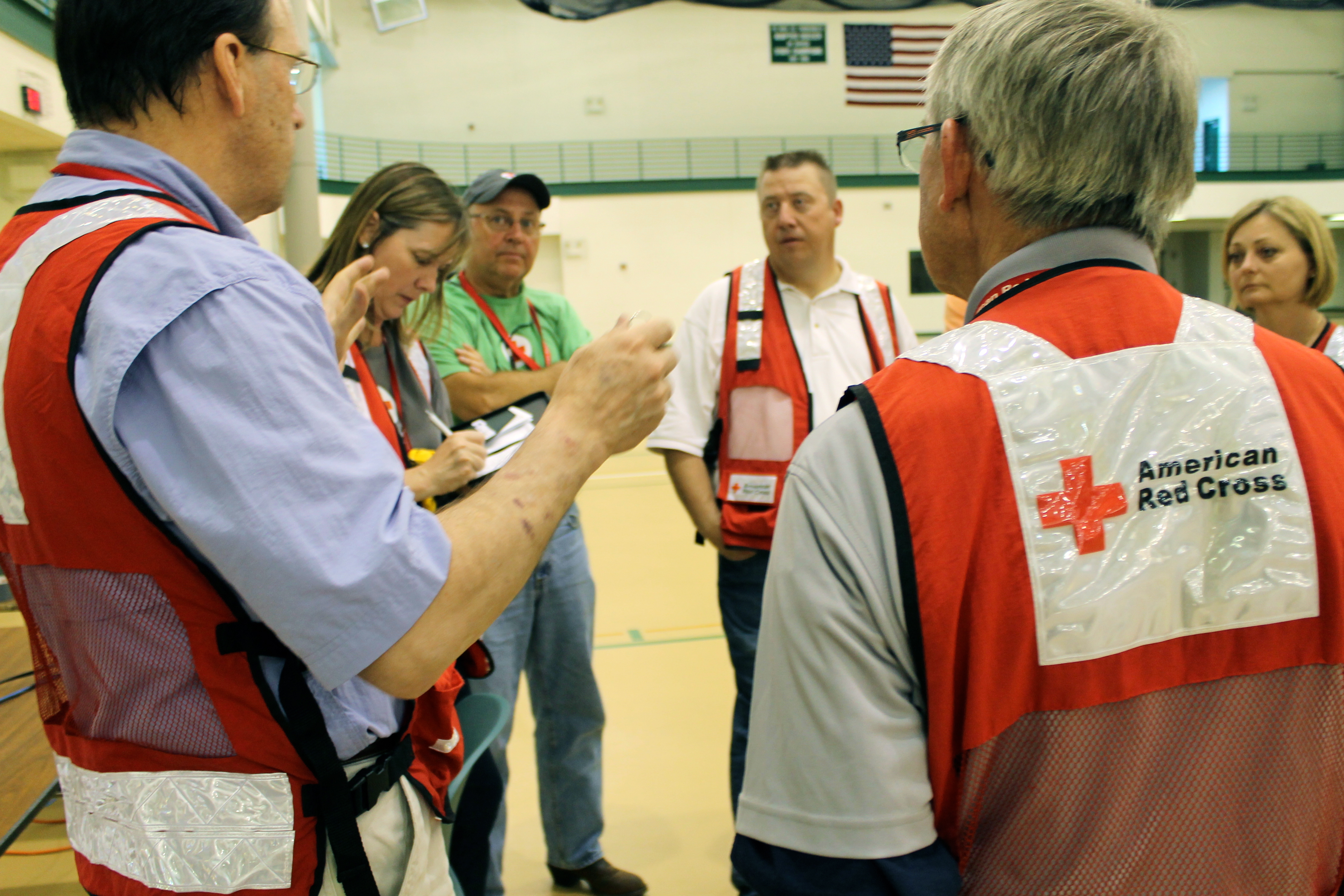
Wednesday’s drill allowed volunteers to practice running their designated stations without the pressure of a real disaster, a concept that Red Cross volunteer Mark Doble calls “controlled chaos.” “This is all about preparation,” said Doble. “Controlled chaos allows us to highlight and address potential problems that might not otherwise have been recognized.” And Doble was right, things got quite chaotic at times. From the distributing dosimeter radiation monitoring badges to all volunteers, to herding anxious individuals through multiple checkpoints and reuniting separated family members, there were a lot of moving parts.

“We need our volunteers to build muscle memory in their departments and be able to communicate using the same jargon for everything to run smoothly,” said drill incident commander Wes Halverson. “Tonight is so valuable because we are able to set that precedent.”

Jill Hallonquist, a Red Cross disaster program manager, said that the drill gives the relief workers an opportunity to coordinate with its partners. “It’s so rare that we get to talk through all the little steps that go into disaster planning,” she said.“Usually we have to jump into action without the chance to advise on all the minor details.”

Red Cross volunteers recap the event and make suggestions about what can be improved next time.

Mastering those details now will make the operation run more smoothly when it counts. It quickly became evident, for instance, that the original plan made no provision for providing water for volunteers. Hallonquist was able to coordinate with the Salvation Army, which agreed to supply water for both Red Cross and Salvation Army volunteers in a real emergency.

Other issues that were addressed included how to transport people to the shelter and how to work around the school’s wifi block on Facebook access. The social network might be a distraction during the school day, but it’s a vital form of communication during emergency response. Red Cross mental health volunteers also took advantage of being on location to identify quiet nooks where they could connect with distressed evacuees during the response.

Red Cross volunteer Rick Campion said he appreciated the chance to prepare for his assignment. “When it’s a blue sky day, literally, we don’t always think about disaster,” he said, gesturing at the sky. “But it can happen at anytime and we have to be ready when it does.”

The next step is moving from REP drill to exercise on July 22. On this date, the Federal Emergency Management Agency (FEMA) will evaluate state, county, and local partner ability to operate a reception center and provide for displaced residents during a radiological emergency in Minnesota.

Story and photos by Vivian Engen, Communications Intern, American Red Cross Minnesota Region

How’s the training going? (Or, checking in with Team Red Cross)

On June 20, Team Red Cross will take to the pavement during Grandma’s Marathon in Duluth, Minnesota. We asked two team members, Susan Waananen, a disaster response volunteer, and Eric Adams, a disaster program specialist, to check-in with each other about training and tips for the event. See below their insights!  

Red Cross volunteer Susan Waananen

Eric: How’s the training going?

Susan: Nothing hurts…that’s about all I require of my training these days! I ran a half marathon last month and it was pretty slow, but I’m not worried about finishing.

E: Any post run rituals or diet to help from hurting the next morning after a run?

S: Well, I often shower afterwards, haha. If it’s been a longer run, I’ll force myself to run cold water on my legs for the first couple of minutes. As for food, I love Lara bars right after a run. I also find it helpful to drink a cup of coffee an hour before a long run and I usually crave a burger that night. Or whenever I wake up from my nap..:) How about you? Do you eat pasta the night before a race?

E: I do eat spaghetti before a marathon or a longer run. I still subscribe to the ritual. Post-race, I try to have a banana or two. I need to force myself to have more protein post-race as well. I think that’s why I’ve been sore longer than I’d like after a marathon. The coffee does really help. I’ve found myself up at 2 a.m. on days when I drink coffee but forget that I need to run. Do you use energy gels or anything during the race? I was just talking with a volunteer who’s done post-race massages in the past and she was commenting on how amazing and disturbing it was that people had so much salt on their skin after the race from the dried sweat!

S: I use gels if I’m running for more than 90 minutes. My favorite GU flavors are the Espresso Love and Salted Caramel. Speaking of salt, I am usually coated after a longer race. I always go for the potato chips and Pearson’s salted nut rolls when they’re offered at the food tent. How about you? I’ve also had good luck with Sport Beans if my stomach can’t handle a GU, especially after Mile 20. Have you tried those? Or the gel blocks? I find those a little too big. I’m running 12 miles tomorrow. Do you have a long run scheduled? I know 13 is easy for you! June seemed so far in the future, but now it’s almost time to start the taper.

Red Cross disaster relief worker Eric Adams

E: Salted caramel is my favorite as well, but there’s another one that just came out that they’re describing like Nutella and it’s pretty good. It’s pretty weird to be able to run your hand over your forehead and see the salt on your hand. Would that qualify as organic or all natural salt? Brand it as “Runner’s Best.” I recently had someone recommend the gel blocks to me. They said the margarita was the their favorite. If I’m going to have a buzz from dehydration, I might as well have the associated taste. I haven’t been able to run my usual 12 miles for 2 weeks due to a busy schedule, but I’ve been doing a little trail running by my house, biking, kayaking, and last week I was climbing up and down a roof like a monkey, so I’m claiming those as cross training. Time just seems to be running out fast.

S: Your cross-training sounds a lot more exciting…and risky…than mine! Does gardening count? As I’ve gotten older, I’ve found that I can’t run every day anymore or I risk injury. I’ve also learned the hard way that you can also get hurt doing yoga if you approach it too competitively! Do you listen to music while you run? My new favorite run song is Around the Bend by Asteroids Galaxy. I’ve also made it through a number of books during long runs. I find the music more helpful for faster workouts or races. How many marathons will this be for you? Do you have a goal in mind?

E: Competitive yoga…I honestly don’t know what to think about that. I listen to a few different Pandora stations depending on my mood…Rolling Stones, Audioslave, Puscifer, Jimi Hendrix, and a few others. I’ve tried listening to MPR while running, but it just becomes too distracting because I actually want to think instead of zoning out. High pace without lyrics is typically the best for me. This will be my fourth marathon, my third Grandma’s. I think I will be aiming for my four hour mark. But depending on the weather, my first goal is always to finish. How about you? How many marathons and any specific goals?

S: I’ve run four full marathons; Grandma’s was my most recent in 2011. I’ve run lots of halfs, but just once before at Grandma’s and it was my very first one. Finishing is always the primary goal. I’d like to finish under two hours if possible. I’ve had a foot injury for the last couple of years and so honestly, I am just thankful to be running without any pain this summer. Did you see that your friends and family can register to track your progress? I think that could be motivating too! The countdown is on! Have you started checking the weather forecast? Looks good so far!

E: As long as it’s not hot, I’ll be happy. The last two years it’s been damp and overcasts which has kept the temp down. I went for my run yesterday and discovered that my “cross training” wasn’t keeping me in as good of shape as I had hoped. I was able to run until the 10.5 mile mark before my knees started to quiver, so I’m going to have to use these last two weeks well. Doesn’t help that I don’t have any water breaks along my route. Under two hours would still put you in the record book for this race. I know about the tracking site. In the past, I posted it on my Facebook page before the race and have had family and friends follow me, sending comments and texts as I reach different milestones along the race. It really does help. The last two races I’ve also worn my Captain America Under Armour, which has added to the cheer factor from the people watching the race. Any traditions or superstitions before the race? You’re running the full marathon, right?

S: I’m running the full half-marathon…:) It’s that 0.1 at the end that is the hardest…unless you’re Captain America and you can just fly over the finish line! I don’t have lucky socks or special safety pins, but I’ve worn the same hat for every race so I’d be sad if that disappeared. I try to get plenty of sleep the week leading up to a long race because I am usually too excited to sleep well the night before. Plus a 6:15 a.m. start is pretty early! I always make sure my shoes are double-knotted and I wear a watch that tells me my average pace so I don’t go out too fast…or finish too slow!  One of my favorite things before the race is walking around the expo after picking up my bib, looking at all the fun stuff and listening to the guest speakers. I’m looking forward to meeting the rest of Team Red Cross that afternoon, too!

We’re wishing the entire Team Red Cross a great event during Grandma’s Marathon. Most team members are raising funds to support Red Cross programs and services. Join Team Red Cross here. Check out Susan’s fundraising page here. Check out Eric’s fundraising page here

Every story has a flip side: Haiti five years on

haitimap_3
American Red Cross Haiti Assistance Program screen grab from website.

Recently, several media reports have called into question the American Red Cross response during the past five years to the 2010 Haiti earthquake disaster. We stand-by our response to the earthquake disaster. And, we are disappointed to see how our work has been misrepresented in some media.

With generous support of the American people, the Red Cross has helped millions of Haitians who desperately needed humanitarian assistance. Donations enabled the Red Cross to help build and operate eight hospitals and clinics, stem a cholera outbreak, supply clean water and sanitation, provide job training, and move more than 100,000 people out of make-shift shelters, comprised mainly of tarpaulins and tents, into safer and improved housing. We also helped build and repair infrastructure, such as schools, roadways and water distribution points, all vital to neighborhood recovery. Despite challenging conditions in a developing nation, including changes in government leadership, lack of land for permanent housing, and civil unrest, our hardworking staff—90 percent of whom are Haitians—continue to work to meet the long-term needs of the Haitian people. While the pace of progress is never as fast as we would like, Haiti is better off today than it was five years ago.

#RedCrossProud_HaitiTeam
American Red Cross team in Haiti, June 2015. Photo provided courtesy of Vanessa Deering, Haiti Assistance Program Coordinator.

To learn the facts about our Haiti Recovery Program and to hear from those we have helped and continue to help, please visit The Red Cross in Haiti: Five Years of Response and Recovery. See also The Real Story of the 6 Homes in Haiti and 13 Facts about the Red Cross Response in Haiti, which directly address the numerous inaccuracies in recent media reports. To read “Haiti on My Mind,” a recent personal account from a relief worker who responded early to the disaster, click here.

The American Red Cross has been there to help people in need for 134 years. It will be there for the next disaster or emergency to help people across the country and in other areas around the world. Thank you for your support of the American Red Cross.

“All In 1 Day” Fundraising Campaign on June 2

american-red-cross-site-logo1428089261.1929It’s only days away from June 2 when the American Red Cross will host its first nationwide Giving Day. This 24-hour period calls for people across the country to ensure the Red Cross can deliver help and hope to people in need. Even when you don’t see disasters in the news, Red Cross volunteers are working every day to help people during great times of need. In moments of despair, there can be hope.

For example, right now the Red Cross is providing shelter, disaster relief, and emotional support in Texas and Oklahoma where severe weather has pounded areas of both states since early May. The response in Texas alone is expected to cost more than $3 million. This past April in Minnesota, the Red Cross responded to 61 disasters, helping 348 adults and children following devastating home fires. This is the highest number of families helped in any one-month period since the Minneapolis Tornado in 2011.

Public support allows the Red Cross to care for people during crisis. Public support allows the Red Cross to help people stand up again and to know they’re not alone. Public supports allows the Red Cross to be All in 1 Day every day.

We need your help. Become a Giving Day social ambassador and help celebrate all of the good that the Red Cross does every day. Become a Giving Day donor and support Red Cross work in communities across our nation.

Volunteer Spotlight: Barb Page and Disaster Health Services

Teaching a CPR class,
Leading or supporting committee work,
Being on-call to assist with small disasters,
Helping in a shelter on larger disaster responses,
Reviewing health forms for the staff and volunteer workforce,
Speaking to nursing students about volunteer opportunities at the Red Cross…

Linked in photo small jpeg Barb PageThere are many ways for those in the medical field to share their time and talents with American Red Cross Humanitarian Services. One nurse doing just that is Barb Page. Barb is celebrating her five-year anniversary with the Red Cross and is nearing the end of her second year as Disaster Health Services (DHS) Lead for the Twin Cities Area Chapter. For Barb, volunteering as a nurse for the American Red Cross is about compassion and community.

COMPASSION
As a DHS volunteer, Barb has enjoyed sharing her gift of compassion with clients when called upon to assist during disaster response.

Asked why nurses have always played such an important role for the Red Cross, Barb replied, “Everybody at the Red Cross has a lot of care and compassion, but I think it’s just innate for nurses, and that comes through in our work and is an important piece of recovery. We are a big part of getting people back on their feet.”

DHS volunteers are able to offer both practical assistance and emotional support to clients in their times of need. “When someone has lost everything or has been hurt because of a disaster, they need help in so many ways. They need help navigating how to get their life back together,” Barb explained. “In almost every disaster response, there is someone with medication or someone with medical needs who needs help.” With DHS volunteers like Barb standing at the ready to share not just her professional skills but also her caring spirit, the Red Cross is able to more completely meet the needs of clients.

COMMUNITY
As DHS Lead for the Twin Cities Area Chapter, Barb has enjoyed fostering a sense of community among the DHS volunteer team.

In the beginning of Barb’s tenure, Barb focused on understanding what interested and motivated different volunteers in order to best engage them in ways they would find satisfying. As Barb described, with the variety of activities there is to participate in at the Red Cross, “We need all kinds of people with all kinds of interests.” Barb’s inclusive message is that anyone can find a way to contribute at the Red Cross that will be fulfilling and that will fit his/her unique schedule and strengths.

BarbBarb is now focusing her time as Twin Cities Area DHS Lead on maintaining a mentorship program and four committees centered on sheltering, national deployment, welcoming new volunteers, and external recruitment and education. The mentorship program has helped more than a handful of new volunteer nurses become acquainted and comfortable with responding to local disasters over the past year. Choua Yang, Regional Recovery Program Support Specialist, explained the impact Barb is having locally: “She is a great leader for the DHS group. The mentorship program helps new volunteers navigate the Red Cross and brings them into the DHS community.”

In addition, the more recently established committees are creating new ways for DHS volunteers to get involved and get to know each other, all the while making the Red Cross well positioned and prepared to take action when called upon.

Thinking holistically, as nurses so often do, Barb stated, “You never know if the client you just helped is going to become a volunteer or a donor or help out at the next disaster. It’s a circle.”  The Red Cross community is a growing, more encompassing circle because of wonderful volunteers like Barb. Thank you, Barb!

Story by Kelly Clark, Volunteer Services, American Red Cross Minnesota Region. If you or someone you know would be interested in joining this compassionate community of Disaster Health Services volunteers in Minnesota, please contact Volunteer Services.

Thanks following West Broadway Fire response

Red Cross volunteers Jennifer Pluhar and Mark Steffer responding on location to the W. Broadway Fire in North Minneapolis on April 15, 2015. Photo credit: Lynette Nyman/American Red Cross

On Wednesday, April 22, we wrapped up our Red Cross sheltering operation following the devastating fire at West Broadway and Emerson in Minneapolis on April 15. On any evening during the week that that the shelter was open there were between three to six residents in who did not have their own resources to find safe shelter elsewhere. In addition to providing shelter, the Red Cross worked all affected by the fire to assess and meet immediate disaster relief needs and to start them on a path to long-term recovery. This important disaster response work happened both on location moments after the fire or later at the shelter or the temporary resource center established with community partners.  To date, the Red Cross has helped 27 people who were displaced by this fire.

W. Broadway Fire victim Cliff Garrett shares his story with Red Cross volunteers in North Minneapolis on April 15, 2015. Photo credit: Lynette Nyman/American Red Cross
West. Broadway Fire victim Cliff Garrett shares his escape story with Red Cross volunteers in North Minneapolis on April 15, 2015. Photo credit: Lynette Nyman/American Red Cross

We are grateful to have organization partners in the West Broadway and North Minneapolis community that have resources for these residents.  We’re also thankful for the outstanding response from local businesses that helped us provide food to shelter residents. Working together, our community provided a strong safety net that many fire victims need to rebuild their lives. And most important to say is this: the Red Cross cannot do any of this relief work without the volunteers who shared their time and expertise during this response effort. Red Cross volunteers are the ones step into the gap left by disasters big and small, holding a hand, giving a hug, and doing the deep dive that helps get people going again after disaster strikes. Once again, our Red Cross volunteers were dedicated to helping others in our community during a time of great need and suffering.

To become a volunteer, click here. To give a financial donation, click here.

Awesome home fire preparedness day in Lake City, Minnesota

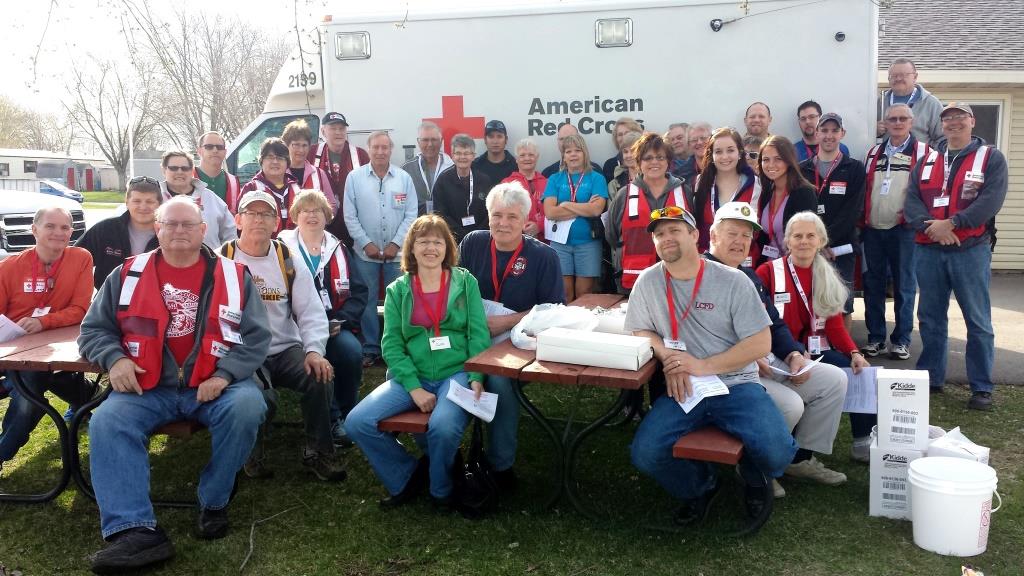
Home Fire Preparedness Campaign volunteers, Lake City, MN, April 18, 2015

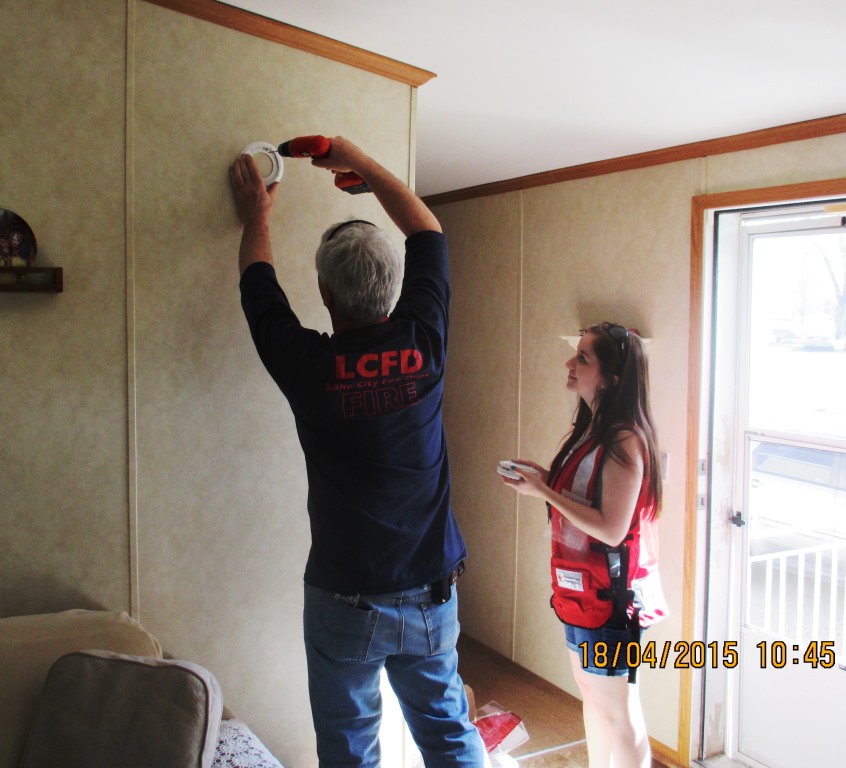
We had an awesome day in Lake City, Minnesota, on Saturday, April 18, installing smoke alarms and talking fire safety.  As part of the national American Red Cross Home Fire Preparedness Campaign, a local team of 25 Red Cross volunteers and volunteer partners canvassed 400 homes the previous week and gathered 115 smoke alarm installation requests. Three mobile home parks and a small area on the south side of the town were the designated areas. Then, this past weekend, 40 volunteers returned to homes that had no answer the week before, and to those with scheduled requests and installed smoke alarms. The teams installed a total of 164 alarms!! Volunteers also provided safety information, helped with creating fire escape plans, and handed out a tornado safety checklist. It was a great day and everyone did an amazing job.

Smoke alarm installation during Home Fire Preparedness Campaign, Lake City, MN, April 18, 2015

Volunteers were made up of Red Cross volunteers, firefighters, Kiwanis members, and local community members. We had three Spanish language speakers who used their talent helping interpret for a few families. Everyone met at 8:30 a.m. for coffee, rolls, and training. Lake City’s fire chief Jeff Diepenbrock, and his wife Julie, came out Saturday to help install alarms. Jeff started off the day thanking the volunteers for their dedication and time. He also talked about fire safety and the importance of smoke alarms. Everyone set out about 9 a.m. and finished around noon. When everyone returned, it was great to hear some of the appreciation stories that families told where alarms were installed.

I am soooo thankful for the group of Red Cross volunteers in my areas!! This could not have been attempted, and become such a success, if it were not for the support of those who continue to be there when they can to lend a hand! Our smoke alarm installation event coordinators for the Lake City were Shar Yorde and Ann Nibbe who put in a lot of hours to make this happen.  A few of my experienced smoke alarm installation event volunteers from Winona, including Joe Whetstone, Mike Papke and Beth Lindholm from Winona, were instrumental in organizing the Lake City event and keeping things on track. Thank you to everyone who came out for this awesome day!! The Red Cross and our community are lucky to have you 🙂

Post and photos by Dianne Thompson, Disaster Program Specialist, American Red Cross serving Southeast Minnesota. The American Red Cross Home Fire Preparedness Campaign seeks to reduce home fire deaths by 25 percent in five years. To learn more, click here.

Severe Weather Awareness Week, April 13-17, 2015

91809SevereStormSlideshow1The recent tornadoes in Illinois are a sober reminder that disasters happen anytime and anywhere. In the Upper Midwest, we experience heavy storms, flooding, and tornadoes. During Severe Weather Awareness Week, April 13-17, take a moment, or two, and review your preparedness plan; check-in with loved ones, neighbors, and friends about their readiness for emergencies; and update your disaster kit so that you’ll have what you need when you need it most.

To get more Red Cross safety information for specific emergencies, click here.  We encourage everyone with mobile device to download the Red Cross Tornado App. This free app features a siren warning, a shelter locator, and instructions on what to do during and after a tornado. Information is available even if there is no mobile connectivity. You can also learn more about tornado safety by viewing this myths and facts slide show.

To help people affected affected by disasters big and small, click here. Your gift enables the American Red Cross to prepare for, respond to and help people recover from disasters. You can donate by visiting redcross.org, calling 1-800-RED CROSS or texting the word REDCROSS to 90999 to make a $10 donation. Your donation helps provide food, shelter and emotional support to those affected by disasters.

Playing Monster Guard teaches Aryn about disasters

In two days, Aryn Gill, 7, graduated from rookie to member playing the American Red Cross Monster Guard mobile app that prepares kids for real-life emergencies. Photo credit: Lynette Nyman/American Red Cross
Aryn Gill, 8, graduated from rookie to member in two days playing the American Red Cross Monster Guard mobile app that prepares kids for emergencies. Photo credit: Lynette Nyman/American Red Cross

Kids can learn just about anything these days. With help from the American Red Cross Monster Guard mobile app, they can learn about how to prepare for and respond to a variety of real-life emergencies, including tornadoes, floods, and other weather disasters. Take Aryn Gill who’s 8 years old.  “I finished it in two days. BOOM!,” she says after demonstrating how to play the game. She learned “how to cope when I’m in a disaster, when I’m scared. I need to feel calm, take a deep breath and blow it out.” She also learned about getting supplies and going to a safe place during a hurricane; screwing shelves to walls before earthquakes happen; and covering her mouth with a damp cloth if she doesn’t have a mask during a volcano. Home fire safety was a big learning moment, too: “I didn’t know I needed to make a primary escape plan.” And checking smoke alarms is really important she says, especially checking batteries: “once every month make sure your smoke alarms work.” Aryn’s not a disaster rookie after finishing all Monster Guard levels and becoming a member. “I tell other kids they should play so they can learn about disasters, too.”

Story and photo by Lynette Nyman/American Red Cross