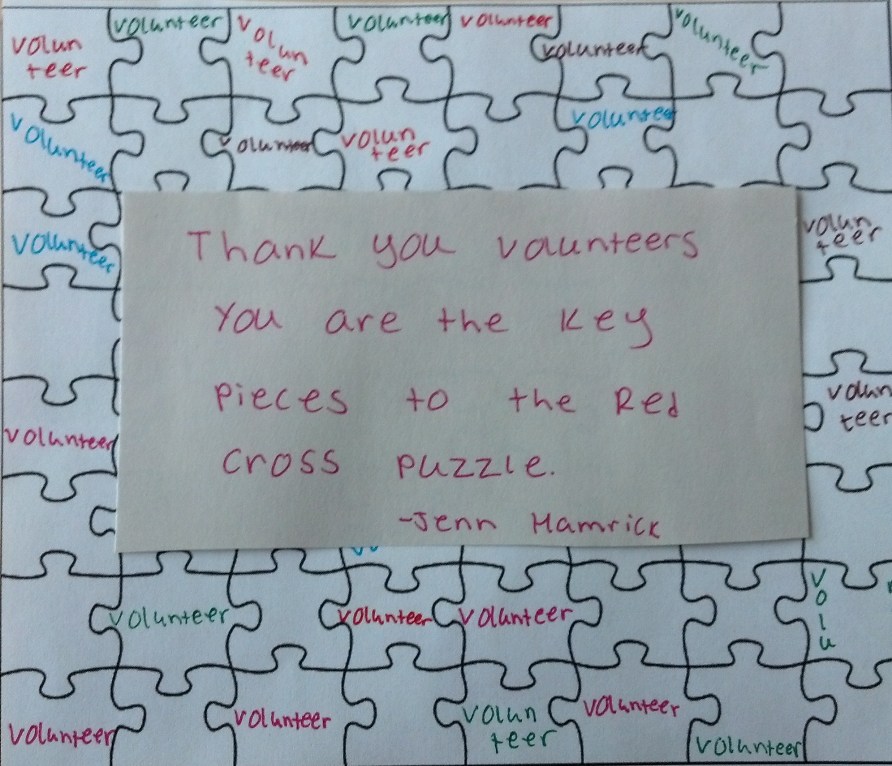
It’s National Volunteer Week, and the staff and board members here in the Northern Minnesota Region have much to be thankful for. This year we decided to write creative thank you notes to volunteers in celebration of their service to the Red Cross. These notes will be compiled into a poster, which we’ll bring to each of the upcoming volunteer appreciation events this spring. But in honor of National Volunteer Week, here’s a preview of how thankful we are for our fabulous Red Cross volunteers.
Information technology (IT) is essential to modern disaster relief operations. And when the American Red Cross responds, Disaster Services Technology (DST) relief workers are called on to build computer networks often from the ground up. In a recent 3-day training held at the Red Cross in Minneapolis, 24 volunteers from across the Upper Midwest learned how to do just that.
Working in groups of two, the participants practiced using advanced IT equipment in the most efficient and expedient way possible to establish a computer network during disaster response. Each pair was taught how to set up a computer workstation, most often with one volunteer reading the provided directions, while the other carried out the procedure. “I’ve been deployed a couple times in Minnesota, never nationally. So I don’t often get to ‘play with toys’,” says volunteer Giampaolo Malin.
In a real disaster situation, volunteers like Malin arrive on scene, assess the situation and survey the post that would become a communications hub for reporting, recording, and sharing disaster response information. Then using methods learned about in trainings like this one they contact national Red Cross operations to get technology equipment needed in the field for providing relief to disaster survivors.
As an added training twist, the computers the volunteers used during the training were not Internet capable. Instead, before the training began several active satellite dishes were set up outside the building. The volunteers were trained how to use their computers to sync with those dishes thereby simulating a potential disaster environment where cable access to the Internet would be unavailable.
The training environment was supportive and helped build rapport between people who would likely work together in serious and intense situations. Here, every volunteer present helped each other learn unfamiliar technology, and of course, the instructors circulated the room offering assistance as needed. For Paul Davidson, the training was worthwhile.
“I come to these trainings because you never know who you’re going to run into out in the field. I also like to see and learn about the equipment we would be using.”
Story and photos by Hayes Kaufman/American Red Cross. To learn more about Red Cross disaster volunteer opportunities click here.
Jim Mehle became an American Red Cross volunteer this past February. Now, only a few months into his volunteer service, Jim is on-the-ground in New York City helping with the ongoing disaster relief response following Hurricane Sandy.
“I had no idea that my first assignment would be responding to one of the biggest storms to hit the United States in recent months,” says Jim.
Red Cross disaster response volunteer Jim Mehle.
After retiring in 2012 from his job as a psychiatric social worker in a minimum-security prison, Jim heard about volunteering with the American Red Cross through word of mouth and decided he’d give it a shot.
Since arriving in New York City, Jim’s been busy. Mostly he’s worked with one of several American Red Cross call centers serving as hubs for communication. Call centers gather damage information in specific geographic areas, record the number of calls centers receive each day and manage casework data entry for individual Red Cross clients. The call center provides Jim with his daily client list. Each day he works with 4 clients who’ve reached out to the Red Cross call center for help. Jim meets them in their neighborhoods where he sees the damage first hand.
“I’ve been on the road a lot. I’ve seen the damage. Some homes and businesses are beyond repair. The worst are closest to the coast.”
Among those Jim visited was a 61-year old man whose home of 40 years was destroyed on Staten Island. Currently, he’s staying with his son. He hopes to rebuild his home, but starting over after 40 years will likely be a difficult task.
“Your heart just goes out to these people,” says Jim.
Story by Hayes Kaufman/American Red Cross. Click here for more about Red Cross helping Sandy survivors.
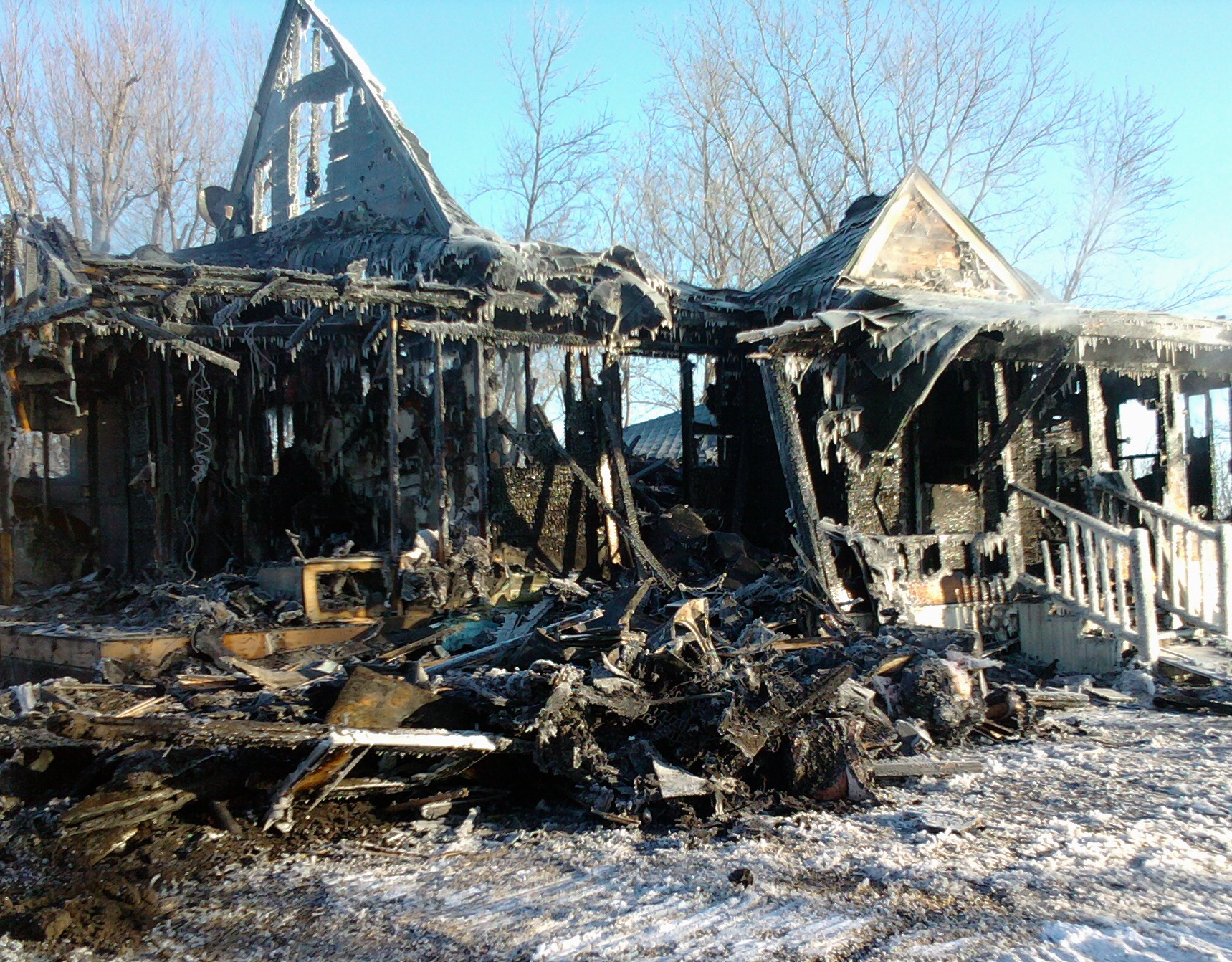
The remains of Sue and Jeff’s home in Parkers Prairie, MN, after the fire on December 21, 2012. Photo credit: Larry Zirbes/American Red Cross
In the wee hours of December 21, we had a house fire and lost everything, including many of our beloved pets.
I want to thank you with all my heart for being there to help us get through those difficult first days. Please also thank those who made the quilts we were given. I found it very comforting to wrap myself up in one when things got overwhelming.
We have been occasional contributors in the past, but from now on we will be regular contributors so we can help pay forward the wonderful work that you do.
From the archives: Phil Hansen in 1990 working for the American Red Cross in Rochester, Minnesota.
They say that what you send out in life comes back to you multiplied. I believe this is so and I have witnessed many examples over the years.
In my own experience, a donor supplemented the cost of a swimming program in which a Red Cross instructor taught me to swim. I got so excited about the program that I joined the Red Cross and helped teach thousands of others– mostly kids–to swim. My ability to swim has saved my life on at least two harrowing occasions. And one time I used my ability to swim to save a friend. I suspect that many of those I trained have saved lives as well.
My experience is one small example of the multiplying effect of a donor’s gift. I bet the Red Cross has already touched you or a family member in some way. If not, maybe someday it will–you may need swimming skills to save a loved one’s life–or have a heart attack and need CPR–or need blood after an accident–or need a place to stay after your home burns down–and the Red Cross will be there for you–always.
During March–Red Cross Month–I want to share my sincere thanks with our board members, volunteers and paid staff members, donors, supporters, partners, and friends for the many ways you have helped the American Red Cross serve the needs of Minnesotans.
Wishing you a very happy Red Cross Month,
Phil Hansen, CEO, American Red Cross, Northern Minnesota Region
P.S. Click here to learn more about ways to be involved with the Red Cross.
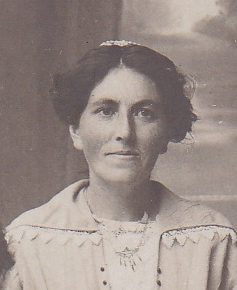
Olufine Kristofa Olsdotter Fjeld, near Adrian, Minnesota, 1914. (Photo provided courtesy of great-granddaughter Melanie Moser)
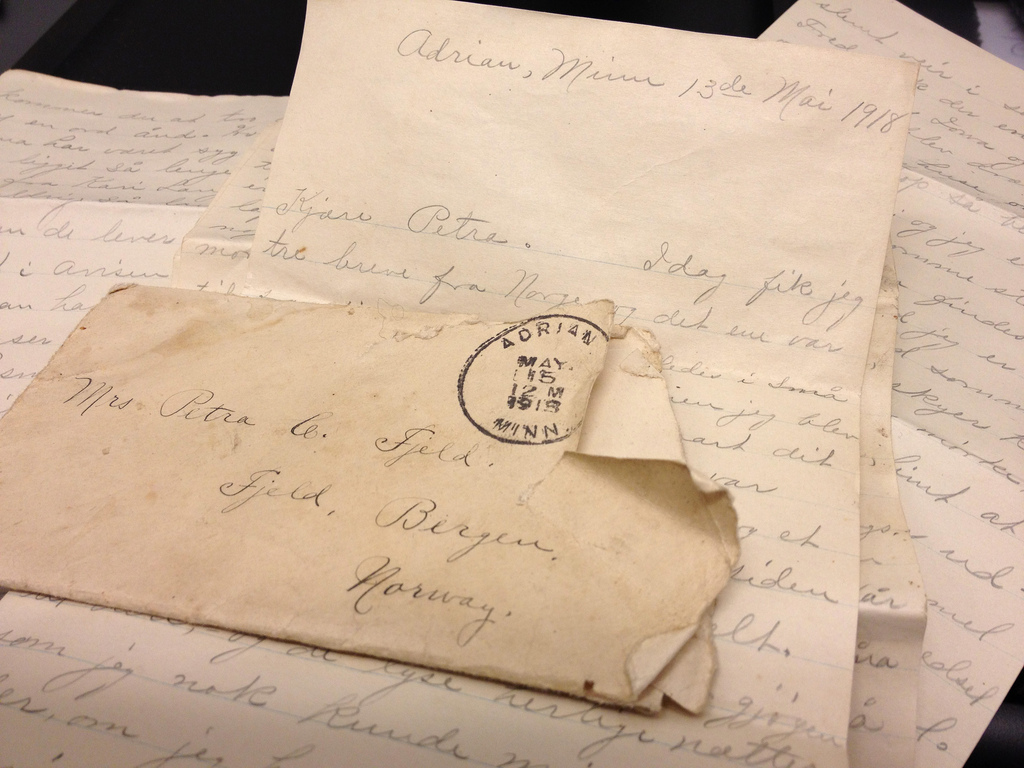
Olufine Fjeld was a busy farm wife when she wrote a letter to her family in Norway in 1918. There were chicks, goslings and children to tend to. There were crops to sow. There was weather to mind. Dangerous storms had recently swept across nearby areas, killing 18 people and injuring 150. And there was patchwork to do for a quilt that would help raise money for the American Red Cross and its work during the Great War (WWI).
“I made a quilt with red, white and blue, which I gave to the Red Cross; I made a cloth for the middle square in the quilt, and sewed 48 small pieces which should resemble stars; then I sent the quilt to the Red Cross headquarters in St. Paul, Minnesota, and now one day I received a letter full of thanks and praise.”
Olufine felt the need to support the war effort. Her husband and oldest son both had registered for the military and waited for their call to service. She recognized the bounty in her life while others were forced to do with less or without.
The quilt made by Olufine Fjeld for the American Red Cross. (Photo provided courtesy of great-granddaughter Melanie Moser)
“And now I hear that you have to use ration cards for foods; such things we have not seen here, yet it is only sugar and wheat flour we cannot buy in as large quantities as we have been used to; except for this, one can buy as much as one wants of everything else.”
Olufine was motivated to make a quilt made by hand–stitch by stitch for humanitarian relief. And winter was the time for her to finish the patchwork, sewing together cloth patches before sowing beans, cucumbers and pumpkins. For the patches she used silk patches purchased through a magazine.
“The ones I got this winter are smaller, the reason is, I guess, that everything is more expensive, and these large clothing magazines use the fabric in a better way; these patches are quite beautiful; some of them are all silk, some half silk.”
Like so many others during her time, Olufine stepped up to help others in need. She turned a personal passion into a means for easing the suffering of others. We can only hope that her quilt made its way to a home, bringing warmth and comfort. And that she continued for many more years writing home to her loveliest Norway.
“Now it is late, almost ten thirty, I have to go out and look after the small goslings before I go to bed…the best of greetings from Fina, and write soon.
Olufine Fjeld’s 1918 letter to her family in Norway. (Photo provided courtesy of Halvor Skurtveit)
Thank you, to Melanie Moser, for bringing her great-grandmother’s story to our attention. Thank you to historian Halvor Skurtviet for providing Olufine’s letter and translation from Norwegian. And thanks also to American Red Cross archivist Susan Watson for sending along information about Red Cross quilts during the Great War.
Click here to learn more about the American Red Cross, its history and how you can get involved.
Story written by Lynette Nyman/American Red Cross.
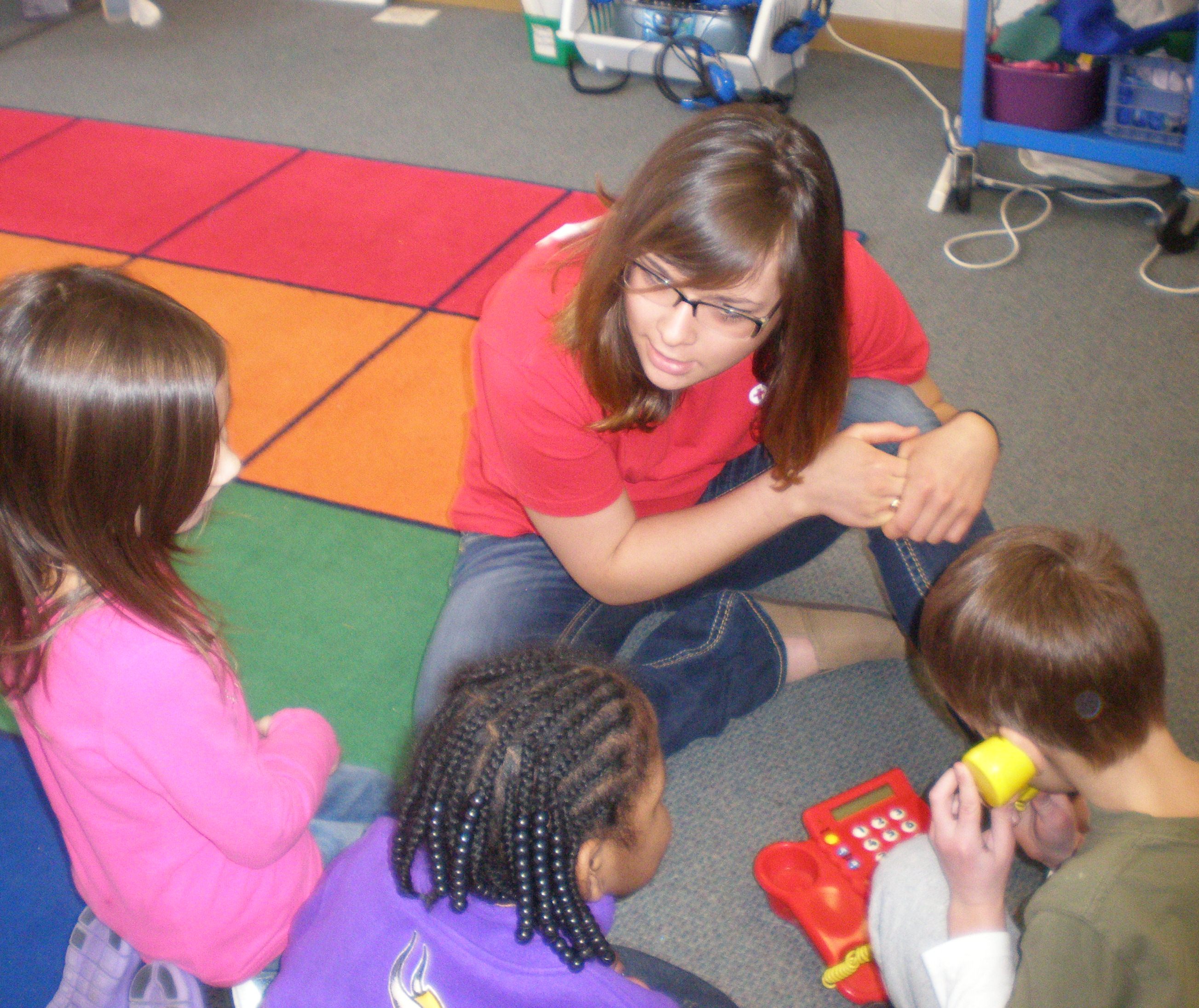
Marie Nordahl, Red Cross Youth Engagement Intern, helps kids practice calling 9-1-1. (Photo credit: Lisa Joyslin/American Red Cross)
What happens when you put 12 high school students in charge of 50 five- and six-year-olds? You might think it’s a recipe for disaster. But on Thursday, January 31, at Chelsea Heights Elementary School in St. Paul, Minnesota, this match-up was a great recipe for disaster preparedness.
The high school students, who are part of the Future Educators Club at Como Park High School in St. Paul, worked with the Red Cross to plan an Elementary Prepare Fair – an opportunity for young kids to learn about calling 9-1-1, preventing basic injuries, tornado safety and other important topics.
High school students Dominic and Stephen talked to kindergarteners about fire safety, explaining that fire is very hot and that only adults should handle it. Dominic then taught the kids how to stop, drop, and roll, demonstrating what to do and leading the kids through a practice run. The kids giggled as they watched Dominic roll across the carpet and under a table decorated with red paper flames, then tried it themselves.
Dominic, a Como Park High School student, demonstrates how to stop, drop and roll. (Photo credit: Lisa Joyslin/American Red Cross)
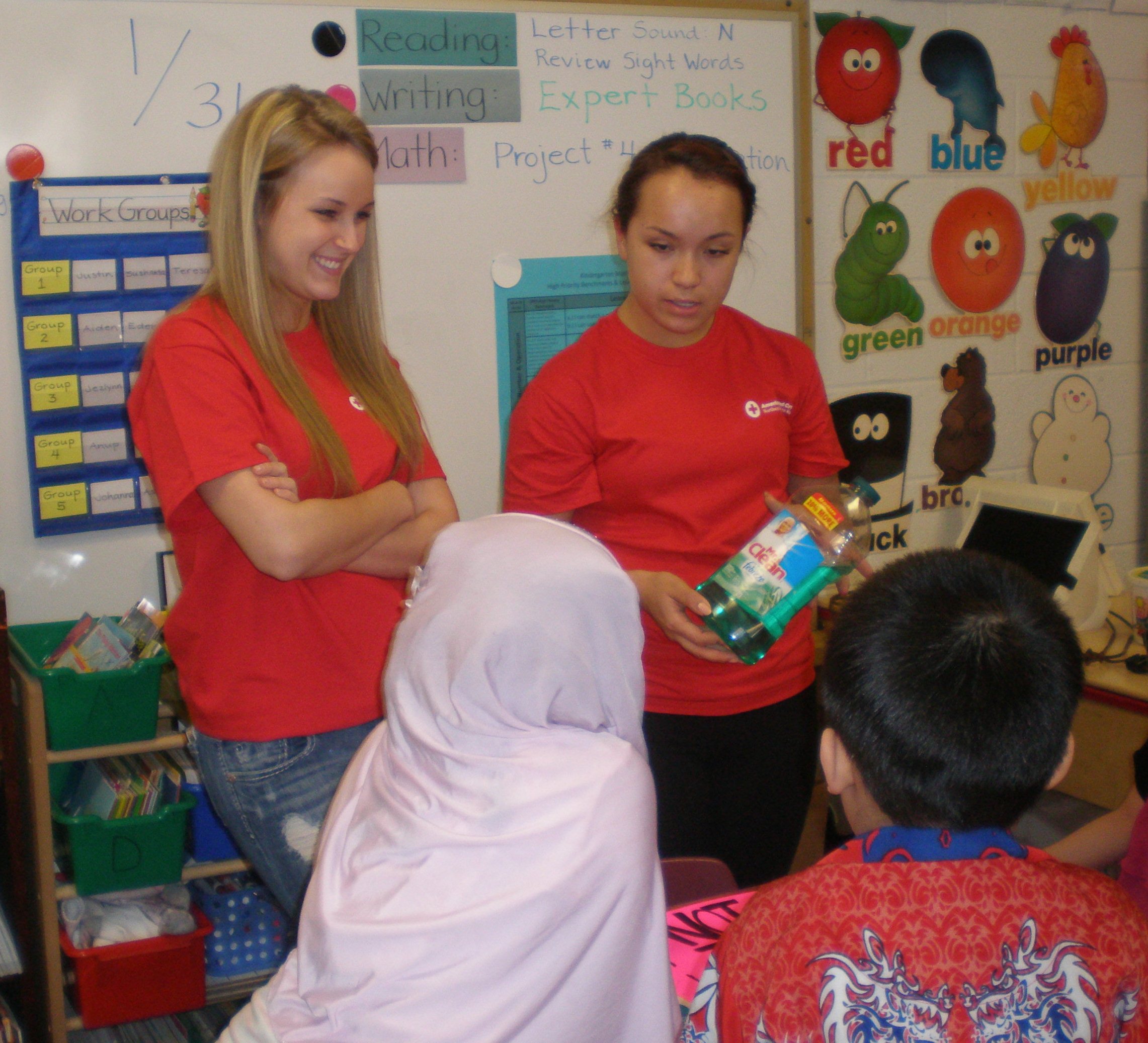
Katie and Nicole taught students about poison safety using a bright poster and props. They showed students that some poisons – like cleaning products or adult medicines – look very similar to safe products, and explained to always ask an adult before eating or drinking something that may be unsafe.
At a nearby table, kids had the opportunity to practice calling 9-1-1 on bright red play phones. “9-1-1, what is your emergency?” the phone prompted. “There’s a fire in my house!” a kindergartener responded. The high school students then asked him his name and address, coaching him on what to tell the 9-1-1 operator. “Great job! High five!” they praised when the pretend call was complete.
Katie and Nicole from the Como Park Future Educators Club talk with kids about safe versus poison substances. (Photo credit: Lisa Joyslin/American Red Cross)
At the end of the fair, the elementary students received colorful achievement certificates, which were prepared and signed by the Future Educators.
The Elementary Prepare Fair is one of several new youth engagement projects for high school students who want to volunteer with the Red Cross, Northern Minnesota Region. Interested groups can contact Volunteer Resources at (612) 871-7676 or arctc.vsvolunteer@redcross.org to learn more and get involved.
Thank you to the fantastic Como Park Future Educators for their hard work and enthusiasm. Because of you, fifty young kids are better prepared for disasters and emergencies!
Story and photos by Lisa Joyslin, Volunteer Resources Director, American Red Cross Northern Minnesota Region
In 1910, when Marguerite Grams was born, the American Red Cross was still a fledgling organization of just 29 years. On November 2 Marguerite celebrated her 102nd birthday and friends from the Red Cross were there to join the party. Grams established the Virginia, Minn., office of the Northland Chapter in 1942 and served the organization for the next 35 years. More than 50 board members from the Northern Minnesota Region of the American Red Cross recently signed a t-shirt with best wishes for Grams. Northland Chapter board member Christina Hujanen and chapter Executive Director Judy Hanne Gonzalez presented her with the shirt, a card and a birthday cake during a meeting of the Soroptomists International Club of Virginia, Minn.
A devastating tornado wiped out much of West Liberty, Kentucky, a mountain town of around 3200 people. Dozens are now relying on Red Cross disaster services. Photo credit: Lynette Nyman/American Red Cross
For some, the Red Cross shelter in West Liberty, Kentucky, is the only home they have. “Without the Red Cross,” says Stacy LeMaster, 26, “we would be on the street.”
Since the March 2 tornado hugged the ground, wiping out dozens of homes and businesses in West Liberty, Stacy, her husband, and their three children have sought refuge at the shelter where everybody knows everybody. “This is just like home,” says Daniel.
Daniel LeMaster and his son Daniel 3, are relying on the Red Cross shelter for safe and warm refuge after a tornado hit West Liberty, Kentucky, on March 2. Photo credit: Lynette Nyman/American Red Cross
Disaster relief workers from around the region are providing essential services to more than 50 people seeking refuge in the shelter. The shelter is also an assistance station for dozens more staying with family and friends, but who are otherwise homeless.
Shelter operations manager Brad Powell says Red Cross relief teams are also in the community. “We have relief workers doing damage assessment and mass feeding,” says Powell.
Some of the relief workers at the shelter have had little sleep, including Breck Hensley, 16, who has friends affected by the tornado. He says being a Red Cross volunteer is a good experience. “I’m just trying to help all those people who need it because if I were them, I would want it,” says Hensley.
Breck Hensley, 16, who has friends affected by the March 2 tornado that hit West Liberty, Kentucky, says being a Red Cross disaster relief worker is a good experience. Photo credit: Lynette Nyman/American Red Cross
People in West Liberty are likely to rely on the Red Cross shelter for many more days as the slow process of tornado recovery takes its turn.
Hope Worldwide Volunteers sorting smoke detectors and batteries to be given to Philips neighborhood homes without proper fire detection.
Armed with Red Cross fire safety tips, seventy Hope Worldwide volunteers hit the streets of the Phillips neighborhood in Minneapolis on Saturday, January 16, to spread the word on household fire safety.
American Red Cross preparedness representatives trained the Hope Worldwide volunteers on fire safety and gave them tip sheets before the volunteers knocked on doors.
Smoke detectors donated by the Minneapolis Fire Department and batteries donated by Home Depot were available to give to homes without them. The volunteers planned to reach out to 1,200 households.
The American Red Cross Twin Area Chapter responds to more than 400 residential fires each year, including house and apartment fires in the Phillips neighborhood. The Red Cross provides people affected by disaster with emergency disaster relief, such as food, clothing, shelter, medical assistance and emotional support. (Click here to learn more.)
Text and images by Andrea Bredow, Red Cross Volunteer








 American Red Cross Minnesota and Dakotas Region