Story and photos by Lynette Nyman/American Red Cross
Donna Parrish lost her home of 30 years in Robbinsdale, Minnesota, during a fire on June 3, 2016
Among the dozens of people displaced by the five-alarm (big and powerful) fire in the very early morning hours of June 3 in Robbinsdale, Minnesota, is Donna Parrish.
Donna, who’s old enough to have children, grandchildren and great-grandchildren, has lived at Beach South Apartments for 30 years. Hers is a home now gone, literally it was burned through and through.
Her memory of the beginning is waking after midnight and hearing a crackling sound that she thought was hail –a storm, after all, was expected to arrive in the next twenty-four hour period. But the sounds were no storm of weather. She went to look out the blinds, through the window, into the darkness. Smoke and sparks are what she saw. And someone with a fire extinguisher, she says.
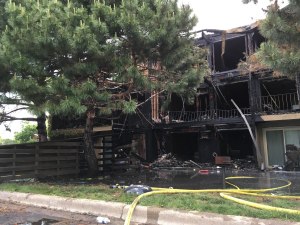
The most burned units at Beach South Apartments in Robbinsdale, Minnesota
Moments later a pounding on the door announced that escape from the burning building was necessary right then, without hesitation. She fled with only her pajamas and slippers. I’ll have to take some quiet time to assess what’s next, she says.
Karri Solum and her mom Donna Parrish after their apartment burned
Dozens of people are displaced because of this fire. Some will never return while others will have to wait for the smoke to clear and repairs to happen.
Red Cross volunteers are helping Donna, her daughter, and each of the others affected by this disaster get back their lives.
Learn more about American Red Cross disaster relief.
Red Cross disaster worker Ruth Talford received the 2016 NVOAD Spirit Award. Photo: Megan Mrozek/American Red Cross
We are pleased to announce that Ruth Talford, a disaster relief worker with the American Red Cross Minnesota Region, received the 2016 National Voluntary Organizations Active in Disaster (NVOAD) Spirit Award. This award is given each year to a person who has exhibited outstanding commitment to the NVOAD movement. The award was presented to Ms. Talford during the NVOAD conference held in Minneapolis in late May. Conference participants included more than 400 people representing voluntary organizations from that respond to disasters around the country in a variety of ways, such as feeding, cleaning, and spiritual care. The Minnesota Region of the American Red Cross, the national American Red Cross, and other Red Cross regions were well-represented with several dozen disaster relief workers on-hand. This year’s conference service project was a Red Cross blood drive. Click here to learn more about NVOAD and click here to learn more about the MNVOAD.
Sarah Carlton has always had a passion for health, fitness and swimming. She graduated from college with a degree in exercise science and health promotion, and now she’s in charge of the aquatics program for Community Education in Stillwater, Minnesota. Sarah has been the Aquatics Coordinator there for four years and she continues to be a supporter of the Red Cross swimming programs they use for instruction.
“A Red Cross program consists of our community education instructors teaching and guiding swim students using an approved curriculum,” says Sarah. By using the Red Cross program, she knows that her students and their families will get the best swimming education possible. “Through the Red Cross program, there are 6 levels of swimming lessons. It also offers preschool and parent with child classes. Students can start as young as six months and most end lessons around the age of eleven or twelve.”
Luckily, while working with students, Sarah hasn’t run into any scary incidents. Sarah says, “The benefit of doing swim lessons is teaching the kids how to swim and prevent drowning. It also teaches them safety skills, not just in the pool, but while at the beach or boating.”
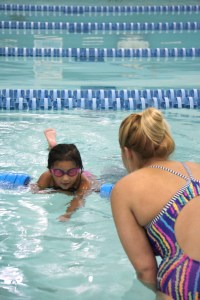
Photo by Connie Harvey/American Red Cross
When Sarah became the Aquatics Coordinator for Stillwater Community Education, she obtained her Red Cross Lifeguard and Water Safety Instructor certifications. Having these certifications helped her understand the job responsibilities better, gave her a great networking forum and improved rapport and credibility among her staff team. When needed, she can take a lifeguard shift or fill in as a swim instructor, which enables the program to run within ratio and with minimal disruption to customer service.
Her best advice for people who don’t know how to swim: learn to swim using a Red Cross program. “It’s used around the country and teaches the right skills to be safe in or near water. If you’re an adult, take private lessons. It’s never too late to learn.” The biggest reward at the end of the day for Sarah is seeing the student faces light up when they pass a level or when they know they’ve become better swimmers.
Photo by Connie Harvey/American Red Cross
Sarah’s Top Five Swimming Pool Safety Tips:
1. Always swim with a buddy
2. Learn to float and use survival strokes
3. No horseplay on the deck or in the pool
4. No crazy stunts off the diving board
5. Learn how to stay afloat in the deep end of the water
If you plan on being in or near water this summer, find a community education program near you for swimming lessons. For more water safety tips, click here. To download the Red Cross mobile Swim App click here.
Phil Hansen with Bea, 90, at her home in St. Cloud, Minnesota.
Story and photo by Kaylee Beevers/American Red Cross Intern
On April 23, Phil Hansen, the senior executive for the American Red Cross Minnesota Region, had the opportunity to participate in Home Fire Campaign activities in St. Cloud. His experience was mostly what he expected: teams made up of Red Cross volunteers and St. Cloud firefighters installed smoke alarms. But this was his first time actually doing installation outreach in homes. “I was really surprised by the number of homes that had inadequate smoke alarms or didn’t have any at all. It was great for us to come in and help make these installations for people who needed it most.” The reason why Phil made the trip to St. Cloud is because he truly believes in what these installations are doing: saving lives. As of April 2016, Red Cross installed smoke alarms have saved more than 90 lives across the country. For Phil, the best part about making home visits was meeting gracious people and seeing their faces shine with thankfulness after sharing with them a lifesaving gift. “For the future, we plan to see this program grow throughout the country due to the number of lives saved.” One challenge, he says, is the number of volunteers and partners currently participating. “We have great groups going out to serve their communities, but we need more.” And the top reason to get involved: “It’s a great reward knowing you’ve impacted and changed lives within your community.”
Learn more about the American Red Cross Home Fire Campaign.
On May 6, the American Red Cross in Minnesota presented six awards that honored ten people for their heroic efforts helping others during great times of need. Below we share with you their inspiring stories.
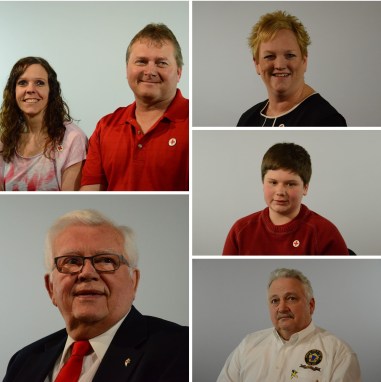
Six of ten heroes honored at the 2016 American Red Cross Minnesota Region’s Heroes Breakfast. They include (clockwise) Shawn Hansen, Bryden Bronikowski, Mike Clark, Jerry Nelson, Jenny Braith and Russ Braith. Photo credit: Lynette Nyman/American Red Cross
Duluth teen Bryden Bronikowski was honored with the Youth Good Samaritan Hero Awardfor helping to save the life of his young cousin. “Panic is your worst enemy,” says Bryden. “Fearing anything can go wrong.” Watch Bryden’s story.
Nisswa Chamber of Commerce president Shawn Hansen received the Community Hero Award for being a vital part of daily coordination and communications during the windstorm disaster relief efforts in Nisswa in July 2015. “As human beings we have to focus on making the world better,” says Shawn. Watch Shawn’s story.
Mike Clark of Eagan received the Military Hero Award for supporting the needs of people in the armed forces. “It gives me an opportunity to connect with people that are just really down to earth,” says Mike. “And they’re really thankful for knowing there’s somebody out there who cares about them.” Watch Mike’s story.
Shoreview resident Jerry Nelson was honored with the Give Life Hero Award for his continuous blood donations and support of organ transplant families. “I’m not a hero for giving blood,” says Jerry. “Transplant patients and the people who get the blood are the heroes.” Watch Jerry’s story.
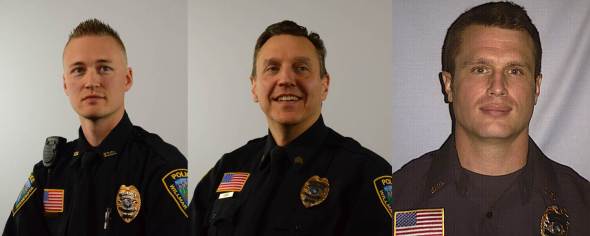
Three Willmar police officers received Red Cross Heroes awards on May 6, 2016.
Willmar police officers Mike Jahnke, Joshua Helgeson, and Jeff Liebl were honored with the First Responder Hero Award for putting their lives on the line to resolve a potentially tragic situation. “He’s a human being,” says Josh. “It’s our job to help him, and that’s what we did.” Watch Mike, Josh, and Jeff’s story.
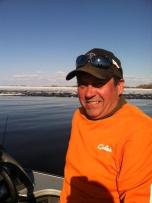
On May 6, 2016, Greg Pint received a Red Cross Hero Award.
Montgomery residents Russ and Jenny Braith, and Lonsdale resident Greg Pint, were honored with the Good Samaritan Hero Award for putting their own lives at risk to save a man from a car going underwater. “I heard him hitting the buttons, the door locking, but no windows coming down,” says Russ. Watch Russ, Jenny and Greg’s story.
Click here to nominate someone for the 2017 Heroes Awards. Post by Lynette Nyman/American Red Cross.
By Vanessa Smith, UW-Superior student and Red Cross Intern
It’s hard to believe that one year ago I was on a trip in Washington, D.C. as a member of the Political Science Association at the University of Wisconsin-Superior, and we had the opportunity to visit the national headquarters of the American Red Cross. I was amazed by the fact that Red Cross does far more than what most people assume that it does. Personally, I had always thought that it mostly dealt with blood services, but after visiting national headquarters I learned that the Red Cross also deals with international humanitarian law (IHL) along with several other areas of service.
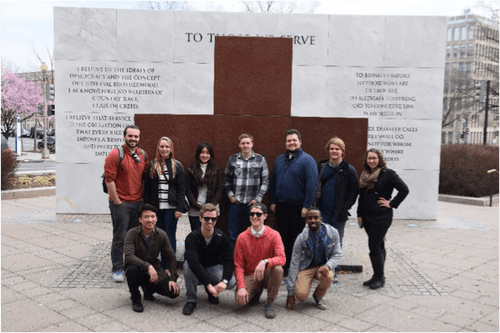
UWS students visiting the American Red Cross in Washington, D.C. Photo credit: Haji Dokhanchi.
Personally, I was highly interested in Red Cross’s dedication to educating and increasing awareness in regards to IHL. In fact, the American Red Cross has adopted a campaign from the Belgian and French Red Cross’s that have developed a simulation training program called “Raid Cross.” This program explores and addresses the humanitarian issues involved in armed conflict situations, the basic rules of IHL that apply, and the importance of these rules in conflict situations, such as preventing harm to civilians.
I was eager to know if and how I could become involved with the American Red Cross and IHL. So, while I was visiting D.C., I asked my professor if he knew of any internship opportunities in the Twin Ports area with American Red Cross. In fact, he pulled his email up on his smart phone and sent an email to Dan Williams with the Minnesota Red Cross chapter in Duluth, right there on the street in front of the Red Cross national headquarters! By the time I returned from the east coast, I had an interview set up with Dan and was well on my way to starting my journey with American Red Cross.
UWS students participating in Raid Cross training. Photo credit: Kota Yanagidani.
Since then, I’ve been working to educate the local community about IHL. We recently held an event at the Allworth Institute for International Studies at the University of Minnesota in Duluth. This was a lecture by Red Cross volunteer Pj Doyle regarding refugees and immigrants to the United States. At this event, we reached out to more of an older generation in attendance from the area community. The next day we held an actual Raid Cross simulation at the University of Wisconsin – Superior. At the simulation we had almost 50 people in attendance, which included local high school and college students. We did both of these events all in one week! I really enjoyed knowing that we had reached more people in the community regarding IHL and refugee and immigration processes. When speaking to students after the events, I learned that many really enjoyed the experience. Also, I think that the community members were quite pleased, and maybe even surprised by, how beneficial the Raid Cross simulation training was.
High school students after a Raid Cross training at UWS. Photo credit: Haji Dokhanchi.
When I started my internship with the Red Cross, I knew this was the kind of work that I wanted experience doing. My major is Political Science and my minor is Global Studies so I’m very interested in various topics, such as law, policy making, international relations, and humanitarian aid. Through my Red Cross internship I continue to learn more and more information that relays back to helping me with my major and it makes me feel especially good because I know that through my internship I’m educating the community on issues that are a passion of my own.
To learn more about IHL for young people, click here. A version of this post was recently published on the Humanity in War blog. To learn more about Red Cross internships and other opportunities to get involved in Minnesota, click here.
A few days ago, our region of the American Red Cross announced its 2016 Heroes Awards recipients. These ten people—whose extraordinary actions exemplify the Red Cross mission to prevent and alleviate human suffering in the face of emergencies—saved lives, connected communities, and supported children when they needed it most:
Community HeroShawn Hansen, Nisswa First Responder HeroesSgt. Mike Jahnke & Officer Joshua Helgeson & Officer Jeff Liebl, Willmar Give Life HeroJerry Nelson, Shoreview Good Samaritan HeroesRuss and Jenny Braith, Montgomery, and Greg Pint, Lonsdale Military HeroMike Clark, Eagan Youth Good Samaritan Hero Bryden Bronikowski, Duluth
Powerful Stories That Inspire
You are invited to attend the 8th Annual Heroes Breakfast, which will take place on Friday, May 6, at the Radisson Blu Mall of America in Bloomington, MN. Tickets and table sponsorships are available online at redcross.org/mnheroes or by calling (612) 872-3241. During the breakfast you will hear powerful and inspiring stories about ten people helping others when they needed it most. The breakfast also is an opportunity to celebrate the Red Cross and its important humanitarian work.
Sponsors Make It Happen
Thank you to our 2016 Heroes Breakfast sponsors. This year’s sponsors include presenting sponsor Land O’Lakes, matching gift sponsor US Bank, award sponsors CenterPoint Energy, CHS, Medica, St. Jude Foundation, Anime Twin Cities, UnitedHealth, reception sponsor Navigate Forward, and vignette sponsor Patterson Companies. And thanks to the Minnesota Twins for donating game tickets to our heroes.
Nearly every eight minutes, the American Red Cross extends a helping hand to a family in need that has lost everything – the roof over their heads, their clothes, and their most cherished possessions – to a home fire. Across Minnesota and parts of western Wisconsin, the Minnesota Region of the American Red Cross has been busy helping neighbors. But your help is needed on one special day to continue to provide the emergency services that our neighbors depend on every day.
Red Cross Giving Day
On April 21, you have a chance to help families in need whenever and wherever they need it by participating in the national American Red Cross Giving Day to #help1family. A donation of $88.50 can provide a family with a day’s worth of food, plus blankets and other essentials. We’re proud of the disaster relief our region provided last year. This included supporting more than 2,300 people affected by local disasters, which were mostly home fires, and installing more than 1,000 smoke alarms to improve home fire safety.
Become a social ambassador
You can help spread the word about Giving Day – the more people who support Giving Day means we can help more families. Use your social media channels to reach out to friends and family and ask them to donate to #help1family. Here are four ways donations will #help1family:
1. Supporting a family in urgent need: provide funding to give a family a day’s worth of food, blankets, and other essentials.
2. Supplying warm meals: help provide hearty, comforting meals to people impacted by disasters.
3. Providing clean-up kits after a disaster strikes: make clean-up kits available for families in need that include vital items like a mop, bucket, and disinfectant.
4. Deploying an emergency response vehicle for a day: Red Cross workers travel to impacted neighborhoods in fully stocked Emergency Response vehicles to provide food, water and critical relief.
Imagine the impact that we could have on our community if everyone wanted to #help1family.
Red Cross volunteer Susan Cebelinski checked in at the Red Cross office in Duluth, Minnesota, on April 6, 2016, before going to Louisiana where she will provide emotional support to people impacted by the flooding. Thank you Susan!
Volunteer /välənˈtir/
Noun someone who freely offers to take part in an enterprise or undertake a task
American Red Cross Volunteer
/əˈmerəkən/ /red/ /krôs/ /välənˈtir/
Person someone who freely donates time to community and country by participating in life changing and saving service
Without volunteers the American Red Cross and its mission to help others would never be fulfilled. The Red Cross depends on volunteers to embrace service within their communities and to come together in times of crisis. During National Volunteer Week, April 10-16, we have the chance to express our gratitude to the women and men, heroes and leaders, and old and young, who voluntarily give their time and expertise, and wear the Red Cross on their shirt sleeves, while working to reduce human suffering.
National Volunteer Week is important to the Red Cross because it has nearly 330,000 volunteers nationwide. From a disaster worker helping one or hundreds, to a military responder comforting an injured solider or family member, or to a blood donor ambassador welcoming someone who’s about to roll-up a sleeve for a cancer patient waiting for lifesaving blood, the Red Cross offers a range of volunteer positions that serve others, both neighbor and stranger. Whether Red Cross volunteers are waking up in the night to assist a family after a fire or teaching a class on how to give first aid, all of them deserve a sincere thank you from us and many others.
To this we say, THANK YOU RED CROSS VOLUNTEERS! Without you, who knows where so many people in need would be today. You’re the light that shines from this organization and you continue to make a difference in your local communities, and across our country, one voluntary service action at a time. Thank you for the hours and hours you’ve given and the number of lives you’ve made better. We know that you generally take the humble path, but during National Volunteer Week it’s your turn to take a bow and accept our applause. We’re grateful for all that you do!
If you’re not a Red Cross volunteer but you know someone who is, give them a hug and say thanks. Ask them about their volunteer service. The many hours they spend helping others is remarkable and worth hearing about. Maybe their stories will inspire you to become a Red Cross volunteer and be the hero in someone’s life.
Across northern Minnesota,AmericanRed Cross disaster relief responders are working towards hosting a disaster shelter workshop in each county and tribal community. Most recently, the Red Cross teamed up with Koochiching County employees. In addition, the Red Cross connected with response partners across the U.S.-Canadian border because, as we know, ‘disasters don’t go through customs.’
Nancy Young with the American Red Cross Dakotas Region guides shelter training participants during a workshop in Koochiching County, March 2016. Photo credit: Richard Johnson/International Falls Journal
The training week started with a shelter set-up that included twenty-four Koochiching County employees. (The workshop was a smaller version of what was used for the statewide Vigilant Guard exercise in Duluth in the fall of 2015.) Before the participants arrived they completed the American Red Cross Shelter Fundamentals course online. During the on-site part of the training, a Red Cross team of three volunteers from the Minnesota and North Dakota guided the shelter participants. (The cross-border collaboration between states has been in place for more than two years because we’re often called to respond together.) The workshop was set-up in three stations: registration, dormitory, and feeding. There was also a training for disaster nursing. After the two-hour workshop there was an open-house for the community members who were not in the training to ask questions and to see how the Red Cross and Koochiching County can work together to shelter displaced people during disaster relief response. The Salvation was also on hand serving lunch to all who participated. (Thanks!)
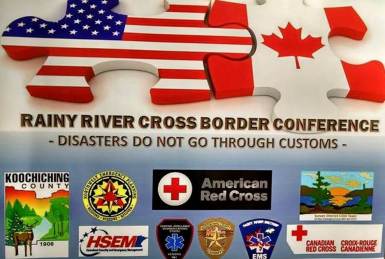
A cross-border conference called “Disasters Do Not go Through Customs” followed the shelter training. Sponsored by the Rainy River Cross Border Planning Group, the conference brought together around one hundred people from both sides of the U.S.-Canadian border who could work together during major disasters affecting both sides of the international border. Presentations included managing potential threats, such as train derailments, floods, tornadoes, biological outbreak, communication failures, quarantine, wild fires and terrorism. All levels of government were represented from both Canada and the United States. Railroad representatives addressed one of the biggest concerns throughout the emergency management world: train derailments involving large amounts of oil carried by rail.
Less than twenty fours after the end of the conference there was a train derailment in Callaway, Minnesota. The accident forced the town of more than 200 people to be evacuated. Red Cross volunteers from North Dakota and Minnesota as well as Salvation Army relief workers were on-scene, providing the care and sheltering that we have trained for and do so well.
Story by Tony Guerra, Disaster Program Manager for the American Red Cross Serving Northern Minnesota. You can be a Red Cross disaster relief volunteer.







 A cross-border conference called “Disasters Do Not go Through Customs” followed the shelter training. Sponsored by the
  American Red Cross Minnesota and Dakotas Region