Hey there, we recently received this digital postcard from one long-time Red Cross disaster relief volunteer Marian Green, who’s in Illinois responding to spring flooding. We’ve inserted a few translations for the layperson and Red Cross disaster rookie readers.
Dear Red Cross Pals,
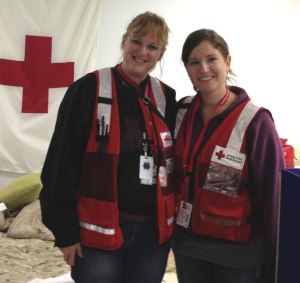
Marian and Tejas working together during the 2013 Spring Flooding response in the Midwest.
I met Tejas Patel in Baton Rouge, LA, last summer for Hurricane Isaac. He was the Log Chief [logistics boss]. It was great to run into him here as the Assistant Director [the #2 in charge of this disaster relief response]. As soon as he saw me walk into the room, he pointed to me and said “You are the FSI Lead!” [FSI = all things related to tracking numbers for the relief operation like meals & clean-up kits distributed, etc.] “Umm, OK,” I stammered brilliantly! It is great to be back in the field as a new FSI [actually stands for Financial Statistical Information] Supervisor. It was even better when an FSI Manager, Elizabeth Norcross from Hawaii, showed up yesterday. This is the first time I worked a DRO [Disaster Relief Operation] with three regions, each having its own staff, plus a DRO. Trying to get four sets of numbers compiled without duplications is a real challenge, but it’s been a great learning experience and Elizabeth is a great mentor. I plan on being here until May 4th but could be talked into a few more days if needed.
Thanks,
Marian in Peoria, Illinois
Our reply: Take care Marian, Tejas and the others who are responding to the spring flooding. You’re brilliant and for sure you have hearts bigger than three regions. And to our readers, both rookies and veterans, click here to see more about how the Red Cross is helping in Michigan, Illinois, Iowa, Minnesota and North Dakota during the 2013 Spring Floods disaster response.
From the archives: Phil Hansen in 1990 working for the American Red Cross in Rochester, Minnesota.
They say that what you send out in life comes back to you multiplied. I believe this is so and I have witnessed many examples over the years.
In my own experience, a donor supplemented the cost of a swimming program in which a Red Cross instructor taught me to swim. I got so excited about the program that I joined the Red Cross and helped teach thousands of others– mostly kids–to swim. My ability to swim has saved my life on at least two harrowing occasions. And one time I used my ability to swim to save a friend. I suspect that many of those I trained have saved lives as well.
My experience is one small example of the multiplying effect of a donor’s gift. I bet the Red Cross has already touched you or a family member in some way. If not, maybe someday it will–you may need swimming skills to save a loved one’s life–or have a heart attack and need CPR–or need blood after an accident–or need a place to stay after your home burns down–and the Red Cross will be there for you–always.
During March–Red Cross Month–I want to share my sincere thanks with our board members, volunteers and paid staff members, donors, supporters, partners, and friends for the many ways you have helped the American Red Cross serve the needs of Minnesotans.
Wishing you a very happy Red Cross Month,
Phil Hansen, CEO, American Red Cross, Northern Minnesota Region
P.S. Click here to learn more about ways to be involved with the Red Cross.
A tired Yvonne Johnson sat at a table in her apartment complex community room. “I am still in disbelief,” she said. “You hear of people in the news who have fires like this, but I never thought it would be ME in this situation. It still seems so unreal!” she said.
Red Cross volunteer Sheila Miller (l) helps Yvonne Johnson (r) with emergency disaster relief after an early morning blaze burned her home on December 26, 2012. (Photo credit: Anne Florenzano/American Red Cross)
Yvonne, her teen daughter and nephew had enjoyed Christmas together in their apartment in Plymouth when their building fire alarm went off at about 12:30 a.m. They were still up, and dressed, and they grabbed their new gifts and put on their boots and coats and went outside. A half-hour later they were given the okay to go back into their apartment. At approximately 3:30 a.m. Yvonne was woken out of her sleep by the smell of smoke and her daughter saw sparks and flame out of the balcony window coming down from above. Yvonne and the two teens raced out of the apartment, this time dressed only in pajamas and unable to save anything but a clutch with her phone and keys.
The three of them took refuge in their car to stay warm. Eventually Yvonne was able to send her kids to warmth and sleep with her sister while she made arrangements for help from the Red Cross for temporary lodging, clothes and food. The firemen have told her that her apartment is uninhabitable because of water damage. Fortunately her landlord has some empty units where Yvonne can begin rebuilding her home, but she won’t know until she can get back into her apartment if any of the kids’ Christmas gifts or the furniture she recently inherited from her Mom can be salvaged. Yvonne is a middle school English teacher at the Woodson Institute for Student Excellence, and she said, “I’ve never had any help or assistance before – never in my life – but I need this help today.”
Disasters are hard any time of year, but can be especially hard around the holidays. Since Friday, December 22, the Northern Minnesota Red Cross has helped more than 8 families, including 20 adults and 15 children. Our volunteers respond to more than a disaster a day here in our region. In addition, more than 100 volunteers from our area have deployed east to help those affected by Superstorm Sandy–several are on their second deployment, missing holidays with their families because they want to help those in need. Everyone can help those affected by local and national disasters: please consider making a year-end gift to the Red Cross at redcross.org.
During the holiday season there is much to be thankful for as we gather with loved ones, participate in traditions and winter festivities, and search for the perfect gifts to give to family and friends. However, there are some gifts that are less tangible than others. Tacy Fleener from Alexandria, Minnesota, describes her recent deployment to the Red Cross disaster relief response to Superstorm Sandy in New York City, and the special “gift of a lifetime” she received.
Red Cross disaster relief volunteer worker Tacy Fleener. (File photo: American Red Cross)
Tacy has been with the Red Cross for 30 years as the first national responder out of Douglas County. She started at 16 years old, teaching swimming lessons and CPR training. Later on, with the help of her husband, she got the local Red Cross chapter in Alexandria up and running with different classes and opportunities of involvement for local community members. Her heart is most passionate about disaster relief and being of use during times of great need.
During past deployments, Tacy specialized in mass care shelter management and hands-on experience. However, this deployment was a different involvement; one that was also very intense but rewarding. Tacy’s job was behind the scenes to guide volunteers through the deployment process. She would enter these volunteers into data bases and designate hotel rooms to keep track of individuals during their deployment.
Tacy expertly handled stress the minute she arrived on site, “Things were chaotic when I got there, my job was to try to keep the peace with the hotels we had under contract. I played detective to try to spend Red Cross’ money the right way, while making sure that volunteers were where they needed to be, with places to stay.”
“Just to see the need I had been hearing about with individual faces and stories kept me motivated throughout my deployment. It was easy to see that the distribution process was very difficult. People on the distribution team were bringing supplies to outskirt areas, such as Stanton Island where 12,000 people are still without power.” She remembers that distribution volunteers are overwhelmed with the need. One story that impacted her life was one gentleman leading a distribution team. She recalls, “He had just got back from Staten Island where he had been sleeping on pallets for two weeks. He looked like death warmed over and I thought to myself, oh wow, we need to find a hotel for this guy so he can rest and get cleaned up.”
A “thank you” from Josh Holper and his friends to the Red Cross. (Photo credit: Sue Gonsior/American Red Cross)
Though rooms were in a shortage in Stanton Island during this time, various New York hotels were gracious and gave American Red Cross a block of discounted rooms. This is an example of a reoccurring theme of camaraderie and teamwork throughout the east coast disaster relief. Even with support and understanding, every day was mentally and emotionally stressful. “We spent 12-14 hours a day keeping track of hotels to try to save the Red Cross as much money as possible,” says Tacy. “Every volunteer constantly gave it their all and was very supportive. Thanksgiving was especially a wonderful time to be volunteering; we had the opportunity to make sure that people had a Thanksgiving dinner. Citizens were very appreciative and it was neat to spend Thanksgiving by giving back to this community. To hear someone say ‘thank you’ was wonderfully rewarding.”
Volunteering during this disaster is a constant 24/7 job, without many breaks, yet Tacy says she would do it again in a heartbeat. “I love the Red Cross, the volunteers, the people I meet. Everyone that is there wants to make a difference. Even when you had been working 12-14 hours a day, you just go and give a big hug to each other and say thank you.”
Helping others & making friends: Red Cross volunteers (l-r) Lizzie Kampf, Ed Newman and Sue Buelow in New York City for Superstorm Sandy.
Thank you’s and appreciation can go a long way. The American Red Cross Northern Minnesota would like to extend its gratitude to Tacy and more than 100 relief workers who have donated, volunteered or been involved with the Red Cross mission to reduce human suffering during the Sandy disaster response on the east coast.
Tacy hopes her experience encourages others to volunteer. “Just to meet one person who says thank you brightens my whole day. It really helps me when I come back home to Minnesota; to appreciate what I have; to appreciate helping others in a time of need. It fills my heart to be able to give back by doing something truly important. I know my whole heart is into it when I’m there. I know the other volunteers feel the same way, young and old. I recommend that anyone become a Red Cross volunteer–it’s an experience of a lifetime. Make the time, take some classes and experience the opportunity to give back to others, because you never know when you will need it yourself. Some of the friends you meet will touch your heart for a lifetime.”
Click here to find out more about how you can help with Superstorm Sandy relief this holiday season and give the gift of a lifetime.
Red Cross responder Sue Buelow is back from New Jersey where she helped with Superstorm Sandy disaster relief efforts. Below, Sue looks back.
The very beginning was a lot of trying to figure out the response system and getting used to hurry up and wait. But soon after arriving I was assigned to supervising special field teams doing “seek and serve” emotional support and traveling to Moonachie, Newark, Jersey City, Toms River and nearby damaged communities.
Sue Buelow (l) and Lizzie Kampf (r) while responding to Superstorm Sandy disaster relief in New Jersey.
I learned a few things along the way: 1) speed limit signs are a suggestion, 2) many cities are not on a map, 3) there are few places that allow left turns, 4) be thankful for clean clothes; and 5) they love Minnesotan accents there!
The work was hard emotionally and physically. My first partner had to return home to California for health reasons. Then, for the next 12 days I had the pleasure of partnering with Lizzie Kampf, a new “just-in-time” disaster mental health responder who was also from the Twin Cities. It felt like we’d known each other a lifetime. I was sad to see Lizzie leave before I finished my final week there. I didn’t know what I’d do without her driving the truck — she took on the persona of a New York cab driver quite naturally.
Lizzie and I went to New Jersey’s upper Barrier Island as the residents returned to see their homes, or absence of, for the first time. The devastation to the townships there was beyond words. The water and sand was 4-5 feet deep and the waves were up to 12 feet high. The stories of the emergency medical services (EMS) workers and residents who rode out the storm there were frightening. We bonded with these communities and it was not unusual to hear “Hey, Minnesota….” My last contact with one of the EMS workers that had been struggling was “Minnesota, I got your back.”
Being there when the residents saw their condemned or empty lot of debris was indescribable as they collapsed into my arms, sobbing and needing a “Minnesota hug.” We helped look for mementos in the debris, from small things to stones of a child’s hand and foot prints. We were there for those in shock who couldn’t think to pack up some clothes. Listening to them tell their stories and showing us their homes or pictures was moving.
I certainly have received a great gift from the same people: I believe I have helped them. I am blessed to have had a small part of their lives and in their recovery from this disaster. I will always remember my time spent there.
Sue returned home a few days ago. She is among more than 100 Red Cross disaster relief workers (mostly volunteers) from Minnesota who have responded to Sandy.
Red Cross volunteer Claudia Kelly, on the ground responding to Superstorm Sandy, sends us “Greetings from New York City”:
I’m halfway through my third week on this operation. I started in Mass Care Sheltering, and was sent to manage a shelter in Glen Cove, Nassau County, Long Island during and immediately after the storm. I had the chance to work with some fabulous people there. Our shelter population stayed small, ranging from 3 to 18 residents, but many community members stopped by during the day to charge their phones and to escape their powerless and increasingly cold homes. A group of Seniors joined us to eat one afternoon (this was a few days into my super effective all-cold-sandwich diet), and they had so much fun that several of them registered as shelter guests and proceeded to stay up all night laughing, chatting, and watching DVDs.
It’s a small Red Cross world: Claudia Kelly (right) bumped into Choua Yang (left), another disaster responder from Minnesota, while working at the Red Cross headquarters in New York City. (Seeing friends during disaster response is nice.)
Later, some shelter consolidation took place and I joined the staff of an 800-resident mega shelter at the Nassau County Community College just before Election Day. The state Board of Elections brought in absentee ballots for the residents, and Best Buy provided TVs, computers and WiFi hotspots so they could follow the election results. (Over at the staff shelter, we were all just exhausted and went right to sleep.) The mega shelter had many other amenities as well: a free laundry service, a medical clinic, a cell phone charging and loan station, and a supervised children’s play area. Nevertheless, a population that large is chaotic. Several residents were transferred to hospitals, including one in full labor who gave birth to a baby boy (+1 to shelter count since Mom was still registered!).
After two weeks in Sheltering I transferred to Client Casework, which is based out of Operation Headquarters at the New York City Red Cross office building. I’ve been on Staten Island for the past few days representing the Red Cross at a FEMA Disaster Recovery Center near the shore. There was a tremendous amount of damage there, and our presence seems meaningful as a validation of the incredible loss the community has suffered. I am being sent to a different area tomorrow, as I am among the fearless and possibly foolish few who are willing to take on New York City driving, and another team’s driver is having a day off. Traffic here is truly abysmal, as some of the tunnels remain closed, and many streets in Lower Manhattan are clogged with recovery trucks and trailers. But that’s only half the fun: New York City drivers are an aggressive lot. I’m working on my swerve technique in hopes that defensive driving becomes an Olympic sport in Rio in 2016.
Greetings from Greater New York, Superstorm Sandy Aftermath Followed by Nor’easter, November 7, 2012
Hello from Greater New York,
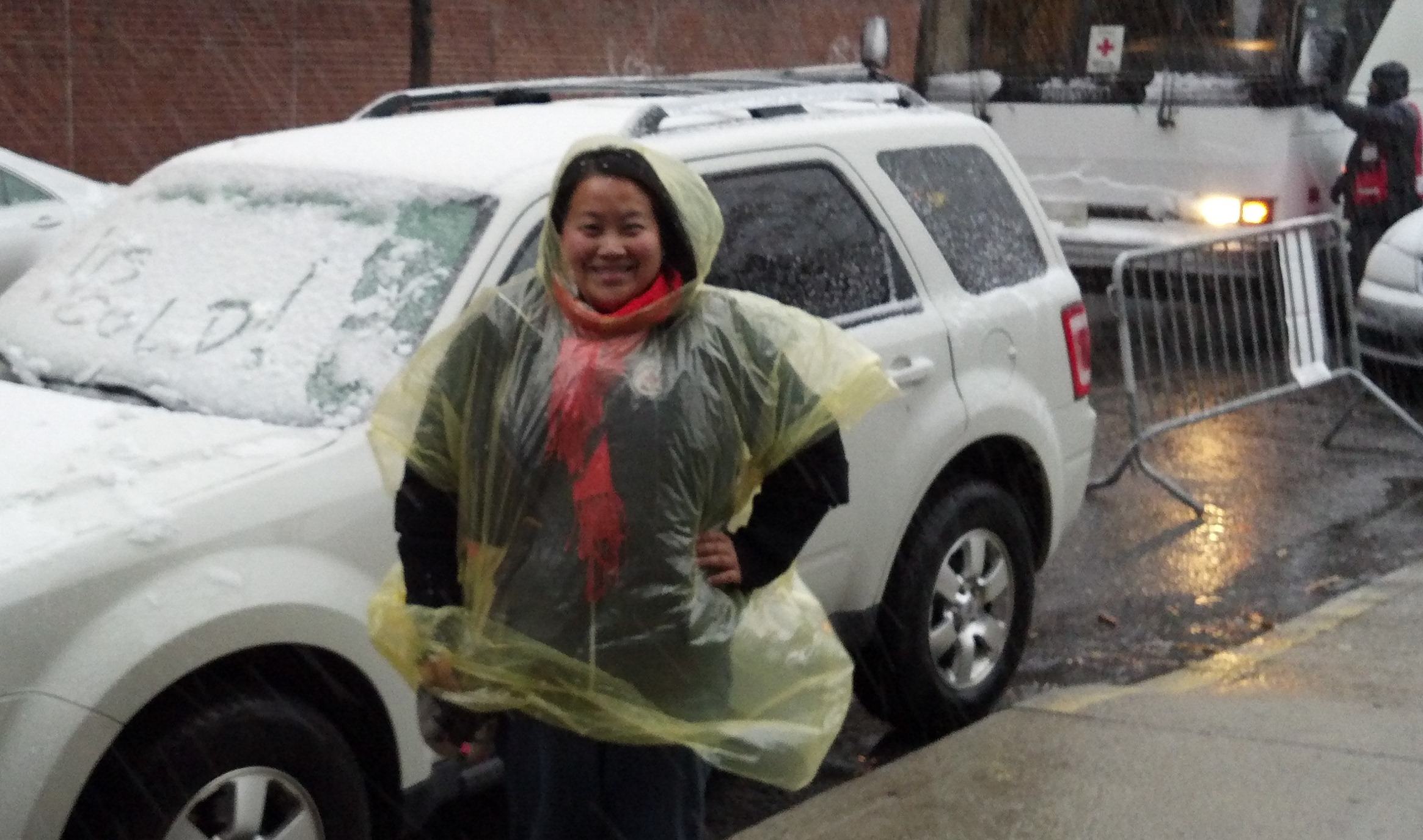
I’ve been going out doing Disaster Assessment (DA). There are so many homes affected and or destroyed by the storm. DA is on hold right now due to the snow mix with rain. Based on the data that we collected, upper managements are planning to deliver supply of goodies to those affected areas. Yesterday, I went to eat with my team and our server asked where we were from. One of the teammates told her that we are with Red Cross and the server just broke down and cried. She was very grateful and happy that we were there for her community. She thanked us for leaving our families and friends to come help out. It was such an amazing experience with this disaster response so far. I am so happy and proud to be Red Crosser!!!
Thanks,
Choua
Choua Yang is one of 5,700 or so Red Cross disaster relief workers responding to Superstorm Sandy. (Around 50 are from Minnesota.) 90 percent of Red Cross responders are volunteers. You can help support Red Cross humanitarian disaster relief.
Ed “Pawpaw” Semmes and granddaughter Corrie Lee, in Picayune, Mississippi, after Hurricane Isaac. Photo & story credit: Lynette Nyman/American Red Cross
Disaster responders from our Northern Minnesota Red Cross region are home from Hurricane Isaac. Everyone returned safe, exhausted, and rewarded with the gift of helping people during a time of need.
People like Edward “Pawpaw” Semmes, 62, and his granddaughter Corrie Lee, 5. Ed’s family received food and a clean-up kit from the Red Cross once it was safe to return to his neighborhood in Picayune, Mississippi. With his household contents piled high on the lawn, Semmes recalled that they had about five minutes to escape because the water came from “the north, the south, the east, and the west. It came from all four directions.” Inside the house, his son-in-law pulled up ruined flooring. Ed easily kicked in sodden sheetrock. “We understand what others went through because we went through it.” Only in recent days did he break down and cry. Before he was too stressed about taking care of his family, something he’s always done with great pride, but he was concerned for them, their lost belongings, and the uncertainty of where they’d live. Thankful for Red Cross assistance, Ed (or Pawpaw), said “storms affect families–that’s what it gets down to.”
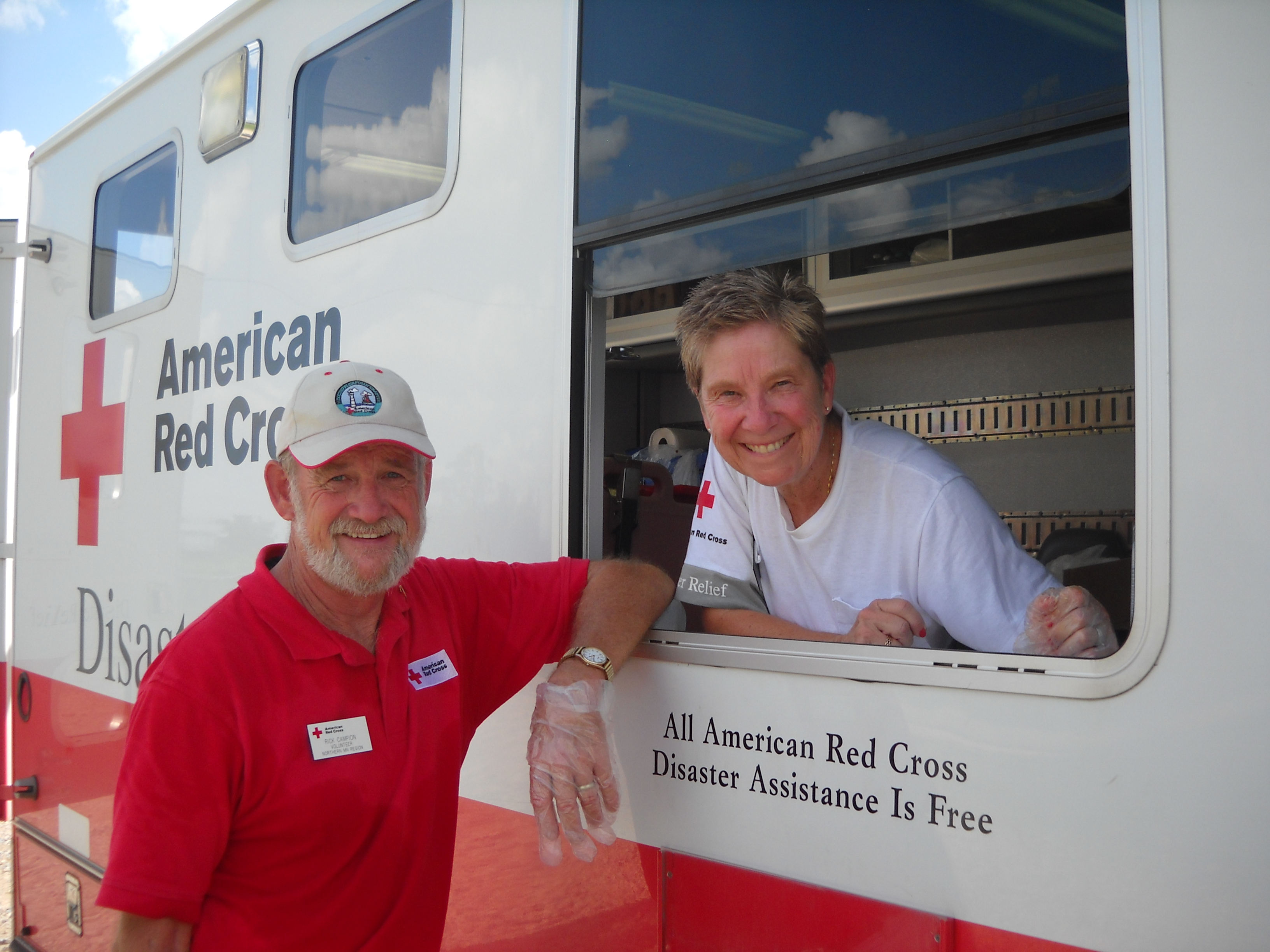
Red Cross Rick and Karen Campion were among the volunteers who responded to Hurricane Isaac. Image provided courtesy of the Campions.
The Red Cross recognizes this truth. We are grateful to everyone within our Northern Minnesota Region who helped–and continue to help–families along the Gulf Coast. A special thanks to local volunteers who worked on this disaster relief response: Mark, Margaret, Marie, Catherine, Mark, Diane, Marty, Dave, Hildred, Judy, Dick, Amanda, Karen, Rick, Harriet, John, Gordie, David, Claudia, Greta, Steve, Richard, Kris, Susan, Debbie, Eric, Brent and Marian.
Click here and learn more about the Red Cross response to Isaac or about how to get involved with the Red Cross.
The other day while riding along the Minneapolis Grand Rounds bike path, we stumbled across Blaine Mogren. He loves bikes. He looooooooves bikes. Among the bikes in his collection is this fine (pictured left) Surly Pugsley. He has six of them. This particular one he calls Fire Engine Pugsley. We can see why. For starters, its BRIGHT RED. It also has loud horns, flashing lights, and a fire-fighter rubber duck. And crosses, white ones (like on the Swiss flag). After a minute of chit-chat with Blaine this thought emerges: let’s make a Red Cross Pugsley!
After all, the Pugsley is (via Wikipedia) revolutionary: In 2005, Surly began selling the Pugsley, the first mass-produced mountain bike with extremely large volume tires, up to 4 inches wide, for deep snow and sand riding. The front and rear wheels share a common hub size and can be interchanged, allowing for additional gearing combinations. Noted bicycle technical authority Sheldon Brown said, “Pugsley is, in its way, as revolutionary as the original mountain bikes were in the early 1980s.” Bicycling Magazine wrote, “It’s not ideal for everyday use, but it can handle a wide variety of demands and conditions well.” Let’s repeat that last bit: a “wide variety of demands and conditions.” Sooooooooo, that could include disaster response in your hometown (or ours where it snows for months except last winter).
Tell us, what do you think? What would your Red Cross Pugsley look like? Would it be red with white? Or white with red? Would you have side bags for water and snacks that you would distribute to people affected by disasters or those responding to them? …..
Story and photos by Lynette Nyman/American Red Cross
So, the other day, this young man named Paul van Vliet stops by Red Cross offices in Minneapolis and drops off comfort kits for kids. How cool is that? He (Paul) comes up with his own project idea (making comfort kits for kids) and provides them (the kits) to us (Red Cross) so that our disaster relief workers can give the kits to kids affected by disasters (like fires, floods, & tornadoes).
Now, let’s give some credit to us (Red Cross) because we came up with the original comfort kits for adults and children idea, but we rely on motivated and generous peeps like Paul to make this kits and help reduce the suffering of people who escape burning buildings or high waters. Paul’s dad John was on hand for the comfort kits for kids drop off. He took a fine photo of his son Paul (top & bottom) and then sent us a nice note (excerpt below left).
“It was great to meet you at the Twin Cities’ Red Cross office today. Thanks for your interest in my son, Paul’s, Eagle Scout project. It was a wonderful surprise and honor to meet Phil Hansen, an Eagle Scout himself. I know Paul was very impressed and honored by Mr. Hanson’s enthusiastic reaction to his project. And I am sure Paul will remember this day for the rest of his life. Most important, he and I are gratified to know these comfort kits will benefit the littlest and most vulnerable victims of disasters.”
Well, John, we think your son is the bee’s knees. We could not do what we do without him and others like him. We wish Paul many happy days during his next adventure (college) and hope that he will make his way around the world and back to us some time in the future.








 American Red Cross Minnesota and Dakotas Region