Witnessing Resilience and Hope: My Red Cross Deployment to Asheville After Hurricane Helene 

Every deployment with the Red Cross is unique. Each one brings new challenges, new faces, and new lessons. My recent deployment to Asheville, North Carolina, after Hurricane Helene was no different. Walking through the aftermath of the storm, I was struck by the immense power of water and its capacity for destruction. But even more impactful was witnessing the resilience of the people and the power of collective action as volunteers, first responders, and neighbors came together to rebuild.

“Walking through the aftermath of the storm, I was struck by the immense power of water and its capacity for destruction.” – Brice Johnson

Responding to a disaster like this is always humbling. It’s a privilege to see the Red Cross mission in action firsthand, to be part of immediate relief efforts, and to know that our work will support long-term recovery for those impacted. This deployment, in particular, left me with lasting memories of strength, compassion, and the incredible difference we can make when we work together.

Finding Hope in Housing 

One of the most remarkable aspects of this deployment was the success of our shelter resident transition teams. These teams worked tirelessly to help shelter residents move into sustainable, long-term housing solutions. By the end of the deployment, almost every shelter resident had a more stable housing solution.

I’ll never forget a moment that brought this work to life for me. After a long day, I stopped at a fast-food restaurant for dinner. At a table near me, I overheard two men filling out job applications. One turned to the other and said, “The Red Cross got me a place to live, so now I can get a job.”

It was such a simple statement, but it carried so much weight. Having a safe and stable place to live gave this man the chance to rebuild his life. It struck me how transformative our work can be. This wasn’t just about housing; it was about hope and opportunity.

Sylvia’s Backyard Operation 

Another unforgettable moment came when I received a call from Sylvia, a local community member who had been supporting nearly 300 people camping in the woods after the storm. With no formal resources, Sylvia set up a makeshift shower in her backyard and provided food and supplies to help them survive.

Her selflessness and determination were extraordinary. She had been doing everything she could with what little she had, but when she contacted us, we knew we could amplify her efforts. Almost immediately, we dispatched one of our emergency response vehicles to her area, initiating a feeding mission that continued long after my deployment ended. Each night, nearly 300 people were served a hot meal.

Sylvia’s story is a testament to the power of individual action and the strength of community. Her willingness to step up in a moment of crisis inspired everyone involved and reminded me how much one person can accomplish with compassion and determination.

The Long Road Ahead 

Disasters like Hurricane Helene leave a lasting impact, and recovery is never quick or easy. While the immediate relief we provide is critical—sheltering families, serving meals, distributing supplies—it’s just the beginning. The road ahead for Asheville and the surrounding areas will be long, but the Red Cross’s commitment to being there for the entire journey is a source of hope for so many.

This deployment reinforced what I’ve always believed about disaster response: It’s a collective effort. From our volunteers on the ground to local community members and first responders, every person plays a role. Together, we help restore not just homes and livelihoods but also dignity and hope.

“This deployment reinforced what I’ve always believed about disaster response: It’s a collective effort.” – Brice Johnson

The Privilege of Service 

Being deployed to a disaster like Hurricane Helene is a profound experience. It’s a chance to witness resilience in action, to be part of something bigger than yourself, and to see firsthand how compassion and dedication can transform lives.

I carry with me the memories of this deployment—the resilience of the people we served, the commitment of our teams, and the extraordinary kindness of individuals like Sylvia. These moments remind me why the work we do is so important and why I’m so grateful to be part of the Red Cross.

As I reflect on my time in Asheville, I’m reminded that every disaster is different, but what remains constant is the spirit of service and the power of hope. To all who serve, thank you for being the light in someone’s darkest moment. And to the communities impacted by Hurricane Helene, know that the Red Cross will be there for you—not just during the storm, but for as long as it takes to recover.

By Brice Johnson
Regional CEO of the American Red Cross Minnesota and Dakotas Region
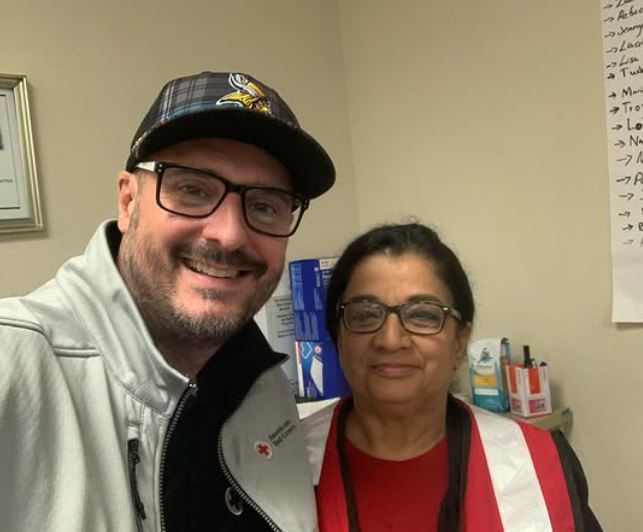
Brice Johnson with regional executive assistant Neela in North Carolina, 2024.

Making a Difference in Time of Crisis: Unsung Heroes on the Frontline

Red Cross volunteer Mark Capaldini from the Twin Cities Chapter of the Minnesota and Dakotas Region recently returned from a 10-day deployment to North and South Carolina. He helped in food operations, driving an emergency response vehicle (ERV) to deliver meals to the communities affected by the wrath of Hurricane Helene. Mark also helped in the distribution of emergency relief supplies in these communities. This was his third such national deployment.

Mark Capaldini, pictured at the Minneapolis-St. Paul Airport as he starts a 10-day deployment to North and South Carolina for Hurricane Helene disaster relief. (Photo submitted)

For the first six days Mark worked with an ERV driving partner, Jeff Wick from Texas. On one of those days Mark and Jeff travelled into a severely impacted community to distribute food and teamed up with two more Red Cross volunteers to package and distribute hot meals.

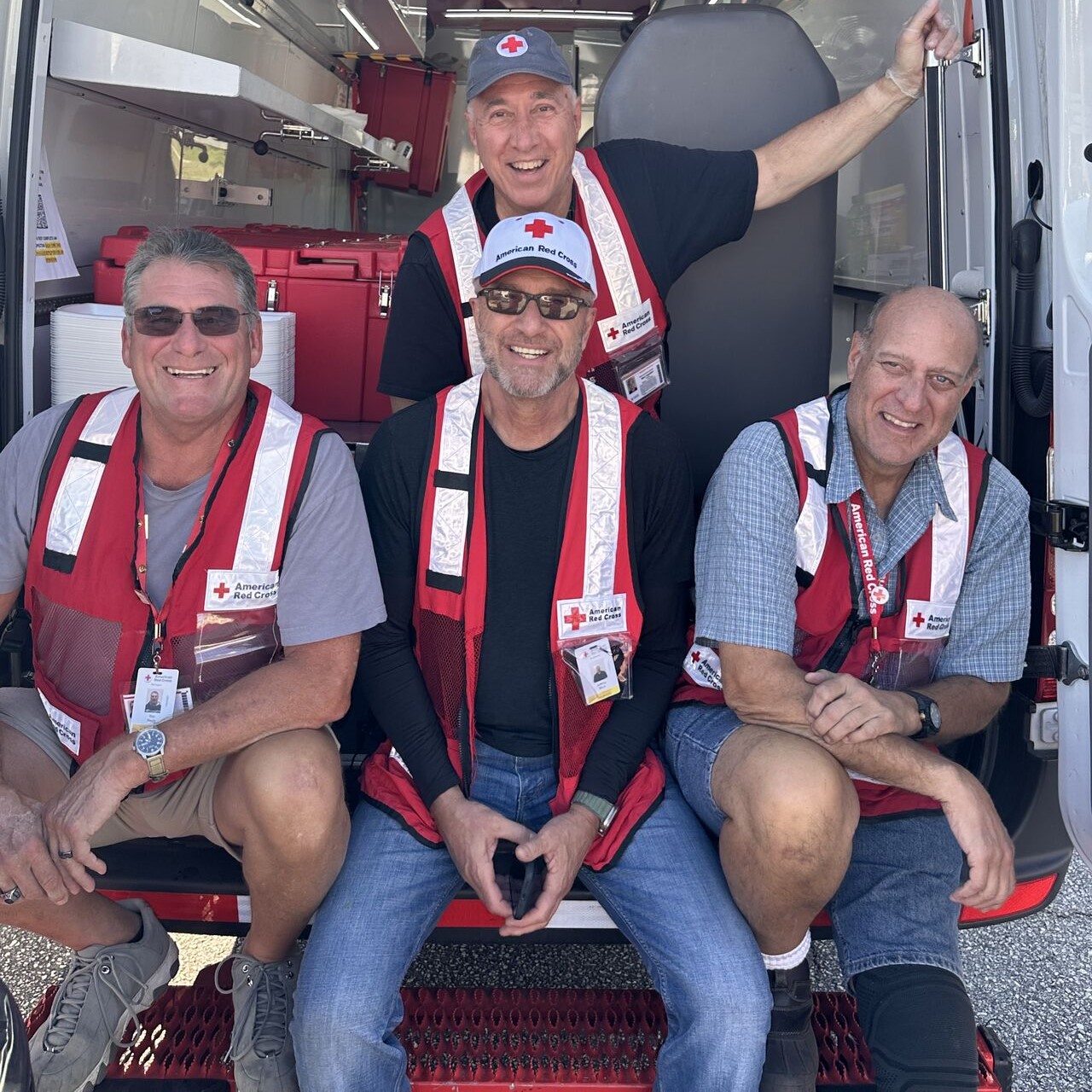
Mark Capaldini pictured helping with meal distribution with fellow Red Cross volunteers Tim Perry, Greg Purkey, and Jeff Wick in a small South Carolina town — Ware Shoals on 10/11/2024.
(Photo submitted)

“We were thanked almost daily for being there and helping out,” Mark humbly expressed. “Frequently, these expressions of gratitude, often paired with a ‘bless you,’ originated from receivers of our food and clean-up kits. We were even thanked by passersby at local gas stations and fast-food locations.”

Mark’s assignment then shifted to delivering emergency relief supplies to some of the communities hardest hit.

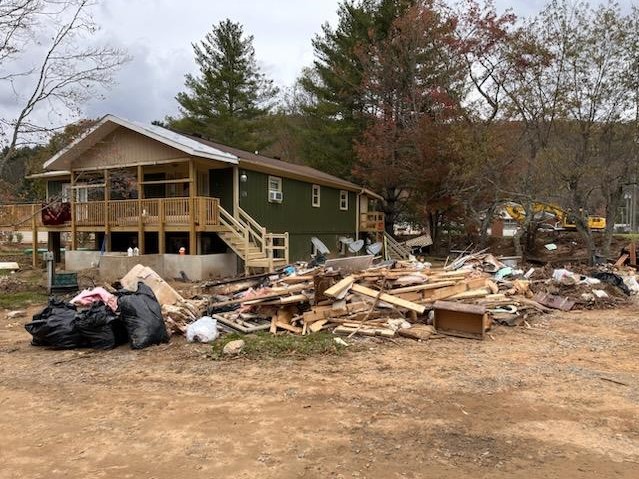
Witnessing the aftermath in Boone, North Carolina, a town in the Blue Ridge Mountains that experienced immense damage from rains, flooding, winds, and a tornado, was a glaring reality check. Mark explained that “furniture and supplies were strewn and stacked outside homes, painting a grim picture of the devastation.”

View of a Boone, North Carolina, neighborhood devastated by the aftermath of Hurricane Helene provided a somber illustration of the disaster’s magnitude. (Photo submitted)

He further noted the widespread impact on the landscape. “The water that rushed down from the mountains carved out huge chunks of the countryside and sometimes completely washed the roads out, requiring us to travel on temporary gravel paths. This is an enormous effort that will take years to get the roads and infrastructure repaired.”

View of a Boone, North Carolina, neighborhood devastated by the aftermath of Hurricane Helene. Temporary gravel paths replaced washed out roads. (Photo submitted)

When asked about his chance to get some well-deserved rest following the deployment, Mark agreed, emphasizing the comfort he anticipated upon returning to his own bed.

“It worked out for me to go and help,” Mark said. “My experience reiterated the critical role the Red Cross plays in these relief operations in responding to natural disasters.”

Mark Capaldini is a board member of the American Red Cross Twin Cities Chapter of the Minnesota and Dakotas Region.

Deployment experience in North Carolina

This past fall volunteer Deb Thingstad Boe responded for the first time to a Red Cross call for nurses to support Hurricane Florence relief efforts. Deb deployed to North Carolina where she worked in a shelter. Below is an excerpt of  Deb’s experience originally published in the December 2018 Minnesota Metro Medical Reserve Corps newsletter. Thank you to Deb for responding to the call to serve when you’re needed most!

Deb at Smith shelter in Fayetteville

I found out the deployment process moves fast! I spoke with the Red Cross on September 25, which was almost three weeks after Hurricane Florence made landfall, and six days later I was on the ground in Fayetteville, North Carolina. I was deployed through what is called Direct Deployment (DD), which is a rapid process used to ready healthcare workers for disaster work.

Once I received a call from Red Cross staff affirming my desire to deploy, I completed forms and about 15 hours of required online training and attended a deployment training in-person. At this training I received my disaster response ID, and mission and procurement cards. The mission card was used for my expenses and the procurement card was used to help clients (there is training on this!).

Along the way I also received a suggested packing list that was invaluable. Among those items were a stethoscope and blood pressure cuff. I found out later that it’s more difficult if you do not own these items when you arrive on assignment without them.  The best thing I purchased to prepare was a self-inflating air mattress that fit on the cot I slept on. Ear plugs are a must! If I didn’t wear them, then I worried about whether the next breath is coming for some people. I wasn’t the only healthcare volunteer that talked about that.

Red Cross volunteer staff shelter (a.k.a. home)

Although it felt like everything was moving fast, I knew this was what I wanted to do. I decided I would go with the flow, take things as they come and try to do my best.

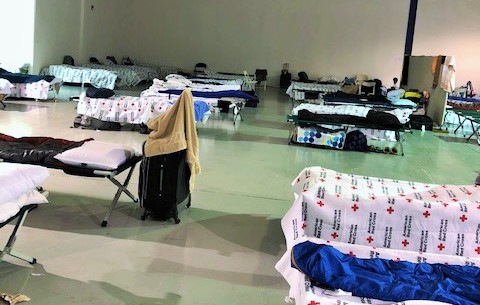
My assignment was to work 12-hour shifts at Smith Recreation Center. This Red Cross shelter was planned to be the last to close in Fayetteville. This meant that as other shelters closed people who had not been able to find housing were relocated to Smith. The shelter had about 150 people in residence, many who were among the most vulnerable people in the city: people with mobility issues, unstable chronic conditions exacerbated by displacement, chronic untreated mental illness, addiction, in hospice care, and (previous to the disaster) long-term homelessness.

Every day was different and yet alike. Within the first fifteen minutes of the first day, I was instructed on how to administer Narcan and safety precautions related to the environment. I was informed that public health obtained Narcan for the shelters because there was a death due to opioids. The shelter had many residents who accessed Disaster Health Services on a daily basis. I learned about “shelter cough.” When I arrived many residents and staff had upper respiratory symptoms, and I wondered about influenza and whether residents had been offered flu vaccinations. Just listening was an important component of care.

Visiting rural communities in North Carolina

My experience with Public Health came in very handy. Part of the plan to help one woman in the shelter included food as a prescription for her chronic health needs. Listening and choices were critical to helping her. During my three hours with her, I managed to work in stress management tips and the power of positive-thinking and being forward-moving in thought and actions.

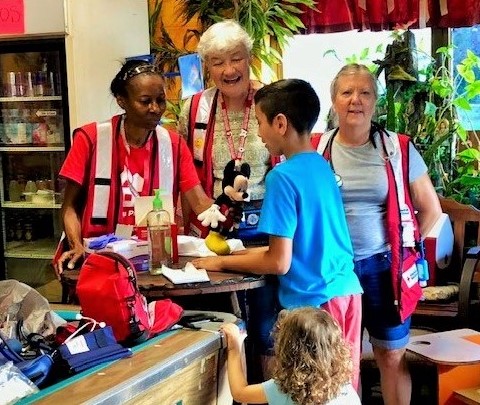
I finished my time working in rural North Carolina working with the community to identify unmet needs, assess how migrant farm workers were managing, and identify where the Red Cross could help. We partnered with Spanish-speaking restaurant owners to inform the area churches of our presence. They opened up an area of their restaurant for Red Cross services and allowed a food truck to be positioned in their parking lot. People came for blood pressure and glucose level checks, OTC meds, blankets, diapers, and TLC (tender-loving care). Staff assigned included an interpreter, disaster mental health, and disaster healthcare. Listening and caring were critical elements of care.

Deb and her new friend Lois

One of the things I enjoyed the most was meeting volunteers from other places. The first night a few of us who had met at the shelter gathered together and headed out to dinner. None of us were assigned to the same place, which meant we met more people the next day. I met a retired pulmonologist and two EMTs, and we had dinner together every night starting on night two of a ten-day deployment. We had fun, and it was a good transition to sleep and the next day.

Deb Thingstad Boe is an American Red Cross Volunteer and a Dakota County Minnesota Medical Reserve Corps Volunteer (MRC). Photos provided by Deb. Click here to learn more about becoming a Red Cross volunteer.

Hurricane Matthew: How The Red Cross Is Helping

The storm hit in the early morning, just after midnight, says Stephanie Hughes on the porch of her home while speaking with a Red Cross relief worker in Pembroke, Georgia. They were very scared especially, she says, when trees started to come down and water started rising around the house, which has been in her family for generations. October, 8, 2016. Photo credit: Daniel Cima/American Red Cross
The storm arrived in the early morning, just after midnight, says Stephanie Hughes on the porch of her home while speaking with a Red Cross relief worker in Pembroke, Georgia. They were especially scared, she says, when trees started to come down and water started rising around the house, which has been in her family for generations. October, 8, 2016. Photo credit: Daniel Cima/American Red Cross

Hurricane Matthew. Thousands of people in shelters. Thousands of relief workers responding. Too many lives lost. This disaster is a big one, for all of us, requiring many hands, heads, and hearts pulling together to help others in dire need. Shelter, food, and relief supplies are Red Cross priorities. And blood and platelet donations are needed from people in unaffected areas to make up for canceled drives. Check out the stories below. They’ll show you how the Red Cross is helping.

You Just Gotta Be Strong: a video from the American Red Cross features Terry, a shelter resident who was forced to evacuate his home in Tarboro, North Carolina, because of Hurricane Matthew

Haiti Needs Help from All of Us: an opinion piece from American Red Cross CEO Gail McGovern published in Huffington Post addresses rumors, issues, and concerns about disaster relief responses in Haiti

Hurricane Matthew: An Inside Look: a blog post featuring photos and stories about people in the aftermath of Hurricane Matthew in Georgia and South Carolina

Suffering Continues After Hurricane Matthew: a news release from the American Red Cross with details about how the Red Cross is responding to the disaster in the U.S. and in Haiti

From Minnesota, there are 24 Red Cross relief workers deployed to help in the affected areas. More will likely be on their way in the days to come.

Karen and Rick Campion are taking a Red Cross mobile feeding truck from Minnesota to North Carolina where they distribute meals and relief supplies. October, 11, 2016. Photo credit: Lynette Nyman/American Red Cross
Karen and Rick Campion are taking a Red Cross mobile feeding truck from Minnesota to North Carolina where they will distribute meals and relief supplies. October 11, 2016. Photo credit: Lynette Nyman/American Red Cross

Please support this relief effort. Click here to donate money to Red Cross disaster relief. Click here to make a blood or platelet donation appointment.

Thank you!