Flood survivor Marcia Walsh welcomes hot meals from Red Cross volunteers James Brown, Sherri Brown and Devyn Brown in Missouri, January 4, 2016. Photo credit: Daniel Cima
It’s once again a new year and probably 2016 already has seen broken resolutions. This year the Red Cross wants to encourage you to do something that will truly make you happy: help others. This may be the best way to bring happiness not just to others but to you as well. Instead of a spin class, maybe a CPR class would benefit the mind, body and soul.
How can you be healthy if you’re not internally happy? It’s supposed to be the little things in life that make us the happiest and by doing something for others, you’re not just helping someone else but inspiring a change for the better in the world. In a time like this there is nothing more important than shining bright with a positive light.
Step One: Donate blood
Donors of all blood types are needed to give blood to help ensure a sufficient supply throughout the year. During winter seasonal declines often occur because of severe winter weather and illnesses, like the flu. Click here to find blood donation appointments near you.
Step Two: Donate time
Everyone is welcome to volunteer and make a difference. The Red Cross encourages you to volunteer, assisting during home fires responses and other disasters all across the United States. Click here to learn about volunteer opportunities. (Click here to see the latest about volunteers responding to disasters in Missouri and Texas.)
Step Three: Donate money
The Red Cross depends on the generous support of the American public to assist people affected by disasters. Consider making a donation today by visiting redcross.org, calling 1-800-RED CROSS (1-800-733-2767) or texting the word REDCROSS to 90999 to make a $10 donation.
Step Four: Take a class
Next on your resolution list should be taking a Red Cross class. These classes include CPR, First Aid, Lifeguard Training and Disaster Preparedness. We can’t think of a better way to keep a happier you new year’s resolution than to learn lifesaving skills that could help you and your family. Click here to find classes near you.
Make this year the year that you begin taking positive steps that bring happiness to you and assistance to others. The new year brings a new you and finding a resolution that really sticks can be hard, but helping others may be the perfect way to start!
Red Cross volunteer Robin Chattopadhyay is helping to build The Pillowcase Project across Minnesota. Photo credit: Lynette Nyman/American Red Cross.
Robin Chattopadhyay can trace his Red Cross connection to early childhood when, like many of you, he had Red Cross swimming lessons. But there was an additional connection. Red Cross tracing services helped his family confirm that his uncle and his family were safe and well following the Union Carbide factory gas leak disaster in Bhopal, India, in 1984. The gas leak killed thousands and injured tens of thousands more.
Today, Robin is on special paid leave from his employer Wells Fargo. The leave allows Robin to dedicate ten weeks towards developing the national Pillowcase Project across Minnesota. The Pillowcase Project aims to increase disaster preparedness among kids in third through fifth grades. First up, he says, will be presenting the project to his own kids at an elementary school in the Minneapolis-St. Paul metro area. “I think that it will be great to present in front of my
A sample pillowcase from The Pillowcase Project, which is sponsored by Disney. Photo credit: Robin Chattopadhyay/American Red Cross.
kids’ classmates.” The overall goal during his special assignment is to increase awareness of the project among teachers and parents, and to encourage others to become presenters. “First I’m starting with the home crowd,” says Robin, whose easy-going manner will likely inspire kids to tell parents about their Pillowcase Project experience.
After this stint, Robin will continue his Red Cross volunteer service both in emergency preparedness, and in disaster response as a Disaster Action Team member. If you’re interested in learning more, becoming a presenter or having a presentation at your school or organization, feel welcome to contact Robin via email (robin.chattopadhyay@redcross.org).
As the holidays approach, people are getting busy – organizing dinner parties, plotting out Black Friday shopping strategies and planning family get-togethers. Lots of fun stuff awaits, and people want to feel good for the holidays, but not everyone does. Patients in hospitals are still in need of blood products from generous donors in good health.
Donors are especially needed in the weeks leading up to and after the holidays. Blood and platelet donations often decline from Thanksgiving to New Year’s Day when festivities pull people away from their donation appointments. This often causes a drop in the blood available for patients in the winter months.
You can give someone the chance to feel better before the holidays are in full swing. Be part of something meaningful, and give blood or platelets through the American Red Cross to help someone hurt or sick. If you are unable to give blood, you can still help by hosting a Red Cross virtual blood drive, volunteering or making a financial donation.
As Thanksgiving approaches, reflect on your blessings and look for ways to give back to the community or someone less fortunate. Remember that giving an hour of your time and donating blood could give a patient needing blood the most valuable gift of all – the gift of life. Many families have started giving blood together on Thanksgiving Day, or over the Thanksgiving weekend, as a way of giving back and giving thanks.
To help encourage blood donations around the holidays, the American Red Cross has teamed up with celebrity chefs John Besh, Richard Blais, Rocco DiSpirito, Mike Isabella, Ellie Krieger and Ali Larter to bring gourmet recipes to donors’ kitchens. Those who come out to donate blood or platelets November 25-29 will receive a Red Cross mixing spoon and celebrity chef recipes, while supplies last.
Make a blood or platelet donation appointment now by downloading the Blood Donor App, visiting redcrossblood.org or calling 1-800-RED CROSS. Please share the need with others in your social network and use the hashtag #GiveWithMeaning.
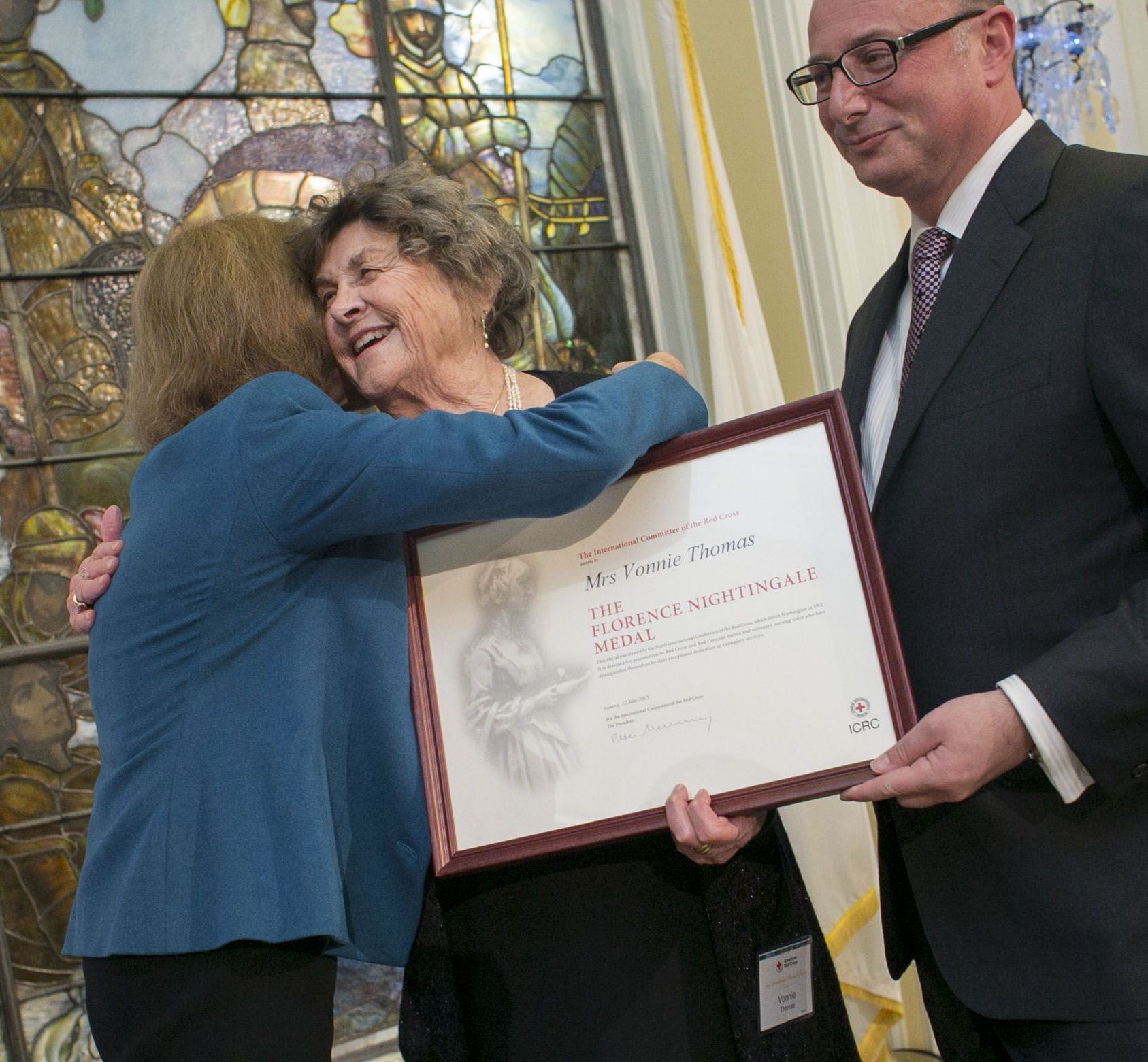
Florence Nightingale Medal winner Vonnie Thomas (center) received her award on October 28, 2015, in Washington, D.C. Photo credit: Dennis Drenner/American Red Cross.
On October 28, at American Red Cross headquarters in Washington, D.C., Vonnie Thomas received a 2015 Florence Nightingale Medal, which is the highest international honor for nursing contributions to the Red Cross and Red Crescent Movement and humanitarian action around the globe. The medal is awarded by the International Committee of the Red Cross (ICRC) every other year. It’s given to nurses or nursing aides who have shown exceptional courage or exemplary service during times of peace or war. In other words, this medal is a big deal. And we’re over the moon that Vonnie Thomas, a Red Cross volunteer for more than 65 years, was among this year’s honorees.
The Florence Nightingale Medal is awarded by the International Committee of the Red Cross.
Vonnie cares for those who have been hurt by disasters as well as the people providing relief. She serves side-by-side with others in the midst of tragedies such as the north Minneapolis tornado, the September 11 terrorist attacks, Hurricane Katrina, and the 35-W bridge collapse on the Mississippi River in Minneapolis. Or to a woman whose husband died when their farm house burned down in Wisconsin. Vonnie is a leader, innovator, health professional, and humanitarian. She has cared for thousands of people during her decades of Red Cross volunteer service. Vonnie is a selfless leader who is dedicated to the Red Cross mission to alleviate human suffering during the toughest of times. She is a coach, mentor and champion for other nurses. She is an example for us all.
Congratulations to you, Vonnie, for receiving this well-deserved recognition. Your humility has a place in the work that you do, but today we ask that you put it aside as we tip our hats in great honor to the amazing woman that you are to many, to us.
“Everything the Red Cross does because of disasters–and we’ve had many this year ranging from Washington wildfires to South Carolina flooding–is done with help from caring people like us. “
I have been a volunteer for the Red Cross since 2003. Based in Minnesota, I first started after I took several classes and became a volunteer to go to local fires and help the families after the incident. We provided those affected some funds depending on the severity of the fire. In our office counselors helped them with a lot of referrals to places like VEAP and Bridging to replace their personal items that were lost. It was always a comfort to them when we were there, especially in the middle of the night.
To date, I have been on about 20 deployments which have ranged from Hurricane Katrina (my first one) on the Gulf Coast to Hurricane Sandy in New York, and most recently the wildfires in Idaho and Montana. A deployment is when you are sent to volunteer at some type of a disaster usually in another state.
When I was deployed to Katrina, another volunteer and I drove the Emergency Response Vehicle better known as the ERV to Montgomery, AL to pick up a load of water and snacks. The ERV is the size of an ambulance and it is a feeding unit to go out in affected areas and feed those who are without electricity and maybe running water. We did 2 meals a day with a Baptist group cooking big kettles of food and there were maybe 20 ERV’s delivering food and water to all parts of the area. We were first assigned to Mobile, AL and drove anywhere up to a 50 miles range to serve lunch. We would serve hot food from a serving window in the truck and when finished or the food was all gone we would head back to our base camp and do it all over for dinner. All the people we served would be so appreciative as they hadn’t had a hot meal for 3-5 days by then.
Another disaster I worked on was the 35-W bridge collapse in Minneapolis. Another volunteer and I were in charge of seeing that there was hot food for the divers, police, federal officials when the first lady and again when the President came. We were only using 2 ERVs to send out food but had many volunteers who came to the Red Cross building to eat which is almost right under the bridge. I was able to go down on the river one evening and take food to the divers. Many days after the incident happened it was still a disturbing event to look up at the bridge and see cars still hanging there.
Hurricane Sandy was another unique disaster because of the size and how long the recovery went on and how large it was. By now I had changed from working with the feeding unit to the staffing unit. That job is to take care of the volunteers that are working on the disaster. They may be doing disaster assessment, mental health work, client casework and feeding those who are without a home, and most likely were staying in one of the many shelters the Red Cross operated across parts of New York, New Jersey and some of New England.
Because the job was so large for Sandy our Staff Services team was divided into several parts. I was the manager of all volunteers coming on the job and leaving the job. Some mornings we would have 50 new volunteers reporting to check in and get their assignments. The Red Cross headquarters where I worked for three weeks was two miles from my hotel. Every morning I walked past some interesting sights like the Good Morning America studio and the jumbotrons on Broadway. I picked up breakfast from a local deli or a street vendor and did the same on the walk back in the evening.
The night before Thanksgiving some of my group decided we would go up to Central Park and look at the parade floats. You cannot imagine the number of people who had decided to do the same thing. There were eight of us in our group and we had to hang on to the coat of the person in front of us or we would have been lost. We decided that we had walked about eight miles that evening, but it was fun. None us would do it again.
My most recent deployment was the Idaho and Montana wildfires. Half of my time there was spent in Kamiah, ID which is way up in the mountains. My workplace was the local American Legion. There was a reception center, called a MARC, that brought many groups into one place where those affected could get different kinds of help. There were 16 families that had totally lost their homes as they burned to the ground in a matter of minutes. Many others had lost part of their homes or all of their out buildings and a lot of cattle.
Everything the Red Cross does because of disasters–and we’ve had many this year ranging from Washington wildfires to South Carolina flooding–is done with help from caring people like us. The Red Cross is always grateful for our help. If any of you have 4-5 hours a week to volunteer, we always need more help. If it would not be your thing to go out to fires or to be deployed, there are simple jobs in the office that can be done, such as addressing birthday cards for volunteers. If you would like to become a Red Cross volunteer, just click here.
Dee Smith, 36, served with the American Red Cross as secretary in Paris, during World War I. Photo from the Minnesota Historical Society collection.
During World War One, people in Minnesota made a major contribution to The Great War effort. Minnesota women were among them. At home, they did many things to help, such as darn socks, make bandages, pack comfort kits, and offer first aid classes. More than 120 of them chose to be close to the front lines in Europe. Their names included Ruby, Marion, Grace, Marguerite, Julia, Aileen, Verna, Leila, Mary, Alice, Helen, Dee, and Rose. Their jobs were many, such as canteener, secretary, nurse, supply-truck driver, and social worker. They, like the men they helped, held steadfast.
As part of ongoing remembrances during the war’s centenary years through 2018, we share below an exceprt from “Awfully Busy These Days: Red Cross Women in France During World War I” by Nancy O’Brien Wagner and published in the Minnesota History Magazine, Spring 2012.
Late train arrivals were just one of many wartime annoyances. Flies, lice, fleas, hives, chilblains–nearly every woman complained of these. Food shortages, food and coal rationing, and high prices were popular topics, too. Marion Backus wrote: “Between cooties, fleas, and hives I am having an interesting time. The last two bother me most…the only things I miss are pie and cake. When I get home am going to eat a dozen pies right straight at one lick, and then a strawberry short cake.”
Alice O’Brien dismissed these discomforts with suspiciously adamant protests.
All your letters carry messages of Sympathy such as–I must be working so hard–not enough food–not enough sleep–feet must be sore, etc. etc. I am sorry if my letters have given you that impression because it is not a true one. Of course we do work hard but we love it and nothing is as healthy as hard work. We have fine beds, and I assure you we use them a lot. I have never been better in my life–never–and I have everything I need.
Everything but intact socks, it appears. In July Alice wrote, “Mugs [Marguerite Davis] came into the room last night and said that she realized, for the first time, how far we were from home. You bet we’re a long way off when I started darning.” She went on to request that socks be sent from St. Paul. They arrived four months later, in the hands of Grace Mary Bell, an acquaintance who had signed on as a canteener. She described the meeting for Alice’s parents: “I delivered safely into her hands sundry articles at which point she devoutly remarked ‘Thank the Lord, I can stop darning!'”
Cases of homesicknesses developed, too, though few would admit it. Dee Smith wrote from Paris with insightful candor:
The whole idea here is anything to keep the morale of the men as high as possible, & everyone is so proud of them that no one begrudges them a good time. It is fine for the girls, too, tho no one ever seems to think they may get lonely and discouraged. I have met an occasional one who was frankly homesick, & don’t doubt there are others who are, but keep it to themselves. I think I might be if I didn’t have lots of work, but I haven’t time to think of being homesick. I sometimes even forget there is a war.
Alone in a foreign land, fighting a war with an uncertain outcome, these women were determined not to let their comrades or their country down. Helen Scriver summed up these attitudes: “My conclusions are always the same, namely if others can speak this language, I can, if the rest can life in these houses, so can I and if the rest can hold their jobs, I must be able to hold mine. It is a good philosophy.”
World War I-era, 1914-1918, Red Cross poster in the Minnesota Historical Society collection.
Helen’s steadfast determination was common, and the volunteers’ unflinching efforts made the work of the American Red Cross possible. For example, nurse Marion Backus was transferred to Evacuation Hospital #110 in Villers-Daucourt in September 1918. After a long day of travel, she went on duty that night and stayed on for two weeks. “If anybody had told me that I could take care of more than two ether patients before I came over here I would have laughed and thought them joking. But now I can watch 45 in one ward, 36 in the next and never wink an eye.”
In the fall of 1918, Marguerite Davis and Alice O’Brien watched as train after train of men unloaded at their camp near Chantilly. “We are awfully busy these days,” Alice wrote home. On September 7, their friend Doris Kellogg reported that, with just three other women, they served 1,157 meals in their canteen in three-and-a-half hours; on September 18, they dished up 1,300 meals, and on October 20, more than 1,600.
Good humor, resourcefulness, and flexibility were invaluable traits for Red Cross volunteers. When asked, these women dropped their work and jumped to do whatever was needed. Margaret MacLaren enlisted as a hospital worker, then began running a canteen. Soon, she was driving a supply truck. Minneapolitan Winifred Swift volunteered as a physiological chemist at Red Cross Hospital #2 in Paris, helping to research the nature and treatment of gas gangrene. “During the heavy work following the offensive in spring 1918 and summer, research work was abandoned to give more hands for the task of caring for the wounded…all spare moments were given to relieve the nurses of such work as might be done by those less trained.”
To read the full article, click here. To learn more about the American Red Cross during World War I, click here.
The American Red Cross has two new workshops that help children of military families to manage challenges that are specific to their lives. The workshops, Roger That! Communication Counts and 10-4: Confident Coping, teach essential life skills for military kids and teens to better manage stressful social situations.
“All kids face challenges,” says Diane Manwill, a behavioral health expert with the American Red Cross. “They are growing up and learning to navigate social situations. However, challenges faced by military kids may be compounded because military families move more frequently and family members may be more absent due to military deployments.”
Each of the workshops is composed of two modules with activities designed for children 8 to 12 and teens 12 to 18 years old. The Roger That! Communication Counts workshop focuses on the importance of developing quality interpersonal communication and listening skills. Operation 10-4: Confident Coping focuses on bolstering strengths present in older military children to help manage stressful situations. The new workshops are part of the Red Cross reconnection workshop series.
“My children have participated in these workshops and they make a difference,” says Kelsey Liverpool, co-founder and president of Kids Rank. “It helps because it gives children of military families a place where they can talk, where they feel safe, be with other people who understand what they are going through and learn how they might better adapt to their situation.”
Red Cross volunteers, who are licensed behavioral health professionals and trained to work with children, facilitate the workshops. All professionals have undergone extensive background checks as required by the Department of Defense for adults working with children. Additionally, a second adult is also available during these workshops for support and assistance to the groups.
“We were very proud to support the Red Cross in the development of this program over the past year along with many other subject matter experts in the field,” says Dr. Mary Keller with the Military Child Education Coalition. “We know that community-based initiatives, like this, make a positive difference for our military kids.”
Story and photos by Richard Underdahl-Peirce, Red Cross Volunteer
The American Red Cross and the Plainview Fire Department worked together to install more than 300 smoke alarms on September 19, 2015.
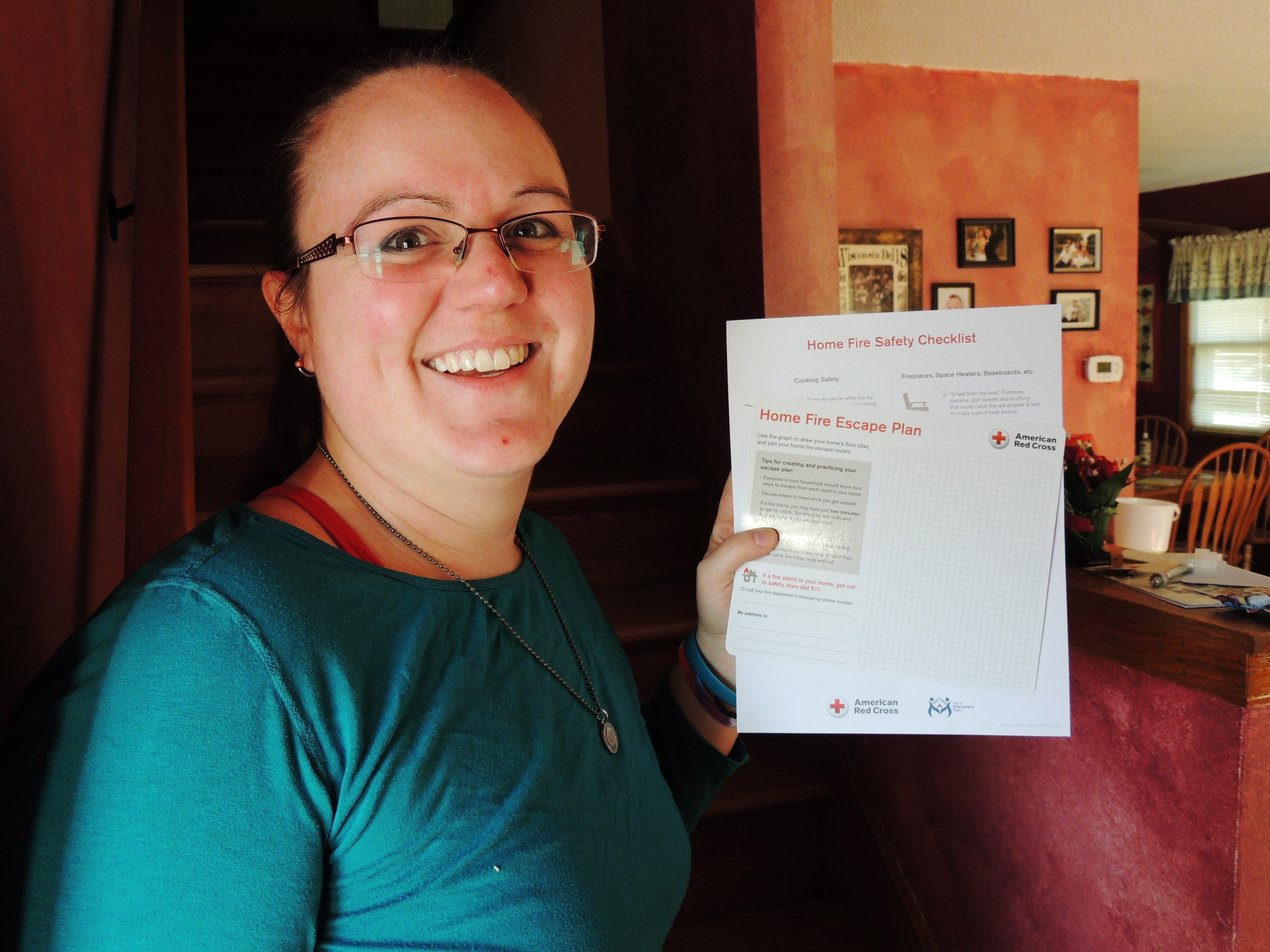
On a crisp and sunny Saturday morning, thirty-eight volunteers spread out across Plainview, Minnesota, to install more than 300 smoke alarms in family homes. On the previous Saturday, volunteers had canvassed around 400 homes in the community to identify where new fire detectors should be added or old ones replaced. Now, on September 19, 2015, firefighters, community and American Red Cross volunteers went in teams of three to five to install the new fire alarms and to give home safety materials concerning home fire prevention and escape planning as part of the national Red Cross Home Fire Campaign.
On hand for the Home Fire Campaign, Jake and Bobbie Sievers, and their son (r), survived a house fire in Plainview, MN, in 2014.
As the volunteers gathered at the Plainview Fire Department, the Sievers family was there to greet and thank them for the Red Cross help they received following a home fire disaster. A year ago Bobbie and Jake, and their young son, escaped from a fire that damaged the front of their house and up into the rafters. Red Cross volunteers responded, providing food and clothing for humanitarian relief after the disaster. Finally, last December, they moved back home with much appreciation for the assistance they had received from local American Red Cross volunteers. The Sievers family was a concrete reminder to the volunteers of the importance of what they were doing this day.
Red Cross volunteer Donny Schreibo installs a smoke alarm during the Home Fire Campaign in Plainview, MN, on September 19, 2015.
Volunteers came from Plainview and neighboring communities. Some, like Bev Holzheu, from Zumbrota, also had helped in the pre-canvassing in Lake City, where home safety materials and smoke alarms were given out by Red Cross volunteers. Others, like Michael Burgdorf, were long-time residents of Plainview and fire department volunteers as well.
Residents receiving the smoke alarms ranged from young parents to senior citizens. Sarah Hassig, a mother with young children, had three new smoke alarms installed in the home where they have lived for ten years. James Haley, a twenty year home owner and proud grandparent, also had three new smoke alarms installed. His three dogs delighted in being petted by the visitors – one of the side benefits of being a Red Cross Home Fire Campaign volunteer!
Sarah Hassig received home fire safety materials and had 3 smoke alarms installed during the Home Fire Campaign in Plainview, MN, on September 19, 2015.
The morning passed quickly, and the volunteers enjoyed rolls provided by the local Kwik Trip, plus water and pop on their return to the fire department. But most of all they left with the thanks of dozens of residents, and the satisfaction of improving the safety of the homes of so many men, women and children.
Super awesome: an additional 143 smoke alarms were installed on Sunday and during the following week! To learn more about the Red Cross Home Fire Campaign, click here. To get involved, contact your local Red Cross.
American Red Cross volunteer Bob Pearce recently returned from deployment to Saipan where he worked directly with more than 400 people affected by Typhoon Soudelor. New to the Red Cross, the typhoon relief operation in Saipan was Bob’s first large-scale response. He’s already responding to his second, serving as a virtual volunteer from his home base in Minnesota for the Red Cross response to the wildfires in California. Below, Bob shares with us his Saipan experience.
Information about Typhoon Soudelor and its damage may be interesting, but it doesn’t tell the real or whole story. Many of the Red Cross volunteers used the term resilient to describe the islanders. Others said they were patient. For me, the people of Saipan are remarkable.
Saipan is a 12 by 5.5 mile island in the south Pacific. Guam, Tinian, Rota and Saipan form the Commonwealth of Northern Mariana Islands, a United States Territory. With a small garment manufacturing industry in continuing decline, the 53,883 residents of Saipan have relied on tourism to help their economy. So, when Typhoon Soudelor slammed into the island in the late night and early morning hours of August 2 and 3, 2015, damage was felt in more than one way.
Winds from the Category III Typhoon broke the NWS anemometer on Saipan at 91mph. Whatever their speed, the winds were sufficient to snap off over 300 power poles on the island, far exceeding the 80-some spares stored for an emergency. Rain and wind-driven sea water also damaged generating plants, further hampering infrastructure recovery. Without power, processing and delivery of fresh and waste water were still further casualties of the storm.
Cleanup of splintered and downed trees from roads began immediately. Hotels and a few businesses, including gas stations, fired up emergency generators and began providing needed services during daylight hours.
The U.S. Navy moved three ships from Guam to Saipan to provide fresh water for the island. People drove cautiously through intersections formerly controlled by traffic signals. And neighbors helped neighbors dig out from the remains of their homes. The same winds and water that knocked out electrical power and stopped road traffic, had also destroyed or seriously damaged well over 500 homes, and many hundreds of other residences were also damaged to some extent.
In the first hours after the typhoon, the Northern Mariana Islands Chapter of the American Red Cross mobilized ten core volunteers plus a trained group of 14 other local volunteers. Together with chapter staff, this initial response force began providing immediate assistance to many of the more than 2000 people who called for help. Gradually, the chapter response was supplemented by volunteers from “the mainland,” which is the islanders’ term for the continental U.S. Minnesota provided four of those volunteers, who served in Disaster Health Services (DHS), Disaster Services Technology (DST), and client casework.
Local residents began lining up at the chapter office early each morning, well before the generator was started, DST had reset all systems, and the doors were opened. With daily preparations and briefings completed, health services and client casework volunteers began seeing local residents by 9:00 each morning, and continued well into the evening until there were no more lines. Estimates of the number of clients seen ranged from 200 to 500 daily, seven days a week, for the first couple of weeks. Direct Assistance to Saipan Households (DASH), ranged from cans of food, bottles of water, and bags of rice, to financial assistance cards for people to use for disaster-related needs.
Saipan definitely has a slower lifestyle than many of us are accustomed to, yet there’s more to the calm and peace that the residents exhibit. Each client greeted us with a warm smile and a firm handshake. Every interview was the start of a new day. One after another, they thanked the Red Cross volunteers for being there. Most of the islanders have little compared to what many of us have. On the other hand, they have so much. They are happy, generous and content. Saipan is unique and its people exceptional in the face of disaster.
To learn more about how to become a Red Cross volunteer, click here. For more about the Red Cross disaster relief response in Saipan, click here.
Photos provided courtesy of Bob Pearce.
It’s been ten years since Katrina, and Dan Hoffman is still a dedicated Red Cross volunteer. Photo provided courtesy of Dan.
“I became a Red Crosser for life after Katrina.” Ten years ago, Dan Hoffman, from New Brighton, Minnesota, was one of 245,000 Red Cross disaster workers who responded to Hurricane Katrina, which hit the Gulf Coast on August 29, 2005. Dan recently sat down with Red Cross intern Vivi Engen to look back on his experience.
Tell me about how you got involved with Katrina.
Katrina was my first national deployment. At the time, I was an employee for the Red Cross at the St. Paul Chapter and a trained disaster volunteer. I got a phone call on the day the storm hit asking if I wanted to deploy, and I accepted. I was on a plane later that afternoon headed down to Houston. From Houston, I was assigned to work at a 6,000 person American Red Cross shelter at the Convention Center in Baton Rouge, Louisiana.
The Convention Center in Baton, Rouge, LA where Dan Hoffman worked during is deployment. Photo provided courtesy of Dan.
What was it like to be at the shelter?
The first few days I would describe as organized chaos. Buses and helicopters unloaded a steady flow of scared, mud-covered people just pulled from disaster. We knew what we needed to do–what the Red Cross always does–everything from setting up portable showers outside the convention center, to providing clothes and hygiene kits, and registering people and contacting other shelter locations to find lost loved ones. We did this for 12 hours a day, and just like the refugees, slept on cots. We saw, and lived it all. I knew that I was part of something big and wouldn’t have wanted to be anywhere else.
Tell me about what you did there.
I think a better question is what didn’t I do. I worked the floor so I did whatever needed to be done. I did everything from giving teddy bears to kids, diapers to moms, to taking down names of people sleeping on cardboard boxes because we ran out of cots early on and pushing people around in wheelchairs who couldn’t walk. But more than anything I would just listen. These people were hurting and needed to tell their story.
What were some of the stories that had an impact on you?
Red Cross relief workers busy at the shelter in Baton Rouge, Louisiana. Photo provided courtesy of Dan Hoffman.
I’ll tell you a few of my favorites…
Miss Evelyn was one of our shelter residents. Her home had been destroyed by the storm, and when the rescue crew came to save her, they told her she had to leave her dog, Pepper, behind. Pepper was Miss Evelyn’s only family, and she was heartbroken without him. There was a pet shelter set up at Louisiana State University, and a couple of days after talking to Miss Evelyn, I stopped over there while on a supply run to see if I could find her dog. I found a Red Cross worker and asked her if she had seen Pepper and she said she would be in touch. A few days later, I received a few photos of different dogs at the shelter. I showed them to Miss Evelyn and, wouldn’t you know, there was Pepper smiling back at her in one of the photos.
Another woman, Hattie Mae, came to the Red Cross shelter unable to walk, and unable to fit into a wheel chair. A day later I stopped by the local hospital and “commandeered” an over-sized wheelchair to lend to Hattie Mae because she needed something to get around in. I will never forget the look on her face, or the hug that she gave me, when I came back with that chair.
Cots were set up all through the convention center in Baton Rouge, Louisiana, for Hurricane Katrina refugees who lost their homes. Photo provided courtesy of Dan Hoffman.
Miss Amelia, another refugee, who was a kind of matriarch over a large family community, introduced me to her family. “This is Mr. Dan, he’s Red Cross, so listen to him.” It sure gave me instant credibility. Then she turned to me and said “You came all the way form Minnesota to help us, you must be an angel.” I am no angel, but I do share the gratitude that the refugees had for my work, for the experience that they gave me. The people at the shelter who had lost everything were so gratified, so appreciative for the smallest things that it changed the way I see life today. And that’s something I will never be able to repay them for.
How did this experience transform your commitment to the Red Cross?
After Katrina, I realized that the work that the Red Cross does is my calling. Once I came home, I shared all of the incredible stories I had been told, what the Red Cross did and how the Red Cross helped all these people. Just like the stories of the shelter refugees needed to be shared, so did the Red Cross’.
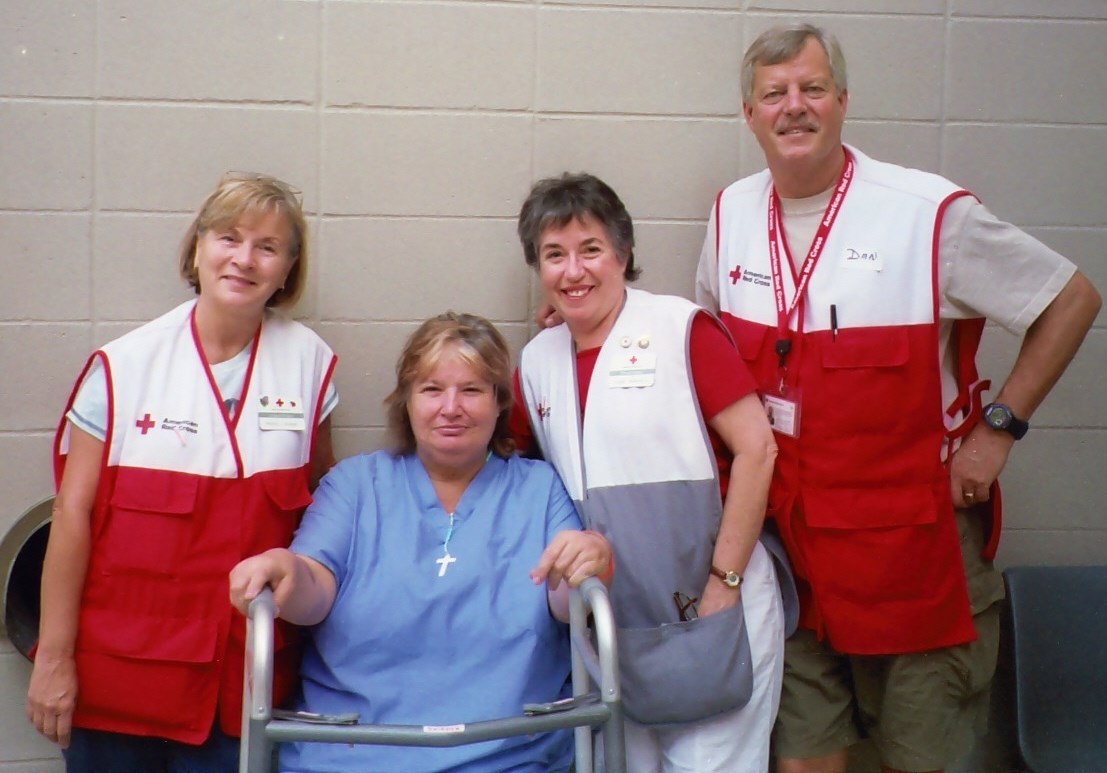
Dan Hoffman (far right) with other Red Cross disaster relief workers and a Hurricane Katrina refugee in Baton Rouge, Louisiana. Photo provided courtesy of Dan.
Is there anything you’d like to add?
I’d like to finish up with a woman named Misty. While working at a shelter as a volunteer, you half adopt people while you are there, meaning there are certain individuals that you go in to check on or eat with them on a regular basis. Misty was one of those people for me. Misty is a poet, and on the day of the storm she wrote a poem that was angry. Angry at Katrina and all of the destruction it had caused and how it impacted her–she lost her dog and everything she owned. A few weeks after I got home, I received a letter in the mail. It was another poem from Misty titled “Thank You”. The last line of the poem read “memories of you will never leave my heart.” Now I ask you, how could an experience like that not change your life?
To learn more about how you can volunteer with the Red Cross, chick here.








 American Red Cross Minnesota and Dakotas Region