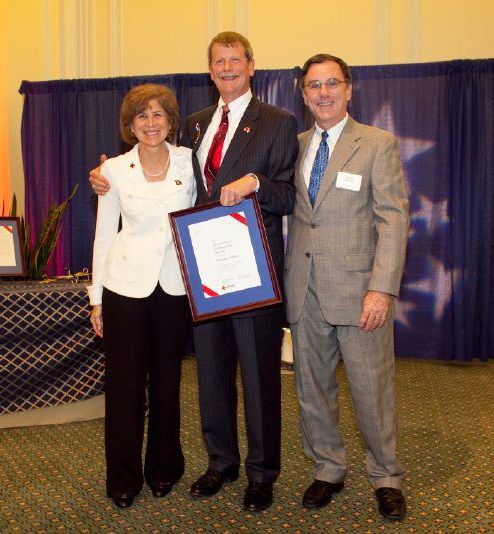
Tom Meyer (center) received a 2011 Harriman Award at American Red Cross headquarters in Washington, D.C.
Please join us in congratulating Tom Meyer for being a 2011 recipient of the American Red Cross Harriman Award for Distinguished Volunteer Service. Meyer, the Volunteer Board Director with the North Central Blood Services Region and a board member of the Twin Cities Area Chapter, received the Harriman Award for Biomedical Partnership.
The Harriman Awards for Distinguished Volunteer Service are presented to American Red Cross volunteers in direct service, administration or management, with the exception of volunteers currently serving on the Board of Governors. The top honor that the American Red Cross issues, the Harriman Award recognizes extraordinary American Red Cross service that extends to people and places beyond the local community and is awarded on the basis of extraordinary accomplishments rather than length of service.
Congratulations Tom! Thank you for your outstanding service!
Children are returning to school during the coming weeks. Some will be spending time home alone until parents return home from work. Now’s the time for both parents and children to take and learn safety steps that will make after-school hours at home alone safer and less stressful for everyone.
Top ten steps parents + guardians can take:
Develop a home safety plan and discuss and practice it with the whole family.
If a child is going home after school, have him or her call to check in after arriving home.
For an older child, set ground rules about whether other kids can come over, whether cooking is okay, and whether the child can leave home.
Post an emergency phone list where the child can see it.
Make sure the first aid kit is stocked and stored where your children can find it, but keep our of reach of young children.
Identify neighbors whose home your child can go to in case of an emergency.
Remove or safely store in locked areas dangerous items like guns, ammunition, knives, hand tools, power tools, razor blades, scissors, and other objects that can cause injury.
Make sure potential poisons like detergents, polishes, pesticides, care-care fluids, lighter fluid and lamp oils are stored in locked cabinets or out of the reach of children.
Make sure medicine is kept in a locked storage place or out of the reach of children.
Make sure at least one approved smoke alarm is installed and operating on each level of the home.
Top ten steps kids can take:
Lock the door and make sure all the windows are closed and locked.
Never open the door to strangers.
Never open the door to delivery people or service representatives.
Never tell someone on the telephone that mom or dad are not at home. Say something like “My mom is busy right now. Can I take a message?”
Do not talk about being home alone on public websites.
Never leave the house without permission.
Do not go outside to check out an unusual noise. If the noise worries you, call mom, dad, or the police.
Do not have friends over to visit when mom or dad aren’t at home without permission.
Do not let anyone inside who is using drugs or alcohol, even if you know them.
If you smell smoke or hears a fire or smoke alarm, get outside and ask a neighbor to call the fire department.
Perhaps you have more steps + tips that you’d like to share. Also, visit redcross.org to learn more about being Red Cross ready before, during, and after emergencies.
Three to get ready, now go cat go! His shoes weren’t blue or suede, but we were delighted to have Elvis on hand for the 2011 Run for Blood Quarter Marathon & 5K.
Elvis kicked of this year's Run for Blood, helping support the Red Cross. Photo credit: William Kahn/American Red Cross
More than 460 people raced around Lake Harriet in Minneapolis, helping to raise more than $10K for the Red Cross and its humanitarian mission to help people prevent, prepare for, and respond to emergencies.
Thank you to Mr. Luther Hagen, event founder and all around booster for the Red Cross, and to everyone who helped make this event a great success.
For Liz, not working for the Red Cross is like not breathing. Wherever she goes, she wants to know: “Où est la Croix Rouge?”… “Where is the Red Cross?”
Let’s start with a war in east Africa in the 1990s. We know this war that happened in Rwanda and how people fled to nearby Democratic Republic of the Congo (DRC).
“Help the Red Cross and the Red Cross helps you,” says Liz, who started with the Red Cross in the Democratic Republic of the Congo. “I am going to help the Red Cross until my death.” Photo credit: Lynette Nyman/American Red Cross
Some know this war better than others. Among them is Liz, a former Red Cross nurse who lived in a DRC border town with Rwanda.
“We gave food to refugees, put up tents, gave medical care, sent messages to families,” says Liz.
Liz responded for four years. As a Red Cross nurse, she tended to the war wounded, or in French “les blessés de guerre.” She helped until it was time to leave.
“Soldiers came and they tried to recruit my sons for the war,” she says.
She fled when her family left for Zambia and became a refugee. Even so, she turned to the Red Cross and started helping others.
“We helped friends and when others arrived from the Congo. We helped them with food, blankets, dishes, and pots. We approached them, to help them.”
Then she flees again. This time to South Africa where her passion for the Red Cross was put aside for getting food and money to support her children.
“Life there was hard. I could not work for the Red Cross in South Africa,” explains Liz.
Jump ahead several years to 2009 when she lands in the United States. One day while riding a bus in Minneapolis, she exits at a wrong (or perhaps a right) bus stop. That’s when she saw the Red Cross flag flying near the Mississippi River.
Dozens of manikin face masks need cleaning everyday for the next CPR + First Aid training classes. Photo credit: Lynette Nyman/American Red Cross
“I went there and I spoke to someone who asked me ‘what do you do?’ I told them and they said I will find a place for you.”
We could in this brief story dwell on the horror and trauma of war, but we will not. Instead, let’s turn to Liz and what inspires her to look for and serve with the Red Cross.
“The Red Cross helps me. It helps me to help people, to reduce suffering, to rescue people. They help me everywhere, not just in the Congo. They help people even back in the forest, sharing information. They go deep in the forest, even by foot, to help people.”
Like Red Cross people around the world, Liz serves without boundaries. In her country, she says, there’s a Red Cross song: “Night or day, blood or wound, always we serve.”
For Liz, this means serving for a lifetime, “I am going to help the Red Cross until my death.”
Liz is currently serving as a Red Cross volunteer cleaning manikins used in health and safety training classes such as CPR and First Aid for the American Red Cross Twin Cities Area Chapter in Minneapolis-St. Paul, Minnesota.
Story, photo, & video credit: Lynette Nyman/American Red Cross
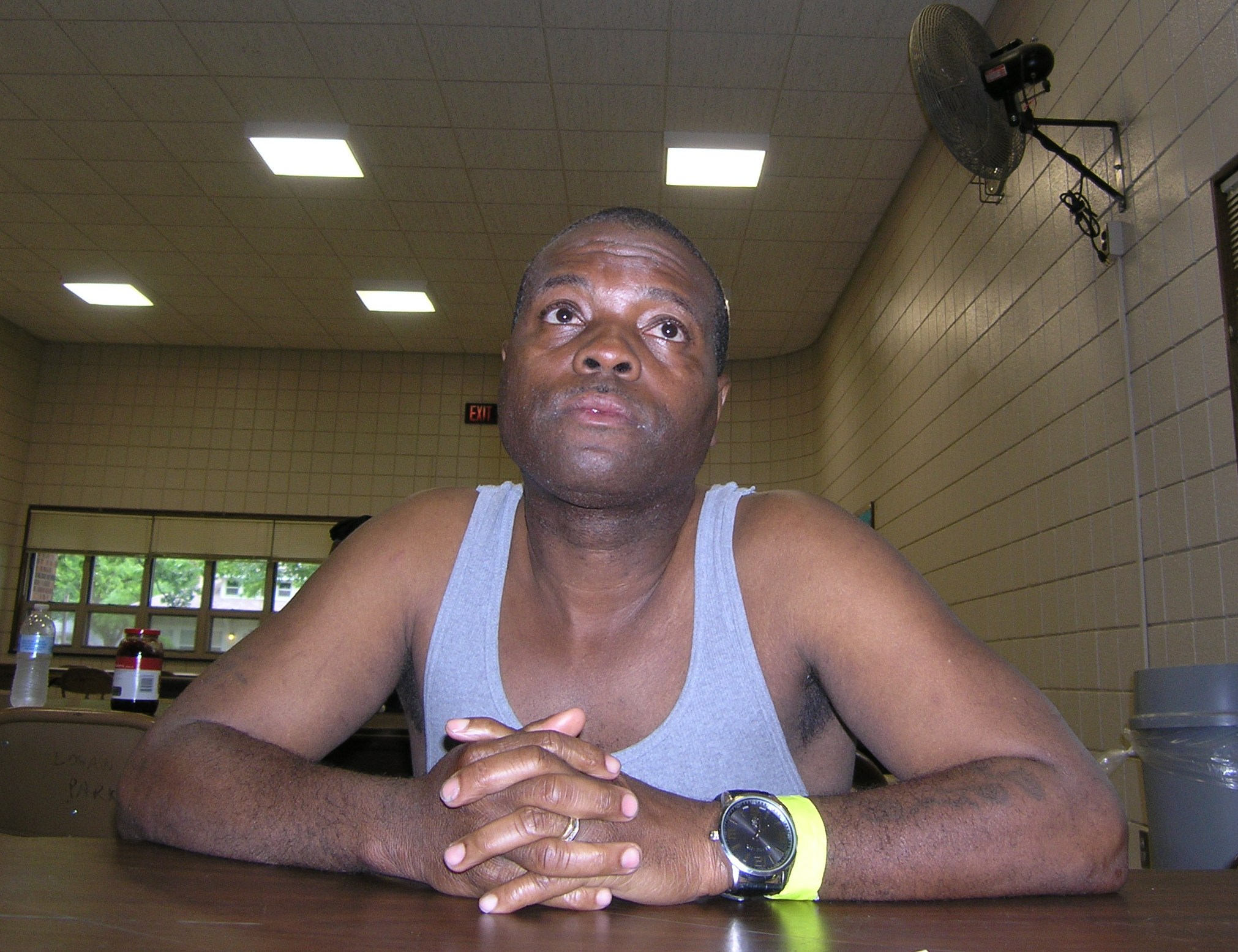
Dennis Parker is holding onto optimism that his family will soon have a new place to call home and move out of the Red Cross shelter in north Minneapolis for families displaced by the May 22 tornado. Photo credit: Bill Fitler/American Red Cross
“I’ll never forget that day,” says Dennis Parker Sr. while sitting down for breakfast at the Red Cross shelter at North Commons Recreations Center nearly 3 weeks after the tornado ripped through north Minneapolis.
“It started raining, it got real windy. I didn’t hear the siren until it was all over,” recalls Parker. “When the tornado came, it sounded like a bunch of trains. Bang! Bang! Bang! The tornado ripped the trees right out of the ground. It laid down five of them on our house, and we had a tree limb in our attic. Our basement flooded. It didn’t touch the neighbors on either side of us.”
Parker’s speech is animated as he describes how he, his wife, and four children sought refuge in their house during the storm, but his voice loses some intensity as he shares details about his family’s experiences looking for a new place to call home.
“My wife is in the computer room looking for other places for us to live. We’ll go visit anything she finds, and then we may go to the library. Yesterday we checked out a couple of apartments, but landlords don’t want to rent to us because we’re low income.”
Cots placed in a circle help families create personal spaces in the Red Cross shelter sleeping area at North Commons Recreation Center in Minneapolis. Photo credit: Amanda Mark/American Red Cross
For Parker, shelter life is something he has come to accept. The shelter’s sleeping area is in the North Commons gym. While not very private, each family has tucked their cots closely together, leaving any extra space they can manage between the different family groups. Families with small children have arranged a little play area in the middle of the cots for them.
“The Red Cross has been doing the best they can,” says Parker. “These people we call family, we’re all in the sandbox together. I kind of like being here. We really haven’t had any problems.”
During a graduation party held in the park behind North Commons a few days ago, and how the party organizers donated the rest of their food to those living in the shelter. He helped by cooking at the center’s outdoor grill.
That night, Parker met with a local group that’s helping people find new places to live after the storm. Parker says he’s holding onto optimism for him and his family.
“They were very uplifting, very reassuring,” he says. “They say ‘soon.’ Maybe we’ll find out today.”
(Reporting by Bill Fitler, Red Cross disaster relief volunteer)
Paul Vanderheiden is among more than 340 Red Cross disaster relief workers responding to the May 22 tornado in Minneapolis. Photo credit: Lynette Nyman/American Red Cross
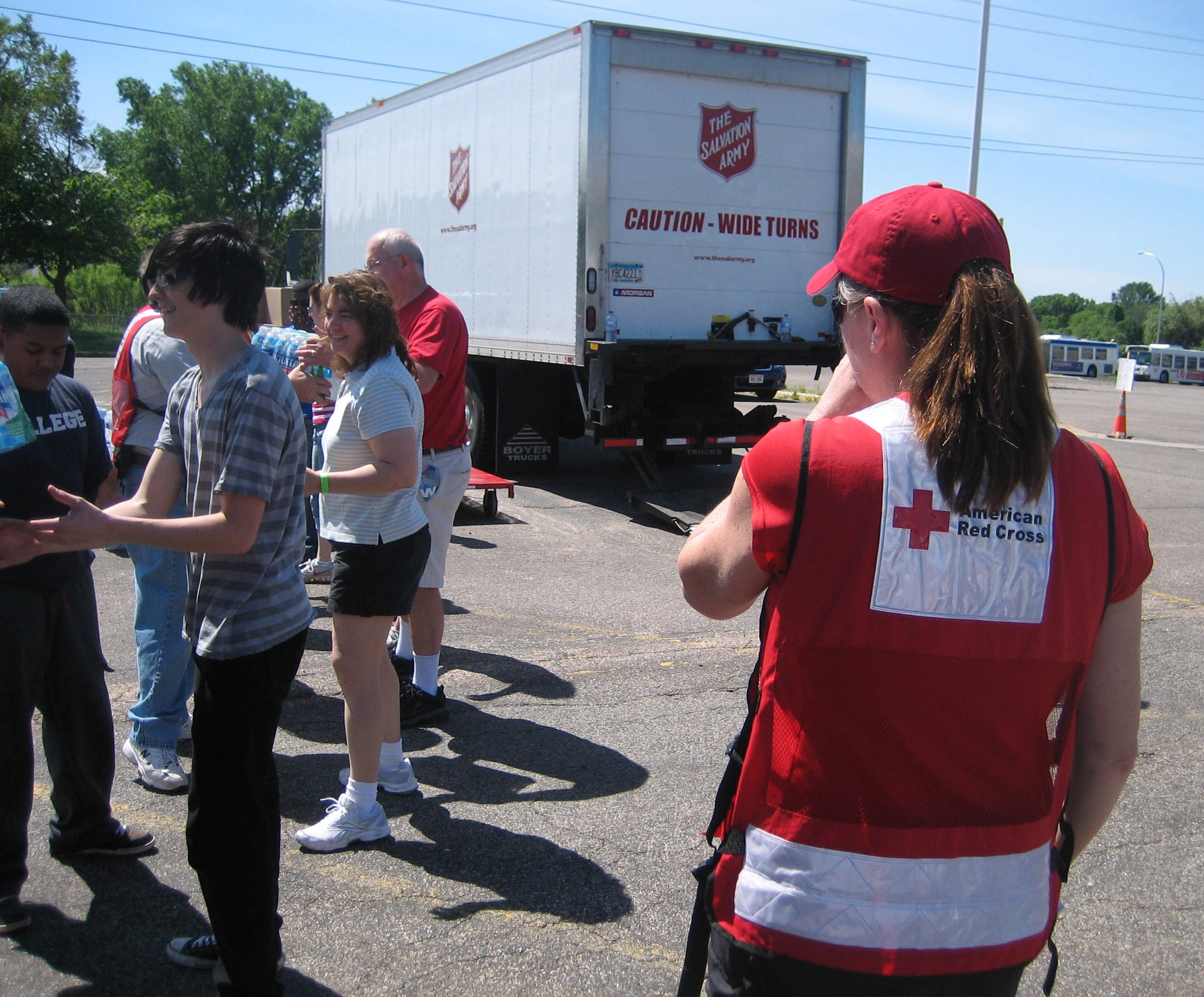
When volunteers arrived for their shifts during the Minneapolis tornado clean-up day on June 4, a Habitat for Humanity volunteer likely received them, a Salvation Army worker probably handed them a meal, and American Red Cross responder gave them bandage packs, gloves, and other useful field supplies such as hand sanitizer and sunscreen.
Once in the disaster area, workers might have made contact with Red Cross mobile feeding trucks supporting the workers on what felt like the first day of summer.
“We’re out here to make sure these folks have enough water and snacks in all this heat,” said Paul Vanderheiden, a Red Cross volunteer from Eau Claire, Wisconsin.
Parking his van near a group of workers, Paul offered them advice. “Make sure you get some salt. Want some chips with that?”
Red Cross disaster relief worker Chris Thomsen surveys the unloading of water during the Minneapolis tornado clean up day on June 4. Photo credit: Bill Fitler/American Red Cross
Paul and fellow volunteer Chris Thomsen had been driving their mobile feeding vehicle around these neighborhoods every day since they had arrived the previous Saturday.
“Back home I’m a surgical nurse,” said Chris. “This is the first time I’ve worked outside the chapter on a disaster. We’ve been out here long enough so I’m starting to know folks, and I’ve been so touched by some of the stories I’ve heard.”
Paul and Chris are among more than 340 Red Cross workers, from as far away as California and Connecticut, helping people affected by the Minneapolis tornado.
To date, Red Cross disaster relief workers have distributed more than 145,000 meals and snacks to affected families and clean-up crews responding to this tornado disaster.
Red Cross shelter night manager Sharon Collin says that she prefers volunteering during the night shift because "it's when you get to know the people and talk through the day." Sharon and McKai have a nightly chat. Photo credit: Amanda Mark/American Red Cross
Red Cross volunteer Sharon Collin is a natural organizer. A former movie theater manager, accountant and school teacher, she’s at ease while directing the flow of traffic that comes through the North Commons Recreation Center where the Red Cross shelter is housed.
Sharon is the night manager at this Red Cross shelter where 43 residents are attempting to rebuild their lives after the May 22 tornado destroyed blocks of North Minneapolis. One week into working at this shelter and Sharon has her routine down.
“I’m calling it organized disorder,” she says. “People are welcomed to come and go as they like as we try to create normalcy in the abnormal.”
Nearly all at once, Sharon sends someone to the snack room, finds a caseworker for another shelter resident, and hugs three kids in between the two tasks, promising one that she’ll tuck her in later.
“We have a lights out time,” she explained. “But one man works nights. Other people are night owls. I offer to fix snacks and hot meals during the night as people come through.”
Red Cross shelter night manager Sharon Collin shares a quiet moment with Willtin, 4. Photo credit: Amanda Mark/American Red Cross
While Sharon has responsibilities and organizational tasks to ensure that the shelter runs smoothly, she says she spends most of her time listening.
“No one wants to be here,” she said. “I listen to where they’re at, answer Red Cross questions, and match them up with services so they can move forward.”
Sharon travelled from Cumberland Foreside, Maine, to be the shelter night manager. She’s volunteered for the Red Cross in various ways for the past 6 years: working on disaster teams, supporting call centers and filling in any way she can, but her favorite assignment is working at shelters.
“People often enter a shelter at their lowest point. Red Cross volunteers enter a shelter, fresh with adrenaline and ready to help. Sometimes that’s really what people need. Someone to support them and provide the energy they don’t have.”
(Reporting and photos by Amanda Mark, Red Cross Volunteer)
Red Cross disaster responder, Ann Layton, offers a slice of her homemade "strata," an Italian casserole she made from leftover bread slices at the Red Cross tornado response headquarters in Minneapolis. Photo credit: Lynette Nyman/American Red Cross
Red Cross disaster response volunteers are extraordinary in many ways, but only a few would turn unused slices of bread into something yummy for dozens of fellow responders who’ve been working for days helping hundreds of families rebuild their lives after the May 22 tornado in Minneapolis.
Ann Layton, a Red Cross volunteer, saw the bread on her way out the disaster operation doors last night and brought the bread back this morning all done up as “strata,” an Italian casserole that’s darn comforting.
“The bread was dry and I needed to add more milk,” said Ann, who made three variations of the dish, which you assemble and refrigerate before baking and serving.
We think your strata dish is perfect… and we thank you’re extra great, Ann, for taking time to provide additional comfort for Red Cross disaster responders who are working hard helping others recover from this awful disaster.
Minneapolis tornado survivor Cathy Stolte shares her harrowing story with Red Cross volunteer Dave Schoeneck. Photo credit: Jason Viana/American Red Cross
Kathy Stolte was working on a cross word puzzle Sunday when she heard a crashing sound. She grabbed her dog and headed for the basement, but the tornado had already passed her north Minneapolis bungalow, leaving behind a path of twisted trees, broken homes and destruction.
Kathy, her husband, and her dog were fortunate — no injuries, just property damage. Part of the roof of their home blew off, and rain soaked the insulation, making the house uninhabitable. Her son’s car was skewered by a five inch tree branch, from windshield to floorboard. The worst damage was to the garage, parts of which currently reside in her neighbor’s kitchen.
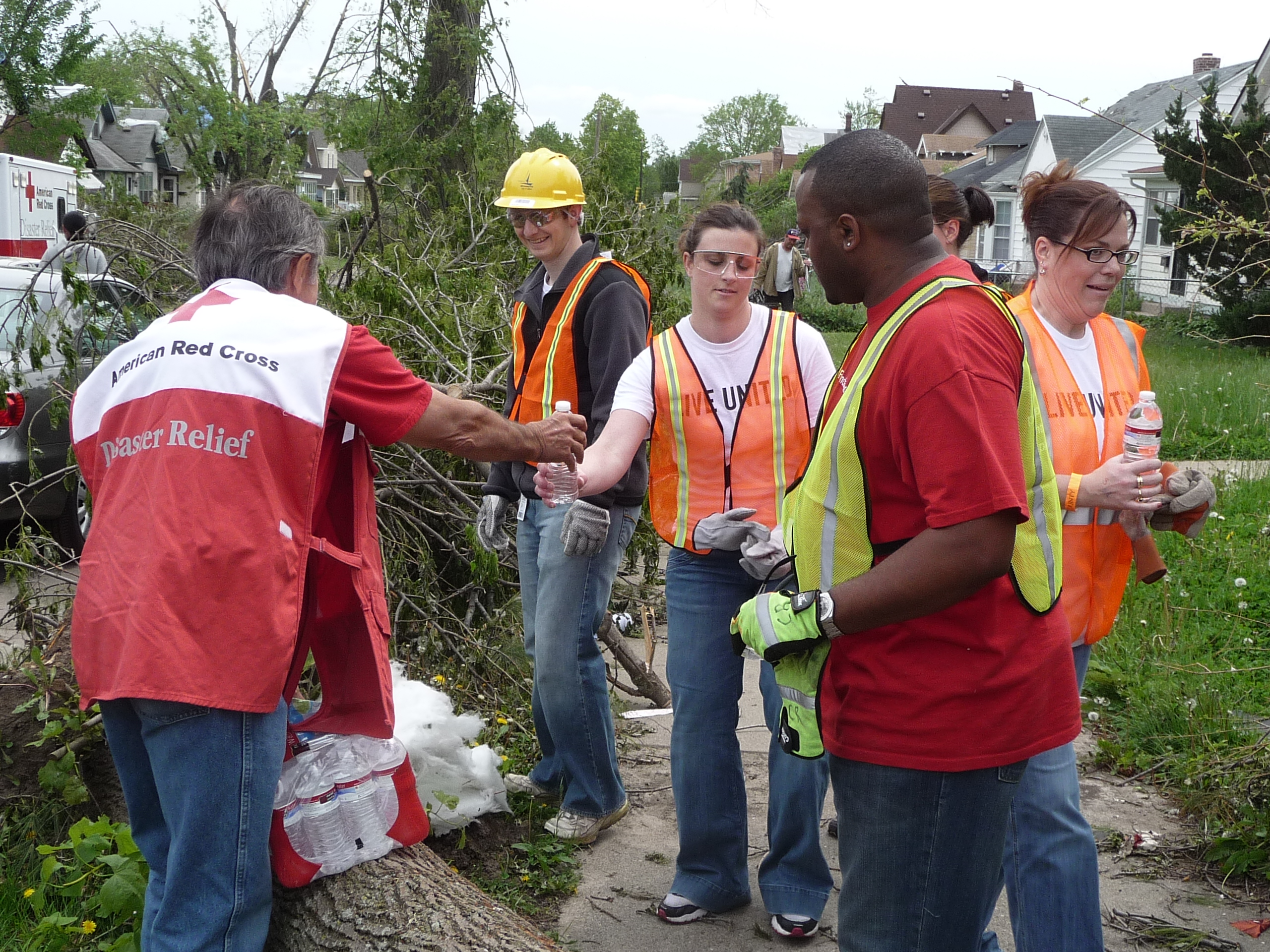
Red Cross volunteers are providing water and snacks to people helping to remove debris after the May 22 tornado in Minneapolis. Photo credit: Jason Viana/American Red Cross
On Wednesday, as repair crews from the City of Minneapolis were hauling away the remains of large trees from their block, and crews from Xcel Energy were restoring electric power to their block, Kathy was grateful when a Red Cross disaster team from the St. Croix Chapter of the American Red Cross came down the street, offering food and water to anyone who needed it. Eric Nickolai and Sherm Boucher were busy handing out water, sandwiches, energy drinks and fruit to residents, volunteers, and work crews.
While Kathy faces weeks before her house can be reoccupied, she is one of the lucky ones who had homeowner’s insurance and has a place to stay temporarily. Hundreds of others were out trying to salvage their belongings and working to find food, clothing and shelter for themselves and their families.
Some of you already know this information, but we wanted to update everyone at the same time. We are deployed by the Red Cross to the Alabama tornadoes for up to three weeks.
We are on the Disaster Assessment team – the first Red Cross representatives on site to do initial damage assessments. Our data gets relayed to the Red Cross Command Center and then on to FEMA. We’re using new technology – hand held collection units. The info is used to assess future aid and services needed.
So far, we’ve been assigned to gather data in 3 counties, which includes the city of Huckleburg. Most of the homes here were destroyed and there is no electric and limited cell phone coverage.
We’ve included a couple pics of what we’ve seen. One of the interesting sights in the middle of town was the cemetery. Headstones had beautiful flowers completely untouched and the grass was perfectly manicured. Total chaos surrounded the cemetery.
The affected people are doing amazingly well (at least for now). They are very gracious and appreciative of those who have come to help. Keep them in your prayers.








 American Red Cross Minnesota and Dakotas Region