Three to get ready, now go cat go! His shoes weren’t blue or suede, but we were delighted to have Elvis on hand for the 2011 Run for Blood Quarter Marathon & 5K.
Elvis kicked of this year's Run for Blood, helping support the Red Cross. Photo credit: William Kahn/American Red Cross
More than 460 people raced around Lake Harriet in Minneapolis, helping to raise more than $10K for the Red Cross and its humanitarian mission to help people prevent, prepare for, and respond to emergencies.
Thank you to Mr. Luther Hagen, event founder and all around booster for the Red Cross, and to everyone who helped make this event a great success.
For Liz, not working for the Red Cross is like not breathing. Wherever she goes, she wants to know: “Où est la Croix Rouge?”… “Where is the Red Cross?”
Let’s start with a war in east Africa in the 1990s. We know this war that happened in Rwanda and how people fled to nearby Democratic Republic of the Congo (DRC).
“Help the Red Cross and the Red Cross helps you,” says Liz, who started with the Red Cross in the Democratic Republic of the Congo. “I am going to help the Red Cross until my death.” Photo credit: Lynette Nyman/American Red Cross
Some know this war better than others. Among them is Liz, a former Red Cross nurse who lived in a DRC border town with Rwanda.
“We gave food to refugees, put up tents, gave medical care, sent messages to families,” says Liz.
Liz responded for four years. As a Red Cross nurse, she tended to the war wounded, or in French “les blessés de guerre.” She helped until it was time to leave.
“Soldiers came and they tried to recruit my sons for the war,” she says.
She fled when her family left for Zambia and became a refugee. Even so, she turned to the Red Cross and started helping others.
“We helped friends and when others arrived from the Congo. We helped them with food, blankets, dishes, and pots. We approached them, to help them.”
Then she flees again. This time to South Africa where her passion for the Red Cross was put aside for getting food and money to support her children.
“Life there was hard. I could not work for the Red Cross in South Africa,” explains Liz.
Jump ahead several years to 2009 when she lands in the United States. One day while riding a bus in Minneapolis, she exits at a wrong (or perhaps a right) bus stop. That’s when she saw the Red Cross flag flying near the Mississippi River.
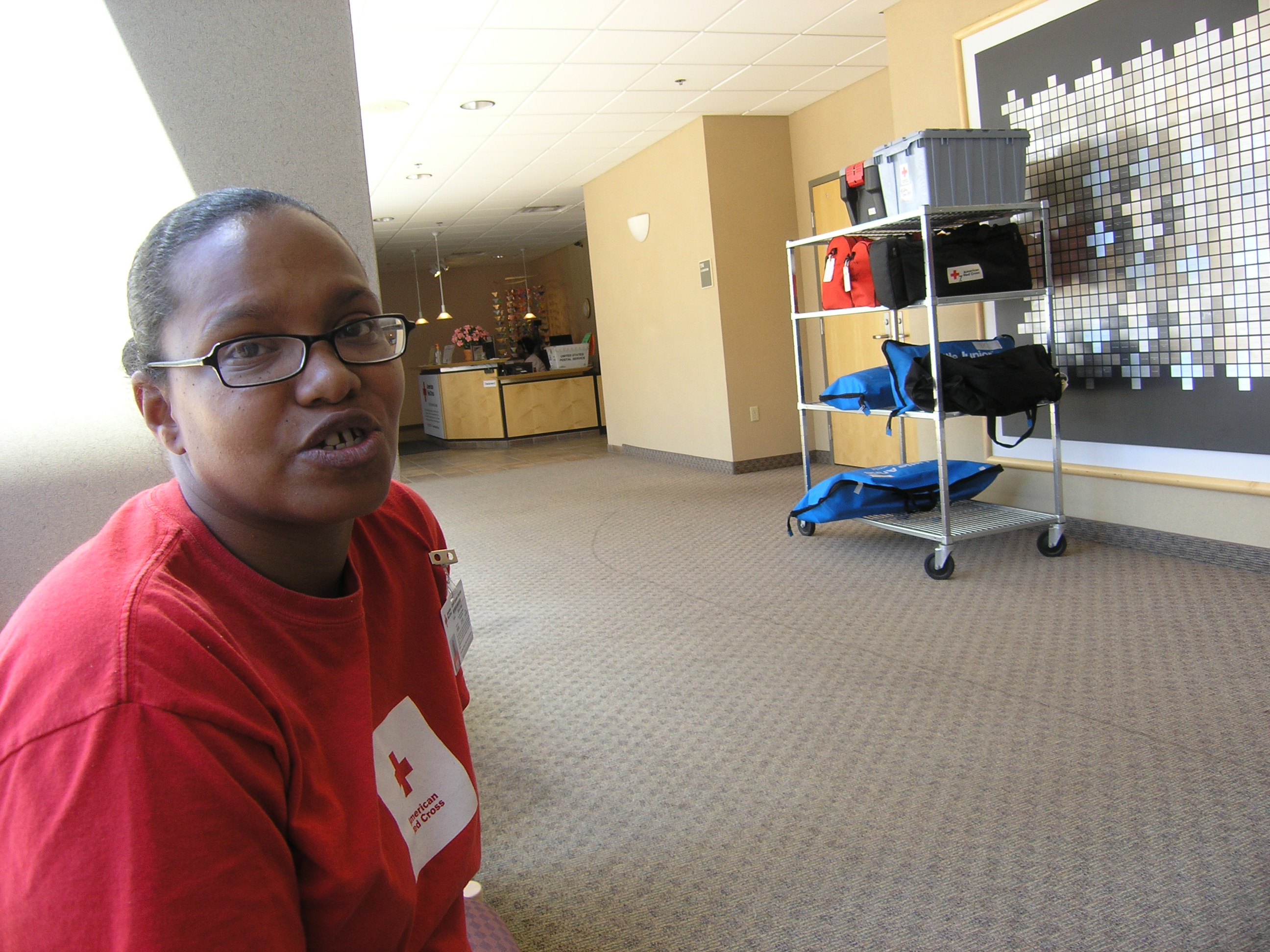
Dozens of manikin face masks need cleaning everyday for the next CPR + First Aid training classes. Photo credit: Lynette Nyman/American Red Cross
“I went there and I spoke to someone who asked me ‘what do you do?’ I told them and they said I will find a place for you.”
We could in this brief story dwell on the horror and trauma of war, but we will not. Instead, let’s turn to Liz and what inspires her to look for and serve with the Red Cross.
“The Red Cross helps me. It helps me to help people, to reduce suffering, to rescue people. They help me everywhere, not just in the Congo. They help people even back in the forest, sharing information. They go deep in the forest, even by foot, to help people.”
Like Red Cross people around the world, Liz serves without boundaries. In her country, she says, there’s a Red Cross song: “Night or day, blood or wound, always we serve.”
For Liz, this means serving for a lifetime, “I am going to help the Red Cross until my death.”
Liz is currently serving as a Red Cross volunteer cleaning manikins used in health and safety training classes such as CPR and First Aid for the American Red Cross Twin Cities Area Chapter in Minneapolis-St. Paul, Minnesota.
Story, photo, & video credit: Lynette Nyman/American Red Cross
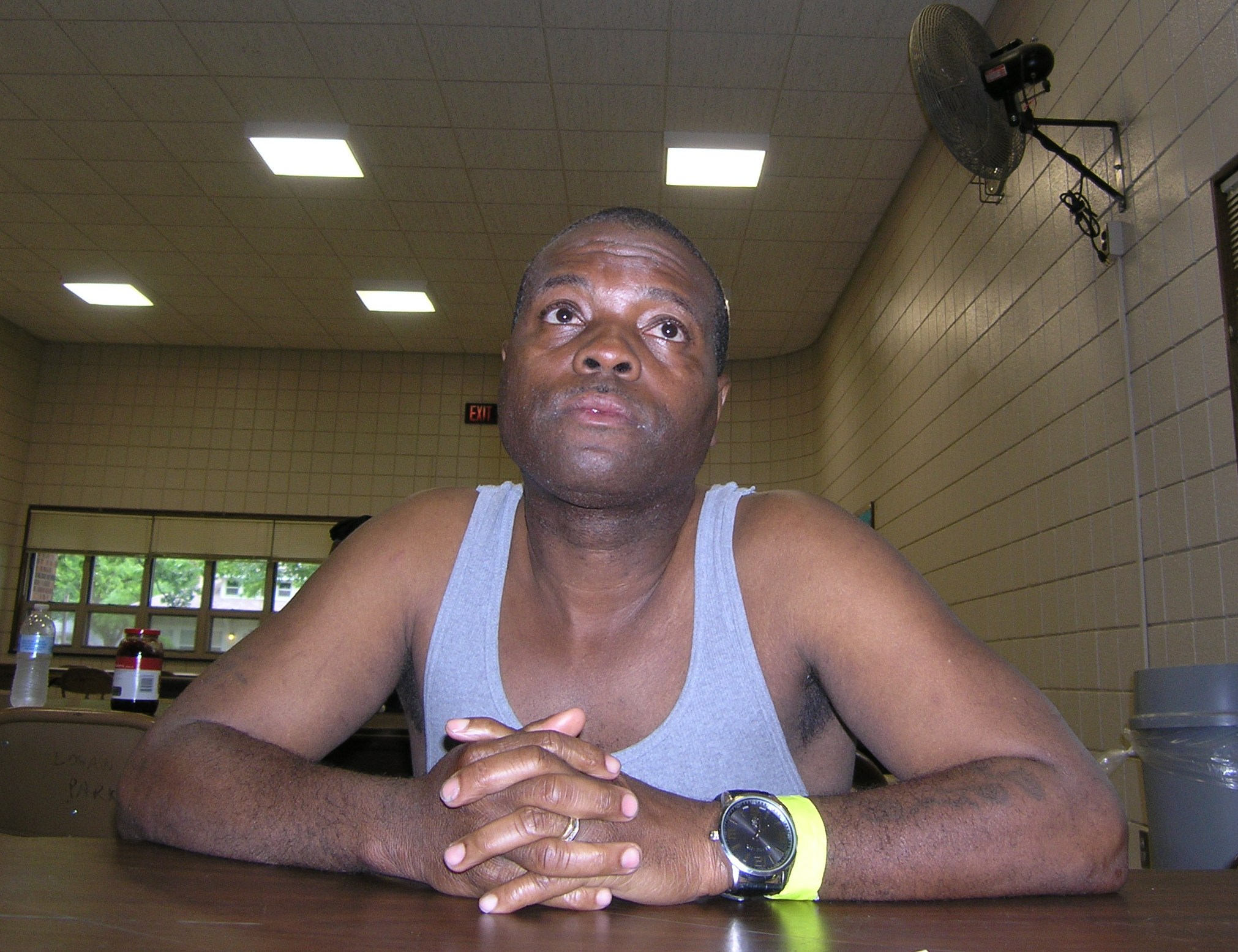
Dennis Parker is holding onto optimism that his family will soon have a new place to call home and move out of the Red Cross shelter in north Minneapolis for families displaced by the May 22 tornado. Photo credit: Bill Fitler/American Red Cross
“I’ll never forget that day,” says Dennis Parker Sr. while sitting down for breakfast at the Red Cross shelter at North Commons Recreations Center nearly 3 weeks after the tornado ripped through north Minneapolis.
“It started raining, it got real windy. I didn’t hear the siren until it was all over,” recalls Parker. “When the tornado came, it sounded like a bunch of trains. Bang! Bang! Bang! The tornado ripped the trees right out of the ground. It laid down five of them on our house, and we had a tree limb in our attic. Our basement flooded. It didn’t touch the neighbors on either side of us.”
Parker’s speech is animated as he describes how he, his wife, and four children sought refuge in their house during the storm, but his voice loses some intensity as he shares details about his family’s experiences looking for a new place to call home.
“My wife is in the computer room looking for other places for us to live. We’ll go visit anything she finds, and then we may go to the library. Yesterday we checked out a couple of apartments, but landlords don’t want to rent to us because we’re low income.”
Cots placed in a circle help families create personal spaces in the Red Cross shelter sleeping area at North Commons Recreation Center in Minneapolis. Photo credit: Amanda Mark/American Red Cross
For Parker, shelter life is something he has come to accept. The shelter’s sleeping area is in the North Commons gym. While not very private, each family has tucked their cots closely together, leaving any extra space they can manage between the different family groups. Families with small children have arranged a little play area in the middle of the cots for them.
“The Red Cross has been doing the best they can,” says Parker. “These people we call family, we’re all in the sandbox together. I kind of like being here. We really haven’t had any problems.”
During a graduation party held in the park behind North Commons a few days ago, and how the party organizers donated the rest of their food to those living in the shelter. He helped by cooking at the center’s outdoor grill.
That night, Parker met with a local group that’s helping people find new places to live after the storm. Parker says he’s holding onto optimism for him and his family.
“They were very uplifting, very reassuring,” he says. “They say ‘soon.’ Maybe we’ll find out today.”
(Reporting by Bill Fitler, Red Cross disaster relief volunteer)
Sharing her story: Silena Vega, a Red Cross disaster relief worker, turned to the Red Cross when a tornado hit home in Minneapolis while she was down river helping flood victims in Mississippi. Photo credit: Bill Fitler/American Red Cross
Silena Vega became a Red Cross disaster relief worker because of her mother.
“The last disaster my mother worked on was the Minneapolis bridge collapse,” says Vega. “When she finished she came home and told me to go sign up and volunteer for the Red Cross.”
Vega did exactly that and has not stopped since. Recently, disaster response became even more personal when tornado struck her home in Minneapolis on May 22. At the time, Vega was hundreds of miles away helping flood victims in the South.
“I tell people I was ‘chasing the river.’ First I deployed for the floods in Fargo, and then I moved down to Mississippi,” Vega explains. “And then I heard about the tornado back home.”
The news was filled with the Minneapolis event. Right away, Vega got a call.
“My fiance phoned to let me know that his father—my future father-in-law—could not be reached at his home in north Minneapolis, one of the hardest hit areas,” says Vega.
North Minneapolis was the hardest hit during the May 22 tornado, forcing hundreds of families to flee their homes and seek shelter with friends, family, or the Red Cross. Photo credit: Bill Fitler/American Red Cross
Suddenly Vega was caught in what every family separated during disaster experiences: are the people we love okay? While the storm may have torn up the street and houses in our neighborhood, we can be physically safe and still torn up inside from the uncertainty of wondering whether we would see our loved ones again. During the next 24 hours, Vega was in a state of turmoil while waiting to learn more.
“I went back to work,” says Vega, “But just imagine what it was like. I felt like I was working in a fog. A friend said I sounded scared and on the verge of crying. So, I phoned my local chapter to see if they could help me find my family.”
The Red Cross has provided comfort and hope around the world to families separated because of natural disaster or human conflict. (Photo credit: Anne Florenzano/American Red Cross)
The American Red Cross has been facilitating communication between family members separated by disaster since World War II. Today, people can use the “Safe and Well” website to let their families know that they’re okay.
Knowing her future father-in-law might not have internet access, Vega decided to reach out to the Red Cross. Within a short period of time, she received an update. Her future father-in-law was fine and checked in at the Red Cross tornado shelter in Minneapolis.
“He was out of touch for so long because downed trees made it very difficult to get around, because he had no cell phone, and because his cordless phone stopped working when the power failed,” Vega explains.
The news, she says, was a huge relief and comfort, especially while being far away from home. “With help from the Red Cross I got the information I needed.”
(Reporting by Bill Fitler, Red Cross disaster relief worker)
Paul Vanderheiden is among more than 340 Red Cross disaster relief workers responding to the May 22 tornado in Minneapolis. Photo credit: Lynette Nyman/American Red Cross
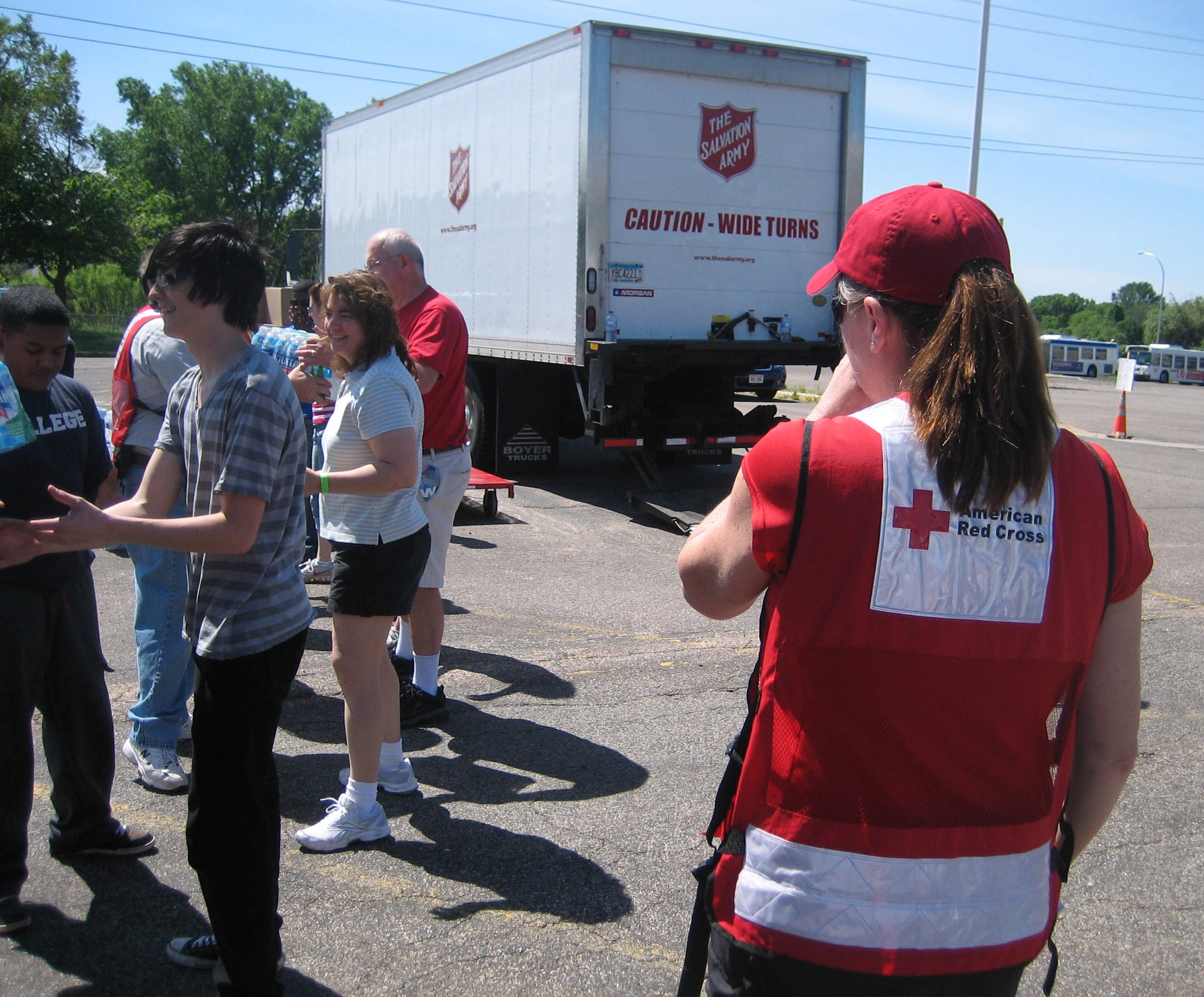
When volunteers arrived for their shifts during the Minneapolis tornado clean-up day on June 4, a Habitat for Humanity volunteer likely received them, a Salvation Army worker probably handed them a meal, and American Red Cross responder gave them bandage packs, gloves, and other useful field supplies such as hand sanitizer and sunscreen.
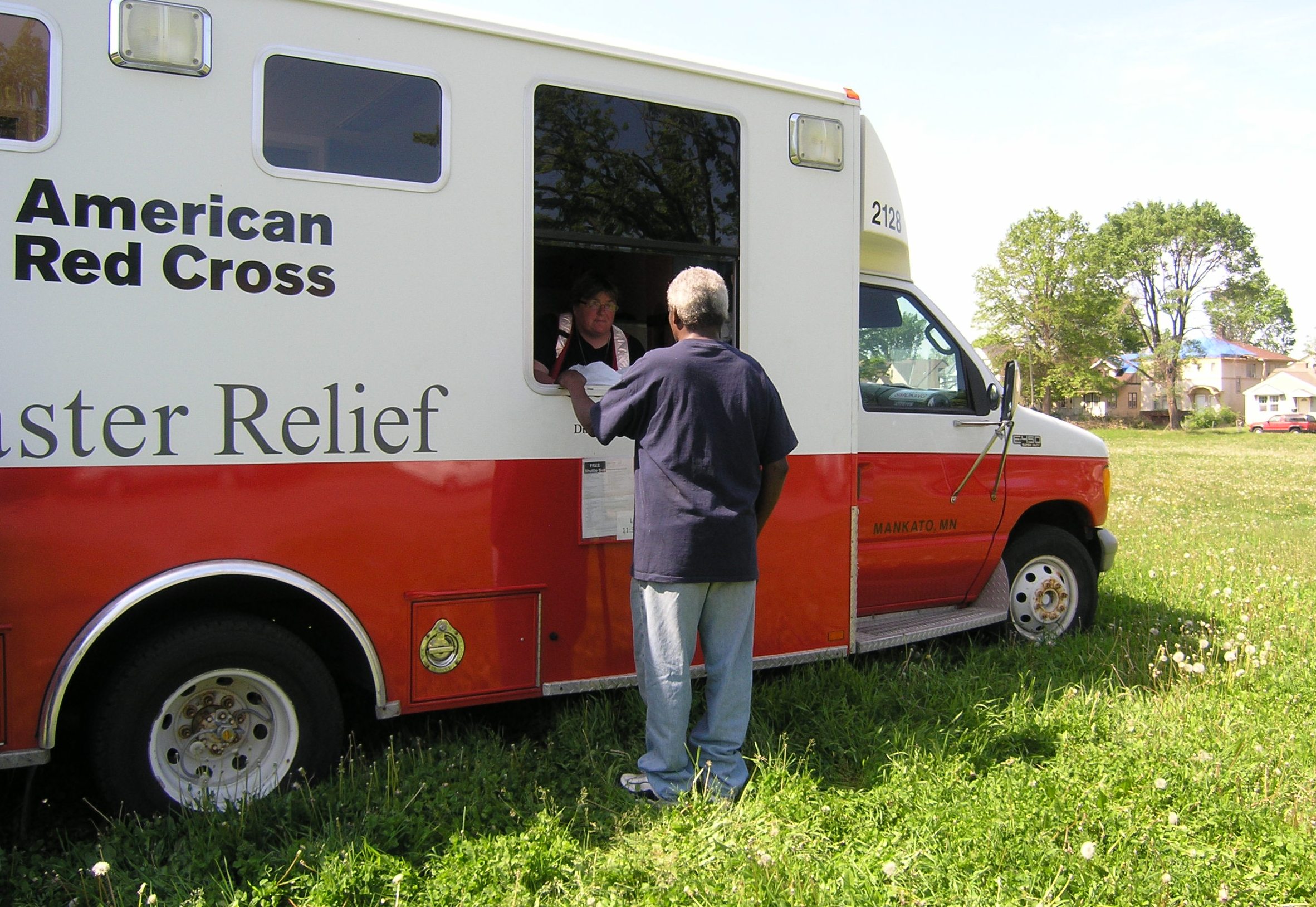
Once in the disaster area, workers might have made contact with Red Cross mobile feeding trucks supporting the workers on what felt like the first day of summer.
“We’re out here to make sure these folks have enough water and snacks in all this heat,” said Paul Vanderheiden, a Red Cross volunteer from Eau Claire, Wisconsin.
Parking his van near a group of workers, Paul offered them advice. “Make sure you get some salt. Want some chips with that?”
Red Cross disaster relief worker Chris Thomsen surveys the unloading of water during the Minneapolis tornado clean up day on June 4. Photo credit: Bill Fitler/American Red Cross
Paul and fellow volunteer Chris Thomsen had been driving their mobile feeding vehicle around these neighborhoods every day since they had arrived the previous Saturday.
“Back home I’m a surgical nurse,” said Chris. “This is the first time I’ve worked outside the chapter on a disaster. We’ve been out here long enough so I’m starting to know folks, and I’ve been so touched by some of the stories I’ve heard.”
Paul and Chris are among more than 340 Red Cross workers, from as far away as California and Connecticut, helping people affected by the Minneapolis tornado.
To date, Red Cross disaster relief workers have distributed more than 145,000 meals and snacks to affected families and clean-up crews responding to this tornado disaster.
Red Cross disaster relief worker Jacob Tolle (l) and Daniel Schultz (r) are meeting one-on-one with families affected by the May 22 tornado in Minneapolis. Photo credit: Jason Viana/American Red Cross
Volunteers have come from many Red Cross chapters across the country to help the north Minneapolis residents recover from the devastating tornado that swept through town on May 22.
Take Jacob Tolle, 20, a caseworker for the Red Cross. Here from Cinncinati, Ohio, he has been trained for Red Cross disaster relief deployment for only five months.
“I want to give my attention to the families in need,” says Jacob.
His inspiration is one of amazing strength. At the age of 16 Jacob decided to take part in a demolition derby. The night before the derby Jacob’s stepfather told him he was nervous and thought participating in the derby was a bad idea. Despite what his father told him, Jacob took the risk.
“Not more than ten minutes into the derby my car started on fire and the whole car shot into flames while I was trapped inside with my seat belt on,” Jacob explains.
He was rescued from the burning car and rushed to Adams County Hospital where he was given multiple numbing medications. From there he was sent Shriners Hospital Burn Center.
“From day one of treatment, the doctors told me that I would be unable to walk for at least 6 months,” says Jacob.
With perseverance on his side, Jacob walked with a gait belt support within 3 days of his recovery treatment. A week later he walked on his own to check-up at the hospital.
Jacob has used his accident as a way to inspire others to never give up.
“That’s why I volunteer for the Red Cross, because of the devastation of someone telling you that you won’t walk,” say Jacob.
Jacob arrived in Minneapolis on May 27, just a few days after the tornado,and he plans to stay and help until things settle down.
Red Cross shelter night manager Sharon Collin says that she prefers volunteering during the night shift because "it's when you get to know the people and talk through the day." Sharon and McKai have a nightly chat. Photo credit: Amanda Mark/American Red Cross
Red Cross volunteer Sharon Collin is a natural organizer. A former movie theater manager, accountant and school teacher, she’s at ease while directing the flow of traffic that comes through the North Commons Recreation Center where the Red Cross shelter is housed.
Sharon is the night manager at this Red Cross shelter where 43 residents are attempting to rebuild their lives after the May 22 tornado destroyed blocks of North Minneapolis. One week into working at this shelter and Sharon has her routine down.
“I’m calling it organized disorder,” she says. “People are welcomed to come and go as they like as we try to create normalcy in the abnormal.”
Nearly all at once, Sharon sends someone to the snack room, finds a caseworker for another shelter resident, and hugs three kids in between the two tasks, promising one that she’ll tuck her in later.
“We have a lights out time,” she explained. “But one man works nights. Other people are night owls. I offer to fix snacks and hot meals during the night as people come through.”
Red Cross shelter night manager Sharon Collin shares a quiet moment with Willtin, 4. Photo credit: Amanda Mark/American Red Cross
While Sharon has responsibilities and organizational tasks to ensure that the shelter runs smoothly, she says she spends most of her time listening.
“No one wants to be here,” she said. “I listen to where they’re at, answer Red Cross questions, and match them up with services so they can move forward.”
Sharon travelled from Cumberland Foreside, Maine, to be the shelter night manager. She’s volunteered for the Red Cross in various ways for the past 6 years: working on disaster teams, supporting call centers and filling in any way she can, but her favorite assignment is working at shelters.
“People often enter a shelter at their lowest point. Red Cross volunteers enter a shelter, fresh with adrenaline and ready to help. Sometimes that’s really what people need. Someone to support them and provide the energy they don’t have.”
(Reporting and photos by Amanda Mark, Red Cross Volunteer)
Red Cross disaster responder, Ann Layton, offers a slice of her homemade "strata," an Italian casserole she made from leftover bread slices at the Red Cross tornado response headquarters in Minneapolis. Photo credit: Lynette Nyman/American Red Cross
Red Cross disaster response volunteers are extraordinary in many ways, but only a few would turn unused slices of bread into something yummy for dozens of fellow responders who’ve been working for days helping hundreds of families rebuild their lives after the May 22 tornado in Minneapolis.
Ann Layton, a Red Cross volunteer, saw the bread on her way out the disaster operation doors last night and brought the bread back this morning all done up as “strata,” an Italian casserole that’s darn comforting.
“The bread was dry and I needed to add more milk,” said Ann, who made three variations of the dish, which you assemble and refrigerate before baking and serving.
We think your strata dish is perfect… and we thank you’re extra great, Ann, for taking time to provide additional comfort for Red Cross disaster responders who are working hard helping others recover from this awful disaster.
North Minneapolis resident Julian Branker stopped by a Red Cross aid station where people affected by the May 22 tornado can receive food, water, and other Red Cross emergency services. Photo credit: Anne Florenzano/American Red Cross
More than a week following the May 22 tornado disaster that struck north Minneapolis, the sun was shining and the wind was blowing while city workers and other helpers were in the neighborhood busy removing tree debris in the most affected areas.
Julian Branker, a local resident who prefers to be called JB, stopped at a recently opened Red Cross emergency aid station located at Willard Park. He says that during the storm a tree fell on his house and a nearby fence.
“I was standing outside watching the tornado come thinking that if it’s my time to go then it’s my time, but I think I still have another thirty years left,” said Branker.
Branker picked up lunch for him and his wife at the Red Cross aid station, which is one of two that the Red Cross is operating in conjunction with the City of Minneapolis disaster recovery shuttle buses in the neighborhood. The second station is at Jordan Park.
The Red Cross aid stations are also providing medical and mental health services; and referral services for information about disaster recovery for affected families.
The fallen tree has been removed from Branker’s home. He says that his family is doing well and that he’s thankful for the Red Cross help.
(Reporting by Red Cross disaster responders Anne Florenzano and Nicole Baier)
Minneapolis tornado survivor Cathy Stolte shares her harrowing story with Red Cross volunteer Dave Schoeneck. Photo credit: Jason Viana/American Red Cross
Kathy Stolte was working on a cross word puzzle Sunday when she heard a crashing sound. She grabbed her dog and headed for the basement, but the tornado had already passed her north Minneapolis bungalow, leaving behind a path of twisted trees, broken homes and destruction.
Kathy, her husband, and her dog were fortunate — no injuries, just property damage. Part of the roof of their home blew off, and rain soaked the insulation, making the house uninhabitable. Her son’s car was skewered by a five inch tree branch, from windshield to floorboard. The worst damage was to the garage, parts of which currently reside in her neighbor’s kitchen.
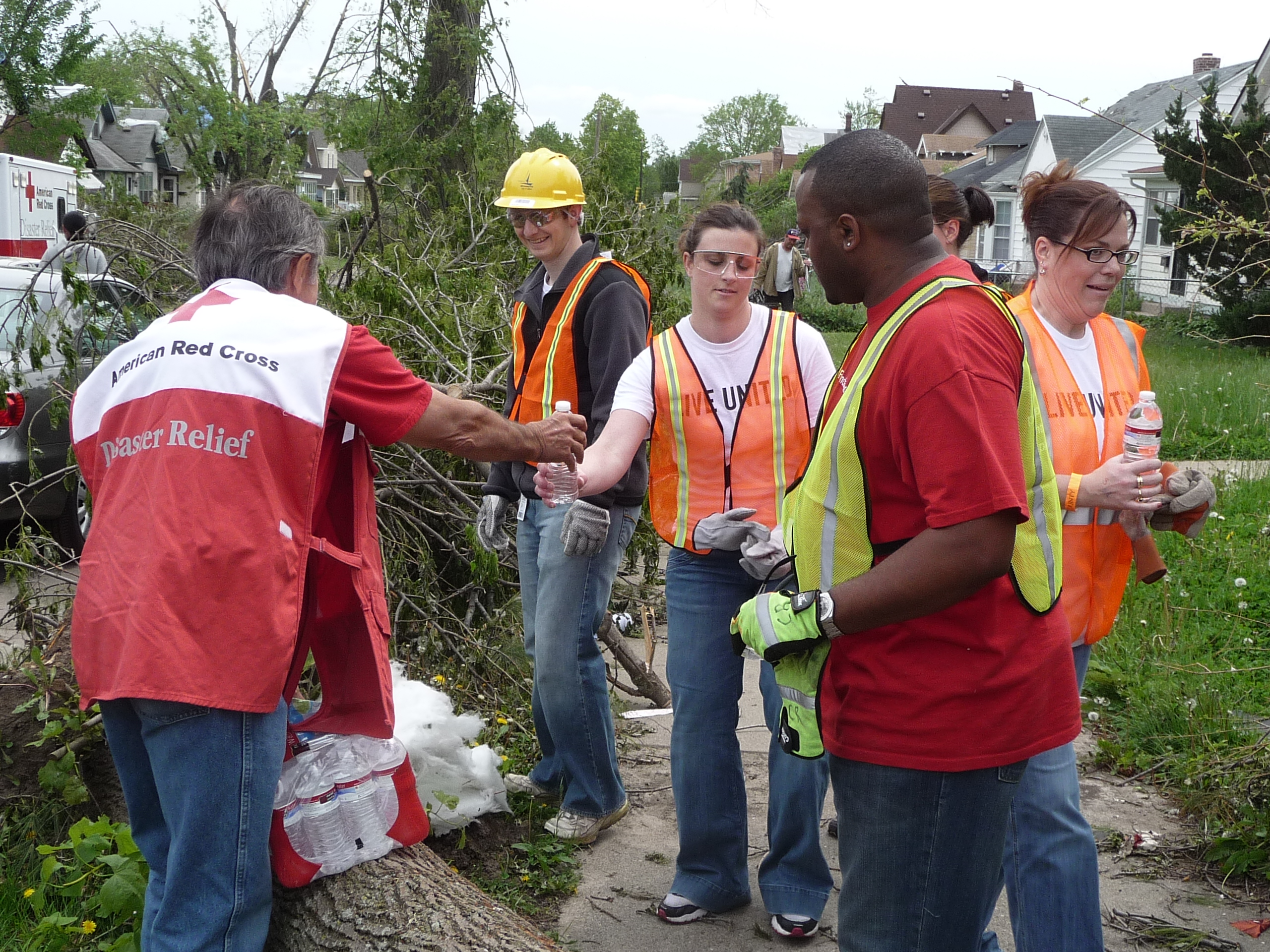
Red Cross volunteers are providing water and snacks to people helping to remove debris after the May 22 tornado in Minneapolis. Photo credit: Jason Viana/American Red Cross
On Wednesday, as repair crews from the City of Minneapolis were hauling away the remains of large trees from their block, and crews from Xcel Energy were restoring electric power to their block, Kathy was grateful when a Red Cross disaster team from the St. Croix Chapter of the American Red Cross came down the street, offering food and water to anyone who needed it. Eric Nickolai and Sherm Boucher were busy handing out water, sandwiches, energy drinks and fruit to residents, volunteers, and work crews.
While Kathy faces weeks before her house can be reoccupied, she is one of the lucky ones who had homeowner’s insurance and has a place to stay temporarily. Hundreds of others were out trying to salvage their belongings and working to find food, clothing and shelter for themselves and their families.








 American Red Cross Minnesota and Dakotas Region