Nearly every eight minutes, the American Red Cross extends a helping hand to a family in need that has lost everything – the roof over their heads, their clothes, and their most cherished possessions – to a home fire. Across Minnesota and parts of western Wisconsin, the Minnesota Region of the American Red Cross has been busy helping neighbors. But your help is needed on one special day to continue to provide the emergency services that our neighbors depend on every day.
Red Cross Giving Day
On April 21, you have a chance to help families in need whenever and wherever they need it by participating in the national American Red Cross Giving Day to #help1family. A donation of $88.50 can provide a family with a day’s worth of food, plus blankets and other essentials. We’re proud of the disaster relief our region provided last year. This included supporting more than 2,300 people affected by local disasters, which were mostly home fires, and installing more than 1,000 smoke alarms to improve home fire safety.
Become a social ambassador
You can help spread the word about Giving Day – the more people who support Giving Day means we can help more families. Use your social media channels to reach out to friends and family and ask them to donate to #help1family. Here are four ways donations will #help1family:
1. Supporting a family in urgent need: provide funding to give a family a day’s worth of food, blankets, and other essentials.
2. Supplying warm meals: help provide hearty, comforting meals to people impacted by disasters.
3. Providing clean-up kits after a disaster strikes: make clean-up kits available for families in need that include vital items like a mop, bucket, and disinfectant.
4. Deploying an emergency response vehicle for a day: Red Cross workers travel to impacted neighborhoods in fully stocked Emergency Response vehicles to provide food, water and critical relief.
Imagine the impact that we could have on our community if everyone wanted to #help1family.
Across the United States, the American Red Cross has people who volunteer their time as dispatchers during Red Cross disaster responses. These volunteers help fulfill the Red Cross mission to reduce human suffering during emergencies. Red Cross dispatchers coordinate response teams that provide basic comfort and care to families after home fires and other disasters. These dispatchers serve their communities with care. This volunteer role is one of the most worthwhile ways to get active in the Red Cross. Below are brief portraits of five volunteers who serve as disaster response dispatchers for the Minnesota Red Cross region.
OLYMPUS DIGITAL CAMERA
Mike and Deb Hofmann, St. Cloud
Based in central Minnesota, Mike and Deb Hofmann proudly serve together as Red Cross volunteer dispatchers. The couple met in high school and they currently living in Cold Spring. Mike has served the American Red Cross for 40 years through multiple volunteer positions and Deb has been with the organization as a dispatcher for 10 months. Some of the most rewarding parts of the job for the couple is knowing you can help people during their time of need and offer services. Deb says, “When they’re looking for a way to go, we give them a direction.” Their advice? If you want to get involved, connect with your local Red Cross chapter.
Diane Dunder, Duluth
After retiring as a health and physical education teacher, Diane Dunder decided to take on the volunteer role as a Red Cross disaster relief dispatcher. Dunder says she was graced with “the best instructors who knew what they were doing and were very well informed about the job.” Some of the role’s challenges in her area, she says, are not having enough field responders as well as other dispatchers. “We all have other things going on in our lives and yet more help would be appreciated.” One of Dunder’s greatest rewards while serving as a dispatcher was helping an elderly woman after a house fire. The victim had health issues and Dunder spent several days following up and working with healthcare and mental healthcare professionals to make sure that the woman was safe. “Being a dispatcher is a great way to volunteer and keeps you educated,” says Dunder.
Joe Reinemann, Mankato
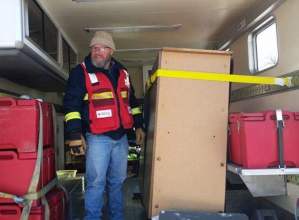
Stationed in the southwest Red Cross chapter in Mankato, Joe Reinemann has been a volunteering dispatcher for more than a year. Reinemann usually works as a dispatcher during night shifts that start from 4:30 to midnight or from midnight to 8 am. Reinemann, who helped create the most recent dispatcher training materials, says “we’re upgrading our dispatcher manual. It’s extremely hands-on. It’s also one-on-one.” Reinemann felt nervous when he received his first dispatch call for Red Cross disaster response. He wanted to make sure that everything went well, but he says “the help and training are so great that sometimes you don’t even need any assistance from other dispatchers.” Reinemann’s advice to future volunteers is to “DO IT! It may be imitating to sign up, but it’s not complicated at all.”
Jan Reyers, Mpls-St.Paul Metro
Jan Reyers has served as a volunteer with the Red Cross for more than 35 years. Most currently, he’s disaster response dispatcher based in the Minneapolis-St. Paul metro area. Originally from White Bear Lake, Jan is proud to serve with the Red Cross alongside his wife Bonnie, who is also a dispatcher. “It’s always nice to have your wife as a dispatcher to help coach you along.” Being a dispatcher has taught Jan how to prioritize what he’s doing and to get it done correctly. Jan says the skills you need in order to become a dispatcher are communication, organization of information and people, and demonstration of empathy. Having served as a disaster responder in the field helps. “Get involved, sign up and be available to serve,” is Reyers’ advice to all anyone who wants to participate with Red Cross disaster relief teams.
Learn more
The need for Red Cross volunteer dispatchers is great. Last year the Red Cross supported more than 2,500 people affected by local disasters, which were mostly home fires. It’s a great way to serve and to meet new people. The current Red Cross dispatchers need to you step up and to get involved! More importantly, your neighbors, friends, family and thousands of others across this region need you. You never know when hard times will strike and you could lend a hand to someone who needs it the most. You could be the person who gives someone hope during a time of despair and a way to look toward a brighter tomorrow. To learn more, click here.
“Everything the Red Cross does because of disasters–and we’ve had many this year ranging from Washington wildfires to South Carolina flooding–is done with help from caring people like us. “
I have been a volunteer for the Red Cross since 2003. Based in Minnesota, I first started after I took several classes and became a volunteer to go to local fires and help the families after the incident. We provided those affected some funds depending on the severity of the fire. In our office counselors helped them with a lot of referrals to places like VEAP and Bridging to replace their personal items that were lost. It was always a comfort to them when we were there, especially in the middle of the night.
To date, I have been on about 20 deployments which have ranged from Hurricane Katrina (my first one) on the Gulf Coast to Hurricane Sandy in New York, and most recently the wildfires in Idaho and Montana. A deployment is when you are sent to volunteer at some type of a disaster usually in another state.
When I was deployed to Katrina, another volunteer and I drove the Emergency Response Vehicle better known as the ERV to Montgomery, AL to pick up a load of water and snacks. The ERV is the size of an ambulance and it is a feeding unit to go out in affected areas and feed those who are without electricity and maybe running water. We did 2 meals a day with a Baptist group cooking big kettles of food and there were maybe 20 ERV’s delivering food and water to all parts of the area. We were first assigned to Mobile, AL and drove anywhere up to a 50 miles range to serve lunch. We would serve hot food from a serving window in the truck and when finished or the food was all gone we would head back to our base camp and do it all over for dinner. All the people we served would be so appreciative as they hadn’t had a hot meal for 3-5 days by then.
Another disaster I worked on was the 35-W bridge collapse in Minneapolis. Another volunteer and I were in charge of seeing that there was hot food for the divers, police, federal officials when the first lady and again when the President came. We were only using 2 ERVs to send out food but had many volunteers who came to the Red Cross building to eat which is almost right under the bridge. I was able to go down on the river one evening and take food to the divers. Many days after the incident happened it was still a disturbing event to look up at the bridge and see cars still hanging there.
Hurricane Sandy was another unique disaster because of the size and how long the recovery went on and how large it was. By now I had changed from working with the feeding unit to the staffing unit. That job is to take care of the volunteers that are working on the disaster. They may be doing disaster assessment, mental health work, client casework and feeding those who are without a home, and most likely were staying in one of the many shelters the Red Cross operated across parts of New York, New Jersey and some of New England.
Because the job was so large for Sandy our Staff Services team was divided into several parts. I was the manager of all volunteers coming on the job and leaving the job. Some mornings we would have 50 new volunteers reporting to check in and get their assignments. The Red Cross headquarters where I worked for three weeks was two miles from my hotel. Every morning I walked past some interesting sights like the Good Morning America studio and the jumbotrons on Broadway. I picked up breakfast from a local deli or a street vendor and did the same on the walk back in the evening.
The night before Thanksgiving some of my group decided we would go up to Central Park and look at the parade floats. You cannot imagine the number of people who had decided to do the same thing. There were eight of us in our group and we had to hang on to the coat of the person in front of us or we would have been lost. We decided that we had walked about eight miles that evening, but it was fun. None us would do it again.
My most recent deployment was the Idaho and Montana wildfires. Half of my time there was spent in Kamiah, ID which is way up in the mountains. My workplace was the local American Legion. There was a reception center, called a MARC, that brought many groups into one place where those affected could get different kinds of help. There were 16 families that had totally lost their homes as they burned to the ground in a matter of minutes. Many others had lost part of their homes or all of their out buildings and a lot of cattle.
Everything the Red Cross does because of disasters–and we’ve had many this year ranging from Washington wildfires to South Carolina flooding–is done with help from caring people like us. The Red Cross is always grateful for our help. If any of you have 4-5 hours a week to volunteer, we always need more help. If it would not be your thing to go out to fires or to be deployed, there are simple jobs in the office that can be done, such as addressing birthday cards for volunteers. If you would like to become a Red Cross volunteer, just click here.
Story and photos by Jerry Eiserman, Red Cross Volunteer
Jerry’s Red Cross “Emergency Response Vehicle” (ERV)
After I retired, I wanted to find a worthwhile way to spend my new-found free time. I remembered hearing about volunteers who packed up when various disasters occurred and served with the American Red Cross. And I decided that was what I wanted to do.
As soon as I began my training, I learned that the first Red Cross relief workers to to arrive on-scene at a local disaster are Disaster Action Team (DAT) members. These response teams are trained to be efficient and effective in their efforts helping people, and I quickly joined the squad.
After becoming a disaster relief volunteer I started to ask, what happens when the disaster gets bigger? There are many different jobs when large-scale disasters, such as a tornado or hurricane, hit a community. I learned that my experience driving trucks and managing computer networks could be useful. I expressed my interest in and willingness to be on-call in this response activity if needed.
Day One
On June 29th I got a call that the Red Cross needed the Minneapolis Emergency Response Vehicle (ERV) to help out in Illinois, and for the first time I was able to say yes. I partnered up with another volunteer named Bill Craig, a delightful gentleman from St. Cloud, MN, who had disaster experience after being deployed to Hurricane Sandy. We took off from Minneapolis on June 30th and arrived at the Red Cross chapter in Romeoville, IL, on morning of July 1st ready to receive our assignments.
Red Cross Volunteers help out in Cole City
We were dispatched to the Bourbonnais and Kankakee, IL, office where severe flooding and tornadoes damaged the surrounding area. We loaded our ERV with cleaning supplies, drinks, snacks and shovels, and headed for Cole City, IL. Cole City is a small, rural town that a recent tornado had ripped through, leveling several neighborhoods and wreaking havoc throughout the town.
After several hours distributing relief supplies to people in Cole City, we returned to Kankakee where we helped open a Multi-Agency Resource Center (MARC). A MARC is where different service agencies congregate to provide a one-stop service center for folks affected by local disaster. I quickly learned that as a volunteer, I was there to help with whatever needed to be done. One minute I was in the gym setting up tables and chairs, and the next I was being asked to set up a small computer network to serve the folks that would be coming in the next day.
Day Two
The MARC set up in Kankakee
Our second day started at 6 a.m. The MARC ran ten computers and two laser printers to service the needs of affected residents. Once the network was up and operating, the local volunteers had everything under control and I moved back to my ERV role. We spent the morning loading relief supplies into people’s cars and handing out drinks and food. There was a flood of people that came to the MARC after lunch, so my job transitioned to walking families through the in-take process. By the time the doors closed at 6 p.m., we had processed 160 families.
Day Three
On day three, we met at the Bourbonnais office at 10 a.m. and loaded flood clean-up supplies and headed for a small, rural town called Momence, IL. We paired up with a case worker from Pennsylvania and drove around the town to see where help and supplies were needed. We soon ran out of cleaning supplies and had to call for back up because so much damage had been done.
We out-processed at the Romeoville office about 7 p.m. and started the drive back to Minneapolis.
Day Four
We finished our journey back in Minneapolis on the 4th of July and got in about noon.
The biggest lesson I took from my four days on an ERV is that the world is not as bad as we make it out to be. Today, the news is full of terrible accidents, criminals and disasters. But what I found was that there is some beauty left in the world. The vast majority of Americans are kind and compassionate people. When our neighbors get hit hard most of us don’t just drive by, we stop and help. Almost everyone that I put my hand out to was unbelievably grateful and had the “I may be down but I’m not out” look in their eyes. Lee Greenwood is correct: I’m proud to be an American.
To learn more about becoming a Red Cross volunteer, click here.
To browse more ways to help fulfill the Red Cross mission, click here.
Throughout March 2015, U. S. Bank is making it easy for its customers to support the important work of the American Red Cross. All month long, customers can make a financial donation to support Red Cross Disaster Relief at more than 5,000 designated U.S. Bank ATMs nationwide.
We are grateful to U.S. Bank for its generous support and partnership that helps ensure that the Red Cross has reliable funding for disaster relief services. It’s support helps us immediately respond to disasters in Minnesota and across the country. The sooner our volunteers get to an emergency site, open shelters, serve hot meals and provide comfort to victims of disaster, the more quickly people and communities can begin to recover.
Our partnership with U.S. Bank extends our reach so that we can help more people before emergencies happen. Richard Davis, Chief Executive Officer of U.S. Bank and a member of the American Red Cross Board of Governors, makes preparedness a priority within U.S. Bank. His effort helps employees to be prepared at work and at home for anything, anytime. By working together, we deliver preparedness information and First Aid, CPR and AED training.
Also, U.S. Bank employees roll up their sleeves and help save lives at Red Cross blood drives. In 2014, U.S. Bank hosted 86 blood drives across the country. In Minnesota, the Red Cross collected an impressive 1,006 units of blood at 26 drives hosted by U.S. Bank and its employees.
Through our combined efforts, U.S. Bank and the Red Cross are strengthening the ability of the communities we serve to prevent, prepare for and respond to emergencies and help rebuild lives after a disaster strikes.
Melinda has been a Disaster Services volunteer since 2011, and is part of the Disaster Action Team (DAT). She also has recently taken on a new role with Volunteer Services – she’ll be interviewing prospective volunteers to introduce them to the volunteer opportunities at the Red Cross and help them find a good fit.
As a child, Melinda was introduced to the Red Cross as part of her home-school curriculum, in which her mother made the Red Cross a recurring theme. What Melinda took away from that was that the Red Cross “is a solid entity that is always there to help.”
Fast forward to Melinda’s adult life when she was working at a group home and became very close to an individual who turned into one of her favorite clients. His health declined and he was put on life support, and then eventually taken off. At that moment Melinda decided she wanted to do something good and help people. She went to the Red Cross office in Duluth, Minnesota, to ask a few questions, and was immediately “roped in.” Within minutes she was filling out an application, and the rest is history!
Melinda went on her first home fire call with one of the chapter’s most experienced volunteers. Since then Melinda has responded to over 30 home fires. Melinda says that the most satisfying part of being a disaster volunteer is “helping people who have experienced a devastating loss and seeing how grateful clients always are for the services of the American Red Cross.”
A few months ago Melinda went through the difficult experience of responding to an incident that involved a fatality. Additionally, it turned out that she was familiar with the person who died. Despite the difficulty involved in this response, Melinda took away the feeling that she was there for the family to help them with the “begin-again phase” of their lives.
The Red Cross has made Melinda more confident, and through her interactions and meeting other volunteers she has become interested in pursuing a career in Emergency Management.
Melinda certainly embodies the mission and fundamental principles of both the American Red Cross and Red Cross and Red Crescent Movement around the globe. She’s always ready, willing and able to assist and a great comfort to those who have suffered a loss because of home fires and other disasters.
Story and photo by Nancy Rogers, Volunteer Services Coordinator for the American Red Cross serving Northern Minnesota.
To learn more about becoming a Red Cross volunteer, click here.
Emergencies can cause people to leave their homes with nothing but the clothes on their backs. That’s why a Red Cross disaster relief response always begins with a safe place to sleep, hot food and a hug.
Photo credit: Lynette Nyman/American Red Cross
This holiday season, as you think of giving holiday gifts to your friends and loved ones, you can give something that means something.
Choose a symbolic gift from the Red Cross Holiday Giving Catalog for someone on your list, and your tax-deductible donation will support a Red Cross program. For example, you can:
Provide 10 warm, cozy blankets to protect disaster survivors from the cold and help them sleep comfortably in our shelters with your gift of $50
Deliver urgent messages for 2 military families to help ensure they get the support they need to reach a loved one when a family emergency occurs with your gift of $160
Provide 500 Measles vaccinations, enough for the children of an entire village, and prevent needless deaths with a vaccination that offers a lifetime of protection with your gift of $500
Help where it’s needed most, for any amount
There is so much you can do. You can help the nearly 70,000 people who turn to the Red Cross every year for help during a disaster. You can help the members of the military, veterans and civilians who receive about 400,000 Red Cross services every year. You can help the patients in hospitals and transfusion centers across the country who depend on Red Cross blood donors to help them regain their health.
Every eight minutes, the American Red Cross brings help and hope to someone in need. We could not do it without you. so this holiday season, please give something that means something.
Story and photo by Carrie Carlson-Guest, American Red Cross
Tiet Nguyen (r) gives a $3,000 donation to Mike Schroeder, a Major Gifts Officer with the American Red Cross, to help those affected by Typhoon Haiyan.
In November, the day before Thanksgiving, a kindly cabinetmaker named Tiet Nguyen came to our local Red Cross office in Minneapolis to help those affected by the recent typhoon in the Philippines. When asked why he brought the check in personally, he said he wanted to hand it to someone –not just put it in the mail– and to share his story.
Tiet and his family escaped Viet Nam 1989 after his brothers and father were killed fighting with the Americans against communism. Fleeing for their lives on a small, wooden boat with more than 70 people, Tiet and his family were shot at for hours as they escaped out to sea. After 10 days with very little food and water, they were rescued by a Filipino fisherman, who took them to the island where he lived. Tiet said, “The people so poor – they have no clothes, but so nice, so nice and kind. They gave us everything.”
He and his family stayed in the Philippines for years and survived even more disasters, including a volcano eruption in ’91 and subsequent deadly mudslides. Remembering the details, he said his oldest son Rung was still in a cradle. Tears welled up in his eyes as he recalled all those lost in the devastation. “The Red Cross was there – they were always there,” said Tiet, “They are always there when anything happens.”
Eventually, Tiet and his family moved to Minnesota to connect with family. They had another son and Tiet built a cabinet-making business with skills he learned in Viet Nam. Today, he and his wife, Hanh Le live in Coon Rapids. One son recently graduated from Hamline and the other is currently a student at Creighton University in Omaha. When he heard the Red Cross was helping those who had helped him and his family so many years ago, he knew he had to help. He collected donations from friends and family, including his sons, and then he and his wife matched it. “Your sons must have gotten you and your wife’s heart,” I commented. He laughs, smiles and cries at the same time, beaming like a proud papa.
“This is what I do, because of what you do – give a little bit of myself to help. I’ve been there, I know. You helped me and my family and who knows when I might need help again, we never know,” says Tiet.
Tiet shared a check for $3,000. Three thousand inspired, connected, paid forward dollars to help those in need. Because, as Tiet said, we never know. We never know when disasters will strike, we never know when it will affect us or someone we love, we never know what tomorrow will bring. But we – and Tiet – know what we can do, we can help now.
Click here to learn about how you can support the Red Cross and its humanitarian mission.
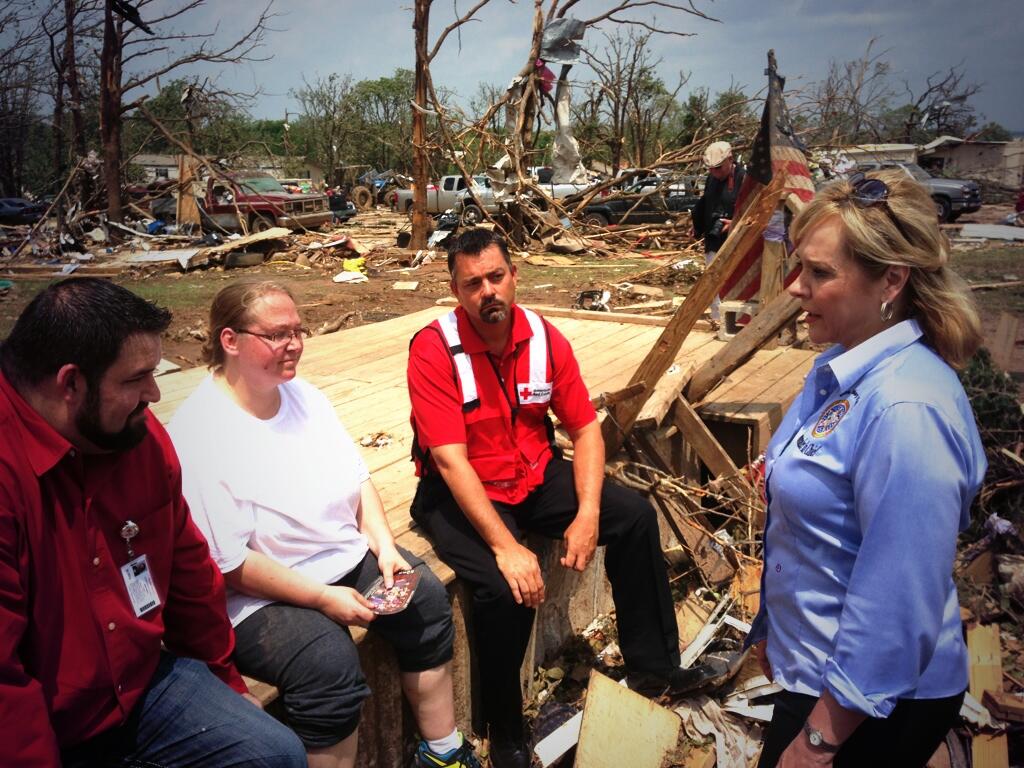
Kimberly Graham lost her home in Moore, Oklahoma. Here, she sits, holding onto a personal picture she found near her home on May 20, 2013. (Photo courtesy of Red Cross OKC)
During a Red Cross disaster response, the best way to help a disaster victim is by making a money donation. Here’s why:
1. Financial contributions allow the Red Cross to purchase what’s needed for disaster relief operations. Monetary donations enable the Red Cross to purchase relief supplies close to the disaster site which avoids delays and transportation costs in getting basic necessities to disaster victims.
2. Donating cash allows the people affected by disaster to put money back into their local economy. Because the affected community has generally experienced significant economic loss, purchasing relief supplies in or close to the disaster site also helps to stimulate the weakened local economy.
3. Donating cash allows individuals to buy what they need. Many people affected by the tornado that hit Moore, Oklahoma, for example, were at work during the storm. All they have are work clothes. They need of clothes and shoes to wear during the clean-up.
4. Many times people want to send stuff: small items such as collections of canned food and used clothing and shoes. But these items must be sorted and repackaged, a process that wastes valuable resources of money, time, and people that are needed for other aspects of Red Cross disaster relief operations.
Please consider making a money donation to the American Red Cross. You can text REDCROSS to 90999 to give $10 to American Red Cross Disaster Relief, go online to redcross.org, or call 1-800-REDCROSS.
We, and the disaster survivors we help, are grateful for your support.
Andrea Bredow
American Red Cross Disaster Relief Volunteer


 Diane Dunder, Duluth
 Joe Reinemann, Mankato





 American Red Cross Minnesota and Dakotas Region